How do we get more consumers to eat seafood? Consumers are confused about sustainability, believe seafood is too expensive and complain that they don't know how to properly prepare it. At the Seafood Expo North America (SENA), I spoke to a seafood company that is attempting to cover all three of these matters, and I think their approach may be effective in countering consumer objections, getting them to eat more seafood.
The Saucy Fish Co., which was established approximately five years ago in the United Kingdom, sells packaged seafood which is inexpensive and possesses simple instructions on how to prepare it. Their basic product contains 2 portions of fish and a sauce, and costs about $7-$9, making for an easy and cheap dinner for two. They also sell Singles (fish & sauce), for one person, Foil Bake Bags (so you don't have to touch the seafood during cooking), Ready To Enjoy (which needs no cooking and can be added atop salads or rice), and Fish Cakes (with a sauce in the center of the cake).
About one year ago, they started selling their products in the U.S., mostly on the East Coast, and they are available locally at Hannaford Supermarkets. Currently, the products available in the U.S. are the most popular products from the UK, and hopefully in time, even more of those seafood products will come to the U.S. Their best selling product is the Chile, Lemon and Ginger Salmon. I was contacted by Saucy Fish prior to the Seafood Expo and received some media samples of their products.
I like the fact that all of the seafood that Saucy Fish sells is sustainable, certified by the Marine Stewardship Council or Global Gap. The fish is sourced from all over the world such as cod from the North Atlantic and Salmon from Norway and Scotland. All of the seafood is also packaged in the UK. Saucy Fish is truly dedicated to sustainability and even are founding members of the Sustainable Seafood Coalition (SSC) "which brings together retailers and brands to agree common responsible fish buying and labeling approach." Started in May 2011, the SSC now represents over 50% of the retailers and seafood businesses in the UK, with an ultimate goal that all seafood sold in the UK become sustainable. The more I look into the SSC, the more admiration I find for their goals and activities.
My favorite product was the Sweet Soy and Chili Dressing with Salmon Fillet, which was not only easy to prepare but was delicious.
This is the finished product, atop some couscous, and the sauce was intense and flavorful, with a spicy kick. The salmon was tender and moist, and one portion was a fine size for one person.
With Saucy Fish, a consumer can know that all of their seafood is sustainable so there is no real confusion. The seafood is inexpensive so cost is not a factor. Two people can eat dinner for about $7-$9, which should be an affordable option for most anyone. Finally, the products provide full and simple cooking directions, and the fish already comes with a sauce so prep time is minimal. Anyone could prepare this seafood so no worries about complicated cooking.
I recommend all consumers check out the Saucy Fish products, and add more seafood to your lives.
For Over 18 Years, and over 5600 articles, I've Been Sharing My Passion for Food, Wine, Saké & Spirits. Come Join Me & Satisfy Your Hunger & Thirst.
Monday, March 23, 2015
SENA15: Rant--Understanding the Seafood Retail Consumer:
Why don't consumers purchase more seafood when shopping for food? Americans don't eat enough seafood and we have seen consumption decrease over the last 6 to 7 years. From my own prior experiences and research, two important reasons stand out for why consumers often choose not to purchase seafood: Cost and difficulty of preparation. These reasons may not be fully valid, but it is the perception of the consumer which is key. If they think seafood is too difficult to cook or too expensive, then they are less likely to buy it, even if, in actuality, it is easy to prepare or inexpensive.
As I encourage consumers to purchase and consume more seafood, I was especially interested in attending a special session at the Seafood Expo North Amrtica (SENA) called Understanding the Seafood Retail Consumer. This session provided a summary of a market study, What are American Seafood Retail Consumers' Purchasing Habits?, conducted by SeafoodSource.com which can be purchased online for $495. The summary of the report was given by Kerry Gross (pictured above), a Market Analyst with SeafoodSource.
The inspiration for this study originated with the reality of increased protein prices and the question of how seafood stacked up against these other proteins. In addition, the study was designed to determine how consumers plan and shop for dinner. That all sounds interesting, especially the latter elements. About 500 people were selected for the study, a group representative of the U.S. census, In addition, they only targeted people who bought seafood at least once a month.
I would have liked to see a larger group surveyed, to obtain a larger input of responses, and I also would have preferred if the group was divided by financial level. It is well settled that the cost of seafood is an impediment to many people purchasing seafood, so it would be beneficial to see how differing income levels address the matter of the cost of seafood, especially when considering their shopping practices.
However, the study was limited in another manner, and that limitation is not mentioned in the description of the study on the Seafood Source website. It's a significant omission which could be very important to the potential customers for the study. The limitation is that the study only dealt with fresh fish, and didn't address frozen fish. As such, any purveyors of frozen fish are likely to get a far more limited value, if any, from this study. The description of the study should have included that limitation as not everyone would be willing to pay for the study, especially as it might not address the type of seafood they sell.
The summary began by noting that in the survey, the average person cooks 5.3 meals at home each week, broken down by poultry 1.9 times, beef. 1.5 times, seafood 1 time, and pork .9 times. It is surprising that people seem to consume more seafood than pork, In addition, 2/3 of people plan what they will have for dinner on that day. They obviously are not thinking far ahead about what to prepare for the week. About 63% of people plan their dinner while they are home, 18% do so at work, 10% at the store itself and 9% on the go. Of those people, 29% include their partners in the planning and 13% include their children too (with a note that half the people in the study had children). All fascinating tidbits.
The survey next addressed dinner time decision drivers, breaking it down into Primary, Secondary and Niche Concerns. The two Primary drivers included Household Eating Preference (75%) and Cost (72%).. The two Secondary drivers included Ease of Prep (69%) and Nutritional Value (58%). The Niche Concerns included Ability For Leftovers (39%), Side Dishes (38%) and Natural/Sustainable (28%). I note that Cost and Ease of Prep are only separated by 3%, which too me seems like a relatively minor difference and I would have placed Ease of Prep in the Primary Concerns, especially based on my own prior study,
They then assessed Specific Protein Preferences by comparing the survey results of selections of 8 different proteins,from chicken breasts to cooked large shrimp. As can we seen, the list does not include frozen seafood, which could have significantly altered the results. We also see that only one non-seafood protein cost more than any of the seafood items. It would have been more interesting to see some other higher priced proteins on this list. I also would have liked to see some seafoods at a lower price point, noting that they were sale prices. In addition, it is likely that the preferences may have changed if the survey was broken down by income levels. This is the section of the survey which I feel is the least effective. The choices given to the survey participants were far too limited.
The survey led them to the conclusion that the key decision drivers for the purchase of seafood in include nutritional content and natural/sustainable, while the weaknesses include cost and ability for leftovers. This seems to largely ignore the fact that ease of prep is often cited by consumers as a primary reason why they don't purchase seafood to cook at home. As I mentioned above, it received a significant enough percentage that I believe it should have been considered a Primary concern.
The summary of the survey ended by noting their Market Segmentation based on the responses to the protein preferences; and they broken it down into 6 groups. The groups include Seafood Selectors, Premium Protein Purchasers, Harried Healthies, Deal Enthusiasts, Plan Aheaders, and Budget Conscious Consumers. They are listed in descending order of seafood preference. Marketers do love to break consumers down into easily digestible segments, whether it is truly fitting or not. At best, these segments only apply to fresh fish, not frozen fish. In addition, the groups might have been different if the number and type of Specific Protein Preferences were different.
In a previous article I wrote about consumer buying behavior, based on information from Buyology: Truth and Lies About Why We Buy, by Martin Lindstrom. I wrote, "But now we know that roughly 90% of our consumer buying behavior is unconscious,…” (p.195) This might be disturbiung to some. “But like it or not, all of us consistently engage in behavior for which we have no logical or clear-cut explanation.” (p.19) Our decisions are far from as rational as we believe them to be and “…our irrational minds, flooded with cultural biases rooted in our tradition, upbringing, and a whole lot of other subconscious factors, assert a powerful but hidden influence over the choices we make.” (p.18)
Seafood purchasing behavior is not always rational, and consumers don't often understand why they buy what they buy. Trying to label them as a specific marketing segment is not that beneficial as there is much outside that segment which has an effect on purchasing decisions.
Overall, I found some value in the initial survey results, on the shopping decisions and planning, but far less value once the protein preferences were considered. The omission of frozen fish also lowers the value of the survey, and that omission should have been noted on the Seafood Source site as a caveat for anyone considering buying the report.
In the end, I continue to urge people to eat more seafood, especially local and sustainable.
As I encourage consumers to purchase and consume more seafood, I was especially interested in attending a special session at the Seafood Expo North Amrtica (SENA) called Understanding the Seafood Retail Consumer. This session provided a summary of a market study, What are American Seafood Retail Consumers' Purchasing Habits?, conducted by SeafoodSource.com which can be purchased online for $495. The summary of the report was given by Kerry Gross (pictured above), a Market Analyst with SeafoodSource.
The inspiration for this study originated with the reality of increased protein prices and the question of how seafood stacked up against these other proteins. In addition, the study was designed to determine how consumers plan and shop for dinner. That all sounds interesting, especially the latter elements. About 500 people were selected for the study, a group representative of the U.S. census, In addition, they only targeted people who bought seafood at least once a month.
I would have liked to see a larger group surveyed, to obtain a larger input of responses, and I also would have preferred if the group was divided by financial level. It is well settled that the cost of seafood is an impediment to many people purchasing seafood, so it would be beneficial to see how differing income levels address the matter of the cost of seafood, especially when considering their shopping practices.
However, the study was limited in another manner, and that limitation is not mentioned in the description of the study on the Seafood Source website. It's a significant omission which could be very important to the potential customers for the study. The limitation is that the study only dealt with fresh fish, and didn't address frozen fish. As such, any purveyors of frozen fish are likely to get a far more limited value, if any, from this study. The description of the study should have included that limitation as not everyone would be willing to pay for the study, especially as it might not address the type of seafood they sell.
The summary began by noting that in the survey, the average person cooks 5.3 meals at home each week, broken down by poultry 1.9 times, beef. 1.5 times, seafood 1 time, and pork .9 times. It is surprising that people seem to consume more seafood than pork, In addition, 2/3 of people plan what they will have for dinner on that day. They obviously are not thinking far ahead about what to prepare for the week. About 63% of people plan their dinner while they are home, 18% do so at work, 10% at the store itself and 9% on the go. Of those people, 29% include their partners in the planning and 13% include their children too (with a note that half the people in the study had children). All fascinating tidbits.
When Americans go shopping, an astonishing 71% of people purchase a week's worth of groceries at a time. That plays a large role in the type of foods they buy, and has direct relevance on the purchase of fresh fish. In this situation, it is far more likely that consumers will buy frozen fish than fresh fish, as they want food they will last the week. Thus, the fact the study ignored frozen fish seems to be problematic. I think they would have arrived at some very different conclusions if the survey had included frozen seafood.
Before they get to the supermarket, 59% of people are pretty sure what proteins they will buy at the store while 32% have a general idea and 10% decide once they get to the store. It is also important to know that 57% of people change their mind on the protein purchase at least once a month. Why do they change their mind? The study does not address that issue, though I suspect it may be financially driven, if they see a sale on a protein at the store. In addition, other special circumstances may have intervened, such as a food demo.
The survey next addressed dinner time decision drivers, breaking it down into Primary, Secondary and Niche Concerns. The two Primary drivers included Household Eating Preference (75%) and Cost (72%).. The two Secondary drivers included Ease of Prep (69%) and Nutritional Value (58%). The Niche Concerns included Ability For Leftovers (39%), Side Dishes (38%) and Natural/Sustainable (28%). I note that Cost and Ease of Prep are only separated by 3%, which too me seems like a relatively minor difference and I would have placed Ease of Prep in the Primary Concerns, especially based on my own prior study,
They then assessed Specific Protein Preferences by comparing the survey results of selections of 8 different proteins,from chicken breasts to cooked large shrimp. As can we seen, the list does not include frozen seafood, which could have significantly altered the results. We also see that only one non-seafood protein cost more than any of the seafood items. It would have been more interesting to see some other higher priced proteins on this list. I also would have liked to see some seafoods at a lower price point, noting that they were sale prices. In addition, it is likely that the preferences may have changed if the survey was broken down by income levels. This is the section of the survey which I feel is the least effective. The choices given to the survey participants were far too limited.
The survey led them to the conclusion that the key decision drivers for the purchase of seafood in include nutritional content and natural/sustainable, while the weaknesses include cost and ability for leftovers. This seems to largely ignore the fact that ease of prep is often cited by consumers as a primary reason why they don't purchase seafood to cook at home. As I mentioned above, it received a significant enough percentage that I believe it should have been considered a Primary concern.
The summary of the survey ended by noting their Market Segmentation based on the responses to the protein preferences; and they broken it down into 6 groups. The groups include Seafood Selectors, Premium Protein Purchasers, Harried Healthies, Deal Enthusiasts, Plan Aheaders, and Budget Conscious Consumers. They are listed in descending order of seafood preference. Marketers do love to break consumers down into easily digestible segments, whether it is truly fitting or not. At best, these segments only apply to fresh fish, not frozen fish. In addition, the groups might have been different if the number and type of Specific Protein Preferences were different.
In a previous article I wrote about consumer buying behavior, based on information from Buyology: Truth and Lies About Why We Buy, by Martin Lindstrom. I wrote, "But now we know that roughly 90% of our consumer buying behavior is unconscious,…” (p.195) This might be disturbiung to some. “But like it or not, all of us consistently engage in behavior for which we have no logical or clear-cut explanation.” (p.19) Our decisions are far from as rational as we believe them to be and “…our irrational minds, flooded with cultural biases rooted in our tradition, upbringing, and a whole lot of other subconscious factors, assert a powerful but hidden influence over the choices we make.” (p.18)
Seafood purchasing behavior is not always rational, and consumers don't often understand why they buy what they buy. Trying to label them as a specific marketing segment is not that beneficial as there is much outside that segment which has an effect on purchasing decisions.
Overall, I found some value in the initial survey results, on the shopping decisions and planning, but far less value once the protein preferences were considered. The omission of frozen fish also lowers the value of the survey, and that omission should have been noted on the Seafood Source site as a caveat for anyone considering buying the report.
In the end, I continue to urge people to eat more seafood, especially local and sustainable.
Sunday, March 22, 2015
SENA15: Food of Interest
"We are tied to the ocean. And when we go back to the sea, whether it is to sail or to watch - we are going back from whence we came."
--John F. Kennedy
The USDA recommends that Americans consume 26 pounds of seafood annually. While I attended the Seafood Expo North America (SENA), I felt as if consumed a year's worth of seafood over the course of three days. It's a gustatory pleasure to walk the aisles of SENA, sampling the multitude of seafood that is available. The exhibitors provide these free samples in order to showcase their products, to entice potential purchasers. You'll find seafood samples that are cold and hot, raw and cooked, fresh and processed, simple and complex. You'll find salmon and oysters, shrimp and lobster, crab and trout, and much more.
If you attend SENA, I recommend that you sample seafood that you've never tasted before, to broaden your palate and hopefully discover something new and delicious. I taste many different items at the show, though certainly not everything as there is just too much for any single person to taste. I want to experience new dishes and products, to find some new favorites. Out of everything I taste, there is only a small number of items which I deem worthy of special mention, to be highlighted here. There are the best foods I savored at SENA and I want to share them with my readers.
Once again, for the third year in a row, my favorite foods at SENA were created by Chef Nathan Fong at the British Columbia, booth. Chef Fong, a food stylist, journalist, and TV personality, was born in Vancouver, and he uses sustainable seafood from BC to prepare a variety of creative and delicious dishes. He is passionate and energetic, talented and personable. He created more than 7 different items, maybe a greater variety than any other chef at the Expo.
Overall, much of the seafood at SENA is prepared very simply, and in some respects, creativity takes a back seat. There are plenty of raw items as well as fried products, so the actual cooking is not as extensive as it could be. There are definitely some chefs who do their best to produce enticing dishes, imbuing them with creativity and passion.
The first seafood sample I had when the Expo opened on Sunday was Chef Fong's French Style Eggs with Smoked Caviar & Northern Divine Caviar, a decadent and delectable dish. I had more on Tuesday morning too.
This is a partial list of the menu items that Chef Fong created during the Expo. I should note that the few items he fried used a special Nextjen Gluten-Free batter blend. You'll never realize that this batter is gluten-free as there is no sacrifice of taste. I also tasted a piece of raw Geoduck, which was chewy but not rubbery. It had a clean, briny taste, and had been harvested by deep water SCUBA divers. Geoduck is from a Hadii word that means "big foot," and geoduck in British Columbia gets much larger than they do in Mexico.
My good friend Jacqueline Church once again assisted Chef Fong, and she worked hard over those three days helping him prepare all of those seafood dishes.
As I've said multiple times before, more attention needs to be given to Peruvian cuisine. With its intriguing spices, tons of different potatoes, and other unique ingredients, it can present some amazing and complex flavors. The Peruvian booth at SENA was no exception, presenting several tasty dishes, including Ceviche.
The Scallops Cau-Cau was a delicious stew with potatoes, green peas and turmeric. Traditionally, Cau-Cau is a tripe stew but there are numerous variations.
The Peruvian Shrimp Chupe (chowder) is made with peas, corn and aji planca (a type of chile pepper). I was enamored with this chowder, finding a great depth of flavor within it, a creamy texture and a unique spicy kick to it. A perfect winter chowder which will warm your body and soul. It's probably a simple dish, but its flavors will impress.
Last year, one of the big surprises for me were the Kelp dishes from Ocean Approved, a kelp farm located in Maine that was also the first kelp farm in the U.S. Their kelp is 100% all natural, gluten free and very healthy for you. It is low in calories, carbohydrates and fat, and is also an excellent source of calcium, magnesium, phosphorus, potassium, and iron. In addition, it is one of the few foods with the nutrient iodine, which is essential for hormone balance. I had a Kelp Smoothie last year which I enjoyed.
This year, I had a different Kelp Smoothie, which was made with kelp, spinach, banana and apple, and once again, it was delicious. They have a new product this year, pictured above, which are kelp squares. They make it simple to use in creating smoothies, soups, sauces, and more. You just add one cube, per serving, to a blender and puree it with the other ingredients; If you aren't big on eating vegetables, using these would be an excellent way to get their nutrition.
Kanefuku Co., Ltd. is a Japanese company that has been involved in natural seafood for over 30 years. Mentaiko is the marinated roe of pollock or cod, and is made in a variety of flavors and colors, and spicy mentaiko is very common. It is commonly eaten with onigiri, a rice ball, or you can enjoy it alone with a glass of Sake.
This Mentaiko was placed atop some white rice, and it had a pleasant spice kick and a slightly briny touch. An interesting addition which I think could accent many other dishes. Though they also had some atop mac n' cheese, and I wasn't a big fan of it. I much preferred it atop the plain, white rice.
Epicurean Butter makes infused butters, using natural ingredients, which home cooks can use to enhance their dishes though food service companies can benefit from their use too. Chef John Hubschman creates their butters, They make at least 15 different flavors, including 8 Savory, 4 Sweet, 2 Premium (Black and White Truffle), and 1 Holiday (Pumpkin Spice). Each 3.5 ounce butter sells for about $3.99, except for the Truffles which are $7.99.
I loved the Black Truffle Butter, finding it creamy and earthy, a nice balance of flavors that I could see being smeared atop Chilean Sea Bass or Sablefish.
The Caramel Sea Salt Butter was also a delight, though it is more for desserts and generally not something for seafood.
This South African Hake, which is wild caught and MSC Certfied Sustainable, as a delicious piece of fish, moist and flaky, with a bit of sweetness to the flesh. It was simply prepared and the purity of the fish stood out.
I need to give another shout out to the people of the California Sea Urchin Commission, who support sustainable caught sea urchin and has established best practices for divers and processors. They once again offered Uni Shooters for sampling, which I had with uni, Sake and wasabi. Damn, that tasty! And it was extremely popular at the Expo, as they almost couldn't keep up with the demand. I savored a spoonful of the uni on its own too, such a creamy and briny delight. I've said before that Uni and Sake make a great pairing, and I continue to believe that is true.
What did you enjoy sampling at the Seafood Expo?
--John F. Kennedy
The USDA recommends that Americans consume 26 pounds of seafood annually. While I attended the Seafood Expo North America (SENA), I felt as if consumed a year's worth of seafood over the course of three days. It's a gustatory pleasure to walk the aisles of SENA, sampling the multitude of seafood that is available. The exhibitors provide these free samples in order to showcase their products, to entice potential purchasers. You'll find seafood samples that are cold and hot, raw and cooked, fresh and processed, simple and complex. You'll find salmon and oysters, shrimp and lobster, crab and trout, and much more.
If you attend SENA, I recommend that you sample seafood that you've never tasted before, to broaden your palate and hopefully discover something new and delicious. I taste many different items at the show, though certainly not everything as there is just too much for any single person to taste. I want to experience new dishes and products, to find some new favorites. Out of everything I taste, there is only a small number of items which I deem worthy of special mention, to be highlighted here. There are the best foods I savored at SENA and I want to share them with my readers.
Once again, for the third year in a row, my favorite foods at SENA were created by Chef Nathan Fong at the British Columbia, booth. Chef Fong, a food stylist, journalist, and TV personality, was born in Vancouver, and he uses sustainable seafood from BC to prepare a variety of creative and delicious dishes. He is passionate and energetic, talented and personable. He created more than 7 different items, maybe a greater variety than any other chef at the Expo.
Overall, much of the seafood at SENA is prepared very simply, and in some respects, creativity takes a back seat. There are plenty of raw items as well as fried products, so the actual cooking is not as extensive as it could be. There are definitely some chefs who do their best to produce enticing dishes, imbuing them with creativity and passion.
The first seafood sample I had when the Expo opened on Sunday was Chef Fong's French Style Eggs with Smoked Caviar & Northern Divine Caviar, a decadent and delectable dish. I had more on Tuesday morning too.
This is a partial list of the menu items that Chef Fong created during the Expo. I should note that the few items he fried used a special Nextjen Gluten-Free batter blend. You'll never realize that this batter is gluten-free as there is no sacrifice of taste. I also tasted a piece of raw Geoduck, which was chewy but not rubbery. It had a clean, briny taste, and had been harvested by deep water SCUBA divers. Geoduck is from a Hadii word that means "big foot," and geoduck in British Columbia gets much larger than they do in Mexico.
My good friend Jacqueline Church once again assisted Chef Fong, and she worked hard over those three days helping him prepare all of those seafood dishes.
As I've said multiple times before, more attention needs to be given to Peruvian cuisine. With its intriguing spices, tons of different potatoes, and other unique ingredients, it can present some amazing and complex flavors. The Peruvian booth at SENA was no exception, presenting several tasty dishes, including Ceviche.
The Scallops Cau-Cau was a delicious stew with potatoes, green peas and turmeric. Traditionally, Cau-Cau is a tripe stew but there are numerous variations.
The Peruvian Shrimp Chupe (chowder) is made with peas, corn and aji planca (a type of chile pepper). I was enamored with this chowder, finding a great depth of flavor within it, a creamy texture and a unique spicy kick to it. A perfect winter chowder which will warm your body and soul. It's probably a simple dish, but its flavors will impress.
Last year, one of the big surprises for me were the Kelp dishes from Ocean Approved, a kelp farm located in Maine that was also the first kelp farm in the U.S. Their kelp is 100% all natural, gluten free and very healthy for you. It is low in calories, carbohydrates and fat, and is also an excellent source of calcium, magnesium, phosphorus, potassium, and iron. In addition, it is one of the few foods with the nutrient iodine, which is essential for hormone balance. I had a Kelp Smoothie last year which I enjoyed.
This year, I had a different Kelp Smoothie, which was made with kelp, spinach, banana and apple, and once again, it was delicious. They have a new product this year, pictured above, which are kelp squares. They make it simple to use in creating smoothies, soups, sauces, and more. You just add one cube, per serving, to a blender and puree it with the other ingredients; If you aren't big on eating vegetables, using these would be an excellent way to get their nutrition.
Kanefuku Co., Ltd. is a Japanese company that has been involved in natural seafood for over 30 years. Mentaiko is the marinated roe of pollock or cod, and is made in a variety of flavors and colors, and spicy mentaiko is very common. It is commonly eaten with onigiri, a rice ball, or you can enjoy it alone with a glass of Sake.
This Mentaiko was placed atop some white rice, and it had a pleasant spice kick and a slightly briny touch. An interesting addition which I think could accent many other dishes. Though they also had some atop mac n' cheese, and I wasn't a big fan of it. I much preferred it atop the plain, white rice.
Epicurean Butter makes infused butters, using natural ingredients, which home cooks can use to enhance their dishes though food service companies can benefit from their use too. Chef John Hubschman creates their butters, They make at least 15 different flavors, including 8 Savory, 4 Sweet, 2 Premium (Black and White Truffle), and 1 Holiday (Pumpkin Spice). Each 3.5 ounce butter sells for about $3.99, except for the Truffles which are $7.99.
I loved the Black Truffle Butter, finding it creamy and earthy, a nice balance of flavors that I could see being smeared atop Chilean Sea Bass or Sablefish.
The Caramel Sea Salt Butter was also a delight, though it is more for desserts and generally not something for seafood.
This South African Hake, which is wild caught and MSC Certfied Sustainable, as a delicious piece of fish, moist and flaky, with a bit of sweetness to the flesh. It was simply prepared and the purity of the fish stood out.
I need to give another shout out to the people of the California Sea Urchin Commission, who support sustainable caught sea urchin and has established best practices for divers and processors. They once again offered Uni Shooters for sampling, which I had with uni, Sake and wasabi. Damn, that tasty! And it was extremely popular at the Expo, as they almost couldn't keep up with the demand. I savored a spoonful of the uni on its own too, such a creamy and briny delight. I've said before that Uni and Sake make a great pairing, and I continue to believe that is true.
What did you enjoy sampling at the Seafood Expo?
SENA15: How To Cook Seafood
"In the hands of an able cook, fish can become an inexhaustible source of perpetual delight."
---Jean-Anthelme Brillat-Savarin
It is unfortunate that American seafood consumption has decreased over recent years, and is now down to only 14.4 pounds per years, despite the fact that the USDA and many other bodies recommend that Americans should consume at least 26 pounds of seafood each year. In general, you should eat seafood twice a week, to gain the beneficial health benefits. We need to find ways to persuade people, overcoming their objections, to eat seafood more frequently.
When consumers are asked about why they don't eat more seafood, cost is always at the top of the list. However, there are plenty of ways to enjoy seafood in an economical manner, as mentioned in my recent post, Seafood Nutrition Partnership & Eating Heart Healthy. I've also previously discussed one of the least expensive, but tasty, versatile and healthy, seafoods: Mussels. Besides cost, many consumers also have indicated their fear and unease at cooking seafood at home. They don't understand the best, or easiest, ways to prepare seafood and fear ruining an expensive piece of fish. That objection is also easy to counter, by educating the consumers, showing them that preparing seafood is just as easy as any other protein.
Do you have difficulty preparing seafood at home?
Do you know how to cook fish and shellfish?
Are there other reasons why you don't cook more seafood at home?
Fish can be prepared in a myriad of methods, from raw to baked, fried to grilled. It can be added to soups, stews, risottos, casseroles, stir fry or sauces. Many recipes intended for other proteins can easily be adapted to use seafood instead. Seafood can be prepared very simply and still possess plenty of taste. Buy a seafood cookbook or get recipes online and experiment if you want to make more intricate dishes. Seek out help from other cooks about the best ways to prepare seafood. It isn't as hard to prepare as you think. And once you create some tasty seafood dishes at home, you'll wonder why you ever worried about preparing it in the first place.
After last year's Seafod Expo North America (SENA), I started a new series on my blog called How To Cook Seafood, and there are currently three volumes in that series: Volume 1, Volume 2, and Volume 3. The idea was to ask Chefs their best and simplest advice to home cooks on preparing seafood. At this year's SENA, I continued gathering together cooking advice for consumers, to help overcome their fears. At SENA, numerous exhibitors provide recipes for their products or have recipes listed on their websites. Consumers can use this post as a resource and hopefully learn that cooking seafood can be as easy as cooking chicken.
Let me start off with a short video. Chef Johnny Carino, with over 30 years of experience in the kitchen, is currently a Corporate Executive Chef for King and Prince Seafood, so he is deeply involved in preparing all types of seafood. I met him at SENA and was impressed with his energy and passion. He provided me a short video with his advice and suggestions to home cooks as to how to prepare seafood. Take a look, listen to what he has to say and heed his advice.
At SENA, Chef Carino cooked several different dishes, including a Lobster Colada Roll. Unfortunately, I didn't get to taste it as I couldn't make it to his booth when it was sampled due to my schedule. However, it sounds quite tasty, and doesn't appear to be that difficult to make. It's a creative recipe but shows making seafood doesn't have to be overly complicated.
Jacqueline Church, a local food writer, assisted Chef Nathan Fong at the British Colombia booth at SENA. Each year, this booth prepares some of the best seafood dishes at the Expo. Besides writing, Jacqueline also operates Kitchen Confidence, providing private cooking classes on a wide variety of topics. from Dumplings to Meat-Free Meals.
If you want to learn how to prepare seafood, you could take her class: "Forget Fishsticks! Enjoying sustainable seafood at home. What to shop for, how to prepare it. Sustainable seafood 101 and great recipes and tips. Cooking fish en papillote, Shrimp-fried rice, Whole fish en croute (baked in salt crust); even an easy microwave poached fish with ginger-scallion sauce." Jacqueline will help show you how easy it can be to prepare seafood at home, giving you more confidence in the kitchen.
Alaska has some of the best, sustainable fisheries in the world and their large booth at SENA always offers a wealth of information about their seafood, including a multitude of cookbooks and recipes. The Alaska Seafood site provides a searchable database of seafood recipes, for both consumers and food service. The list includes entries for Appetizers, Salads, Soups, Sandwiches, Entrees,Fish Tacos, Breakfast and Brunch. You can also search by a specific type of seafood or a cooking method. It's an extensive and valuable site for home cooks. Anyone up for a Bacon-Wrapped Alsaka Scallop Slider?
I often recommend that people eat more domestic seafood as we import far too much seafood, ignoring all the excellent seafood found in American waters. The Gulf Coast is the source of plenty of delicious seafood, from shrimp to red snapper. The Eat Gulf Seafood site has a multitude of information for preparing seafood at home. They too have a searchable database of recipes, which can be filtered by the type of seafood. Want some Gulf Oyster Pasta with Creole Tomato Sauce or Fried Green Tomatoes with Gulf Crawfish?
As an added benefit, their site provides a Wine & Beer Pairing Guide for a number of fin fish. I would like to see similar pairings provided for shellfish too. In addition, I would have loved to see them pair their seafood with Sake, an excellent choice for all types of seafood.
Some of the individual Gulf states also have their own sites containing different seafood recipes. Check out this searchable list of nearly 200 Florida Seafood Recipes, for seafood from Grouper to Shrimp, Tuna to Oysters. Enjoy some Rock Shrimp & Blue Crab Bisque or Pecan Crusted Swordfish.
The recipes from Louisiana Seafood are separated by the type of seafood, including oysters, shrimp, crab, crawfish, fish, and even alligator. Try some Cream of Redfish Soup, Po Man;s Gumbo, or Louisiana Creole BBQ Shrimp.
Mississippi Gulf Seafood provides plenty of searchable recipes, as well as Recipe Books (in PDF format). There are three recipe books, for Oysters, Shrimp and Seafood. They also have a series of Recipe Videos you can watch. Enjoy such dishes as Mississippi Gulf Coast Lasagna, Mississippi Gulf Oyster Alfredo or Mississippi Gulf Crabmeat Dip.
At North Carolina Seafood, you'll find a seafood cookbook with dozens of recipes for a variety of fish. Maybe you would like some Garlic Flounder, Shrimp Casserole, or Southern Clam Chowder. Unfortunately, the site lacks photos of the various dishes so you don't know what some of the dishes look like.
The Maine Lobster Marketing Collaborative site offers an astounding 456 ways to prepare and enjoy lobster! It is a searchable data base and you'll find a huge range of recipes, for everything from breakfast to bisque. Try a Maine Lobster Benedict, Classic Maine Lobster Stew, or a Creamy Maine Lobster Risotto. The only thing this recipe list seems to be missing is Dessert recipes. I've had Lobster Gelato before and it was delicious, so I know lobster can work in certain desserts.
Though Lobster dominates Maine, I've already wrote about their compelling Maine Dayboat Scallops and you can find a few scallop recipes on their site.including Scalloped Scallops, Honey Buttered Scallop Casserole, and Wasabi Coated Scallops.
The Seafood Oregon site provides numerous recipes, broken down by the type of seafood including Salmon, Albacore, Bottomfish, Crab and Shrimp. How about a Salmon Omelet, a Deep Dish Tuna Pot Pie, or Dungeness Crab Tater Tots? The Oregon Trawl Commission also offers some seafood recipes, including some videos, such as Spicy Coconut Braised Black Cod or Hake Fish Fingers.
Verlasso Salmon, which farms sustainable Salmon from Chile, provides 24 salmon recipes, including Steamed Verlasso Salmon Bouillabaisse and Sweet Chili Verlasso Salmon Over Asian Noodles. Besides the recipes, they also have a page of Salmon Cooking Techniques, which explain six techniques, from grilling to poaching, to assist you in preparing salmon at home. They also just released a small print cooknook, called Sea Change, at the Expo, with over 20 recipes, from Brioche Salmon Club Sandwich to Seared Salmon with Berry/Chipotle Sauce. Hopefully, they will post this new cookbook on their website in the near future.
The Japan Ministry of Agriculture, Forestry & Fisheries site provides a number of recipes using Japanese ingredients, including seafood. For example, check out recipes for Herb-Roasted Scallops, Salmon Curry, or Sweet & Sour Yellowtail.
The Scottish Salmon Producers Association site obviously offers recipes for preparing Salmon, from Salmon Baked In Cream to Twice-Baked Hot Smoked Salmon Souffles. For something other than salmon, the Scotland Seafood site contains about 30 recipes for a range of seafoods, including Skippers, Mackerel, Clams, Hake and more. Enjoy some Smoked Hake & Leek Chowder, Moules Frites, or Classic Fish Pie.
Iceland Responsible Fisheries provides a number of interesting recipes for Icelandic Cod. Try some Pan-Fried Cod with Baked Onions or Cod Loins with Anchovy-Egg Sauce.
The British Colombia Salmon site has four Salmon recipe booklets that you can download. You'll find recipes such as Salmon Miso Yaki, Honey Lime BBQ Kebobs, and Smoked Salmon & Fennel Potato Pizza. Each booklet also has basic info about salmon, from its nutrition value to preparation.
And for something out of the box, consider Ocean Approved, who provide a bunch of recipes that use Kelp, a seaweed! From Smoothies to Salads, Entrees to Desserts, you'll find plenty to intrigue your taste buds. Try a Kelp-Carrot Cake or Eggs A La Mar.
What is your best advice for cooking seafood at home?
---Jean-Anthelme Brillat-Savarin
It is unfortunate that American seafood consumption has decreased over recent years, and is now down to only 14.4 pounds per years, despite the fact that the USDA and many other bodies recommend that Americans should consume at least 26 pounds of seafood each year. In general, you should eat seafood twice a week, to gain the beneficial health benefits. We need to find ways to persuade people, overcoming their objections, to eat seafood more frequently.
When consumers are asked about why they don't eat more seafood, cost is always at the top of the list. However, there are plenty of ways to enjoy seafood in an economical manner, as mentioned in my recent post, Seafood Nutrition Partnership & Eating Heart Healthy. I've also previously discussed one of the least expensive, but tasty, versatile and healthy, seafoods: Mussels. Besides cost, many consumers also have indicated their fear and unease at cooking seafood at home. They don't understand the best, or easiest, ways to prepare seafood and fear ruining an expensive piece of fish. That objection is also easy to counter, by educating the consumers, showing them that preparing seafood is just as easy as any other protein.
Do you have difficulty preparing seafood at home?
Do you know how to cook fish and shellfish?
Are there other reasons why you don't cook more seafood at home?
Fish can be prepared in a myriad of methods, from raw to baked, fried to grilled. It can be added to soups, stews, risottos, casseroles, stir fry or sauces. Many recipes intended for other proteins can easily be adapted to use seafood instead. Seafood can be prepared very simply and still possess plenty of taste. Buy a seafood cookbook or get recipes online and experiment if you want to make more intricate dishes. Seek out help from other cooks about the best ways to prepare seafood. It isn't as hard to prepare as you think. And once you create some tasty seafood dishes at home, you'll wonder why you ever worried about preparing it in the first place.
After last year's Seafod Expo North America (SENA), I started a new series on my blog called How To Cook Seafood, and there are currently three volumes in that series: Volume 1, Volume 2, and Volume 3. The idea was to ask Chefs their best and simplest advice to home cooks on preparing seafood. At this year's SENA, I continued gathering together cooking advice for consumers, to help overcome their fears. At SENA, numerous exhibitors provide recipes for their products or have recipes listed on their websites. Consumers can use this post as a resource and hopefully learn that cooking seafood can be as easy as cooking chicken.
At SENA, Chef Carino cooked several different dishes, including a Lobster Colada Roll. Unfortunately, I didn't get to taste it as I couldn't make it to his booth when it was sampled due to my schedule. However, it sounds quite tasty, and doesn't appear to be that difficult to make. It's a creative recipe but shows making seafood doesn't have to be overly complicated.
Jacqueline Church, a local food writer, assisted Chef Nathan Fong at the British Colombia booth at SENA. Each year, this booth prepares some of the best seafood dishes at the Expo. Besides writing, Jacqueline also operates Kitchen Confidence, providing private cooking classes on a wide variety of topics. from Dumplings to Meat-Free Meals.
If you want to learn how to prepare seafood, you could take her class: "Forget Fishsticks! Enjoying sustainable seafood at home. What to shop for, how to prepare it. Sustainable seafood 101 and great recipes and tips. Cooking fish en papillote, Shrimp-fried rice, Whole fish en croute (baked in salt crust); even an easy microwave poached fish with ginger-scallion sauce." Jacqueline will help show you how easy it can be to prepare seafood at home, giving you more confidence in the kitchen.
Alaska has some of the best, sustainable fisheries in the world and their large booth at SENA always offers a wealth of information about their seafood, including a multitude of cookbooks and recipes. The Alaska Seafood site provides a searchable database of seafood recipes, for both consumers and food service. The list includes entries for Appetizers, Salads, Soups, Sandwiches, Entrees,Fish Tacos, Breakfast and Brunch. You can also search by a specific type of seafood or a cooking method. It's an extensive and valuable site for home cooks. Anyone up for a Bacon-Wrapped Alsaka Scallop Slider?
I often recommend that people eat more domestic seafood as we import far too much seafood, ignoring all the excellent seafood found in American waters. The Gulf Coast is the source of plenty of delicious seafood, from shrimp to red snapper. The Eat Gulf Seafood site has a multitude of information for preparing seafood at home. They too have a searchable database of recipes, which can be filtered by the type of seafood. Want some Gulf Oyster Pasta with Creole Tomato Sauce or Fried Green Tomatoes with Gulf Crawfish?
As an added benefit, their site provides a Wine & Beer Pairing Guide for a number of fin fish. I would like to see similar pairings provided for shellfish too. In addition, I would have loved to see them pair their seafood with Sake, an excellent choice for all types of seafood.
Some of the individual Gulf states also have their own sites containing different seafood recipes. Check out this searchable list of nearly 200 Florida Seafood Recipes, for seafood from Grouper to Shrimp, Tuna to Oysters. Enjoy some Rock Shrimp & Blue Crab Bisque or Pecan Crusted Swordfish.
The recipes from Louisiana Seafood are separated by the type of seafood, including oysters, shrimp, crab, crawfish, fish, and even alligator. Try some Cream of Redfish Soup, Po Man;s Gumbo, or Louisiana Creole BBQ Shrimp.
Mississippi Gulf Seafood provides plenty of searchable recipes, as well as Recipe Books (in PDF format). There are three recipe books, for Oysters, Shrimp and Seafood. They also have a series of Recipe Videos you can watch. Enjoy such dishes as Mississippi Gulf Coast Lasagna, Mississippi Gulf Oyster Alfredo or Mississippi Gulf Crabmeat Dip.
At North Carolina Seafood, you'll find a seafood cookbook with dozens of recipes for a variety of fish. Maybe you would like some Garlic Flounder, Shrimp Casserole, or Southern Clam Chowder. Unfortunately, the site lacks photos of the various dishes so you don't know what some of the dishes look like.
The Maine Lobster Marketing Collaborative site offers an astounding 456 ways to prepare and enjoy lobster! It is a searchable data base and you'll find a huge range of recipes, for everything from breakfast to bisque. Try a Maine Lobster Benedict, Classic Maine Lobster Stew, or a Creamy Maine Lobster Risotto. The only thing this recipe list seems to be missing is Dessert recipes. I've had Lobster Gelato before and it was delicious, so I know lobster can work in certain desserts.
Though Lobster dominates Maine, I've already wrote about their compelling Maine Dayboat Scallops and you can find a few scallop recipes on their site.including Scalloped Scallops, Honey Buttered Scallop Casserole, and Wasabi Coated Scallops.
The Seafood Oregon site provides numerous recipes, broken down by the type of seafood including Salmon, Albacore, Bottomfish, Crab and Shrimp. How about a Salmon Omelet, a Deep Dish Tuna Pot Pie, or Dungeness Crab Tater Tots? The Oregon Trawl Commission also offers some seafood recipes, including some videos, such as Spicy Coconut Braised Black Cod or Hake Fish Fingers.
Verlasso Salmon, which farms sustainable Salmon from Chile, provides 24 salmon recipes, including Steamed Verlasso Salmon Bouillabaisse and Sweet Chili Verlasso Salmon Over Asian Noodles. Besides the recipes, they also have a page of Salmon Cooking Techniques, which explain six techniques, from grilling to poaching, to assist you in preparing salmon at home. They also just released a small print cooknook, called Sea Change, at the Expo, with over 20 recipes, from Brioche Salmon Club Sandwich to Seared Salmon with Berry/Chipotle Sauce. Hopefully, they will post this new cookbook on their website in the near future.
The Japan Ministry of Agriculture, Forestry & Fisheries site provides a number of recipes using Japanese ingredients, including seafood. For example, check out recipes for Herb-Roasted Scallops, Salmon Curry, or Sweet & Sour Yellowtail.
The Scottish Salmon Producers Association site obviously offers recipes for preparing Salmon, from Salmon Baked In Cream to Twice-Baked Hot Smoked Salmon Souffles. For something other than salmon, the Scotland Seafood site contains about 30 recipes for a range of seafoods, including Skippers, Mackerel, Clams, Hake and more. Enjoy some Smoked Hake & Leek Chowder, Moules Frites, or Classic Fish Pie.
Iceland Responsible Fisheries provides a number of interesting recipes for Icelandic Cod. Try some Pan-Fried Cod with Baked Onions or Cod Loins with Anchovy-Egg Sauce.
The British Colombia Salmon site has four Salmon recipe booklets that you can download. You'll find recipes such as Salmon Miso Yaki, Honey Lime BBQ Kebobs, and Smoked Salmon & Fennel Potato Pizza. Each booklet also has basic info about salmon, from its nutrition value to preparation.
And for something out of the box, consider Ocean Approved, who provide a bunch of recipes that use Kelp, a seaweed! From Smoothies to Salads, Entrees to Desserts, you'll find plenty to intrigue your taste buds. Try a Kelp-Carrot Cake or Eggs A La Mar.
What is your best advice for cooking seafood at home?
Saturday, March 21, 2015
SENA15: Fish Fun & Photos
“It is to be observed that 'angling' is the name given to fishing by people who can't fish."
--Stephen Leacock
Every year at the Seafood Expo North America (SENA), I take a few hundred photos of all of the fascinating things I find there, including plenty of fish heads. Not all of those photos easily fit into my other posts, but I still want to share them with my readers, to give you a better insight into all that takes place at SENA. I've collected a group of my photos here for your viewing pleasure and I've added captions (some serious, some humorous). Please enjoy this visual journey through the warped eye of the Fish Head Whisperer.
Several vehicles with a fish decor can be seen at the Expo.
This is the front of that previous vehicle, and it is now obvious this is a catfish car.
This vehicle was parked outside, in front of the convention center.
This is the rear of that same vehicle. Notice the "Smart Fish" license plate.
A Shrimp motorcycle.
This motorcycle is more subtly decorated in a seafood theme.
It's wheel though has a cool shark on it.
The body of this fish reminds me of an ear of corn where a few nibbles have been taken.
The fabled Unicorn fish.
When you all live in a tiny apartment, you need to share the single bed.
Capt'n Catfish, the official mascot of the U.S. catfish industry, has been able so far to avoid ending up in a frying pan. He's a regular character at each SENA.
"I'm hoping that I can hide among these peppers. I don't want to end up in the oven. "
Such an appealing plate of Sushi, though too bad it is made of plastic!
A scholarly octopus, soaring high above the Expo.
How many stuffed polar bears can fit inside a telephone booth?
At night, once the Expo close, these larger polar bears prowl the aisles, seeking any leftover fish.
In one of the halls of the convention center, you'll find this octopus sculpture, and it doesn't seem related to the Expo. But it is very cool.
It seems like the Macy's Thanksgiving Day Parade with the huge fish floating high above the Expo.
The Chicken of the Sea mermaid is another character who you'll regularly see at the Expo.
Look at the size of that lobster claw! The lobster is estimated to weigh 18-20 pounds.
The attendees are not the only ones who get to enjoy some seafood samples.
"Where's the cocktail sauce?"
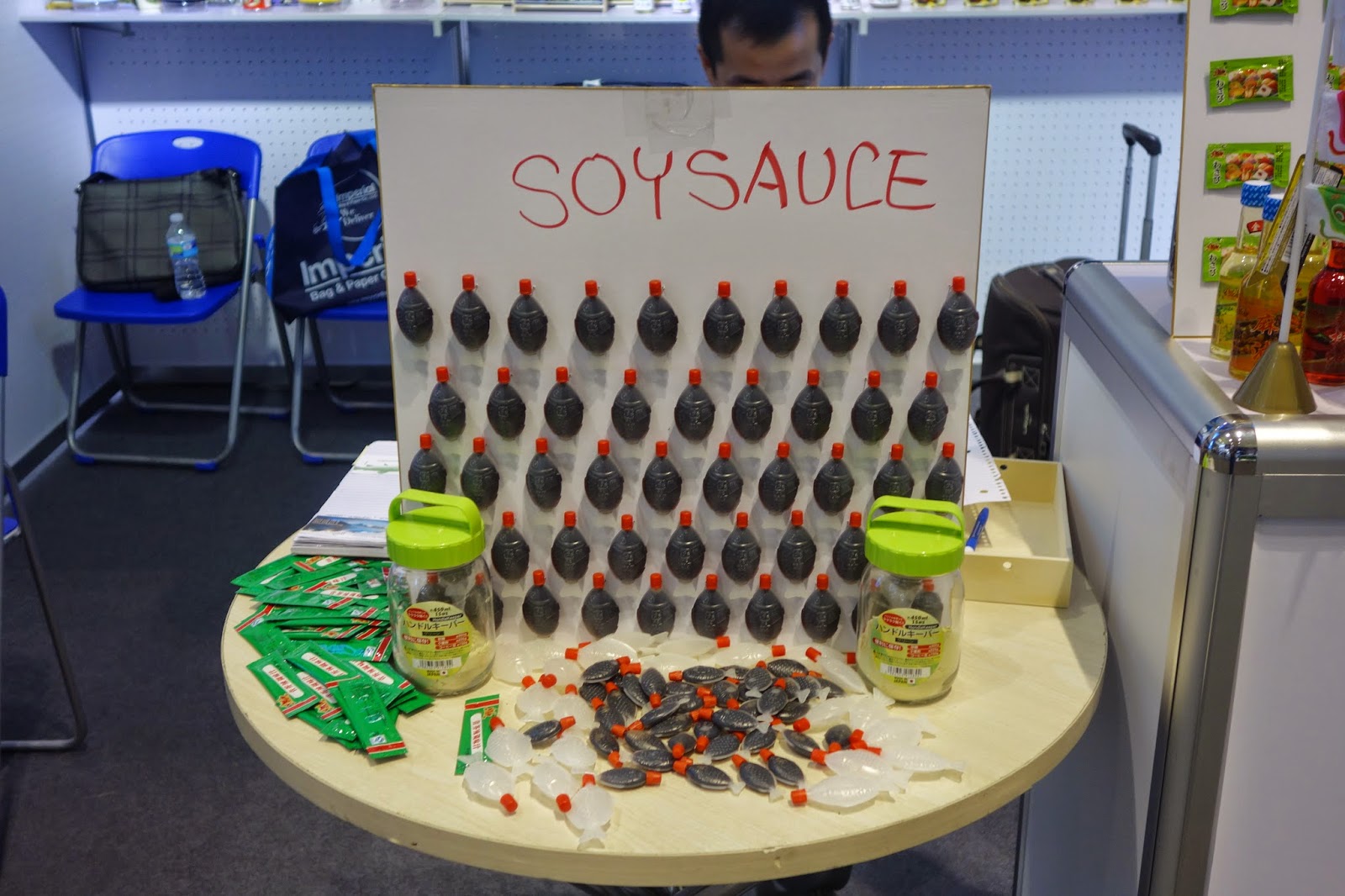
Some kids have lemonade stands, but this was the first time I saw a Soy Sauce stand.
"Raise your hand if you are enjoying the Seafood Expo."
These tiny squid actually do resemble fire flies as they emit lights when they are in the sea. Off the coast of Japan, they create a huge light show when millions gather together to spawn.
"I'm the true King. Elvis was a pretender."
What has 800 legs but doesn't walk? A counter full of octopi.
"It's supposed to be an apple not an orange, you dummy."
These look like the biggest caterpillars I've ever seen,though they are actually sea cucumbers.
“No good fish goes anywhere without a porpoise.”
--Lewis Carroll
--Stephen Leacock
Every year at the Seafood Expo North America (SENA), I take a few hundred photos of all of the fascinating things I find there, including plenty of fish heads. Not all of those photos easily fit into my other posts, but I still want to share them with my readers, to give you a better insight into all that takes place at SENA. I've collected a group of my photos here for your viewing pleasure and I've added captions (some serious, some humorous). Please enjoy this visual journey through the warped eye of the Fish Head Whisperer.
Several vehicles with a fish decor can be seen at the Expo.
This is the front of that previous vehicle, and it is now obvious this is a catfish car.
This vehicle was parked outside, in front of the convention center.
This is the rear of that same vehicle. Notice the "Smart Fish" license plate.
A Shrimp motorcycle.
This motorcycle is more subtly decorated in a seafood theme.
It's wheel though has a cool shark on it.
The body of this fish reminds me of an ear of corn where a few nibbles have been taken.
The fabled Unicorn fish.
When you all live in a tiny apartment, you need to share the single bed.
Capt'n Catfish, the official mascot of the U.S. catfish industry, has been able so far to avoid ending up in a frying pan. He's a regular character at each SENA.
"I'm hoping that I can hide among these peppers. I don't want to end up in the oven. "
Such an appealing plate of Sushi, though too bad it is made of plastic!
A scholarly octopus, soaring high above the Expo.
How many stuffed polar bears can fit inside a telephone booth?
At night, once the Expo close, these larger polar bears prowl the aisles, seeking any leftover fish.
In one of the halls of the convention center, you'll find this octopus sculpture, and it doesn't seem related to the Expo. But it is very cool.
It seems like the Macy's Thanksgiving Day Parade with the huge fish floating high above the Expo.
The Chicken of the Sea mermaid is another character who you'll regularly see at the Expo.
Look at the size of that lobster claw! The lobster is estimated to weigh 18-20 pounds.
The attendees are not the only ones who get to enjoy some seafood samples.
"Where's the cocktail sauce?"
Some kids have lemonade stands, but this was the first time I saw a Soy Sauce stand.
"Raise your hand if you are enjoying the Seafood Expo."
These tiny squid actually do resemble fire flies as they emit lights when they are in the sea. Off the coast of Japan, they create a huge light show when millions gather together to spawn.
"I'm the true King. Elvis was a pretender."
What has 800 legs but doesn't walk? A counter full of octopi.
"It's supposed to be an apple not an orange, you dummy."
These look like the biggest caterpillars I've ever seen,though they are actually sea cucumbers.
“No good fish goes anywhere without a porpoise.”
--Lewis Carroll
Subscribe to:
Posts (Atom)