"I've never been hurt by a sea creature, except for jellyfish and sea urchins."
--Peter Benchley, Author of Jaws and The Deep
Their gonads are a culinary delicacy, highly valued by many Japanese diners. You can find them available at a number of Japanese restaurants in the U.S. as well as some other high-end restaurants. I'm a fan and know plenty of others who enjoy them too. I'm referring to Sea Urchin, a spiny sea creature, and its "roe" which are actually gonads. You may know their gonads by their Japanese name, Uni. "Uni" doesn't mean "sea urchin" but specifically refers to their "gonads."
At the Seafood Expo North America (SENA), they offered a Master Class in Sea Urchin, presented by Chef Ned Bell of Ocean Wise, a sustainable seafood program, and Claire Li Loong of the Vancouver Aquarium Marine Science Centre. The presentation was sponsored by the Pacific Urchin Harvesters Association, an industry association established to examine fishery issues in the Red Sea Urchin in British Columbia.
Chef Ned Bell is the Ocean Wise Executive Chef at the Vancouver Aquarium, as well as a sustainable seafood ambassador. Bell founded Chefs for Oceans in 2014 to raise awareness about sustainable seafood. He has worked in a number of restaurants, including, most recently, the Four Seasons Hotel Vancouver and YEW seafood + bar. The Four Seasons was the first hotel in British Columbia to be 100% certified Ocean Wise. Bell’s cooking philosophy is "globally inspired and locally created" and he has a cookbook due out in the fall. He was a personable and passionate speaker, and I was fortunate to see him at another seminar at the Expo as well.
He began with some general remarks on sustainable seafood, noting we all should "choose responsible seafood." Like a growing number of chefs, Chef Bell seems to prefer to use the term "responsible" rather than "sustainable." A growing number of people feel that the term "sustainable" has been diluted over time and have chosen a different term which they feel is more appropriate. Chef Bell stated that we need to build relationships with responsible fishermen, supporting those who do the right thing. I fully agree and it is those relationships which help to build trust, and when assessing sustainability, trust is very important.
Polling the audience, only about 40% of them had tasted sea urchin before. It was cool to see a significant number of adventurous attendees who were curious about sea urchin and willing to sample it. As I've often said before, including in yesterday's post, we need to eat more species than the most common ones. Chef Bell noted that in North America, sea urchin is a relatively new delicacy, and most sea urchin is exported to Japan. The domestic market in Canada for sea urchin is still small, but growing. The discussion centered on the Red Sea Urchin from British Colombia.
The Red Sea Urchin ranges from Alaska down to Baja, California, though about 80% of these sea urchin are collected on the North Coast. Last year, 4000 metric tonnes were caught in British Colombia, by divers in remote areas. They dive to depths from 12-60 feet, and the sea urchins they harvest are often available within 24 hours. The Red Sea Urchin is the largest in the world, with a maximum diameter of about 18 centimeters and spines up to 7 centimeters long. It takes them about five years to reach maturity and they have millions of eggs per spawning event. The harvest season is from October to May.
Sea Urchin has a shelf life of 7-10 days. The firmer and more well defined sea urchin is better used in sushi while the softer variety is better used in soups and sauces. Chef Bell recommended that we should eat less common seafood, such as sea urchin, which is certainly an excellent idea to take pressure off some of the more popular types of fish. As Red Sea Urchin is very sustainable, it makes for a good option.
Claire then took over the discussion to talk about Ocean Wise, which recommends sustainable seafood by scientific assessment. This is akin to the Seafood Watch of the Monterey Bay Aquarium. These assessments are based on four main components: a) Heathy stock; b) Limited bycatch; c) Well managed; and d) Limited habitat damage. A numerical score is generated, ranging up to a maximum of 5, and a fishery needs at least a 2.8 to be considered sustainable.
The Red Sea Urchin has been assessed as sustainable by Ocean Wise. It has a healthy and abundant stock. Its main predator is the sea otter but there are not as many otters around so its population has grown. Harvesting sea urchin by individual divers means that there is almost no bycatch. That also means that is very limited habitat damage from those divers. The fishery is also well managed, with a quota system, minimum size limits, good enforcements, and even observers at the docks to help monitoring.
Locally, I know that Red's Best at the Boston Public Market sometimes sells Sea Urchins. You could buy some, take them home and prepare them yourself. Check out some Sea Urchin Recipes from the Pacific Urchin Harvesters Association. Or, the next time you dine out and see Sea Urchin on the menu, order it and enjoy its compelling flavors.
For Over 18 Years, and over 5600 articles, I've Been Sharing My Passion for Food, Wine, Saké & Spirits. Come Join Me & Satisfy Your Hunger & Thirst.
Tuesday, April 11, 2017
Monday, April 10, 2017
The Tipsy Sensei Returns!
Nate Randall, the Tipsy Sensei, is back and facing terrible Kaiju, gigantic monsters that bear some resemblance to beasts like Godzilla and Ghidorah.
The Tipsy Sensei is the name of my fictional series of supernatural thrillers which feature Sake-expert Nate Randall who faces off against a variety of supernatural creatures from Japanese folklore. At his side is his friend, Hato, an immortal Samurai and a master of the katana, bow and other weapons. Currently, the Tipsy Sensei series consists of four short stories and three novels, with more forthcoming. And the Tipsy Sensei has now expanded from fiction to the gaming world.
A new role-playing game has just been released, Tiny Frontiers: Mecha and Monsters, which was created by game-designer Alan Bahr. With a minimalistic set of rules, you can pit giant robots against mighty monsters. As an example, think of the movie Pacific Rim. It is a fun game that is easy to learn, and is appropriate for all ages. A number of other writers were invited to contribute to this role-playing game, to create a variety of settings for the game. I was fortunate to have been chosen for inclusion, and one of my contributions is a setting that includes the Tipsy Sensei!
In my last novel, Halloween Nightmare At Fenway, Nate and Hato faced off against Doctor Toshio Yagi and Major Zannin Iwafuku, who were onryō, vengeful ghosts that wanted to replay World War II. As an alternate future history, I used these same villains and their goals to create a setting, Hyakki Yagyō, for the Tiny Frontiers game. Out of the mists of Japanese mythology, Doctor Yagi and Major Iwafuku were able to use potent magic to summon a myriad of Kaiju to the Earth, trying to destroy those countries which defeated Japan during WWII. In response, the U.S. and its allies created the Steelnecks, powerful Mecha which they hope to counter the Kaiju. And Nate Randall might be the turning point in this epic battle.
What will happen next? That is up to you as you can role-play many different scenarios and endings. In addition, you'll find eighteen other settings for the Mecha and Monsters game, providing a wealth of diversity. Plus, I wrote a second setting for this game called Mecha Chef. Consider Iron Chef but where giant robots must first hunt down their ingredients, huge Kaiju, and then create a special dish from their flesh.
Check out Tiny Frontiers: Mecha and Monsters and experience the Tipsy Sensei's new adventures.
Rant: Be More Seafood Adventurous
"As Mark Kurlansky noted in his oyster-centric history of New York, The Big Oyster, up until the 1920s, the average New Yorker ate annually as many as six hundred local oysters as part of a locally sourced seafood diet of more than thirty-six pounds of fish and shellfish a year—more than double the current per capita level of American seafood consumption. New York oysters were so common as to be considered a poor man’s food, priced at less than a penny apiece."
--American Catch: The Fight for Our Local Seafood by Paul Greenberg
As I mentioned in Friday's post, Barton Seaver stated we need to eat different types of seafood species, and not just the top 10 most popular species. I've addressed this issue before in a few different posts but feel the need to discuss it again, providing some updated and additional information.
Let me preface by stating Americans need to eat more seafood in general, and that the scientific community advises you should eat seafood twice a week, an annual consumption of 26 pounds of seafood. Unfortunately, Americans only consume about 15.5 pounds annually, more than ten pounds less than advised. Since 2001, the highest annual seafood consumption was in 2005 with 16.6 pounds and the lowest amount was in 2012 with 14.4 pounds. Now consider the quote above, how New Yorkers once ate over 36 pounds of seafood annually. Why did we stop eating so much seafood?
(I also long for the days when oysters were only a penny a piece, rather then the $2-$4 a piece you find now. The same book also noted that "In the mid-1800s the average New Yorker spent more on oysters than on butcher meat.")
According to Seafood Health Facts, there are between 300 and 500 different species of fish and shellfish sold annually. What an incredible diversity is thus available, and it makes it even more unfortunate when American seafood consumption habits are so limited. In 2014, about 55% of the seafood consumed in the U.S. was limited to three types: shrimp, canned tuna and salmon. And 90% of what is consumed is limited to 10 different types. Let me break down those numbers in more detail.
In 2015, the National Fisheries Institute stated that the top ten seafood species consumed in the U.S. include: Shrimp (4 lbs), Salmon (2.9 lbs), Tuna (2.2 lbs), Tilapia (1.4 lbs), Alaska Pollock (1.0 lbs), Pangasius (.7 lbs), Cod (.6 lbs), Crab (.6 lbs), Catfish (.5 lbs), and Clams (.3 lbs). These Top Ten species constitute about 14.2 pounds of American's annual consumption, with another 1.3 pounds of miscellaneous species. Salmon, Pangasius, and Crab saw an increase in consumption, with Crab moving from 9th place to 8th place
Obviously, these statistics are an average for the entire country and are likely different in certain regions of the country, such as the Northeast. With our proximity to the coast and access to the vast bounty of the sea, our particular seafood consumption habits are probably different from the norm. For example, Lobster might be on our Top Ten species list and Clams, cause of all the fried clams and chowders, could also be in a higher place than 10th. However, it is still clear that even those in the Northeast don't eat enough different species of seafood. We far too often remain with the common and familiar rather than venturing out to something different. Try some mussels, dogfish, sardines, mackerel, fluke, and much more.
By limiting ourselves to primarily ten species, we put heavy pressures on those seafood populations, causing sustainability issues. It is why many of those species have quotas, because their populations would be threatened by unregulated fishing. We need to ease those pressures by lowering consumption of those species, and consuming other species that don't have sustainability issues. We have to give the populations of those ten common species more time to rebound and recover.
By limiting ourselves to primarily ten species, we are also hurting the economic situation of our fishermen, driving some of them out of business. With strict quotas on the most common seafood species, it gets harder and harder to make a living by catching those fish. Fishermen harvest many other different seafood species but there is little market for many of those species so they can't earn much money from those catches. If Americans started consuming more of those less common species, the market for them would grow, helping fishermen make more money. We should cherish our local fishermen and help protect them, especially when it is so easy to do so by simply consuming different types of seafood. Don't you want to help your local community?
Get over your psychological barriers! Don't be afraid of something unfamiliar and take a chance on a different fish. It is time now to stop eating the same old fish all the time and experiment with less common seafood, to broaden your palate to the pleasure of whelks and sardines, cobia and mackerel. You will enjoy the tastes if you only give them a chance, especially if you dine at a good restaurant which knows how to properly prepare seafood. For the sake of sustainability, to save our oceans and all of the endangered species, to save our fishermen, this is an excellent choice and one you should seriously consider.
Be more seafood adventurous!
Friday, April 7, 2017
SENA17: "We Don't Know How To Talk About Seafood"
"We don't know how to talk about seafood."
It might seem strange to hear that sentiment spoken at the Seafood Expo North America (SENA), but if you think more carefully about it, maybe it is the perfect place to discuss this statement.
The first conference session I attended at SENA was "How Can Market Measures Promote Sustainable Seafood Production and Consumption" which was intended to discuss the following: "What is the current situation, where are we headed, and how can we insure that sustainable practices are adopted to meet future demand? First, a statistical overview of global trends (FAO stats) in seafood production, consumption and trade, along with a comparison of model projections (FAO/OECD/WB) of future production and utilization. Second, identification of key factors that hinder sustainable production, consumption and trade of fish products that threaten our future seafood supplies, global food security, and achievement of the UN Sustainable Development Goals."
The Moderator was Victoria Chomo, a PhD economist specializing in international trade and development who is currently a Senior Fishery Officer in the Products, Trade and Marketing Branch of the Food and Agriculture Organization (FAO). There were also four expert speakers, including: John Connelly, the President of the National Fisheries Institute (a trade association advocating for the full seafood supply chain); John Henderschedt, the Director of the Office of International Affairs and the Seafood Inspection at NOAA Fisheries; Niklas Wehner, Advisor at the Deutsche Gesellschaft für Internationale Zusammenarbeit (GIZ); and Barton Seaver, of the Sustainable Seafood & Health Initiative at the Center for Health & the Global Environment at the Harvard T.H. Chan School of Public Health.
Initially, Victoria Chomo began discussing the United Nations Food and Agriculture Organization (FAO), which is involved in food security and sustainability. In September 2015, U.N. members agreed to a series of sustainability goals, adopting the 2030 Agenda for Sustainable Development and its 17 Sustainable Development Goals. For this conference session, they concentrated on Goal #12, "Ensure sustainable consumption and production patterns." However, Goal #14, "Conserve and sustainably use the oceans, seas and marine resources", would probably also be applicable here.
We then proceeded to learn about the worldwide role of seafood and how integral it is to the global economy and more. The global fish & seafood value chain was estimated at approximately $818 Billion in 2008. That can be broken down into Capture Fisheries $100 Billion, Aquaculture $98 Billion, Primary Processing $90 Billion, Secondary Processing $180 Billion, and Distribution $350 Billion. It is the most highly traded food commodity in the world. About 880 million people, 12% of the world population, subsist on these fish & seafood value chains for their livelihood.
About 3 billion people rely on seafood for more than 20% of their animal protein intake, and some as much as 50%. Unfortunately, approximately 30% of seafood production ends up as waste, which is a significant problem for our entire food industry. It is predicted that aquaculture will rise to 57% within the next 10 years, necessary to help feed the world's growing population. Though some oppose increased aquaculture, its conversion efficiency is better than terrestrial proteins, including beef, pork and chicken. In addition, it has very low on emissions with bivalves have the lowest.
John Connelly then spoke, first noting that most people, except for governments and NGOs, don't talk in terms of Sustainable Development Goals (SDG). This term needs to be translates into business practices. He also mentioned that he believes it is the government's responsibility to ensure sustainability as it is a common. In addition, he mentioned that the seafood industry wants better communication from the government. For example, he feels that NOAA doesn't talk enough about efficiency and fisheries, caring more about scientific assessments. Finally, addressing the issue of waste, he stated this was a new issue for the industry, which needs to examine the issue much more to learn how and where they can reduce waste. I'm not sure I agree that it is a new issue, though its importance might have only been raised in the recent past.
Next, John Henderschedt stepped up, agreeing with most of what Connelly already said. He added that the government can be informative, telling the market and public about what is sustainable and what is not. He stated that we want informed consumers, educated about seafood sustainability. The final speaker was Niklas Wehner, who discussed the rules of development corporations.
However, it was the speech from Barton Seaver that most resonated with me, which caused me to contemplate much of what he said. He began stating: "We don't know how to talk about seafood." He continued, noting that we don't have a great definition of "sustainable seafood," especially as there are so many elements of sustainability. Seafood often isn't included in discussion about "good food" despite it being maybe the only food with the term "food" actually in it. We need to look at seafood more from a cultural viewpoint.
Seafood suffers from "otherness," being seen as different from other foods. Over time, seafood lost its identity, partially from the advent of refrigeration and a decrease in home cooking. When people commonly think of proteins, they usually don't include seafood in their thoughts. It is also the only food that is considered guilty before being innocent. It is something people think must be analyzed, to determine whether it passes a person's standards or not. These same individuals don't conduct that same analysis with their beef, chicken, or pork.
The culinary aspect of seafood scares people, who feel intimidated when trying to cook seafood. Currently, Americans eat almost only 10 species of fish, 8 if you group the catfish together. Other fish and seafood is not seen as having the same value as these 10. Our fishermen catch so many other species and this is an unsustainable economic situation. We demand the market supply for fish rather than take what is caught. We must all start eating other species of fish and seafood, going beyond the common 10. We need to be less pressure on those common 10 and also help fishermen who catch all the other species. This is an issue I'll be writing about more in the near future.
Barton then raised an issue I hadn't considered before, but which makes much sense. He stated that one of the biggest obstacles to sustainability is the recipe. The problem is that recipes usually are composed to use a specific type of fish. For example, you will find recipes for Cod and Mussels, Salmon and Crab. Some seafood cookbooks break down into chapters for these specific seafood types. However, Barton feels that recipes shouldn't specify the fish type but be more generic, such as a "light, flaky whitefish."
The idea is to encourage home cooks to seek outside the common 10 and use other seafood species, which are similar to the common ones they already enjoy. That is excellent advice, though such a cookbook would probably need to have a list somewhere, grouping seafood species by the generic definitions within the cookbook. For example, the average consumer doesn't know what dogfish is like, so they would need to have some guidance as to what type of recipes it would fit within. Barton also had advice for Chefs, that they should not ask for specific species but should ask for what is fresh. In addition, they should "sell the dish, not the seafood."
Barton then moved on, stating that we need to "end the conversation of wild vs farmed." He feels it is an artificial distinction, that we should treat them both the same and stop arguing about aquaculture. In a recent online article, Barton expanded upon this issue and it is worth a read. He makes numerous valid points and I have long been a proponent of aquaculture as well. You'll find numerous articles on my blog discussing aquaculture.
As Barton says, "Seafood is such an amazing opportunity" and "Seafood sustains us." He also noted how valuable it is for our health, how numerous studies show that eating sufficient seafood can reduce your risk of heart disease by about 36%. A doctor from Tufts once told him of the 3 Ss of good health: Wear Seatbelts, No Smoking, and Eat Seafood.
Barton Seaver provided me much to ponder and I hope it helped spark something within my readers as well. People need to eat more seafood, for an abundance of reasons, from improving your own health to helping local fishermen make a living. Stop treating seafood as an enemy and treat it as you would hamburger or fried chicken.
It might seem strange to hear that sentiment spoken at the Seafood Expo North America (SENA), but if you think more carefully about it, maybe it is the perfect place to discuss this statement.
The first conference session I attended at SENA was "How Can Market Measures Promote Sustainable Seafood Production and Consumption" which was intended to discuss the following: "What is the current situation, where are we headed, and how can we insure that sustainable practices are adopted to meet future demand? First, a statistical overview of global trends (FAO stats) in seafood production, consumption and trade, along with a comparison of model projections (FAO/OECD/WB) of future production and utilization. Second, identification of key factors that hinder sustainable production, consumption and trade of fish products that threaten our future seafood supplies, global food security, and achievement of the UN Sustainable Development Goals."
The Moderator was Victoria Chomo, a PhD economist specializing in international trade and development who is currently a Senior Fishery Officer in the Products, Trade and Marketing Branch of the Food and Agriculture Organization (FAO). There were also four expert speakers, including: John Connelly, the President of the National Fisheries Institute (a trade association advocating for the full seafood supply chain); John Henderschedt, the Director of the Office of International Affairs and the Seafood Inspection at NOAA Fisheries; Niklas Wehner, Advisor at the Deutsche Gesellschaft für Internationale Zusammenarbeit (GIZ); and Barton Seaver, of the Sustainable Seafood & Health Initiative at the Center for Health & the Global Environment at the Harvard T.H. Chan School of Public Health.
Initially, Victoria Chomo began discussing the United Nations Food and Agriculture Organization (FAO), which is involved in food security and sustainability. In September 2015, U.N. members agreed to a series of sustainability goals, adopting the 2030 Agenda for Sustainable Development and its 17 Sustainable Development Goals. For this conference session, they concentrated on Goal #12, "Ensure sustainable consumption and production patterns." However, Goal #14, "Conserve and sustainably use the oceans, seas and marine resources", would probably also be applicable here.
We then proceeded to learn about the worldwide role of seafood and how integral it is to the global economy and more. The global fish & seafood value chain was estimated at approximately $818 Billion in 2008. That can be broken down into Capture Fisheries $100 Billion, Aquaculture $98 Billion, Primary Processing $90 Billion, Secondary Processing $180 Billion, and Distribution $350 Billion. It is the most highly traded food commodity in the world. About 880 million people, 12% of the world population, subsist on these fish & seafood value chains for their livelihood.
About 3 billion people rely on seafood for more than 20% of their animal protein intake, and some as much as 50%. Unfortunately, approximately 30% of seafood production ends up as waste, which is a significant problem for our entire food industry. It is predicted that aquaculture will rise to 57% within the next 10 years, necessary to help feed the world's growing population. Though some oppose increased aquaculture, its conversion efficiency is better than terrestrial proteins, including beef, pork and chicken. In addition, it has very low on emissions with bivalves have the lowest.
John Connelly then spoke, first noting that most people, except for governments and NGOs, don't talk in terms of Sustainable Development Goals (SDG). This term needs to be translates into business practices. He also mentioned that he believes it is the government's responsibility to ensure sustainability as it is a common. In addition, he mentioned that the seafood industry wants better communication from the government. For example, he feels that NOAA doesn't talk enough about efficiency and fisheries, caring more about scientific assessments. Finally, addressing the issue of waste, he stated this was a new issue for the industry, which needs to examine the issue much more to learn how and where they can reduce waste. I'm not sure I agree that it is a new issue, though its importance might have only been raised in the recent past.
Next, John Henderschedt stepped up, agreeing with most of what Connelly already said. He added that the government can be informative, telling the market and public about what is sustainable and what is not. He stated that we want informed consumers, educated about seafood sustainability. The final speaker was Niklas Wehner, who discussed the rules of development corporations.
However, it was the speech from Barton Seaver that most resonated with me, which caused me to contemplate much of what he said. He began stating: "We don't know how to talk about seafood." He continued, noting that we don't have a great definition of "sustainable seafood," especially as there are so many elements of sustainability. Seafood often isn't included in discussion about "good food" despite it being maybe the only food with the term "food" actually in it. We need to look at seafood more from a cultural viewpoint.
Seafood suffers from "otherness," being seen as different from other foods. Over time, seafood lost its identity, partially from the advent of refrigeration and a decrease in home cooking. When people commonly think of proteins, they usually don't include seafood in their thoughts. It is also the only food that is considered guilty before being innocent. It is something people think must be analyzed, to determine whether it passes a person's standards or not. These same individuals don't conduct that same analysis with their beef, chicken, or pork.
The culinary aspect of seafood scares people, who feel intimidated when trying to cook seafood. Currently, Americans eat almost only 10 species of fish, 8 if you group the catfish together. Other fish and seafood is not seen as having the same value as these 10. Our fishermen catch so many other species and this is an unsustainable economic situation. We demand the market supply for fish rather than take what is caught. We must all start eating other species of fish and seafood, going beyond the common 10. We need to be less pressure on those common 10 and also help fishermen who catch all the other species. This is an issue I'll be writing about more in the near future.
Barton then raised an issue I hadn't considered before, but which makes much sense. He stated that one of the biggest obstacles to sustainability is the recipe. The problem is that recipes usually are composed to use a specific type of fish. For example, you will find recipes for Cod and Mussels, Salmon and Crab. Some seafood cookbooks break down into chapters for these specific seafood types. However, Barton feels that recipes shouldn't specify the fish type but be more generic, such as a "light, flaky whitefish."
The idea is to encourage home cooks to seek outside the common 10 and use other seafood species, which are similar to the common ones they already enjoy. That is excellent advice, though such a cookbook would probably need to have a list somewhere, grouping seafood species by the generic definitions within the cookbook. For example, the average consumer doesn't know what dogfish is like, so they would need to have some guidance as to what type of recipes it would fit within. Barton also had advice for Chefs, that they should not ask for specific species but should ask for what is fresh. In addition, they should "sell the dish, not the seafood."
Barton then moved on, stating that we need to "end the conversation of wild vs farmed." He feels it is an artificial distinction, that we should treat them both the same and stop arguing about aquaculture. In a recent online article, Barton expanded upon this issue and it is worth a read. He makes numerous valid points and I have long been a proponent of aquaculture as well. You'll find numerous articles on my blog discussing aquaculture.
As Barton says, "Seafood is such an amazing opportunity" and "Seafood sustains us." He also noted how valuable it is for our health, how numerous studies show that eating sufficient seafood can reduce your risk of heart disease by about 36%. A doctor from Tufts once told him of the 3 Ss of good health: Wear Seatbelts, No Smoking, and Eat Seafood.
"Fish lacks story." Barton is not the first sustainable seafood proponent that I have heard make this point, and its validity is without dispute. Barton feels we need to use other methods to connect people to seafood, and shouldn't start with the seafood. We need to connect it more to cultural issues. For example, we can talk about social issues such as the fact that 52% of the people involved in aquaculture are women. Aquaculture provides plenty of jobs and that is a great story. In addition, we should consider the story of how we keep fishermen in business, the civic values of helping members of our community. We all should "Talk about sustainability in any measure that is meaningful to you."
Barton Seaver provided me much to ponder and I hope it helped spark something within my readers as well. People need to eat more seafood, for an abundance of reasons, from improving your own health to helping local fishermen make a living. Stop treating seafood as an enemy and treat it as you would hamburger or fried chicken.
Thursday, April 6, 2017
SENA17: Fish Fun & Photos
Fish heads fish heads,
Roly poly fish heads,
Fish heads fish heads,
Eat them up yum
--Barnes & Barnes
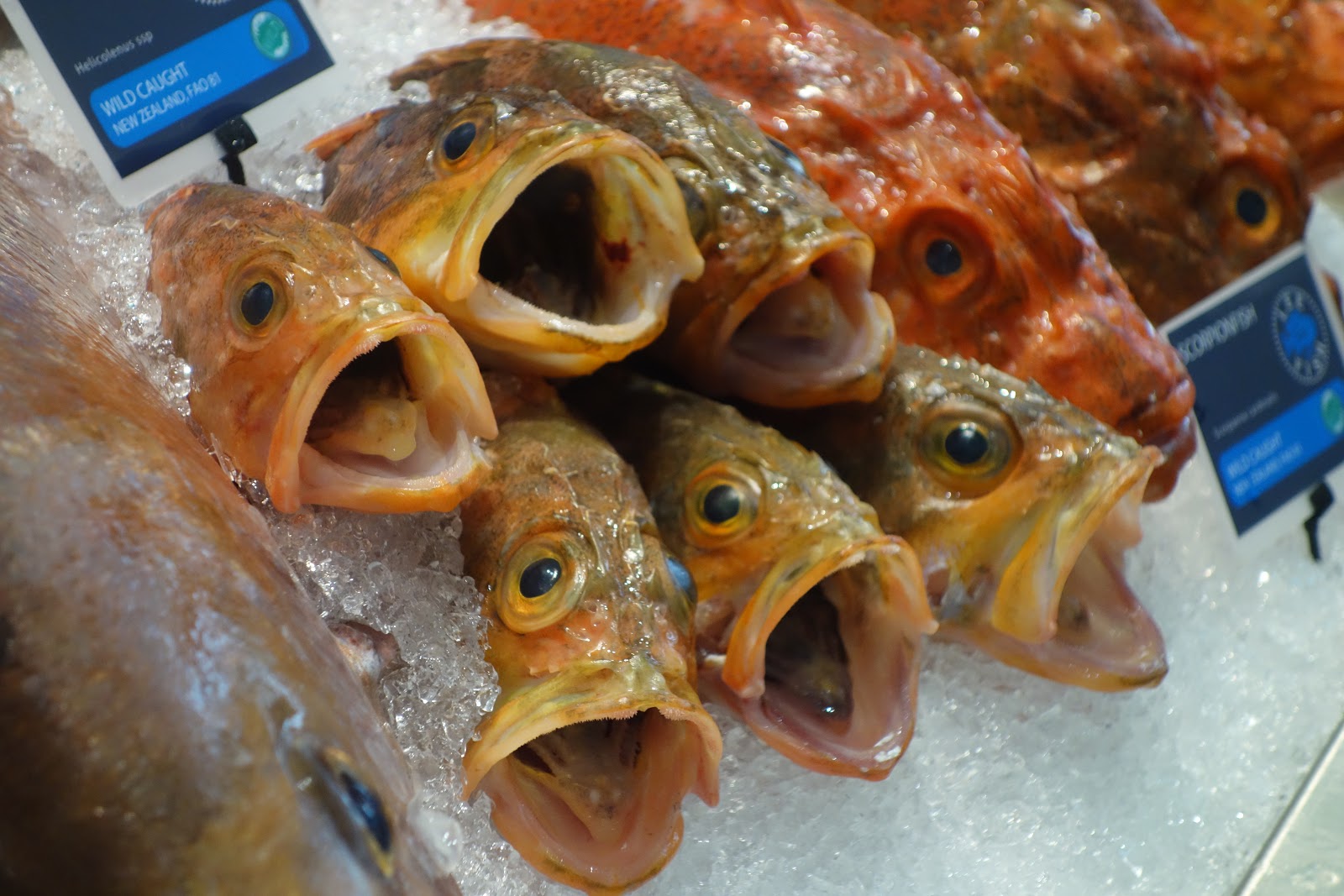
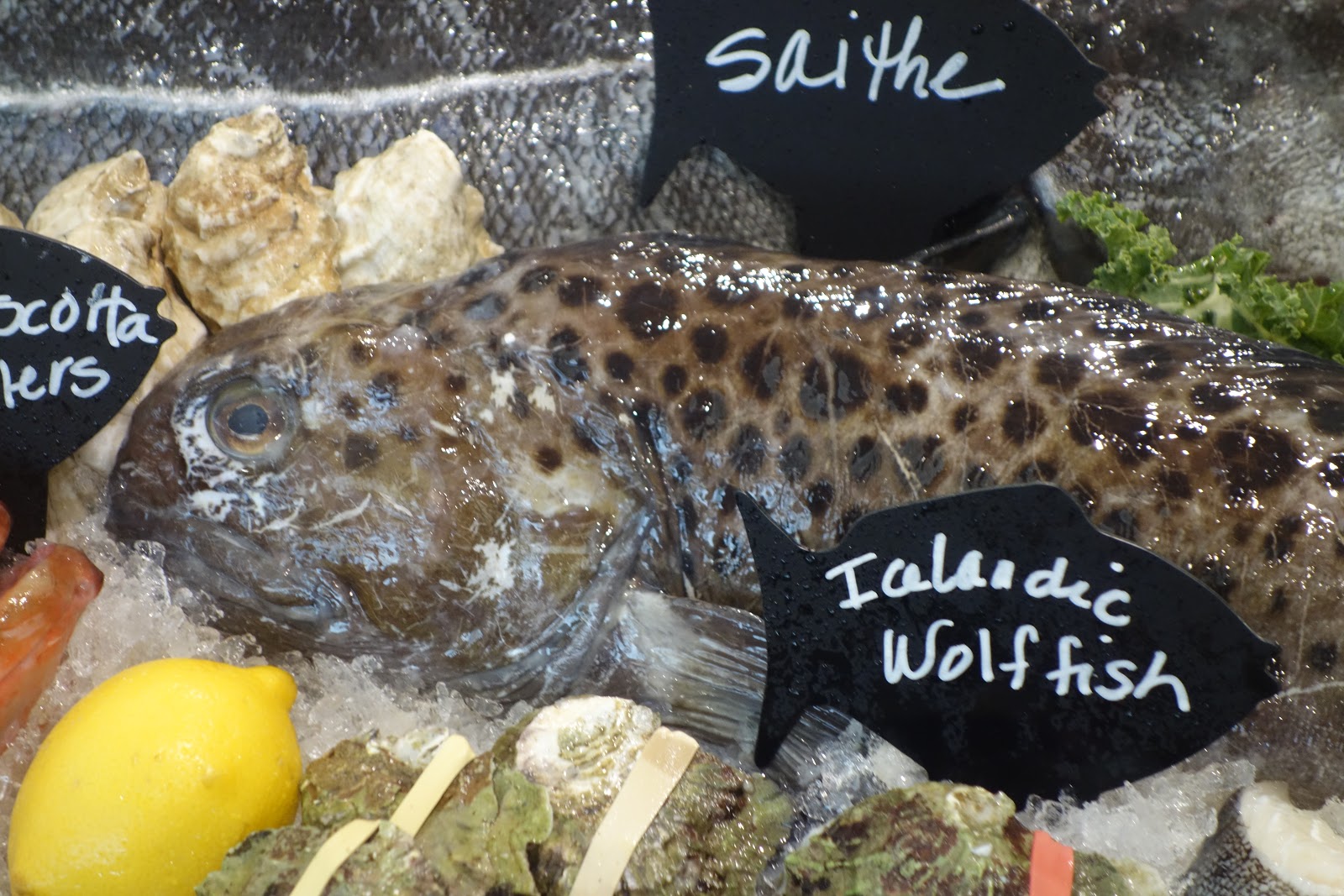
Every year at the Seafood Expo North America (SENA), I take plenty of photos of all of the fascinating things I find there, including numerous fish heads. I've collected a group of my photos for your viewing pleasure. Please enjoy this visual journey through the warped eye of the Fish Head Whisperer.
See you next year at the Seafood Expo!
Subscribe to:
Posts (Atom)