An aerial view of the Croatian city of Dubrovnik, located on the coast of the Adriatic Sea. It's a city with a fascinating history, and its medieval walls and fortifications are compelling, enough that Game of Thrones used various sites in Dubrovnik as settings in the series. We spent a little time touring the city, including walking along some of the city high walls, immersing ourselves in its rich history. From atop the city walls, you'll find such great views of the city and the water. Dubrovnik is a popular Croatian destination, and numerous cruise ships dock at their port, so you'll find plenty of other tourists in the streets.
While in Dubrovnik, our lunch was sponsored by the Dubrovnik & Neretva County Tourist Board, and we dined with their representative, Ivona Bijač Nikolić, at the Riblji Restoran Proto, more commonly known as the Proto Restaurant. "Riblji" mean "fish" and "Proto" is a nickname for the owner. Proto is part of a trio of restaurants, which also includes Orlando, a cafe/bistro in Dubrovnik, and Konavoski Dvori, a national restaurant at Gruda-Ljjuta in the Konavle region.
The restaurant is easily located at 1 Široka Street, which is a side street off the Stradun, the main thoroughfare of Dubrovnik. There has been a Riblji Restoran located at the site of Proto since 1886, and it long been known as an excellent place for fresh seafood. Currently, the head chef is Boško Lonac, and the kitchen concentrates on what is fresh and available, not only seafood but all of their ingredients, from meat to vegetables. As such, the menu changes dependent on availability and the seasons. Proto is also one of the small number of Croatian restaurants listed in the Michelin Guide.
There is an elegance to the ambiance of this restaurant, though it avoids being pretentious. There is a small patio on the street, and on the second floor, you'll find an area which is partially outside, with a covering above. Proto's sommelier is Siniša Lasana, who was chosen as Croatia's top sommelier in the 21st National Sommelier Championship, organized by the Croatian Sommelier Club. He actually joined us for lunch, choosing the wines to accompany our meal. Those wines were delicious and exciting, especially for geeky wine lovers, giving us another glimpse into some of the best of Croatian wines.
The food menu at Proto is dominated by seafood, though you'll find a number of meat and vegetarian options too. There are Cold & Hot Starters, most ranged from $20-$30 US, including dishes such as Dalmatian-style Octopus Salad, Lobster Salad, Fish Carpaccio on Rocket Leaves, Dalmatian Prosciutto, Oysters au Gratin, Grilled Foie Gras, and Risotto Matelote. Entrees, most ranging from $29-$66, include dishes such as Lobster Tail with Pasta, Grilled Mediterranean Scallop, Gratinated Sea Bream, Charcoal-Grilled Ribeye Steak, and Duck Breast. There are a couple special items as well, including the Adriatic Fish (daily catch selection, grilled/oven-roasted-steamed/stewed, 1 kg, $118) and the Adriatic Lobster (2 styles, 1 kg, $202). Plus, they offer the Porto Menu, a special 5 course meal, for $118.
This was the most expensive restaurant I visited while in Croatia, its prices equivalent to some of the higher end restaurants in Boston, and it's well worth the splurge. The high quality and freshness of the food, its perfect execution, the ambiance of the restaurant, the professional service, all warrant the prices. This isn't some over-priced tourist trap, but rather a serious restaurant which would excel in any city. If you love seafood, then this is your destination in Dubrovnik.
We began our lunch with some bubbly, the Tris Limited Edition Sparkling Wine from the island of Korčula. This wine was made by a joint endeavor between three winemakers, Igor Radovanović, Nikola Mirošević and Matej Jovanović. In addition, the wine is made from three indigenous grapes, Pošip, Rukatac and Cetinka. As the number three was so important to the making of the wine, they decided to call it Tris. I very much enjoyed this wine, finding it to be crisp and dry, with plenty of tiny bubbles, and delicious and complex flavors, primarily of green apple, pear, and a hint of brioche. Such a refreshing wine, with a pleasing finish, and an indication that Croatians can make excellent sparkling wine.
I decided to start with some Ston Oysters, having previously enjoyed them so much. These were superb, so fresh, clean, and meaty, with a prominent briny element. As I've mentioned before, the Ston oysters also possessed an additional unique taste that is hard to pin down but which is quite tasty. These were probably the best Ston oysters I enjoyed during my time in Croatia, and I easily could have devoured a couple dozen.
One of my dining companions shared his First Class Fish Tartare with me, which was smooth and flavorful, fresh and creamy. It was spiced nicely, and immediately brought to mind the sea. It was an ample portion as well, and would make a good choice.
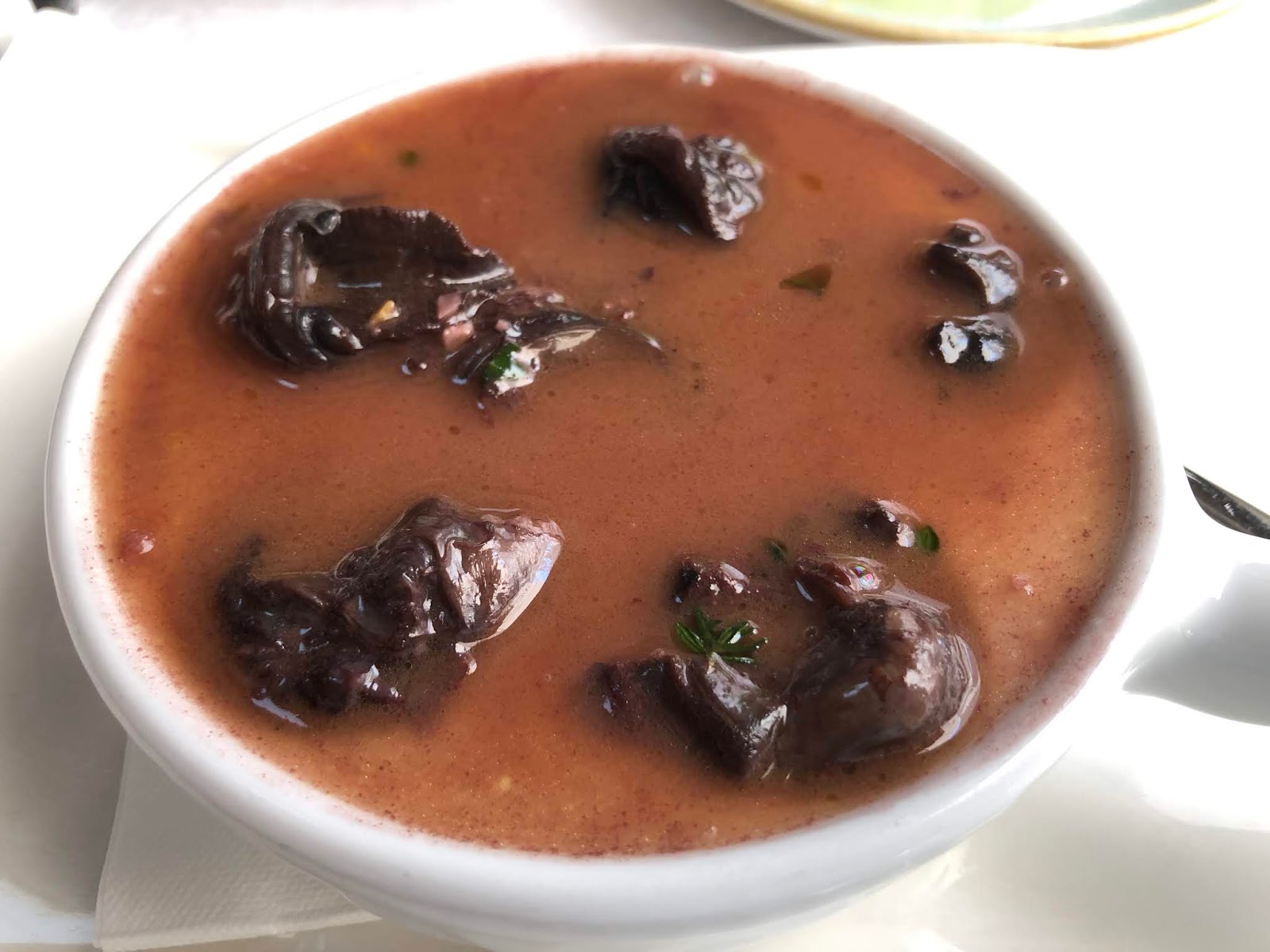
The Snails, Prepared Pelješac-Style, were meaty and earthy, bathed in a rich and flavorful red wine and garlic sauce. Another killer of a dish! I love snails, though usually have them in a lighter, white wine garlic sauce, but I'd like to see more restaurants using this richer sauce. Being able to dip your bread in this sauce is another benefit of this dish.
The 2017 Crvik Blasius Malvasia Dubrovacka is an orange wine, produced by a small, family-run winery with roots back to 1897. The Malvasija Dubrovačka grape has existed since the time of the ancient Greeks and it's seeing a revitalization in recent years. Fermented with natural yeasts, this wine was macerated on the lees for about six months. It is complex and intriguing, with a fascinating melange of flavors, including peach, almonds, orange peel, floral notes, and a subtle mineral aspect. Excellent acidity, well-integrated tannins, and a lengthy finish. There is so much going on in each sip, and you could easily sit and savor a glass for hours, reveling in what can be found with each taste. Highly recommended!
The Cream of Crab Soup had tiny shrimp within its, and it was tossed by some tiny, crunchy croutons. It had a deep, rich and savory taste with a mild sweetness from the crab.
Our final wine was the 2017 Heritage, produced to be an homage to Korčula. The wine was created by Igor Radovanovic, blending two indigenous varieties, Grk and Pošip, from a 50 year-old vineyard. The grapes were macerated on the skins, and then aged on the lees in oak barrique. Sommelier Siniša Lasan was also a consultant on the project to create this wine. It was alluringly aromatic, with a palate that was dry, crisp and fresh with intense herbal flavors and subtle citrus and stone fruit tastes. Another complex wine that only surprises you with each sip, bringing something new to you with each taste. Also Highly recommended!
For my entree, after much contemplation, I opted for the Gambero Rosso Shrimps Tails, accompanied by homemade ravioli with ricotta, in a sweet wine sauce. It turned out to be a scrumptious choice. The plump shrimp were meaty and fresh, enhanced by the savory and complex wine sauce. The ravioli were plump as well, the pasta cooked perfectly, and possessed of a delightful creamy filling. The sauce wasn't overly sweet, with plenty of savory notes, and it complemented both the ravioli and shrimp. This is the type of dish that makes you want to return to the restaurant to try more of their menu.
Proto is certainly a seafood lover's paradise, and it's well worth a splurge. The service was excellent, professional and accommodating, while the ambiance was elegant yet still comfortable. Fresh seafood, skillfully prepared, and absolutely delicious. Fascinating and delicious Croatian wines, showcasing the best of that country. The small production wines we enjoyed were sensual and intellectual pleasures. If you visit Dubrovnik, make sure to dine at Proto.
For Over 18 Years, and over 5600 articles, I've Been Sharing My Passion for Food, Wine, Saké & Spirits. Come Join Me & Satisfy Your Hunger & Thirst.
Friday, October 25, 2019
Thursday, October 24, 2019
Thursday Sips & Nibbles
I am back again with a new edition of Thursday Sips & Nibbles, my regular column where I highlight some interesting, upcoming food & drink events.
**********************************************************
1) On Friday, November 1, from 6pm-9pm, you can try three varieties of exclusive Cincoro Tequila at a special tequila dinner at Rebel’s Guild. Executive Chef Sean Dutson has designed an innovative three-course menu to pair with Cincoro’s Blanco, Reposado, and Añejo tequilas.
The idea for Cincoro tequila was born entirely of circumstance – cofounders Michael Jordan, Wyc Grousbeck, Emilia Fazzalari, Jeanie Buss and Wes Edens met while in New York for NBA owner meetings back in 2016. The group bonded over their mutual love for smooth, high-quality tequila, and decided to form Cinco Spirits Group to create their own blend.
Cincoro agave is handpicked from farms in the San Miguel el Alto region in the highlands and the El Arenal region in the lowlands of Jalisco, Mexico. The agave is slow cooked and extracted in small batches, then carefully blended for the greatest flavor complexity. The tequila comes in a sleek glass agave leaf sculpture, with the five-facet form representing the five owners. Cincoro’s four tequila types – blanco, reposado, añejo, and extra añejo – will be released in small quantities nationwide in January.
The full Cincoro tequila dinner menu is as follows:
--Ceviche of Salmon, Sword, & Scallop
--Ruby Red Grapefruit and Avocado Arancini
Cincoro Blanco
--Chili Dusted Duck Breast (Sour Cherry Reduction, Candied Brussels Sprouts, and Pecans with Smoked White Corn Grits)
Cincoro Reposado
--Poblano Pot au Crème (Orange infused whipped cream)
Cincoro añejo
Tickets for the evening are $95.00 each and are available via Eventbrite. All attendees must be 21+ with a valid ID.
2) Tickets are now on sale for The B-52s "Halloween Bash" at Encore Boston Harbor. Selling more than 20 million albums worldwide, the band has impacted alternative music, fashion and culture over the course of four-plus decades.
Selling over 20 million albums worldwide, The B-52s - Fred Schneider (vocals), Kate Pierson (vocals), Cindy Wilson (vocals), and Keith Strickland (guitar, drums, keys, programming) - have quietly impacted alternative music, fashion, and culture over the course of four-plus decades. They count John Lennon, Madonna, James Murphy, and Michael Stipe among their disciples. They inched towards the forefront of the post-punk movement in America codified by 1979's self-titled The B-52s. Not only did the record go gold, but it also placed at #152 on Rolling Stone's "500 Greatest Albums of All Time" and #99 on VH1's "Greatest Albums of All Time." The gold-selling Wild Planet arrived hot on its heels in 1980. With Keith brilliantly filling the void in music composition and live show guitar duties, 1989's watershed Cosmic Thing elevated The B-52s to another galaxy altogether. It moved 5 million-plus units and spawned a string of Top 10 smashes in the form of the GRAMMY®-nominated "Roam" and "Love Shack" - which Rolling Stone lauded on the "500 Greatest Sings of All Time."
After a 16-year hiatus, The B-52s proved as bright, bold, and boundless as ever on 2008's Funplex. The momentum only ramped up when they roamed on tour in 2015. As they prepare a high-profile documentary and first official book, The B-52s look forward to inspiring future generations.
Doors open at 6:30 p.m. for this general admission show. Tickets start at $59.50. For more information, or to purchase tickets, please visit encorebostonharbor.com/experiences/the-b52s-halloween-bash.
**********************************************************
1) On Friday, November 1, from 6pm-9pm, you can try three varieties of exclusive Cincoro Tequila at a special tequila dinner at Rebel’s Guild. Executive Chef Sean Dutson has designed an innovative three-course menu to pair with Cincoro’s Blanco, Reposado, and Añejo tequilas.
The idea for Cincoro tequila was born entirely of circumstance – cofounders Michael Jordan, Wyc Grousbeck, Emilia Fazzalari, Jeanie Buss and Wes Edens met while in New York for NBA owner meetings back in 2016. The group bonded over their mutual love for smooth, high-quality tequila, and decided to form Cinco Spirits Group to create their own blend.
Cincoro agave is handpicked from farms in the San Miguel el Alto region in the highlands and the El Arenal region in the lowlands of Jalisco, Mexico. The agave is slow cooked and extracted in small batches, then carefully blended for the greatest flavor complexity. The tequila comes in a sleek glass agave leaf sculpture, with the five-facet form representing the five owners. Cincoro’s four tequila types – blanco, reposado, añejo, and extra añejo – will be released in small quantities nationwide in January.
The full Cincoro tequila dinner menu is as follows:
--Ceviche of Salmon, Sword, & Scallop
--Ruby Red Grapefruit and Avocado Arancini
Cincoro Blanco
--Chili Dusted Duck Breast (Sour Cherry Reduction, Candied Brussels Sprouts, and Pecans with Smoked White Corn Grits)
Cincoro Reposado
--Poblano Pot au Crème (Orange infused whipped cream)
Cincoro añejo
Tickets for the evening are $95.00 each and are available via Eventbrite. All attendees must be 21+ with a valid ID.
2) Tickets are now on sale for The B-52s "Halloween Bash" at Encore Boston Harbor. Selling more than 20 million albums worldwide, the band has impacted alternative music, fashion and culture over the course of four-plus decades.
Selling over 20 million albums worldwide, The B-52s - Fred Schneider (vocals), Kate Pierson (vocals), Cindy Wilson (vocals), and Keith Strickland (guitar, drums, keys, programming) - have quietly impacted alternative music, fashion, and culture over the course of four-plus decades. They count John Lennon, Madonna, James Murphy, and Michael Stipe among their disciples. They inched towards the forefront of the post-punk movement in America codified by 1979's self-titled The B-52s. Not only did the record go gold, but it also placed at #152 on Rolling Stone's "500 Greatest Albums of All Time" and #99 on VH1's "Greatest Albums of All Time." The gold-selling Wild Planet arrived hot on its heels in 1980. With Keith brilliantly filling the void in music composition and live show guitar duties, 1989's watershed Cosmic Thing elevated The B-52s to another galaxy altogether. It moved 5 million-plus units and spawned a string of Top 10 smashes in the form of the GRAMMY®-nominated "Roam" and "Love Shack" - which Rolling Stone lauded on the "500 Greatest Sings of All Time."
After a 16-year hiatus, The B-52s proved as bright, bold, and boundless as ever on 2008's Funplex. The momentum only ramped up when they roamed on tour in 2015. As they prepare a high-profile documentary and first official book, The B-52s look forward to inspiring future generations.
Doors open at 6:30 p.m. for this general admission show. Tickets start at $59.50. For more information, or to purchase tickets, please visit encorebostonharbor.com/experiences/the-b52s-halloween-bash.
Wednesday, October 23, 2019
Volarević Winery: Organic Rakija & The Complexity of Plavac Mali
One of the highlights of my trip to Croatia was definitely the visit with the good people of Vinogradi Volarević, one of the K7 wineries in the Komarna region. A river boat ride, superb Rakija, scrumptious frog legs & eel, compelling wines, and a fascinating enologist. I was also impressed with their research and experimentation with the Plavac Mali grape, which could end up benefiting many other Croatian wineries.
For centuries, black and low wooden boats, commonly known as lađa or ladja, were used to traverse the waterways of the Neretva Valley. They were used for fishing as well as transporting people and cargo, and many locals owned a lađa. We boarded a converted boat, for a pleasant journey down one of the waterways. It was a beautiful sunny day, with a light breeze, and the waters, fed by springs, were crystal clear.
Eventually, the need for the lađa largely vanished, so many of these boats were abandoned and remained unused for years. More recently, there has been a renewed interest in these boats, more for pleasure rides, and there is even an annual Marathon lađa race, held in August, which has only been receiving growing interest.
Our host was Josip Volarević, owner and oenologist (pictured on the right side), and there were also two locals who provided traditional Croatian music as our boat slowly made its way down the river.
Here is a brief sample of some of that traditional Croatian music.
Aboard, we snacked on some Croatian prosciutto, cheese, and bread, and also enjoyed some Volarević Rakija. They produce seven types of Rakija, which are all organic, and we tasted three of them on the boat. My favorite of the three, which was also my favorite Rakija during my time in Croatia, was their Travarica. Travarica is a grape brandy which has been infused with numerous herbs, and everyone's recipe varies. It reminds me of a good Vermouth. The Volarević Travarica contains about 7-10 herbs, has a 40% ABV, and possesses a delicious and complex herbal taste. It was silky and warming, with a lengthy finish and a mild sweetness. I brought home some of this Rakija because I loved it so much.
The Volarević Visnjevac is a Cherry Rakija, with a 25% ABV, and possesses a pleasing sour cherry flavor, which was sweet but far from cloying. This would make a nice after-drink drink, maybe with dessert.
The Volarević Menta is a Wild Mint Rakija, with a 25% ABV, and possesses a strong minty flavor and plenty of sweetness. A nice digestive after dinner.
The Volarević family are relatively newcomers to the winery business, and initially, in 1976, they started the Prud Nursery business. named after the village where they originate. About ten years ago, after much hard work and growth, they became the largest nursery in Croatia, with about 50 hectares of fruit, vegetables and other plants/trees.
As the winery is situated next to several of the greenhouses, we had some time to tour the greenhouses, and it was an extensive operation, with an amazing diversity of fruits and veggies.
Their winery is currently open only for special guests, and Josip Volarević led us through a tasting of many of their wines, and then provided us a delicious, traditional and regional lunch. Though Josip's grandfather made a little bit of wine, it was more a minor hobby than anything else. With the Volarević Winery, Josip states that "we are creating a tradition" and they have chosen the new Komarna appellation to begin their history.
Josip always had a dream to become an oenologist, and with his family, which includes three brothers, they chose to enter the wine industry. Starting in 2005, they began to prepare land in Komarna for their vineyards, which entailed a lengthy and costly process of breaking up great sections of stone. It wasn't until 2008-2009, that they were finally able to plant vines, which now occupy about 12.5 hectares of their estate, the vast majority planted with Plavac Mali. And like all of the other Komarna wineries, their vineyards are certified organic. Their total estate is about 15 hectares, and they plan to construct a tasting room in the extra space. They originally worked out of a winery in Prud and created their new winery in 2016. Their wines bear the name Syrtis, which translates as Prud, their family's village.
The winery produces about 100,000 bottles annually, 50% which are Plavac Mali, and their wines are generally 100% varietal. They possess a variety of oak barrels, including French, American, Hungarian, and Croatian. Within their cellar, they generally only store older Plavac Mali, selling off most of their fresh wine. Plavac Mali is an important Croatian grape, and Josip is engaged in intense research and experimentation to understand this grape, especially considering little prior research has been done on this significant grape. So, let's take a bit of a deeper dive into what is known about Plavac Mali.
Although Plavac Mali is first mentioned back in document back to 1841, genetic investigations seems to indicate that it is a much older grape. The lack of previous documentation may be due, at least in part, because Plavac Mali has long been thought to be Tribidag, though DNA testing has revealed that it is actually a cross between the Tribidag and Dobričić grapes. The name Plavac Mali translates as "small blue," which refers to its small, blue, thick-skinned grapes.
Plavac Mali was the first Croatian grape to have its own appellation, Dingač, which was established in 1961. Dingač, located on the Pelješac peninsula, continues to be known as one of the best regions for Plavac Mali. The grape is also said to be the most widely planted red grape in Croatia, though it's primarily found in the Dalmatia region. It grows best in areas with lots of sunshine and heat, and minimal rain during the late spring and summer.
It's a late ripening grape, and when I visited Croatia in mid-September, many of the vineyards hadn't yet harvested their Plavac Mali, though would soon do so. I should note though that some wineries, which produce Rosé from Plavac Mali, have separate plots for those grapes and had already harvested them. Plavac Mali grapes commonly have high sugar levels, which can lead to high alcohol levels, and they also often have high tannins as well. Although this seems like it would only make powerhouse wines, that is far from the case, and I was impressed with the wide variety of expressions I found in the various Plavac Mali wines I tasted during my time in Croatia.
Common flavors found within Plavac Mali wines includes blackberry, black cherry, plum, pepper, and spice, though sometimes you might also find herbal notes and earthiness. It produces wines that can age very well, and often is aged, at least for a short time, in oak. In Croatia, I tasted fresh and light Plavac Mali, at 13% ABV, but also bigger, bolder Plavac Mali at 16% ABV, and even a few at 18% ABV! However, the best versions were well balanced, and the high alcohol content wasn't readily noticeable. The tannins were commonly well integrated, and within the best wines, there was ample complexity and depth of flavor. This is a grape which can present greatness, which can compare well to other famed red grapes around the world.
Josip has a deep passion for Plavac Mali, and mentioned that as there has been so little research on the grape, he began a project to experiment with it, to delve deeper into its mysteries. His objective is to make perfect Plavac Mali, noting it's "an advantage to make one perfect wine from one perfect grape." Within Komarna, he stated that the pH of Plavac Mali is low, and it presents four types of berries on the wine. The dark red berries are the best for making wine, and the other three types include regular red, raisins, and green grapes (which get sorted out). There are also issues with the seeds in the grapes, which can put sour flavors in the wine, so it's important not to tear those seeds.
Their Plavac Mali commonly spends two years aging in oak, a blend of French, American and Croatian barrels, which they believe is the best blend of barrels. They use only about 10% new oak, and Josip also mentioned that Plavac Mali doesn't need much time in oak.
The primary focus of Josip's research, for the last four years, has been on evaluating Plavac Mali harvesting times as well as various maceration periods. In addition, Josip is "participating in a research project in collaboration with the Faculty of Medicine in Split on the topic: Biological effects of wine - the impact of vinification technology, deal-making and wine aging. It is funded by the Croatian Science Foundation." Eventually, Josip plans to publish a book with his findings, and he already helps his colleagues with Plavac Mali issues. And once Josip concludes his work with Plavac Mali, he will then start research and experimentation on the Pošip grape.
I loved Josip's passion and intelligence, his ardent curiosity about figuring out the puzzle of Plavac Mali. His endeavors will benefit the Komarna region, as well as many other areas of Croatia. Croatia needs more people like Josip, more people willing to study the grapes and terroir of Croatia to make their wine industry even better. Josip was also personable and humble, a very gracious host, and the type of person you want to sit down with over a glass of wine, and a plate of cheese, and just chat about life.
Our tasting began with a couple Rosés, beginning with the 2018 Volarević Le Chic Rosé, with a label clearly intended to appeal to women. This Rosé is made from 100% Plavac Mali, which is difficult as Plavac Mali grapes provide almost red juice, so it's hard to get a pink color, even with minimal maceration. With a 13.5% ABV, this was a dry, crisp and fruity wine, a pleasing drink which would be a fine summer wine.
The 2017 Volarević Rosé Premium, also made from 100% Plavac Mali and a 13.5% ABV, uses only free run juice. In addition, the final period of fermentation occurs in oak barrels, and later it ages for 3-4 months in stainless steel. This was a more complex and intriguing wine, which was crisp and dry, with more subtle red fruit flavors (especially strawberry and cherry), as well as a touch of herbs and floral elements. This was the type of Rosé that I would drink year round, savoring each sip, and it was also very food friendly. Highly recommended!
The 2018 Volarević Quattro is one of their non-Komarna wines, a wine that reflects their heritage as it was the type of wine their grandfather once made. It is a blend of four grapes, with 80% Chardonnay, and the other 20% including Ugni Blanc, Rkatsiteli, and Smederevka, which was once a common blend in Yugoslavia. It has a 12% ABV, saw no oak, and was interesting, with citrus flavors, subtle spice notes, some minerality and a touch of creaminess. This would make for an excellent seafood wine.
Onto another excellent seafood wine! The 2018 Volarević Pošip, made from 100% Pošip, underwent 6-12 hours of skin contact. spent five months in stainless steel and two months in the bottle. With 13.5% ABV, it had a nice golden yellow color with alluring aromatics. On the palate, it was fresh and crisp, with tasty flavors of citrus and peach, a hint of almonds, and a touch of floral honey. It was light bodied and compelling, and definitely would be great with shellfish, like the oysters of Ston. A hearty recommendation.
It was a treat to sample some 2019 Pošip from the tank, which wasn't fully fermented yet. Each Pošip is made in 3-4, each with different yeasts, which will later be blended together. This sample was lightly sweet with plenty of prominent peach and grapefruit flavors.
Moving onto their red wines, we began with the 2015 Plavac Mali, which comes in at 16% ABV. Looking at that ABV on the label, some wine lovers might be worried, concerned the wine would be too hot. This was not the case with this Plavac Mali, which was well balanced and you wouldn't suspect the ABV to be that high. The wine spent about 12 months or so in oak barrels, and then another 12 months in the bottle. It possessed an appealing nose of black fruits and spice, and the palate presented a complex and delicious taste. There were flavors of blueberry and plum, underlying spice notes, well-integrated tannins, and excellent acidity. It was silky smooth with a moderately long and satisfying finish. This wine beckons for a steak, or another hearty dish. An excellent introduction to this grape.
We then moved onto the 2016 Volarević "Gold Edition" Plavac Mali, which is only 15% ABV. This was a bigger, bolder wine, with stronger tannins but it wasn't overpowering in the least. You received a powerful and alluring aroma of black fruits and spice, both which also came out on the palate. Ripe plum, blackberry, a bit of blueberry, black pepper, dark spice and a hint of herbs, especially on the finish. There was a certain freshness to the wine as well. Complex, well balanced, and with a lengthy, satisfying finish. This is a wine best paired with a hearty dish, a big steak, wild game, or something similar.
With a little age, how would this Gold Edition turn out? We got a glimpse into this through the 2013 Volarević "Gold Edition" Plavac Mali, with a 15.5% ABV. It still possessed a fresh element, though it had also mellowed some, with less tannins, presenting even more of a silky feel. The black fruit flavors and spice remained, though the spice had grown more subtle and there were now notes of leather and chocolate. Complex, well balanced and superb, just a true pleasure to slowly sip and enjoy. smooth. Highest recommendation!
Finally, we got a peek into Josip's research on Plavac Mali, through a tasting of six experimental bottles, all from the 2017 vintage. The first three wines were all from the time of their regular time while the second three were from a harvest ten days later. In each trio, they were divided by the length of maceration, 7, 21 and 45 days. The norm for most Croatian wineries is a 7 day maceration. Interestingly, all six of the wines had an 18.2% ABV, but they were so well balanced you would never have realized it. None of us at the tasting guessed the wines were that alcoholic. Overall, I preferred the 21 day macerated wines, as they seemed the best balanced, with the 45 day macerations being my second choice. Josip also mentioned that he preferred the 21 and 45 day maceration, though he didn't choose one over the other.
It was fascinating to get an insight into Josip's research, and it seems possible it could have significant ramifications for the Croatian wine industry and their use of Plavac Mali. If a longer maceration provides more complexity and depth of flavor to Plavac Mali, then maybe the norm of 7 days could change across the industry. It might also persuade other wineries to conduct their own research and experimentation, whether with Plavac Mali or other indigenous grapes.
After our tasting, Josip provided us lunch, a sign of his generous hospitality. In the Neretva Valley, frog legs are a traditional food and they took center stage at our lunch at Volarević. I love frog legs so I was excited for the dishes brought to our table. There were sautéed frog legs with onions, showcasing the tender meat of the frog.
There were also breaded, fried frog legs, adding a bit of crunch to the sweet meat.
The centerpiece of the lunch was Brudet, a traditional Croatian, tomato-based seafood stew. You'll find varieties of this stew across Croatia, though most commonly are made with tomatoes, olive oil, onions, garlic, parsley, salt, and pepper. Many different types of seafood can be used in this stew, though in the Neretva Valley, eels and frog legs is very common, and that is what we were served, atop polenta. A rich and hearty stew, the meaty eel was a nice addition to the lighter meat of the frog legs. It was spiced well, with rich garlic notes, and was an excellent pairing with Plavac Mali.
Every wine region needs wineries like Volarević, which engage in research and experimentation which can benefit the entire region. Within a relatively short time period, Volarević has also been producing an excellent range of wines and Rakija. As a number of these wines are currently available in Massachusetts, local wine lovers should check them out. And hopefully more of their portfolio will also become available in the near future. Volarević is another reason why you need to know more about the Komarna appellation.
For centuries, black and low wooden boats, commonly known as lađa or ladja, were used to traverse the waterways of the Neretva Valley. They were used for fishing as well as transporting people and cargo, and many locals owned a lađa. We boarded a converted boat, for a pleasant journey down one of the waterways. It was a beautiful sunny day, with a light breeze, and the waters, fed by springs, were crystal clear.
Eventually, the need for the lađa largely vanished, so many of these boats were abandoned and remained unused for years. More recently, there has been a renewed interest in these boats, more for pleasure rides, and there is even an annual Marathon lađa race, held in August, which has only been receiving growing interest.
Our host was Josip Volarević, owner and oenologist (pictured on the right side), and there were also two locals who provided traditional Croatian music as our boat slowly made its way down the river.
Aboard, we snacked on some Croatian prosciutto, cheese, and bread, and also enjoyed some Volarević Rakija. They produce seven types of Rakija, which are all organic, and we tasted three of them on the boat. My favorite of the three, which was also my favorite Rakija during my time in Croatia, was their Travarica. Travarica is a grape brandy which has been infused with numerous herbs, and everyone's recipe varies. It reminds me of a good Vermouth. The Volarević Travarica contains about 7-10 herbs, has a 40% ABV, and possesses a delicious and complex herbal taste. It was silky and warming, with a lengthy finish and a mild sweetness. I brought home some of this Rakija because I loved it so much.
The Volarević Visnjevac is a Cherry Rakija, with a 25% ABV, and possesses a pleasing sour cherry flavor, which was sweet but far from cloying. This would make a nice after-drink drink, maybe with dessert.
The Volarević Menta is a Wild Mint Rakija, with a 25% ABV, and possesses a strong minty flavor and plenty of sweetness. A nice digestive after dinner.
The Volarević family are relatively newcomers to the winery business, and initially, in 1976, they started the Prud Nursery business. named after the village where they originate. About ten years ago, after much hard work and growth, they became the largest nursery in Croatia, with about 50 hectares of fruit, vegetables and other plants/trees.
As the winery is situated next to several of the greenhouses, we had some time to tour the greenhouses, and it was an extensive operation, with an amazing diversity of fruits and veggies.
Their winery is currently open only for special guests, and Josip Volarević led us through a tasting of many of their wines, and then provided us a delicious, traditional and regional lunch. Though Josip's grandfather made a little bit of wine, it was more a minor hobby than anything else. With the Volarević Winery, Josip states that "we are creating a tradition" and they have chosen the new Komarna appellation to begin their history.
Josip always had a dream to become an oenologist, and with his family, which includes three brothers, they chose to enter the wine industry. Starting in 2005, they began to prepare land in Komarna for their vineyards, which entailed a lengthy and costly process of breaking up great sections of stone. It wasn't until 2008-2009, that they were finally able to plant vines, which now occupy about 12.5 hectares of their estate, the vast majority planted with Plavac Mali. And like all of the other Komarna wineries, their vineyards are certified organic. Their total estate is about 15 hectares, and they plan to construct a tasting room in the extra space. They originally worked out of a winery in Prud and created their new winery in 2016. Their wines bear the name Syrtis, which translates as Prud, their family's village.
The winery produces about 100,000 bottles annually, 50% which are Plavac Mali, and their wines are generally 100% varietal. They possess a variety of oak barrels, including French, American, Hungarian, and Croatian. Within their cellar, they generally only store older Plavac Mali, selling off most of their fresh wine. Plavac Mali is an important Croatian grape, and Josip is engaged in intense research and experimentation to understand this grape, especially considering little prior research has been done on this significant grape. So, let's take a bit of a deeper dive into what is known about Plavac Mali.
Although Plavac Mali is first mentioned back in document back to 1841, genetic investigations seems to indicate that it is a much older grape. The lack of previous documentation may be due, at least in part, because Plavac Mali has long been thought to be Tribidag, though DNA testing has revealed that it is actually a cross between the Tribidag and Dobričić grapes. The name Plavac Mali translates as "small blue," which refers to its small, blue, thick-skinned grapes.
Plavac Mali was the first Croatian grape to have its own appellation, Dingač, which was established in 1961. Dingač, located on the Pelješac peninsula, continues to be known as one of the best regions for Plavac Mali. The grape is also said to be the most widely planted red grape in Croatia, though it's primarily found in the Dalmatia region. It grows best in areas with lots of sunshine and heat, and minimal rain during the late spring and summer.
It's a late ripening grape, and when I visited Croatia in mid-September, many of the vineyards hadn't yet harvested their Plavac Mali, though would soon do so. I should note though that some wineries, which produce Rosé from Plavac Mali, have separate plots for those grapes and had already harvested them. Plavac Mali grapes commonly have high sugar levels, which can lead to high alcohol levels, and they also often have high tannins as well. Although this seems like it would only make powerhouse wines, that is far from the case, and I was impressed with the wide variety of expressions I found in the various Plavac Mali wines I tasted during my time in Croatia.
Common flavors found within Plavac Mali wines includes blackberry, black cherry, plum, pepper, and spice, though sometimes you might also find herbal notes and earthiness. It produces wines that can age very well, and often is aged, at least for a short time, in oak. In Croatia, I tasted fresh and light Plavac Mali, at 13% ABV, but also bigger, bolder Plavac Mali at 16% ABV, and even a few at 18% ABV! However, the best versions were well balanced, and the high alcohol content wasn't readily noticeable. The tannins were commonly well integrated, and within the best wines, there was ample complexity and depth of flavor. This is a grape which can present greatness, which can compare well to other famed red grapes around the world.
Josip has a deep passion for Plavac Mali, and mentioned that as there has been so little research on the grape, he began a project to experiment with it, to delve deeper into its mysteries. His objective is to make perfect Plavac Mali, noting it's "an advantage to make one perfect wine from one perfect grape." Within Komarna, he stated that the pH of Plavac Mali is low, and it presents four types of berries on the wine. The dark red berries are the best for making wine, and the other three types include regular red, raisins, and green grapes (which get sorted out). There are also issues with the seeds in the grapes, which can put sour flavors in the wine, so it's important not to tear those seeds.
Their Plavac Mali commonly spends two years aging in oak, a blend of French, American and Croatian barrels, which they believe is the best blend of barrels. They use only about 10% new oak, and Josip also mentioned that Plavac Mali doesn't need much time in oak.
The primary focus of Josip's research, for the last four years, has been on evaluating Plavac Mali harvesting times as well as various maceration periods. In addition, Josip is "participating in a research project in collaboration with the Faculty of Medicine in Split on the topic: Biological effects of wine - the impact of vinification technology, deal-making and wine aging. It is funded by the Croatian Science Foundation." Eventually, Josip plans to publish a book with his findings, and he already helps his colleagues with Plavac Mali issues. And once Josip concludes his work with Plavac Mali, he will then start research and experimentation on the Pošip grape.
I loved Josip's passion and intelligence, his ardent curiosity about figuring out the puzzle of Plavac Mali. His endeavors will benefit the Komarna region, as well as many other areas of Croatia. Croatia needs more people like Josip, more people willing to study the grapes and terroir of Croatia to make their wine industry even better. Josip was also personable and humble, a very gracious host, and the type of person you want to sit down with over a glass of wine, and a plate of cheese, and just chat about life.
Our tasting began with a couple Rosés, beginning with the 2018 Volarević Le Chic Rosé, with a label clearly intended to appeal to women. This Rosé is made from 100% Plavac Mali, which is difficult as Plavac Mali grapes provide almost red juice, so it's hard to get a pink color, even with minimal maceration. With a 13.5% ABV, this was a dry, crisp and fruity wine, a pleasing drink which would be a fine summer wine.
The 2017 Volarević Rosé Premium, also made from 100% Plavac Mali and a 13.5% ABV, uses only free run juice. In addition, the final period of fermentation occurs in oak barrels, and later it ages for 3-4 months in stainless steel. This was a more complex and intriguing wine, which was crisp and dry, with more subtle red fruit flavors (especially strawberry and cherry), as well as a touch of herbs and floral elements. This was the type of Rosé that I would drink year round, savoring each sip, and it was also very food friendly. Highly recommended!
The 2018 Volarević Quattro is one of their non-Komarna wines, a wine that reflects their heritage as it was the type of wine their grandfather once made. It is a blend of four grapes, with 80% Chardonnay, and the other 20% including Ugni Blanc, Rkatsiteli, and Smederevka, which was once a common blend in Yugoslavia. It has a 12% ABV, saw no oak, and was interesting, with citrus flavors, subtle spice notes, some minerality and a touch of creaminess. This would make for an excellent seafood wine.
Onto another excellent seafood wine! The 2018 Volarević Pošip, made from 100% Pošip, underwent 6-12 hours of skin contact. spent five months in stainless steel and two months in the bottle. With 13.5% ABV, it had a nice golden yellow color with alluring aromatics. On the palate, it was fresh and crisp, with tasty flavors of citrus and peach, a hint of almonds, and a touch of floral honey. It was light bodied and compelling, and definitely would be great with shellfish, like the oysters of Ston. A hearty recommendation.
It was a treat to sample some 2019 Pošip from the tank, which wasn't fully fermented yet. Each Pošip is made in 3-4, each with different yeasts, which will later be blended together. This sample was lightly sweet with plenty of prominent peach and grapefruit flavors.
Moving onto their red wines, we began with the 2015 Plavac Mali, which comes in at 16% ABV. Looking at that ABV on the label, some wine lovers might be worried, concerned the wine would be too hot. This was not the case with this Plavac Mali, which was well balanced and you wouldn't suspect the ABV to be that high. The wine spent about 12 months or so in oak barrels, and then another 12 months in the bottle. It possessed an appealing nose of black fruits and spice, and the palate presented a complex and delicious taste. There were flavors of blueberry and plum, underlying spice notes, well-integrated tannins, and excellent acidity. It was silky smooth with a moderately long and satisfying finish. This wine beckons for a steak, or another hearty dish. An excellent introduction to this grape.
We then moved onto the 2016 Volarević "Gold Edition" Plavac Mali, which is only 15% ABV. This was a bigger, bolder wine, with stronger tannins but it wasn't overpowering in the least. You received a powerful and alluring aroma of black fruits and spice, both which also came out on the palate. Ripe plum, blackberry, a bit of blueberry, black pepper, dark spice and a hint of herbs, especially on the finish. There was a certain freshness to the wine as well. Complex, well balanced, and with a lengthy, satisfying finish. This is a wine best paired with a hearty dish, a big steak, wild game, or something similar.
With a little age, how would this Gold Edition turn out? We got a glimpse into this through the 2013 Volarević "Gold Edition" Plavac Mali, with a 15.5% ABV. It still possessed a fresh element, though it had also mellowed some, with less tannins, presenting even more of a silky feel. The black fruit flavors and spice remained, though the spice had grown more subtle and there were now notes of leather and chocolate. Complex, well balanced and superb, just a true pleasure to slowly sip and enjoy. smooth. Highest recommendation!
Finally, we got a peek into Josip's research on Plavac Mali, through a tasting of six experimental bottles, all from the 2017 vintage. The first three wines were all from the time of their regular time while the second three were from a harvest ten days later. In each trio, they were divided by the length of maceration, 7, 21 and 45 days. The norm for most Croatian wineries is a 7 day maceration. Interestingly, all six of the wines had an 18.2% ABV, but they were so well balanced you would never have realized it. None of us at the tasting guessed the wines were that alcoholic. Overall, I preferred the 21 day macerated wines, as they seemed the best balanced, with the 45 day macerations being my second choice. Josip also mentioned that he preferred the 21 and 45 day maceration, though he didn't choose one over the other.
It was fascinating to get an insight into Josip's research, and it seems possible it could have significant ramifications for the Croatian wine industry and their use of Plavac Mali. If a longer maceration provides more complexity and depth of flavor to Plavac Mali, then maybe the norm of 7 days could change across the industry. It might also persuade other wineries to conduct their own research and experimentation, whether with Plavac Mali or other indigenous grapes.
After our tasting, Josip provided us lunch, a sign of his generous hospitality. In the Neretva Valley, frog legs are a traditional food and they took center stage at our lunch at Volarević. I love frog legs so I was excited for the dishes brought to our table. There were sautéed frog legs with onions, showcasing the tender meat of the frog.
There were also breaded, fried frog legs, adding a bit of crunch to the sweet meat.
The centerpiece of the lunch was Brudet, a traditional Croatian, tomato-based seafood stew. You'll find varieties of this stew across Croatia, though most commonly are made with tomatoes, olive oil, onions, garlic, parsley, salt, and pepper. Many different types of seafood can be used in this stew, though in the Neretva Valley, eels and frog legs is very common, and that is what we were served, atop polenta. A rich and hearty stew, the meaty eel was a nice addition to the lighter meat of the frog legs. It was spiced well, with rich garlic notes, and was an excellent pairing with Plavac Mali.
Every wine region needs wineries like Volarević, which engage in research and experimentation which can benefit the entire region. Within a relatively short time period, Volarević has also been producing an excellent range of wines and Rakija. As a number of these wines are currently available in Massachusetts, local wine lovers should check them out. And hopefully more of their portfolio will also become available in the near future. Volarević is another reason why you need to know more about the Komarna appellation.
Tuesday, October 22, 2019
Peka: Signature Dish of Dalmatia
In an outside oven, underneath the branches and buried under ashes and embers, is a Peka, a domed metal "bell" or lid that is covering a large metal pan. Within that pan, you can slow cook meat, seafood, vegetables, fruits, and plenty of other ingredients, dependent on your preferences. This is a historic tradition in the Dalmatian region of Croatia, and the meal itself is also commonly referred to as a Peka, though it is also known by other terms, including ispod čripnje, šač, lopiž or pokrivac.
During my time in Croatia, I was fortunate enough to experience a Peka and what a superb experience. Our guide in Croatia, Mirena Bagur, brought us to the home of her uncle, Ante Bagur (pictured above), who cooked the Peka for us. Ante had prepared us another dinner during our trip, so we already knew he was a talented cook, making us even more eager to experience the Peka. We were treated like family, embraced with the genuine warmness of Ante's hospitality.
We began our evening with a traditional Rakija welcoming, a tasting of Croatian brandy. Ante had created his own Rakija, including Herbal, Walnut and Sour Cherry. All three were fairly smooth, with intriguing tastes, and my favorite was the herbal, which showed a nice complexity of flavor. The walnut also had an excellent nuttiness to it, while the sour cherry was tart and not overly sweet.
Traditionally, a Peka is cooked in a fireplace, and Ante has one outside his home. Historically, the basic concept of the Peka extends back at least 3000 years (and maybe as far back as 5,000 years), to the late Bronze Age, when the bell or lid was made of clay. At that time, the food would have been placed directly onto the hearth and then covered with the lid. Over the centuries, the food would eventually be placed into a pan, and then covered by the lid. Hot coals and embers would be placed upon the lid, allowing the food beneath to slowly cook over the course of about two to three hours.
Throughout the centuries, this cooking method has remained popular and relatively unchanged. The biggest innovation would be due to the influence of the Ottoman Empire, who introduced iron Peka, rather than the usual clay lids. The iron lids proved much more popular and continue to be used even today. When you experience a Peka, it is as if you are experiencing a slice of history, thousands of year old. The Peka is also versatile, allowing you to prepare a diverse selection of ingredients, dependent on your preferences. You could easily experience a different Peka every week for a year, each time trying a different combination of ingredients.
"..., for the Croatians of every degree are an amiable, open-hearted, open-handed people, who give to hospitality a very high place among the cardinal virtues and take a sincere pleasure in exercising it."
--The Times (London), August 9, 1884
Peka can be found at some Croatian restaurants, though you might have to order it the day before. However, I think it's better experienced at someone's home because there is an important social element as well. For example, while we waited for Ante's Peka to be ready, we had time to sip wine, talk, visit Ante's garden, eat some local cheese, and simply savor the evening. It isn't quite the same at a restaurant. The excellent hospitality of a Croatian home enhances the experience of the Peka.
Finally, the big reveal, as the Peka is ready to be uncovered.
Once Ante removed the Peka from atop the large pan beneath it, you could see all the alluring ingredients. The main ingredient was octopus, and there was also potatoes, rice, eggplant, apples, olive oil, chili pepper, and herbs from his garden. Basically, any type of protein can be cooked in a Peka, from lamb to chicken, veal to fish. The Peka cooked for about two hours, which you might think wasn't long enough for the octopus, but it proved to be perfect.
My plate was rather full, but I easy devoured it and got even more. The food was so intensely flavorful, the delectable juices having soaked in everything. The octopus might have been the most tender that I've ever eaten, and every piece of it was equally as tender. Even if you thought you didn't like octopus, I think this might have changed your mind. It was such a hearty dinner, yet it made you crave more, and I certainly wasn't the only one who had seconds. With our dinner, we enjoyed a Croatian Plavac Mali and an Italian Aglianico, and both reds actually worked well with the Peka. Yes, some seafood does work well with red wine! This was easily one of my favorite meals while I was in Croatia.
If you'd like to make your own Peka at home, then you could always travel to Croatia and buy one at a local market or shop. There is also a company, Culinary Croatia, which sells two different-sized Pekas and ships them to anywhere in the world. I don't know much about this company, except what I've read online about them.
And if you ever get invited to a Peka dinner, just say yes.
During my time in Croatia, I was fortunate enough to experience a Peka and what a superb experience. Our guide in Croatia, Mirena Bagur, brought us to the home of her uncle, Ante Bagur (pictured above), who cooked the Peka for us. Ante had prepared us another dinner during our trip, so we already knew he was a talented cook, making us even more eager to experience the Peka. We were treated like family, embraced with the genuine warmness of Ante's hospitality.
We began our evening with a traditional Rakija welcoming, a tasting of Croatian brandy. Ante had created his own Rakija, including Herbal, Walnut and Sour Cherry. All three were fairly smooth, with intriguing tastes, and my favorite was the herbal, which showed a nice complexity of flavor. The walnut also had an excellent nuttiness to it, while the sour cherry was tart and not overly sweet.
Traditionally, a Peka is cooked in a fireplace, and Ante has one outside his home. Historically, the basic concept of the Peka extends back at least 3000 years (and maybe as far back as 5,000 years), to the late Bronze Age, when the bell or lid was made of clay. At that time, the food would have been placed directly onto the hearth and then covered with the lid. Over the centuries, the food would eventually be placed into a pan, and then covered by the lid. Hot coals and embers would be placed upon the lid, allowing the food beneath to slowly cook over the course of about two to three hours.
Throughout the centuries, this cooking method has remained popular and relatively unchanged. The biggest innovation would be due to the influence of the Ottoman Empire, who introduced iron Peka, rather than the usual clay lids. The iron lids proved much more popular and continue to be used even today. When you experience a Peka, it is as if you are experiencing a slice of history, thousands of year old. The Peka is also versatile, allowing you to prepare a diverse selection of ingredients, dependent on your preferences. You could easily experience a different Peka every week for a year, each time trying a different combination of ingredients.
"..., for the Croatians of every degree are an amiable, open-hearted, open-handed people, who give to hospitality a very high place among the cardinal virtues and take a sincere pleasure in exercising it."
--The Times (London), August 9, 1884
Peka can be found at some Croatian restaurants, though you might have to order it the day before. However, I think it's better experienced at someone's home because there is an important social element as well. For example, while we waited for Ante's Peka to be ready, we had time to sip wine, talk, visit Ante's garden, eat some local cheese, and simply savor the evening. It isn't quite the same at a restaurant. The excellent hospitality of a Croatian home enhances the experience of the Peka.
Once Ante removed the Peka from atop the large pan beneath it, you could see all the alluring ingredients. The main ingredient was octopus, and there was also potatoes, rice, eggplant, apples, olive oil, chili pepper, and herbs from his garden. Basically, any type of protein can be cooked in a Peka, from lamb to chicken, veal to fish. The Peka cooked for about two hours, which you might think wasn't long enough for the octopus, but it proved to be perfect.
My plate was rather full, but I easy devoured it and got even more. The food was so intensely flavorful, the delectable juices having soaked in everything. The octopus might have been the most tender that I've ever eaten, and every piece of it was equally as tender. Even if you thought you didn't like octopus, I think this might have changed your mind. It was such a hearty dinner, yet it made you crave more, and I certainly wasn't the only one who had seconds. With our dinner, we enjoyed a Croatian Plavac Mali and an Italian Aglianico, and both reds actually worked well with the Peka. Yes, some seafood does work well with red wine! This was easily one of my favorite meals while I was in Croatia.
If you'd like to make your own Peka at home, then you could always travel to Croatia and buy one at a local market or shop. There is also a company, Culinary Croatia, which sells two different-sized Pekas and ships them to anywhere in the world. I don't know much about this company, except what I've read online about them.
And if you ever get invited to a Peka dinner, just say yes.
Subscribe to:
Posts (Atom)