Tuesday, May 10, 2011

La Mar, Pisco Sours & A Cautionary Tale

Ceviche and Pisco Sours.

On my recent journey to Chile, we dined one evening at La Mar, a high-end Peruvian restaurant in Santiago. La Mar is a small chain, with a couple restaurants in the U.S. as well, one in San Francisco and another to open in New York City in the near future. From its multi-colored potato chips to its fresh seafood, from its causa to ceviche, we enjoyed a seemingly endless series of dishes, most quite delicious and compelling. We did a good tour of the menu, and found much to enjoy. It is a restaurant I would highly recommend, for both their food as well as their Pisco Sours.

Multi-colored potato chips. A nice start to the meal. There are so many different varieties of potatoes in Peru and we really need to see more of them available in the U.S.

Grilled Prawns. A delectable crustacean.

Several different causa, which are essentially mashed potato dumplings, topped by a variety of seafoods including crab and tuna. An interesting presentation and they were all quite tasty as well.

A group of different ceviches, raw fish that has been marinated in citrus juices and with added chili pepper. The signature dish of La Mar, and an excellent pairing with Pisco Sours.

Even more delightful dishes from a very enjoyable evening.

Beside its cuisine, La Mar is also very well known for its hand-crafted Pisco Sours.  Pisco is basically a type of grape brandy, produced in Peru and Chile. There is some friction between Peru and Chile over Pisco, as Peru believes it alone is entitled to call their product "Pisco" while Chile believes it too is entitled to use that term. They also disagree as to which country invented the Pisco Sour. This debate is unlikely to resolve any time soon.

The word "pisco" derives from "pisqu," a term in the Quechua language, that of the Incas, which refers to "little birds."  There is a city on the Peruvian coast called Pisco, and the term also refers to conical pottery in which the alcohol was aged. The Spaniards, during the 16th century, created pisco in Peru as an alternative to the more expensive Orujo, a pomace brandy, which was being imported into the region. Pisco, especially as it was cheap, soon became popular with sailors of all nationalities who stopped on the Peruvian coast. During the Gold Rush, Pisco even became popular in California.

It is believed that Pisco came to Chile in the later 19th century when Chile occupied part of southern Peru.  Chile began producing their first Pisco around 1871, and its Appellation of Origin was legally approved in 1931. Interestingly, though Peruvians originated Pisco, Chileans currently drink, per capita, about twenty times more Pisco than Peruvians.

Pisco is typically 60-100 proof, and several different types are available, including oak aged versions. It can be produced from several different grapes, such as Muscat, Torontel and Pedro Jiménez. Some are clear in color while others range from yellow to deep amber.  Peruvians celebrate National Pisco Sour Day on the first weekend of February.  In the U.S., Pisco is still relatively uncommon and approximately 25,000 cases were imported in 2009. In most U.S. restaurants and bars, Pisco Sours will be the most common drink found that is made from Pisco.

There is no clear cut origin of the Pisco Sour, though one story claims an Englishman set up a bar in Peru, in about 1872, and created the cocktail. The Peruvian city, Iquique, where the bar was established became a Chilean city in 1884. The Pisco Sour is essentially made with Pisco, Lemon Juice, Simple Syrup and an Egg White, and topped by Angostura Bitters. You will find recipes though using different amounts of each ingredient, as well as recipes using different ones, such as limes instead of lemons. Much will depend on your own cocktail preferences as to how you choose to make your Pisco Sour. Interestingly, another popular Pisco drink in Chile is Piscola, a mix of Pisco and Coca Cola.   

At La Mar, the Pisco Sours were especially good, and during the course of the evening, I ended up drinking six of them. The recipe for their Pisco Sour includes: 3oz Pisco, 1oz lemon juice, 1oz simple syrup and 1 oz egg white. Shake the ingredients over ice, strain and and then top with angostura bitters. This provided a nice, balanced drink which was not overly sweet. I had more Pisco Sours at our hotel, but they were usually too sweet for me. I brought a bottle of Pisco home with me and plan to have a Pisco Sour party in the near future, using the recipe from La Mar.

Have you had Pisco Sours before?  If so, what were your thoughts?

Let me end with a cautionary tale. Drinking too many Pisco Sours, or any cocktail, could end up in you passed out on an elevator floor. You don't want that to happen to you so please drink with caution.

(No, that did not actually happen to me. It was a staged photo.)

Monday, May 9, 2011

The Passionate Foodie Turns Four!

Today is the Fourth Anniversary of The Passionate Foodie blog, and though it may sound cliche, it really does seems like forever since I first began this endeavor.  As I also previously wrote for another wine and food blog for 1.5 years, the time seems even longer.  During all that time, I have seen a number of local food and wine blogs come and go, with a surge in food blogs within the last year or so.  There are now nearly 350 wine and food blogs in Massachusetts, most which did not exist when I started my blog.  And many of them will probably not last for four years. 

Why have I had such longevity?  Is there some big blogging secret that I can reveal to others?  What continues to inspire me after all this time?  Are there still original and unique topics for me to write about? Am I still happy doing what I am doing?   

The first and last questions are directed related, and there is no major secret involved.  I have made it this long because I still very much enjoy doing it. Writing can be a task, but it is something which I find fulfilling, which brings me joy, satisfaction and a sense of accomplishment. Yes, there are times when it only seems to be a laborious chore, but those are few and far between. If writing became laborious as a norm, then I probably would stop doing it. But overall, writing continues to make me very happy so I will continue to do so for a long time to come.

Not everyone feels that way, and there is no reason they should. Everyone is different, and possesses their own preferences and dislikes. Starting a blog is very easy, and appeals to many people, but a significant number of people will never complete a year of blog posts. Kudos to everyone though who has continued to blog year after year, as it is a significant achievement.     

Food, wine, sake and spirits continue to inspire me as there is always so much more to learn, taste and experience. I cannot grow bored as there is always a new challenge out there, a new marvel to behold, new factoids to learn. I believe my knowledge and wisdom have continued to expand over these last four years, but there is still so much more room for growth. I have but delved into a mere fraction of what exists. Thus, I will never run out of items to write about. As I look back just over this past year, I realize how many new things I have experienced.  With a new year before me, I can anticipate many more.

Let me present just a few highlights of the past year.  I have acquired two certifications, becoming a Certified Sake Professional and a Wine Location Specialist.  In addition, I have taught several educational classes and presided over a number of tastings and dinners. My travels have taken me to places including San Francisco, Washington, Spain, Italy, Argentina and Chile. My rants have garnered lots of attention, both positive and negative, especially when I called out Alton Brown. My extensive number of restaurants reviews have kept me at #1 (out of 203 blogs) on the Urbanspoon Boston Blog Leaderboard.  I was also interviewed by the Boston Globe about my sake passion.

My passion for food, wine, sake and spirits has become more than a hobby, and has transformed into my profession for more than a year. That has been far from an easy road, but one which has been more fulfilling than any of my previous careers. It entails more than just writing on my blog, and extends in many different directions, such as teaching seminars and hosting wine dinners. To make this a profession you need to be flexible, versatile and creative. You must always be looking out for new opportunities. You'll probably never get wealthy, but you might be very happy, and that is what is most important in life.

There are many people to thank for not only this past year, but for all four years. I want to give thanks to all of my readers, and hope they continue to provide me their input, questions and comments.  I want to thank all of my family and friends, who have been so supportive for all these years. I am very appreciative as well to all of the new friends I have met through the food and wine community, from fellow bloggers to chefs, from wine store owners to wine makers. Food, wine, sake and spirits are always much better when shared with others.

What is coming up in my fifth year?  Hopefully more certifications, maybe including becoming a Certified Sherry Educator.  More travel, with a couple of trips already planned for Niagara, Toronto and Virginia. More new restaurants, more new wines, more new friends.  And who knows what else will come about. All I know is that it will be a fascinating year, with plenty of new experiences.

Go forth and drink and dine with passion!

Friday, May 6, 2011

Roger Berkowitz & Vietnam Shrimp Farms

Can Roger Berkowitz be trusted?

Back in January, Berkowitz hosted a controversial dinner at Legal Sea Foods, showcasing "blacklisted" seafood. Clearly, the dinner was intended to be provocative, and it accomplished that purpose, garnering much criticism and publicity prior to the event. Yet it also placed a burden on Berkowitz, to provide a sufficient rationale for why seafood that was being served was actually sustainable. His failure to do so could have significant negative ramifications for Legal Sea Foods.

At the end of the dinner, after listening to everyone speak and discuss the issues, I came away with a general trust for Berkowitz and his desire for sustainable seafood.  As I stated then: "He comes across as sincere in his advocacy of sustainable seafood, desirous of promoting the best scientific evidence." Even as far back as 1999, Berkowitz had given a speech in support of sustainability.

But, that didn't mean I accepted everything Berkowitz said at face value, and planned to follow up and further investigate the issues.  One of the items on the blacklisted menu was black tiger shrimp from Vietnam, which is controversial because many claims that Asian farmed shrimp is not sustainable. The two main complaints about such aquaculture are that it often leads to mangrove swamp destruction and also creates significant pollution.

Berkowitz admitted the industry has had its share of serious problems, but that there were Asian shrimp farms trying to be sustainable. Berkowitz said that he had instituted strict requirements for the Vietnamese shrimp farm he dealt with, and that he planned to visit the farm some weeks after the dinner. I planned at that time to follow up with Berkowitz after his visit, to ascertain his thoughts about the farm.

What is the current and actual status of Asian farmed shrimp?  If you only look at the Seafood Watch wallet card, you will see that "Imported Shrimp" is listed as "Avoid."  But the wallet card fails to tell an accurate picture as, even by their standards, not all Imported Shrimp is an Avoid. If you look at their expanded website entry for Shrimp, you will note that shrimp from Thailand, farmed in fully recirculating systems, is listed as a Good Alternative. This was a significant change to the Seafood Watch website in January 2011. Seafood Watch makes significant revisions to their website every six months. 

Of the shrimp imported into the U.S., about 35% comes from Thailand, making it the primary exporter of shrimp to the U.S.  Obviously, they are making strides in transforming their shrimp farming into a more sustainable industry, though there is still much that needs to be done.  Only 25% of their farms are considered to be "fully recirculating" and the rest of the farms remain on the Avoid list. This though indicates that we cannot generalize that all Asian farmed shrimp is unsustainable. It is probably best to look at it on a case by case basis. 

Efforts to improve sustainability at shrimp farms in other Asian countries have also been occurring.  For example, the WWF has been promoting sustainable shrimp acquaculture in Vietnam. The "WWF has been promoting Better Management Practices (BMPs) and the establishment of farmer groups and cooperatives in several provinces including Soc Trang, and especially Ca Mau, which accounts for 32% of the total shrimp production in the Mekong Delta." And Vietnam is where Berkowitz recently visited.

Berkowitz spent three days in the Soc Trang Province, in the Mekong Delta, visiting the Nam Anh shrimp farm (which you can see pictured at the top).  He was accompanied by the Assistant Director of Food Production, who is Vietnamese, and translated for Berkowitz.  Overall, Berkowitz was very impressed with the high quality of the shrimp. In addition, he noted that the ponds were clean, the farm seemed immaculate, and that everyone from the owners to the staff were very professional. His conclusion was that the farm was sustainable and the farm has even applied to be certified sustainable by the Aquaculture Certification Council. 

This council seems to have extensive guidelines for shrimp farms to be certified by Best Aquaculture Practices. The guidelines include topics such as Mangrove Conservation and Biodiversity Protection, Microbial Sanitation, Worker Safety, and Effluent Management. I also noted that other Vietnamese shrimp farms have already acquired this certification, including some which garnered 3 Stars.

So, this seems very positive and there appears to be more hope for sustainability in Asian shrimp farms. Kudos to Berkowitz for traveling to Vietnam to inspect the farm, which is more than many others probably would do. Does anyone know any other local chefs or restaurant owners who have traveled out of the country to check out the source of their seafood? 

We now know the exact source for the black tiger shrimp served at Legal so there is traceability on its origin. Does anyone out there know anything more about the Nam Anh farm?  I did some online research but really came up with nothing.

Some may say that Legal should only be serving local or U.S. shrimp. But, Legal does have Maine shrimp on their menu as well as the imported black tiger shrimp.  In addition, by Legal buying imported shrimp, but also requiring sustainability, they are helping to transform the entire Asian shrimp aquaculture industry. That industry is moving towards more sustainability and needs encouragement, which partially comes from having a sufficient customer base.   

Stay tuned, as I will soon be posting a follow-up on the issue of Ocean Acoustic Waveguide Remote Sensing (OAWRS), which was also raised at this dinner.

Thursday, May 5, 2011

Thursday Sips & Nibbles

I am back again with a new edition of Thursday Sips & Nibbles, my regular column where I briefly highlight some interesting wine and food items that I have encountered recently.
**********************************************************
1) As Americans pay tribute to the beef patty on May 28th for National Hamburger Day, local restaurants will be shelling out their best renditions to join the celebration.

Cuffs-An Irish Bar
The Back Bay Hotel, 350 Stuart Street, Boston
Phone: 617-266-7200
Cuffs is now serving up two variations on their new spring menu available by day and late into the night. Guests can toast the holiday with the Sirloin Burger (caramelized onion, mushrooms, choice of cheese - $13) or Cheeseburger Sliders (Cashel Blue, Irish cheddar and Manchego - $11).

Fleming’s Prime Steakhouse & Wine Bar
217 Stuart Street, Boston
Phone: 617-292-0808
Choose from Fleming’s Prime Burger (cheddar cheese, peppered bacon - $12; $6 before 7pm nightly); Sliced Filet Mignon Burger (sautéed mushrooms, Béarnaise sauce - $18); Jumbo Lump Crab Cake Burger (creamy mustard sauce - $16); Ahi Tuna Burger (soy ginger sauce - $12); and, Portobello Mushroom Burger (sautéed spinach, creamy goat cheese - $10). All Fleming’s Prime Steakhouse & Wine Bar’s options come with signature onion rings and a mini wedge salad.

Legal Sea Foods
All locations
The chefs at Legal Sea Foods are cooking up an ‘al-tuna-tive’ for fish lovers to partake in the celebration. The Tuna Burger is made from freshly ground tuna with chili paste, crumbs and spices ($13.95). Legal Sea Foods also serves up a Niman Ranch Burger, 10 oz. hand packed all natural beef ($10.95).

Poe’s Kitchen at the Rattlesnake
384 Boylston Street, Boston
Phone: 617-859-7772
Executive Chef Brian Poe is now dishing out a burger that celebrates his namesake: Poe Burger (Kobe beef burger stuffed with lobster, foie gras and black truffles served with house-cured whiskey bacon, avocado and Irish porter cheese on brioche - $18.75).

Towne Stove and Spirits
900 Boylston Street, Boston
Phone: 617-247-0400
Co-Culinary Director Lydia Shire and Executive Chef Mario Capone offer a version on their all-day bar menu. Available in the Street Lounge, The Mini Burger is comprised of 70/30 skirt and shortrib and is served with chips ($11).

2) May is designated National Celiac Awareness Month, and Fleming’s Prime Steakhouse & Wine Bar wants those who have celiac disease (CD) to enjoy a meal out without the concern over their dietary restrictions.

“As the executive chef of Fleming’s, I take our guests’ dietary needs as seriously as they do,” says Fleming’s Executive Chef Russell Skall. “This is why we have such an extensive gluten-free menu without a lot of substitutions required. We want our guests to experience what eating at Fleming’s is all about by enjoying all of the great flavors offered with our appetizers, salads, entrees, sides and tempting desserts. Because we make everything from scratch, our chefs can ensure that every meal is the best it can be,” he adds.

Fleming’s offers guests a gluten-free menu which is also available online. Upon arrival at the restaurant, guests are advised to tell their servers that they are ordering gluten-free. Numerous appetizers can be ordered as they are indicated on the menu, such as the shrimp cocktail, butternut squash soup, cream of asparagus soup and lobster bisque. Other dishes can be customized for a gluten free experience. Appetizers like the tenderloin carpaccio, wicked Cajun barbeque shrimp and seared ahi tuna can be ordered without croutons, bread or mustard sauces to make the dish gluten-free. Most salads may be ordered without croutons; while others such as the lobster Cobb and filet mignon Cobb can be made gluten-free by removing the puff pastry and substituting the dressing (all salad dressings are gluten-free except the red onion balsamic dressing).

Dinner entrees like Australian lobster, tuna mignon, Alaskan king crab and any of the meat selections can be ordered as is for a gluten-free meal. Other seafood dishes like the barbeque Scottish salmon filet and the seared scallops can be adjusted for guests with a gluten-free diet.  On the dinner menu, gluten-free sides include baked potato, Fleming’s potatoes, green beans, mashed potatoes, sautéed spinach, sautéed mushrooms and grilled asparagus.  Fleming’s even has several gluten-free deserts: crème brûlée, mixed berries with whipped cream and vanilla ice cream with raspberry or fudge sauce.

3) On Saturday, May 14th, from 1pm-6pm, the Wine ConneXtion, located in North Andover, is hosting its annual complimentary Grand Tasting. Featuring food paired by Tommy Grella of the Next Food Network Star, the Wine ConneXtion will be pouring more than 50 exclusive, hand-selected wines from all over the world. Topping it all off, the Wine ConneXtion will offer preferred wines such as Malbecs, Amarones and unique grape varietals at a special, one-day discounted price. Guests are invited to taste a wide selection of new wines while perusing some great deals.

RSVP: Tasting is complimentary and open to the public, 21+ only.

Tuesday, May 3, 2011

Bergamot Continues To Shine

Since my initial, and extremely impressive, visit to Bergamot, I have returned for two suibsequent visits, hoping that its quality remained consistent. I need not have worried as both visits have been equally as compelling as my first, and I find myself eager to dine there again soon.  If you have not yet dined at Bergamot, then make it an imperative to visit in the near future.

On my second dinner at Bergamot, I was accompanied by three family members, two of whom had never eaten there before. Everyone was extremely pleased with the dining experience, from the food to the service, and there was not a single complaint. I did not take any notes or photos that evening, simply enjoying the meal. But, I can say that the Berkshire Pork Belly Ravioli was once again amazing, such a delicious combination of flavors and textures, something I could even make my main entree. The Hudson Valley Duck Breast also was once again a scrumptious dish, cooked just perfectly.

On my third visit, I sat alone at the bar, as I wanted to check out the bar menu.  You can still order off the regular menu, but there is an extra menu available too, with items like a Lobster Melt and Griddled Burger. I began with a pleasant glass of French rosé, but was slightly disappointed that the Pork Belly Ravioli was not on the menu. The menu changes frequently, which is a good thing, though I miss the ravioli. But there was plenty else on the menu which appealed to me.

I started with the Crab Bisque ($10), with a soft scrambled egg and green garlic. The creamy bisque had a strong crab flavor and the egg added an intriguing texture and taste.

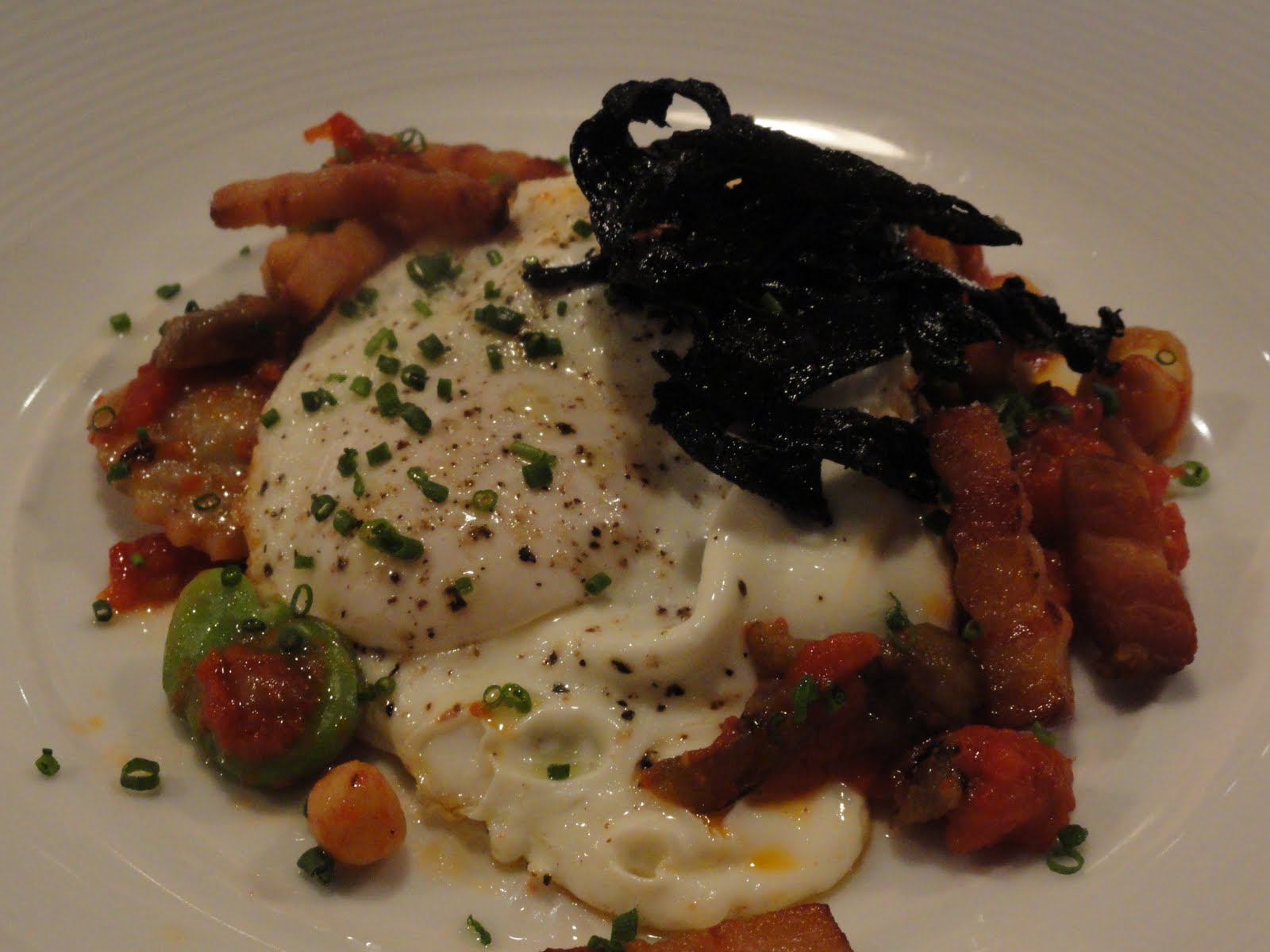
Off the bar menu, I ordered the Bacon & Eggs ($9), which certainly elevated this breakfast dish. You had an over easy egg, with pieces of bacon, atop chickpea ravioli, with black trumpet mushrooms, favas and cippolini onions. What a blend of delectable flavors, the earthy mushrooms complementing the salty bacon and moist egg yolk. At Bergamot, they understand how to blend ingredients into a harmonious whole, making the sum even more impressive than its components.

At this point, I also ordered a Pisco Sour, which I have been hooked on since my recent trip to Chile, and it was satisfying, not too sweet and nicely refreshing.

As I perused the Dessert Menu, the Taza Chipotle-Chocolate Cake ($10) stood out to me, with its caramelized banana ice cream, marshmallows, peanuts and graham crackers. The cake was more like a chewy brownie with a touch of spiciness.  The ice cream tasted like fresh bananas, and I made sure to finish the entire plate. A perfect ending to my dinner.

Service was once again impressive, the entire team working very well together being courteous and attentive, without being obtrusive.  The other nearby diners all seemed to be enjoying themselves very well too. The consistency of Bergamot, on three separate visits, is a strong indicator of their excellence. Their creative and delectable food complements their interesting wine and cocktail list. Bergamot has earned my highest recommendation, and is one of my favorite restaurants of 2011. I will certainly be dining there again very soon and hope to see you there.