However, it was much less of a cookbook and more of a scientific analysis about Chinese vegetables, from how they were grown to their nutritious content. It contained only some brief directions on how these vegetables were commonly prepared and lacked explicit recipes. This certainly was not the type of pamphlet that home cooks would have sought out, and it didn't allow a home cook to recreate their favorite Chinese dishes.
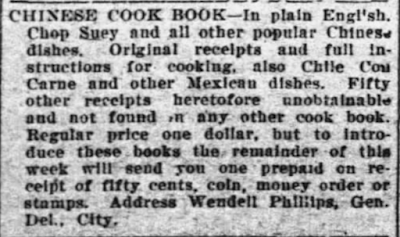 The next pamphlet, which was more of an actual cookbook, made a brief appearance in an advertisement in the Journal & Tribune (TN), March 12, 1908, pictured above. The ad stated the pamphlet included a number of Chinese recipes, such as Chop Suey, but also included recipes for Mexican dishes too. The cookbook cost $1.00, but was on sale for half that price for a week. The author was not provided, and the book didn't seem to get mentioned again in the newspapers.
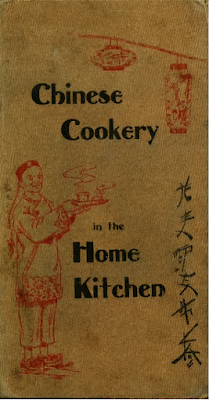 Probably the first actual Chinese cookbook, and not just a pamphlet, was self-published in 1911, Chinese Cookery in the Home Kitchen by Jessie Louise Nolton. Nolton worked for The Chicago Inter-Ocean newspaper. Although born in New York, Nolton spent much of her childhood in Chicago, later moving to Los Angeles, but around 1900, she moved back to Chicago. This cookbook, which was published in Detroit, Michigan, sold for $1.50. It was about 135 pages long, with over 30 recipes, broken down into four parts, including: Part 1—First Word, Second Word; Part 2—Special Ingredients; Part 3—Recipes; and Part 4—Menus.
In Part 1, the author presented the objective of the cookbook, “It is for use in the home kitchen that this little volume has been compiled.” The book continued, noting that it doesn’t contain any Americanized dishes, and that: “American imitations lack the peculiar flavor which makes the chief charm of the Oriental cookery.” The rest of the book was interspersed with empty pages where the reader could add their own notes, so the actual content of the book was much less than the size of 135 pages, closer to half that amount.
Part 2 described and explained the use of numerous Chinese ingredients, such as Chinese Potatoes, Chinese Mushrooms, Chinese Beans, Bean Sprouts, Chinese Pineapple, Lichee Nuts, Cum Quats, Canton Chow Chow, Chinese Ginger, Chinese Almonds, Chinese Oils, Chinese Seasoning Sauce, and Chinese Flavoring Sauce.
Part 3 contained the recipes, which were allegedly sourced from Chinese chefs in Chicago’s Chinatown. The section began with instructions on how to cook rice, noting that the most important step is washing the rice, which is said to be “one of the secrets of the Chinese cook.”
The section then moved onto Chinese Chop Sooy, stating “Chop Sooy, in its various forms, is the foundation of three-fourths of all the dishes served in the Chinese restaurants.” For specific Chop Sooy recipes, it includes Chicken, Chicken with Giblets, Chicken with Green Ginger, Chicken with Pineapple, Veal, Lamb, Beef Tenderloin, Duck and Chop Sooy with Green Peppers.
Then, the book moved onto Noodle dishes, beginning with a recipe on making Noodles. The Noodle Dishes include Chow Mein, War Mein, War Mein (Extra Fine), Yet Gai Mein, Gai Mein Gang, and Moo Goo War Mein.
Next, the book provided a miscellany of additional recipes, including Eggs Fo Yong, Eggs Fo Yong with Chicken, Eggs Fo Yong with Lobster Yook, Eggs Fo Yong with Shrimp Yook, Chinese Cured Pork, Chinese Roast Pig, Ham & Eggs (Canton Style), Fried Rice (Chinese Style), Fried Rice (Canton Style), Boned Squab, Fried Rice with Chicken, Shark’s Fin, Yan Wor Gang (Bird’s Nest Soup), Chinese Fritters, Chinese Ginger Salad, and Chinese Salad.


In Part 1, the author presented the objective of the cookbook, “It is for use in the home kitchen that this little volume has been compiled.” The book continued, noting that it doesn’t contain any Americanized dishes, and that: “American imitations lack the peculiar flavor which makes the chief charm of the Oriental cookery.” The rest of the book was interspersed with empty pages where the reader could add their own notes, so the actual content of the book was much less than the size of 135 pages, closer to half that amount.
Part 2 described and explained the use of numerous Chinese ingredients, such as Chinese Potatoes, Chinese Mushrooms, Chinese Beans, Bean Sprouts, Chinese Pineapple, Lichee Nuts, Cum Quats, Canton Chow Chow, Chinese Ginger, Chinese Almonds, Chinese Oils, Chinese Seasoning Sauce, and Chinese Flavoring Sauce.
Part 3 contained the recipes, which were allegedly sourced from Chinese chefs in Chicago’s Chinatown. The section began with instructions on how to cook rice, noting that the most important step is washing the rice, which is said to be “one of the secrets of the Chinese cook.”
The section then moved onto Chinese Chop Sooy, stating “Chop Sooy, in its various forms, is the foundation of three-fourths of all the dishes served in the Chinese restaurants.” For specific Chop Sooy recipes, it includes Chicken, Chicken with Giblets, Chicken with Green Ginger, Chicken with Pineapple, Veal, Lamb, Beef Tenderloin, Duck and Chop Sooy with Green Peppers.
Then, the book moved onto Noodle dishes, beginning with a recipe on making Noodles. The Noodle Dishes include Chow Mein, War Mein, War Mein (Extra Fine), Yet Gai Mein, Gai Mein Gang, and Moo Goo War Mein.
Next, the book provided a miscellany of additional recipes, including Eggs Fo Yong, Eggs Fo Yong with Chicken, Eggs Fo Yong with Lobster Yook, Eggs Fo Yong with Shrimp Yook, Chinese Cured Pork, Chinese Roast Pig, Ham & Eggs (Canton Style), Fried Rice (Chinese Style), Fried Rice (Canton Style), Boned Squab, Fried Rice with Chicken, Shark’s Fin, Yan Wor Gang (Bird’s Nest Soup), Chinese Fritters, Chinese Ginger Salad, and Chinese Salad.
It's very interesting that Shark's Fin and Bird's Nest Soup were included, as they aren't dishes you'd expect Americans to order at Chinese restaurants, let alone prepare at home. They are definitely dishes that appeal far more appealing to Chinese diners. Finally, in Part 4, there were suggestions for compiling lunch and dinner menus.
However, this cookbook didn’t seem to garner much publicity or reviews in newspapers across the country. The few newspaper references were primarily from the Midwest, near Chicago and Detroit. They were positive reviews, rarely printing any of the recipes from the book, but didn’t seem to have a nationwide impact. Maybe as it was self-published, it didn't have a wider reach, and was only more locally available.
After I’ve mentioned elsewhere, maybe the first Boston-area newspaper to provide Chinese recipes was the Boston Herald, December 31, 1916. This was an extensive article with a general discussion of Chinese cuisine, as well as talk of the wide variety of ingredients used by the Chinese, from noodles to seafood. The seventeen provided recipes, quite an extensive list, include Yea Foo Main, Yat Ko Main, Gai Gum Yung Waa (bird's nest soup), Bak Toy Gun, Pineapple Fish, Chu Popo, Pao Ping (thin cakes), Yang Gou Tsnan Wan Tzu, Boo Loo Gai (pineapple chicken), Lychee Chicken, White Chop Suey, Pork Chop Suey, Chow Main, Foo Young Dan, Char Qua (artichokes), Pak Choi, and Almond Cakes. The recipes were all relatively easy to prepare, the only caveat being you had to seek some of the less common ingredients at the Chinese markets.
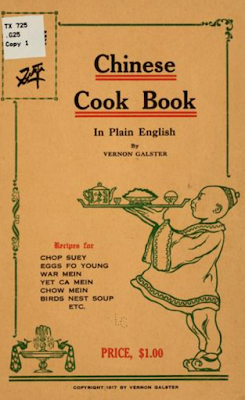 Another tiny Chinese pamphlet was released in 1917, the Chinese Cook Book: In Plain English by Vernon Galster (self-published). It cost $1.00 and was only 8 pages long, with recipes for Chinese Chop Suey, Rice (Chinese Style), Lamb/Veal/Tenderloin of Beef Chop Suey, 3 types of American Chop Suey, Chicken Chop Suey, Chinese Cured Pork, Eggs Fo Young, Yet Ca Mein (Noddle Soup), War Mein, Chow Mein, and Birds Nest Soup.
However, this cookbook didn’t seem to garner much publicity or reviews in newspapers across the country. The few newspaper references were primarily from the Midwest, near Chicago and Detroit. They were positive reviews, rarely printing any of the recipes from the book, but didn’t seem to have a nationwide impact. Maybe as it was self-published, it didn't have a wider reach, and was only more locally available.
After I’ve mentioned elsewhere, maybe the first Boston-area newspaper to provide Chinese recipes was the Boston Herald, December 31, 1916. This was an extensive article with a general discussion of Chinese cuisine, as well as talk of the wide variety of ingredients used by the Chinese, from noodles to seafood. The seventeen provided recipes, quite an extensive list, include Yea Foo Main, Yat Ko Main, Gai Gum Yung Waa (bird's nest soup), Bak Toy Gun, Pineapple Fish, Chu Popo, Pao Ping (thin cakes), Yang Gou Tsnan Wan Tzu, Boo Loo Gai (pineapple chicken), Lychee Chicken, White Chop Suey, Pork Chop Suey, Chow Main, Foo Young Dan, Char Qua (artichokes), Pak Choi, and Almond Cakes. The recipes were all relatively easy to prepare, the only caveat being you had to seek some of the less common ingredients at the Chinese markets.

Once again, Bird's Nest Soup was presented, a curious addition to the cookbook. This pamphlet also received very little publicity in the newspapers so might not have been very widespread either.
Another Chinese cook book was published in 1917, and it was very influential, with a great impact across the entire country. It wasn’t the first of its kind, but it was extremely popular, received lots of publicity, and its recipes were seen all across the U.S. This is the type of cookbook which numerous home cooks might have purchased, hoping to recreate Chinese dishes.
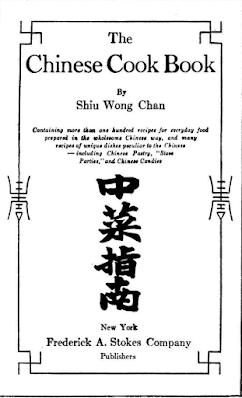
The Chinese Cook Book by Shiu Wong Chan (1917, Frederick A. Stokes Company) contained about 246 pages and presented over 150 recipes, being the largest Chinese cook book to date. Shiu Wong Chan came to the U.S. from China in the late 19th century, although more biographical information about him seems elusive.
In the Preface to the cook book, Shiu Wong Chan noted, “Some one once said that without a good cook and good cooking life was not worth living. The author's purpose is to make good cooking possible.” He continued, “This book is meant not only for the housewife but also for the restaurateur. In fact, it is written in such a clear, simple form that any one by following its rules can prepare dishes of rare delicacy and flavor.” This is interesting as the prior Chinese cookbooks were intended only for home cooks. How many restaurant chefs during that time period might have been inspired by this cookbook?
The Table of Contents is extensive, containing headings including: The History of Chinese Cooking; General Laws of Chinese Cooking; Marketing; Preliminary Recipes, Soup, Noodles, Chicken, Duck, Lamb, Chop Suey, Pork, Beef, Fish, Eel, Turtle, Shark, Shrimp, Oysters, Lobster Crab, Chinese Tomato, Pigeon, Quail, Partridge, Deer, Goose, Winkle, Eggs, Beans, Squash, Peppers, Immortal Food, Dry Foods. Stove Party, Rice, Meat Biscuit, Cake, Pudding, Candy; Conclusion: The Chemistry of Foods, and Chinese Grocery Stores & Noodle Shops. As you can see, it covers so many different types of Chinese recipes, including some which are much rarer today.
Another Chinese cook book was published in 1917, and it was very influential, with a great impact across the entire country. It wasn’t the first of its kind, but it was extremely popular, received lots of publicity, and its recipes were seen all across the U.S. This is the type of cookbook which numerous home cooks might have purchased, hoping to recreate Chinese dishes.

The Chinese Cook Book by Shiu Wong Chan (1917, Frederick A. Stokes Company) contained about 246 pages and presented over 150 recipes, being the largest Chinese cook book to date. Shiu Wong Chan came to the U.S. from China in the late 19th century, although more biographical information about him seems elusive.
In the Preface to the cook book, Shiu Wong Chan noted, “Some one once said that without a good cook and good cooking life was not worth living. The author's purpose is to make good cooking possible.” He continued, “This book is meant not only for the housewife but also for the restaurateur. In fact, it is written in such a clear, simple form that any one by following its rules can prepare dishes of rare delicacy and flavor.” This is interesting as the prior Chinese cookbooks were intended only for home cooks. How many restaurant chefs during that time period might have been inspired by this cookbook?
The Table of Contents is extensive, containing headings including: The History of Chinese Cooking; General Laws of Chinese Cooking; Marketing; Preliminary Recipes, Soup, Noodles, Chicken, Duck, Lamb, Chop Suey, Pork, Beef, Fish, Eel, Turtle, Shark, Shrimp, Oysters, Lobster Crab, Chinese Tomato, Pigeon, Quail, Partridge, Deer, Goose, Winkle, Eggs, Beans, Squash, Peppers, Immortal Food, Dry Foods. Stove Party, Rice, Meat Biscuit, Cake, Pudding, Candy; Conclusion: The Chemistry of Foods, and Chinese Grocery Stores & Noodle Shops. As you can see, it covers so many different types of Chinese recipes, including some which are much rarer today.
In The History of Chinese Cooking, it was noted: “Confucius, the great philosopher, taught how to eat scientifically, The proportion of meat should not be more than that of vegetable. There ought to be a little ginger in one's food. Confucius would not eat anything which was not chopped up properly. Today, unconsciously, the Chinese people are obeying this same law.”
This was supplemented in the chapter on General Laws of Chinese Cooking, which stated, “A Chinese dish consists of three parts: (a) meat; (b) secondary vegetables, such as Chinese water chestnut, bamboo shoot, celery, Chinese mushroom, and sometimes other vegetables according to the season; (c) the garnish on the top of each dish, consisting of Chinese ham, chicken, or roast pork cut up into small dice or into small bars about one inch long, and enough parsley to aid the taste as well as to ornament the dish.”
The chapter continued, “The amount of meat, in accordance with the hygienic law of Confucius, is about one-third that of the secondary vegetables. The meat should be the same size and shape as the vegetables and must be uniform. It may be cut into dice, into bars, or into fragments; judgment must be used as to this when the size of the vegetable is limited.” If you examine many Chinese dishes in modern restaurants, you will find many that still follow these precepts.
The section of Recipes is fascinating, and as indicated, they are relatively easy to prepare, provided you can obtain the ingredients. For example, the recipe for Bird-Nest Soup (Yuen War Tong) stated, “The substance of which this soup is made is found in bird nests. It is the saliva of the swallows of northern China.” Obviously, this description would likely have turned off many Americans in 1917, and locating bird nests would have been difficult. So why were Bird's Nest Soup recipes prevalent in these early Chinese cookbooks? Were they actually popular with more Americans than we might think?
In the recipe for Chicken Chop Suey, it’s mentioned, “This dish is not known in China. From the name it means simply a variety of small pieces. However, the principles of Chinese cooking are the same.” The recipe is made from chicken, water chestnuts, mushrooms, bamboo shoots, celery and Chinese gravy. There are also recipe variations such as Pigeon Chop Suey and Partridge Chop Suey, items you're very unlikely to find in modern Chinese restaurants.
You'll also fine a recipe for Fried Duck Feet (Chow Arp Gung), which began, “You may laugh all you want. You will soon be convinced that this is the best part of the duck after you taste it.” For six people, you need 20 pairs of duck feet, of which the skin and bones are removed. The dish includes bamboo shoots, mushrooms, water chestnuts, and Chinese gravy. Have any you eaten fried duck feet?
The recipe for Shark Fins (Yue Cre) began: “This dish has an interesting history. A ruler of China found a large shark in the South Sea. It was killed. Later, in deciding how best to use each part of the animal, a cook by the name of Lang Pow invented this dish. He discovered how delicious and tasty it was. This was in the year 50 B.C.” Again, it's very interesting that this would be again a recipe offered for home cooks. Americans loved chop suey at this time, but how many actually ordered shark's fins at a Chinese restaurant?
The cookbook also has a recipe for Egg Roll (Dan Gun) but it’s not what you expect. It’s not fried, but is more of an omelet, filled with ham and vegetables, that is rolled and then sliced. As I wrote about previously, fried egg rolls didn't make an appearance until possibly 1925, or maybe later.
There’s also an intriguing section on Immortal Food, which noted: “Buddha said that if you leave meat alone you will live forever. Therefore the priests and nuns belonging to the Buddhist religion live on dishes which contain no meat.” This section include three vegetarian recipes, including Food of the God of Law Horn, Soft Immortal Food, and Hard Immortal Food.
The cookbook includes recipes for Chinese Frankfurters, known in Cantonese as Lab Chung (aka Lab Cheong), which is most often translated as Chinese Sausage. The recipe requires you to obtain the outside lining of the small intestine of a pig, which you will fill with pork, salt, sweet sauce, Fun Wine, and orange skin. It will then be allowed to sit and dry for a number of days. The recipe also stated, “Chinese Frankfurter should be kept in a china jar. At least they must be kept in a jar for 5 days before being eaten.” Once you are ready to eat them, it stated they should be steamed, served with fried potatoes.
The book ends with a section noting the stores and noodle shops where you could obtain Chinese ingredients. However, all six of these businesses were located in New York City, which wouldn't be too useful for those living in other states.
During 1917 and 1918, numerous newspapers across the country mentioned or discussed this cook book, many also providing some of the recipes. For example, the Boston Globe, December 9, 1917, wrote about the cook book, mentioning, “The book is just the thing for women who want new ideas for cooking appetizing and nutritious food, and the directions are so explicit that even a woman with little experience can follow them.” The article also provided recipes for Primary Soup, Chinese Sauce, Vegetable Soup, Pork Salad, and Rice.
Numerous other newspapers provided different recipes for the book, and this certainly spread the idea that home cooks could relatively easily prepare Chinese cuisine at home. This Chinese cookbook thus seems to have been very influential, and likely resulted in plenty of home-cooked Chinese dinners and parties. Not all of the recipes were probably popular, but I suspect many home cooks created their own Chop Suey and Chow Mein. In addition, it is likely the popularity of this cookbook led to many more such books and pamphlets in the 1920s.
What's your favorite Chinese cookbook?