
Most people believe Chess Pie to be a Southern speciality, but is that where it originated? I decided to investigate the matter, to see what I could discover about the origins of this tasty pie. Initially, I found multiple websites indicating that the actual origin of chess pie, as well as the origin of its name, is largely unknown, although there were multiple theories put forth. Some claim the pie originated in the South, but others claim it originated in England.
One of the more intriguing articles about its origins was published in a magazine, American Home, April 1938, in an article "In Search of Chess Pie" by Marion W. Flexner. Marion, from Louisville, Kentucky, wrote several books about Southern cuisine and entertaining. Flexner sought the origin of chess pie, starting with the assumption that it was a Southern dish.
However, she found that chess pie also existed in New England, which began changing her assumptions. Then, while she was in Salisbury, England, probably researching one of her books, she found a dish called “Cheese Cake,” which actually wasn't made with cheese and seemed very similar to Chess Pie. She would not be the first person to make this connection.
 The earliest reference to "chess pie" I found was in The American Agriculturalist, October 1866, and the recipe was also reprinted in The Coshocton Tribune (OH), October 12, 1866. The recipe was submitted by a Texan, and it wasn't presented as something new or unusual. As such, it's very likely chess pie existed prior to 1866, although for how long we don't know. The recipe made 2 pies, and the ingredients included eggs, sugar, cream, butter, flour and nutmeg.
There was a brief mention of chess pie in the Hampshire Gazette (MA), September 17, 1867, noting that at the Cattle Show in Middlefield, someone made a “good looking ‘chess pie’” As the term chess pie was in quotes, it was probably something new to the New England area. It also indicated that even if chess pie had been invented in the South, it had already spread to New England by 1867.
 The first reference to Transparent Pie was in The Port Chester Journal (NY), October 28, 1869, which was made with eggs, sugar, and cream, although no butter. In addition, it used jelly and was flavored with lemon. This is very different from the prior chess pie recipe, so it's unsure whether transparent pie was an actual synonym, or a variation of chess pie.
 The Fayetteville Observer (TN), August 4, 1870, had a different recipe for "transparent jelly pie" but it didn't require any actual jelly. The recipe is closer to the original chess pie recipes.

Chess pie apparently wasn't mentioned again for almost six years. In the book Motherly Talks with Young Housekeepers by Mrs. H.W. Beecher (1873), the above recipe was published, which is nearly identical to the prior recipe from 1866. However, this recipe failed to mention that the recipe would make two pies.
 The Corvallis Gazette-Times (OR), March 10, 1876, also printed a similar recipe, which was also reprinted in newspapers in Massachusetts and Ohio. So, for nearly the first ten years of references to "chess pie," the recipe remained basically the same, and was known outside of the South, from Massachusetts to Oregon.
A new recipe arrived! In Practical Cooking and Dinner Giving by Mary Foote Henderson (1876), Mary wrote that a friend of hers had told her about chess pie, and Mary asked for the recipe. He offered to give it to her but claimed he had done so for others but they had failed to make the pie properly. So, Mary went directly to the source, to find out how to best prepare the dish.
 In Buckeye Cookery With Hints on Practical Housekeeping, by Estelle Woods Wilcox (1877), there was another variation, although it also was topped with meringue. Again, the amount of the ingredients differed from the other recipes. Interestingly, this same recipe was reprinted almost 20 years later, in newspapers in Missouri, Kansas, Wisconsin, Mississippi, North Dakota, Oklahoma, and Louisiana.
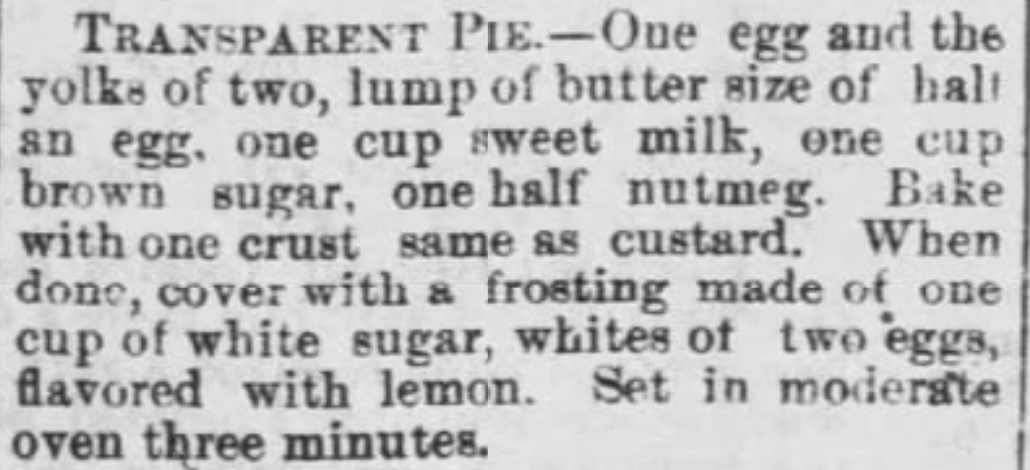
 The Memphis Evening Herald (TN), March 22, 1878, presented a recipe for transparent pie, which was more similar to the chess pie recipes, with nutmeg and a meringue topping.
 The Crestline Advocate (OH), June 7, 1878, offered an even more different recipe (and the recipe was also reprinted in newspapers in Kansas, Missouri, Pennsylvania and Illinois). This recipe didn't use sugar, but added jelly for sweetness. The use of jelly, jam or preserves would be included in other chess pie recipes in the future, mirroring its used in the first transparent pie recipe.
 The Orleans County Monitor (VT), July 22, 1878, presented a slightly edited version of the recipe from Practical Cooking and Dinner Giving (1876). This recipe was also later reprinted in newspapers in Wisconsin (1882), Ohio (1885), Georgia (1888), North Carolina (1890), Texas (1891), Vermont (1900), and Massachusetts (1900).
 Another transparent pie recipe. The Galion Inquirer (OH), January 16, 1880, printed the above, which again is very similar to chess pie recipes, except for the addition of candied peel.
 The Rocky Mountain Husbandman (MT), February 16, 1882, presented a recipe similar to that from the Buckeye Cookery (1877) book.
There was a brief mention of chess pie in the Boston Evening Transcript (MA), November 17, 1882, in an article discussing a cooking demonstration at the Boston Cooking School. One of the items that was taught was “.., chess pie (a novelty to most of the audience),..” So, chess pie certainly existed in Massachusetts but it was still relatively rare. And in the Worcester Daily Spy (MA), March 19, 1884, there was another cooking school lecture, which included information on the preparation of chess pie.
 The Sumner County Standard (KS), March 19, 1886, presented a different recipe, with different amounts of the usual ingredients, with the addition of a cup of preserves, with plum preserves mentioned as a favorite choice. Lemon was also added as a flavoring, another ingredient which would be included in numerous future recipes. This recipe was later reprinted in a Mississippi newspaper.
More references to Jeff Davis Pie. Three newspapers briefly referenced Jeff Davis Pie in articles that discussed life in the Confederacy during the Civil War. The Lambertville Record (NJ), June 22, 1887, briefly noted someone receiving a box from home with various foods, including “Jeff Davis pies.”
The St. Landry Democrat (LA), December 17, 1887, mentioned that “Jeff Davis pies, a mixture of sorghum and eggs, were quite popular…” This is the first mention of the pie being prepared with sorghum. which probably referred to a syrup which was a common sweetener. This article was reprinted in articles across the country, including Maryland, Connecticut, Kansas and Nebraska. The News-Herald (OH), December 22, 1887, noted that in a kitchen, “Jeff Davis pies were in course of construction.”
 Another variation. The Marshfield News & Wisconsin Hub (WI), June 26, 1890, presented its own recipe for chess pie, with even less butter than usual. It too was topped with a meringue. This recipe would also be printed in newspapers in Michigan, Indiana, Illinois, Kansas, Nebraska, Alabama, and Tennessee.
 The first reference to Jeff Davis Pie. The Housekeeper's Friend, published by the Young Ladies Missionary Society of the Grace Methodist Episcopal Church (Illinois, 1891). The recipe is similar to some of the prior recipes for chess pie. Although I'll provide more explanation later in this article, I'll briefly note that there's a theory that Jeff Davis pie predated chess pie, and might be its ancestor.
 Another of the first references to Jeff Davis Pie. The Home Queen World's Fair Souvenir Cook Book (1893), presented a recipe for Jeff Davis Pie, but without any background or explanation of its origins. The recipe is similar to chess pie, except for the use of light brown sugar.
 The Journal of Agriculture Cook Book (Missouri, 1894), also had a recipe for Jeff Davis pie, with a different amount of the basic ingredients, and without the addition of lemon or nutmeg.
 The Boston Globe (MA), November 28, 1894, published another variation on chess pie, which included the use of lemon juice.
 The Bethany Republican-Clipper (MO), February 13, 1895, presented a recipe, similar to prior ones.
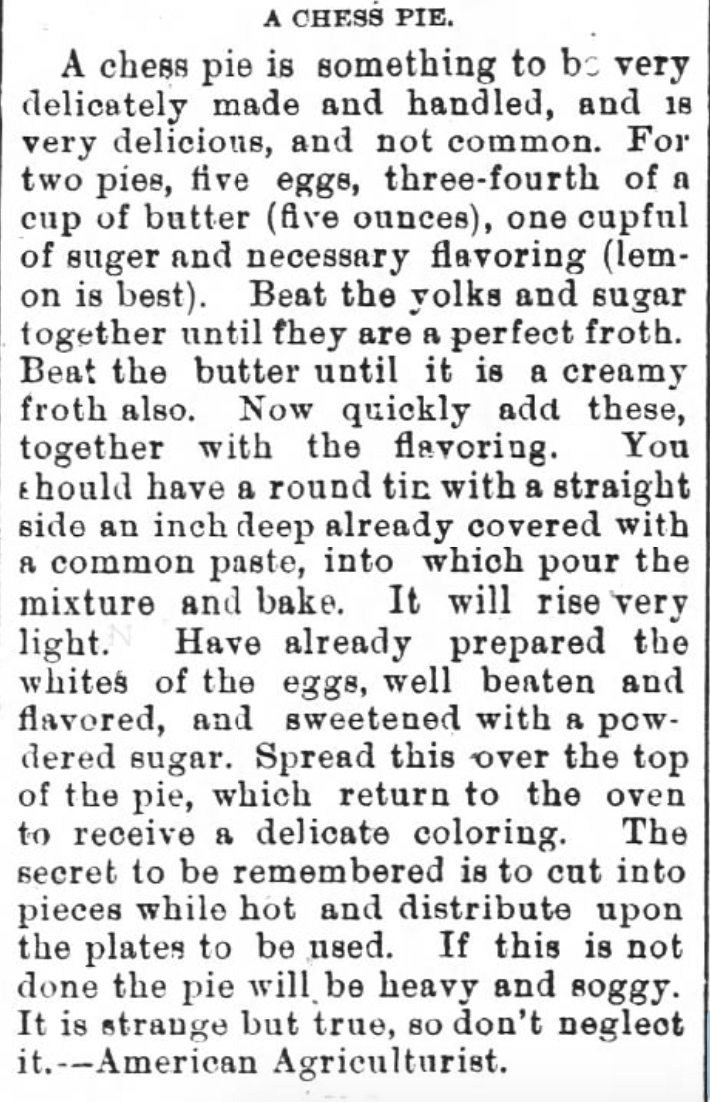
 The Warrenton Gazette (NC), March 15, 1895, also published a chess pie recipe, first noting that, "A chess pie is something to be very delicately made and handled, and is very delicious, and not common." Was chess pie still something not widely eaten at this point? The recipe itself is very similar to some of the prior recipes.
 The first named variation! The Columbus Daily Advocate (KS), May 21, 1896, presented information and a recipe about a Lemon Chess Pie, although lemon juice was mentioned as an ingredient in prior recipes. This is the first time that the use of lemon juice led to a change in the name of the pie. The ingredients included three eggs, three tablespoons of butter, five tablespoons of sugar, and the juice and grated peel of a lemon. This recipe was reprinted in various other newspapers, including in Kentucky, New York, Missouri, Michigan, Iowa, Connecticut, Nebraska, Massachusetts, Pennsylvania, Vermont, Indiana, and Louisiana. As we can see, chess pie was known throughout the country.
 The Neodasha Register (KS), August 3, 1900, presented another recipe for Jeff Davis pie, although its ingredients differed from the other recipes, especially with the addition of sour cream and baking powder. And this is the first time such a a recipe had a meringue topping.
 The Evening Star (D.C.), October 1, 1904, presented a chess pie recipe, similar to some prior recipes.
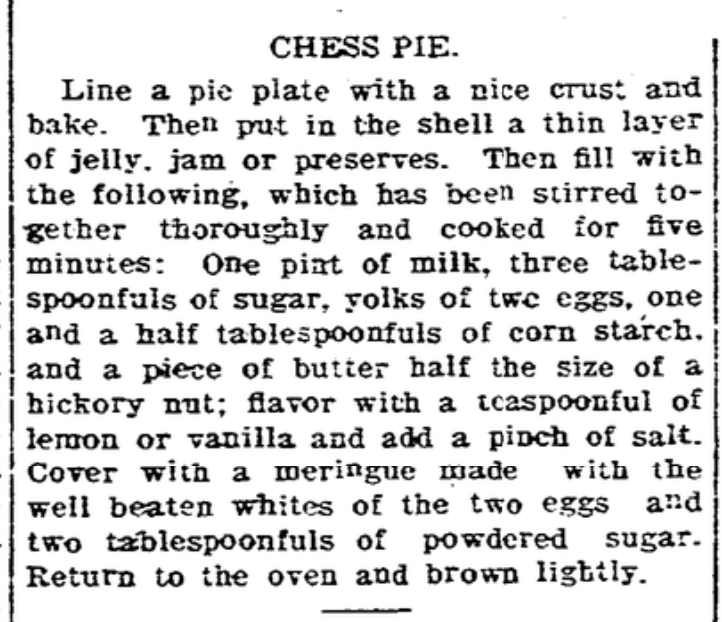
 The return of jelly! The Sunday Journal News (IN), September 22, 1907, published a recipe which called for a thin layer of jelly, jam or preserves at the bottom of the pie, atop the crust. The ingredients then included milk, sugar, eggs, corn starch, and butter. It was flavored with lemon or vanilla, and covered with a meringue.
 The Chicago Tribune (IL), October 21, 1907, published a Jeff Davis pie recipe, this time calling for the addition of cinnamon, cloves and allspice, as well as topped by a meringue. This recipe would also be posted in newspapers in Colorado, Kansas, Minnesota, Mississippi, Missouri, Montana, Nebraska, Ohio, Oklahoma, Vermont, Wisconsin, and the District of Columbia. As we can see, the recipe was available across the country, from Vermont in the northeast to Colorado in the west.
 The Farmington Times (MO), May 8, 1908, presented another chess pie recipe, noting that the dish was an old favorite, but implying that it had fallen out of favor more recently, although the writer still had fond memories of the pie.
 In support that chess pie had fallen out of favor, the Nashville Journal (IL), July 2, 1908, noted, "Forty years ago nobody thought of giving a grand dinner without chess pie. It was the piece de resistance of the meal. It has gone a bit out of fashion, but it as good as ever, and, like everything else, it will again have its day." So, it seems chess pie was hugely popular during the 1860s, but for unknown reasons, its popularity had waned. The article also included the above recipe.
 With a more provocative title, the Buffalo Evening News (NY), August 5, 1908, presented a chess pie recipe, including a lemon chess pie variation, and neither recipe included a meringue.
 Chess pie in Canada! The Free Press Prairie Farmer (Manitoba, Canada), August 5, 1908, offered a recipe for chess pie, which included a meringue topping.
 The San Francisco Call (CA), November 8, 1908, had a recipe for Jeff Davis Pie, provided by one of their readers in California.
 An advertisement with a recipe. The Log Cabin Democrat (AR), January 28, 1909, published an ad for Piercey & Sons, with a recipe for chess pie and recommending people use Cook's Pride Extract and Chief Flour.
 The Gladstone Cook Book (Oregon, 1909), presented a Jeff Davis pie recipe, calling for sour cream or buttermilk, and also a meringue topping.
 Another different Jeff Davis pie recipe, presented in the Cherryvale Journal (KS), December 14, 1910.
 The Citizen (MD), April 21, 1911, gave a chess pie recipe which called for a teacup of blackberry jam. It's interesting how a few recipes used "teacups" as measurement devices.
 Raisins! The Weekly Eagle (KS), February 16, 1912, gave a variation recipe which included the use of raisins. Raisins would be occasionally mentioned in other chess pie recipes in the future.
 Maybe the first mention of the use of cornmeal in a chess pie recipe, in The Buffalo News (NY), November 8, 1912.
 Chess Pie for Christmas? The San Francisco Call (CA), August 10, 1913, published a "Christmas Chess Pie" recipe but it's basically like many other such recipes, and possesses nothing actually Christmas-related.
 More raisins. The Wichita Daily Times (TX), July 1, 1914, offered a reader's recipe for chess pie, and it included raisins. And in The Evening Telegram (UT), August 26, 1914, there was an advertisement, noting fifty suggestions for the use of Raisins. And #36, stated: "Chess pie is a rich pastry with a filling of butter, sugar, egg, and halved raisins."
 The Farmer-Stockman (OK), August 10, 1915, offered two Jeff Davis pie recipes, one which included the addition of jelly, and the other with cinnamon, nutmeg and lemon extract.
 Missouri Rural (KS), March 20, 1916, provided another chess pie recipe.
 Many more details were provided in the Kansas City Star (MO), September 10, 1916. The article first described a centennial celebration that recently took place, where a number of women served Jeff Davis Pie. The newspaper noted that for 50 years, since the 1860s, the pie has been praised "as the most delicious of all confections." It also noted that it was well known throughout the South and even part of the North, but under a different name, Chess Pie. So, this newspaper was claiming that chess pie was merely a different name for Jeff Davis pie, and a name primarily used in the North. That doesn't fit what I found in my research as chess pie was often used in the South, since the 1860s.
 Oatmeal? The American Falls Press (ID), March 15, 1918, presented a more unique chess pie, which included the use of fine ground oatmeal. It also omitted the use of eggs, butter and milk/cream, such omissions which would seem to mean it's not actually a chess pie.
 The Every Evening (DE), December 10, 1919, noted that chess pie had been very popular years ago, and that there had recently been a revival, as previously predicted by others. This recipe is similar to others, including the use of a meringue topping.
 The Oregonian (OR), July 30, 1922, presented an alternative origin for chess pie, stating, "Chess pie is a corruption of the old-fashioned English 'cheese cake' and appears to mean simply a small tart with some kind of filling other than plaint fruit or jelly." The article also noted that some years ago, they sent out a request for chess pie recipes and received 19 submissions. "They were all different. Some were made with nuts and raisins, some without; some with cheese, some with lemon, some with orange, some with egg yolks, some with egg white, some with cake-like mixtures, some with rice, some with meringue, some without, some with macaroon mixtures, some with cream, some with custard, but all like some form of the old style English 'cheese cakes' of colonial times."
 Another unique variation. The Evansville Journal (IN), November 3, 1922, printed a chess pie recipe which included the use of a quart of Dutch cheese. When is a chess pie no longer a chess pie?
 Chocolate! The Boston Herald (MA), January 14, 1923, offered the first recipe for a Chocolate chess pie, although the ingredients only included eggs and cocoa. No sugar, milk/cream, or butter. This recipe was also reprinted in newspapers in New York, California and Ohio.
She eventually concluded that chess pie likely derived from this English Cheese Cake. When she conducted additional research, she learned that there were a few American cookbooks which had recipes for "Cheese Cake Pie." One of the earliest references was in The Blue Grass Cook Book compiled by ladies of Kentucky in 1830. The cookbook contained a recipe for "English Cheese Pie,” which was composed of the same ingredients as many recipes for modern chess pie.
However, the recipes for "English Cheese Cake" which I found in newspapers in the 1870s, were very different from chess pie recipes, adding additional ingredients such as rennet and biscuit powder.
Where did the "chess" name originate? It probably has nothing to do with the game of chess, and none of the proposed theories reflect any such connection. Its origin seems to be a question without definitive evidence, but multiple theories have been put forth, including:
- The name is a corruption of English "Cheese" pie, maybe a misreading of handwritten recipes or a typo.
- Southerners simply stated "It's jes' pie", which was misinterpreted by others as "chess" pie.
- Pies were once stored in food chests, and thus were referred to as "chest pie," which later became transformed into "chess pie."
- Chess pie was allegedly once made with chestnut flour, and again, the name was corrupted.
So, the commonality of all of these theories is that "chess" was a corrupted version of some other term, but which term remains in question. In addition, chess pie may also be known by other names, such as Jeff Davis pie and transparent pie.
Let's examine the early specific references to "chess pie," and its synonyms, to analyze some of its evolution in the U.S., and maybe learn more about its origins. I'll start off though noting an important aspect of chess pie recipes, their diversity. As stated in the Dallas Morning News (TX), March 13, 1953, many Southern cookbooks have chess pie recipes but they vary a great deal in ingredients, such as “a divergence of from 1 tablespoon of butter to 2 cups, and from 1 cup of sugar to 3 cups, and anywhere from no liquid to 1 ½ cups cream.”

There was a brief mention of chess pie in the Hampshire Gazette (MA), September 17, 1867, noting that at the Cattle Show in Middlefield, someone made a “good looking ‘chess pie’” As the term chess pie was in quotes, it was probably something new to the New England area. It also indicated that even if chess pie had been invented in the South, it had already spread to New England by 1867.

The Aurora of the Valley (VT), June 18, 1870, printed the same recipe for transparent pie, but added more commentary on the choice of jelly. It noted, "The fairer the jelly the better, as it makes a nicer looking pie than the dark jelly; either makes a delicious article."


Chess pie apparently wasn't mentioned again for almost six years. In the book Motherly Talks with Young Housekeepers by Mrs. H.W. Beecher (1873), the above recipe was published, which is nearly identical to the prior recipe from 1866. However, this recipe failed to mention that the recipe would make two pies.

********************
The first reference to Jeff Davis Pie! Previously, I had noted the earliest reference to this pie was in 1891, but new research has found earlier references. Although I'll provide more explanation later in this article, I'll briefly note that there's a theory that Jeff Davis pie predated chess pie, and might be its ancestor.
In Practical Receipts of Experienced Housekeepers (First edition 1874), compiled by the Ladies of the Seventh Presbyterian Church of Cincinnati, there was a recipe for "Jeff. Davis Pie, Yolks of three eggs, one and a quarter cupfuls of sugar, one- third cupful of melted butter, three tablespoonfuls of flour, one cupful of sweet milk. Flavor with lemon. Beat the whites stiff with sugar and put on the top of the pie.” This was a different recipe in a few aspects than the previous chess pie ones. First, this recipe used only the egg yolks and not the whole eggs. Second, this recipe was flavored with lemon, when the chess pie recipes were not. Finally, the egg whites were beaten with sugar and then added atop the pie almost like a meringue.
The cook book also had a recipe for “Transparent Jelly Pie. One cupful of butter, one cupful of powdered white sugar, and four eggs well beaten; bake the crust, then pour in the mixture, and put it back in the oven for a few minutes until it becomes stiff.” This was more similar to chess pie, although it used powdered sugar, and it's interesting that the recipe did not include actual jelly.
******************
A new recipe arrived! In Practical Cooking and Dinner Giving by Mary Foote Henderson (1876), Mary wrote that a friend of hers had told her about chess pie, and Mary asked for the recipe. He offered to give it to her but claimed he had done so for others but they had failed to make the pie properly. So, Mary went directly to the source, to find out how to best prepare the dish.
The ingredients, for the preparation of two pies, included five eggs, 3/4 cup of butter, 1 cup of sugar and "necessary flavoring." Compared to the prior recipes, this one had more eggs, more butter, less sugar, and no cream.
Then, the directions for the recipe stated, "Beat the yolks and sugar until they are a perfect froth. Beat the butter until it is a creamy froth also. Now quickly add them together, flavoring with a little extract of vanilla. Bake it in a crust; it will rise very light. As soon as done, have ready the whites of the eggs beaten to a stiff froth, sweetened with a light sugar, and flavored with a few drops of the extract. Spread this over the tops of the pies, which return to the oven, to receive a delicate coloring." As we see, this chess pie was topped with a meringue, and didn't include any nutmeg. Going forward, a number of other chess pie recipes would also be topped by meringue, although meringue is used far less frequently for modern versions of chess pie.
The passage continued, "The lady says the secret of the pies not becoming heavy is in cutting them, and distributing them on the plates as soon as they are cooked, and still hot; that if they are allowed to cool without cutting them, they will fail. This is rather strange; nevertheless, it seems to be true."



There was a brief mention of chess pie in the Boston Evening Transcript (MA), November 17, 1882, in an article discussing a cooking demonstration at the Boston Cooking School. One of the items that was taught was “.., chess pie (a novelty to most of the audience),..” So, chess pie certainly existed in Massachusetts but it was still relatively rare. And in the Worcester Daily Spy (MA), March 19, 1884, there was another cooking school lecture, which included information on the preparation of chess pie.

More references to Jeff Davis Pie. Three newspapers briefly referenced Jeff Davis Pie in articles that discussed life in the Confederacy during the Civil War. The Lambertville Record (NJ), June 22, 1887, briefly noted someone receiving a box from home with various foods, including “Jeff Davis pies.”
The St. Landry Democrat (LA), December 17, 1887, mentioned that “Jeff Davis pies, a mixture of sorghum and eggs, were quite popular…” This is the first mention of the pie being prepared with sorghum. which probably referred to a syrup which was a common sweetener. This article was reprinted in articles across the country, including Maryland, Connecticut, Kansas and Nebraska. The News-Herald (OH), December 22, 1887, noted that in a kitchen, “Jeff Davis pies were in course of construction.”


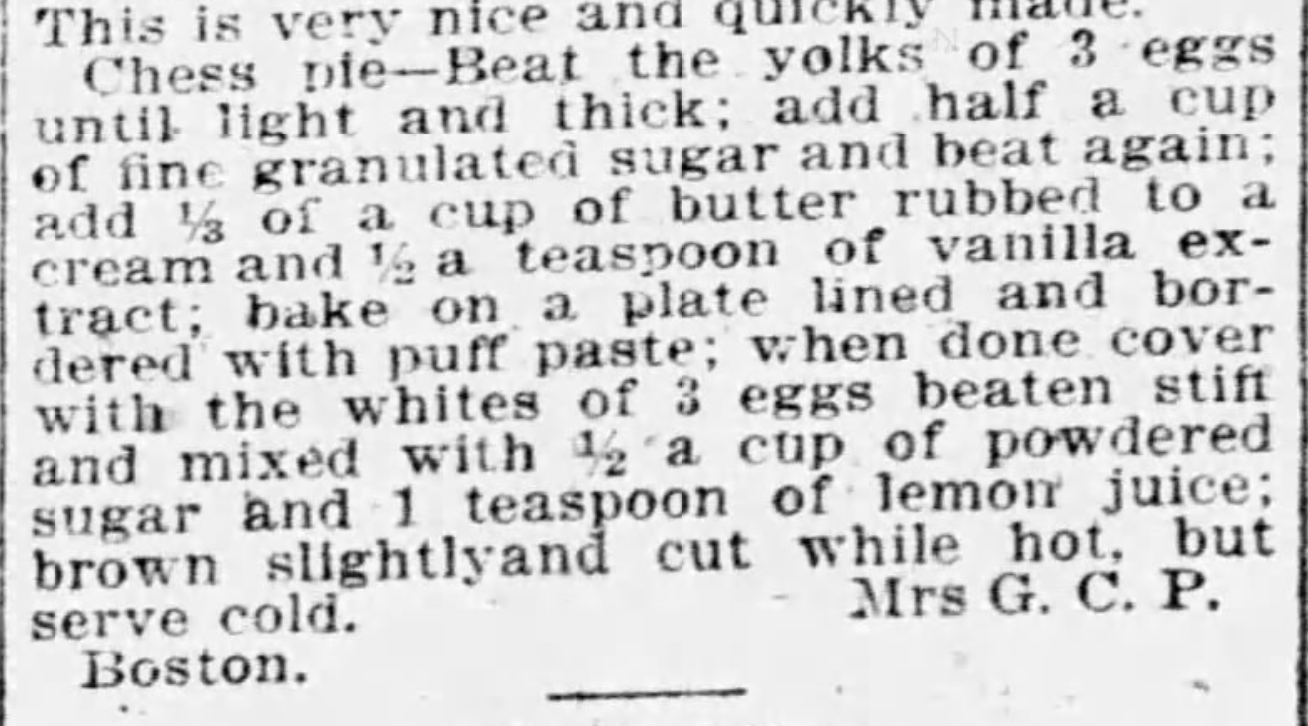

In the Wathena Breezes (KS), October 5, 1895, it mentioned that, "All of Mrs. Amanda Brown-Grays friends will be glad to learn that she has learned how to make chess pie so well that her recipe was placed in the Atlanta Exposition cook book, just out by Mrs. Ida D. Bailey of Washington, D.C." The Leavenworth Herald (KS), October 12, 1895, noted that Amanda was from Kansas but now living in Washington D.C.


There were other brief mentions of Jeff Davis pie in other places around the country. The Minneapolis Journal (MN), July 4, 1901, mentioned Jeff Davis pie being served at a local event, along with Dixie biscuit, Virginia fried chicken, and R.E. Lee cake. The Lebanon Daily News (PA), July 26, 1901, noted that a local school had gave lessons on how to cook Jeff Davis pie. The St. Louis Post-Dispatch (MO), August 31, 1902, discussed how Jeff Davis pie was served at a new restaurant in Oklahoma.


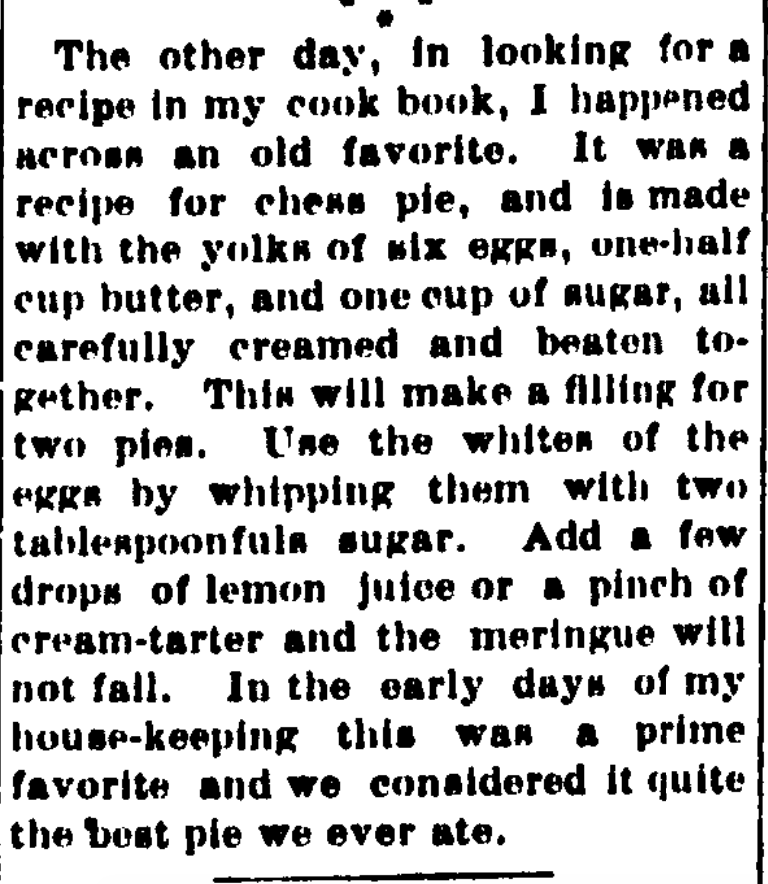


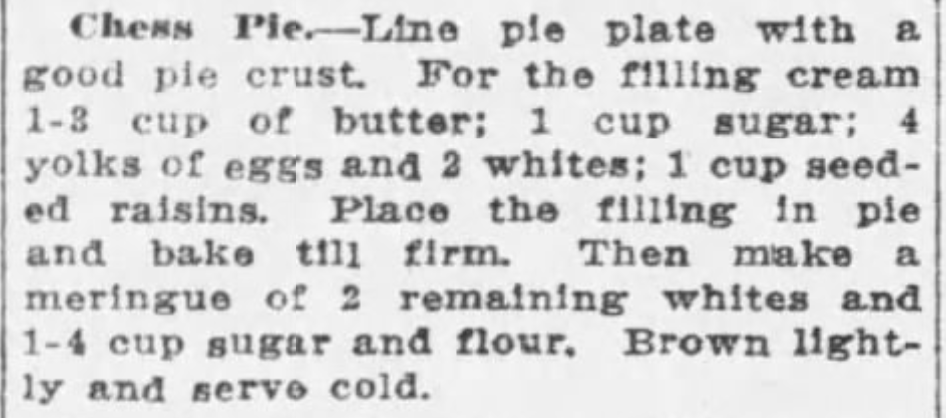


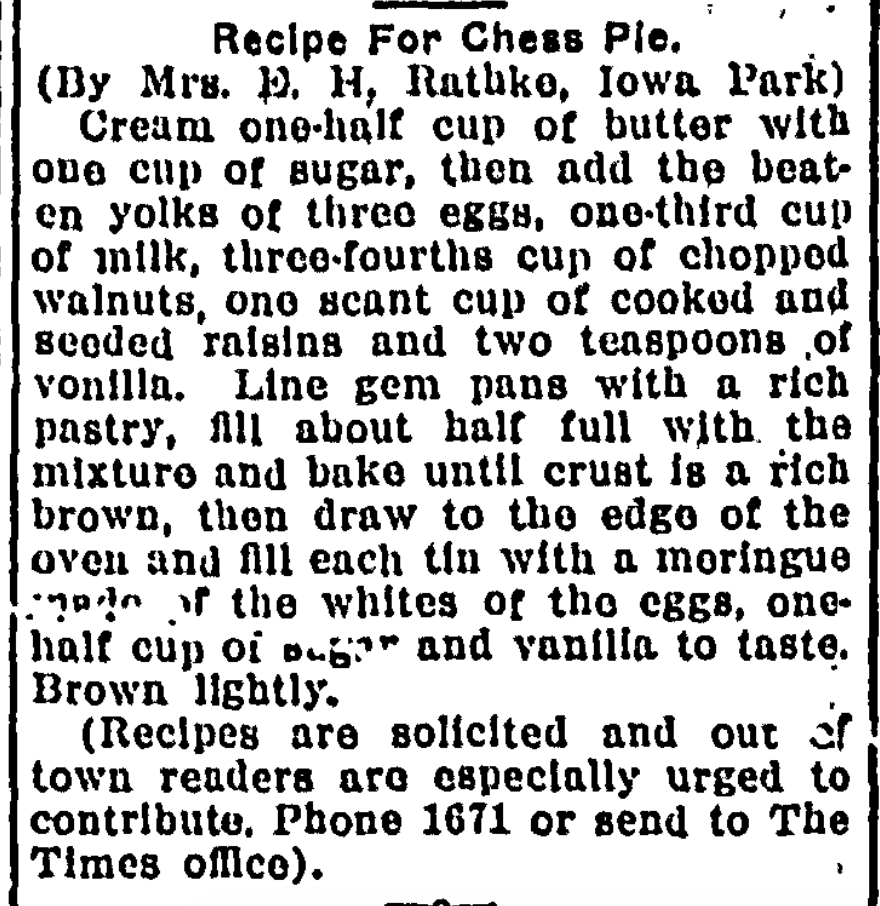


Now, we get to the alleged origins of Jeff Davis pie, a story which seems more myth to me than truth, The St. Louis Post-Dispatch (IL), August 17, 1916, wrote: "Jeff Davis pie first was served in Western Missouri in the early sixties." That is possible, although I didn't find a documented reference any earlier than 1893. The newspaper then noted that some time before the Civil War, George B. Warren, with his family and enslaved blacks, moved to Dover, Missouri. One of those enslaved, Aunt Jule Ann, was Warren's cook and it was alleged that she invented a new pie, Jeff Davis, for a Sunday dinner. The article included a recipe for the pie, which was supposedly given from Aunt Jule Ann to a friend of the Warren family.

The newspaper then presented an alleged origin story for the pie. "Jeff Davis pie was discovered and named by Aunt Jule Ann, a slave in the family of George B. Warren of Dover, Lafayette county, Missouri. Shortly before the war Mr. Warren moved from the South to Dover, bringing his slaves and household effects with him, among them Aunt Jule Ann, who was queen and tyrant of the kitchen in the Warren home. One Sunday, when there were distinguished guests at the Warren's, Aunt Jule Ann served a new kind of pie, so toothsome, so melting, so delicious, that there was a general desire to know how it was made. Aunt Jule was called in and asked about it."
The article continued, "... Jule was a strong Southern sympathizer, that she loved Jefferson Davis as the greatest man on earth and that she was mightily wrought up over the 'pernisherness' of the 'pore white trash' of the North who had dared to start something with the South." She said, "I done make dat new kind o' pie to name it aftah Gineral Jeff Davis. That's Jeff Davis pie."
The newspaper then stated, "Gradually the fame of the new pie spread. It went South and marched through Georgia and other states. It spread to the North, but there went under an alias. It is known as 'chess pie' or 'transparent pie.'" This does not coincide with my own research, and the numerous references I found to chess pie in the South, and that I didn't find Jeff Davis mentions until the 1890s. Frankly, I suspect Jeff Davis pie didn't receive that name until after the Civil War, and was an alternate name for chess pie.
The recipe above, allegedly received from Aunt Jule, included the use of meringue, which was a later addition to chess pie, casting more doubt on this origin tale. Finally, the newspaper mentioned that some people thought vanilla improved the taste of the pie, while others chose to substitute buttermilk for the cream.
Chess pie in California! The Oregonian (OR), June 3, 1917, briefly noted that about 15 years ago, the writer visited Los Angeles and found a number of women who made chess pie.


The Sunday Journal News (IN), February 6, 1921, provided some intriguing items about chess pie, first calling it an "old Virginia delicacy." The article also mentions that chess pie was extremely rich, and originated when milk and eggs were cheap. It also claimed that old fashioned chess pie was commonly flavored with whiskey and maybe a little nutmeg. Later, vanilla became more prevalent than whiskey and nutmeg. This was the first article I saw that mentioned the use of whiskey, and it might have been a more "secret" ingredient that wasn't mentioned in more conventional recipes.
The article also noted, "... the old chess pies had no meringue and no cream or milk as an ingredient. They were literally egg yolks and sugar creamed, flavored and baked in once crust. The 'spreading' was not more than an eighth of an inch thick. Individual tarts were often made in preference to the pies."


Another recipe for chocolate chess pie wasn't presented until 13 years later. The Oregon Daily Journal (OR), November 10, 1936, gave a recipe which was much closer to a chess pie than the previous one. This recipe called for 1/2 cup of butter, 1 cup of sugar, 2 teaspoons ground chocolate, 1/4 cup of cream, 1 cup of chopped nuts, 3 egg yolks, and 6 tablespoons of sugar. This recipe also called for a meringue topping.
Jump forward seventeen years. The Dallas Morning News (TX), March 13, 1953, stated, “Chess Pie is an old and delightful favorite that unfortunately has been dropped from general use." It continued, "It’s a dessert worth serving, for its richness and flavor belong to the opulent era before the day of packaged mixes.”
Chess pie extends back at least to 1866, and likely is even older than that, and its ancestors likely came from England, from English Cheese Cake. The reason for the "chess" name is unknown, although the theories tend to agree it was a corrupted version of a different word, from cheese to chest. Chess pie definitely seems to predate the terms Jeff Davis pie and transparent pie, which may be simply synonyms for chess pie.
There are many different recipes for chess pie, varying by the amount of the same basic ingredients, as well as the addition of many varied ingredients. Although many see it as a speciality of the South, its early years show the recipe was known throughout the country, from New England to California. Its popularity has been cyclic, and most recently, it has apparently been more commonly found in the South. Most people can agree that it's a rich and delicious dessert, and more people should be aware of its sweet taste.
************
As a brief supplement, I also wanted to touch on the origins of Coconut Chess Pie, as it was what spurred me on to write this history of chess pie.
The earliest mention I found for coconut chess pie was in The Atlanta Constitution (GA), May 3, 1952. They printed an ad for a local cafeteria ad which offered Coconut Chess Pie for 15 cents. The Kannapolis Daily Independent (NC), May 31, 1957, presented the first published recipe for Coconut Chess Pie, which was made with 6 eggs, 2 cups of sugar, tablespoon of lemon juice, quarter teaspoon of salt, 1 teaspoon of vanilla, and 1 1/2 cups of coconut. There was no meringue topping.
The Taylor Daily Press (TX), September 29, 1957, printed a different recipe for coconut chess pie, made with 1/2 cup of butter, 1 1/2 cups of sugar, 2 tablespoons of flour, 2 eggs, 1 cup of milk, 1 cup of coconut, and 1 teaspoon of vanilla. Again, there wasn't a meringue topping.
The Beaumont Journal (TX), February 22, 1958, also printed a ad for a cafeteria, which offered Orange Coconut Chess Pie for 20 cents. The Hutchinson News (KS), May 29, 1958, also offered a recipe, made with only 2 eggs, 1/2 cup of sugar, 2/3 cup of white syrup, and 1 cup of coconut. And the Beaumont Journal (TX), December 24, 1960, had an ad for a different cafeteria, with Coconut Chess Pie for 15 cents.
The Corpus Christi Caller (TX), May 6, 1961, presented another recipe for Coconut Chess Pie, noting "The filling is a custard mixture, a smooth blend of evaporated milk, eggs and sugar with a little vanilla. Flaked coconut, oven toasted until golden brown and crisp, is mixed into the filling, then sprinkled over its top midway in the baking time."
The Virginian Pilot (VA), September 6, 1962, briefly mentioned Coconut Chess Pie in a proposed menus for shoppers. The Albuquerque Tribune (NM), May 11, 1965, presented a cafeteria ad, offering Orange Coconut Chess Pie for 25 cents. And the Arkansas Gazette (AR), September 8, 1966, presented a recipe for Coconut Chess Pie, calling for the use of 4 eggs, sugar, butter, flour, cream, nutmeg, vanilla, and coconut.
I'm looking forward to returning to Chester, Vermont, visiting the Southern Pie Cafe, and getting another of their delicious Coconut Chess Pies.


