It's often said that
New Englanders eat more ice cream than any other region of the country. And New Englanders enjoy ice cream year round, even during the winter. It's also said that in New England, a
frappe is made with ice cream while a
milk shake is not. Around the rest of the country, it's said that the opposite is true, that milk shakes, not frappes, are the ones made with ice cream.
Numerous articles have mentioned this difference, such as this
recent article, yet none of these have been unable to determine why New England is different in this regard. They also often make assertions without providing any historical evidence. I decided to do my own research into this issue and have found some intriguing information which may bring more clarity to these issues. It's a complex matter, and more research is warranted so consider this article to be a work in progress as I continue digging into this matter.
Let’s begin our historical exploration of frappes and milk shakes with a brief etymological item. The term “frappe” is derived from a French word which roughly translates as “chilled.” This term also derives from an Old French word “fraper” which meant “to hit or strike.”
The first mentions of “frappe” in U.S. newspapers, across the country, were in the 1840s, referencing “champagne frappe.” The earliest mention may have been in the New York Daily Herald (NY), December 8, 1842. In the 1850s, there were also mentions of Champagne frappe in newspapers in Great Britain as well. These mentions would continue to occur for the next hundred+ years, although in more modern times, the nature of the champagne frappe changed.
During the 18th century, and into the 19th century, The Widow Clicquot by Tilar J. Mazzeo (2008), noted that “In fact, dry—or what the specialists call brut—champagne, like the word champagne itself, did not become popular for another sixty years. It certainly wasn’t served as a predinner aperitif. Instead, people drank champagne as a dessert wine, sometimes so cold that it was almost frozen slush. And it was shockingly sweet.”
So, the Champagne frappe in the U.S. was simply iced Champagne which was almost like a slush. Nothing was generally added to the Champagne. The Evening Star (D.C.), May 26, 1854, noted that Champagne frappe was selling for $3 per bottle. And in the Boston Saturday Evening Gazette, October 30, 1858, it was said, “.., gave me some champagne which was very thick; it was like soft ice. It was champagne frappe,’ said the merchant.” In addition, the Boston Semi-Weekly Advertiser, October 5, 1861, mentioned, “…left our only bottle of champagne to become ‘frappe’ in the snow,..”
Anyone could make champagne frappe, simply by chilling it until it became slushy. It's all important to realize that champagne frappe was known all across the country, so the term "frappe" was not unfamiliar.
The next mention of a different type of frappe was in 1873, where the “absinthe frappe” made its first appearance. No description was initially given. Then, The Tennessean (TN), June 1, 1885 mentioned, “…absinthe frappe, which is simply frozen absinthe, tipped with brandy.” So, it was similar to a Champagne Frappe, a slushy drink, except they added a second ingredient, a bit of brandy.
This article was reprinted in numerous all across the country, including in California, Florida, Illinois, Indiana, Iowa, Kansas, Massachusetts, Michigan, Missouri, Montana, New Jersey, New York, North Carolina, North Dakota, Pennsylvania, and Wisconsin. It’s safe to say many people all across the U.S. heard of the term “frappe.” Yet at this time, it basically referred to only iced drinks.
The Chicago Tribune (IL), December 25, 1887, also mentioned the absinthe frappe, stating, “It is very popular at Christmas. Everything depends upon the manner of mixing it. In this house we make it of white absinthe and imported soda.” So, we see a slightly different recipe here, using soda instead of brandy. And in the Salt Lake Herald (UT), June 3, 1888, it was mentioned that, "Absinthe frappe is getting to be almost as popular as cocktails."
The next mention of a different type of frappe was in the Chicago Tribune (IL), July 19, 1878, which briefly mentioned a “tea frappe,” without providing a description. Later newspaper references though would go into more detail, and ice cream was not included in its creation. The Chicago Tribune, July 27, 1884, provided another brief mention of a tea frappe in an article on food and drinks to take on a picnic. It stated, "Caterers now have tea frappe, iced coffee, and cold milk, which is especially designed for private picnics..." This article was reprinted in numerous newspapers across the country, once again showing that the term "frappe" was known all over.
We then see the appearance of a coffee frappe, also known as a “café frappe,” in 1883.
Most of the first mentions also don’t provide much description of coffee frappes, but there was a recipe in the
Iron County Register (MO), December 11, 1890, which didn’t include any ice cream. The ingredients included coffee, sugar and an egg white, which are frozen to a slush. The article also stated that
tea frappe could be made in the same way, but with a mixture of black and green tea. This article was reprinted in a number of other newspapers around the country.
More frappe varieties began to appear. The
Fall River Daily Evening News, July 30, 1890, noted that, “
Iced cocoa is a new beverage for the summer lunch table. It is made for breakfast, sweetened and frozen, frappe—that is, iced, but not frozen as firm as ice cream.” Fruit-flavored frappes eventually started to appear as well, such as the
orange frappe in the
Hartford Courant (CT), November 20, 1891.
One of the most unusual frappes, a
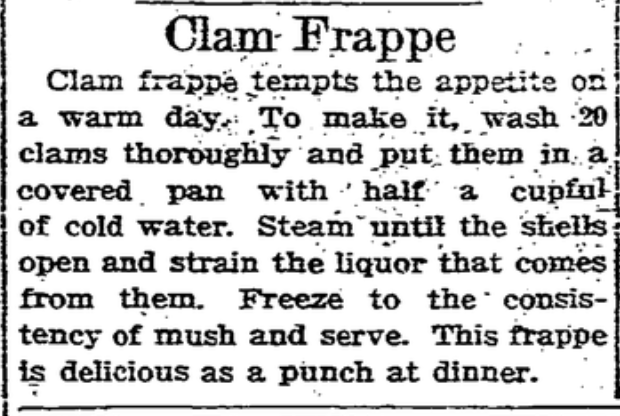
Clam Frappe, was detailed in 1894. Would you drink a Clam Frappe? The
New England Farmer, March 3, 1894, in an article on fare for the convalescent, recommended, “
The clam frappe or frozen clam juice is the only rule suitable for a very sick person, and requires 20 clams. Wash them thoroughly and put them into a stew pan with one-half cup of cold water, cover closely and steam until the shells open, strain the liquor, cool and freeze to a mush. Serve in glasses.” This article also mentioned a
Lemon Frappe, as well as noting that, “
The latest fashion in frappe glasses is a glass with standard and a handle..”
Clam Frappe, or Clam Broth Frappes, would continue to make newspaper appearances also across the country, sometimes referred to as a “delicacy,” and obviously not just for the convalescent. References would continue into the 1950s, including additional recipes, mentions on restaurant menus, and more. However, none of those recipes ever called for ice cream, though there were a few that used whipped cream as a topping.
The Boston Globe, July 8, 1894, noted “Iced foods and frapped drinks may not be the best things for digestion, but on a hot summer day,…are most refreshing.” The article mentioned Champagne, coffee, sherbet & chocolate frappes, stating, “To frappe champagne it must be packed deep and tight in chipped ice for at least 12 hours.”
As for other flavors, the Boston Globe, December 19, 1894, mentioned “peppermint frappe” while the Worcester Daily Spy, May 23, 1895, noted “strawberry frappe.”
The
Springfield Republican, July 19, 1895, referred to a “
raspberry frappe.” A recipe for “
peach frappe” was provided in the
Boston Globe, August 9, 1895. “
Line a mold with vanilla ice cream, fill the center with sliced fresh peaches. Spread over them ice cream, cover closely and set in a freezer for half an hour with salt and ice packed well around it. The fruit must be chilled, but not frozen.” However, it should be noted that this was not actually a type of drink like prior frappes.
A recipe for a “
pineapple frappe” and a “
café frappe” was published in the
Boston Globe, March 14, 1897. The
Transcript-Telegram, November 8, 1897, had a recipe for a “
fig frappe.”
The
Springfield Daily Republican, April 23, 1898, mentioned a
French Strawberry Fruit frappe.
And the
Boston Globe, August 28, 1898, briefly mentioned a “
consommé frappe,” likely a savory version.
The
Boston Evening Transcript, January 25, 1899, published an advertisement for
Ruinart Champagne, which stated, “
The idea prevails, in American, that Champagne cannot be too much iced. Some, even, drink it ‘frappe’—a custom open to criticism in treating the very best wine, but used because it makes a sweet wine palatable.” At this point in time, dry Champagne was becoming more of the norm, and champagne frappe was starting to become less common.
An advertisement in the
Springfield Daily Republican, May 9, 1899, referenced a “
Crème de Menthe frappe” and a “
Mint Julep frappe.”
A fuller description of the “frappe” was provided in the
Springfield Daily Republican, June 18, 1899. “
A frappe is almost a water ice, save that it is a little heavier, and should resemble, if properly made, moist or wet snow. Frappe is usually served with the meat course, or as a drink for evening affairs or at afternoon teas, and not as a dessert.” No ice cream was used in its creation. It's also interesting that it was often paired with a meat course.
More description was given in the
Boston Sunday Herald, July 22, 1900. The article stated, “
Frappe is a term given to water ices which have been only partly frozen; that is, to the consistency of mush, rather than hard enough to mould. It is really an iced drink, therefore the name should not be given to a thick custard cream. These ices are served in glasses, and usually are more or less liquid, as the mixture melts very quickly. They made be of any fruit juice diluted with water and sweetened, or with a mixture of juices, or with tea, coffee or clam juice. They are served at afternoon teas, evening entertainments, or before the game course at dinner. In freezing frappe we use equal parts of ice and salt, and freeze quickly as we wish to have a granular texture, and we turn the crank only until the mixture is partly frozen; or it may be left in the can without stirring and when partly frozen, by scraping the icy portions from the side of the can and a slight mixing, the desired consistency may be obtained.”
So, a frappe is basically a slushy drink. Again, there’s no mention of the addition of ice cream, and the frappe is not seen as a dessert. We also once again see the use of clam juice in some frappes.
And now, let’s take a slight detour and look at the origins of the
milk shake.
************
It seems that the milk shake was invented in the mid-1880s, thus later than the invention of the frappe, and it's possible that it was first created in
Atlanta, Georgia, around 1885. The first newspaper mention I found was in
The Sunday News (SC), July 26, 1885, which states,
"...the 'Milk Shake' has taken the starch out of all of them. It is the latest invention in the soda waterline and it seems to have caught on immediately. It is composed of a little vanilla syrup, enough Catawba to flavor it and a tumblerful of milk shaken up with ice."
The Richmond Daily Palladium (IN), September 19, 1885, noted that at their current Exposition, one of the refreshment's was the milk shake. The News & Courier (SC), October 8, 1885, had an ad for the Clover Daily Milk Saloon, claiming to have "The Best Milk Shake in the City." The Junction City Sentinel (KS), April 13, 1886, mentioned, “The milk shake is becoming quite a popular drink, but sometimes it is so strong of pure cream that it makes the drinker shake a wee bit next morning.”
The Savannah Morning News (GA). April 16, 1886, had a drug store ad, noting “Milk Shakes with shaved ice.” And The Union Times (SC), May 14, 1886, stated that at a soda fountain, they had “the most delightful drink” which was “something new, delicate in flavor and delightfully refreshing; and he called it a Milk Shake.”
As for its invention, the Boston Herald, May 13, 1886, reprinting an article from an Atlanta newspaper, mentioned that, “The newest Atlanta drink is ‘milk shake.’ You get it at the soda fountains. The mixer of cooling beverages pours out a glass of sweet milk, puts in a big spoonful of crushed ice, puts in a mixture of unknown ingredients, draws a bit of any desired syrup, shakes the milk in a tin can like a barkeeper mixes lemonade, sprinkles a little nutmeg on the foaming milk until it looks something like a Tom and Jerry, sets it out for you and you pay five cents. ‘Milk shake’ is an Atlanta drink. Atlanta is nothing if not original.”
At this time, no one seemed to dispute the claim that the milk shake was an Atlanta invention. And the reprinted article showed up in newspapers all across the country, helping the spread the idea of the milk shake. I’ll also note that at this time, the milk shake, like the frappe, had no ice cream in it.
More information on the milk shake was provided in the Fall River Daily Herald, September 28, 1887, reprinting the information from a Cincinnati newspaper. “It is a big glass full of flavored milk—vanilla suits most people better than any other flavor—iced and ‘shaken before taken,’ until there is an inch of froth or foam at the top.” The article continued, “But perhaps the chief charm of a milk shake is it novelty and the watching its manufacture. You can get it at most of the drug stores and at several of the corner stands.”
As for its preparation, “The maker asks what syrup you prefer, draws it in the glass, shaves in some ice, or puts in some powdered ice, fills it nearly full of milk—they generally have a good quality—claps it on the cup shaped top of a little machine behind the counter, which is only an upright rod made to oscillate up and down with lightning like rapidity by means of a crank.” Customers apparently loved the milk shake. “Ninety-nine out of a hundred pay their nickel well satisfied and call again,..”
The milk shake apparently arrived in Massachusetts around 1888. The Pharmaceutical Record: A Semi-Monthly Journal (May 1, 1888), mentioned, “The demand for this summer drink is making its way Eastward…” It continued, “The necessaries are perfectly fresh, rich milk; this is an absolute requisite—especially laying the emphasis on the word FRESH; clean ice, an ice crusher or shaver, pure juice syrups and a good ‘shaker.’” The Pittsfield Sun, May 17, 1888, noted, “With some sparkling pounded ice, some syrup from the fountain and a glass of rich milk agitated together by a whirling crank machine, Druggist Manning makes the new southern drink called ‘Milk Shake.’ It is a delightful beverage, wholesome, satisfying and strictly temperance.”
Then, the Fitchburg Sentinel, May 11, 1889, mentioned, “The ‘milk-shake,’ a Western drink, was introduced last year, and this year, ‘milk punchine’ promises to be a favorite summer drink...” The Boston Globe, August 11, 1889, stated, “Milk Shake. This is composed of milk flavored with syrups to taste.”
The Steward’s Handbook by Jessup Whitehead (Chicago, 1889), described a, “Milk Shake—A good trade is done in this in summer time. A milk shake is ½ pt. milk in a large lemonade-glass, a spoonful sugar, shaved ice, flavor if requested; covered and shaked to froth.”
The Complete Practical Confectioner (Chicago, 1890) discussed Milk Shake Formulas. “Take not quite as much of the syrup as is generally used for soda water; be careful not to get too sweet; shave ice to about half fill the glass; pour in enough milk to fill the glass within about an inch of the top and then shake. One secret in making Milk Shake is, to thoroughly shake the milk."
A Port Wine Milk Shake? The Pharmaceutical Journal Supplement, July 6, 1895, noted, “Milk Shake (New Formula). Fill the tumbler half full of shaved ice, add 1 ½ fluid ounce of milk-shake syrup (equal parts of vanilla and pineapple syrup), fill the glass almost full of milk, and shake well. A pint of port wine added to a gallon of the milk-shake syrup improves the drink.”
However, it appears the milk shake might have lost some of its popularity in Massachusetts in less than ten years. The Recorder (MA), September 18, 1897, stated, “For the milk-shake, which was the fad a few years ago, there is now hardly ever a call, and the shake-machine has disappeared.” Shake-machines used to sell for $35, but the price had dropped drastically to only $5. Why did this happen?
The article alleged, “The tuberculosis scare is doubtless largely accountable for the disappearance of the milk shake. When it first came into vogue it was supposed to be the most healthful of drinks. A glass of good fresh milk with a savoring of some syrup, an egg perhaps, cracked ice and a sprinkling of nutmeg was put into the machine and given a veritable Y.M.C.A. shake.” The article continued, “But some doctors cried against the drinking of ice cold milk when it was heated, and others showed that the milk was not always healthy—sometimes coming from tuberculosis animals, and it was not always pure—sometimes being made of chalk—and the public stopped drinking it.”
There were numerous articles at this time about the potential dangers of milk, including the risk of tuberculosis from contaminated cows. This might have led to a decrease in milk shake consumption across the country.
Ice cream made an appearance! In MacMahon’s Latest Recipes and American Soda Water Dispensers’ Guide by Albert C. MacMahon (Chicago 1893), there was a recipe for an “Ice Cream Shake. Mixing glass one-third full Shaved Ice. Don’t Care Syrup 1 ½ oz. Sweet Cream 2 oz. Fill with milk. Shake well and strain into fancy glass. Then add heaping teaspoonful of ice cream. Top off with nutmeg and serve with spoon.”
This was basically the first and only milk shake recipe in the 19th century that called for ice cream. It was more an outlier and the ice cream was basically an accompaniment rather than integrated into the shake. You couldn't drink the ice cream, but rather needed a spoon to eat it.
Now, back to the frappe.
***********
With the start of the 20th century in Massachusetts, frappes continued to be mentioned, in a variety of flavors, and ice cream was still not an ingredient. The
New England Farmer, January 5, 1901, had a recipe for a
Pomona Frappe, made with sugar, water, sweet cider, orange juice, and lemon juice. And the
New England Farmer, July 13, 1901, noted that, “
A frappe is simply a half-frozen ice. Its distinguishing characteristic is mushiness. If liquor is added to a frappe, it becomes punch.”
The
Fall River Globe, January 27, 1902, provided a recipe for a
cider frappe while the
Boston Globe, March 7, 1902, mentioned
Lemon, Orange and
Claret Frappes. This was expanded upon in the
Boston Globe, March 9, 1902, which gave recipes. “
To make lemon, I simply make a good strong lemonade and add quite a little lemon flavoring. Orange is made by using half oranges and half lemons.” In addition, “
Claret—A strong lemonade to which is added more or less claret according to taste.” The
Boston Globe, June 15, 1902, referred to a variety of frappe flavors, including
pineapple, coffee, mint, ginger, peach & orange, apple, and
rhubarb.
A
Clam & Chicken Frappe??? The
New England Farmer, May 3, 1902, provided a recipe for a Clam & Chicken Frappe, first noting, “
This is really an iced soup and of course is to be served on a warm day.” The recipe called for you to steam two quarts of clams and then strain the liquor through a cheese cloth. Then, you added highly seasoned chicken stock to the liquor. Finally, “
Cool and freeze to a mush; serve garnished with whipped cream.” Quite a unique frappe!
The
Boston Globe, June 17, 1902, provided a definition for a frappe. “
A frappe is but a ‘water ice’ partially frozen. It is stirred in freezer till soft and mushy instead of firm and hard. It is really an iced drink, and is served in handled glasses. Frappes are made of any fruit juice diluted with water and sweetened, or with several fruit juices combined, or with tea, coffee, and even clam juice.”
More recipes. The
Fall River Daily Herald, August 8, 1902, published a recipe for a
Tea Frappe while the
Fall River Globe, September 6, 1902, gave one for a
Cantaloupe Frappe. The
Worcester Daily Spy, January 3, 1904, printed a recipe for a
Cranberry Frappe. The
Boston Herald, July 7, 1904, had an advertisement for Sanford’s Ginger, with a recipe for a
Ginger Frappe, while the
Boston Journal, August 11, 1904, gave a recipe for a
Black Raspberry Frappe. None of these recipes included ice cream as an ingredient.
When was ice cream first used in creating a frappe? There was a mention in
The Boston Journal, April 29, 1904, although the dish sounded more like a sundae than a frappe. It wasn’t really a drink, but more of a dessert. The article stated, “
Almost every woman nowadays has her own special frappe combination with which she delights to mystify her guests. One that scored immediate success the other night was made in this way: Into the bottom of the frappe glass went a generous spoonful of preserved strawberries; on top of the berries came the ice cream—vanilla in this case—then a spoonful of whipped cream, and on top of the cream a grating of English walnuts.”
However, frappes with ice cream, as a drink, appeared around 1909.
The Dispenser Soda Water Guide compiled by
The Soda Fountain (2nd edition, NY, 1909), noted, “
Frappe is simply another name for a well-shaken ice cream soda. A dispenser in a small drug store can serve a frappe as easily as an ice cream soda. Mix as for an ice cream soda and convert into a frappe by putting a common shaker over the glass and shaking it well. Serve with a straw.” The book had recipes for numerous frappes, most without ice cream, including:
Ping Pong, Honey Dew, Maple, Flinch, Orange, American, Pineapple, Coffee, Tea, Admiral, Blood Orange, Buffalo, Café, Chocolate, Crème de Menthe, Funston, Honeycomb, Maple Crusta, Martian, Navy, Opera, Orange, Mint Cordial, Mint, Fruit, Ambrosia, Ginger, and
Delmonico.
However, several of those frappe recipes actually included the use of ice cream, including
Honey Dew, Maple, Flinch, American, Coffee, Buffalo, Chocolate, and
Fruit. The ice cream was integrated into the drink, and wasn't merely an add-on. There were also a couple of recipes for Milk Shakes,
Peach and
Coffee, but they didn't include ice cream.
The
1915 edition of this book included more Milk shake recipes and information. It stated, “
The shakes fall naturally into three general classes, dependent upon their principal basic material. The milk shakes are essentially sweet milk and a flavoring to which can be added an egg (egg milk shake), malted milk (Malted milk shake), or both (egg malted milk shake). The cream shakes are enriched by the use of sweet cream, and the ice cream shakes by the use of ice cream.” The Milk Shake recipes included
Coffee, Peach, Findlay’s Fruit Milk Shake, Japanese Milk Shake, Sportsman Shake, and
Clam Milk Shake. The Clam Milk Shake was made with 1 ½ oz. clam juice, 2 oz. milk, 5 oz. soda water, and a pinch of salt and a little white pepper. None of the recipes included ice cream.
However, frappes continued to be frequently mentioned without the addition of ice cream. The
Berkshire Eagle, November 7, 1910, stated, “
A frappe is simply a water ice frozen to the consistency of mush, equal parts of ice and salt being used to make it granular in the process of freezing.” There were also mentions of many more frappe flavors during these ten years, including
grapefruit, maple, banana, lime & lemon, muskmelon, lemon & grape juice, cider, marshmallow, loganberry, pistachio, vanilla, double egg, tomato juice, chocolate mint, raspberry nut, nut chocolate, pistachio nut, cocoanut, and
raisin & cranberry.
Another book though mentioned frappes made with ice cream.
Wm M Bell’s “Pilot”: An Authoritative Book on the Manufacture of Candies and Ice Creams compiled by
Wm M. Bell (Chicago 1911), wrote that, “
One of the best drinks Tom served with this syrup was a coffee frappe…He placed in the shaking glass one ounce of the coffee syrup and then about two or three dishers full of ice cream (if the cream was hard, he used it in small pieces); he then placed the shaker over the glass and shook it extra hard in order to dissolve the ice cream without using ice in the glass, which would make the frappe too thin. After this operation the shaker, containing the mixture, was run full of carbonated water and poured into a serving glass. The glass was allowed to set for a few seconds and then some more of the liquid was poured into it, which forced the heavy foam on the top of the frappe to come up over the top of the glass and form a sort of cap. A small dab of whipped cream was placed on the top, two straws placed in the drink and a spoon served on the side.”
The book continued, “
Tom served all kinds of frappes, among the best being maple, chocolate and coffee, although his coffee was the most popular. The other frappes were made in the same manner as the coffee.” It also said, “
To make frappe, use 2 oz. any flavor and about 4 oz. soft ice cream; shake well and finish with fine and coarse stream.”
It’s important to note that this book was printed in Chicago, indicating that frappes made with ice cream were available in that city. They were not restricted to New England. Plus, the reach of this book could easily have spread across the country, introducing lots of people to the idea of frappes made with ice cream.
Clam frappes continued to be mentioned. The
Boston Sunday Herald, July 5, 1914, provided a recipe for
Clam Frappe, noting, “
This frappe is delicious as a punch at dinner.” And the
Springfield Republican, June 19, 1915, published a restaurant ad for a special Sunday dinner menu that included a “
Clam cocktail frappe.”
Handy Household Hints and Recipes compiled by
Mattie Lee Wehrley (1916, Louisville, KY), noted,
“If originality palls at times, put the frappe glasses to the use they were intended to fill. There is nothing quite so sure to win to the heart of every guest as a frapped itself—which commonly means vanilla ice cream with some sort of sauce. The variety of simple sauces is endless, but chocolate is the general favorite.” This mentions ice cream and frappe but again seems more like a sundae than a drink.
The
Boston Herald, August 20, 1916, stated, “
A frappe, properly speaking, is a sweetened mixture filled with shaved ice and set in salt and ice a few minutes before being sent to table.” The general definition of a frappe still didn't include the use of ice cream.
And the
Boston Globe, December 25, 1917, printed a similar article to a prior Globe article from June 1902. It added, “
General Rule for Frappes—One quart water with 2 cups sugar, boiled together from 5 to 20 minutes. Add 2 or 3 pints mashed and sifted juice and pulp of fruit, like strawberries, raspberries, peaches, plums, apricots, cherries, etc. Add more sugar is needed. Some fruits need a little lemon juice.” Still no mention of ice cream.
What would it take to make ice cream a usual ingredient for frappes?
Maybe the first store advertisement which offered a frappe made with ice cream! The
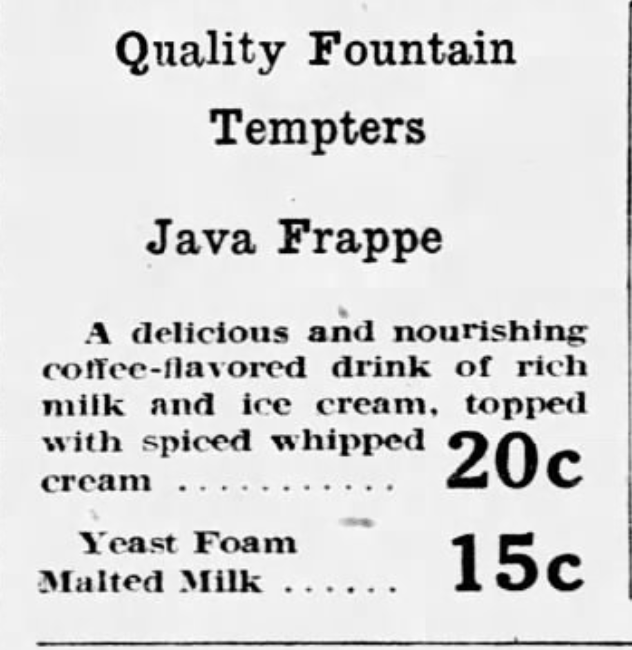
Star-Gazette (NY), July 9, 1925, published an ad for a drug store, part of the
Rexall group, which offered a “
Java Frappe. A delicious and nourishing coffee-flavored drink of rich milk and ice cream, topped with spiced whipped cream.” It cost 20 cents.
Five years later, the
Boston Globe, June 13, 1930, published a large drug store ad for
Liggett’s, “
America’s Greatest Drug Stores,” and part of the
Rexall group. The ad mentioned, “
Frappes. A generous portion of rich Ice Cream is beaten to a soft consistency—any flavor syrup. The Dixie Cup is filled with rich, pure dairy milk, and you have a palate teasing combination, rich in food value.” They cost 15 cents. There was also a mention of, “
Milk Shakes. Cool, rich, dairy milk flavored to your taste with coffee, chocolate, vanilla or any other pure fruit syrup. A cool nourishing drink that is incomparable.” They only cost 10 cents.
During the rest of the 1930s, newspapers provided plenty of frappe recipes which still didn’t include ice cream. There were some soda fountain/drug store ads which mentions flavored frappes, but didn’t specify whether they were made with ice cream or not. There were a few mentions though of frappes with ice cream, but most of them mentions were in ads for Liggett’s.
The
Evening Gazette, June 17, 1931, had an ad for the
Brockelman Bros., a market in Worcester with a soda fountain. The ad mentioned, “
Egg Frappe with Ice Cream” costing 10 cents a glass and you had your choice of flavors. The
Springfield Republican, April 19, 1936, mentioned that, “
In season, almost any fresh fruit is combined with the desired flavor in ice cream, to form a fancy-named sundae, frappe or parfait.”
In 1939, several Boston newspapers had ads for Liggett’s, advertising items such as “
Delicious Bostonia Ginger Ale Frappe with ice cream,” and
Chocolate and Coffee Frappes with “
pure ice cream.”
In 1903,
Louis Kroh Liggett, who founded the
L.K. Liggett Drug Company, established a retailer’s cooperative,
United Drug Stores, which sold items under the
Rexall brand. After World War I, the cooperative created a franchise program, where the franchisees sold Rexall products. During the 1930s, the company was based in Boston. For many years, they were the largest player in retail drug stores, and each store likely had a soda fountain.
When we consider how frappes, made with ice cream, became so prominent in New England, a primary reason may have been Liggett's. We see that they were producing frappes with ice cream since at least 1925, and they were the first newspaper ad I found for a soda fountain offering such a frappe. In addition, as there were so many Liggett's stores, the largest number of any retail drug store, then they were able to make frappes familiar to many people in New England. At this time, if a lone soda fountain had offered a frappe with ice cream, it would have been very difficult for them to spread the ida of such a frappe all across New England. For a large chain like Liggett's, it was very easy to spread the concept.
Even though
Brigham's Ice Cream was also around during this time period, having been established in 1914, I couldn't find any evidence that they sold frappes during this period. The few ads they placed in the local newspapers noted that they made ice cream and candies, sundaes and sodas. However, none of those ads mentioned frappes, even though we know they eventually started selling them much later in time.
1939 seemed to be a watershed year for frappes made with ice cream as a number of other soda fountains started offering them. Remember that this is 14 years after the first Liggett's ad for ice cream frappes.
The
Boston Globe, July 17, 1939, noted a regional difference concerning frappes. It stated, “
If you order a milk shake in Los Angeles you’re served a frappe, and when you ask for a frappe the clerk looks at you as though there are bats in your belfry.” However, it seems very likely that such a California clerk would have at least heard of a frappe before, although he probably would have seen it as a type of water ice, and not something with ice cream.
The
Boston Herald, August 18, 1939, mentioned a
Moxie Frappe, made with a scoop of coffee ice cream and Moxie, which was “
thoroughly blended in the electric mixer.” In the
North Adams Transcript, September 5, 1939, there was an ad for
McCann Dairy Store, which sold “
Ice Cream Frappes” for 10 cents each. The
Fitchburg Sentinel, September 20, 1939, printed a grocery ad which sold “
Ice Cream Frappe” for 10 cents while the
Fitchburg Sentinel, November 7, 1939, noted that the same grocery advertised, “
Frappes. All Flavor with 2 Scoops of Ice Cream.”
During the 1940s, plenty of frappe recipes still didn’t include ice cream. For example, the
Boston Herald, July 6, 1941, had a recipe for
Café Frappe, without any ice cream. Additional recipes were printed, such as
cranberry frappe, tomato frappe, and
grape juice frappe, none with ice cream. However, there were some advertisements during this period which mentioned frappes, but didn't specify whether they had ice cream or not.
Another regional issue. The
Boston Herald, February 26, 1947, published an article on “
sectional dialects.” The article stated, “
I learned that a good many words are unknown in other parts of the country. Such commonplace words, for example, as ‘frappe,’ ‘cobbler,’ ‘cruller,’ and ‘cranberry.” However, as I've previously shown, the term frappe was actually known across the country, although it probably didn't include ice cream.
As the 1940s ended, and into the 1950s, ice cream frappes became even more common. The
Boston Herald, October 29, 1949, advertised a 24 ounce Frappe, made with ice cream, that sold for 25 cents. The
Boston Traveler, June 13, 1951, published an ad for
Whitings Milk Co., noting that a chocolate frappe could be made with a scoop of ice cream and Whiting’s chocolate beverage.
The
Quincy Patriot Ledger, June 19, 1951, had a large ad for the nationally known, locally owned, “
Genuine Dairy Queen.” They offered “
Thick & Cooling Frappes” for 30 cents each.
Another Dairy Queen ad. The
Quincy Patriot Ledger, May 2, 1952, had an ad that stated, “
Step right up and order your favorite flavor extra-thick frappe made with Dairy Queen. Sm-o-o-th, delicious Dairy Queen is a freshly frozen dairy food.” The
Journal Tribune, (ME) June 19, 1952, also had a Dairy Queen ad, which stated, “
Call it what you want—milk shake, frappe, or velvet—It’s all the same here—A BIG, thick, cooling drink, mixed to your taste—"
The
Boston Evening American, July 20, 1954, described frappes. “
Our favorite dessert is a frappe;” It continued, “
These are not frozen frappes, a kind of ice, but de luxe ice cream and milk drinks, popular in New England, and pronounced ‘frap.’ These are most easily made in an electric blender or liquefier. Combine the ingredients and run about 2 minutes or until smooth and fluffy.” In addition, the article noted, “
Almost any kind of fresh ripe or half-thawed frozen fruit can be used for frappes in combination with whole milk and ice cream. If frozen fruit is used, add less sugar.” A few frappe examples included banana, strawberry and peach.
Regional differences once again. An article in the
Boston Traveler, December 21, 1954, noted the differences of Boston and Kentucky, including that “
...a milk shake in Kentucky is a frappe here.” In Boston, there’s no ice cream in the milk shakes."
************
We know that the term "frappe" predated the appearance of "milk shake," but initially, both drinks didn't includes any ice cream. Both terms were also known all around the country. Ice cream wouldn't become an ingredient for some of these drinks, both frappes and milk shakes, until the early 20th century, and even then, it didn't become the norm until years later. In addition, the earliest soda fountain recipe books that mentioned the use of ice cream in frappes and milk shakes were published in New York and Illinois, so it doesn't seem that ice cream frappes actually originated in New England.
What may have spurred on the idea of frappes with ice cream in the New England could be the Liggett's drug stores, which were the dominant drug store at the time, and which their side fountains sold frappes made with ice cream. This ubiquitousness may have then led to more independent soda fountains to start creating frappes with ice cream as well, eventually leading to the idea that such frappes were only a New England thing. Other regions of the U.S. would generally embrace milk shakes with ice cream, instead of frappes, forgetting that New England didn't originate the idea of frappes and ice cream.


 I'm sure that I'll take many hundreds, if not thousands, of photos and a myriad of notes of my experiences in Portugal, which I'll share with my readers upon my return. And I'll share some pictures while I'm in Portugal as well. Probably the toughest part of my trip will be deciding which wines I can bring home in my luggage. At the very least, there will be aged Port, Tawny and White, coming home with me.