is a slightly effervescent, light, fruity, low alcohol, and sometimes mildly sweet,
white wine. It's a great summer wine, and also pairs well with seafood and plenty of other dishes. However, not all Vinho Verde is the same and it's worthy to explore what else this region has to offer. We need to get over the misconception that Vinho Verde is a singular type of wine and seek out the diversity that exists.
region was demarcated in 1908 and there currently are nine subregions, including
. Each subregion has it own specific terroir, and some regions are better known for specific grapes. The entire region encompasses approximately 21,000 hectares of vineyards (with 47 grape varieties), 18,000 winegrowers, and 600 bottlers. White Vinho Verde is primarily made from grapes including Alvarinho, Arinto, Avesso, Azal, Loureiro, and Trajadura. Red Vinho Verde is primarily made from Alvarelhao, Amaral, Baker, Borraçal, Espadeiro, Pedral, Rabo de Anho and Vinhão.
Annually, the region produces over 80 million liters of wine, composed of 87% White wine, 7% Red and 6% Rosé wine. These percentages were drastically different in the past, as I'll later explore in this article. In 2021, production of Vinho Verde grew by more than 3 million liters, an increase of 3.7%, up to 84.9 million liters. The region also includes
(designated Aguardente Vínica de Vinho Verde and Aguardente Bagaceira de Vinho Verde), and even
Of the white wines, not all fit into the common perception of Vinho Verde, some lacking effervescence and being produced to be more serious and complex wines. The Vinho Verde DOC possesses much more diversity than many realize. However, it's difficult to experience this diversity in the U.S. as the more unique wines are hard to find in local wine stores. Hopefully that will change as more producers in the Vinho Verde DOC highlight their diversity and export their unique wines to the U.S.
Vinho Verde is currently exported to over 100 markets. The top market is the United States (importing over 10 million liters) and second place is taken by Germany, although most of their Vinho Verde sales are in supermarkets, meaning they import mostly very inexpensive Vinho Verde. Poland and Russia are growing markets, while Japan imports some of the most expensive wines from Vinho Verde.
As for the U.S., these Vinho Verde imports have grown nearly sixfold since 2000, although most still are inexpensive, lightly sparkling wines. It's only during the last decade that some of the more premium Vinho Verde wines have started being imported into the U.S. Those are the Vinho Verde wines you should seek out.
As for Portuguese wines in general, their exports reached a record high in 2022, a value of 941 Million Euros, a 5.75% growth. Their overall main wine export market was France while the U.S. was in second place, with a value of over 99 Million Euros.
Port wine was still the largest category, consisting of about 296 Million Euros, while Vinho Verde took second place, with a value of about 78 Million Euros, a growth of 6.8%. As the numbers show, the value of Port wine exports is nearly 4 times are large as the second place export, Vinho Verde.
************
What's the history of Vinho Verde in the U.S.? When was it first introduced into this country? How was it initially perceived? Let's explore these and other related questions.
One of the first mentions of Vinho Verde in the U.S. was in
The Flag of Our Union (MA), July 30, 1853. The newspaper presented a serialized, fictional tale of Portugal, and one chapter briefly mentioned, “
By the way, this vintage is good, but a little too strong; give us some of the vinho verde, (green wine).” It's likely that with this only mention of Vinho Verde during the 19th century, most Americans were unfamiliar with the term, especially as it apparently was not exported to the U.S. during the 19th century.
At the beginning of the 20th century, a few books began mentioning and describing Vinho Vinho, although not always positively. For example,
The Story of the Vine by
Edward R. Emerson (NY & London, 1902), wrote, “
One peculiar wine that is made in Portugal is the Vinho Verde or ‘green wine,’ so called from the fact that it is made from unripe black grapes, a variety which can almost be called indigenous to the soil. The wine resembles in taste a strong acid vinegar in which a goodly amount of alum has been dissolved. It is said to be very pleasant when one gets used to it, but it is seldom that any one but a native takes the second taste. It is never exported.”
First, it's interesting to note that this Vinho Verde was a red wine, made from black grapes. Was red Vinho Verde more common then? As I mentioned above, currently, about 87% of Vinho Verde is white wine, made from white grapes. Could that percentage have been different 100 or so years ago? I'll raise this issue again later in this article as more evidence arises. Second, the wine isn't said to have a good taste, unless you somehow get used to it over time. Third, it was also noted that Vinho Verde wasn't exported at that time.
In another book, by the same author, Beverages, Past and Present by Edward R. Emerson (NY & London, 1908), he continued his rant against Vinho Verde. First, he noted, “In the northern part of Portugal and especially in the province of Minho the farmers make for themselves and their labourers a wine which they call vinho verde—or green wine. This wine never leaves the confines of the country,….” So again, he mentions that this wine weren't exported.
The book continued, “Any one therefore who has tasted the famous vinho verde of northern Portugal—the thick, red, sour and astringent wine which the Minhotes delight in—may satisfy himself that he has drunk a liquid identical in every way with that wherewith the Latian farmer quenched his thirst two thousand years ago.” So, it's now clear that this Vinho Verde was red. In addition, the writer seems to believe the wines were similar to those that were produced a couple thousand years ago.
In addition, the book added, “Vinho verde is not made to keep more than a few months over a year, and by April that which was made some eighteen months ago has reached the dregs and is hard and poor, but that which was made in the previous September has, during the winter, become clear and with the opening of spring is ready to use.” Thus, Vinho Verde was allegedly not a wine made to last, although nowadays, there are definitely Vinho Verdes that are intended to age very well.
In the Spain and Portugal: Handbook for Travellers by Karl Baedeker (1908, Third Edition), there was a brief mention of Vinho Verde. “The Vinho Verde is very light and contains almost no sugar.” The previous two editions didn't mention this wine at all. And in the 4th edition (1913), it was mentioned, “The Vinho Verde, an acid red wine, is considered a good thirst-quencher.” Again, the wine was described as red, although now it was viewed more positively. Where were the white Vinho Verdes?
Vinho Verde exports! The
Rutland Daily Herald (VT), August 22, 1913, discussed the status of the agriculture of Portugal in the prior year. “
The vineyards produced a low quality wine, and the exportation of vinho verde (green wine) fell off considerably as compared with 1911.” So, it seems that Vinho Verde was now being exported, and exports might have only began within the prior five years or so. However, there was no indication where the wine was exported to, and it doesn't mention the U.S. received any Vinho Verde.
The
Commerce Reports (D.C.), February 26, 1916, noted that in Brazil, 80% of their wine consumption was Portuguese wines, including Vinho Verde. So, Brazil was clearly one of the export markets however, there still weren't any mentions that Vinho Verde was yet being exported to the U.S.
It wouldn't be until 1940, that I found the first advertisement for Vinho Verde in the U.S. The
Albuquerque Journal (NM), December 25, 1940, ran a wine ad, which included, “
Vinho Verde Tamegao, a light red, dry, Portuguese wine, in beautiful stone jug. Fifth $1.85.” Again, we see that Vinho Verde was a red wine. It's possible, and maybe even likely, that at this time, and earlier, red Vinho Verde was produced much more than white versions. And that would be supported by later references. I'll also note that this Vinho Verde import seemed to be a rarity, as there weren't any other such imports mentioned in the newspapers until the 1960s. Its fascinating that the first known Vinho Verde export to the U.S. might have been a red wine.
A Portuguese pairing menu. The
Fort Worth Star-Telegram (TX), March 19, 1950, noted that, “
The national wine board of Portugal has issued directions as to what the well-bred, well-fed and properly drinking man will consume as beverages all day long. Portuguese products will get a monopoly if the ‘fastidious and discriminating American gentleman’ (and his spouse) follows the curriculum.” The article continued, “
Here is the chronological list: Appetizers, Madeira and port, dry or sweet; hors d’ouvres, sparkling wines, brut or dry; soup, Madeira or tawny port; fish, white wines-Vinhos Verdes, Alenque, Agueda or Bucelas; entrée, light red wines—Alcobaca, Agueda, Lafoes, Bairrada, Pinhel; roasts and game, full bodied red wines—Colares, Cartaxo, Alenqer, Torres Vedras; cheese, port, full and ruby.” So, Vinho Verde was recommended for fish, an excellent pairing.
The
Modesto Bee (CA), November 30, 1950, mentioned, “
Vinho Verde—pronounced veen-yo Vair-dee—is a wine from Minho, Portugal. It is consumed when young and is rarely bottled.” Another brief mention was in the
Detroit Free Press (MI), November 16, 1952, discussing a dinner in Lisbon. “
Vinho Verde wines that effervesced like champagne.” This is the first reference I found mentioning that Vinho Verde was fizzy.
Discussing a dinner in
Cascais, Portugal, the
San Francisco Examiner (CA), April 27, 1955, stated, “
And we had a bottle of Vinho Verde, a light, greenish Portuguese wine with a slight effervescence that, as far as we’re concerned, is even more palatable than Portugal’s famed Lancer’s Crackling Rose.” So, this is the maybe the first mention that the Vinho Verde was not a red wine. And again, it's noted that the wine has an effervescence.
The
Pittsburgh Press (PA), September 30, 1957, in an article on Portugal and wine, stated, “
In the Vinho Verde country, the grapes are trained to grow up tall trees and the traveler drives through endless avenues draped on each side with high swags of green vines heavy with the autumn harvest of fat purple or pale, translucent green grapes.”
More positive comments! The
Winston-Salem Journal, October 23, 1957, briefly mentioned, “
the delicious Portuguese specialty, ‘vinho verde’ (green wine) which was served ice-cold from a porcelain crock—a ‘must’ if there ever was one!” And the
Cincinnati Post (OH), December 26, 1959, in an article on Portugal, noted, “
Wine works out at about 14 cents a bottle and is very good, particularly the vinhos verdes—young wines with a slight sparkle, marvelously refreshing in hot weather.”
Continuing the positivity, the
News-Press (FL), July 2, 1962, printed, “
In Portugal I found a vinho verde tinto, a fine example. Its taste was somewhat reminiscent of velvet, yet it had a bouquet as fresh as gingham. But that is exactly the only way I can describe this lovely wine. I also found a vinho verde blanco that was Montrachet or Wehlener Sonnenuhr but speaking Portuguese. This was a truly Portuguese wine, yet reminiscent of those two.” We now see references to both a red and white Vinho Verde. And comparing the white Vinho Verde to a Montrachet is quite a compliment!
Another newspaper advertisement offering Vinho Verde for sale appeared in the
Modesto Bee (CA), August 16, 1962. The ad stated, “
Tres Marias Vinho Verde (White Table Wine). $1.89/5th." During the rest of the 1960s, advertisements for Vinho Verde started to become more widely seen in the newspapers, and it was nearly always for white wines.
The
Fort Lauderdale News (FL), March 7, 1963, answered a reader's question about whether Vinho Verde was also being produced in California. At this time, California was making their own version of Port Wines, as well as other wines, from Sherry to Champagne. The response to the reader was that, “
Vinho Verde wines can be either red or white, are low in alcohol content (about 8 per cent), are young, and often still are fermenting in the bottle when sold. Hence they are foamy. Verde means green. But not in color. In age, as in a green fruit.”
Addressing the reader's specific question, the newspaper responded, “
California doesn’t produce such a wine because (1, the state law requires white wines to be at least 10 per cent and red wines 10 ½ per cent in alcohol content to assure stability; (2, a wine as foamy as Vinho Verde would run into the sparkling wine tax in the U.S. ($3.40 a gallon) and the price would bubble out of reason.”
More positivity! The
Indianapolis Star (IN), July 12, 1964, briefly stated, “
The most attractive are the vinhos verdes from the North, very light and sparkling.” And the
Independent Star-News (CA), August 2, 1964, noted, “
The slightly acidulous green wine or vinho verde is an attractive dinner wine.”
The
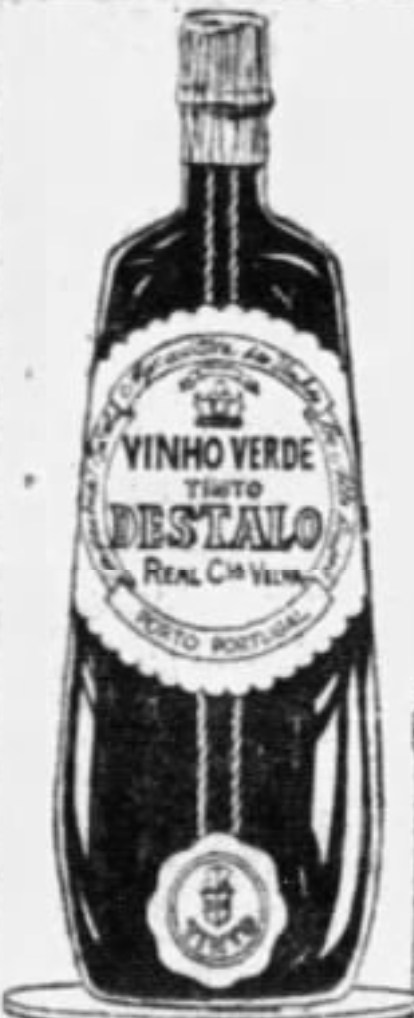
Los Angeles Times, September 30, 1964, ran an ad, mentioning an exhibition and sale of more than 50 varieties of Portuguese wines, including Vinho Verde. The above is a drawing of a bottle of Vinho Verde in that ad. It's interesting to note the bottle is a red Vinho Verde.
The arrival of
Casal Garcia Vinho Verde! The
Chicago Tribune (IL), October 2, 1964, mentioned, “
I think you’ll enjoy a fresh-flavored ‘vinho verde’ (green wine) of Portugal called Casal Garcia, which comes in a cute, squatty bottle with a cluster of green plastic grapes hanging around its neck. It is a very light wine, only 10 per cent alcohol.” It continued, “
The name is not significant of color; this wine is almost white, but another vinho verde might be red or pink. Green as related to Portuguese wines carries the implication of young and ‘eager.’ Portuguese wines are classifies as ‘vinhos verdes’ or ‘vinhos maduros,’ the latter being the full-bodies wines that are better when aged.” The article finished, noting that, “
One Chicago wine dealer ordered 100 cases of this Portuguese newcomer, the Casal Garcia. He likes it so well that 50 cases are for his own use.”
Casal Garcia would be the most popular and widely available Vinho Verde in the U.S. from the 1960s to the 1970s. It would often appear in newspaper wine advertisements concerning Vinho Verde. This brand is still available today, although it's bottle has changed, looking more like a common wine bottle.
The
Waukesha Daily Freeman (WI), April 14, 1965, printed a wine ad noting, “
Portuguese Casal Garcia Vinho Verde Medium Dry White Wine” which sold for $2.25 4/5 quart, or 2 for $3.98.
The
Chicago Tribune (IL), May 14, 1965, printed this advertisement, although they didn't mention the name of the brand. The bottle is also an interesting shape, with a handle on the neck.
The
San Bernardino County Sun (CA), June 6, 1965, mentioned, “
vinho verde, a so-called ‘green wine.’ It is made from grapes grown in fog-topped mountains. They never fully ripen and the wine flavor is usually tangy.” And the
Boston Globe (MA), April 24, 1966, noted, “
Try the vinho verde, the Portuguese green wine, for something different; especially good with seafood.”
Pink Vinho Verde! The
San Antonio Express (TX), July 28, 1967, ran a wine ad for “
Fonte Bela, Vinho Verde, Rose 1964 vintage” for only 99 cents.
The
Newsday (NY), March 14, 1968, briefly stated, “
For instance, the vinho verdes, or ‘green’ wines, are actually young wines only a year or so in the bottle. Both red and white, they have a low alcoholic content (8 to 11 per cent), are semisparkling and come from the north of Portugal.”
The
Galveston Daily News (TX), April 28, 1968, printed a large ad for a gourmet shop, with a concentration on Casal Garcia Vinho Verde. “
The name of this month’s wine means, ‘green wine,’ and refers not to its color, but to the fact that it is young and fresh. Vinho Verde may be red, white or rose, but the best is white. It is produced in the most northern province of Portugal, the Minho. The principal grape varieties are the Azal Branco and Dourado. The vines do not grow in orderly rows, but are trained on trellises and arbots around the edges of fields where other crops are grown. Vinho Verde is a well balanced medium dry wine, and is an excellent summer wine. Serve it chilled with all light summer foods and seafood.” This is the first mention of specific grapes found in Vinho Verde.
The
Hartford Courant (CT), May 15, 1968, mentioned, “
The vinho verdes, fairly new in the American market, are ‘green wines’ which may be red, white or pink; the ‘green’ refers to the youthful quality of the wines, and their light, refreshing flavor.” So, it seems that Vinho Verde was a recent export, maybe within the last five years or so.
The
Sacramento Bee (CA), July 2, 1969, printed an article by a writer who went to a Portuguese wine tasting. He stated, “
I found the ‘Vinho Verde’ white table wines the most pleasant. The translation of vinho verde literally is ‘green wine’ but it really means ‘young wine.’ It is not green, but can be either red or white. The two I liked best both were water white—one was Casal Garcia and the other Tres Marias. In Portugal the vinho verdes are light in alcohol—about 9 to 10 ½ per cent—but those imported to the U.S. come in at about 12. They are refreshing, fragrant and somewhat dry.”
The
Chicago Tribune (IL), October 10, 1969, in a long article on Portuguese wines mentioned that sales of their red and white table wines have increased by over 64% from the previous year. The article also stated, “
Portuguese vinhos verdes are the new thing. They are ‘green wines’ only in the sense of being youthful, and having been made of somewhat underripe grapes; their alcoholic content is low, 8-11 per cent. In color, they are both red and white. They come from one of the eight legally defined districts of the Romans and later people.” It continued, “
Vinhos Verdes are light, fruity wines, bright red or yellowish, and some are pink; they have a tendency to sparkle naturally.”
The
Orlando Sentinel (FL), May 24, 1970, printed a large wine advertisement, with a feature on Vinho Verde. “
Thousands of rugged, independent small farmers grow these vinhos verdes—which are rapidly becoming popular and fashionable summer coolers in Florida, as they have been in South American for many years!” It continued, “
Vinhos verdes are light and bracing, with a sprightly, prickly tartness which is their special trademark; they range from greenish-straw to pale golden in color.” It also stated, “
These are outdoor wines—for swallowing, not sipping! Try a well chilled bottle for the most sensational summer drink you can imagine.” Finally, the ad mentioned three brands, including
Casal Garcia, Balboa and
Scampi.
There was a lengthy article on Vinho Verde in the
San Francisco Examiner (CA), July 7, 1971. It stated, “
Vinho verde is strange stuff. It is red or white, but never green. When it is out of reach, the best substitutes are not other wines, but rather well-made cider or light beer. It is, in short, a refreshment.” The article then noted, “
It has an extremely light body and taste—so pale in both regards that it does not interfere with appetite, even if drunk in gulps.” And it continued with, “
The alcohol is almost always less than 10 percent and dips down to 8 percent or so on the wine’s home grounds. This is another encouragement to gross consumption.”
The article also mentioned, “Vinho verde prickles a bit on the tongue because it has a natural sparkle….the people who make vinho verde say that the sparkle…is due to minerals in the local soils, proof of which is that melons from the area also sparkle in the same way.” Next, it noted, “Finally, vinho verde finishes so dry that the only comparable flavor I think of is bicarbonate of soda. The wine makes you feel like you are preventing heartburn from the first bite onwards, so you shovel down an enormous meal in spite of its being 90 degrees.”
And as for red Vinho Verde, the article mentioned, “Conventionally, the white goes with shellfish and chicken, the red with pork. It is a rule most Portuguese would just as soon break as keep.” And then it was stated, “Nobody exports red vinho verde. Senhor Fernando Guedes, whose firm makes Casal Garcia, was aghast at the mere thought of it. So, although the earliest mentions of Vinho Verde mentioned the red version, it appears the white version became the most common export from Portugal.
In two issues, the Daily News also presented some interesting information about Vinho Verde. First, the Daily News (NY), July 11, 1974, began, “Tourists don’t find the Porto right away, being busy discovering Vinho Verde, the wine that can cost $1 on a seaside fish restaurant, although there are some special bottlings like Alvarhino from Moncao that run as high as $10.” This is the first mention of more premium Vinho Verde, showing that it was being produced at this time. It wasn't just the cheap, fizzy version that most were familiar. And Alvarhino from Moncao is still well known as high quality Vinho Verde.
The article also noted, “Vinho Verde is meant to be fresh and young, light and inexpensive, sometimes only 9% alcohol, just the thing to drink while lolling in the sands. Most of it is white and each vintage is meant to be drink up before the next is made,…” Finally, it mentioned, “…it has just begun to be imported into the U.S.”
Second, the Daily News (NY), July 18, 1974, added, “The perfect wine for the American market would be one that is young and fresh, low in alcohol and low in price….Vinho Verde, the perfect wine, is made here in northern Portugal, but the catch is that scarcely any of it is sent to the States.” This seems to indicate that only small amounts of Vinho Verde were yet being exported to the U.S., and Casal Garcia was probably the most dominant.
The article continued, “It’s pronounced veen-yo vaired and it comes in the usual three colors—red, white and pink. The phrase means green wines in Portuguese, sure enough, but that refers to age, suggesting wines that should be drunk before the following vintage,…” It then noted, “The wines lose their freshness quickly, and importers have used that as an excuse for not bringing them in. The excuse was that the wines would not last a year or longer on the shelves and would go bad before they were sold.” In response, the article made the point that, “Now that wines disappear from the shelves in a matter of days, there should be a lot of Vinho Verde on the market, all of it young, from last year’s vintage or the year before.” Finally, the article mentioned, “The whites are best. They are sharp and acid, just what some people thirst for after years of drinking soft, bland wines from California or the Mediterranean countries.”
The dominance of Red Vinho Verde! The Knoxville News-Sentinel (TN), March 24, 1980, wrote about Vinho Verde, stating, “They comprise about 25 percent of all the wines made in the country. The Portuguese favor them—consuming about 90 percent of the production. About 60 percent of the wines made are red. Both the reds and whites are light and fresh—made to be drunk young. They are low in alcohol, about 10 percent, and have an attractive sparkle that leaves a tingle on the tongue.” 60% of Vinho Verde was red? Today, only 7% of the production in the Vinho Verde region is red. When and why did this percentage change so drastically?
The Daily Register (NJ), September 11, 1985, also noted "Red Vino Verdes might be somewhat of a surprise to many people in the United States because they rarely find their way here, but red wines constitute about 70 percent of the production in the region." So, the drastic percentage difference between red and white Vinho Verde remained until at least 1985.
The Asbury Park Press (NJ), September 20, 1987, mentioned that in the Vinho Verde region, "Although far more red is produced than white, it is the white that has become known in this country."
The dominance of Red Vinho Verde starts to wane. The Miami Herald (FL), August 29, 1999, wrote, "Unknown even to many rabid wine fans, nearly half of Portugal's vinho verdes are red--made from the traditional port grapes of touriga nacional, touriga francesca, and tinta barroca. Why are they little known? According to wine author Jancis Robinson, in her Oxford Companion to Wine, it's because the reds are 'fizzy, acidic, dry and raspy' and thus 'anathema to foreign palates." We see that the percentage of red Vinho Verde had dropped from 60%-70% to less than 50%. A relatively small decrease, but still significant.
The Kitsap Sun (WA), June 1, 2005, printed, "Vinho Verde is Portugal's most famous wine and is usually red. Half of all the Vinho Verde produced is not the exported white wine but a fizzy, acidic dry red wine. This wine is not a favorite with foreign wine drinkers but is one of the most popular for everyday drinking among the local populace. Red Vinho Verde is a shocking magenta and is as acidic as red wine gets."
For information was provided in The Miami Herald (FL), June 16, 2005, which stated that red Vinho Verde is 40% of all the Vinho Verde made. In addition, it stated, "But they export only about 1 percent of it, and even the portion that arrives in the U.S. is drunk almost entirely by the New York City's Portuguese community." Around 2014, the production of red Vinho Verde was down to 10% of the region's total production, and by 2023, that amount had decreased to 7%. Why did red Vinho Verde, in the course of only about nine years, drop from 40% down to only 10%?
It appears that Vinho Verde started being imported into the U.S. during the early 1960s, except for maybe one or two outliers prior to that time. Red Vinho Verde may have been the first Vinho Verde to be exported to the U.S. During the 1960s, when Vinho Verde began to be more commonly exported to the U.S., Casal Garcia, a white wine, was the primary brand, although a few others were also exported to the U.S. At this time, Vinho Verde, especially the white, was largely viewed very positively, and often seen as an accompaniment for seafood.
However, Red Vinho Verde was the most commonly produced Vinho Verde at this time, and it remained so until the 1990s, when it became closer to a 50/50 split. But, even as late as 2005, 40% of the production of Vinho Verde was still red. Yet today, one 7% red Vinho Verde is produced? Why that changed is a mystery to me, and something I want to explore further. Could red Vinho Verde become a major element once again?
Seek out Vinho Verde, especially the more premium versions, which are more complex and diverse. And even those premium versions can often be found for reasonable prices, some under $20. I'll be visiting the Vinho Verde in October, and hope to find some amazing wines when I visit a few of their wineries.