A Boston Globe correspondent stands in the middle of a small room without walls, surrounded by piles of jagged, glass shards. Next to one pile is a medium-sized rock and the correspondent stares at the rock, which she had thrown only moments before. The ramifications had been obvious, yet she made the throw anyway. There are always consequences.
A headline on the front page of the Boston Globe newspaper, the March 7 edition, disturbed me: "Bloggers Eat Free." What sensationalism was this all about? I turned to the article, Eat, Tweet, Blog, and found it was about the Boston Brunchers. I have attended a few of the Boston Bruncher events so I am familiar with the organization and a number of the other bloggers who go to their events. In general, I found the article to be shallow, failing to depict the greater details and scope of the organization. But what most bothered me were the attacks on the integrity of the bloggers for accepting free meals.
Throughout the article, the correspondent made several digs at the bloggers including, "While bona fide reviewers, who taste anonymously and pay for everything, see this as a conflict of interest (what bad things are you likely to say when the meal is free?)" This is insulting on numerous levels, such as not considering bloggers to be "bona fide." In addition, the writer is essentially implying that a blogger will sell their integrity for a measly $30 brunch.
As one of those bloggers, I am deeply offended that anyone would think I would compromise my integrity for such a meager amount. I have spent years honing my craft and believe I possess a very good reputation. My blog even possesses a Code of Ethics with a listing of my Disclosure, Advertising and Sample Policies. The correspondent seems to possess an air of superiority because she is writing for a traditional newspaper, though she also has her own blog, Bistro Broad.
Now return to my initial paragraph for a moment and consider what I am trying to say. To put it more plainly, think about the saying that "people who live in glass houses shouldn't throw stones."
The Boston Globe correspondent who penned the Boston Bruncher article is named Kathleen Pierce and I have met her. In fact, I met her back in March 2010 when we both attended a free wine junket to Paso Robles, California. Free airfare, free hotel, free meals, free wine tastings, and more. As a reasonable estimate, each writer probably received benefits worth at least $2000. This really puzzles me. How can the writer who received such a bountiful freebie now complain about a blogger receiving only a $30 brunch? Even if a blogger went to 10 of those brunches, the value of those meals still would not equate to the value of the wine junket.
There is an unjust double standard here, and Kathleen should be ashamed she even raised the issue in her article. Did Kathleen compromise her own integrity when she received that free press trip? If she thinks someone will do so for a $30 brunch, then such a trip must surely have done so to her. Just consider how many $30 brunches it would take to equal a $2000 press trip. How many other freebies has Kathleen accepted during her writing career? Is the Boston Globe aware of the previous Paso Robles trip? Stop throwing stones when you are guilty of accepting far more than a meager brunch.
Bloggers are particularly aware of disclosing any freebies they receive, especially after the FTC rule changes of 2009. Anyone who considers themselves a Journalist should be even more aware of such ethical issues. So it seems logical that Kathleen, who describes herself as a journalist, is aware of those rules yet why did she ignore them on her own blog? If you look at her Paso Robles blog posts, you will see that she failed to disclose the press trip that she took, a clear violation of the FTC rules. And this is the person who is questioning the ethics of the Boston Brunchers. It is very sad to me.
I believe Kathleen Pierce should publicly apologize for questioning the integrity of the Boston Brunchers. I also believe the Boston Globe should offer their own public apology for Kathleen's article. So let us await their response.
For an additional discussion on the ethical issues of this article, please check out Adam Japko's post, Wine Blogger Sample Disclosure Double Standard, a well-written discourse on this matter.
Update (3/15/12): Douglas Most, the Deputy Managing Editor of Features at The Boston Globe emailed me a response to my post. He stated they were unaware of Kathleen's wine trip, but at the time she was not a regular Globe freelancer and had only submitted several freelance pieces. She never wrote about the wine trip for the Globe. He has also spoken to Kathleen, reminding her of the Globe’s freelance policy and that freelancers must avoid all trips, free meals or such which could be or be seen as a conflict of interest. It does not appear that any apology will be forthcoming.
For Over 18 Years, and over 5600 articles, I've Been Sharing My Passion for Food, Wine, Saké & Spirits. Come Join Me & Satisfy Your Hunger & Thirst.
Wednesday, March 14, 2012
Tuesday, March 13, 2012
International Boston Seafood Show: Aquaculture & Cobia
“With earth’s burgeoning human population to feed we must turn to the sea with understanding and new technology. We need to farm it as we farm the land.”
--Jacques Cousteau
What is the role of aquaculture both globally and in the United States? It is very significant and provides approximately 50% of the world's seafood. Annually, global consumption of seafood is about 115 million tons, half which is acquired through aquaculture. Interestingly, the U.S. only eats about 7 million tons of seafood, and around 84% of that is imported. Value wise, world-wide aquacultural production constitutes about $70 billion dollars and only $1.2 billion is produced within the US. The majority of aquaculture in the U.S. occurs in freshwater and catfish occupies about 40% of that market.
So how sustainable is aquaculture? Though it all depends on the specific species, aquaculture in general often has a poor reputation, whether deserved or not. Some feel that many types of aquaculture sprouted up and spread too quickly, without sufficient concern for potential problems. That led to some significant issues such as environmental damage, pollution, disease and more. For example, Asian shrimp farms bear some responsibility for the destruction of mangrove swamps. Fortunately, there is now a greater awareness of the pitfalls of aquaculture, and more sustainable systems are being devised. But, at the current time, only 2% of aquaculture is eco-certified, as compared to 15% for wild fisheries.
Prior to the Seafood Show, I received an inquiry from an exhibitor, Open Blue, which farms Cobia in Panama. Cobia rang a bell in my mind, as I recalled a recent mention of it on my blog. In the February issue of Food & Wine magazine, Chef Rick Moonen of RM Seafood stated: "One of the best ways to fight overfishing is diversity: People must be willing to cook and eat species besides the familiar ones,..Try cobia on Monday,.." I had never tasted Cobia before, so I was intrigued and made plans to meet up with Brian O’Hanlon, the President and Founder of Open Blue, at the Seafood Show.
Cobia is known by many other names, including Black Kingfish, Black Salmon, Ling, Lemonfish, Crabeaters, Chubby Yew, and Aruan Tasek. They usually inhabit tropical and subtropical waters, including off the coast of Panama. In the wild, Cobia can grow to a maximum length of 72 inches and maximum weight of 100 pounds. Cobia has a mild flavor and is versatile, allowing you to prepare it in any myriad of ways. People feel that Cobia may resemble halibut or sturgeon. Roger Berkowitz of Legal Sea Foods is a fan of Cobia, and just started serving Open Blue Cobia at his Harborside location. That is a positive endorsement of the Open Blue product.
According to Seafood Watch, imported farmed Cobia is listed as an Avoid while U.S. farmed Cobia is listed as a Best Choice. Their information states: "Outside the U.S., cobia is farmed in floating or submerged cages and pens in nearshore and open ocean waters. This creates a risk of disease transfer, escapes and pollution impacts on surrounding ecosystems and species." But, the Seafood Watch report on farmed Cobia is from May 2009, so it is three years old and probably should be updated to reflect potential new data.
So should consumers be concerned about the sustainability of Open Blue Cobia, which is farmed off the coast of Panama? That was a question I wanted to get answered when I met with Founder Brian O’Hanlon at the Seafood Show. I understand the weaknesses of the Seafood Watch decision on imported farmed Cobia so I didn't automatically assume that Open Blue was not sustainable. Such matters are best evaluated on a case by case basis, especially as the Seafood Watch does generally not address individual fish farms. It makes more general pronouncements, by region and species.
Brian O’Hanlon’s grandfather, John, worked at New York’s Fulton Fish Market and his father continued in the fishing industry as well. Though Brian entered school to study marine biology, he dropped out and began working on raising red snapper. He eventually became involved in a project on Puerto Rico, experimenting with snapper and cobia. Cobia excelled, outperforming all of the other fish, but the region was not as conducive as Brian desired. So he hunted for a new area and around 2007, he selected Panama, and established Open Blue.
By 2009, they began to sell their first Panamanian Cobia. They control nearly the entire process from the hatchery to to sales, though they do have a third party for processing the fish. They believe they have complete traceability, which is very important to them, and they also try to sell as close to the consumer as possible. The feed for the Cobia includes fishmeal, fish oil, plant proteins, vitamins and minerals. It is also supposed to be "all-natural and free of hormones, colorants, pesticides, prophylactic antibiotics and other harmful contaminants." They have recently started nutritional analysis, trying to adjust the feed to make it better for the Cobia. The current FIFO (feed in, feed out) ratio ranges from 1.6 to 2.4, and the ratio has been decreasing with each new crop.
Brian stated that they have had zero escapes from their open seas nets, and the pen density ranges from 10-15 kilos per cubic meter. Because the Cobia are raised in the open seas, they see little illness there, though there is a greater issue at the shore. So, they are trying to find ways to move their shore activities to deeper waters to reduce the chance of disease. They do use antibiotics, under the supervision of a veterinarian when the Cobia are ill and require it. That can be an issue of concern. For example, Berkowitz has stated, "The reality is, there are good aquaculture producers, and there are bad ones…those that refuse to use hormones and antibiotics, and those that do."
Open Blue Cobia is still a relatively new operation and they are working out numerous issues, trying to get certain numbers within the parameters they desire. Changes appear constant, though sometimes they might be incremental. It is still a time when they are learning much. Open Blue currently sells Cobia to a few restaurants, and they are not really in retail at this time. If the Cobia was at retail, it might sell for about $15 or so per pound. They did not have any Cobia to sample, but were giving away $10 discount vouchers for people to visit Legal Harborside and order Cobia entrees.
So is Open Blue Cobia sustainable? The answer is going to depend on your definition of sustainability. My impression is that the Cobia is not yet 100% sustainable, and much of that has to do with the newness of their operation, and the fact they are still working out all of the kinks. For example, the FIFO probably needs to be reduced. But, my impression does not mean you shouldn't support Open Blue. It seems that Open Blue is working towards sustainability, and that time will only lead to improvement. It is a situation to monitor, to assess their forward progress over time. We should support fisheries which are moving towards greater sustainability, rather than shunning them until they reach that goal.
Update (3/15/12):
I am adding a couple Cobia photos.
This is a belly fillet of Cobia.
This is a seared center fillet of Cobia.
--Jacques Cousteau
What is the role of aquaculture both globally and in the United States? It is very significant and provides approximately 50% of the world's seafood. Annually, global consumption of seafood is about 115 million tons, half which is acquired through aquaculture. Interestingly, the U.S. only eats about 7 million tons of seafood, and around 84% of that is imported. Value wise, world-wide aquacultural production constitutes about $70 billion dollars and only $1.2 billion is produced within the US. The majority of aquaculture in the U.S. occurs in freshwater and catfish occupies about 40% of that market.
So how sustainable is aquaculture? Though it all depends on the specific species, aquaculture in general often has a poor reputation, whether deserved or not. Some feel that many types of aquaculture sprouted up and spread too quickly, without sufficient concern for potential problems. That led to some significant issues such as environmental damage, pollution, disease and more. For example, Asian shrimp farms bear some responsibility for the destruction of mangrove swamps. Fortunately, there is now a greater awareness of the pitfalls of aquaculture, and more sustainable systems are being devised. But, at the current time, only 2% of aquaculture is eco-certified, as compared to 15% for wild fisheries.
Prior to the Seafood Show, I received an inquiry from an exhibitor, Open Blue, which farms Cobia in Panama. Cobia rang a bell in my mind, as I recalled a recent mention of it on my blog. In the February issue of Food & Wine magazine, Chef Rick Moonen of RM Seafood stated: "One of the best ways to fight overfishing is diversity: People must be willing to cook and eat species besides the familiar ones,..Try cobia on Monday,.." I had never tasted Cobia before, so I was intrigued and made plans to meet up with Brian O’Hanlon, the President and Founder of Open Blue, at the Seafood Show.
Cobia is known by many other names, including Black Kingfish, Black Salmon, Ling, Lemonfish, Crabeaters, Chubby Yew, and Aruan Tasek. They usually inhabit tropical and subtropical waters, including off the coast of Panama. In the wild, Cobia can grow to a maximum length of 72 inches and maximum weight of 100 pounds. Cobia has a mild flavor and is versatile, allowing you to prepare it in any myriad of ways. People feel that Cobia may resemble halibut or sturgeon. Roger Berkowitz of Legal Sea Foods is a fan of Cobia, and just started serving Open Blue Cobia at his Harborside location. That is a positive endorsement of the Open Blue product.
According to Seafood Watch, imported farmed Cobia is listed as an Avoid while U.S. farmed Cobia is listed as a Best Choice. Their information states: "Outside the U.S., cobia is farmed in floating or submerged cages and pens in nearshore and open ocean waters. This creates a risk of disease transfer, escapes and pollution impacts on surrounding ecosystems and species." But, the Seafood Watch report on farmed Cobia is from May 2009, so it is three years old and probably should be updated to reflect potential new data.
So should consumers be concerned about the sustainability of Open Blue Cobia, which is farmed off the coast of Panama? That was a question I wanted to get answered when I met with Founder Brian O’Hanlon at the Seafood Show. I understand the weaknesses of the Seafood Watch decision on imported farmed Cobia so I didn't automatically assume that Open Blue was not sustainable. Such matters are best evaluated on a case by case basis, especially as the Seafood Watch does generally not address individual fish farms. It makes more general pronouncements, by region and species.
Brian O’Hanlon’s grandfather, John, worked at New York’s Fulton Fish Market and his father continued in the fishing industry as well. Though Brian entered school to study marine biology, he dropped out and began working on raising red snapper. He eventually became involved in a project on Puerto Rico, experimenting with snapper and cobia. Cobia excelled, outperforming all of the other fish, but the region was not as conducive as Brian desired. So he hunted for a new area and around 2007, he selected Panama, and established Open Blue.
By 2009, they began to sell their first Panamanian Cobia. They control nearly the entire process from the hatchery to to sales, though they do have a third party for processing the fish. They believe they have complete traceability, which is very important to them, and they also try to sell as close to the consumer as possible. The feed for the Cobia includes fishmeal, fish oil, plant proteins, vitamins and minerals. It is also supposed to be "all-natural and free of hormones, colorants, pesticides, prophylactic antibiotics and other harmful contaminants." They have recently started nutritional analysis, trying to adjust the feed to make it better for the Cobia. The current FIFO (feed in, feed out) ratio ranges from 1.6 to 2.4, and the ratio has been decreasing with each new crop.
Brian stated that they have had zero escapes from their open seas nets, and the pen density ranges from 10-15 kilos per cubic meter. Because the Cobia are raised in the open seas, they see little illness there, though there is a greater issue at the shore. So, they are trying to find ways to move their shore activities to deeper waters to reduce the chance of disease. They do use antibiotics, under the supervision of a veterinarian when the Cobia are ill and require it. That can be an issue of concern. For example, Berkowitz has stated, "The reality is, there are good aquaculture producers, and there are bad ones…those that refuse to use hormones and antibiotics, and those that do."
Open Blue Cobia is still a relatively new operation and they are working out numerous issues, trying to get certain numbers within the parameters they desire. Changes appear constant, though sometimes they might be incremental. It is still a time when they are learning much. Open Blue currently sells Cobia to a few restaurants, and they are not really in retail at this time. If the Cobia was at retail, it might sell for about $15 or so per pound. They did not have any Cobia to sample, but were giving away $10 discount vouchers for people to visit Legal Harborside and order Cobia entrees.
So is Open Blue Cobia sustainable? The answer is going to depend on your definition of sustainability. My impression is that the Cobia is not yet 100% sustainable, and much of that has to do with the newness of their operation, and the fact they are still working out all of the kinks. For example, the FIFO probably needs to be reduced. But, my impression does not mean you shouldn't support Open Blue. It seems that Open Blue is working towards sustainability, and that time will only lead to improvement. It is a situation to monitor, to assess their forward progress over time. We should support fisheries which are moving towards greater sustainability, rather than shunning them until they reach that goal.
Update (3/15/12):
I am adding a couple Cobia photos.
This is a belly fillet of Cobia.
This is a seared center fillet of Cobia.
International Boston Seafood Show: How A Restaurant Becomes Sustainable
As I have repeated often, seafood sustainability is a very complex issue so how does a restaurant navigate through those murky waters and become sustainable?
Attendees of the 2012 International Boston Seafood Show (IBSS) were provided some suggestions at a conference entitled: Implementing a Sustainable Seafood Program for your Restaurant-How to Navigate through the Sea of Conflicting NGO Information. Don't let the lengthy title throw you off, as it was a basic guide to the types of questions and actions a restaurant needs to consider if they wish to become sustainable. The conference was large on generalities and short on specific details, but it was only intended to be an overview and not an intense and detailed seminar.
The suggestions and advice were provided through the lens of two primary individuals. First, Jim Ulcickas, the co-founder of the Bluewater Grill, shared his own personal experiences with trying to create a seafood sustainability program. Currently, greater than 90% of the restaurant's offerings are sustainably caught or certified by respected Seafood Industry NGO’s. He is not resting on his laurels and is trying to move towards 100% compliance. Second, Emma McLaren, of Emma McLaren Consulting, works as a sustainable seafood consultant and shared some of her own insights into this issue.
There was an emphasis on the uncertainty of sustainability, the fact that it is quite difficult to properly evaluate the biomass of fish species. There are plenty of disagreeing experts on a range of topics. Thus it is a realm of gray areas, where there are few clear cut answers. In addition, there is no single solution as to how a restaurant becomes sustainable, as everyone has different needs and desires. What must be done is to custom design a program to the necessary specifications of the owner and restaurant. One of the most important elements, through the entire process is to gather as much information as possible.
A Five Step Program was then introduced, to be a general guide to proceeding down the sustainability path. The steps are very general, and the path will be largely determined by how the restaurant answers certain questions. For assistance, the contact information and description of a number of online and offline resources were distributed to the attendees to help with the five step program. Emma also consults to the restaurant industry and can be hired if a restaurant is having difficulty.
The first step is Commit, making that decision to become sustainable and creating a few basic goals. The second step is Learn, which entails assessing your current menu items to determine whether they are sustainable or not. This is also the step to decide whether you want to hire a consultant or not, though that can really be done at any step. The third step is to Source Responsibly, to seek out the proper suppliers, to decide which species to carry, which to avoid. The fourth step is Implementation & Adaptive Management, which entails training your employees, revising your menu, and ensuring you will react and change if new information surfaces. The final step is to Share, where you are encouraged to share your experiences with others, to help other restaurant owners who want to follow the same road.
I think these suggestions might help some restaurant owners understand all that goes into creating a seafood sustainability program. Planning is obviously crucial, and every step needs to be a learning process, gathering information, making decisions. Strangely enough, most of the attendees were not restaurant owners so I am unsure how much value everyone else found in this conference. It does show the burdens of a restaurant trying to be sustainable so maybe it is a valuable insight for some. Maybe next year they could do a more advanced conference for restaurant owners.
Attendees of the 2012 International Boston Seafood Show (IBSS) were provided some suggestions at a conference entitled: Implementing a Sustainable Seafood Program for your Restaurant-How to Navigate through the Sea of Conflicting NGO Information. Don't let the lengthy title throw you off, as it was a basic guide to the types of questions and actions a restaurant needs to consider if they wish to become sustainable. The conference was large on generalities and short on specific details, but it was only intended to be an overview and not an intense and detailed seminar.
The suggestions and advice were provided through the lens of two primary individuals. First, Jim Ulcickas, the co-founder of the Bluewater Grill, shared his own personal experiences with trying to create a seafood sustainability program. Currently, greater than 90% of the restaurant's offerings are sustainably caught or certified by respected Seafood Industry NGO’s. He is not resting on his laurels and is trying to move towards 100% compliance. Second, Emma McLaren, of Emma McLaren Consulting, works as a sustainable seafood consultant and shared some of her own insights into this issue.
There was an emphasis on the uncertainty of sustainability, the fact that it is quite difficult to properly evaluate the biomass of fish species. There are plenty of disagreeing experts on a range of topics. Thus it is a realm of gray areas, where there are few clear cut answers. In addition, there is no single solution as to how a restaurant becomes sustainable, as everyone has different needs and desires. What must be done is to custom design a program to the necessary specifications of the owner and restaurant. One of the most important elements, through the entire process is to gather as much information as possible.
A Five Step Program was then introduced, to be a general guide to proceeding down the sustainability path. The steps are very general, and the path will be largely determined by how the restaurant answers certain questions. For assistance, the contact information and description of a number of online and offline resources were distributed to the attendees to help with the five step program. Emma also consults to the restaurant industry and can be hired if a restaurant is having difficulty.
The first step is Commit, making that decision to become sustainable and creating a few basic goals. The second step is Learn, which entails assessing your current menu items to determine whether they are sustainable or not. This is also the step to decide whether you want to hire a consultant or not, though that can really be done at any step. The third step is to Source Responsibly, to seek out the proper suppliers, to decide which species to carry, which to avoid. The fourth step is Implementation & Adaptive Management, which entails training your employees, revising your menu, and ensuring you will react and change if new information surfaces. The final step is to Share, where you are encouraged to share your experiences with others, to help other restaurant owners who want to follow the same road.
I think these suggestions might help some restaurant owners understand all that goes into creating a seafood sustainability program. Planning is obviously crucial, and every step needs to be a learning process, gathering information, making decisions. Strangely enough, most of the attendees were not restaurant owners so I am unsure how much value everyone else found in this conference. It does show the burdens of a restaurant trying to be sustainable so maybe it is a valuable insight for some. Maybe next year they could do a more advanced conference for restaurant owners.
All About The International Boston Seafood Show
The 2012 International Boston Seafood Show (IBSS) is now over and it is nearly time for this Fish Head Whisperer to take a rest. The 2nd Annual iPura Tweet & Blogfest is also winding down, and will end at midnight this evening. As the reigning champion, I have worked hard these past three days in a frenzied and valiant attempt to retain my crown, and to win both prizes. Numerous other local bloggers attended the Seafood Show as well, and a flood of blog posts, tweets and more have begun to circulate. It seems clear that the sheer number of posts will far surpass last year's total. It is also clear that blogger coverage of the IBSS will dominate, in quantity and quality, any coverage by the two local newspapers. Kudos to the future of new media!
I knew that in order to remain competitive with all of the other participating bloggers, I would have to step up my game from last year. I believe I accomplished that goal in a major way and I am proud of all the effort I have put into this endeavor. In the end, I will have written at least 14 blog posts, three times more than the 4 blog posts I wrote last year. As usual, I tweeted like a mad man too, ranging from the silly to the serious. Overall, it was fun, delicious, educational and a worthy challenge. I hope that all of my competitors feel the same way as I. But how will I top this next year?
To be beneficial for my readers, I am compiling all of the links to my International Boston Seafood Show posts into a single place. This post will be that repository, and as such will be updated whenever I write another article about IBSS. There is a good possibility that I will follow up on certain seafood issues in the near future. The posts will be listed in chronological order, from newest to oldest. And if you have any questions about the Seafood Show, feel free to ask.
Aquaculture & Cobia
How A Restaurant Becomes Sustainable
Fish Fun & Photos
State of Fisheries Address
Japan & Seafood
Food Of Interest
Verlasso Farmed Salmon
Consumers Purchasing Sustainable Seafood
A Sustainability Primer
Status & Safety of Japanese Seafood
Twelve Things You Should Know
Wine & Seafood
An Interview With Monty
Boston Food Bloggers, The Gauntlet of Poseidon Has Been Thrown
All Hail the Fish Head Whisperer!
I knew that in order to remain competitive with all of the other participating bloggers, I would have to step up my game from last year. I believe I accomplished that goal in a major way and I am proud of all the effort I have put into this endeavor. In the end, I will have written at least 14 blog posts, three times more than the 4 blog posts I wrote last year. As usual, I tweeted like a mad man too, ranging from the silly to the serious. Overall, it was fun, delicious, educational and a worthy challenge. I hope that all of my competitors feel the same way as I. But how will I top this next year?
To be beneficial for my readers, I am compiling all of the links to my International Boston Seafood Show posts into a single place. This post will be that repository, and as such will be updated whenever I write another article about IBSS. There is a good possibility that I will follow up on certain seafood issues in the near future. The posts will be listed in chronological order, from newest to oldest. And if you have any questions about the Seafood Show, feel free to ask.
Aquaculture & Cobia
How A Restaurant Becomes Sustainable
Fish Fun & Photos
State of Fisheries Address
Japan & Seafood
Food Of Interest
Verlasso Farmed Salmon
Consumers Purchasing Sustainable Seafood
A Sustainability Primer
Status & Safety of Japanese Seafood
Twelve Things You Should Know
Wine & Seafood
An Interview With Monty
Boston Food Bloggers, The Gauntlet of Poseidon Has Been Thrown
All Hail the Fish Head Whisperer!
International Boston Seafood Show: Fish Fun & Photos
While I was at the 2012 International Boston Seafood Show (IBSS), I did see some cool things and took plenty of photos. Not all of them easily lent themselves to an entire post so I figured I would collect them here for your viewing pleasure.
This is a trio of alligator products that are probably available locally. Cajun Swamp Chicken anyone?
Asian periwinkles.
These are fish bladders, which were extracted and processed in a Chinese factory. Supposed to be tasty but they didn't have any samples available.
Ping Pong tables in the Game Lounge.
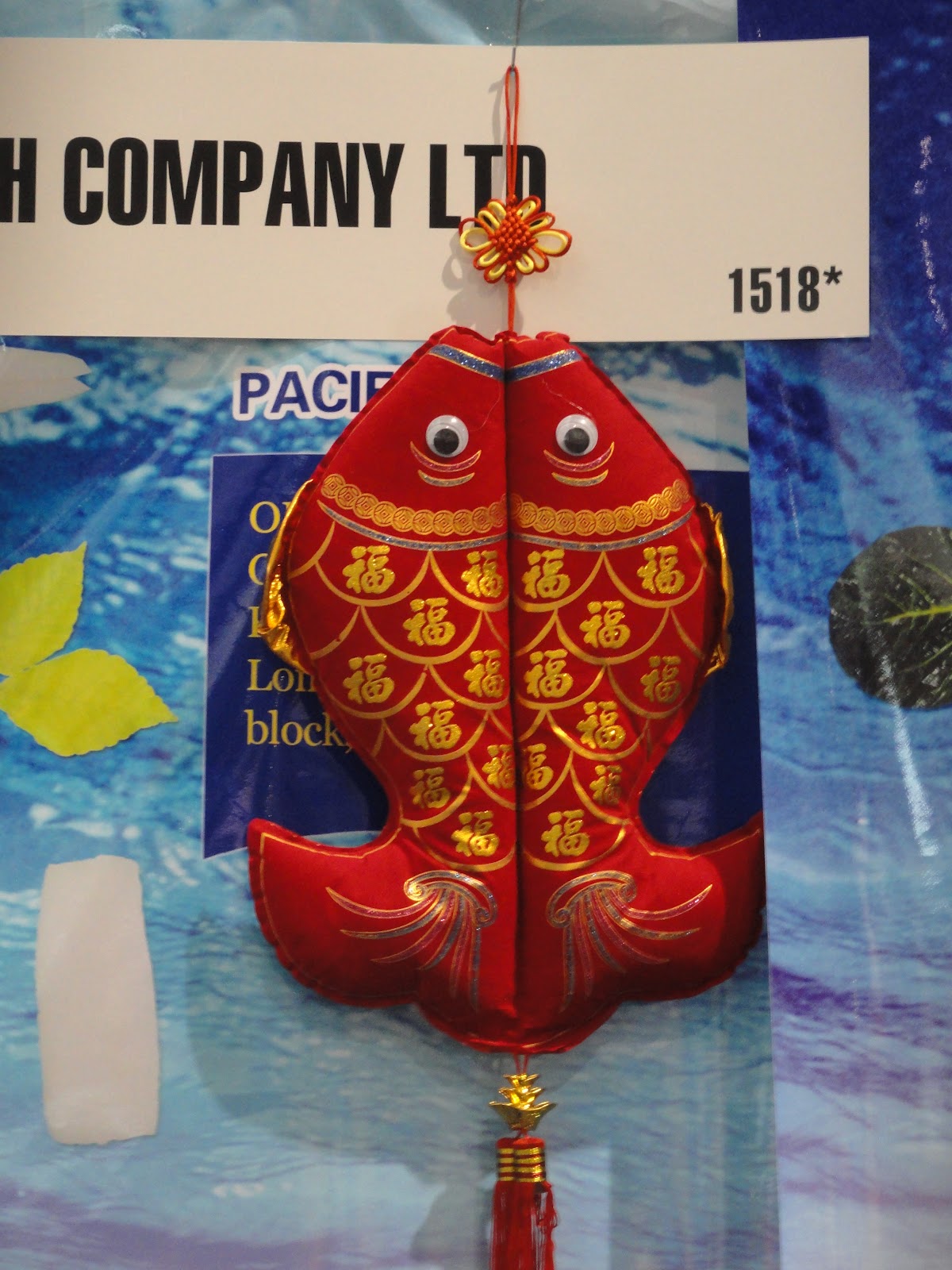
I just thought this decoration was cool.
This big boy weighs in at 16 pounds! Now that would be a feast.
What a Rave last night! I don't remember how I got all these different colored lipsticks all over my face.
"Sonny, true love is the greatest thing, in the world-except for a nice MLT - mutton, lettuce and tomato sandwich, where the mutton is nice and lean and the tomato is ripe."
Look at all that lobster meat. Don't you just want to dive in face first?
This is one big-ass crab! He could wrap his claw around you and you might as well then make out your will.
How come no one wanted to be the Shrimp Whisperer?
And the bottom fish lost the swimming race by a nose.
A Smart Car for Smarter Fish.
They look like blind, baby birds, their mouths open, hoping for mommy to give them a worm.
I am a stud muffin!
This is a trio of alligator products that are probably available locally. Cajun Swamp Chicken anyone?
Asian periwinkles.
These are fish bladders, which were extracted and processed in a Chinese factory. Supposed to be tasty but they didn't have any samples available.
Ping Pong tables in the Game Lounge.
I just thought this decoration was cool.
This big boy weighs in at 16 pounds! Now that would be a feast.
What a Rave last night! I don't remember how I got all these different colored lipsticks all over my face.
"Sonny, true love is the greatest thing, in the world-except for a nice MLT - mutton, lettuce and tomato sandwich, where the mutton is nice and lean and the tomato is ripe."
Look at all that lobster meat. Don't you just want to dive in face first?
This is one big-ass crab! He could wrap his claw around you and you might as well then make out your will.
How come no one wanted to be the Shrimp Whisperer?
And the bottom fish lost the swimming race by a nose.
A Smart Car for Smarter Fish.
They look like blind, baby birds, their mouths open, hoping for mommy to give them a worm.
I am a stud muffin!
Subscribe to:
Posts (Atom)

.jpg)