Showing posts with label newspaper. Show all posts

Thursday, September 17, 2026

National Monte Cristo Day: The Origins of This Delicious Sandwich

Happy National Monte Cristo Day! 

For over 100 years, the Monte Cristo has existed although the exact date of its invention is unknown. The sandwich holiday was established in 2015, by the Bennigan’s restaurant chain, to honor their own Monte Cristo sandwich, which is made with honey wheat bread, ham, roasted turkey, Swiss and American cheeses before it's batter-dipped, gently fried, and dusted with powdered sugar. It's also served with red raspberry preserves, if you wish to dip it. 

A Monte Cristo sandwich is essentially ham, turkey and Swiss cheese between two pieces of French toast, though there are plenty of variations across the country. For example, the cheese might be different, the sandwich might be grilled or fried, it may contain spicy mustard, it might be served with maple syrup, and so on.  

I've long been fond of the Monte Cristo, although I prefer it as a savory variation. I don't want it covered by powdered sugar or syrup. What makes it special to me is the French toast bread, a great vehicle for the ham, turkey and cheese, but which also would make an excellent vehicle for plenty of other fillings as well. I enjoyed such variations as pastrami and cheese, chicken cutlets, and cheeseburger, each of which was elevated by the use of French toast. We need more sandwiches with French Toast as the bread! 

No one seems to know the exact origins of the Monte Cristo though it's believed to be a variation of the French croque-monsieur, which is a grilled ham and cheese sandwich, with numerous variations, that was likely invented in the late nineteenth century. Literally translated, "croque monsieur" basically means "mister crunch." The sandwich became famous when it appeared at a French cafe, Le Bel Âge, owned by Michel Lunarca, in Paris around 1910. 

However, the croque-monsieur received almost no publicity in U.S. newspapers until about 1928, years after the Monte Cristo was created. The earliest reference I found to the croque-monsieur was in the Boston Evening Transcript (MA), April 11, 1908. There was an article about a lunch at a Paris restaurant, and one of the offerings was a croque-monsieur, for 50 cents, and the article noted, "We have no idea what croque monsieur or Orloff  veal might be,..."

The next reference was from The Reading Eagle (PA), August 29, 1915, which discussed local women contributing recipes to a cookbook intended to help Belgian war sufferers. One contributor provided a recipe for croque-monsieur. And then there no other newspaper references until 1928.


******************** 

Although most sources allege the Monte Cristo was created during the 1920s, it seems more probable it was created during the 1910s, and maybe the later half of that decade. The earliest reference I found to this sandwich was in the San Francisco Chronicle (CA), February 18, 1920, which printed a restaurant advertisement for Tait’s Downtown. The large ad detailed a Special After-Theater Supper, and listed numerous dishes of which you could choose two. Under Sandwiches, there was a mention of the Monte Cristo, although no explanation was given.

It also seems probable that the Monte Cristo originated in California, as all of the mentions of the sandwich during the 1920s and early 1930s indicated it was available in California, and there weren't any references to it being available elsewhere. A Hawaiian newspaper in 1929 provided a recipe for the Monte Cristo, but didn't indicate that any Hawaiian restaurants offered the sandwich. It's curious that no one has ever stepped forward to claim credit for inventing the sandwich. 

The Los Angeles Times (CA), May 24, 1924 and Sacramento Union (CA), June 6, 1924, both printed the same recipe for the Monte Cristo Sandwich, the first newspapers to do so. The sandwiches contained only American full cream choice and slices of boiled ham, and not any turkey. The sandwiches though were dipped in egg and fried. 

The San Francisco Chronicle (CA), May 11, 1927, published a restaurant ad which offered a Monte Cristo Sandwich for 50 cents, the same price as their Chicken Sandwich. 

A reader submitted a recipe for the Monte Cristo sandwich to the San Francisco Examiner (CA), May 23, 1927. This recipe was different from the previous one, using pimento cheese with boiled ham. In addition, it called for a tablespoon of cocktail sauce. It too was dipped in beaten egg and fried. 

The San Francisco Examiner (CA), May 27, 1927, provided another recipe, and also stated that the Monte Cristo was a “tearoom specialty.” This is the first recipe to use Swiss cheese with the boiled ham, although still no turkey. 

The San Antonio Light (TX), October 18, 1928, Omaha Morning Bee-News (NE), October 19, 1928, and El Paso Times (TX), October 20, 1928, all briefly mentioned, “Snapshots of Hollywood collected at random: Seena Owen and Mae Sunday gossiping over a Monte Cristo sandwich at the Montmartre café.”

The Los Angeles Evening Citizen News (CA), February 8, 1929, printed another recipe, called for a specific bread, the Langendorf Royal bread, a famous bread brand at that time. This recipe called for cream cheese, mashed with a little cream. It also asked for a slice of chicken or ham. Then, it's mentioned that it should be served with jelly or relish, the first time this addition is noted. 

The Los Angeles Times (CA), August 9, 1929,  provided a recipe almost exactly as they previously did on May 24, 1924, except this time they mentioned garnishing it with pickle slices. 

The Honolulu Star-Bulletin (HI), August 29, 1929, was the first non-California newspaper to provide a Monte Cristo recipe, but this was simply a copy of the one above from the Los Angeles Times.  

The San Jose Evening News (CA), May 5, 1930, had an advertisement for a Coffee Shop with a partial menu, including a Monte Cristo Sandwich for 50 cents. 

It wasn't until 1934, that it seems likely the Monte Cristo started being available outside of California. The Tulsa Tribune (OK), December 3, 1934, printed a recipe for the sandwich, provided by Chef Harry Micas. It was noted to be "an unusual sandwich," good for lunch or a midnight feast. First, the bread was covered in egg with milk or cream, and then fried. After that, the bread was topped with boiled ham, chicken meat and a slice of cheese. Finally, it was toasted under a broiler, and served with spiced apricot. This may be the first recipe calling for both ham and chicken (but not turkey). It's also the first that calls for milk or cream added to the egg before coating the bread. 

The Des Moines Tribune (IA), December 22, 1934, in an ad for Harvest Bread, provided a recipe from Herman, the Health Chef. The recipe called for Swiss cheese and slices of Baked Virginia ham, but no poultry. The sandwich was also to be dipped in beaten egg, "similar to the method of making French toast." Curiously, the sandwich was served with tomato sauce, which is definitely a rarity for this sandwich. 

The Los Angeles Times (CA), January 29, 1935, offered a recipe calling for Tillamook cheese and boiled ham. No poultry was included. 

The San Diego Union (CA), March 19, 1936, published a recipe which called for boiled ham, sliced chicken and Kraft's American cheese. It also called for Nuco, "for spreading," although I'm unable to determine what that was. It also called for Snowdrift, "for deep frying," and that was a vegetable shortening commonly used for frying. 

A brief mention in the Los Angeles Times (CA), June 7, 1936, noted, “Peter Lorre favors the Monte Cristo sandwich as an article of diet,..” Peter Lorre was a famous actor, having appeared in some classics such as Casablanca and The Maltese Falcon.

The Oakland Tribune (CA), September 20, 1936, discussed an upcoming Tribune Homemakers Forum, where Chef “Joe” Beyl of the Athens Club, would "present three of his most popular recipes for the late-supper menus: Lobster Thermidore, Monte Cristo Sandwich and Tomato Stuffed with Tuna.” 

The Sexton Cook Book for the Sexton Market (1937)
 by John Sexton & Co., printed a recipe, by Frank Hurliman, for the Monte Cristo Sandwich. It only called for ham and cheese, with the addition of tomato, which was maybe the first such addition.  

The Modesto Bee (CA), February 2, 1937, had its own recipe, and called for three slices of bread, making it more like a club sandwich. It called for boiled ham and cheese, as well as chicken, lamb, pork or turkey. The sandwich was then dipped in a blend of egg, salt, pepper, and milk before it was fried. This may be the first mention of the use of turkey for this sandwich.   

The Highland Park News-Herald (CA), March 26, 1937, also had a recipe calling for three slices of bread, but it only called for cheese and Hormel's spiced luncheon meat. It was also served with Iris Currant jelly.  

The Los Angeles Times (CA), November 25, 1937, also called for three slices of bread, with a layer of ham, topped with mustard, and a layer of turkey with mayonnaise. Curiously, the recipe didn't call for any cheese. 

There was an interesting article in a London newspaper, dealing with a Monte Cristo sandwich served at the Warner's Bros film studio. The Daily Mirror (London), May 3, 1938, had a Hollywood page where the writer mentioned, “I often go to lunch at Warners,…because there is something on the menu there which I have never met anywhere else. It is called a Monte Cristo sandwich and it is no doubt very fattening and indigestible. But I keep on ordering it because I can never quite figure out how it’s made. It seems to be thin bread fried in a cheesy batter with thin slices of chicken and ham between. It is served on lettuce with a pickled peach and it is better and more elusive than it sounds.”

In a follow-up, The Daily Mirror (London), July 6, 1938, noted that Miss Gail Patrick, a famous actress who married the manager of the Brown Derby restaurant, had written down many of their best recipes. She provided the writer with their recipe for a Monte Cristo sandwich, which called for three slices of bread, ham, chicken and cheese. The sandwich pieces were set upon crisp lettuce, and a pickled peach was placed into the middle of the plate.  

The Modesto Bee (CA), December 17, 1938, ran an ad for the Schurra’s restaurant, which stated, “Try Our Monte Cristo Sandwich. Something New and Different.”

The Standard Star (NY), September 29, 1939, provided advice for visitors to Holloywood, including, “Food: One of the first things you have when in California is a Monte Cristo sandwich. It is delicious and substantial, I might add. It is a club sandwich affair which has sliced chicken, a layer of melted cheese and then one of ham. The concoction is then dipped in an egg batter and fried in a deep fat. The results are very tasty.”

The St. Joseph Gazette (MO), February 12, 1941, published an ad for a hotel, which offered “Ladies’ Lunches” and their special that day was “Hot Monte Cristo Sandwich, vegetable, potatoes, salad, dessert, beverage” for 45 cents. 

The Nevada State Journal (NV), September 17, 1942, ran an ad for a club which served supper snacks from 10:30pm to closing, including a Monte Cristo Sandwich for 75 cents. 

The Oregon Daily Journal (OR), January 18, 1948, published an ad for the Pago Pago restaurant, which had late evening specialties, including “The Monte Cristo Sandwich.”

The Minneapolis Star (MN), November 17, 1948, mentioned that local chef, Dale Kirkpatrick, named the Monte Cristo as his favorite. His recipe then called for only two slices of bread, with ham, cheese, and chicken or turkey. It was served with sweet pickle relish and potato chips.  

Monte Cristo sandwiches in Australia! Maybe the first newspaper mention of this sandwich in Australia was in The Mercury (Tasmania, Australia), June 2, 1949, which had this brief recipe, calling only for ham and cheese.  

The Galveston Daily News (TX), October 9, 1949, ran a restaurant ad, which offered a Monte Cristo Sandwich, Olives, Sliced Tomato, and Potato Chips, for $1.

Over the next decades, the Monte Cristo's popularity would continue to grow, although currently, the sandwich has decreased in popularity and much fewer restaurants offer it on their menus. It's time for the sandwich to make a come-back, was well as for other sandwiches to use French Toast as their bread.

As I've shown, the Monte Cristo likely originated in California during the 1910s, and it seems to have taken about 15 years for the sandwich to be created in restaurants in other states. However, recipes to make the Monte Cristo were presented in a number of newspapers across the country for home cooks to try. We also see that the nature of the sandwich varied over the years, and continues to come in a number of variations. We may never know exactly who invented the sandwich, but we owe that person a debt for creating such a delicious sandwich.  

Monday, August 26, 2024

The Origins of the Frozen Drumstick & Nutty Buddy

I've long been a fan of the Nutty Buddy, an ice cream cone, commonly filled with vanilla ice cream, where the top is covered in chocolate and nuts. When the ice cream truck showed up in the neighborhood, I might choose a Nutty Buddy. When I was growing up, there was only one kind of Nutty Buddy, but today, there are multiple variations, and they are also sometimes known by different names. 

Recently, I read on Facebook a claim about the alleged invention of the Nutty Buddy. As I did some additional brief searching online, I quickly learned that most sources claim that the Nutty Buddy was invented by the Seymour Ice Cream Company, located in Dorchester, Massachusetts, and that it was named after Charles "Buddy" Seymour, who was the treasurer of the company in the mid-1960s. Many sources also claimed that the term "Drumstick" came after the Nutty Buddy, and referred to the same ice cream treat. Other sources though have alleged there are slight differences between the two items.

However, after I conducted more in-depth research, I learned the truth. First, the existence of the Drumstick predated the Nutty Buddy, by about twenty years. Second, although the Nutty Buddy existed at least as early as 1950, it didn't show up in Massachusetts until the 1960s. Third, the evidence makes it clear that the Nutty Buddy was not invented by the Seymour Ice Cream Company.  

************

The Drumstick, usually referred to at the time as the "Frozen Drumstick," was created by I.C. Parker, an advertising or sales manager for the Pangburn Ice Cream & Candy Co. in Fort Worth, Texas. Pangburn was established around 1912, and was a pioneer ice cream factory in Texas, and five years later, they began manufacturing candy as well.

The Manufacturing Confectioner (July 1931) noted that I.C. Parker had received a trademark for "Drumstick," whose use had been claimed since March 11, 1931. The Official Gazette of the U.S. Patent Office (August 1931) also mentioned the "Frozen Drumstick," under #13,379, and that it was "For Ice Cream Product Consisting of an Ice Cream Cone Dipped in Candy Coating, Etc."

What was the Drumstick? The Abilene Daily Reporter (TX), April 13, 1931, mentioned that Pangburn had recently added a novelty feature to their offerings, the “Drumstick.” It was “a chocolate nut sundae in cone form—ice cream center with firm chocolate coat thickly covered with nut particles.” It then noted, “When slipped from its tidy Pangburn paper cover, the ‘drumstick’ looks mightily like a crispy browned chicken leg.” The article continued, “The novelty was introduced a few week ago in Fort Worth and is now on the wholesale ice cream delivery routes in Abilene.” 

The description is basically the same as the Nutty Buddy, so it's easy to understand the ancestry of the Nutty Buddy. 

The first advertisement, pictured above, for the Frozen Drumstick appeared in the Abilene Daily Reporter (TX), April 16, 1931. It noted that it was a "Chocolate Nut Sundae" and sold for 5 cents. Keep the picture in your mind as when ads for the Nutty Buddy arise, twenty years later, its picture is basically the same.    

Although the Frozen Drumstick began in Texas, only four months later, it started to appear in other states, starting with California. The News-Pilot (CA), August 7, 1931, published an ad for "Gibson’s Frozen Drumstick" which was “An Ice Cream Cone filled with Gibson’s Ice Cream and topped with nuts." It was also stated that it was “The latest and most delicious 5c seller on the market.”  The next day, another ad in the News-Pilot (CA), August 8, 1931, further described Gibson’s Frozen Drumstick as “An Ice Cream Cone filled with Gibson’s Ice Cream, Dipped in Chocolate, and topped with nuts.” 

The Contra Costa Times (CA), September 17, 1931, presented an ad for MacMarr Stores, which mentioned Frozen Drumsticks, described as “The newest ice cream confection—a hand rolled chocolate cone, heaping full of Dairyland Ice Cream, dipped in chocolate and crushed peanuts. Looks just like a chicken or turkey leg, and it costs only 5c.”

During the rest of the 1930s, there were ads mentioning the Frozen Drumstick in Alabama, Colorado, Idaho, Indiana, Iowa, Kansas, Kentucky, Maryland, Michigan, Missouri, Montana, Nebraska, New Mexico, North Carolina, Ohio, Oklahoma, Oregon, Pennsylvania, South Carolina, Washington, Wisconsin, and Wyoming. Interestingly, there weren't any references in any of the New England states. In fact, there wasn't a mention of the Frozen Drumstick in Massachusetts for at least 50 years.

The Santa Ana Daily Register (CA), February 9, 1939, published an ad for Sontag Drug Stores, noting that the Frozen Drumstick was “An ice cream nut sundae in a cone…ice cream, chocolate, nuts and cake! Something entirely new in a frozen confection.” This is the only ad to mention it contained cake, although other ads sometimes mentioned it was served in a "cake cone."

The Tri-Country Forum (MN), March 7, 1940, had an ad for Land O’Lakes Frozen Drumsticks, noting it was “A sugar cake cone cooked in chocolate—filled with Ice Cream—covered with chocolate and rolled in toasted nuts.”

The Ice Cream Field (May 1950), posted an ad for the Frozen Drumstick, with a picture of the drumstick. 

The Nutty Buddy finally appeared, nearly 20 years after the Frozen Drumstick! The Ice Cream Field, October 1950, published an ad for Flare-Tops, which sold Cake Cones and Cake Cups, and had 14 bakeries across the country, including the Eastern Baking Co., in Chelsea, MA, and the Maryland Baking Co. in Baltimore, MD. One of their products was the “Nutty-Buddy,” pictured above, looking exactly like a Frozen Drumstick. It appears this was just a different name for the Drumstick. 

The Statesman Journal (OR), April 6, 1951, had an ad for Piggly Wiggly, offering a “Nutty Buddy Ice Cream Cone” for 10 cents.

The Oregon Daily Journal (OR), May 18, 1951, published the above ad for Arctic Ice Cream, noting the Nutty Buddy, “A Chocolate Nut Sundae.” It comes “In an old Fashioned Honey Roll Sugar Cone” which is “Filled with Arctic Ice Cream Chocolate Coated Rolled in Nuts.” And the picture once again resembles those of the Frozen Drumstick.  

The Lewistown Daily New (Montana), August 2, 1951, had an ad for the Lewistown Market which stocked “Nutty Buddies.”

The Free-Lance Star (VA), October 17, 1951, had an almost exact ad to the previous Arctic Ice Cream ad in Oregon. 

The Town Talk (LA), April 25, 1952, published the above ad for a new store, Cree-Mee, which offered a "Nutty Buddy,” described as "A chocolate nut sundae in a crisp honey roll sugar cone." During the rest of the 1950s, other ads for the Nutty Buddy appeared in Alaska, Illinois, Louisiana, Maryland, Minnesota, Missouri, Montana, Nebraska, New York, North Carolina, Ohio, Pennsylvania, Texas, and Virginia. No ads for the Nutty Buddy appeared in Massachusetts during the 1950s.

On June 27, 1958, the Maryland Baking Company, of Baltimore, MD, filed with the U.S. Patent Office for the "Nutty Buddy, for Ice Cream Cones." They noted that the first use of the term was on or about October 6, 1949. This could not have occurred if the Seymour Ice Cream Company had actually invented the Nutty Buddy.

When did the Nutty Buddy first appear in Massachusetts? Not until 1962!

The North Adams Transcript, June 14, 1962, published an ad for Sealtest Ice Cream and their “Sealtest Nutty Buddy.” The ad noted, “All the goodness of a chocolate nut sundae in a crisp honey roll cone!”  

There was another ad in The Republican, October 28, 1965, for Cumberland Farms. It offered a 6-pack of Nutty Buddy, on sale for only 49 cents, 10 cents less than its regular price of 59 cents. There would be a number of additional Cumberland ads during the later 1960s mentioning the Nutty Buddy. 

There weren't any articles or advertisements during the 1960s which connected Seymour Ice Cream Company and the Nutty Buddy. Their alleged invention of this ice cream treat appears to be merely a myth.

The blog of the Dorchester Historical Society had some interesting information about this issue, including a statement by Paul Samuelian, whose family started Seymour Ice Cream. Paul claimed "Some where in the 1960’s the “Nutty Buddy” was born named after Buddy Seymour who was my Great Uncle Mike’s son." Clearly this claim is false as the Nutty Buddy has been around since at least 1950. And there is no other evidence that indicates Seymour invented it.  

However, the blog also had a line which might be more indicative of the truth. It stated, "The Seymours Ice Cream Company had the sole franchise in New England to manufacture the Nutty Buddy product from the Sweetheart Cup Company." This indicates Seymour didn't invent the Nutty Buddy but instead received a franchise from another company to produce them in New England. If Seymour had invented it, they would have been the ones offering franchises to other companies. This certainly makes much more sense when we consider the history of the Nutty Buddy. 

In addition, I previously mentioned that the Maryland Baking Company had filed with the U.S. Patent Office for the Nutty Buddy. The Maryland Baking Company was connected to the Sweetheart Cup Company, so they obviously could have sold franchises to ice cream companies to produce the Nutty Buddy. And that is most likely what happened with the Seymour Ice Cream Company. They did not invent the Nutty Buddy.

Do you enjoy the Nutty Buddy?

Friday, January 6, 2023

The Origins of American Goulash

Is American Goulash the same as American Chop Suey? What are the origins of American Goulash?

While researching my article, The Origins of American Chop Suey, and after it was published, there were those, especially in the Midwest, who stated that the dish of American Chop Suey was known to them as American Goulash, or simply goulash. The three main basics of this dish include ground beef, macaroni and tomato sauce, with some variation of other ingredients. 

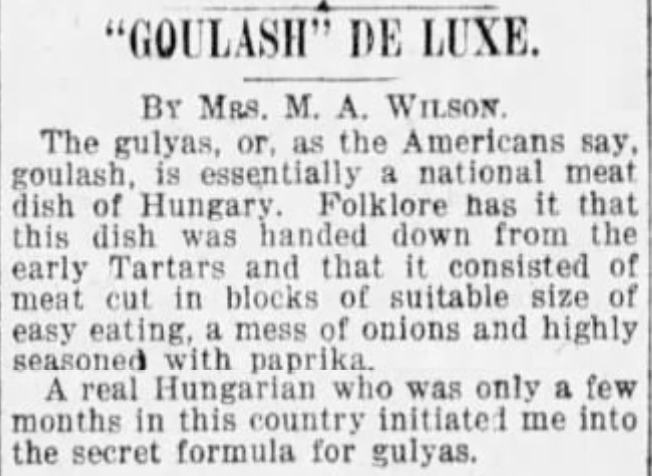
Obviously, American Goulash owes its ancestry to Hungarian Goulash, known in Hungary as gulyás, but the two dishes are very different in a number of ways, especially the modern version of American Goulash. The Hungarian version is more of a soup or stew, consisting of meat and vegetables with a variety of seasonings, including paprika. The modern versions of American Goulash are more like a casserole, and often do not include paprika.  

Most sources claim that the earliest printed recipe for American Goulash was from 1914, but my own research has uncovered recipes from as early as 1909. In addition, the early recipes for this dish are very different from the modern version, slowly evolving over time to its present form. It's also interesting to note that this dish was known all across the country, and wasn't limited to just the midwest. It might currently be thought of as more of a regional dish, but it certainly didn't begin that way. 

The first printed recipe I found for American Goulash was from California in 1909. The Morning Union (CA), January 16, 1909, printed the recipe above, and as can be seen, it called for a sirloin steak, cubed, rather than the usual ground beef. The recipe also called for carrots, rice, tomatoes, celery and optionally an onion. No paprika was included. This certainly is not like the modern version of goulash. 

I'll also note that the first recipes for American Chop Suey, which differed significantly from Chinese Chop Suey, were from 1908. One of those recipes called for ground beef, spaghetti, and a can of tomatoes, a clear ancestor to the modern versions. 

However, later in 1909, a different American Goulash recipe appeared. First appearing in the San Antonio Light (TX), June 13, 1909, the recipe also appeared in the Boston Herald (MA), July 2, 1909, Star-Gazette (NY), August 2, 1909, Evening Chronicle (NC), August 7, 1909, Cincinnati Post (OH), August 17, 1909, and the Jersey Journal (NJ), August 5, 1909. This recipe called for "beef cakes" (basically ground beef) and spaghetti, but no tomatoes or paprika. Again, this recipe doesn't reflect the modern versions of goulash. We also see that American Goulash was known throughout the country, from Texas to Massachusetts, New York to North Carolina, Ohio to New Jersey.

In 1910, the first recipe for American Chop Suey appeared which used ground beef, tomatoes and macaroni appeared. When would the first recipes of American Goulash ask for macaroni?

In Mexican Cooking: The Flavor of the 20th Century (1911), there was a recipe for American Goulash, called for cubed beef, chili powder, bacon, onions and garlic, but no pasta or tomatoes. 


The Denver Post (CO), June 19, 1913, offered another American Goulash recipe, although it called for mutton rather than beef. It also called for rice and tomatoes, as well as carrots, and optionally onions. Again, this is not a similar dish to the modern version.


As I mentioned previously, most sources claim the first printed recipe for American Goulash was in 1914, from The Woman's Educational Club Cook Book (1914) by the Women's Educational Club of Ohio. And as I've shown, this claim isn't true as there are other recipe extending back to 1909. This cookbook had two recipes, one for Goulash and one for American Goulash. The two recipes are fairly similar, although I'll note neither recipe called for pasta. The American Goulash recipe also called for paprika, as well as tabasco.

By 1914, recipes for American Chop Suey were published in Illinois, Nebraska, Indiana, New Jersey and California which all called for the use of ground beef, macaroni, and tomatoes. American Goulash recipes still hadn't called for the use of these three ingredients, so it's also clear that American Chop Suey was the ancestor to modern versions of American Goulash. 

The Omaha Daily News (NE), May 23, 1916, printed this recipe, which called for veal rather than beef, and didn't include tomatoes, rice, or pasta. 

The Boston Journal (MA), June 27, 1917, had a recipe which also didn't include tomatoes, rice, or pasta, but it did call for paprika. 

Another recipe was presented in the Rutland Daily Herald (VT), August 1, 1917, as well as the Middletown Times-Press (NY), August 1, 1917. This recipe called for both chopped pork and beef, as well as rice and spaghetti, plus strained, stemmed tomatoes (or tomato soup). 

A number of newspapers would print restaurant ads, which offered American Goulash dishes. The San Antonio Light (TX), October 6, 1917, had an ad offering American Goulash with "Paprica" for 25 cents. The Portage Daily Register (WI), November 28, 1917, noted a restaurant's Thanksgiving  menu with American Goulash as one of the dishes. The Times (LA), August 17, 1918, had a cafeteria ad with American Goulash as a lunch entree. The St. Louis Stars & Times (MO), October 17, 1918, printed a supermarket ad offering American Goulash with vegetables for 25 cents. 

The Billings Gazette (MT), November 13, 1918, noted a luncheon special of American Goulash with macaroni. This was the first reference I found mentioning macaroni in connection with American Goulash. The Billings Gazette (MN), October 23, 1920, had another restaurant ad, offering American Goulash with Spatzen. 

The Fresno Morning Republican (CA), February 25, 1920, printed a restaurant ad, with menu items including American Goulash tagliarini. The Detroit Free Press (MI), April 2, 1912, presented a restaurant ad with American Goulash for 35 cents. The Oroville Daily Register (CA), July 30, 1921, had a restaurant ad with American Goulash Canape, while their August 5, 1921 issue had a similar ad but with American Goulash with Stars and the September 14, 1921 issue had American Goulash with Home Made Noodles. 


The Kansas City Star (MO), August 25, 1921, had a brief article, with a recipe, on Hungarian goulash. This makes an interesting comparison to the American Goulash variations I've already presented.  


The Portland Evening Express (ME), February 3, 1923, presented recipes for American Goulash and American Chop Suey, which make for an excellent comparison. As you see, the Goulash recipe didn't include the use of pasta, while the Chop Suey recipe called for spaghetti or macaroni. The Goulash recipe also called for kidney beans, although that was the first use of that ingredient I'd seen in these recipes. The American Chop Suey recipe is basically like the modern version, but the Goulash recipe still hasn't reached that point in its evolution.  

The Buffalo News (NY), March 14, 1923, and the Long Beach Telegram (CA), April 20, 1923, offered another recipe, which also included the use of kidney beans. It didn't call for the use of spaghetti or macaroni, but stated you could add rice to vary the flavor. 

The San Antonio Light (TX), March 23, 1923, and Oregonian (OR), July 8, 1923, printed a different American Goulash recipe. Once again, the recipe does not call for rice, spaghetti or macaroni, or even tomatoes. 


The Evening Star (D.C.), October 22, 1924, presented another recipe for American Goulash, similar to some prior ones, which included the use of kidney beans, tomatoes, cayenne and pepper, but not the use of spaghetti or macaroni. 

A similar recipe was then presented in the Richmond Times Dispatch (VA), March 5, 1926. Still no spaghetti or macaroni.

Pasta! The Coos Bay Times (OR), June 21, 1928, published this recipe and it included the use of spaghetti and tomato soup. This is the most similar recipe to the modern version, except for the use of spaghetti rather than macaroni.  

But the use of spaghetti was far from the norm at this point. The Daily News (PA), November 21, 1928, offered this recipe, which also called for potatoes and tomato soup but no pasta. 

Again, kidney beans were called for in this recipe in La Belle Star (MO), February 1, 1929. And there was no spaghetti or macaroni.

A similar recipe was in the Brooklyn Times Union (NY), February 5, 1929, and again, no spaghetti or macaroni was used.

Another similar recipe in the Boston Globe (MA), February 8, 1930. We also see from the last few recipes that American Goulash was known in Massachusetts, New York, Missouri, Pennsylvania and Oregon. It certainly wasn't a regional dish. 

The Record (NJ), March 10, 1932, offered a slightly different recipe, which called for spaghetti. It also called for carrots, onions, and the use of Worcestershire sauce. 

Macaroni! The Democrat & Chronicle (NY), April 6, 1936, presented the first American Goulash recipe that used macaroni. This was 26 years after the first recipe for American Chop Suey used macaroni. However, this Goulash recipe didn't use tomatoes, making a creamy sauce with butter, flour and milk. This recipe was reprinted in the Abilene Daily Reporter (TX), April 17, 1936, The La Belle Star (MO), May 15, 1936, The Commercial Appeal (TN), May 29, 1936, The Missourian (MO), June 18, 1936, and The Morning Call (PA), October 16, 1936. 

The Pittsburgh Sun-Telegraph (PA), November 15, 1938,
also published a recipe calling for macaroni, but also using tomatoes. This is essentially the modern version, that which is also known as American Chop Suey. 

During the 1940s, recipes for American Goulash continued the use of ground beef, tomatoes, and macaroni, although still with some variation. Some recipes still called for kidney beans, while others offered the option of rice instead of macaroni. Recipes also continued to be published all across the U.S,, including as far as Hawaii. There was no indication in any of these recipes that American Goulash was a regional dish. For unknown reasons, over time, the term "American Goulash" became much more commonly used in the Midwest, although its origins extended all across the country. 

American Chop Suey, the version with ground beef, tomato sauce and macaroni, clearly predated, by over 25 years, that of American Goulash. Goulash also appears to have followed a similar path to American Chop Suey, from first, no use of rice or pasta, to second, the use of rice, and finally, the use of pasta. However, it took Goulash much longer to make that evolution than it did American Chop Suey.