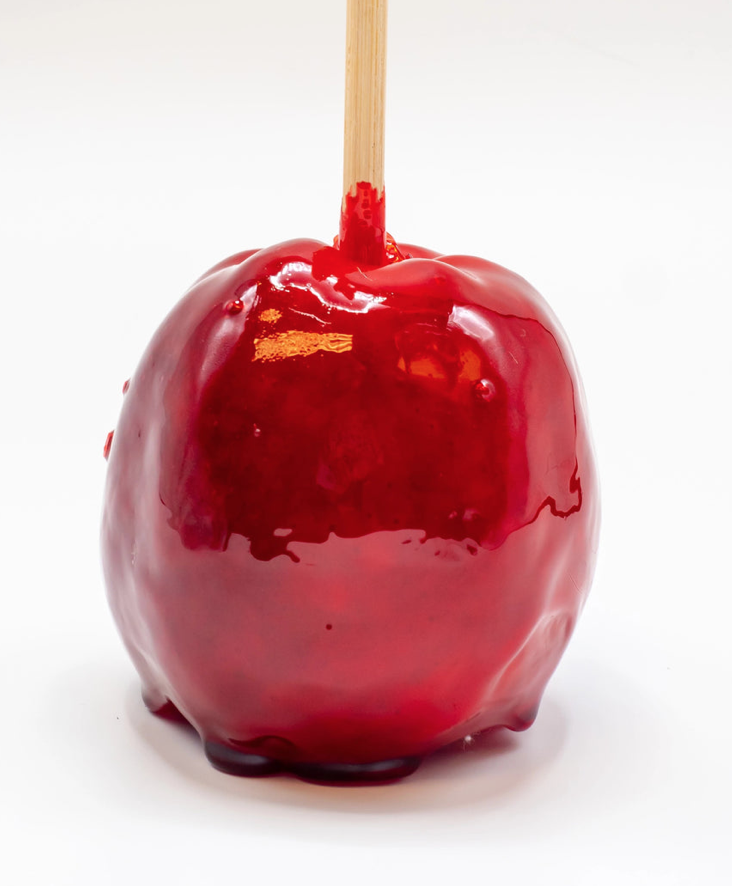
Before we get into a discussion of the merits of each type, let's examine their origins and history.
Most sources claim that red candy apples were invented first, by William Kolb, a candy-maker in Newark, New Jersey around 1908. Based on my own research, that origin tale is false, as candy apples existed prior to 1908, at least as far back as 1898. Sources also claim that caramel apples were first developed by Kraft Foods in the 1950s. That again seems to be false, as they existed as far back as 1904, although Kraft might have helped popularize them.
Although I found multiple references to "candy apples" in 19th century newspapers, the vast majority of the references weren't specific enough to identify their actual nature. Some of the 19th century references also seemed to indicate that a number of the references to "candy apples" were merely a type of candy, and not what we think of when we think "candy apple."
For example, in the Hartford Courant (CT), November 26, 1896, there was a reference to "candy apples" but they were described as "... all of the colors of the rainbow, each was as large as a marble, and all were mounted on sticks." The article seems to indicate they were a type of candy, and didn't include any actual apples.
However, I was able to find multiple, specific and detailed references to candy apples which predated their alleged invention in 1908. The earliest reference I've found so far is from the New York Herald (NY), September 17, 1898, which noted, "In some parts of the town may be found at this season a confection called apple-on-a-stick, a small apple that has been impaled by a stick three or four inches in length and then dipped in candied sugar, the stick serving as a handle to hold the apple by in eating it." The article continues, "The candied sugar is perhaps colored red; it is flavored maybe with cinnamon." They were sold for one cent each. It then concluded, "Standing in rows in a shallow pan in a confectioner's window, they present an inviting appearance, and they meet with a ready sale. Apples-on-a-stick are only sold in the fall."
However, I was able to find multiple, specific and detailed references to candy apples which predated their alleged invention in 1908. The earliest reference I've found so far is from the New York Herald (NY), September 17, 1898, which noted, "In some parts of the town may be found at this season a confection called apple-on-a-stick, a small apple that has been impaled by a stick three or four inches in length and then dipped in candied sugar, the stick serving as a handle to hold the apple by in eating it." The article continues, "The candied sugar is perhaps colored red; it is flavored maybe with cinnamon." They were sold for one cent each. It then concluded, "Standing in rows in a shallow pan in a confectioner's window, they present an inviting appearance, and they meet with a ready sale. Apples-on-a-stick are only sold in the fall."
This article would be reprinted in newspapers in Pennsylvania and West Virginia.
The St. Louis Republican (MO), November 5, 1900, published an article about local candy shops that were lowering their prices. It also mentioned that one of the shops had introduced a "Russian delicacy." The article continued, "The new thing was candied apples on a stick. The apples were raw but the candy was red and sticky, and altogether winning." A competing candy store quickly learned how to create these candied apples, and the price dropped from 3 for a nickel, to one penny each, and finally to 2 for a penny.
Death by candy apple! The Jersey Journal (NJ), August 22, 1903, reported that the Deputy Health Inspector had prepared a report for the Mayor of the current health danger of apples-on-a-stick. These apple sticks, which cost one cent, had been prepared with contaminated milk, leading to a number of infantile diseases, such as dysentary, marasmus, and summer diarrhea. The free dispensaries issued 715 prescriptions in one week due to these tainted candy apples, and all sales of such apples were then prohibited.
As a follow-up, the Jersey Journal (NJ), September 21, 1909, noted that stores were once again selling apples-on-a-stick, and it was said a confectioner shop was selling 300 a day.
The Buffalo Evening News, July 19, 1904, provided a recipe for a "candy apple" that stated "place apples pierce with bits of wood (like skewers) where the stems had been. These are placed in a pan and covered with a common brown taffy." This isn't a red candy apple but seems more similar to the caramel apple, as it was covered with a softer coating.
There was another reference to a red candy apple prior to 1908, in The Times Herald (MI), December 9, 1905, which published an article about the holiday season and mentioned "Red candy apples for the holiday time may be easily made at home by dipping small perfect apples in a bath of hot candy colored a brilliant red."
As for caramel apples, I found a recipe which extends back to 1904, decades earlier than Kraft's alleged invention, although it didn't include a stick. The Kansas Agitator (KS), November 25, 1904, printed a recipe for "Caramel Apples" and stated, "Steam sufficient pared and cored apples, and when cold, pour over them a thick caramel sauce....Whipped cream improve them, but is not necessary."
The Minnesota Journal (MN), January 27, 1908, also had another recipe for Caramel Apples, but again no stick was required. Their recipe though added nuts to the caramel sauce on the apples. The Osawatomie Globe (KS), March 12, 1908, included the same recipe but added some introductory comments, noting "Caramel apples are a dainty dish served at a Boston restaurant which caters to the feminine taste." That recipe, with the introduction, would be reprinted in numerous newspapers across the country.

The stick appears! The Seattle Star (WA), October 2, 1931, provided a recipe for a caramel apple, as a Halloween treat, and the apple was put on a stick. The apple was covered in caramel, without any nuts or other toppings. The Nebraska Farm (NE), October 21, 1931, noted that, due to Halloween, "All over the country, children are making apples-on-a-stick." The article provided a recipe for a caramel apple on a stick, but also covered with shredded coconut. So, it is also clear that caramel apples weren't created by a Kraft employee in the 1950s.
Candy apples, with their distinctive red candy shell, are usually made with a flavored boiled sugar recipe, while Caramel apples are covered with melted caramel. There's a huge textural difference between the two, one with a hard outer shell and the other with a gooey exterior. The popularity of each varies across the country, though I've been noticing over the last several years, to my dismay, an increase in the ubiquity of caramel apples locally.
I love red candy apples, especially covered with coconut. It's often a challenge to take that first crunchy bite into the hard shell, but it's rewarding. With a fresh, crisp apple, the candy, coconut and fruit make for a very appealing treat. For me, the caramel apple fails. I love caramel, from a nice sweet sauce atop ice cream to a salted, gooey center of a dark chocolate. But I don't like its soft gooey texture on a caramel apple. It's too soft, and just doesn't seem complementary to the crisp, juicy apple. Plus, maybe it's also a bit sentimental, as growing up I most often enjoyed red candy apples.
Why has the popularity of red candy apples waned? What is behind the rise of caramel apples? I don't have answers to these questions but I want to be able to more readily find red candy apples. Where are they hiding?
Do you prefer red candy apples or caramel apples? And why?
(This article has been revised/expanded from a prior article)


No comments:
Post a Comment