I am back again with a new edition of Thursday Sips & Nibbles, my regular column where I briefly highlight some interesting wine and food items that I have encountered recently.
**********************************************************
1) Bistro du Midi’s Executive Chef Robert Sisca and his team announce the debut of Chef’s Table 100, the latest addition to their upstairs dining room. Chef’s Table 100 offers exclusive open views of the Bistro du Midi kitchen and is an intimate culinary adventure. Guests can now experience off menu dishes and techniques of modern Provençal cuisine.
“I am delighted to unveil Chef’s Table 100 for guests of Bistro du Midi,” says Executive Chef/Partner Robert Sisca. “This new addition to our dining room allows me to interact with guests in a more intimate setting while presenting tasting menus comprised of new techniques and modern Provençal ingredient-driven creations.”
Chef’s Table 100 features both five and seven course tasting menus that are curated to satisfy the most discerning gastronome. The tasting menus showcase Chef Robert Sisca’s latest culinary muses. The Tour de Cinq is the five course tasting menu, priced at $85 per person. The Tour de Sept is the seven course tasting menu which includes additional courses of fresh pasta and foie gras, priced at $115 per person. More adventurous gourmands can elect to add additional courses such as a cheese selection ($15/person) and seasonal freshly shaved truffles ($50/person).
The Tour de Cinq and Tour de Sept tasting menus allow guests to experience menu items not yet available on the regular Bistro du Midi menu, and those which utilize techniques that Chef Robert Sisca has most recently perfected such as smoked Beau Soleil oysters, grilled Spanish octopus with eggplant caviar, and lobster and corn chowder cappuccino.
Chef Robert Sisca can also craft a menu to accommodate the dietary requirements and allergies of his guests. Additionally, Head Sommelier Todd Lipman plays an integral role in the Chef’s Table 100 adventure as he tailors the beverage experience closely with the desires of his guests.
Chef Robert Sisca also provides guests with personalized take home menus to commemorate their time at Chef’s Table 100. Reservations at Chef’s Table 100 are available nightly and can accommodate two to four guests by reservation only.
For reservations, please call 617-426-7878.
2) Beverage Manager John Mayer and the staff from Local 149 kick off their annual Tiki Week on Monday, August 19 to Sunday, August 25. Local 149 invites guests to celebrate the warm weather with a tropical experience accompanied by lively entertainment, karaoke, trivia, Polynesian dishes, umbrella drinks and tiki torches. Throughout the week, guests can sip on lively libations such as: My oh Mai-Tai, Singapore Sling, Painkiller and Dave’s Doctor Funk. To accompany the tropical drinks, Local 149 will be offering additional themed items like Malaysian Wings, Crab Avocado Salad, Coconut Panna Cotta and Hawaiian Pizza with Banana Peppers.
Below is a listing of the specialty dishes Local 149 will showcase for each day of the week:
Monday: Lamb Burger with Grilled Pineapple
Tuesday: Tuna Poke with Macadamia Nuts (addition)
Wednesday: Spam Porchetta
Thursday: Spam Wellington with Maraschino Cherry Stuffing
Friday: Tiki Tacos
Saturday: Hawaiian Gnocchi
Sunday: Pig Roast
Reservations can be made by calling the restaurant directly at 617-269-0900.
3) On September 10, from 6pm-9:30pm, the East Broadway Foodie Crawl will open the doors of fifteen local establishments in Somerville to allow ticket holders to taste their way through the East Broadway Business District. The District has restaurants from Vinny’s Restaurant, a Sicilian mecca, to Fasika Ethiopian, for authentic Ethiopian.
East Somerville Main Streets led 1,000 people on this cultural crawl last year – and this year promises to be even better with not only tasty bites but entertainment along the way. The 2013 crawl will include performances by professional magician Matias Legier, on site caricatures from Alejandro Yegros, and free local restaurant guides from Shape Up Somerville. And the event has a mission to boot. East Somerville Main Streets is committed to building a safe, sustainable and prosperous multicultural community by developing a vibrant business district at the neighborhood’s heart – all proceeds from the event will forward this goal.
Topping off this tasty affair are three after parties with local desserts and live music. Other local businesses including local Mezzo Design Lofts, Assembly Row and the Holiday Inn will be on site as well. Crawlers can check out Assembly Row’s portable “MBTA car,” which marks the addition of an orange line T stop to the area, and tastes from the Holiday Inn’s new DRAFT restaurant.
Tickets for the Foodie Crawl are on sale now here. You can buy them for $20 online and $25 at the door if there are still tickets.
4) On Saturday, August 31, from 1pm-5pm, the Wine Connextion invites everyone to celebrate a Summer End Bash, sipping on warm-weather wines while snacking on pulled pork BBQ sandwiches. Guests will be able to taste a selection of wines that will not only compliment a variety of budgets but are sure to please a range of palates. As always, the Wine ConneXtion’s weekly tastings are complimentary.
5) 29 Sudbury, located west of Boston, is now open! A collaboration between Greg Hill and Evan Deluty, 29 Sudbury serves Chef Deluty’s award-winning modern American cuisine with Italian influences (think: fresh pastas, coal-fired pizzas, and an all-local raw bar) in a bi-level space that blends modern finishes with historical elements in a style dubbed “funky colonial.”
“Having been a lifelong resident of Stow, it’s always been my dream to open a restaurant nearby that perfectly replicates the Boston dining experience – but without the hassle of driving into the city,” says Managing Partner Greg Hill. “From Evan’s menu, to the craft cocktail program, local beer selection, unparalleled wine list, and sophisticated, yet casual design of the space, we’ve done just that.”
Executive Chef Evan Deluty, chef/owner of Stella, infuses his modern American menu of appetizers, salads, coal-fired pizza, and entrees with Italian flavors and preparations. In addition to a raw bar featuring all local seafood, crustaceans, and mollusks, the menu at 29 Sudbury includes the following sampling of dishes:
· Crispy Fried Artichoke Hearts with Country Mustard Remoulade
· Lemon Arancini with Spicy Tomato
· Local Sausage Pizza with Banana Peppers and Fresh Mozzarella
· Rigatoni Bolognese with Reggiano (a Stella staple)
· Linguine, Asparagus Cream, Poached Egg, Truffle, Thyme
· Pork Milanese with Pomodoro, Buffalo Mozzarella, and Basil Oil
· Swordfish “Siciliano” with Capers, Red Onion, and Roasted Potato
Deluty says. “We’re excited to work with local producers like Erickson’s Dairy in Maynard, who are producing tiramisu ice crean exclusively for 29 Sudbury’s dessert menu.”
29 Sudbury’s beverage program looks to local, handmade ingredients and producers. Classic cocktails like the Moscow Mule served in a copper mug are offered alongside signature creations like the Blueberry Collins (Cold River Blueberry Organic Vodka from Maine, fresh lemon, soda) and the 29 International (Elderflower Liqueur, Aperol, Prosecco). The wine list, which includes bottles from both Old and New Worlds, features more than 25 varietals by the glass and more than 100 by the bottle. The beer selection offers domestic and imported bottles, drafts, cans, and large-format bottles.
29 Sudbury is now open for dinner and drinks daily, 4pm-1am. Lunch and weekend brunch to begin this fall.
Thursday, August 15, 2013


Wednesday, August 14, 2013
Strega Prime: A Brief Lunch Review
Opened for less than two weeks, Strega Prime, located in Woburn at the site of the former Beacon Grille, is Nick Varano's third restaurant. Strega Prime is intended to be an upscale Italian steakhouse and it seems to fit that objective. I recently ate lunch there and will provide my thoughts though please keep in mind that the restaurant is newly opened and needs time to iron out the initial kinks that all new restaurants face.
Though it maintains a similar basic layout to the Beacon Grille, there have been some changes to the decor, from the "cow hide" bar stools to the multiple TV screens in the main dining room showing black & white movies.
Their wine list is extensive, with over 1300 selections, but it is pricey. For example, the Caymus Conundrum, at an average retail of $20, is on their list for $65. A 3 1/2 times markup on the retail is huge, especially considering the true markup is even higher. "Upscale" shouldn't mean that wine prices are at such a high markup, catering to businessmen on expense accounts.
The Lunch menu is broken into Raw Bar, oysters or shrimp, ($14), 3 Salads ($7-$12), 2 Soups ($6-$7); 4 Appetizers ($9-$14), 3 Sandwiches ($12-$14), 3 Lunch Salads ($14-$18), 4 Lunch Specials ($14-$26) and 6 Desserts ($8-$9). For example, you could start with a Hand Chopped Beef Tartar ($9) and then get a 12 oz. Sirloin Burger ($14) with Parmesan Frites. Or a Shrimp Caesar Salad ($18) or even a Grilled Chicken Club ($12)
 Lunch begins with a warm Popover, which though some see them as old-fashioned, I still enjoy. This was a nice popover, with what seemed like a dusting of parmesan atop it, and I smeared butter all along the eggy inside. A good start to lunch.
 I then began my meal with the New England Corn & Clam Chowder ($6) which has crispy pancetta and parsley butter. Though it had a pleasant taste, and plenty of corn, lots of onions and tiny potatoes, it seemed to lack many clams. What clams seemed to be present were minced to tiny, almost unidentifiable pieces. It seemed like far more of a corn chowder, with some clam flavor, and not quite what I was expecting.
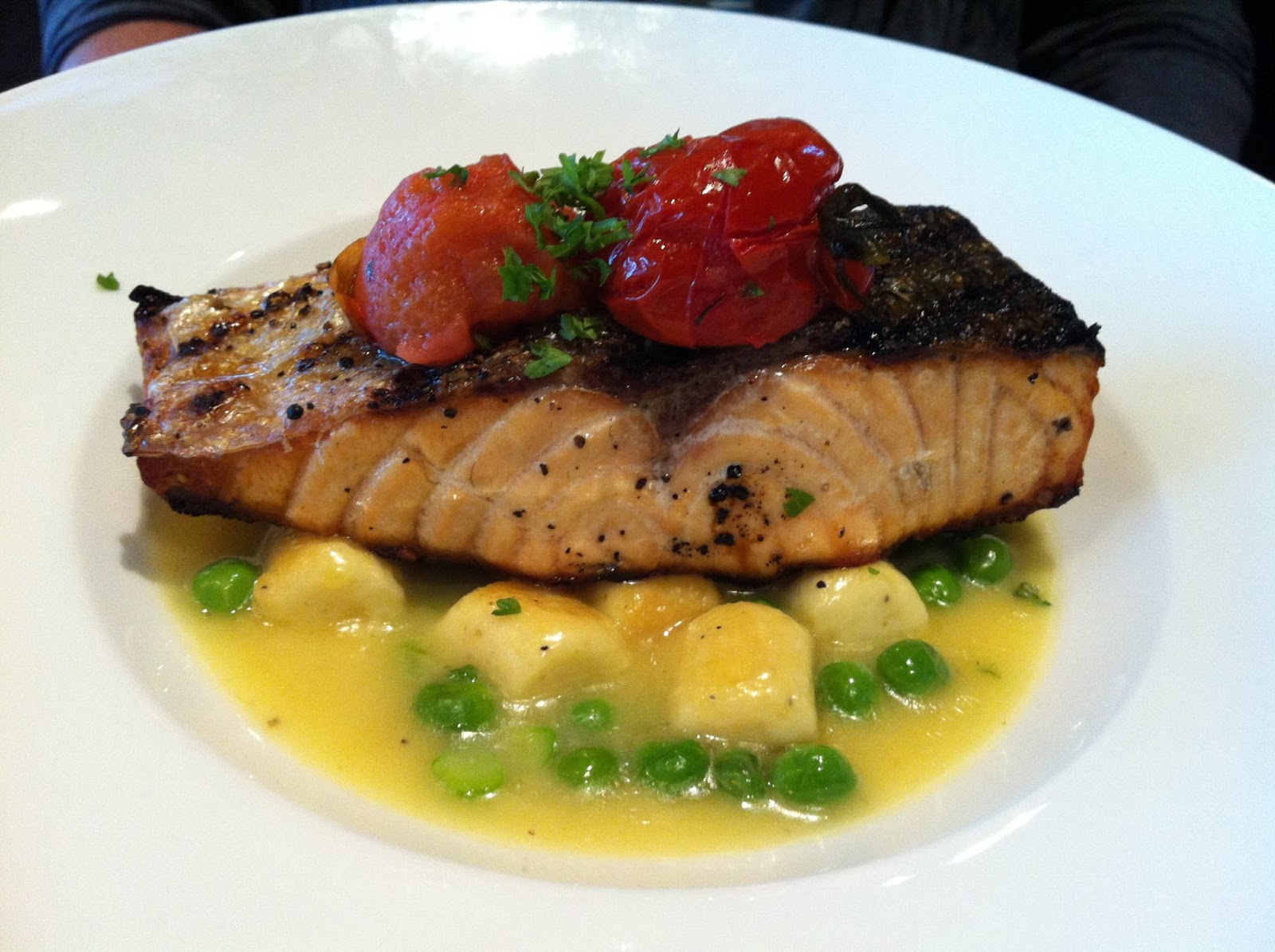
 The Grilled Salmon ($19) comes with Yukon gnocchi, fresh peas, cherry tomatoes, and is in a white wine sauce. The large piece of fish was cooked well, and was tender and flavorful, complemented by the light white sauce. The gnocchi were well made, pillowy and tender. A good lunch choice.
 The Chicken Milanese ($16), with capers, tomatoes, and baby arugula, has a light Marsala sauce which adds flavor to the chicken without swimming in it. It was a substantial piece, with moist, tender chicken covered by a crisp & clean coating. I was impressed with this dish and would order it again. Highly recommended for lunch.
 For dessert, the Italian Smores ($9), with gianduja budino, marshmallow, & pizzelle, makes a cool presentation. It is also tasty, with rich, smooth chocolate, covered by sweet marshmallow, with a caramelized crust. You can either take your spoon to the chocolate and marshmallow, or smear it on a pizzelle. It is large enough to share, and I am sure both of you will enjoy it.
There were a couple services issues initially, basically a server who didn't pay attention to what told to him. In addition, another server was apparently soaked in a strong cologne and every time he passed by the table, you couldn't help but have your nose assailed by his cologne, detracting from lunch. These are issues though which hopefully will be fixed in the near future as the new restaurant works out its initial kinks.
I'll return here and report back on the progress of Strega Prime.
Though it maintains a similar basic layout to the Beacon Grille, there have been some changes to the decor, from the "cow hide" bar stools to the multiple TV screens in the main dining room showing black & white movies.
Their wine list is extensive, with over 1300 selections, but it is pricey. For example, the Caymus Conundrum, at an average retail of $20, is on their list for $65. A 3 1/2 times markup on the retail is huge, especially considering the true markup is even higher. "Upscale" shouldn't mean that wine prices are at such a high markup, catering to businessmen on expense accounts.
The Lunch menu is broken into Raw Bar, oysters or shrimp, ($14), 3 Salads ($7-$12), 2 Soups ($6-$7); 4 Appetizers ($9-$14), 3 Sandwiches ($12-$14), 3 Lunch Salads ($14-$18), 4 Lunch Specials ($14-$26) and 6 Desserts ($8-$9). For example, you could start with a Hand Chopped Beef Tartar ($9) and then get a 12 oz. Sirloin Burger ($14) with Parmesan Frites. Or a Shrimp Caesar Salad ($18) or even a Grilled Chicken Club ($12)




There were a couple services issues initially, basically a server who didn't pay attention to what told to him. In addition, another server was apparently soaked in a strong cologne and every time he passed by the table, you couldn't help but have your nose assailed by his cologne, detracting from lunch. These are issues though which hopefully will be fixed in the near future as the new restaurant works out its initial kinks.
I'll return here and report back on the progress of Strega Prime.
Tuesday, August 13, 2013
Changes At Posto: An Updated Review
Change has come to Posto and the intended objective is to make the restaurant even better than before. I have long been a fan of Posto so I was intrigued to see what the changes would bring. Last week, I was invited to a media dinner to check out some of those changes, and speak to them about what else might be coming for Posto. I am pleased to say that the quality of the food remains as high as ever.
 Joseph Cassinelli, Chef & Owner of the Alpine Restaurant Group, recently named two inaugural positions including: Alec Riveros as Director of Operations and Chef Robert Jean as the Culinary Director of the group. Casssinelli and Riveros previously worked together in 2002 at Excelsior, where Cassinelli was Sous Chef and Riveros was the General Manager. Riveros was our host during the media dinner, answering our questions about the new changes. Additionally, at Posto, Chef Wyatt Maguire was named as Executive Chef and Vanessa Leesam named as Sous Chef (and they are pictured above).
The menu has been revised in both substance and layout. It now is a single page menu, broken down into Antipasti (11 choices from $2.50-$14), Ensalate (4 choices from $10-$13), Paste (6 choices from $17-$19), Carne E Pesce (5 choices from $18-$26), and Pizze (12 choices from $11-$19). They have kept some of the long time favorites, like the Arancini and Nonna's Meatballs. The menu also changes around every 3-4 days, though only about 2-3 items change each time. Some of the changes are seasonal, such as taking the Bolognese and Carbonara off the summer menu though they will return when the hot weather is over. The menu continues to present plenty of diversity, an assortment of dishes that should appeal to all preferences.
They no longer offer Brunch though you could visit their other restaurant, The Painted Burro, for Brunch. (And if you go, get the meatloaf!) As for future changes to the Posto menu, they are considering the possibility of adding Charcuterie or even a Cheese program.
The beverage program has also seen some changes. The cocktail list now includes a selection of Aperitivo, Cocktails made with house infused spirits, house made limoncello and simple syrups, in addition to selections of local and international draft and bottled beer. Cocktails are generally priced $9-$12 and they carry about 15 beers and a pear cider, priced from $6-$9.
The wine list, which is about 90% Italian, offers 32 wines by the glass, priced $8-$22, with most $12 or under. They have some good diversity, including some more artisan wines, and they are seeking to expand their choices. Wines by the bottle are generally priced about $36-$100, however the markup on many of those wines is 3 times the usual retail, which means the markup from their cost is even higher. I would like to see a lesser markup, which I think would lead to increased wine sales. They are also seeking ways to keep their wines available by the glass at a better temperature.
We started the evening with an Aperol Spritz ($10/glass, $34/pitcher), made from Aperol, Prosecco, and Soda water. A pleasant and refreshing summer cocktail with a balance of sweet and bitter.
 A couple Antipasti were initially brought to our table including Olivas ($5), warm olives with orange, rosemary, and chile de arbol.
 We also received Pane ($2.50), hot loaves of rosemary sea salt bread, which use the same dough as they use for their pizza. This is a Posto classic that has been kept and as a bread lover, this gets my hearty recommendation. There is a spicy chili oil into which you can dip the bread, or just enjoy it on its own. The bread is also perfect for dipping into some of the other dishes you'll have.
 For our first course, there were two dishes which were split between everyone. There was Barbabietola ($13), a salad of baby beet, sicilian pistachio, orange vinaigrette, and feta. I am not a fan of beets but the feta was creamy and tasty, and those who liked beets very much enjoyed this salad.
 I enjoyed the Fritto ($11), a fried green tomato with fennel salad and buttermilk dressing. A pleasant start to the meal, with a fresh, juicy tomato and a light, crisp coating.
 To accompany this course, we drank some 2012 Poderi Cellario Favorita. Made from the Favorita grape, a white grape grown primarily in the Piedmont, this wine was crisp and clean, with delicious pear and citrus flavors, as well as hints of floral and herbal elements. A delicious and more unique wine, it was food friendly too, and a welcome addition to their wine list.
 Our second course was the Mozzarella ($14), Bufala mozzarella with prosciutto, yellow peaches, and a rosemary honey. Both the Bufala and honey are from Vermont, and they infused the honey in house with rosemary. A superb melange of flavors, this is an excellent summer dish with creamy cheese, juicy grilled peaches, salty ham and hints of sweetness from the honey. Give me some hot bread, this dish and a nice wine, and I would be very happy.
 Our next course, again split among the diners, was a Pasta course. Pasta has always been a strong point at Posto and it remains so. The Gnocchi ($18) is made with braised lamb, pecorino toscano, white wine, and vidalia onion. The tender, pillowy gnocchi were accompanied by tasty, earthy flavors from the lamb. The white wine sauce was light and flavorful, accenting the gnocchi and lamb.
 The Agnolotti, containing beef shin, were accompanied by thumbelina carrot and fried shallots. Again, the pasta was cooked perfectly, and the meaty filling added plenty of flavor to the dish. It was a lighter dish, perfect for summer, and the fried shallots were a nice addition.
 The next wine of the evening was the easy drinking, 2009 Guido Porro "Vigna Santa Catarina" Barbera d'Alba. Light and fruity, with a touch of spice and earthiness, it is a fine food wine as well as something you could enjoy on its own. This wine is going to appeal to most wine lovers, seeking a simple wine to savor and enjoy.
 Fish head time! The Trota ($22) is a piece of Rainbow Trout, sustainably farmed in Idaho, with kale, marcona almonds, onions and marrow. When you order the dish from the menu, you get the whole trout, so they added the fish heads to our dishes as a nod to that. The trout was tender and tasty, and the crunch of the salty almond enhanced the fish.
 During our dinner, there was a discussion of Risotto, and I mentioned how it had always seemed rare on the Posto menu. The only Risotto they have right now is a Heirloom Tomato Risotto, which is part of the Swordfish dish. It is made with yellow tomatoes, using tomato water and not cream, as well as parmesan rind. An excellent Risotto, it was creamy with rice at just right texture, and the taste of tomato was prominent and fresh. I could have easily devoured a big bowl of this Risotto, and hope that Posto decides to add more Risotto to their menu.

 Our final savory course was a selection of four pizzas, including Caponata ($17), Marinara ($11), Mais ($17) and Salsiccia ($17). I tried 3 of the different pizzas, all but the Caponata, which is made with eggplant, goat cheese, tomato conserva, grapes, and pine nuts. This is Neapolitan pizza, with a soft, chewy crust, though people unfamiliar with this style may think the dough is undercooked, though it is not. I like this style of pizza, and the crust has always been one of my favorite parts of this type of pizza.
The Marinara, with sliced garlic, oregano, and parmesan, is a basic pizza, sure to appeal to the picky pizza lovers. The Mais comes with sweet corn, fontina, applewood bacon, grape tomato, and basil puree, offering a nice balance of sweet and salty flavors. The Salsiccia is made with fennel sausage, whipped ricotta, and a pistachio nut pesto. There was plenty of tender sausage, complemented by the creamy ricotta and nutty pesto. Pizza is always a fine option at Posto.
 Dessert was up next. Though much of their dessert is made in house, they do purchase their Gelato from Christina's in Cambridge and their Cannoli from Modern Pastry. We had their Panna Cotta, a lemon basil flavor with strawberry and shortbread. Though Panna Cotta usually doesn't impress me much, this was different, the creaminess making for a more compelling dish.
 My favorite dessert at Posto has long been their Tiramisu, which I think is one of the best in the area. Besides a wonderful blend of balanced flavors, it has a great texture, which doesn't fall apart or start oozing. In the past, I have taken it home and it still remains as a solid piece, rather than sliding into a gooey lump. If you have any room after dinner, you must order the Tiramisu.
 With our dessert, we sipped some 2012 Vietti Cascinetta Moscato d'Asti, a crisp, lightly sweet, and fruity wine with a bit of frizzante. Nice flavors of peach and citrus, it is well balanced with a pleasant finish. This is not one of those overly sweet Moscatos that some people enjoy. This is a more serious wine, which should please many wine lovers.
 As a final treat, we savored glasses of the Damilano Barolo Chinato, said to be similar to an offspring of Vermouth and Amaro. Posto has 4 Chinato on their wine list, and this is supposed to be the sweetest of the four. Chinato starts with a base of Barolo and then adds an herb infused alcohol, which contains quinine bark and some 21 other spices and herbs (such as rhubarb, gentian, orange peels, cloves, and cardamom seeds). As the quinine bark is known as "china" in Italian, that is the derivation of the name chinato. Legend states that Barolo Chinato was invented in the 1800s by a pharmacist seeking to create a medicinal potion. It is an interesting wine, with a savory blend of spices and some bitterness, though not to the level of a Fernet Branca. The sweetness, which is still relatively low, balances out the bitterness. There is plenty of complexity in the Chinato, and you get some of the usual Barolo flavors too.
 Our main server for the evening was Jaime (pictured above), who was personable and attentive. She knew the food menu and wine list well and made sure we all had an enjoyable evening. Our main host, Alec Riveros, also did his best to ensure we had a fine evening. He was upfront in his answers to our questions, and also seemed interested in any suggestions we had to offer as well.
Posto remains as one of my favorite restaurants, and the changes have not diminished the quality in the least. The changes have largely been positive and I think the restaurant will continue to improve, rather than remain stagnant. My only concern is with the high markup on their wines, which is a problem with many restaurants, and far from unique to Posto. If you haven't been to Posto, or haven't been there in some time, then you should make the effort to dine there and experience some delicious Italian food, from small plates to pizza, from pasta to seafood.

The menu has been revised in both substance and layout. It now is a single page menu, broken down into Antipasti (11 choices from $2.50-$14), Ensalate (4 choices from $10-$13), Paste (6 choices from $17-$19), Carne E Pesce (5 choices from $18-$26), and Pizze (12 choices from $11-$19). They have kept some of the long time favorites, like the Arancini and Nonna's Meatballs. The menu also changes around every 3-4 days, though only about 2-3 items change each time. Some of the changes are seasonal, such as taking the Bolognese and Carbonara off the summer menu though they will return when the hot weather is over. The menu continues to present plenty of diversity, an assortment of dishes that should appeal to all preferences.
They no longer offer Brunch though you could visit their other restaurant, The Painted Burro, for Brunch. (And if you go, get the meatloaf!) As for future changes to the Posto menu, they are considering the possibility of adding Charcuterie or even a Cheese program.
The beverage program has also seen some changes. The cocktail list now includes a selection of Aperitivo, Cocktails made with house infused spirits, house made limoncello and simple syrups, in addition to selections of local and international draft and bottled beer. Cocktails are generally priced $9-$12 and they carry about 15 beers and a pear cider, priced from $6-$9.
The wine list, which is about 90% Italian, offers 32 wines by the glass, priced $8-$22, with most $12 or under. They have some good diversity, including some more artisan wines, and they are seeking to expand their choices. Wines by the bottle are generally priced about $36-$100, however the markup on many of those wines is 3 times the usual retail, which means the markup from their cost is even higher. I would like to see a lesser markup, which I think would lead to increased wine sales. They are also seeking ways to keep their wines available by the glass at a better temperature.
We started the evening with an Aperol Spritz ($10/glass, $34/pitcher), made from Aperol, Prosecco, and Soda water. A pleasant and refreshing summer cocktail with a balance of sweet and bitter.


The Marinara, with sliced garlic, oregano, and parmesan, is a basic pizza, sure to appeal to the picky pizza lovers. The Mais comes with sweet corn, fontina, applewood bacon, grape tomato, and basil puree, offering a nice balance of sweet and salty flavors. The Salsiccia is made with fennel sausage, whipped ricotta, and a pistachio nut pesto. There was plenty of tender sausage, complemented by the creamy ricotta and nutty pesto. Pizza is always a fine option at Posto.


Posto remains as one of my favorite restaurants, and the changes have not diminished the quality in the least. The changes have largely been positive and I think the restaurant will continue to improve, rather than remain stagnant. My only concern is with the high markup on their wines, which is a problem with many restaurants, and far from unique to Posto. If you haven't been to Posto, or haven't been there in some time, then you should make the effort to dine there and experience some delicious Italian food, from small plates to pizza, from pasta to seafood.
Monday, August 12, 2013
Rant: Stop Eating Pangolin!
Shark fins get all the attention.
You've probably read plenty of articles calling for bans on shark fin soup, a famous Chinese soup, with a history extending back centuries to at least the Ming Dynasty, if not older. Millions of sharks have been slaughtered for only their fins, the rest of their bodies tossed back into the sea. The outrage has been loud and prevalent, and there is nothing wrong with that. Except that some of that outrage should be directed toward protecting other endangered species, like pangolin.
Pangolin. You probably have never heard of them before. And you probably didn't know that they were endangered. I know that I wasn't aware of that fact until recently. They just haven't received sufficient publicity, haven't been brought before enough of the public. It is time that they had the spotlight shined on their plight.
They have no teeth but have a long, sticky tongue. They primarily dine on ants and termites. When threatened, they usually choose to roll up into a ball, protected by their overlapping scales. And they are endangered because too many people are illegally catching them to dine on their meat and to use their scales in medicine.
Also known as scaly anteaters, there are eight species of Pangolin, four in Africa and four in Asia. They are cute creatures and pose no threat to man. They actually help with pest control, and it is estimated that a single pangolin might be able to consume around 70 million insects in a single year. As many pangolin live hidden underground, scientists don't know much about their behavior. And with their dwindling numbers, it is even harder to learn about them.
Under the Convention on International Trade in Endangered Species (CITES), trade in the Asian species is illegal and trade in the African species is severely restricted. Despite its illegality, there is a large blackmarket trade in these creatures, with the primary markets being in China and Vietnam. They enjoy the taste of its meat, but also use its other body parts for medicinal purposes. Their scales are though to cure everything from cancer to asthma, though there is absolutely no scientific evidence that they possess any efficacy.
From 2011 to August 2013, it is estimated that 91,390 and 182,780 pangolin were illegally slaughtered. Last week, seven people were arrested in India for smuggling 70 kilograms of pangolin scales, an amount that could have come from nearly 300 pangolin. In April, French authorities seized 50 kilograms of pangolin scales that were headed to Vietnam. This is a serious issue but not enough people people in the U.S. are aware of this issue.
Now that you know about pangolin, then I hope you will lend some of your outrage to their plight. For more information, you can check out a couple organizations dedicated to helping these scaly anteaters, including Save Pangolins and Project Pangolin,
You've probably read plenty of articles calling for bans on shark fin soup, a famous Chinese soup, with a history extending back centuries to at least the Ming Dynasty, if not older. Millions of sharks have been slaughtered for only their fins, the rest of their bodies tossed back into the sea. The outrage has been loud and prevalent, and there is nothing wrong with that. Except that some of that outrage should be directed toward protecting other endangered species, like pangolin.
Pangolin. You probably have never heard of them before. And you probably didn't know that they were endangered. I know that I wasn't aware of that fact until recently. They just haven't received sufficient publicity, haven't been brought before enough of the public. It is time that they had the spotlight shined on their plight.
They have no teeth but have a long, sticky tongue. They primarily dine on ants and termites. When threatened, they usually choose to roll up into a ball, protected by their overlapping scales. And they are endangered because too many people are illegally catching them to dine on their meat and to use their scales in medicine.
Also known as scaly anteaters, there are eight species of Pangolin, four in Africa and four in Asia. They are cute creatures and pose no threat to man. They actually help with pest control, and it is estimated that a single pangolin might be able to consume around 70 million insects in a single year. As many pangolin live hidden underground, scientists don't know much about their behavior. And with their dwindling numbers, it is even harder to learn about them.
Under the Convention on International Trade in Endangered Species (CITES), trade in the Asian species is illegal and trade in the African species is severely restricted. Despite its illegality, there is a large blackmarket trade in these creatures, with the primary markets being in China and Vietnam. They enjoy the taste of its meat, but also use its other body parts for medicinal purposes. Their scales are though to cure everything from cancer to asthma, though there is absolutely no scientific evidence that they possess any efficacy.
From 2011 to August 2013, it is estimated that 91,390 and 182,780 pangolin were illegally slaughtered. Last week, seven people were arrested in India for smuggling 70 kilograms of pangolin scales, an amount that could have come from nearly 300 pangolin. In April, French authorities seized 50 kilograms of pangolin scales that were headed to Vietnam. This is a serious issue but not enough people people in the U.S. are aware of this issue.
Now that you know about pangolin, then I hope you will lend some of your outrage to their plight. For more information, you can check out a couple organizations dedicated to helping these scaly anteaters, including Save Pangolins and Project Pangolin,
Friday, August 9, 2013
Tavolo, Porchetta & La Caja China




Do you own a La Caja China? If so, what are your thoughts about it?

Subscribe to:
Posts (Atom)