Showing posts with label Italy Wines. Show all posts

Wednesday, March 27, 2019

Tonno: A Compelling Italian Seafood Restaurant in Wakefield

One of my most anticipated restaurants of 2018 was Tonno, an Italian Seafood restaurant which eventually opened in Wakefield. Tonno was to be located only a short distance from my home, and I already respected the Chef/Owner Anthony Caturano very much. Back in 2000, Chef Caturano opened his first restaurant, Prezza, situated in the North End of Boston, and it has become one of my favorite Italian restaurants in Boston.

Last Spring, I wrote about the forthcoming opening of Tonno, noting: "I also have much faith in the culinary skills and knowledge of Chef Caturano, and feel secure that his new restaurant will be impressive. I rarely dine at the other Italian restaurants in Wakefield, finding most of them to be of rather average quality. However, I expect I'll be a regular at Tonno when it opens. So, before you dismiss Tonno as just another Italian restaurant, do your research and understand its differences, and the reasons why you should anticipate its opening."

In 2016, Chef Caturano opened his second restaurant, Tonno, in Gloucester, highlighting Italian seafood dishes. "Tonno," which is Italian for “tuna,” is also the name of the chef’s boat. Last year, he decided to open a second location of Tonno in Wakefield. The concept of Tonno is to feature "coastal Italian seafood and other treasures from land and sea. The culinary program is designed to showcase Italian seafood classics, with nightly specials that reflect the catches of the day from the local waters."

I've now dined at Tonno multiple times and found it to be consistently excellent, for food, drinks, and service. I love the variety of dishes that are always offered, as well as the various specials held on different nights. Prices are reasonable for the quality and quantity you receive. The house-made pastas are killer and they certainly know how to prepare a compelling seafood dish. Chef Caturano has created another top-notch restaurant and it's great to see it in the suburbs.

Tonno has a full bar, so you can begin your evening with a beer, cocktail or glass of wine. They carry a few Italian beers, as well as a number of local beers, from breweries like Night Shift and Bent Water. They have a dozen of their own inventive cocktails, and certainly can make most any other cocktail you might desire. One of my favorites is the Black Manhattan ($13)pictured above, which is made with Putnam Rye, Zucca Rabarbaro, and Carpano Antica Vermouth. The wine list is about 75% Italian, the rest being domestic wines plus a few Champagnes. There is a nice diversity of Italian wines, with a fair number of bottles costing under $50 as well as some high-priced splurge wines.

The regular Food Menu is broken down into Sfizi (about 15 choices, $2.25-$16, Shrimp Cocktail to a Meat Board, Arancini to Crostini, Olives to Crudo), Primi (8 choices, $10-$14, Mussels to Crab Cake), Homemade Pasta (4 choices, $20-$24, Tagliatelle Bolognese to Bucatini Alla Carbonara),
Secondi (9 choices, $25-$38, Grilled Tonno Steak to Ribeye, Grilled Swordfish to Boneless Half Chicken) and Desserts (3 choices, $6-$8, Tiramisu to Biscotti). Plenty of choices, even if you don't like seafood.

Although the regular menu has plenty of options, Tonno also has a daily page of Specials, which nearly doubles your choices. The Specials menu adds Raw Bar items, Appetizers, Entrees, Sides and Desserts. Much depends on what is fresh and available. This means that every time you dine at Tonno, you'll find something new on the menu to tempt your palate. Some other local Italian restaurants have the same menu, day after day, and it gets stale quickly.

In addition, Tonno runs a number of other daily specials during the week. There are Gravy Sundays, which showcase red sauce dishes like Chicken Parmigiana, Eggplant Parmigiana and Gnocchi with Tomato. A new addition is their Grill Mondays, presenting dishes such as Grilled Stuffed Calamari, Grilled Salmon Burger and Grilled Seafood Skewer. On Tuesday, they offer Spaghetti & Clams with Oregano & Garlic while on Wednesday, you'll find Spaghetti & Meatballs. For Thursday evening, from 4pm-5:30pm, they have a number of inexpensive bar specials, such as Meatball Slider ($3), Veal Milanese Slider ($4), Roasted Red Pepper Crostini with Mozzarella ($3), Fried Oyster Po'boy ($3), and Shucked Oysters ($1). And on Friday, you can find Cacio e Pepe.

I didn't take notes and photos on a couple of my visits, simply enjoying the experience. Thus, the following is but a sampling of dishes I and my dining companions enjoyed. I will note that there wasn't a single dish on any of my visits that disappointed.

A sampling of Tonno Tartare, compliments of the kitchen, and each spoonful was a silky delight, with rich tuna enhanced by fruit and spices.

On another occasion, we received these Seared Tuna slices as another compliment of the kitchen. The tuna was cooked perfectly, with that lovely rare tuna surrounded by a nice sear. The tuna was silky and tender, such a tasty treat. I've also enjoyed their Grilled Tonno Steak with White Beans ($29), which was also cooked perfectly, rare with a nice sear. When you name yourself after tuna, you better make sure you can deliver on excellent tuna dishes, and Chef Caturano succeeds well in this regard.

The Scallop Crudo ($14), with blood orange puree, spiced almonds, cucumber tsukemono, candied citron, and Gloucester sea salt, was a delicious blend of flavors and textures, from the tender scallop slices to the crunchy almonds, with tasty citrus accents. The thinly sliced, pickled cucumbers were mildly flavored, with a nice crispness to them. Highly recommended.

This was one of their daily specials, a Burrata dish, with orange slices and nuts, and it was delightfully creamy, balanced with the crunch of the nuts and the grilled bread. Simple but tasty ingredients.

The House Crostini ($10) was made with honey ricotta, cherry mostarda, toasted pistachios, and coppa. Once again, ⁣the chef created a well-balanced dish, in both flavor and texture, and this was absolutely delicious, being sweet, creamy, salty, and crunchy.

The Arancini ($10) have a light, crunchy coating, with a creamy and cheesy interior, and sit within the rich tomato sauce. I enjoy Arancini and these certainly fit my idea of what an excellent arancini should be.

The Fried Calamari with Cherry Peppers ($13) is another very good example of an iconic dish. The calamari is very tender, with a light and clean coating, and will please any calamari-lover. Even one of my dining companions who didn't normally eat calamari enjoyed these.

The Chicken Parmigiana ($24) is a common dish at many Italian spots but this is one of the best examples you will find. It has a scrumptious crispy coating, not the softer coating you too often find elsewhere. The chicken was tender, enhanced by the plenty of melted cheese and tangy red sauce. Tonno is not just about seafood, and has plenty of other dishes to offer.

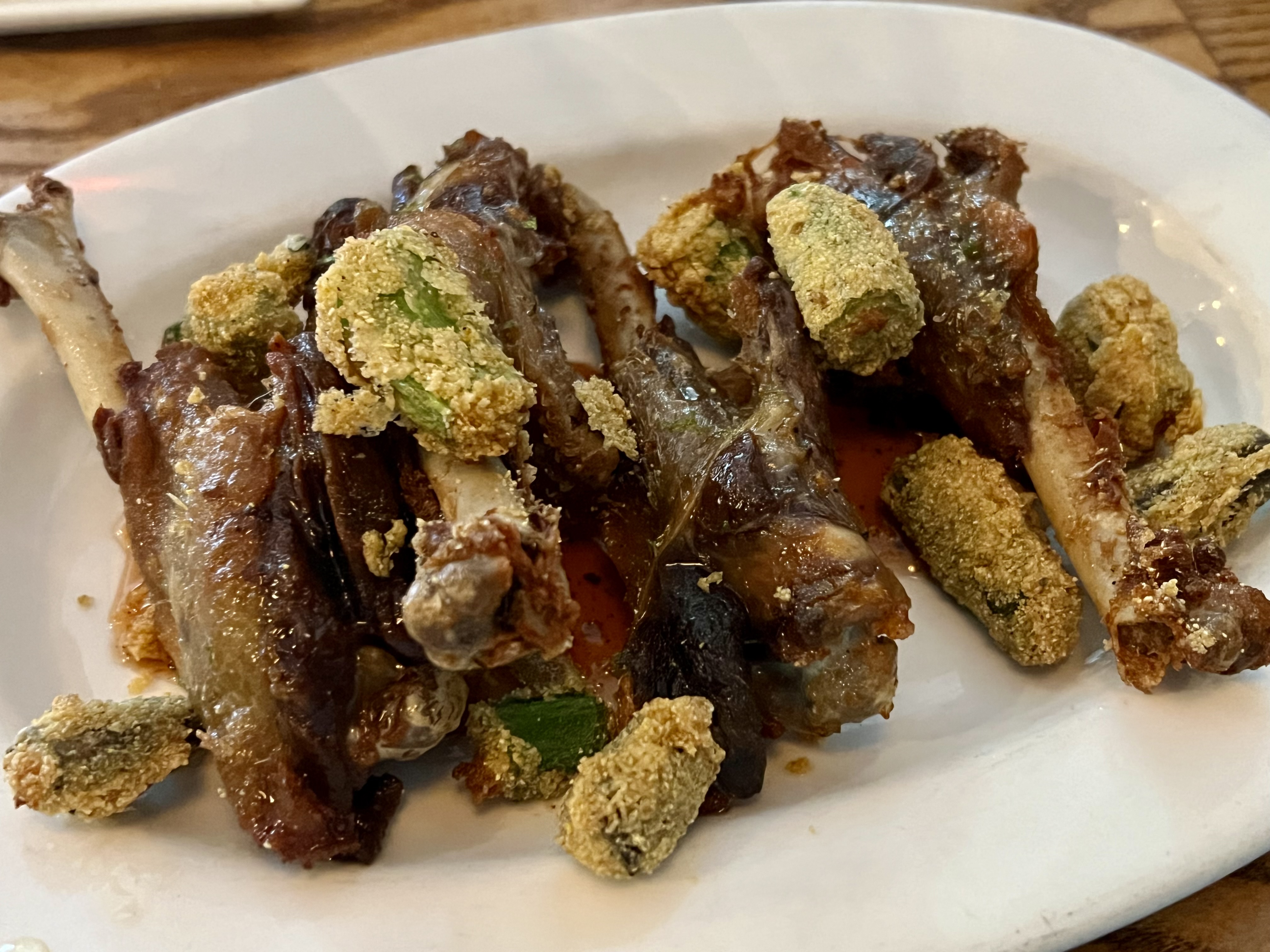
The Braised Pork Shank ($32), with barley risotto and clementine mostarda, was a hearty dish, and the pork easily fell off the bones. It was tender and flavorful, and the risotto was rustic, with a savory kick.

The Veal Milanese ($26), covered with arugula, sliced tomatoes and parmesan, was cooked like the Chicken Parmigiana, with a nice crisp coating, surrounding tender veal. It was an ample dish as well, though I made sure I ate every last piece of veal. Highly recommended.

The Grilled Ribeye ($38), with rabe and roasted potato, is a nice and flavorful piece of steak, and carnivores won't be disappointed.

The Eggplant Parmigiana is another ample dish, almost resembling a large piece of lasagna as it is stacked so high. Tender and delicious, you'll enjoy this dish too.

One of their special Desserts, was the Semolina Cake ($8), with laurel leaf syrup, blood orange coulis, toasted pistachios, and whipped cream. The cake was light, with an almost savory taste, but sweetened by the syrup, coulis and whipped cream. A nice ending to our dinner.

The more traditional Tiramisu ($8) is very good, the right blend of flavors.

Tonno receives my highest recommendation and Chef Anthony Caturano has another winner in his culinary group. I'm always telling my readers to eat more seafood and Tonno is definitely a place to find plenty of delicious seafood dishes. In addition, you'll also find excellent Italian cuisine, from hand-made pasta to crisp veal milanese. Tonno is such a great addition to the suburban culinary scene and you should check it out.

Friday, March 22, 2019

Slow Wine Guide Tasting: What is Caberlot? (Part 2)

Maybe rather than burying a cow horn, stuffed with manure, beneath your vineyard, you might do better to bury a bottle of 1985 Sassicaia. It certainly seems to have brought much good fortune to Podere Il Carnasciale

At the Slow Wine Guide tasting event, I had the opportunity to taste a grape new to me, a grape that is produced by only a single winery in the world. The grape is called Caberlot and is mentioned only briefly in Jancis Robinson's comprehensive Wine Grapes encyclopedia. She wrote, "There is also a small, isolated vineyard near Arezzo, central Italy, where Carnasciale grow a variety called Caberlot, thought to be a crossing of Merlot with an unidentified parent." However, there is more known about Caberlot and it is a fascinating tale.

The story begins in the late 1960s, in an abandoned vineyard near Padua, where Remigio Bordini, an agronomist, discovered a new grape. This grape, which would become known as Caberlot, seemed to share characteristics of both Cabernet Franc and Merlot, and appears to be a natural crossing of the two varieties. Remigio kept this unique grape in a nursery for about twenty years, until 1986. It was then that he chose to share the grape with a single family.

Four years before that, Wolf and Bettina Rogosky, husband and wife, decided to buy some land, full of olive trees, atop a hill in Tuscany, in the southern Chianti hills of the Valdarno, just outside of the Chianti Classico appellation. They discussed planting grapes to make wine, eventually seeking advice from Vittorio Fiore, an enologist. It was Vittorio who fortuitously introduced them to Remigio Bordini. Their meeting must have gone extremely well because Remigio decided to allow the Rogoskys to take cuttings from his nursery so that they could grow Caberlot in their new vineyard.

The Rogoskys planted their initial vineyard, named Carnasciale, in 1986 on the site of an old olive grove, and it was tiny, only about .74 acres. Carnasciale is a nearly obsolete word in Italian that refers to the "period of Carnival." Hoping for luck, Wolf buried a bottle of 1985 Sassicaia, a famous Super Tuscan wine, under his first vines. At the time, Wolf probably didn't realize that the 1985 Sassicaia would eventually become known as a legendary wine. For example, that was the first Italian wine that Robert Parker gave 100 points.

Their Caberlot wine, which was bottled only in magnums as Wolf believed the wine would age well in that format, would eventually become a cult hit. It's scarcity helped, plus the fact that no one else was permitted to grow this grape. Unfortunately, Wolf died in 1996, but Bettina continued pursuing their passion for Caberlot. Following previous plans, Bettina planted additional vineyards in 1999, 2004, and 2011, so that they now have about 13.5 acres of vineyards, producing a total of about 9000 bottles annually. Even with the additional vineyards, production remains small. Their son, Moritz (who I met at the tasting), now works with his mother, helping to promote their wines.

The vineyards are being converted to organic, and they hope for the process to be completed in the near future. It wasn't until about 2005, that the wine was first exported to the U.S., and even at that time, it was still difficult to find in Italy. The "X" that is seen on their labels, which is different each year, is intended to signify the crossing of the grapes, the Cabernet Franc and Merlot, plus it also draws attention to the label even from across a room. The color of the label is also different each vintage. 

In the Slow Wine event guide, the winery received two designations, including a Bottle indicating the winery is a benchmark in quality. The other designation, "Slow Wine," is because the winery produces wines that represent "an expression of place, originality and history." Their 2015 Caberlot also received a designation as a "Great Wine."

Before getting into the Caberlot, we had a chance to taste a Sangiovese wine they started producing in 2015. The 2016 Valdarno Di Sopra Ottantadue, made from 100% Sangiovese, sees no oak and is intended to be an easy drinking red wine. It is fresh and bright, with prominent red fruit flavors, especially cherry, good acidity, and a pleasing finish. It is a simple, everyday wine, which would pair well with pizza to burgers.

In 2000, the winery created a second wine, Carnasciale, which is made from Caberlot from younger vines, is released in 750ml bottles, and is supposed to be more approachable. I tasted the 2016 Carnasciale, which is vilified in the same manner as the higher-end Caberlot. It is aged in French barriques, 70% new, for about 22 months and then for another 6 months in the bottle. I found this wine to definitely be very approachable, with restrained tannins, rich flavors of red and black fruit, mild spice notes, and a lengthy finish. There was a light greenpepper/vegetal note, typical of some Cabernet Franc, though I'll note a couple of my friends who tasted the wine didn't discern that note.

The 2015 Caberlot (about $275/magnum) is made from their oldest and best Caberlot grapes. It undergoes malolactic fermentation and then is aged, for about 22 months, in French barriques, of which 70% are new, one third each Allier, Vosges and Tronçais oak, medium toast. It will then spend about 18 months in the bottle before release. The wine is unfiltered, has a 13.5% ABV, is bottled only in magnums, and Bettina hand-numbers each label. It has to be labeled as IGT Toscana as the grape is unrecognized in the DOC. It was definitely a more complex wine, with silky tannins, more plum and black raspberry flavors, a spicy backbone, and a touch more green. Each sip delivered an intriguing taste, which tantalized the palate with a harmonious melange of flavors. The lengthy finish was satisfying and the acidity was spot-on. It seemed a little tight, so would benefit from aging, but it was still enjoyable as is.

I preferred though the 2014 Caberlot, which came from a cooler vintage, especially as I couldn't detect any green pepper notes. The fruit flavors were a touch more vibrant and the mouthfeel was a bit more smooth, yet it retained all of the complexity of the 2015. It was also a bit more enjoyable as is, though the potential for aging was evident. Both wines would benefit from food pairing, maybe wild boar or lamb.

The wines of Podere Il Carnasciale won't be easy to find, but they are worth the splurge if you get the opportunity.

To be continued...

Wednesday, March 20, 2019

Slow Wine Guide Tasting: Italy, California & Oregon (Part 1)

When you're confronted with about 300 wines available for tasting, you have to make some hard decisions. In only four hours, no one can properly taste and give respect to all of those wines so you need to be very selective as to which of those wines you'll sample. Forced to be selective, I knew that I'd miss out on tasting some interesting and delicious wines. However, I was pleased to find some compelling wines which were well worthy of attention.

The 2019 U.S. Slow Wine Tour visited five cities, starting in San Francisco and ending in Boston, where it took place at the City Winery. The Tour was intended to showcase the release of the 2019  Slow Wine Guide, a wine review guide which doesn't use numeric scores to assess wine. This guide is an offshoot of the Slow Food movement, which was established in Italy, in Piedmont, by foodways activist Carlo Petrini as a way to protect the world’s gastronomic traditions.

Their website states their basic philosophy, "Slow Food believes that wine, just as with food, must be good, clean, and fair--not just good. Wine is an agricultural product, just like any of the foods we eat, and has an impact on the lives of the people who produce it, as well as on the environment--through pesticides, herbicides and excessive water consumption which are all commonplace in conventional wine production." The first edition of the annual Slow Wine Guide, centered on Italian wines, was published in 2010, with an English translation released the next year. To review their wines, they visited each winery, spoke about their agricultural practices & wine production, blind-tasted their wines, and then composed their reviews.

In 2017, Slow Wine decided to expand their coverage to California, so they traveled there, visiting and evaluating hundreds of wineries. The 2018 Slow Wine Guide was the first to include reviews of California wineries, 70 in all. For the 2019 Slow Wine Guide, they expanded their California coverage to include over 130 wineries. In addition, they have added coverage of Oregon, including about 50 wineries. As their website states, "Oregon’s commitment to sustainable wine-making and respect for the terroir is consistent with Slow Wine’s principles and its mission to support local agriculture."

In addition, they note, "Like last year’s book, the 2019 guide isn’t intended to be exhaustive or comprehensive: it’s a growing, living, and breathing almanac that’s meant to give voice to the new wave of America’s viticultural renaissance." Next year's guide will continue to grow, including more wineries from California and Oregon, and possibly reaching out to other U.S. states as well. Though the inclusion of other states might take a bit longer.

I didn't know until I arrived at the Slow Wine tasting that approximately 300 wines were available for sampling. I was pleasantly surprised at the size of the event. Representatives of 85 wineries were present, including 79 from Italy, 3 from California and 3 from Oregon, each pouring about three wines. Some of the Italian regions covered include Emilia-Romagna, Lazio, Marche, Piedmont, Veneto, Puglia, Sicily, Tuscany, Umbria, and more. There were also three joint tables, representing the Prosecco DOC, Lugana DOC, and Bardolino Chiaretto DOC, which added about another 50 wines. Some of the wineries were seeking importers but a significant amount are already available locally.

In the tasting event guidebook, some of the wineries and wines were marked with various symbols or phrases, indicating something special. The wineries might be marked with a Snail, Bottle, or Coin while the wines might be marked as Slow Wine, Great Wine or Everyday Wine. In short, the Snail indicates those wineries whose values align with the Slow Food movement, the Bottle indicates high quality, and the Coin indicates excellent value. The Slow Wine designation represents "an expression of place, originality and history," while the other two phrases are self-explanatory.

The tasting was spread out over three rooms, and though it was well-attended, by various representatives of distributors, wine stores, restaurants, the media, and more, it generally didn't feel too crowded. There was a table of food, snacks to help cleanse your palate, and there was plenty of bottle of water too. The event seemed to run well and I encountered plenty of other attendees that I knew. There was a casual vibe, though plenty of work got done as well.

A few of my highlights of the tasting included a Tannat/Malbec blend from Oregon, a delicious Italian Rosé made from a blend of Barbera, Groppello, & Sangiovese, and an Italian wine made from a grape that only a single winery in the world is allowed to produce. In the next couple weeks, I'll be writing in detail about some of these highlights as well as some of the other wines I tasted, sharing the best of what I tasted.

To Be Continued...

Friday, December 14, 2018

2018: Favorite Wine-Related Items

What were some of my favorite wine related items of the past year?

Let me continue the lists of my best recommendations and favorites of 2018. I have already posted my Top Ten Wines Under $15Top Ten Wines Over $15 (But Under $50) and Top Wines Over $50 lists. This post will now concentrate on some of my Favorite Wine-Related Items, which are not specific wine recommendations. This is certainly not a complete list but it is more a sampling of compelling and memorable matters I have experienced and posted about over the past year.

This is also a purely subjective list, based on my own preferences, and makes no claims about being the "best" of anything. But all of the items here have earned my strong recommendations and I hope you will enjoy them as well. For more wine related items, you can just search my blog posts for the past year.

Analysis Of Top Ten Wines: In my three prior Top Wine lists of 2018, I mentioned a total of 36 wines, which included wines from 9 different countries and regions, four less than last year. In first place was Portugal, with 10 wines, and I'll note that last year, Portugal and Georgia were tied for first place, each with 6 wines. France came in second with 6 wines, including 3 from Alsace. Spain and Italy tied for third place with 5 wines each. Uruguay and California each had 3 wines, while Germany had 2 wines. Rounding out the lists, Turkey and Australia each had 1 wine. As for wine types, the lists are also broken down into 4 Sparkling, 3 White, 4 Rosé, 18 Red, 6 Fortified and 1 Aromatized Wine. 

Favorite Discount Wine Stores: Consumers always want bargains, excellent value wines which won't stretch their wallets. You can buy the cheap, mass-produced commercial wines which can be found in almost any wine store or instead, you can seek out excellent, value wines which put to shame those cheap wines. Certain discount wine stores provide not only excellent prices but also an interesting selection and good service. I want to highlight three such stores which continue to do an especially good job, places where I go to seek bargains: Bin Ends in Braintree & Needham, Wine Connextion in North Andover, and Rapid Liquors in Stoneham. Shop at any of those stores and you won't be disappointed.

Favorite Wine Stores: This is a small list of wine stores which consistently impress me with their selection and service. Each shop is worthy of your patronage and wine lovers should make the effort to visit these places if you have not done so yet.
Lower Falls Wine Company in Newton Lower Falls
Wine-Sense in Andover
Wine Bottega in Boston's North End
Central Bottle Wine & Provisions in Cambridge
Wine Press in Brookline and Wine Press now in the Fenway
Streetcar Wines in Jamaica Plain

Favorite Private Wine Dinner: The wines of Uruguay are still new to many but they deserve your attention. I had the opportunity to taste several Uruguayan wines from the portfolio of Bodega Garzón: Uruguayan Treasures, From Albarino to Tannat, finding plenty of treasures, from Albarino to Tannat, Cabernet Franc to the high-end Balasto. Three of their wines ended up on my Top Wine lists this year. And we got to enjoy this wines while dining at the compelling La Bodega By Salts, savoring some Uruguayan cuisine. Such delicious food, paired with excellent wines, combined to elevate the evening.

Runner-Up Favorite Private Wine Dinner: When you're savoring a dish of Escargot en Cocotte, snails in garlic butter, at Brasserie Jo, you probably crave some French wine. I had an enjoyable and fascinating lunch there with Romain Teyteau, the North America Export Director for Les Vins Georges Duboeuf, which led me to write about The Beauty Of Beaujolais. We had plenty of stimulating conversation, while tasting some delicious wines, including some killer Beaujolais. A couple of those wines even ended up on my Top Wine lists.

Favorite Public Wine Dinner: This was an easy decision as Il Casale in Belmont thoroughly impressed me with their San Felice Wine Dinner. They sold out the entire restaurant, indicative of the popularity of their wine dinners, and I understood the reasons. The food was superb, the wines were amazing, and service was professional. They made it seem easy to serve around 100 guests the same multi-course dinner. A couple of the Italian wines from this dinner ended up on my Top Wine lists. Plus, I was stunned by one of their incredible dishes, the Fusilli fatti in casa con ragù "bianco" di carne e salamino di cinghiale (Handmade fusilli with "white" meat ragù and diced wild boar salami). It was one of the best dishes I ate in 2018. I also attended a wine dinner, dedicated to Olio Taibi & Olive Oil, at their Lexington location, which was just as well done. I give my strongest recommendation that you attend an Il Casale wine dinner.

Favorite Regional Wine Tasting: With a fascinating and delicious portfolio of nine, family-owned Greek wineries, from all across Greece, An Odyssey Greek Wine Tasting with Cava Spiliadis was a stellar tasting event, one that was open to the public. I've long been an advocate for Greek wines and it is tasting like this that can be so persuasive to consumers. The wines were diverse, a myriad of styles and flavor profiles, as well as approachable and food-friendly. Every wine I tasted had its merits and I loved learning more about the indigenous grapes of Greece as well as its terroir. Plus, Post 390 presented plenty of tasty food to accompany all of the wines. You need to Drink More Greek Wine!

Runner-Up Favorite Regional Wine Tasting: Puritan & Co. hosted an informative and fun tasting of Georgian wines, which I wrote about in two parts: Georgian Wine: All About Context (Part 1) and Georgian Wine: All About Context (Part 2)Georgian wines are another passion of mine and I take almost every possible opportunity to taste their wines. With 8,000 years of vinous history, over 500 indigenous grapes, and a tradition of the qvevri, Georgia has plenty to offer a wine lover. There was even an intriguing discussion about skin contact wines that raised some compelling issues. You need to Drink More Goergian Wine!

Favorite Formal Wine Seminar: At the City Winery, I attended an educational seminar about the wines of the Italian region of Alto Adige - Südtirol, which were once known as Rhaetian Wines, Favorites of the Ancients. We did some comparison tastings of wines from various grapes, including Pinot Bianco, Schiava, Pinot Grigio, Pinot Nero, Lagrein and Gewurtztraminer. I was particularly taken with the Schiava wines and want to find more of them to sample. Overall, the wines were delicious, food friendly and compelling, sure to please any wine lover.

Favorite Informal Wine Seminar: This year, Sommelier Theresa Paopao created a Wine School At Asta, an afternoon wine lounge inspired by New York Times wine critic Eric Asimov’s monthly column. I visited the restaurant during the month she showcases the Fiano grape, offering seven Fiano wines from the Campania region of Italy. They were all available by the glass as well as in flights of three wines. Theresa explained all about the grape and the various wines, evidencing her passion and knowledge. Plus, you could pair the wines with various special and delicious dishes created by the restaurant. Excellent food and drink in a fun and informative atmosphere make this a compelling event and hopefully they will continue their Wine School in 2019.

Favorite Restaurant Wine List Change: At Committee, one of my favorite Greek restaurants, Wine Director Lauren Friel instituted significant changes to their wine list, compiling an All Greek, All Natural Wine Program. The list is diverse, exciting, reasonably priced and has plenty of delicious options. And this past summer, they held a Natural Wine Pop-Up on their patio on Wednesday nights, helping to promote their new list. The wines pair very well with the various Greek dishes and every wine lover will find something to excite their palate. Lauren has done a great job with this new list and I will repeat, You need to Drink More Greek Wine!

Favorite New Wine List: Though The Table at Season To Taste has been open since 2016, I only just dined there recently. And I look forward to dining there again very soon. Besides their excellent food, they have an intriguing wine list, curated by Jesse Eslin, their Wine Director, which changes on regular basis with their changing food menu. The wine list has plenty of intriguing and small production wines, the type of wines that excite an adventurous wine lover. The evening began well with a German sparkling wine made from the rare Elbling grape, and continued on that same level throughout the dinner. If you love wine, you need to make a trip to The Table at Season To Taste.

Favorite Wine Pairing: Last New Year's Day, I chose to celebrate with a large pot of Lobsters, paired with two different bottles of Crémant d'Alsace. Sparkling wine is a versatile food wine and often pairs very well with seafood. With the sweetness and rich of lobster, especially dipped in drawn butter, it helps to have a wine with good acidity and these Crémant wines possessed that trait. Plus, their tiny bubbles helped to cleanse the palate between bites. The complex flavors of the two Crémant wines also complemented the delicious lobster. It was a killer pairing, well appreciated by everyone at the table. And such a hedonistic way to begin the New Year.

Favorite Wine Travel Event: This past October, I visited Portugal, touring Porto and the Douro region. It was an amazing trip, filled with so much fun and excitement, great food and wine, intriguing museums and historical sites, and much more. A number of the wines from this trip ended up on my Top Wine lists this year. And I'll be mentioning some of the culinary highlights in other Favorite lists next week. Check out my page of Collected Linkswhich will lead you to all of my 20 articles about the trip to Portugal. And I'll likely add a couple more articles next month.

What were some of your favorite wine-related items this year?

Wednesday, December 12, 2018

2018: Top Wines Over $50 (Plus My Wine of The Year)

What were some of my favorite wines of the past year?

Welcome to my third, and last, Top Wines List. I've already posted my Top Ten Wines Under $15 and Top Ten Wines Over $15 (But Under $50). It is now time for my Top Wines Over $50. This isn't a Top Ten list as there aren't always sufficient wines at this price point that I've tasted and deemed worthy for inclusion. Like the prior lists, this list includes wines that not only I enjoyed, but which I also found to be particularly compelling for various reasons. They might be especially delicious, something more unique or just excellent values for the price. They all stand out, for some particular reason, above the other wines at this price point that I have tasted this past year.

This is a purely subjective list, based on my own preferences, and makes no claims about being the "best" wines out there. It is primarily the wines which spoke to me the loudest, even when they were subtle wines. These are all wines that I highly recommend and which I believe many other wine lovers will also enjoy.

The wines are not listed in any particular order and each choice is linked to my more detailed prior review. All of these value wines are worth your consideration but please also note that the prices are approximations and the actual price may vary in your area. In addition, some of the wines might not be available in your local area, though you might be able to order them from the winery or an online store, dependent on your state's shipping laws.

I'm also going to note that this is the first year that I am announcing an overall Wine Of The Year! One wine simply stood out so much this year that I saw the need for such a declaration. And I will begin my list with that very wine...

1) Bodegas Yuste Conde de Aldama Amontillado Sherry ($210)
It was a very easy decision to select this phenomenal and unique Sherry as my Wine Of The Year. First, it may be the oldest wine I've ever tasted. This Sherry is an average of 130-150 years old, and its solera was begin sometime from 1740-1750, before the U.S. was even a country. Second, you need to read my detailed review for more details about its history and production, as well as my full tasting notes. For me, this wine may be as close to perfect as any wine will ever be. Third, it certainly helped that I shared this bottle with some very close friends at a fantastic birthday celebration. Fourth, even at this price point, I think the wine is a bargain and if I ever see it again on a wine store shelf, I'll buy it without question. How often can you say that about a $200 wine? I cannot recommend this wine highly enough.

2) 2014 San Felice Il Grigio Chianti Classico Gran Selezione ($50.99)
This Italian wine is a blend of 80% Sangiovese, with the rest a blend of indigenous grapes including Abrusco, Pugnitello, Malvasia Nera, Ciliegiolo and Mazzese. This is a WOW wine, impressive and compelling. The aromas seduce your nose, giving evidence of the quality that you'll find within the wine. On the palate, it is silky smooth, with plenty of complexity, including ripe plum, black cherry, mild spice notes, hints of earthiness, and wisps of additional flavors that seem to flit in and out. Well-balanced, fine acidity, and a lingering, satisfying finish. It is the epitome of elegance, a wine to slowly savor over the course of an evening, relishing each sip, finding new flavors within each taste.

3) Graham's 20 Year Old Tawny Port ($60-$65).
Port doesn't get enough attention, and when it does, Vintage Port seems to get the spotlight. However, there are plenty of other excellent Port types available, such as this one. This Port wine is actually about 24 years old, made from high quality wines, and is complex and intriguing, more dry than sweet, well-balanced and delicious. Caramel and salted nuts, dried fruit, a wisp of citrus and black cherry, hints of spice and good acidity. A Port to slowly savor over the course of an evening, chatting with good friends, paired with blue cheese or creme brulee. Each sip will bring something new to your palate, and you could get lost within your glass.

4) 2015 Bodegas Garzón Balasto ($120)
From Uruguay, the 2015 vintage was the first release of this wine, a blend of the best grapes of the vineyard, including 45% Tannat, 25% Cabernet France, 20% Petit Verdot, and 10% Marselan. The grapes were fermented in concrete tanks and then the wine spent about 20 months in untoasted, large French oak casks. This is a powerful, muscular wine with concentrated red and black fruit flavors, yet it still possesses a beautiful elegance. The tannins are restrained, helping to rein in its power. There are also subtle spice notes, nice acidity, a hint of earthiness and it possesses a lingering and pleasant finish. This is a wine built for aging, though it is still impressive now.

5) 2014 Kay Brothers Amery Vineyard Block 6 Shiraz ($119.99)
An Australian wine made from 100% Shiraz from a vineyard that was planted in 1892. 122 year old vines! This wine, with a 14.5% ABV, aged for at least 22 months in 1/3 new, 1/3 second, and 1/3 third use French and American oak puncheons. It possesses a rich, crimson color and an alluring nose of spice and black fruit. On the palate, the wine is elegant and silky smooth, with a complex melange of concentrated flavors of plum, black cherry and raspberry, with a strong spicy backbone, well integrated tannins, and pleasing acidity. It is well balanced with a long, lingering finish that completely satisfies. This is nowhere close to a jammy, fruit bomb but rather the type of high quality wine that seduces your senses.

6) 2013 Bedrock Wine Co. Griffin's Lair Syrah, Sonoma Coast ($50-$60)
A blend of 88% Syrah and 12% Viognier, this California wine possesses a dark, almost purplish colored wine, emitted an alluring nose of black fruits and spice, with subtle, almost fleeting aromas of other elements, such as herbal and floral notes. You can detect the complexity of this wine from the start, and that complexity is further elaborated on the palate. Full bodied and intense, it is lush and seductive, possessed of an intricate melange of flavors, including plum, black cherry, vanilla, dark spice, and an underlying earthiness. Such a long and lingering finish, each sip providing pleasure for minutes at the least. The tannins are well integrated, the silky feel of the wine caressing your palate. A hedonistic and complex wine that will please almost any wine lover.

This year, six countries and regions have a single spot on the list, including Spain, Italy, Portugal, Uruguay, Australia, and California. Of these six wines, they also consist of 2 Fortified Wines and 4 Red Wines. The Uruguayan wine may be the most surprising wine on the list as most people wouldn't expect such an amazing, high-end wine from this up and coming wine country. For myself, the biggest surprise may be the Australian wine, as I've tasted little from this country in several years after having had too many disappointing wines. It's time for me to sample more Australian wines.

Not all expensive wines are worth their high price but these wines well worth the splurge. These are the type of wines that words often cannot do justice. These are wines to experience and savor, not to dissect and analyze. These wines should be shared with others, with family and friends, to share the experience. With the holidays near, why not splurge and buy one of these wines.

If you have some of your own recommendations for unique and compelling wines over $50, please add them to the comments.

Tuesday, December 11, 2018

2018: Top Ten Wines Over $15 (But Under $50)

What were some of my favorite wines of the past year?

Welcome to my second Top Ten Wine List. Yesterday, I posted my Top Ten Wines Under $15, which I hope you enjoyed and found useful. Now it is time for my Top Ten Wines Over $15, though these wines also cost less than $50.

Like the prior list, this list includes wines that not only I enjoyed, but which I also found to be particularly compelling for various reasons. They might be especially delicious, something more unique or just excellent values for the price. They all stood out, for some particular reason, above the other wines at this price point that I have tasted this past year.

This is a purely subjective list, based on my own preferences, and makes no claims about being the "best" wines out there. It is primarily the wines which spoke to me the loudest, even when they were subtle wines. These are all wines that I highly recommend and which I believe many other wine lovers will also enjoy.

The wines are not listed in any particular order and each choice is linked to my more detailed prior review. All of these wines are worth your consideration but please also note that the prices are approximations and the actual price may vary in your area. In addition, some of the wines might not be available in your local region, though you might be able to order them from the winery or an online store, dependent on your state's shipping laws.

1) 2014 Domaine Albert Mann Extra Brut Crémant d'Alsace ($24)
This Crémant d'Alsace is a blend of Auxerrois, Pinot Blanc and Pinot Noir. With a fine golden color and a myriad of tiny bubbles, it possesses an alluring aroma, with elements of fresh fruit. On the palate, the Crémant is fresh, crisp and dry, with delicious flavors of green apple, pear and hints of lemon. Though it is fruit driven, there is complexity in the palate as well, with a touch of minerality and hints of spice. There is a light, elegant creaminess to this wine with a lengthy, pleasing finish, ending with more fruit notes. At this price point, it is also an excellent value.

2) 2014 Domaines Schlumberger "Les Princes Abbés" Pinot Noir ($25) Pinot Noir from Alsace is rare and that needs to change. This wine is produced from 100% Pinot Noir, from vines of an average age of 19 years. The wine is fermented in stainless steel and then aged on the lees for about 8 months in old wooden foudres. This is a wine of silky elegance, of bright, fresh red fruit flavors, a hint of spice, and a wisp of earthiness. Excellent acidity, some floral accents, soft tannins, and a lengthy, pleasing finish. Such a well balanced and delicious wine, its elegance is so compelling and its complex melange of flavors pleases me immensely.

3) 2016 Georges Duboeuf Domaine les Chenevieres, Macon-Villages ($21.99)
This French wine is made from 100% Chardonnay, with vines that are over 20 years old, this wine has a 12.5% ABV and sees only stainless steel. It has an interesting and fresh taste, lots of crispness with flavors of green apple and citrus, with a backbone of minerality, and a lingering finish. This wine would go very well with goat cheese, as well as many types of seafood.

4) 2016 Georges Duboeuf Jean Ernest Descombes, Morgon ($21.99)
Another French wine, fro the Morgon Cru, this wine is made from 100% Gamay (vines from 50-100 years old), with a 13% ABV. It was vinified and aged in cement tanks. It possesses a captivating aroma, one that quickly lures you into the bottle. The red and black fruit flavors are intense, with crisp acidity, spice notes, and an earthy undertone. It is elegant and complex, intriguing and delicious.  Many of my favorite Beaujolais wines come from the Morgon Cru and this is an excellent example of what that Cru has to offer.

5) 2015 Darting Winery Pinot Meunier ($21.99)
This German wine is made from 100% Pinot Meunier, from the Pfalz region, and has a 13.5% ABV. It is rare to find single varietal Pinot Meunier. This wine has a light red color, with a touch of sediment, and a mild, pleasing aroma of red fruit and spice. It is a light-bodied wine, subtle and elegant in its presentation, with delicious flavors of cherry and cranberry, a mild spicy backbone and a hint of earthiness. Nice acidity, a lingering finish, and interesting. Overall, it is delicious and paired perfectly with a dinner of lamb lollipops.

6) Gonzalez Byass La Copa Vermouth ($25)
Vermouth is actually a wine, an aromatized wine, and many people seem to forget that fact, which is why you rarely see Vermouth on Top Ten Wine lists. They are worthy though of more recognition. The La Copa Vermouth is a blend of 75% Oloroso Sherry and 25% Pedro Ximinez Sherry. It is rare to find any Vermouth made from Sherry. Some of the botanicals that are used in this Vermouth include wormwood, angelica, savory, clove, orange peel, nutmeg, quinine, and cinnamon. On the nose, its complexity is first experienced, a wonderful melange of spices, salted nuts, and citrus notes. On the palate, you will be intrigued by its complexity, balance and elegance. There is a superb blend of spices and herbs, with nuts, caramel, a touch of plum, candied orange and more. The Sherry influence is prominent and well integrated. There is balanced sweetness with hints of bitterness, exactly what you want from a fine vermouth. It's smooth with a lengthy, satisfying finish and is wonderful on its own, though it also works well in a Manhattan.

7) 2015 Post Scriptum de Chryseia ($20-$25)
This Portuguese wine is impressive, a blend of 64% Touriga Franca, 28% Touriga Nacional and 8% Tinta Roriz, spending about 12 months in French oak. It has bright red fruit flavors, nice acidity, a spicy backbone and an elegant nature. Definitely very approachable, with good complexity, a lengthy finish and a wine that is very food friendly. Simply delicious.

8) 2015 Bodegas Garzón Cabernet France Reserve ($27)
Uruguay is producing some interesting and delicious wines, and this wine, made from Cabernet France, is an impressive example of their potential. With a rich purple color, the wine has alluring aromas, lots of ripe fruit and hints of spice. On the palate, there are delicious black and blue fruit flavors, enhanced by mild spice notes and a hint of herbal notes. There isn't a prominent flavor of green peppers, which delights me. The tannins are well integrated, the finish lingers, and there is a touch of mint on the finish too. This would be a great wine to pair with grilled meats or even a pizza.

9) 2015 Scheid Vineyards Pinot Noir ($36)
From California, this wine is made from 100% Pinot Noir, a blend of grapes from two estate vineyards, and it is aged for about 9 months in neutral French oak. With a 14.1% ABV, the wine has an appealing nose of red and black fruits with a hint of spice. On the palate, the wine is light bodied and silky, with a complex melange of flavors, from cherry to blackberry, cranberry to plum, with subtle spice notes, a touch of vanilla, and a hint of smoke, especially on the lengthy finish. An elegant Pinot, this is a wine to slowly savor over the course of an evening.

10) 2015 Kocabağ Öküzgözü ($19.99)
This is the first wine from Turkey that I've ever reviewed and it won't be my last. Öküzgözü is an indigenous grape with high acidity and mild tannins, tending to make soft, easy drinking wines similar in some respects to Gamay or Pinot Noir. This wine possesses a medium-red color with an interesting nose of black cherry and raspberry, with a few spice notes. On the palate, it is light bodied, with plenty of acidity, and delicious ripe plum and black cherry flavors, enhanced by a mild earthiness and hints of spice. It has a very Old World feel to it, with mild tannins, a moderately lengthy finish, and is simply tasty.

This is always my toughest list to compile because there are numerous other excellent wines which I could have added. I had to ponder long over which wines to actually select for the main list, meaning that I had to eliminate other worthy wines. To give some credit to those other worthy wines, which almost made the Top Ten list, I have an Honorable Mention list. These are also wines you definitely should check out.

Honorable Mention
1) 2016 Alto do Joa Tinto ($15-$17)
This compelling Portuguese wine is a field blend of 20 grapes, including Alvarelhão, Bastardo, Chasselas Suíça, Cornifesto, Dona Branca, Folgasão, Formosa, Jaen, Mourisco, and Tinta Amarela. With a dark red color, and an alluring nose, I was captivated by this wine from my first taste. It is elegant and silky smooth, with well-integrated tannins, good acidity, and a touch of rusticness. Its complex melange of flavors includes ripe plum, black cherry, fig, dark spices, and a subtle earthiness. A long and lingering finish tantalizes and satisfies. It over delivers for the price and was pure pleasure on the palate.

Another Portuguese wine, this Sparking wine is made from 100% Touriga Nacional, which is certainly more unique. Almost a Rosé in color, and with tiny bubbles, there are mild red fruit notes on the aroma. As soon as I tasted a sip, bright berry flavors burst on my tongue, such a pleasurable taste and sensation. Dry and crisp, once I got past the berries, there were subtle notes of almond and plum, as well as a lingering finish. If I could have easily transported it home from Portugal, I would have bought a case of this bubbly.

Portugal is taking dominance on this Honorable Mention list. This Port has an amazing taste and aroma, being more dry than sweet, with concentrated black fruit flavors, notes of dried fruit, spicy accents, and plenty of complexity. Well balanced, this is a powerful Port yet still restrained, more elegant than muscular. And you can easily enjoy it now without a need for further aging. Pure deliciousness at a very reasonable price.

And one more Portuguese wine, a rare aged White Port, made from a blend of at least Malvasia Fina, Gouveio, Moscatel Galego, and Rabigato. It is fermented in traditional lagares, granite treading tanks where the grapes are trod on by foot. It was aged for about 9 months in stainless steel and then for at least more 20 years in wooden casks. Sniffing your glass, you'll be seduced by an alluring blend of honey, floral and herbal scents, with wisps of citrus. On the palate, the complexity of the aromas is still evident, with each sip bringing something new to your mouth. There is a mild sweetness, well balanced by its acidity, with bright honey notes, citrus flavors, and touches of herbs. It is more full bodied and rich, with a long, lingering finish that soothes and satisfies. It is well worth the effort to seek it out, especially due to its complexity and superb taste.

This fascinating Sherry is produced from Palomino grapes all sourced from the Macharnudo Alto, making it a single-vineyard Sherry, which is rare in the Sherry industry. It is also one of the few Sherries that is still fermented in cask, in American oak, with nearly all other Sherries fermented in stainless steel. This Amontillado begins its life by spending from eight to twelve years under flor, like a Fino Sherry, and then spent another five to eight years without flor, aging oxidatively, averaging about 16-18 years in total. This Sherry has a compelling aroma, and the complex taste is nutty with rich caramel, vanilla and spice, as well as lots of acidity. It also possesses a long and pleasing finish. When I think of this Sherry, I think of it as delicious and comforting, fueling my belly and soul.

An En Rama Sherry is unfiltered or lightly filtered, which tends to produce a Sherry that is more intense and complex. With a 15% ABV, the Tio Pepe Fino En Rama has a bright golden color and is aromatic, with intriguing notes of toast and the briny nature of the sea. On the palate, it is fresh and dry, with a complex and intense melange of citrus, almonds, and the taste of the ocean. The finish has a tinge of bitterness, which doesn't detract from the taste, and lingers on your palate for quite a time. It is not as light and subtle as more heavily filtered Fino Sherries. I'm a big fan of this style and love the intense expressiveness of this Tio Pepe.

Made from 100% Pinot Noir, this Alsace bubbly is produced by the méthode champenoise and remains on the lees for about 12 months. With an appealing nose of red fruits and a touch of spice, this is a delicious and lush Crémant with ripe flavors of strawberry, cherry and raspberry. Dry, crisp, and clean, with a fine effervescence, this is a true crowd pleaser. At this price, it is an excellent value for the taste and complexity found within the bottle. 

This Italian wine is made from 100% Sangiovese, which spent about 24 months in oak, 20% in small barriques, and 1 year in the bottle. It is made in a more traditional style, which is my preference, and is quite good, with nice acidity, notes of cherry and black fruit, mild spice notes, and low tannins. It is delicious, but definitely does best when paired with food, especially meat or a hearty dish. To me, this is an example of a very good traditional Chianti Classico.

From Uruguay, thus wine is made from 100% Albarino, selected from the best seven plots in the vineyard. About 80% of the grapes were fermented in large, concrete tanks (without epoxy) and the rest were fermented in untoasted oak barrels. The wine spent about 8 months on the lees. This is an impressive wine, elegant and complex, something meant to be slowly sipped and savored. It has a richer texture, great acidity, and more savory notes with only underlying and subtle fruit notes. The finish is long and satisfying, simply a stellar wine. 

10) 2015 Windvane Carneros Pinot Noir ($45)
This California Pinot Noir, from the Carneros region, possesses a medium red color and an enticing aroma of red fruit with mild, underlying spice notes. On the palate, the complex wine presents delicious and intense flavors of red cherry and blackberry, enhanced by mild spice notes and plenty of acidity. Medium-bodied, the finish is fairly lengthy and satisfying, ending with a silky crispness. Paired with Chinese sausages, the acidity of the wine helped to balance the sweetness of the sausages, and its flavors worked well with the spices and flavors of the sausage.

Summary

Eight wine countries and regions made the list this year, the same amount as last year. France dominates, occupying four spots, which include two wines from the Alsace region. The rest of the list is occupied by Germany, Spain, Portugal, Uruguay, Turkey and California. The list is also broken down into one Sparkling wine, one Aromatized wine, one White wine and seven Red wines.

On the Honorable Mention list, six countries made the list, compared to seven last year. Portugal dominates this list, with four spots, and Spain takes second place with two spots. The rest of the spots were taken by France (Alsace), Italy, Uruguay, and California. The list is also broken down into two Sparkling wines, four Fortified wines, three Red wines, and one White wine. Last year, there weren't any Fortified wines on this list.

When you combine the two lists, France (with three from Alsace) and Portugal are tied for first place, each with five spots. In comparison, last year's leader of this combined list was the country of Georgia with four spots, while Portugal had two spots and France only one. This year, Spain occupied three spots while Uruguay and California both had two spots. Rounding out the combined list are Germany, Turkey and Italy, each with one spot. In addition, the combined list includes three Sparkling wines, four Fortified wines, one Aromatized wine, two White wines, and ten Red wines.

I have plenty of other recommendations for wines at this price point on my blog. There are top notch wines from countries all over the world, made from an incredibly diverse selection of grapes and you can still find plenty of values too. My advice is that you seek out wines outside of your comfort zone. Explore the multitude of diversity in the wonderful world of wine. Taste and try anything new, unique or potentially interesting. I am sure your search will lead to new favorites.

If you have some of your own recommendations for wines that are over $15 but under $50, please add them to the comments.

Monday, December 10, 2018

2018: Top Ten Wines Under $15

What were some of my favorite wines of the past year?

As 2019 approaches, it's time once again to reflect upon the past year, to remember and savor many pleasant memories. As 2018 winds down, I'll be posting my annual series of Favorite Lists over the next few weeks, covering food, wine, spirits and other drinks. These lists should provide a comprehensive summary of my favorites from this past year, allowing my readers to more readily locate such gems, the best of my recommendations.

My first Favorites List of 2018 is my Top Ten Wines Under $15. This list includes wines that not only I enjoyed, but which I also found to be particularly compelling for various reasons. They might be especially delicious, something more unique or just excellent values for the price. They all stand out, for some particular reason, above the other wines at this price point that I have tasted this past year.

This is a purely subjective list, based on my own preferences, and makes no claims about being the "best" wines out there. It is primarily the wines which spoke to me the loudest, even when they were subtle wines. These are all wines that I strongly recommend and which I believe many other wine lovers would also enjoy.

The wines are not listed in any particular order and each choice is linked to my more detailed prior review. All of these value wines are worth your consideration but please also note that the prices are approximations and the actual price may vary in your area. In addition, some of the wines might not be available in your local region, though you might be able to order them from the winery or an online store, dependent on your state's shipping laws.

1) 2018 Les Vins Georges Duboeuf Beaujolais Nouveau Rosé ($13.99)
This is the first year that this wine was imported into the U.S. and it made an impressive debut. With a bright pink color, this wine has a nose of bright red fruit, and on the palate, those red fruit flavors, especially strawberry and cherry are prominent, though with minor notes of citrus too. It is dry and crisp, with some underlying minerality, and has a pleasing, though short, finish. Easy drinking, it is an excellent food wine and a very good value.

2) NV Vilarnau Cava Brut Reserva ($14.99)
This Spanish Cava is a blend of 50% Macabeo, 35% Paralleda; 15% Xarel.lo, three indigenous grapes, and is aged for over 15 months in the bottle. With a nice golden color, small bubbles, and 11.5% ABV, this Cava presents a pleasing aroma of fruit, including apple and citrus. On the palate, it is fresh, crisp and dry, with a tasty blend of green apple, citrus and pear, enhanced with a touch of toast, and a moderately long finish. For inexpensive bubbly, it is an appealing choice.

3) 2015 Schlossmühlenhof Dornfelder Rotwein Trocken ($14.40/liter)
This German red wine, made from the Dornfelder grape, has a deep, opaque red, almost purplish, color. On the nose, it is appealing, with enticing black fruit flavors enhanced by mild floral and spice notes. On the palate, it is silky, with mild tannins, and a delicious melange of juicy black fruit, intense spice and nice acidity. It is more elegant rather than powerful, with a lingering, pleasing finish. There is plenty of complexity for a wine at this price point and is a sheer pleasure to drink. This is definitely a food-friendly wine, a versatile wine that pairs well with pizza to tuna. And at this price, for a full liter, it is a fantastic bargain.

4) 2017 San Felice Perolla Rosato ($12)
A blend of 65% Sangiovese and 35% Cabernet Sauvignon, this Italian Rosé is made in the saignee process. It has an alluring aroma and is pure deliciousness on the palate. Light bodied, crisp and dry, with bright red fruits (especially strawberry) and a savory touch. Refreshing and an excellent summer wine, it will also pair well with a variety of foods. I bought a case of this wine to enjoy during the summer and continued drinking some into the fall.

5) 2017 Planeta Rosé ($14)
This Sicilian Rosé is a blend of 50% Nero d'Avola & 50% Syrah and I believe it to be an excellent value wine. It is crisp, light and full of tasty red fruit flavors, from strawberry to raspberry, with subtle hints of peach. Easy to drink, very food friendly, and perfect year round. I've been a fan of this winery for a number of years  and this is definitely one of their best wines under $15.

6) 2016 Feudo Maccari Noto Nero d'Avola ($14)
Another Sicilian wine, this red is silky smooth, with bright cherry, raspberry and plum flavors, enhanced by some pepper and spice notes. Nice acidity, well-restrained tannins, and a fairly long finish. It is an easy drinking wine, which can be enjoyed on its own though it also pairs well with plenty of dishes, from pasta to pizza, burgers to hotdogs. Simply delicious.

7) 2015 Dow's Vale do Bomfim ($12.99)
Portugal offers plenty of excellent value wines, which is why you often see them on my annual lists. This Portuguese red wine is a blend of 40% Touriga Franca, 25% Touriga Nacional and 35% Field Blend. It spent about 9 months in neutral oak, and presents as a light bodied wine, with cherry and plum flavors, mild spice notes, and low tannins. For a wine of this price point, it is moderately complex with some intriguing licorice notes on the finish. Definitely a good value wine!

8) 2017 Quinta de Covela Avesso (About $12)
My trip to Portugal this year led me to some fine vinous treasures, including this Portuguese white wine. It is made from 100% Avesso, an indigenous grape, which makes it more unique. The aromas are subtle, with hints of peach and pear, and on the palate, the wine is crisp, dry and fruit, with bright tastes of pear, green apple and a hint of more tropical fruit. With a medium-body, the wine is certainly delicious and mouth-watering, with a pleasing and fairly long finish. Easy-drinking, this wine is enjoyable on its own, or paired with seafood, light chicken dishes, and more.

9) 2017 Quinta de Covela Touriga Nacional Rosé (About $12-$13)
From the same winery as the Avesso, this Rosé, made from 100% Touriga Nacional, possesses a very pale pink color and its aroma is almost savory, with mild notes of red fruits. On the palate, it is light and crisp, dry and elegant, with delicious notes of strawberry and cherry, as well as wisps of floral notes. Such a fine example of Rosé and definitely the style I prefer. Another excellent value wine.

10) 2016 Quinta do Vallado Douro Red (About $10-$12)
Also encountered during my trip to the Douro region, this Portuguese red wine is s a blend of 25% Touriga Franca, 25% Touriga Nacional, 25% Tinta Roriz, 5% Sousão and 25% mixed grapes from old vineyards. About 70% of the wine is aged for 16 months in stainless steel tanks while 30% is aged in 225 liters used French Oak barriques for 16 months. With a nose of red fruit and spice, this was also an easy drinking and delicious wine, with prominent cherry and raspberry notes and spice accents. Low tannins, good acidity and a pleasing finish. A wine for everyday drinking, which would pair well from burgers to pizza.

Five countries made the list this year, the same as last year. Portugal took the lead with four spots on the list (not a surprise in the least), followed by Italy with three spots. Germany, Spain and France each occupied one spot. Last year, Alsace took three spots on this list but isn't included this year, though you will see their wines on another of my Favorite Wine lists. As for wine types, the list is also broken down into four Rosé, one White, four Reds and one Sparkling. Last year, there weren't any Rosé wines on this list.

The cancellation of of the 2018 Boston Wine Expo certainly affected this list as I usually find several excellent value wines there which then end up on this list. It also seemed that I found less wines, new to me, under $15 this past year. That may be indicative that wine prices have actually been rising, as a number of news sources have predicted they would this year.

I have other recommendations for wines under $15 on my blog and you just have to search for them. Even if some wine prices are rising, you can still find value wines all over the world, in every region, though some regions provide a greater range and diversity of value wines. It is important to remember that though wine stores sell plenty of wines in this price range, not all of them are of equal value. Wines in this price range do not have to be one-dimensional wines that all taste the same.

You can find wines of character and complexity, though you might need to spend a little more time seeking them out. Wine blogs can help you in that regard, pointing out wines that you might not otherwise know about. Tasting the wines before you buy them is another way to find such values. Or simply ask your trusted wine store staff for advice and suggestions. For more advice on finding value wines, please check out my recent article on the subject.

If you have some of your own recommendations for excellent wines under $15, please add them to the comments.

Tuesday, September 18, 2018

il Casale, Olio Taibi & Olive Oil

"The olive tree is first of all the trees."
--Columella, Roman agronomist

There have been olive trees on Sicily for over two thousand years, at least as far back as the ancient Greeks, and currently Sicily produces about 10% of Italy's olive oil production. Worldwide, there are about 700 different olive cultivars and some of the most common olives varieties on Sicily include Biancolilla, Castiglione, Carolea and Nocellara. Sicily also has 6 Protected Designation of Origin (DOP) olive oil regions, more than any other Italian region.

Like wine grapes, olive cultivars have different flavor profiles and may be presented in an olive oil as a single variety or a blend. Because of these different flavor profiles, pairing olive oil with various foods can be similar in some respects to pairing wine and food. However, how many consumers actually consider the flavor profile of their olive oil when using it in their recipes? Probably few people do so and they could benefit from some pairing suggestions. Last week, I attended a dinner, as a media guest, where such pairing suggestions were front and center.

il Casale, in Lexington, hosted a five course dinner, showcasing the two olive oils of Olio Taibi owned by Giuseppe Taibi, who has lived in Lexington since 2009. As the olive oils are from the Taibi estate in Sicily, the wine pairings were also from Sicily. The demand for this dinner was so high that the restaurant shut down regular service for the evening, hosting only this special dinner. This was a repeat situation of the last wine dinner I attended at il Casale, though at the Belmont location. It is clear that il Casale has a very solid and loyal customer base. I've attended numerous wine dinners and they rarely take over the entire restaurants, and sometimes only occupy a table or two. il Casale seems to possess the formula for success for these special events.

Like the Belmont wine dinner, there were probably over 100 people at the Lexington olive oil dinner. As I mentioned previously, when you have so many people enjoying the same dishes, at the same time, there is always a worry that it will overwhelm the kitchen, and that your dishes will be less than hot when they reach your table. However, once again, that was not the case at all, as each dish we enjoyed in Lexington was at an optimal temperature. Their professional kitchen is obviously well experienced in dealing with such crowds and know exactly how to handle the situation. Overall, il Casale once again provided a superb dining experience, with excellent food, wines, and service. If you've never dined at il Casale before, I highly recommend you do so.

Chef Daniele Baliani took the lead on presenting the cuisine for this wine dinner. Daniele has worked with Chef Dante de Magistris and the entire team on and off for 24 years at both il Casale Belmont and Lexington. If you spend a little time speaking with Chef Baliani about the food, you'll quickly notice his passion. And during the course of the evening, he stopped by many tables to speak with the various guests about the cuisine, as well as Italy in general.

The special guest of the evening was Giuseppe Taibi, a 4th-generation olive oil producer, and also a  tech entrepreneur with a PhD in artificial intelligence from Boston University. Giuseppe grew up in Agrigento, on the southeast coast of Sicily, near the famed Valley of the Temples, an archaeological site containing the ruins of seven ancient temples. Back in 1867, his ancestor, Cav. Gerlando Taibi purchased an estate and grew olives, starting a family business that continues to the present, though that almost didn't happen.

In 2006, Giuseppe's father felt that their olive oil business was no longer sustainable so he believed it needed to be sold. Giuseppe didn't want that to happen and began examining the business to see what could be done to save it. He quickly realized that the family business had been closer to a hobby, never generating significant income, though the olive oil was well loved. To save the business, Giuseppe knew it would require a significant restructuring, and he chose to undertake that great endeavor.

Giuseppe opted to institute organic and sustainable agriculture, and to harvest for quality over quantity. Part of this quest for quality included harvesting earlier than other farmers. All these changes weren't easy, and were costly, but Giuseppe was driven to transform the estate. The estate currently consists of about 30 acres of olive trees, primarily the Nocellera and Biancolilla cultivars, though they have a small amount of a third olive cultivar. Giuseppe also chose to treat his olives like wine varieties, and this paradigm shift is both logical and should make it more accessible to consumers.

Olio Taibi produces two organic, monocultivar, EVOO from the Biancolilla and Nocellara olives (each $49.95/500ml). At each table, there were two small bottles of this olive oils with tiny plastic tasting cups. Prior to the dinner, after our Processo aperitif, Giuseppe led us through a tasting so that we could taste, experience and understand the differences between the two. I think Giuseppe did an excellent job of differentiating the two olive oils, and making it easier for people to know which they should use for different dishes.

The Biancolilla olive cultivar, one of the oldest olives in Western Sicily, is said by Giuseppe to produce an olive oil with "green fruitiness, delicate bitterness, medium pungency, & well balanced." It can be lightly spicy (especially pepper notes), slightly fruity, and may have notes of tomato, artichoke, almond and fresh grass. It is a more delicate and subtle olive oil. Giuseppe states that this an olive oil that pairs well with dishes and ingredients that are typically paired with white wines, such as seafood, vegetables, and fresh cheeses. That advice makes it much easier to pair this olive oil at home.

The Nocellara olive cultivar, grown primarily in Sicily, is from the Valle del Belice area of south-western Sicily and can be used for both olive oil and table olives. It derives its name from the Italian word for "hazelnut" as the olive's shape resembles a hazelnut. Giuseppe says that it produces an olive oil with "green fruitiness, medium bitterness, intense pungency, and well balanced." It has a more intense fruitiness with a peppery finish. It will pair well with dishes and ingredients that are typically paired with red wines, such as red meats, legume soups, and red sauces. This was my personal favorite of the two olive oils as I enjoyed its intensity, both its fruitiness and spiciness.

Our dinner began with Insalata di Finocchio all'Olio Taibi "Biancolilla", a salad of fennel, arugula, orange slices, and sliced Castelvetrano olives dressed with the Biancolilla olive oil. The delicate olive oil went well with the salad, just the right touch of dressing, enhancing the spicy arugula, acidic oranges, and briny olives. A fine way to open up your palate for the rest of the courses to come.

The salad was paired with the 2017 Stemmari Chardonnay, from Sicily, which possesses excellent acidity, some tropical fruit notes, a subtle floral aspect and mineral notes. Fresh, dry and delicious.

The second course was Bruschetta al Pesce Azzurro con Olio Taibi "Biancolilla, a smoked bluefish pate with grilled garlic bread bruschetta finished with the Biancolilla olive oil. There was the addition of a salad of diced zucchini, shaved radish, torn mint and parsley, dressed with the EVOO, lemon juice and finished with fresh cracked black pepper. The bluefish pate was brined in a solution with demerara sugar, and then citrus peels were added before it was all cold smoked. The pate was bursting with delicious flavors, earthy and briny, with a hint of smoke. It was also silky smooth, and excellent when slathered on the bread. A superb pate! The salad added some crunchiness to the dish, and that type of textural addition was included on the next two courses too.

Paired with the plate was the 2017 Planeta Rosé ($14), a blend of 50% Nero d'Avola & 50% Syrah. I've long been a fan of this winery and you can read a couple of my prior articles for more background on Planeta: Planeta Wines: Indigenous Treasures of Sicily and Planeta Wines: More Indigenous Treasures of Sicily. This Rosé was excellent, crisp, light and full of tasty red fruit flavors, from strawberry to raspberry, with subtle hints of peach. Easy to drink, very food friendly, and perfect year round. This would make for a great Thanksgiving wine and at an average cost of $12, this is also a great value wine.

Next, we enjoyed the Maccheroni al Pesto Siciliano, homemade tube pasta with sun-dried tomato pesto, almonds, and pecorino pepato, finished with the Nocellara olive oil. You might be confused that there are no pine nuts in this pesto, but the Italian term "pesto" simply refers to something crushed by a mortar. The familiar version of pesto, with pine nuts, is a Genoese speciality. This is il Casale's own version of pesto. Pecorino pepato is a Sicilian sheep's milk cheese studded with black pepper. This was an interesting and tasty dish, with al dente pasta, crunchy almonds, and strong peppery notes. The intense olive oil also added an additional layer of flavor. A well crafted dish and a worthy pesto variant.

Paired with this pasta dish was the 2016 Feudo Maccari Noto Nero d'Avola, which is aged only in stainless steel. Silky smooth, with bright cherry, raspberry and plum flavors, enhanced by some pepper and spice notes. Nice acidity, well-restrained tannins, and a family long finish. An easy drinking wine, it could be enjoyed on its own though it would pair well with plenty of dishes, from pasta to pizza, burgers to hotdogs. Simply delicious.

M favorite dish of the night was the Agnello al Forno alla Saracena, Cous-cous al Pistacchio con Olio Taibi "Nocellara", an oven roasted lamb saracene style, atop pistachio cous-cous, with crispy artichokes and Nocellara olive oil. I love lamb and this was so tender you didn't need a knife, only the side of your fork, to cut it. The lamb was earthy and flavorful, with an added crunch from the pistachios and the nuttiness of the cous-cous. Each bite was sheer gustatory pleasure and I would definitely order that if I saw it on the menu another time.

The 2014 Cos Cerasuolo di Vittoria Classico, a blend of 60% Nero d’Avola and 40% Frappato, was aged for at least 18 months, with the Nero in oak botti and the Frappato in glazed cement tanks. With an intense, dark red color, this was a superb wine, with intense flavors of black cherry, plum, spice, chocolate, and a touch of earthiness. Moderate tannins, good acidity, and a lingering, pleasing finish. Perfect with the lamb, this wine showcases the quality of wines that can be found in Sicily.

Dessert was Torta della Nonna all'Olio Taibi "Biancolilla", Grandma’s olive oil tea cake, with whipped ricotta and candied orange peel. A light dessert, with plenty of flavor and not overly sweet.

The final wine of the evening was the 2015 Donnafugata Ben Ryé Passito di Pantelleria, which is produced from the Zibibbo grape, also known as Muscat of Alexandria. Intensely aromatic, this dessert wine was mildly sweet with balanced acidity, presenting flavors of apricot and dried fruits, with some herbal notes.

Overall, this was another winner of a dinner from il Casale, once again indicative of the quality of these two restaurants. The dishes evidenced creativity, with a nice balance of flavor and textures, and the wine pairings were spot on, showcasing some of the best of Sicily. It was a pleasure to meet Giuseppe and taste his high-quality olive oils, and it was great how he presented them so consumers could more easily choose which specific olive oil would work best with their own recipes and dishes. Kudos to Chef Dante de Magistris, Chef Daniele Baliani and the entire team at il Casale.

"The olive tree is surely the richest gift of heaven."
--Thomas Jefferson