Friday, January 27, 2023

Testament Winery: All About The Babić

Near the end of our two week tour of Croatia, after we visited Istria, we journeyed to Dalmatia, the final wine region of our trip. On my first journey to Croatia, I spent all of my time in the region of Dalmatia, but on this visit, I checked out a couple wineries I didn't visit previously.

Our first stop was the Testament Winery, located in Northern Dalmatia near the medieval city of Šibenik, on the coast of the Adriatic. It's owned by a Swedish corporation, Zhoda Investments, which also owns the Merga Victa ("Black Island") Winery on the Croatian island of Korčula. Testament Winery was established in 2017, so it's a relatively new winery, but the region has over 2000 years of winemaking history. The name "Testament" was chosen "as a testimony to the ancient wine producing past.


The manager and winemaker at Testament is Juraj Sladić (pictured above), who previously worked at Korlat Winery. He is young, one of the new generation winemakers in Croatia, bringing much energy and passion to this winery. Juraj is running this winery like a small, boutique winery, concentrating on quality wines made from indigenous grapes, rather than a like large, corporate operation churning out inexpensive, bulk wine. Juraj was down-to-earth, personable and very interesting. 


The winery owns about 50 hectares of organic vineyards, primarily Babić, but also native grapes such as Tribidag, Plavac Mali, Debit, Marastina, and Lasina. In addition, the property has 25 hectares of olive trees, of native varieties, and the winery makes their own olive oil. The grape vineyards were previously owned by farmers who sold their grapes, although some of the land was replanted from 2007-2012. The soils are mostly limestone, so machines were necessary to break through the rock and prepare the soils. Their yields are only about .5-.75 kilogram per plant, and they are working on building a new irrigation system, especially because of the problems of climate change.


The capacity of their winery is about 300,000 liters, but their annual production is only about 200,000 bottles, and they are exporting to about 20 countries, including the U.S. They have received some money from the European Union to assist in the construction of a new winery, tasting room, and a restaurant (which will be situated atop a nearby hill). Juraj stated, it is "Most important to make good wines that reflect terroir.

Juraj clearly has a deep passion for Babić, also known as Rogoznička, whose origins are unknown although it's related to Plavac Mali. It has been grown in Dalmatia for hundreds of years, although currently it's grown in only about 4% of Croatian vineyards. One of the best regions for this grape are said to be the hills of Primošten, and at Testament, the Babić is generally grown in different positions than in Primošten. The grape does best with lower yields, in less fertile soils, such as limestone soils, forcing it struggle. It also is age-worthy, and can benefit from some time in oak. Juraj produces several different types of Babić wines, from Sparkling to Dessert. 

There was a "myth" that Babić wasn't appropriate for Sparkling Wine, so Juraj took up the challenge to produce one, making his first one in 2019. We began our wine tasting with the 2020 Testament Opolo Babić Sparkling Wine Brut Nature, which is made from 100% Babić, harvested at the end of August, and has an 11% ABV. The term "Opolo" is a historical name for "Rosé" in Croatia. Made in the méthode champenoise, using only free run juice, the wine spent 12 months on the lees, and the bottles were all hand riddled. Juraj has been experimenting with aging the wine on the lees for 24-36 months. About 4K-5K wines of this bubbly were produced. 

With a fine golden yellow color, and small bubbles, the Sparkling Wine had an appealing fruity aroma, and on the palate, it was crisp, dry, refreshing and fruity, with tasty apple and pear notes (and a subtle hint of red berries), and a backbone of minerality. A fine aperitif, it would also pair well with a variety of foods. Juraj also has a future plan to make Sparkling Wine from the Debit grape. 

Of course we were served a plate of meats, cheese, dips and veggies with our tasting. 

We got to taste the 2021 Testament Selekcija Olive Oil, pressed from organic Oblica olives, the oldest olive varietal in Croatia and constituting about 75% of all olive trees in Croatia. I found the olive oil to be fruity, with subtle grassy notes, and a bit of a bitter finish. It possessed a very clean taste too. 

The 2021 Testament Opolo Babić Rosé is made from Babić grapes that were harvested about a week later (in late August) than the other Babić grapes. It possessed a light pink color, which is a challenge with the Babić grape. With an 11% ABV, and using only free run juice, the wine is dry and crisp, with bright strawberry and raspberry flavors and a streak of minerality. Easy drinking and delicious, this would be an excellent summer wine, although it would pair well with a variety of foods as well. The label for this wine is intended to be a double label, representing both a traditional and modern approach.

The 2021 Testament Debit, with a 13% ABV, is produced from an indigenous Croatian grape, although some claim its origins may actually be in Italy. It is primarily grown in Northern Croatia, especially near  Šibenik. There's a legend that the grape acquired its name during the Napoleonic Wars, when Napolean's army occupied the region and demanded taxes from the residents. The poor people couldn't afford to pay their taxes in cash, so they paid in wine instead. Debit can produce Sparkling wines as well as amber/orange wines. I'll note too that this wine label is different from the previous wine. It was meant to be a temporary label but when people really liked it, the winery decided to keep it.

This wine saw only stainless steel, no oak. The Debit was delicious, with a nice intensity and complexity, presenting flavors of apple and citrus, herbal notes, and a prominent minerality and saline aspect. Another fine wine for the summer, as well as food pairings. 

The 2021 Testament Pošip was produced to be different from the wines of Korčula, the home of Pošip. Juraj wanted the wine to express the terroir and grape variety. The grapes were harvested in mid-August, about 20 days before the usual harvest on Korčula. This wine also saw only stainless steel, and it was fresh, bright and crisp, with tasty stone fruit flavors and a prominent minerality. This would be great with oysters! 

As a comparison, we next sampled the 2021 Black Island Dalmatian Dog Pošip. Merga Victa, the Black Island Winery, was established on Korčula in 2018, with their vineyards located on the outskirts of Smokvica, the birthplace of Pošip. The winery's name was inspired by the ancient Greek name for the island, Korkyra Melaina, which translates as "Black Korčula." The Dalmatian dog was chosen by the CEO of Zhoda Investments, and the Dalmation, which is native to Croatia, is said to be the only dog that smiles by showing his teeth. Compared to the Testament Pošip, this wine was more aromatic, with notes of grapefruit and lemon, and less minerality. It was also richer, with more body to it. My personal favorite of the two was the Testament.

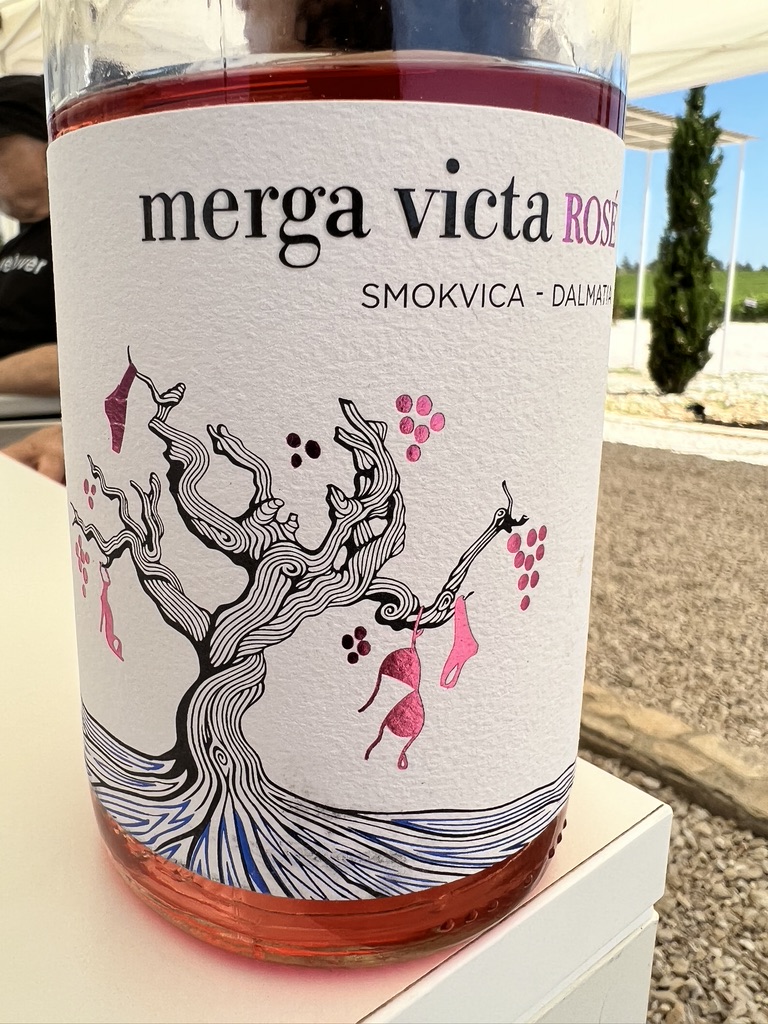
The 2021 Magna Victa Rosé, with a 12.5% ABV, is a blend of 60% Plavac Mali and 40% Plavina. It had a darker pink color, and was very aromatic, with fruity and herbal notes. On the palate, it was dry and crisp, and presented strawberry and raspberry notes, with herbal accents, especially on the finish. Easy drinking and tasty.

When I first saw this bottle, I noted how large and heavy it was, and Juraj mentioned that in Croatia, such bottles are seen by many people as signifying quality. The 2018 Testament Zenith Pošip was named Zenith, as it means the "highest peak of inspiration." Its origins began out of a vinous tragedy, which Juraj turned into an opportunity. He once had 20 tons of Pošip to crush, but the press broke after pressing only 5 tons. Juraj almost left the winery at that point, but decided instead to pay homage to his ancestors who produced "yellow wine," skin contact wines (or what we usually refer to as orange/amber wines). He also noted that the Šibenik region has a history of yellow wine.

The Pošip grapes were macerated on the skins for about 21 days, aged for 6 months on the lees in oak barrels, and ha a 13% ABV. Juraj produced about 15K bottles, noting that it would easily age for at least 10 years. With a bright orange color, the wine was deep, intense and complex, with strong tannins, a bright minerality, some citrus and dried fruit notes, herbal accents, and a lengthy, pleasing finish. An excellent and delicious wine. Highly recommended. 

The 2019 Magna Victa Posip Sur Lie, with a 13.5% ABV, was produced with only a couple hours of skin contact, and then fermented in large oak barrels, sur lie, for about 24 months. The barrels were equal portions of Slavonian, French and American oak. Only 2K liters of this wine were produced. It was in a more modern style, rich with a strong oaky and buttery nature, so it wasn't my personal preference. 

The 2019 Testatment Babić, with a 13.5% ABV, is made in a more traditional style, from older vines, with some skin contact, and about six months in French and American oak. It was a bit tight, and could use more time in the bottle. With a medium red color, it had juicy black fruit, black cherry and raspberry, with firm tannins, high acidity, a hint of spice and some minerality. Last year, the winery sold 10,000 bottles in their wine shop, and this wine was their #1 best seller. Another very good food wine, from burgers to pizza, steaks to a hearty pasta dish.

The 2017 Testament Plavac Mali, with a 15% ABV was also placed into a heavy bottle. They only have three hectares of this grape. The wine saw 10 days of skin contact, 14 months in new oak (French and American), and 1 year in the bottle. Their Plavac Mali grapes create wines that are different those in southern Dalmatia. Juraj is friends with Josip Volarevic, another young and talented winemaker who has an intense passion for Plavac Mali, and they share similar winemaking philosophies. 

This was an impressive wine, very elegant and complex, with soft tannins, ripe plum, black cherry, and blackberry flavors, with hints of spice and minerality, and a lengthy, pleasing finish. Highly recommended. Juraj also noted he would like to create a Super Dalmatian blend, composed of Babić, Tribidag, and Plavac Mali.  

We ended our tasting with the 2018 Testament Babić Prošek, a sweet dessert wine. Prošek is a traditional Dalmatian sweet wine, made from dried grapes. The grapes for this wine were dried on the vine, harvested around mid-November. With a 14% ABV, the wine had 10 days of skin contact and was aged for 24 months in oak. The wine had a dark red color, and on the palate, there was a well balanced sweetness, and intriguing flavors of figs, dried fruits, subtle spices and a touch of chocolate. 


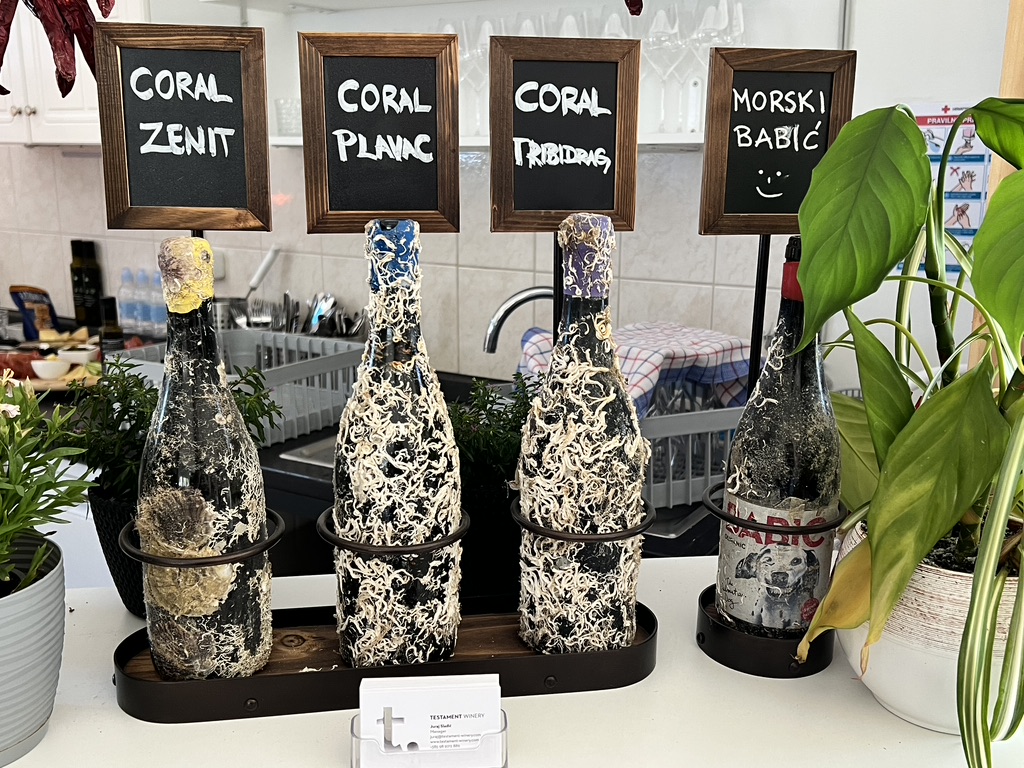
Juraj also produces a line of "Coral" wines, which are aged underwater in the Adriatic Sea. In general, the wines kept about 25 meters below the sea, with 3 bars of pressure, cold temperatures and almost no light. Being underwriter speeds up the aging process, and Juraj keeps the coral on the bottles. These are very limited edition, and expensive, wines. 

A friendly winery dog.

Juraj Sladić is producing excellent wines at Testament Winery, especially with Babić, showcasing its potential as an important Croatian grape. He has clear passion and it's exciting that he's experimenting with new wines and styles. The winery may be owned by a large corporation, but it's run as a small, boutique winery. A number of their wines are available in the U.S. too, through Croatian Premium Wine Imports

Thursday, January 26, 2023

Thursday Sips & Nibbles

I'm back again with a new edition of Sips & Nibbles, my regular column where I highlight some interesting, upcoming food and drink events. I hope everyone dines out safely, tips well and are nice to their servers.
******************************************************
1) The Patriots may not be in this year's Super Bowl, but that doesn't mean you still can't party with food, fun, and football on Super Bowl Sunday. For Super Bowl Sunday, Chef Will Gilson's Puritan & Co. will be offering a $65 game-day party pack to-go to keep you and your crew well fed for the big game! 

Serving three to four, the party pack features elevated game-day favorites including:
12 piece shrimp cocktail with 'St. Elmo’s Fire' sauce
12 dry-rubbed wings with sides of buffalo & cilantro sauces
12 lamb meatballs with feta & cucumber sauce
Chips & dips with pimento dip & Puritan Oyster Bar's crab rangoon dip
8 Parker House rolls with garlic parsley butter
6 housemade cookies

Party packs are available HERE for pre-order with pickup on Sunday, February 12th from 3 to 5 p.m.

2) Mooncusser, located in Boston's Back Bay, is one of my favorite seafood restaurants in Boston. Chef Carl Dooley has now created a Winter Prix Fixe menu,  a seasonal four-course tasting menu showcasing global flavors and local seafood. The Menu includes the following:

FIRST COURSE: Choice Of
KANPACHI CRUDO (Oro Blanco, wasabi, shiso)
MARINATED ARCTIC CHAR (Roasted beets, pickled red onion, pink peppercorn)
SECOND COURSE: Choice Of
GLAZED YUCCA (Jonah crab, habanero, sour orange)
ROASTED VEAL SWEETBREAD (Coconut, oyster mushrooms, makrut lime)
THIRD COURSE: Choice Of
SEARED LOCAL HAKE (Salt cod cream, soy beans, black truffle)
ROASTED LAMB LOIN (Carrots, fenugreek, Kashmiri chili)
DESSERT: Choice Of
POUND CAKE (Frozen yogurt, honey, saffron, pears)
WHITE CHOCOLATE SEMIFREDDO (Tangerine, parsnip, citrus curd

The Tasting Menu costs $105/per person, with wine pairings for an additional $55. Mooncussers dining room is open from 5 PM-9:30 PM, Tuesday thru Saturday, and closed on Sundays and Mondays. Reservations are highly recommended by calling 617-917-5193.

3) At Row 34 in Burlington, they are bringing back La Ventana, their Mexico City taqueria-inspired menu, which began as a ghost kitchen during the pandemic. This special menu will only be available for the next few Sundays, and for take-out only. You place an order for tacos or a tostado, such as Braised Beef Short Rib Taco, Tempura Mushroom Taco, Fried Haddock Taco, Lobster Tostado, and more. You can also purchase Sides such as Pineapple Salsa & Chips and Chorizo & Scallion Queso & Chips. You can preorder online HERE.

Tuesday, January 24, 2023

Vina Fakin: "Teran Is His Life Blood"

While visiting the region of Istria, on our two week tour of Croatia, we spent a couple days in Motovun and the surrounding area. During this time, we met the charismatic Marko Fakin, the owner and winemaker at Vina Fakin, which is located in the foothills below Motovun. Within Motovun, Marko also owns Konoba Fakin, as well as Enoteka Fakin, a wine, truffle and olive oil shop. 

We first met Marko in Motovun, and then went with him to visit a couple of his vineyards and then his winery. Overall, I found Marko to be personable and passionate, young and ambitious. He was also down-to-earth, knowledgeable, and very skilled at wine making. He made you feel very welcome. 

Marko's family has lived in the same local village for at least 300 years, so his roots in Istria run deep, and his wife was also born in a nearby village. Marko's interest in wine started at a young age. As a small child, Marko would ride on his father's tractor while he worked their small 7.5 acre vineyard. His father sold the grapes to other local producers.  

Prior to the Homeland War, his father's vineyard, and others in the region, were part of a cooperative. However, after the War, the cooperative dissolved and the vineyards were split into seven parts, which Vina Fakin would eventually try to purchase. 

Marko graduated from wine school around 2010-2011, and he noted that it primarily taught you how to tend a vineyard during good conditions. Thus, you had to learn how to handle problems on your own as they came, gaining experience each year. He also stated that if you make a mistake on year, you have to ensure that you don't repeat it the next year. In winemaking, you only acquire experience once a year, rather than on a constant basis like other professions. 

Marko started producing wines in 2010, using grapes from 10 acres of family vineyards, and made about 2000 bottles, 50% Teran and 50% Malvazija Istarska. He sold his wines at local farmers' markets, and used his garage as a tasting room. And he excelled from the start, winning a Croatian wine award for his Teran, and also was recognized as Winemaker of the Year.

Currently, Marko owns about 50 hectares of vineyards, most recently buying 4 hectares in Spring 2022, although he doesn't foresee much more growth. He stated that their biggest problem in the vineyards is humidity, so he generally needs to plant at higher altitudes to avoid low fogs, or plant on the southern side. Wild boars are also a problem, as they can easily devour 1-2 kilograms of grapes at a time. 

Some of his vineyards have vines that are as much as 100 years old, some of the oldest vines in commercial use in the region. They have cut about 70% of the quantity of their red grapes, primarily Teran, to improve its quality. For example, they used to get yields of 5 kilograms but have drastically decreased that amount to 1/2 to 1 kilogram. His wines also have excellent acidity. 


The winery produces about 50/50 red and white wines, and it has a capacity of 150,000 bottles, although they only produce about 120,000 bottles currently. He does have plans to construct a new winery, to make it larger. Marko's original plan was to produce only 50,000 bottles, but that has changed, and although Marko claims he is about at his limit now, it's certainly possible he could expand more in the future. 

They have 10 labels, mostly Malvazija Istarska and Teran, although they have recently planted Cabernet Sauvignon, Pinot Noir, Merlot and Syrah, to prove they can so. However, they will have to wait 5 years until wines with those grapes will be allowed on the market. One of Marko's goals is to make a "Super Istrian" blend, using Cabernet Sauvignon, Merlot, Syrah and Teran.

Marko also grows numerous olive trees, indigenous Croatian varieties, and produces about 1500 liters of olive oil each year.

As Marko stated, "Teran is his life blood." Teran is not an easy grape to work with, especially in the vineyard, which has caused him to cut down the harvested amounts for extra quality. Marko desires to make a variety of new types of Teran. For example, he wants to make more fresh Terans wines, although this is the hardest style to make as you need to throw out many grapes. He also wants to make Teran wines with longer maceration, such as one year of skin contact. 

He currently makes an Amarone-style Teran, commonly with grapes dried on vines, or sometimes on grass mats. He also makes a Teran Rosé. Marko doesn't grow Refosco even though it grows well in the region. Marko also noted that Teran pairs very well with the strong aromas of Istrian truffles.

A big, friendly wine dog!


We toured the winery, and Marko noted that they use French oak as well as Acacia barrels. The winery is small, and compact, so I can understand why Marko wants to construct a new winery, making it more spacious.


Marko sometimes uses amphora, mostly for whites grapes (although sometimes red), producing interesting amber/orange wines. 


In their tasting room, we sampled the 2018 Fakin Teran "Michel," a limited edition red wine (of only 1200 bottles) made in an Amarone style. This is their most expensive wine, at 100 Euros, and one of the most expensive Croatian wines I saw in my travels. The grapes came from the Flaminio single vineyard, which was planted in 1972, so the grapes are about 50 years old. The grapes dried on the vine, and had to be hand harvested very quickly. 

The grapes spent 50 days with skin contact & fermentation, and then the wine was aged in amphora for a year and then in used barrique for another year. Natural yeast was used, and the shape of the amphora helped to move around the yeast more easily. The wine isn't made very year, and prior vintages included 2011 and 2015, with planned releases for the 2020 and 2021 vintages as well. 

With a 16% ABV, this is a big wine, yet not a powerhouse, being very well-balanced. It possesses an alluring aroma of black fruits and mild spice and a dark red, almost purple color. On the palate, it's dry and smooth, with good acidity, rich and complex flavors of ripe plum, black cherry, and blackberry, along with subtle spice notes. It has a long, lingering and pleasing finish, and is considered a young wine which will age very well. I was told that 2027 would be the prime time for drinking this wine. An impressive wine, even in its youth, and clear evidence of Marko's skills, as well as the vast potential of Teran. 

I purchased a bottle of this wine, believing it was worth the price, and will let it sit in my cellar, waiting for 2027. Highly recommended, although it would likely be difficult for many people to obtain a bottle of such a limited edition wine.


When we stayed in Motovun, we were a very short walk to Konoba and Enoteka Fakin. The Konoba opened in 2005, and their new chef previously worked at a Michelin star restaurant. They currently have 17 full-time employees at the konoba, and 18 employees at the winery. Marko explained the main difference between a konoba and a restaurant, noting that a konoba served larger portions.  

Their Konoba has patio tables, overlooking the Mirna River Valley. As I mentioned previously, there are numerous feral cats in this area, hoping that diners will feed them. And sometimes they walk atop the wall, very close to the tables, so you need to keep an eye on them just in case they try to steal food off your plate. The cats are generally friendly, especially if you give them a taste of your food.


We stopped for lunch at the Konoba Fakin, and had our choice of two dishes. I opted for the Risotto with boletus, black truffles, and Istrian prosciutto chips. What an amazing dish, with perfectly cooked risotto, creamy and flavorful, with earthy notes from the mushrooms and the compelling aromas of the truffles. And those prosciutto chips were crispy, meaty and salty. A well balanced and delicious dish. 

The other option was the Fuži pasta with black truffles, which was also quite tasty. This is a common dish in Istria, showing its Italian influences. 

With lunch, we enjoyed the 2021 Fakin Malvazija Istarska, with a 13% ABV which only spent 6 months aging in stainless steel. It was fresh and bright, with juicy peach and citrus flavors, a backbone of minerality, and a pleasant finish. 

After lunch, we had some free time which I used to further explore Motovun. Later that evening, we returned to Konoba Fakin for dinner, with more truffles and wines. 

Dinner began with a glass of the 2019 Fakin Chamal, a sparkling wine made by the Charmat method and with an 11.5% ABV. It's a blend of 80% Malvazija Istarska and 20% Chardonnay, and that blend is how it got its name (CHArdonnay & MALvazija). The grapes were harvested 20 days early to maintain its acidity and lower ABV. It was dry and crisp, with nice flavors of apple and hints of brioche. Easy drinking, and said to pair well with oysters, seafood and pasta. This wine is sold in many Croatian restaurants. Marko noted that Riedel has a specific glass for Malvazija, but it's primarily intended for fresh Malvazija wines.  

With an appetizer of scrambled eggs and asparagus, the next wine was the 2019 Fakin Malvazija Istarska La Prima. With a 15% ABV, the Malvazija grapes for this wine were from the Komarso single vineyard, which was planted in 1954. The grapes spent 7 days with skin contact and then was aged for 12 months in acacia barrels. This orange/amber wine had an appealing aroma, and on the palate is was smooth and dry, with a complex and intriguing melange of notes of honey, dried fruits, intriguing spices, minerality and savory elements. Marko stated it was a "fatty wine" that paired well with bitter foods, which would explain its pairing with the asparagus. He also stated he preferred to use a big bowl Burgundian glass for this wine. Highly recommended.

We then moved onto the 2020 Fakin Teran, with a 13.5% ABV and which only 20% of the wine spent a little time in oak. An easy drinking wine, with rich black fruit flavors, spices notes, an elegant of earthiness, and soft, restrained tannins. It can be enjoyed on its own or paired with food, such as spicy manestra, our next course. A fine example of a "fresh" Teran.

Istrian Manestra is the most common dish in Marko's house, a soup (although thicker like a stew) with beans, corns, pork, and vegetables. It's usually served for lunch, a strong meal to fill them up after the work of the morning. This was a hearty and delicious soup, with pieces of crispy prosciutto. A true taste of Istria.

My entree was the Beefsteak with black truffles and mashed potatoes. The meat was tender, juicy and flavorful, enhanced by the alluring aromas of the black truffles. A decadent dish, sure to please any meat lover.

With the beef, we sipped the 2018 Fakin Teran Il Primo, with a 14.5% ABV, from grapes of the Flaminio single vineyard, which were planted in 1972, which spent 21 days with skin contact.. Only 3900 bottles were produced, and the wine spent two years in the barrel, 50% new oak. The wine had an intense fruity aroma, and on the palate it was dark and deep, intense and smooth, but well-balanced too. Ripe plum, black raspberry, deep spices, mineral notes, and a lengthy, satisfying finish. Again, Teran makes an impressive wine, and it's clear that Marko is quite skilled with this Istrian grape. Highly recommended.

Dessert was Home made Ravioli with black truffles, and filled with white chocolate. Another delicious and more unique dish, the truffles certainly elevated it. The chef at Konoba Fakin certainly deserves kudos for his menu. 
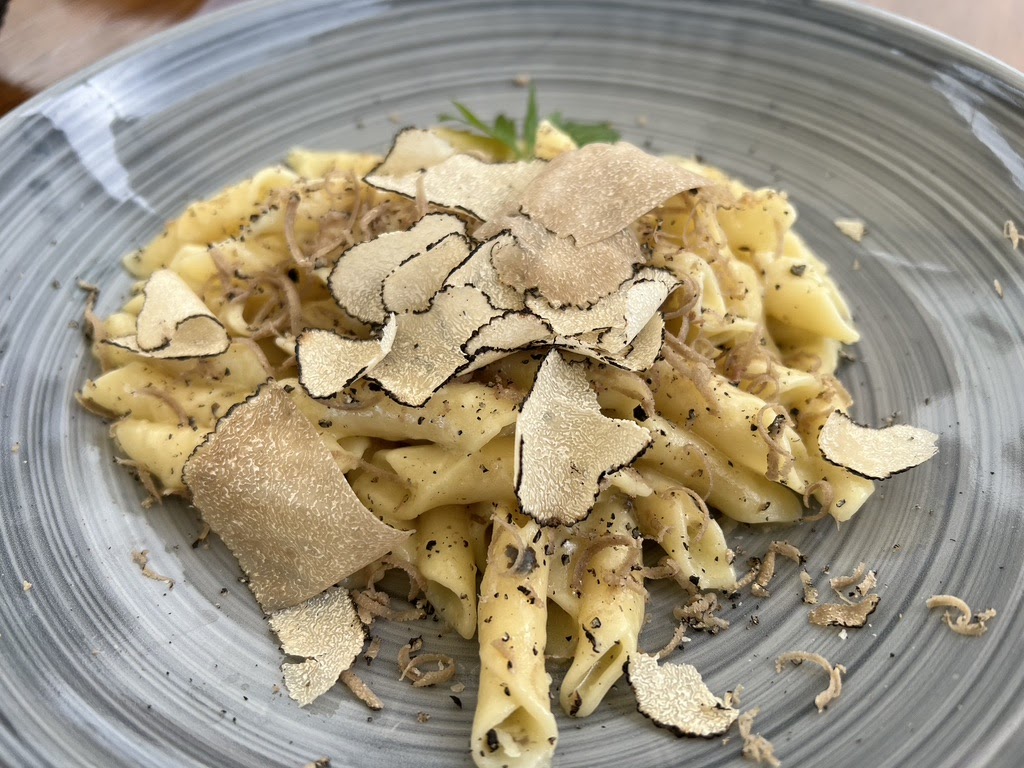
Marko Fakin has certainly earned his excellent reputation as a wine maker, and it's great that he is concentrating his efforts on indigenous grapes, Malvazija Istarska and Teran. His passion for Teran is more than evident, and he is leading the way to show the vast potential of Teran. All wine lovers should learn more about Teran, and sample it if possible. Marko is a leader in the new generation of Croatian wine makers, and it was a pleasure to spend time with him, talking and sampling his wines. If you are in Istria, you definitely should visit his winery and check out his Konoba in Motovun.