However, White Port appears to be probably as old as Red Port, extending back to the late 17th century. White Port was first exported to the U.S. in the first half of the 18th century, and those imports included old White Ports as well as Vintage White Ports! Aged White Ports are still produced and they can be wonderful and complex wines.
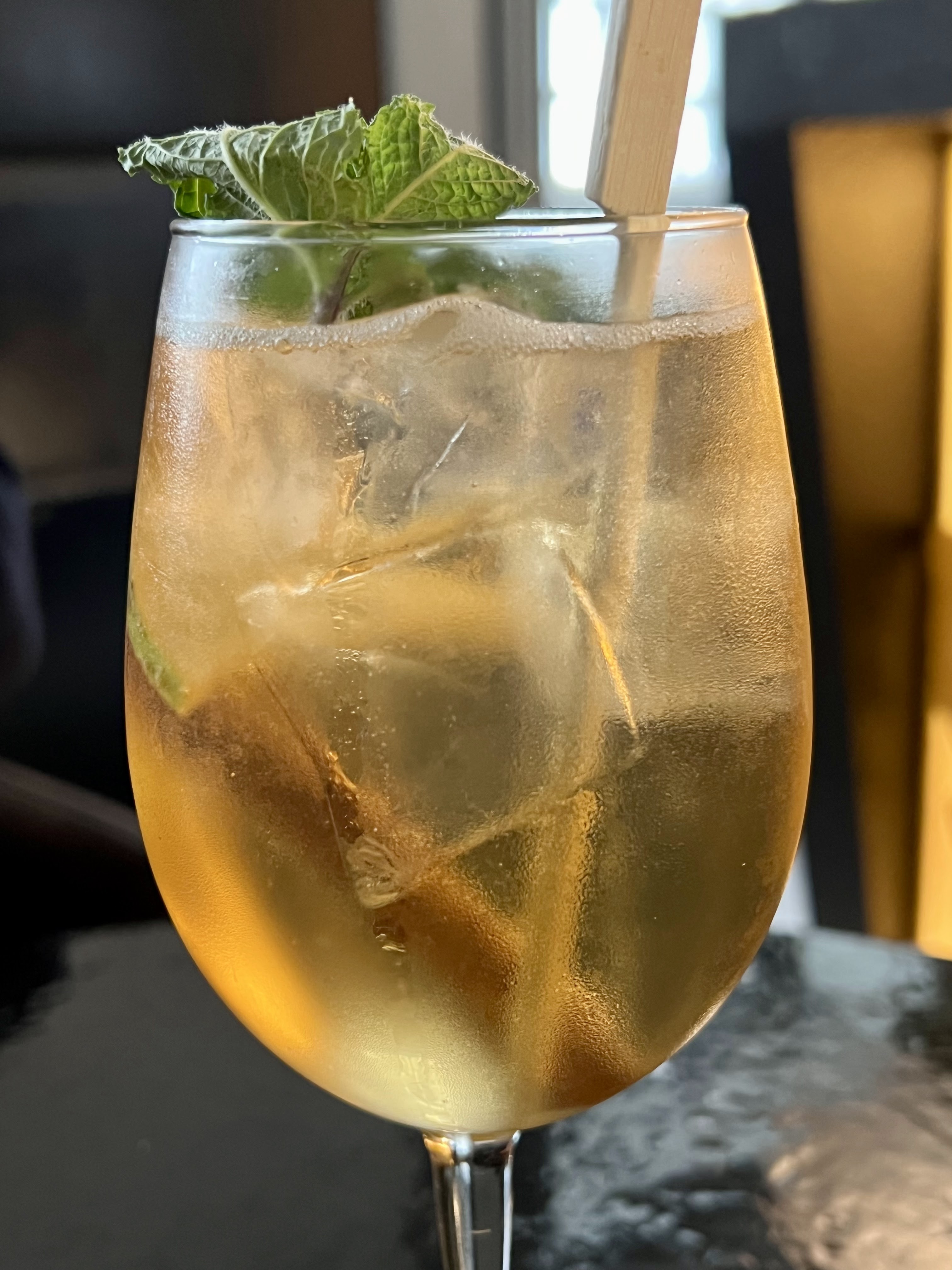
In general, a White Port and Tonic is made with ratio of one part White Port and two parts Tonic Water, with a slice of lemon or lime, but variations exist. In the picture above, there's a Porto Tonico which I enjoyed at the Quinta da Pacheca in the Douro region of Portugal. It was made with Pacheca White Port, tonic water, lemon and a cinnamon stick. It was refreshing and bright, with only a mild sweetness, and it's easy to understand why these Port Tonics are so popular during the summer.
The exact origins of Port and Tonic in Portugal are unknown, but we can gain an understanding of its first appearances in the U.S. California once produced many sweet, Port-style wines so it's not a stretch to believe the first Port and Tonic cocktail recipes in the U.S. called for red California Port. I'll also note some of the first appearances of Port and Tonic in other countries.
 The first U.S. newspaper to mention Port and Tonic was about 60 years ago, the San Jose Evening News (CA), July 27, 1966. The article mentioned a recent trend for a "little bitterness in beverages." The article continued, "As it is produced in California, Port is sweet, fruity, and heavy-bodied. It is usually served as a dessert wine to sip with fruit and cheese or to drink in front of the fireplace with an apple and a bowl of nuts at hand. But it has taken on a new image now that its affinity for quinine water has been discovered." Quinine water is more commonly known now as tonic water.

The article added, "Port and Tonic are very friendly. Mixed in a tall glass with ice and a garnish of lemon, the combination is extremely refreshing." It was also mentioned that this cocktail is visually appealing, as the deep red color of the Port looks even better partially diluted with tonic water. The basic recipe was, "For taste and appearance, two parts of quinine water to one part Port creates a nice balance between the bitter and sweet."
This same article was reprinted in newspapers in Louisiana, Washington, Texas, and possibly other states as well. So, a fair amount of people across the country may have seen this article and recipe. It's important to note though that this recipe called for a Red Port, and not a White Port.
 Port & Tonic in England. One of the first mentions of Port & Tonic in England was in the Eastern Daily Press (Norwich, England), November 12, 1968. The newspaper provided the above recipe, which is a little different from the prior U.S. recipe. The English one called for a Ruby or Tawny Port, also red like in the U.S. recipe. However, the ratio was different, with the English recipe calling for equal parts of Port and Tonic.

 The San Francisco Chronicle (CA), May 3, 1970, published the above photo of a Port & Tonic cocktail and the accompanying recipe. Again, we see it used a red Port, not a white Port.
 The St. Helena Star (CA), October 29, 1970, provided a recipe for Port & Tonic, which appears to have become by that time the standard one in the U.S.
 The first mention in the U.S. of White Port in this type of cocktail was in the San Antonio News (TX), August 26, 1971. In a grocery store advertisement, they presented a recipe for a "Strawberry White Port." It called for 4 ounces of California Gallo White Port, iced tonic water, 1/2 ounce of strawberry liqueur, a slice of lemon, and a strawberry garnish.
The Syndney Morning Herald (Australia), October 27, 1992, mentioned that Port wine shippers were trying new things to boost sales, including "dry white port and tonic as an appetiser."
The Cambridge Evening News (Cambridge, England), January 28, 1997, stated that for Valentine's Day, try "a chilled white port or add tonic and a twist of lemon for a long refreshing drink." And the Evening Press (York, England), February 1, 1997, mentioned that "...for that romantic evening try chilled white port with tonic and a twist of lemon as an apertif."

The Birmingham Post (Birmingham, England), December 5, 1968, noted that Port was coming back into fashion, and the article provided recipes for a number of mixed drinks. It noted, "Port and tonic: Another cool one, bitter-sweet and sparkling." Then, it gave the recipe, "Mix 1 part ruby ot tawny port wine, 1 part tonic water, ice." The article also provided recipes for other Port cocktails, including Port and Pepsi, Port Fizz, Port Punch, and others, all made with Ruby or Tawny Ports.
The Birmingham Evening Mail, (Birmingham, England), May 29, 1969, provided the first mention of White Port & Tonic. In an article about a journey to northern Portugal, the writer mentioned that he visited the Sandeman Wine Lodge. He stated, "... I learned that port need not only be a warming after-dinner drink on a cold day but a fresh cool apertif on a warm one--Sandemans served white port with tonic and ice in tall glasses." So, we thus know that White Port and Tonic existed in Portugal since at least the late 1960s, and probably even earlier.


The Corpus Christi Caller-Times (TX), November 26, 1970, published a similar recipe as did the Sacramento Union (CA), August 25, 1971, in their recipe for "California Port and Tonic."

The Times-Picayune (LA), August 2, 1973, in an article on wine coolers, provided a recipe for Port & Tonic, calling for 1 cup of Port to 2 cups tonic water, adding crushed ice and lemon wedges for garnish.
The Morning Call (PA), June 29, 1974, briefly noted, "This time of the year also causes an upsurge in 'cool' drinks --gin and vodka tonics and the like. A newer one, we're told, is port wine and tonic." Maybe Port & Tonic wasn't too well known in the U.S. at this time.
Articles in the Richmond Times-Dispatch (VA), August 25, 1974, the Mobile Press (AL), August 28, 1975, and the Palm Beach Post (FL), December 10, 1975, all provided Port & Tonic recipes, confirming to the prior standard.
White Port again! The Evening Standard (London, England), October 22, 1985, noted, "... I can commend white port and tonic as a refreshing mid-morning drink on one's day off." Morning drinking? Why not?
It doesn't seem until the 1990s that White Port & Tonic really took off outside of Portugal.
The Syndney Morning Herald (Australia), October 27, 1992, mentioned that Port wine shippers were trying new things to boost sales, including "dry white port and tonic as an appetiser."
The Edmonton Journal (Canada), November 3, 1993, reported that "a favorite tipple at Paris cocktail parties this year is white port over ice." The article provided a recipe they called the Sandeman Splash, which was made with 1 part white Port, 1 part tonic water, ice, and a lemon slice. Note that the ratio of Port to tonic water is one for one, unlike the standard of one part Port to two parts tonic water. The article also mentioned that for something lighter, you could make it with one part Ruby Port, two parts tonic water, and a twist of orange.
The Edmonton Journal (Canada), November 16, 1994, noted that at a Portuguese party, many of the guests were introduced to a new apertif, white Port and tonic.
The Edmonton Journal (Canada), November 16, 1994, noted that at a Portuguese party, many of the guests were introduced to a new apertif, white Port and tonic.
Back in the U.S.., the Arizona Republic (AZ), March 8, 1995, stated, "Mixing white Port with tonic water makes a most pleasant drink. Serve over ice in a tall glass with a slice of lemon or lime. It makes a wonderful contrast to smoked meats and fish, spicy or salty foods." The News and Observer (NC), May 26, 1995, in an article on hot weather drinks, it noted, "A white port served with tonic in a highball glass on ice, with or without lime."
The Cambridge Evening News (Cambridge, England), January 28, 1997, stated that for Valentine's Day, try "a chilled white port or add tonic and a twist of lemon for a long refreshing drink." And the Evening Press (York, England), February 1, 1997, mentioned that "...for that romantic evening try chilled white port with tonic and a twist of lemon as an apertif."
The Worcester News (Worcester, England), September 5, 1997, wrote, "No drink is as welcome on a warm day as a long, tall glass packed with ice and a good measure of white port topped up with tonic water." The article continued, "This is the favorite drink of the port producers as they while away their time in the vineyards up the Douro waiting for the harvest to begin."
The first mention of the term "Porto Tonico" didn't occur in the U.S. until 2018. The Chicago Tribune (IL), November 18, 2018, first noted that Taylor, one of the largest Port houses, allocated about 500 cases of its Chip Dry White Port to the U.S. for the first time since the 1990s. This Port was fermented longer than other white Ports so it possessed a dry finish. It was also aged in oak to temper its sweetness.
As for the Porto Tonico, the article noted, "In Portugal, the drink is served before nearly every big meal, alongside snacks like Marcona almonds and slipper sardines, as something not--too-boozy to sip before the main event." It also mentioned, "The cocktail, tall and chilled, made with a crisp white port rather than the raisin-y red stuff, is a staple up and down the Portuguese coast." Some people garnished it with mint or orange zest. Finally, it was mentioned that, "Back in the U.S., the drink is harder to find."
Beatriz Machado, the wine director at the famed Yeatman Hotel, provided her own recipe for a Porto Tonico, which was composed of 3 ounces dry white Port, 2 ounces of tonic water, and 1 slice of orange zest.
Hopefully you've been intrigued enough to want to try a White Port and Tonic. If you enjoy a Vodka Tonic or Gin & Tonic, it makes for an intriguing and tasty variation. It also has less alcohol than Vodka and Gin. Anyone who desires a refreshing cocktail, with a nice balance of sweet and bitter, should give it a try. It's great during the summer, but you can enjoy it year round. The next time you have guests over, provide them White Port and Tonic as a new cocktail. It's simple to make, but I'm sure your guests would enjoy it.


No comments:
Post a Comment