Showing posts with label religion. Show all posts

Tuesday, November 7, 2023

Amarante: São Gonçalo, His Church & Phallic Cakes

As I previously mentioned, after we left the Monverde Wine Hotel Experience, we traveled to the town of Amarante, still in the Vinho Verde region. After lunch at Zé da Calçada, we did a little sightseeing, crossing the Ponte de São Gonçalo to visit the Church of São Gonçalo. Some believe the town might have been originally founded by Amarantus, a Roman centurion.


The Ponte de São Gonçalo (Saint Gonçalo) crosses over the Tâmega River, a tributary of the Douro River, which extends from Spain into Portugal. The original bridge over the river was constructed in the 13th century, but around 1763, it was washed away in a flood. So, a new granite bridge was built in 1790, with three arches and a pair of Baroque spires. 

In 1809, this bridge was the site of a battle between the forces of Napoleon and Portuguese troops. The Portuguese were able to hold off the French troops for nearly two weeks, allowing British troops in Portugal to attack other areas. However, once the French troops were finally able to capture the bridge, they pillaged and vandalized Amarante, making the Portuguese pay for their resistance. The photo above shows a sign commemorating the 100th anniversary of the battle.

As you walk down the bridge, the Church of São Gonçalo is in front of you. Saint Gonçalo is the patron saint of Amarante. Gonçalo Pereira was born around 1187 in Vizela, Portugal, and began his religious training as a child. After his ordination, he was placed in charge of the parish of Saint Pelagius, which he governed well. Eventually, he turned the parish over to his nephew so he could make a pilgrimage to the Holy Land, visiting Rome and Jerusalem. After fourteen years in the Holy Land, the archbishop commanded that Gonçalo return to the parish. 


Gonçalo quickly learned that his nephew had abused his position in the parish, using the money that was supposed to go to the poor to purchase himself fine horses and hounds. The nephew wasn't happy to see Gonçalo and had his dogs attack him. Before they could kill his uncle, they were called off and Gonçalo chose to leave the area, eventually settling in the hills of Amarante, living as a hermit. Over time, pilgrims came to see him, to hear him preach. 


Through prayer, Gonçalo saw a new future for himself, which led him to joining the Dominican Order. He then returned to Amarante, to establish a church, and the people, many who had heard him preach before, eagerly flocked to him. He also became known as a miracle worker, and at least one of those miracles involved wine from an unlikely source. 

Gonçalo was said to be the impetus for constructing a bridge over the Tâmega River. Legend claims that the bridge workers once ran out of wine, and were quite thirsty. So, Gonçalo split open his own head, from which wine poured out to slake the thirst of the workers. Another version of the legend claims that he only split open a rock, and wine poured out. When the workers were hungry, it's also claimed that Gonçalo called out to the fish in the river, who leapt onto the river bank, sacrificing themselves for the workers. 


Gonçalo died on January 10, 1259, and he allegedly predicted the exact date of his death. Even after his death, people felt he still performed miracles, including appearing to various people. Pope Pius IV made him a Saint in 1561, and his feast day is January 10th. 


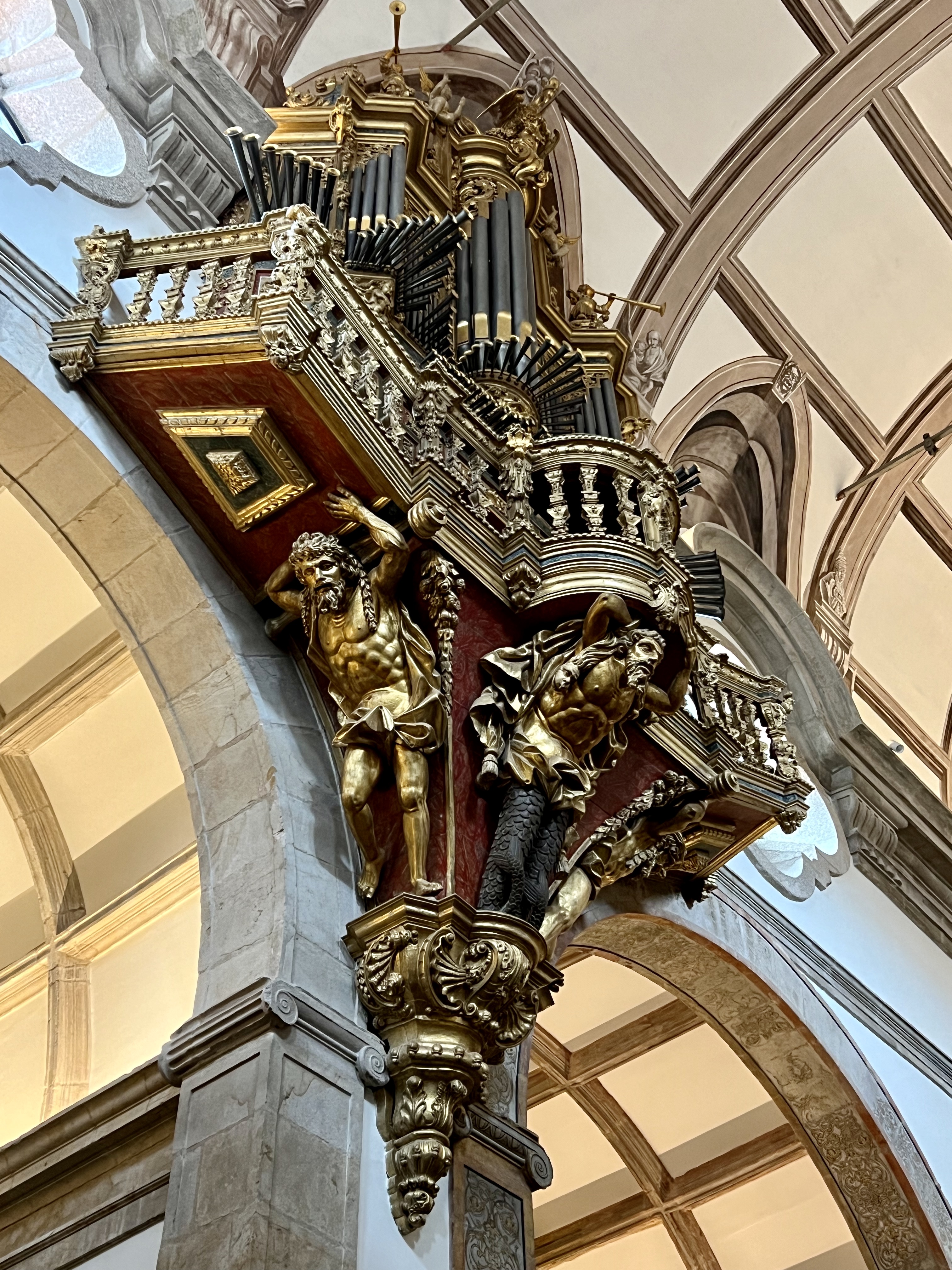
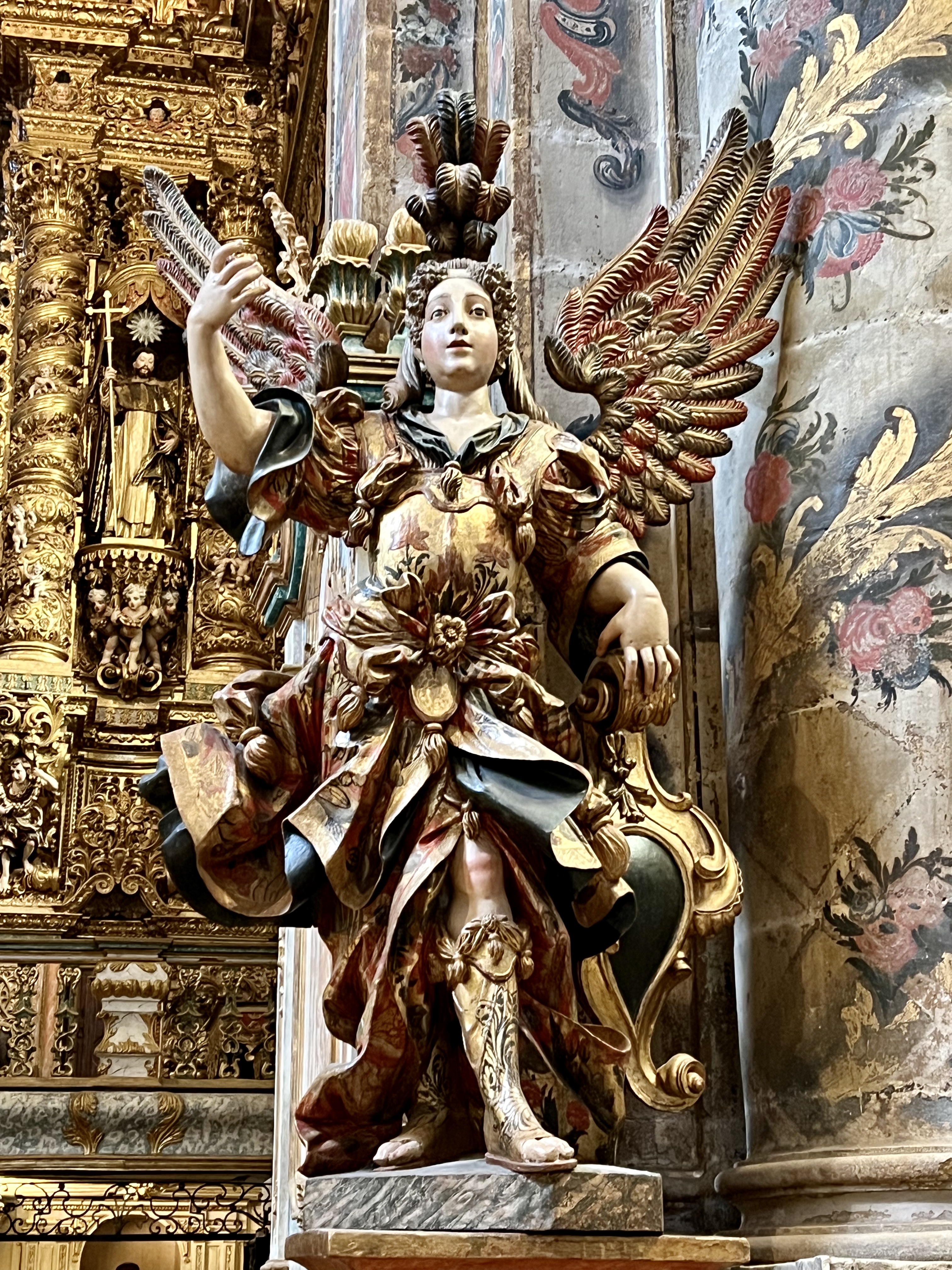
The Church is gorgeous, and once again I'm amazed at the quality, intricate work done by the artists during the 16th century. You don't have to be religious to appreciate the great beauty of the artwork and architecture. 


For unknown reasons, Saint Gonçalo became associated with love and fertility, and women still pray to him to secure a husband, and to have children.


The bottom photo shows an effigy of Gonçalo on his tomb, and it is often here that women come seeking his assistance for their love lives. Some leave flowers atop the effigy. It's also said that if a single woman pulls on the rope belt of the statue of Gonçalo, in the second picture above, they will find a husband. 


Another famous symbol of Saint Gonçalo is the Bolos de São Gonçalo, the cakes of Saint Gonçalo, which are also known as Doces Fálicos, "phallic sweets." These penis-shaped cakes can be found throughout Amarante, from its bakeries to wooden stalls managed by elderly women. These cakes are supposed to promote fertility, but also are given to single woman as a charm to help them attract a husband. No one knows the origins of these cakes, and many suspect they extend back to ancient pagan practices. By some unknown twist of fate, the cakes became associated with Saint Gonçalo. 

Initially, the cakes were created only on a couple religious holidays, in January and June, but eventually they started being made year-round. Around 1926, the cakes were declared obscene by the government and thus prohibited, although people still made them secretly. It wasn't until 1974 that the laws changed, and people could once again openly produce these cakes. 

Amarante is worth a stop if you visit the Vinho Verde region. A delicious lunch, tasty convent sweets, fascinating history, medieval architecture, great beauty and more. 

Tuesday, December 13, 2022

Visit to Poreč: The Basilica & Boškarin


During our time in Istria, on our two-week tour of Croatia, we made a brief stop at the town of Poreč, a popular resort spot on the west coast of Istria, along the Adriatic Sea. Poreč is bout 2000 years old, and the Romans once built a city there. As expected, you'll find many tourist shops here and plenty of restaurants. 

One of the top attractions in Poreč is the 6th-century Euphrasian Basilica, also known as the Cathedral Basilica of the Assumption of Mary, which was designated a UNESCO World Heritage Site in 1997. Part of this complex dates back to the 4th century, when an earlier basilica was established by Saint Marus of Parentium. Around 535, Bishop Euphrasius had much of the basilica constructed. The Basilica is very well preserved, and includes a baptistry, bishopric, atrium, bell tower and chapel. We made a stop at the Basilica, and you can check out my photos of some of the sights within this fascinating place.


You could easily spend at least a couple hours exploring the Basilica. 

While wandering through Poreč, after stopping at a few shops, I decided to stop for a bite to eat at Fora Le Parte, a wine bar & bistro which was established in 2016. It was a pleasant day and I sat outside, so I could people watch while enjoying some food and a glass of wine. 

There were plenty of choices of restaurants I could have stopped at, but Fora's sandwich board caught my eye with its mention of Boškarin. The Boškarin, also known as Bakin, are an ancient breed of cattle that originated in Istria, said to be descended from bulls of the Podolica breed, originally from southern Italy. Like Waygu, Boškarin began as draft animals, but when tractors eventually took over, there was little need for Boškarin. The breed nearly died out until some dedicated breeders established the Federation of Istrian Cattle Breeders and brought the population back from extinction. Now, it is seen as a gourmet delicacy, and I wanted to experience it.

The Boškarin Carpaccio was exquisite, silky and flavorful, with a rich, beefy taste. And at only about $13 US, this was also an excellent value. I chose an older Malvazija wine for this dish, based on a recommendation from the server, and the pairing worked well, with the richer, more savory Malvazija complementing the delicious beef. If you visit Istria, you need to sample some Boškarin at some point. 

Monday, October 22, 2018

Alheira Sausages: Protection For Portuguese Jews

How did sausages help protect Jews from persecution?

During my recent travels in Portugal, we visited several museums, including the fascinating Centre for the Interpretation of Sephardi Culture in the Northeastern Trás-os-Montes, which is located in the city of Bragança. This museum "...aims at revising the lives and experiences of Sephardic Jews from the Northeastern Trás-os-Montes,..." The ancestry of Sephardic Jews extends back to Jewish communities in Spain and Portugal during the Middle Ages, and who spread to various regions after the Jews were expelled from Spain in 1492. Jews have lived in the Iberian region for over two thousand years.

This map shows 32 Jewish communes in Portugal during the 14th century. In 1492, when the Jews were expelled from Spain, about 3000 traveled to Bragança, but near the end of the 15th century, even the Jewish communities in Portugal faced a dire threat.

In 1496, King Manuel I issued an edict that all the Jews in Portugal either had to convert to Christianity or leave the country without their children. Not much of a choice. Even those who attempted to leave the country were often coerced into staying and converting. All of the converted Jews and their descendants would become known as "New Christians." However, many of these Jews only pretended to convert and secretly practiced their religion, fully aware of the harsh penalties if they were caught. In Hebrew, they were known as anuism, the "forced ones.

In 1536, the situation worsened with the formation of the Portugal Inquisition, which especially targeted the New Christians, seeking to ensure whether their conversion was true or not. The Jews needed to be clever, to maintain their disguise as converted ones, and sausages played a role in this deception. Sausages???

In the region of Trás-os-Montes, many people prepared their own pork sausages, meat which could easily last through the winter, and they would commonly hang the sausages from the rafters of their homes. These sausages were easily visible and homes without such sausages might be suspect, as Jews didn't eat pork. Thus, in a clever stratagem, Jews decided to create their own type of sausage, something to hang in their own rafters, to avoid drawing attention to themselves.

Possibly originating in the city of Mirandela, the alheira was born, a sausage made from chicken, garlic and bread crumbs. No pork was used in the creation of these sausages. When they were hanging out, they appeared to be a normal sausage and no one was the wiser. In the photo above, you can see slices of alheira, and it somewhat resembles an exploded sausage due to the fillers within it. Nowadays, alheira sausages come in many different variations, such as using different meats or even no meat at all.

During my trip, we enjoyed alheira during several different meals, generally sliced and placed on a plate with another type of sausage. The alheira has a more unique texture, cause of the fillers, which might seem odd to you at first if you've never tasted these sausages before. I liked the taste of the alheira, with it's nice blend of spices and garlicky taste, and it wasn't as salty as some other sausages I've tasted. If you travel to northern Portugal, seek out alheira and remember how they helped to save Jews from persecution.

Tuesday, June 17, 2008

Is Christianity Responsible For Great Wine?

When we discuss great wines, there is often discussion of terroir, skilled wine making and expert viticulture. Yet how often do you hear that Christianity is responsible for great wines? Have you ever heard that?

In the latest issue of Decanter (June 2008), there is a brief article with statements by famed Spanish winemaker Alvaro Palacios. His best wine is L’Ermita from the Priorat region, a wine that has international renown. Alvaro has stepped forward to make a bold statement, to give much credit to Christianity for good wine.

Alvaro stated: "Good wine comes from godly places. I am not crazy--I really want people to know how important this is. I don't understand why no-one else appreciates that the monks were the ones who chose the best places for vineyards. I'm not claiming that non-Christian countries can't produce good wine. But in Alsace, Burgundy, Bordeaux and Spain--in Priorat for example-- it's the same. These vineyard sites were gradually selected over hundreds of years; these places are mystical. Other wines are good but I truly believe the greatest wines come from religious regions."

Do his statements have any validity? If so, how much validity do they possess?

Coincidentally, I have been reading a new book, Bordeaux/Burgundy: A Vintage Rivalry, that touched upon exactly this topic.

"In Burgundy, as everywhere in Europe, it was the Church that maintained the tradition of viticulture during the early Middles Ages." (p.23)

Historically, it probably cannot be denied that the Church played a significant role in promoting vineyards and wine making. Even in California, the Church played a large role in such, including even during Prohibition. But, how much impact did the Church have in determining the locations of vineyards? What were the factors involved in their decisions as to where to plant grapes? Are these sites truly mystical? Or is some of it merely chance?

What is needed is a deeper examination and analysis of the history of Christianity and wine making. We need to determine why did the Church planted vineyards in certain areas. We need to determine whether the Church simply protected vineyards that had been planted previously, by secular individuals or organizations. It is an intriguing topic that hopefully will receive more attention in the near future.

What do you think about this topic?