There are numerous wines and spirits which possess names which are worthy of protection, indicative of a specific place of origin which cannot be adequately replicated elsewhere. Some examples include Champagne, Port, Bourbon, and Cognac. Scotch Whisky is another example and the term is a Protected Geographical Indication (PGI), meaning it can only be produced in Scotland according to UK rules. No other distillery in any other country can claim to produce 'Scotch Whisky,' and if they tried, there are legal remedies to stop them from doing so.
What boggles my mind though is that some Scotch distilleries have chosen to ignore one of the Protected Geographical Indication of another country, Spain. Two years ago, I wrote, Rant: Whisky, Sherry Barrels & A Lack Of Transparency, detailing how some Scottish distilleries used the term 'Sherry' on their bottles, describing the type of barrels used for aging, when those barrels weren't actually from the Jerez-Xérès-Sherry DO. In its most simplistic, they use 'fake' Sherry barrels. For unknown reasons, this doesn't seem to be a significant matter though it certainly should be.
As such, I'm always pleased to find a whiskey that uses authentic Sherry barrels, like the Nomad Outland Whisky ($49.99). This whiskey is an intriguing partnership between Richard Patterson, the famed Master Blender, with over 50 years of experience, of Whyte & Mackay and Antonio Flores, the Master Blender of González Byass, an esteemed Sherry House. As the whiskey is aged in both Scotland and Spain, it was given the name 'Nomad,' indicative of its travels.
The base is a blended whiskey, at 41.3% ABV, produced from a melange of over 30 different malt and grain whiskies, each 5-8 years old, from the Speyside and Highlands regions. This blend is then aged in González Byass Pedro Ximénez Sherry barrels for three years. They had previously experimented with a variety of Sherry barrels, including Fino and Oloroso, but they ultimately selected Pedro Ximénez as best for their vision.
What then makes this whiskey more unique, is that it is then transported to Spain, to the city of Jerez, where it continues to age for another year, in the San Fernando cellar of González Byass, in old Pedro Ximénez Sherry barrels. This adds an intriguing element to the whiskey, aging in a vastly different climate than Scotland.
With a rich amber color, the Nomad has an appealing nose which definitely reminded me of Pedro Ximénez sherry, combined with a spicy undertone and subtle malt notes. The taste is compelling and complex, a wondrous melange of flavors of both whiskey and sherry. It is smooth and elegant, with a bold spicy aspect, and notes of vanilla, salted nuts, raisins, honey, and dried fruit. It is more dry, not sweet, despite the raisin and honey notes. The pleasing finish simply lingers and lingers within your mouth, and it beckons you toward another sip. Well-balanced, delicious, and unique. Highly recommended!
For Over 18 Years, and over 5600 articles, I've Been Sharing My Passion for Food, Wine, Saké & Spirits. Come Join Me & Satisfy Your Hunger & Thirst.
Showing posts with label spain. Show all posts
Monday, December 2, 2019
Tuesday, November 5, 2019
Harvey's Bristol Cream Sherry: A Historic & Best-selling Brand
Back in 2010, after a visit to Bodegas Harvey in Jerez, I wrote, "Forget about Harveys Bristol Cream."
So why am I writing about it now?
In my previous article, my point wasn't that you should actually ignore Harvey's Bristol Cream, but rather that you should understand that Bodegas Harvey also produces other compelling Sherries, such as their VORS line, aged 30+ years. International Sherry Week is now taking place, from November 4-10, a celebration of the wonders of Sherry, a time for the ardent promotion of this fascinating and delicious wine. As such, it's a good time to revisit Harvey's Bristol Cream.
For some history and background information on Bodegas Harvey, please read my previous article. It's may be the only winery in the world that has alligators and albino peacocks on their estate.
What is a Cream Sherry? It's a sweet Sherry, commonly created from a base of an Oloroso, sweetened with some Pedro Ximenez (PX). One of the legends concerning the invention of cream sherry states that a few centuries ago, at the end of the night at Spanish taverns, some of the customers would order a a "small brunette." This was a tavern blend of about 80% Oloroso and 20% PX, which was sweet and had a creamy texture. British sailors eventually tried this blended Sherry and loved it, starting its popularity overseas.
There is another origin tale as well, that Harvey's were the creators of Cream Sherry, and even if they weren't the original inventors of this style, they may have created its name and certainly popularized the use of the term Cream Sherry. Since the 17th century in Bristol, England, "milk sherry" was popular, a thick blend of sweet and dry sherries. There is a legend concerning the origin of milk sherry, as it was thought to be the first moisture given to infants in Bristol.
In the 1840s, Harvey's Bristol Milk was a best seller but the company had a desire to make a finer blend. Around 1860, it's claimed that an aristocratic woman visited the offices of Harvey's, and tasted some of the Bristol Milk. She then tasted the new, finer sherry, and said "If the first was Bristol Milk, then this must surely be Bristol Cream." Harvey's Bristol Cream became hugely popular, eventually coming to the U.S. in 1933.
Let's take a brief exploration of some of the early history of Harvey's Bristol Cream. The popularity and prestige of Harvey's Bristol Cream was quite evident in 1880. In newspaper articles in the Western Mail (Wales), May 31, 1880 and The Times (London), June 1, 1880, it was reported that the estate of Mr. Cartwright would be sold by Chrisitie's at auction on July 1. Mr. Cartwright had owned one of the country's largest wine cellars, and it included over 150 dozen cases of Sherry including both Harvey's Bristol Milk and Bristol Cream, both bottled in 1862.
The Chicago Tribune, July 21, 1880, reported on the results of the auction, noting that a "dark golden sherry known as Bristol Milk" sold for 106-111 shillings per dozen. However, the Bristol Cream, an "old pale sherry," sold for 250-260 shillings per dozen. This was the highest amount ever paid at auction for a Sherry, until 1901. During the next twenty years after the 1880 auction, there would be other auctions, held at other venues, which would sell cases of Bristol Cream for much less, from 86-140 shillings, partially due to a diminished market for Sherry at the end of the 19th century.
Its record price was broken at another Christies's auction, in July 1901. The Buffalo Commercial (NY), July 29 1901, noted that "golden sherry from cellars of Sandringham House" sold for 570 shillings a dozen, more than twice the price paid for the Bristol Cream back in 1880. However, the Bristol Cream retained the record for the 19th century.
This advertisement is from The Times (London), March 30, 1912, referring to Bristol Cream as one of "Spain's Royal Wine." It is priced at 105 shillings, which is likely for a case.
As I mentioned, Harvey's Bristol Cream was first exported to the U.S. in 1933, and the first newspaper I found that mentioned it was The San Francisco Examiner, November 9, 1933. It was an advertisement for L.P. Ginsburg & Company, an importer, offering to sell several of Harvey's Sherries and Ports, with the Bristol Cream priced at a wholesale price of $64 for a case of 12 bottles.
The Record (NJ), April 20, 1934, presented an ad for the sale of a large amount of alcohol that had been confiscated by the U.S. government from tourists over the previous 19 years. Under "Wines Fit for Kings and Queens," Harvey's Bristol Cream was listed, though no prices were posted in the advertisement. It was in excellent company, considering the other wines listed in this grouping.
One of the first mentions of a retail price for Harvey's Bristol Cream Sherry occurred in The Montclair Times, October 12, 1934, stating it cost $4.95/bottle and $57.75/case.
The Chicago Tribune, October 26, 1934, ran an ad for Stop & Shop, with a large section for Harvey's wines, including a photo of the "Full Pale Sherry Bristol Cream." It was priced at $4.95/bottle. There were three other of Harvey's Sherries listed, priced from $1.95-$2.95, indicating the Bristol Cream was the most expensive. At this point, Harvey's had not taken on its iconic blue bottle.
During the rest of 1934 through 1935, there were numerous retail ads for Harvey's Bristol Cream, all across the country, with prices ranging from $4.49-$6.25/bottle. Some of the lower prices were sale prices. The highest price, $6.25, was in an ad in The Baltimore Sun, December 16, 1934, which also mentioned that it was "Aged for 50 years in the wood in Harvey's famous caves. This is the choicest old full pale Sherry."
The Pittsburgh Post-Gazette, February 3, 1937, posted an interesting ad, boasting about the quality of Harvey's Bristol Cream.
A similar ad was posted in the Los Angeles Times, February 10, 1937.
Interestingly, the price of Harvey's Bristol Cream appeared to decrease in 1938, with prices generally from $4.00-$4.95, including regular prices.
A new ad, similar to the two prior, was launched in the Los Angeles Times, April 4, 1940.
Let's jump ahead almost fifty years. In 1996, in honor of Harvey's 200th anniversary, they began to bottle their Bristol Cream in a "Bristol Blue" bottle. The city of Bristol used to be the main point of supply for Saxon cobalt oxide, a coloring staff which created a deep blue color. Some members of the company had initial concerns about the blue bottle. In Europe, poison was once sold in small blue bottles so there were worries that the blue bottle would fail but it ended up being a big success. Recently, Harvey's changed the bottle slightly, adding a label with thermochromic ink which turns blue when the bottle reaches a perfect temperature of 50-55 degrees Fahrenheit.
Harvey's Bristol Cream Sherry ($24.99) is also more unique as rather than just a blend of Oloroso and PX, it is a blend of 80% Fino, Amontillado, Oloroso and 20% PX. It's also a blend of more than 30 soleras, aged from 3-20 years. With a 17.5% ABV, it's smooth and creamy, sweet though not overly so, with notes of raisins, nuts, caramel, dried fruit, and brown sugar. It's easy drinking, something for a pleasing after dinner drink, or paired with desserts, like a Pear Crostata with Blue Cheese. And once you open a bottle, it should last for about a month in your refrigerator. This would be a fun choice for the holidays, especially to pair with your holiday pies and other sweets.
Sip a little history with Harvey's Bristol Cream Sherry!
So why am I writing about it now?
In my previous article, my point wasn't that you should actually ignore Harvey's Bristol Cream, but rather that you should understand that Bodegas Harvey also produces other compelling Sherries, such as their VORS line, aged 30+ years. International Sherry Week is now taking place, from November 4-10, a celebration of the wonders of Sherry, a time for the ardent promotion of this fascinating and delicious wine. As such, it's a good time to revisit Harvey's Bristol Cream.
For some history and background information on Bodegas Harvey, please read my previous article. It's may be the only winery in the world that has alligators and albino peacocks on their estate.
What is a Cream Sherry? It's a sweet Sherry, commonly created from a base of an Oloroso, sweetened with some Pedro Ximenez (PX). One of the legends concerning the invention of cream sherry states that a few centuries ago, at the end of the night at Spanish taverns, some of the customers would order a a "small brunette." This was a tavern blend of about 80% Oloroso and 20% PX, which was sweet and had a creamy texture. British sailors eventually tried this blended Sherry and loved it, starting its popularity overseas.
There is another origin tale as well, that Harvey's were the creators of Cream Sherry, and even if they weren't the original inventors of this style, they may have created its name and certainly popularized the use of the term Cream Sherry. Since the 17th century in Bristol, England, "milk sherry" was popular, a thick blend of sweet and dry sherries. There is a legend concerning the origin of milk sherry, as it was thought to be the first moisture given to infants in Bristol.
In the 1840s, Harvey's Bristol Milk was a best seller but the company had a desire to make a finer blend. Around 1860, it's claimed that an aristocratic woman visited the offices of Harvey's, and tasted some of the Bristol Milk. She then tasted the new, finer sherry, and said "If the first was Bristol Milk, then this must surely be Bristol Cream." Harvey's Bristol Cream became hugely popular, eventually coming to the U.S. in 1933.
Let's take a brief exploration of some of the early history of Harvey's Bristol Cream. The popularity and prestige of Harvey's Bristol Cream was quite evident in 1880. In newspaper articles in the Western Mail (Wales), May 31, 1880 and The Times (London), June 1, 1880, it was reported that the estate of Mr. Cartwright would be sold by Chrisitie's at auction on July 1. Mr. Cartwright had owned one of the country's largest wine cellars, and it included over 150 dozen cases of Sherry including both Harvey's Bristol Milk and Bristol Cream, both bottled in 1862.
The Chicago Tribune, July 21, 1880, reported on the results of the auction, noting that a "dark golden sherry known as Bristol Milk" sold for 106-111 shillings per dozen. However, the Bristol Cream, an "old pale sherry," sold for 250-260 shillings per dozen. This was the highest amount ever paid at auction for a Sherry, until 1901. During the next twenty years after the 1880 auction, there would be other auctions, held at other venues, which would sell cases of Bristol Cream for much less, from 86-140 shillings, partially due to a diminished market for Sherry at the end of the 19th century.
Its record price was broken at another Christies's auction, in July 1901. The Buffalo Commercial (NY), July 29 1901, noted that "golden sherry from cellars of Sandringham House" sold for 570 shillings a dozen, more than twice the price paid for the Bristol Cream back in 1880. However, the Bristol Cream retained the record for the 19th century.
This advertisement is from The Times (London), March 30, 1912, referring to Bristol Cream as one of "Spain's Royal Wine." It is priced at 105 shillings, which is likely for a case.
As I mentioned, Harvey's Bristol Cream was first exported to the U.S. in 1933, and the first newspaper I found that mentioned it was The San Francisco Examiner, November 9, 1933. It was an advertisement for L.P. Ginsburg & Company, an importer, offering to sell several of Harvey's Sherries and Ports, with the Bristol Cream priced at a wholesale price of $64 for a case of 12 bottles.
The Record (NJ), April 20, 1934, presented an ad for the sale of a large amount of alcohol that had been confiscated by the U.S. government from tourists over the previous 19 years. Under "Wines Fit for Kings and Queens," Harvey's Bristol Cream was listed, though no prices were posted in the advertisement. It was in excellent company, considering the other wines listed in this grouping.
One of the first mentions of a retail price for Harvey's Bristol Cream Sherry occurred in The Montclair Times, October 12, 1934, stating it cost $4.95/bottle and $57.75/case.
The Chicago Tribune, October 26, 1934, ran an ad for Stop & Shop, with a large section for Harvey's wines, including a photo of the "Full Pale Sherry Bristol Cream." It was priced at $4.95/bottle. There were three other of Harvey's Sherries listed, priced from $1.95-$2.95, indicating the Bristol Cream was the most expensive. At this point, Harvey's had not taken on its iconic blue bottle.
During the rest of 1934 through 1935, there were numerous retail ads for Harvey's Bristol Cream, all across the country, with prices ranging from $4.49-$6.25/bottle. Some of the lower prices were sale prices. The highest price, $6.25, was in an ad in The Baltimore Sun, December 16, 1934, which also mentioned that it was "Aged for 50 years in the wood in Harvey's famous caves. This is the choicest old full pale Sherry."
The Pittsburgh Post-Gazette, February 3, 1937, posted an interesting ad, boasting about the quality of Harvey's Bristol Cream.
A similar ad was posted in the Los Angeles Times, February 10, 1937.
Interestingly, the price of Harvey's Bristol Cream appeared to decrease in 1938, with prices generally from $4.00-$4.95, including regular prices.
A new ad, similar to the two prior, was launched in the Los Angeles Times, April 4, 1940.
Let's jump ahead almost fifty years. In 1996, in honor of Harvey's 200th anniversary, they began to bottle their Bristol Cream in a "Bristol Blue" bottle. The city of Bristol used to be the main point of supply for Saxon cobalt oxide, a coloring staff which created a deep blue color. Some members of the company had initial concerns about the blue bottle. In Europe, poison was once sold in small blue bottles so there were worries that the blue bottle would fail but it ended up being a big success. Recently, Harvey's changed the bottle slightly, adding a label with thermochromic ink which turns blue when the bottle reaches a perfect temperature of 50-55 degrees Fahrenheit.
Harvey's Bristol Cream Sherry ($24.99) is also more unique as rather than just a blend of Oloroso and PX, it is a blend of 80% Fino, Amontillado, Oloroso and 20% PX. It's also a blend of more than 30 soleras, aged from 3-20 years. With a 17.5% ABV, it's smooth and creamy, sweet though not overly so, with notes of raisins, nuts, caramel, dried fruit, and brown sugar. It's easy drinking, something for a pleasing after dinner drink, or paired with desserts, like a Pear Crostata with Blue Cheese. And once you open a bottle, it should last for about a month in your refrigerator. This would be a fun choice for the holidays, especially to pair with your holiday pies and other sweets.
Sip a little history with Harvey's Bristol Cream Sherry!
Monday, December 18, 2017
Matadora in Woburn: A Taste of Spain
“Food had always been something that brought people together in my life and that’s a tradition I want to continue at my restaurants.”
--William "Billy" Jimenez, Chef de Cuisine at Matadora
I love Spanish cuisine, from Tapas to Paella, as well as Spanish wines, from Cava to Sherry. I've travelled to Spain three times, spending a total of about five weeks in that wonderful country. When I learned that a new Spanish restaurant would open in Woburn, only a few miles from my home, I was excited and curious. How would it stack up against other local Spanish restaurants? Would they serve authentic Sherry? Would they serve some of my favorite Spanish dishes?
The Hilton Boston/Woburn, located on Forbes Road, recently completed a comprehensive renovation, including the addition of Matadora, a Spanish restaurant, which opened on October 30. Matadora was created in partnership with COJE Management, the team behind Boston restaurants Yvonne’s, RUKA and Lolita. The menus at Matadora were developed by COJE’s Culinary Director Tom Berry and are now being executed at the restaurant by Matadora’s Chef de Cuisine William Jimenez, focusing on "tailored tapas and flavorful cuts of meat and fish from the kitchen’s centerpiece – a custom, wood-fired grill."
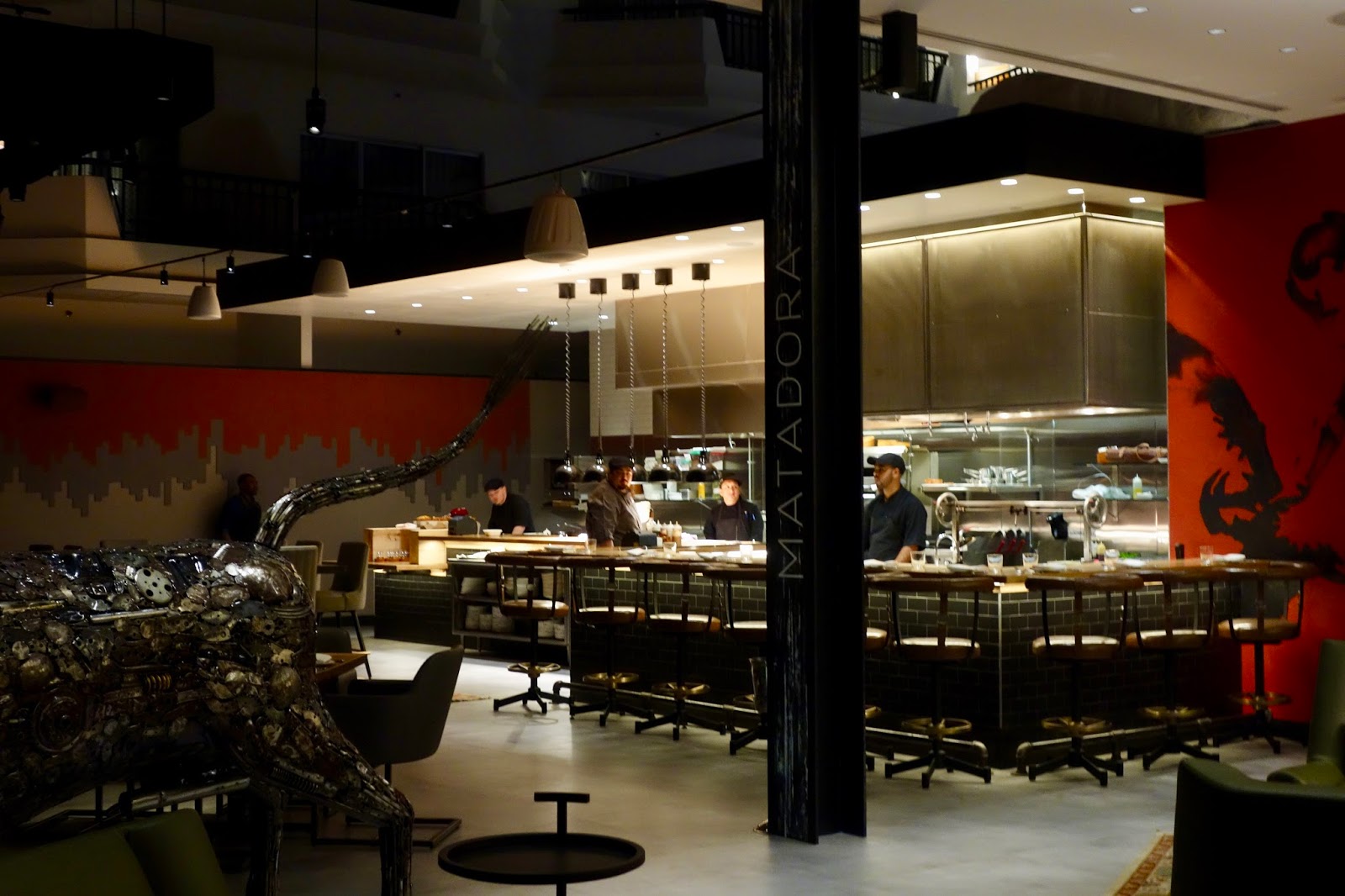
The restaurant is located just to the left of the hotel lobby, open to the lobby and not hidden behind any walls. Most of the ceiling is also open, ascending numerous floors and visually accessible from the balconies of numerous guest rooms. The kitchen too is open, a design concept I always appreciate, and you can sit at the counter directly in front of the kitchen, watching the cooks work their culinary skills. It is an aesthetically pleasing restaurant, that emanates an ambiance of welcoming and comfort.
As you enter the restaurant, it'll be impossible to miss their huge centerpiece, a 900 pound sculpture of a bull, which was made from scrap metal, including automobile parts, from Thailand. Quite a stunning piece of art.
There are several semi-circular banquettes, very comfortable spots for couples or small groups. There are also a variety of other tables within the restaurants, which can accommodate most any group.
In the back of the restaurant is a large, rectangular bar, with a view outside the front windows.
This is their custom, wood-fired grill, the centerpiece of their kitchen, and where many of their entrees are cooked. William "Billy" Jimenez is the chef de cuisine, a graduate of the Culinary Institute of America in New York, started his culinary career as a line cook at the Seaport Hotel in Boston. He has also spent five years at the Mandarin Oriental Hotel in Boston and in the Bar Boulud kitchen with Chef Aaron Chambers, whom Billys calls his most influential mentor. While there, Jimenez worked his way up from line cook to sous-chef. The most important rule he’s teaching his staff is that the smallest and simplest details are what sets great food apart. “My whole kitchen philosophy revolves around this - perfect the smallest detail and then perfect the next,” explains Chef Jimenez. “When you have every detail from start to finish perfected, the same ingredients become something else entirely.”
I was invited, as a media guest, to check out Matadora and I should note that it only has been open for 1 1/2 months so it is still within that stage where restaurants shake out the final kinks. As such, some matters could potentially change at the restaurant in the near future as they determine what works best for them. Overall, I was impressed with the restaurant and feel it is an excellent addition to the local area. I will definitely be returning to try out more of their menu and recommend that my readers check it out as well.
With a full bar, there is plenty of interest for your drink preferences. They have a list of ten special Cocktails ($8-$12), such as the Calimocho (Red wine & Cola) and Fancy Pants (Gin, Fino Sherry, Bergamot). They also have Red and White Sangria ($10/glass & $32/pitcher). On Tap, they have 10 beers & ciders ($6-$12), as well as 9 beers by the bottle ($5-$18). The list includes several Spanish beers and ciders.
As for Wine, they have 10 choices available by the glass ($10-$14) with 6 Spanish wines, the rest from California and Oregon. These 10 wines include one Sparkling wine, a Cava, as well as 4 Whites and 5 Reds. Though I didn't see it on the menu, maybe an oversight on my part, they have 8 Sherries available by the glass, and all 8 are authentic Sherry including La Gitana Manzanilla and a few bottlings from Lustau. That pleases me very much and I note that they use the Lustau Sherries in their cocktails.
The Wine list by the bottle ($38-$140) is broken down into Red, White and Sparkling, and then further grouped by general region, like North Atlantic Coast & Archipelagos. The list has about 5 Sparkling Wines (all Cavas), 23 Whites and 25 Reds. Most of the wines are Spanish, but with some wines from Portuguese, California, and Oregon. There is a nice diversity on the list with plenty of intriguing Spanish wines and even the non-Spanish wines are generally interesting as well. It was cool to see some wines from the Canary Islands, as well as Spanish grapes like Godella, Mencia, Hondarrabi Zuri, Albillo, and more.
We began our evening with a glass of Cava, the 2013 Gramona “Gran Cuvee” ($13), a delicious, crisp and dry Cava, with tiny bubbles, notes of apples and a hint of toast. A pleasant way to begin dinner.
The Red Sangria ($10) is made from Tempranillo, Brandy, Orange Liqueur, Juniper, and Cranberries. It was tasty, not too sweet and possessed an interesting melange of fruit flavors, with a hint of juniper and a bit of tartness from the cranberries.
The Sherry Cobbler ($10) is made with Lustau Amontillado, Apples, Cinnamon, and Mint, and had a pleasing taste, the hint of cinnamon making it a bit more unique than other Cobblers I've enjoyed. Refreshing and nutty, with a touch of mint.
The Slow Motion ($12), made with Bourbon, Lustau East India Sherry (a Cream Sherry), Amaro, and Bitters. This reminded me of a Manhattan and despite the addition of the Sherry, it wasn't overly sweet, balanced out nicely by the Amaro. There was a bit more richness in the cocktail than a normal Manhattan and it persuaded me to add some Cream Sherry to my Manhattans at home.
The Bullfighter ($10) is made with Plantation Rum, Lime, Honey, and Ginger Beer, more of a Light n' Stormy. It was a well balanced cocktail, with a mild sweetness, and a rich ginger taste.
Matadora currently serves Breakfast and Dinner, though not Lunch. As for the Dinner menu, it primarily includes small plates and wood-grill entrees. You'll find entries for Spanish Cheese (6 options, $8-$12 each, from Aged Manchego to Garrotxa), Spanish Meats (6 options, $11-$16 each, from Chorizo Iberico to Jamon Serrano), Olives, Nuts & Cured (6 options, $5-$7 each, from Boquerones to Marinated Manchego), Tapas (14 options, $8-$19, from Patatas Bravas to Charred Galician Octopus), Entrees (4 options, $19-$29 each, from Grass Fed Burger to Spicy Catalan Mussels), Wood Grill A La Carte (6 options, $18-$59, including Steaks, Pork Chop, Salmon, and Tuna), and Sides (5 options, $7-$9). Their Dessert menu has 3 options, $7-$9 each, including Creme Fraiche Ice Cream, Cantabrian Ricotta Cake, and Hot Churros.
There is a good diversity of dishes, though I wish they served one of my favorite tapas, Gambas al Ajillo, garlic shrimp. They also do not serve another of my favorite Spanish dishes, Paella, though they had considered it, eventually deciding to concentrate on tapas and wood-grilled items. During my visit, I concentrated on the small plates, and each dish was a nice portion size considering the nature of each item.
From Spanish Meats, the Chorizo Iberico ($11), sausage cured with smoky sweet paprika, is served exquisitely thin, with what appears to be a little olive oil. The spicy chorizo was tasty, a light dish which would be a nice way to begin your dinner.
From Olives, Nuts & Cured, the Marinated Manchego ($7) is prepared with olive oil, vinegar, roasted garlic and herbs. The cheese itself has a soft cheddar-like consistency and was an addictive little snack, with a nice blend of flavors enhancing the cheese.
From Olives, Nuts & Cured, the Spicy Gordal Olives ($6), made with some spice, are briny with a tender, fleshy exterior around the pit. The spice adds an intriguing taste to the briny olive, elevating them above a bare olive.
From Olives, Nuts & Cured, the Boquerones ($7), white anchovies, are made with vinegar, garlic, and herbs. The anchovies are tender and meaty, with a clean, lightly briny flavor. Even if you generally don't like anchovies, you need to try this dish as I think these anchovies will change your mind.
From Tapas, the Chickpea Fried Calamari ($12), with Andalusian dipping sauce, Ras el Hanout, Aioli and herbs, was excellent! The thin rings of calamari were especially tender with a delicious, clean fried batter. Some of the best fried calamari I've tasted in some time. And the Andalusian dipping sauce was a compelling complement to the calamari.
From Tapas, the Spicy Tuna Tartar ($16) is made with hummus, green olive, espelette mayo, and sesame, all atop a rosemary torta. There was plenty of silky tuna atop this dish and its flavors were intriguing, very different from the usual tuna tartar dish. The torta was flaky, with a pleasing herbal note to it.
From Tapas, the Pan con Tomate ($8) is a simple, but iconic Spanish dish, which basically consists of tomato rubbed garlic toast with EVOO and sea salt. The bread was nice and crusty on the edges and soft on the inside, with a clean and delicious taste, with the acidity of the tomato and plenty of garlic. A well executed dish.
From Tapas, the Patatas Bravas ($10) was an ample plate of crispy potatoes with sides of pimenton aioli and tomato romesco. The potatoes were tender and fluffy inside and I loved the spicy romesco sauce. I kept thinking about the other dishes that the romesco sauce could enhance, even the idea of slathering some atop a burger.
From Tapas, the Jamon Iberico Croquettes ($11) are made with Idiazabal cheese and are topped by Pimenton Aioli and herb salad. They are small enough that you could pop an entire one into your mouth, and when you bite into them, they are crunchy and creamy, bursting with flavor, including bits of ham.
From Tapas, the Basque Street Corn ($8), topped with roasted garlic aioli, Idiazabal cheese, and Espelette pepper, was probably my favorite dish of the evening. I've had similar dishes at other Spanish restaurants, and far too often, the corn tends to be a bit mushy. Here, the corn was tender and firm, the way an excellent corn on the cob should taste. The corn was grilled very well and the addition of the compelling melange of cheese, garlic and pepper well complemented the corn, creating an especially delicious dish. Highly recommended!
From Tapas, the Shrimp Toast ($15) is made with wild shrimp harvested from the U.S. Gulf, from Apalachicola, Florida. It's great to see that they are sourcing their shrimp domestically! The shrimp, with a number of veggies, including hot peppers, sits atop a thin slice of garlic toast and slathered with spicy saffron butter. The plump shrimp were tender and the rest of the toppings mixed for a tasty blend, with a mild spicy heat. Another winner of a dish.
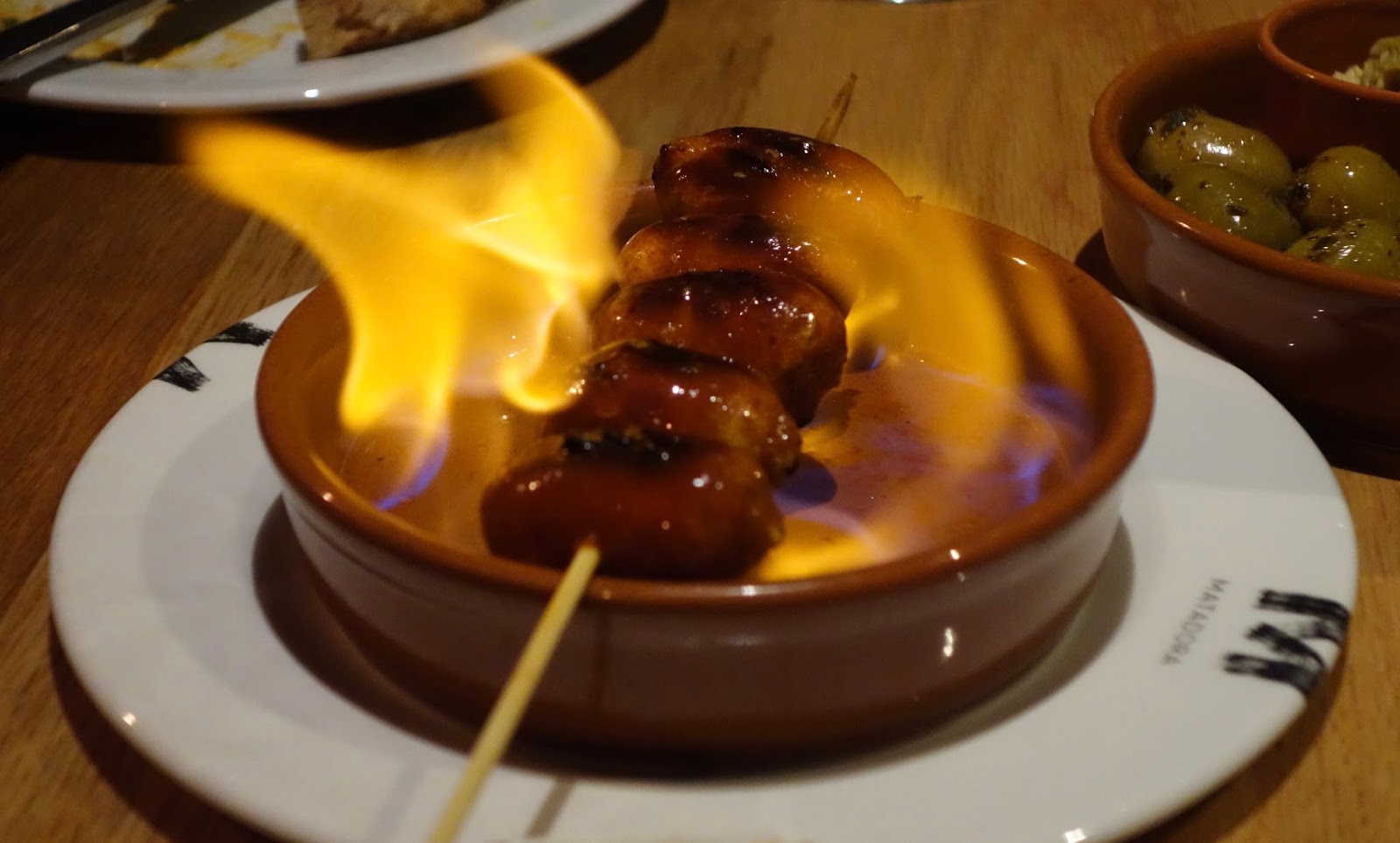
Finally, we opted for one more Tapas, the Flaming Chorizo ($16), grilled chorizo pequeno with a piquillo honey mustard. The five plump chorizo sit in a flame for a short time on your table, a cool presentation. When you bite into the crisp skin of the chorizo, you'll be impressed with the moist and spicy meat, probably the spiciest of dishes we ate. Cooked perfectly, the chorizo were delicious, an excellent ending to our savory dishes.
I had to order one of the desserts, the Hot Churros ($9), which are covered with cinnamon sugar and accompanied by a rich chocolate dipping sauce, that was thick and reminded me of dark chocolate. The hot Churros had a crisp exterior with a fluffier interior, and plenty of sweetness from the cinnamon sugar. Dipping them in the rich chocolate made for a delectable treat, a great way to end an excellent evening.
Overall, I had an excellent experience at Matadora and they are doing quite well despite only having been open for 1 1/2 months. They have a very good drinks program, from their cocktails to wine list, and their food menu has plenty of delicious options. Portion size is reasonable, quality is high, and the dishes are certainly reflective of fine Spanish tapas. Service was attentive and personable, without being obtrusive. Matadora is a welcome addition to the local culinary scene and I definitely will return to try more of their menu, especially to explore their entrees such as the Spicy Catalan Mussels and even their Grass Fed Burger. I recommend you check out Matadora and get a taste of Spain in Woburn.
--William "Billy" Jimenez, Chef de Cuisine at Matadora
I love Spanish cuisine, from Tapas to Paella, as well as Spanish wines, from Cava to Sherry. I've travelled to Spain three times, spending a total of about five weeks in that wonderful country. When I learned that a new Spanish restaurant would open in Woburn, only a few miles from my home, I was excited and curious. How would it stack up against other local Spanish restaurants? Would they serve authentic Sherry? Would they serve some of my favorite Spanish dishes?
The Hilton Boston/Woburn, located on Forbes Road, recently completed a comprehensive renovation, including the addition of Matadora, a Spanish restaurant, which opened on October 30. Matadora was created in partnership with COJE Management, the team behind Boston restaurants Yvonne’s, RUKA and Lolita. The menus at Matadora were developed by COJE’s Culinary Director Tom Berry and are now being executed at the restaurant by Matadora’s Chef de Cuisine William Jimenez, focusing on "tailored tapas and flavorful cuts of meat and fish from the kitchen’s centerpiece – a custom, wood-fired grill."
The restaurant is located just to the left of the hotel lobby, open to the lobby and not hidden behind any walls. Most of the ceiling is also open, ascending numerous floors and visually accessible from the balconies of numerous guest rooms. The kitchen too is open, a design concept I always appreciate, and you can sit at the counter directly in front of the kitchen, watching the cooks work their culinary skills. It is an aesthetically pleasing restaurant, that emanates an ambiance of welcoming and comfort.
As you enter the restaurant, it'll be impossible to miss their huge centerpiece, a 900 pound sculpture of a bull, which was made from scrap metal, including automobile parts, from Thailand. Quite a stunning piece of art.
There are several semi-circular banquettes, very comfortable spots for couples or small groups. There are also a variety of other tables within the restaurants, which can accommodate most any group.
In the back of the restaurant is a large, rectangular bar, with a view outside the front windows.
This is their custom, wood-fired grill, the centerpiece of their kitchen, and where many of their entrees are cooked. William "Billy" Jimenez is the chef de cuisine, a graduate of the Culinary Institute of America in New York, started his culinary career as a line cook at the Seaport Hotel in Boston. He has also spent five years at the Mandarin Oriental Hotel in Boston and in the Bar Boulud kitchen with Chef Aaron Chambers, whom Billys calls his most influential mentor. While there, Jimenez worked his way up from line cook to sous-chef. The most important rule he’s teaching his staff is that the smallest and simplest details are what sets great food apart. “My whole kitchen philosophy revolves around this - perfect the smallest detail and then perfect the next,” explains Chef Jimenez. “When you have every detail from start to finish perfected, the same ingredients become something else entirely.”
I was invited, as a media guest, to check out Matadora and I should note that it only has been open for 1 1/2 months so it is still within that stage where restaurants shake out the final kinks. As such, some matters could potentially change at the restaurant in the near future as they determine what works best for them. Overall, I was impressed with the restaurant and feel it is an excellent addition to the local area. I will definitely be returning to try out more of their menu and recommend that my readers check it out as well.
With a full bar, there is plenty of interest for your drink preferences. They have a list of ten special Cocktails ($8-$12), such as the Calimocho (Red wine & Cola) and Fancy Pants (Gin, Fino Sherry, Bergamot). They also have Red and White Sangria ($10/glass & $32/pitcher). On Tap, they have 10 beers & ciders ($6-$12), as well as 9 beers by the bottle ($5-$18). The list includes several Spanish beers and ciders.
As for Wine, they have 10 choices available by the glass ($10-$14) with 6 Spanish wines, the rest from California and Oregon. These 10 wines include one Sparkling wine, a Cava, as well as 4 Whites and 5 Reds. Though I didn't see it on the menu, maybe an oversight on my part, they have 8 Sherries available by the glass, and all 8 are authentic Sherry including La Gitana Manzanilla and a few bottlings from Lustau. That pleases me very much and I note that they use the Lustau Sherries in their cocktails.
The Wine list by the bottle ($38-$140) is broken down into Red, White and Sparkling, and then further grouped by general region, like North Atlantic Coast & Archipelagos. The list has about 5 Sparkling Wines (all Cavas), 23 Whites and 25 Reds. Most of the wines are Spanish, but with some wines from Portuguese, California, and Oregon. There is a nice diversity on the list with plenty of intriguing Spanish wines and even the non-Spanish wines are generally interesting as well. It was cool to see some wines from the Canary Islands, as well as Spanish grapes like Godella, Mencia, Hondarrabi Zuri, Albillo, and more.
We began our evening with a glass of Cava, the 2013 Gramona “Gran Cuvee” ($13), a delicious, crisp and dry Cava, with tiny bubbles, notes of apples and a hint of toast. A pleasant way to begin dinner.
The Red Sangria ($10) is made from Tempranillo, Brandy, Orange Liqueur, Juniper, and Cranberries. It was tasty, not too sweet and possessed an interesting melange of fruit flavors, with a hint of juniper and a bit of tartness from the cranberries.
The Sherry Cobbler ($10) is made with Lustau Amontillado, Apples, Cinnamon, and Mint, and had a pleasing taste, the hint of cinnamon making it a bit more unique than other Cobblers I've enjoyed. Refreshing and nutty, with a touch of mint.
The Slow Motion ($12), made with Bourbon, Lustau East India Sherry (a Cream Sherry), Amaro, and Bitters. This reminded me of a Manhattan and despite the addition of the Sherry, it wasn't overly sweet, balanced out nicely by the Amaro. There was a bit more richness in the cocktail than a normal Manhattan and it persuaded me to add some Cream Sherry to my Manhattans at home.
The Bullfighter ($10) is made with Plantation Rum, Lime, Honey, and Ginger Beer, more of a Light n' Stormy. It was a well balanced cocktail, with a mild sweetness, and a rich ginger taste.
Matadora currently serves Breakfast and Dinner, though not Lunch. As for the Dinner menu, it primarily includes small plates and wood-grill entrees. You'll find entries for Spanish Cheese (6 options, $8-$12 each, from Aged Manchego to Garrotxa), Spanish Meats (6 options, $11-$16 each, from Chorizo Iberico to Jamon Serrano), Olives, Nuts & Cured (6 options, $5-$7 each, from Boquerones to Marinated Manchego), Tapas (14 options, $8-$19, from Patatas Bravas to Charred Galician Octopus), Entrees (4 options, $19-$29 each, from Grass Fed Burger to Spicy Catalan Mussels), Wood Grill A La Carte (6 options, $18-$59, including Steaks, Pork Chop, Salmon, and Tuna), and Sides (5 options, $7-$9). Their Dessert menu has 3 options, $7-$9 each, including Creme Fraiche Ice Cream, Cantabrian Ricotta Cake, and Hot Churros.
There is a good diversity of dishes, though I wish they served one of my favorite tapas, Gambas al Ajillo, garlic shrimp. They also do not serve another of my favorite Spanish dishes, Paella, though they had considered it, eventually deciding to concentrate on tapas and wood-grilled items. During my visit, I concentrated on the small plates, and each dish was a nice portion size considering the nature of each item.
From Spanish Meats, the Chorizo Iberico ($11), sausage cured with smoky sweet paprika, is served exquisitely thin, with what appears to be a little olive oil. The spicy chorizo was tasty, a light dish which would be a nice way to begin your dinner.
From Olives, Nuts & Cured, the Marinated Manchego ($7) is prepared with olive oil, vinegar, roasted garlic and herbs. The cheese itself has a soft cheddar-like consistency and was an addictive little snack, with a nice blend of flavors enhancing the cheese.
From Olives, Nuts & Cured, the Spicy Gordal Olives ($6), made with some spice, are briny with a tender, fleshy exterior around the pit. The spice adds an intriguing taste to the briny olive, elevating them above a bare olive.
From Olives, Nuts & Cured, the Boquerones ($7), white anchovies, are made with vinegar, garlic, and herbs. The anchovies are tender and meaty, with a clean, lightly briny flavor. Even if you generally don't like anchovies, you need to try this dish as I think these anchovies will change your mind.
From Tapas, the Chickpea Fried Calamari ($12), with Andalusian dipping sauce, Ras el Hanout, Aioli and herbs, was excellent! The thin rings of calamari were especially tender with a delicious, clean fried batter. Some of the best fried calamari I've tasted in some time. And the Andalusian dipping sauce was a compelling complement to the calamari.
From Tapas, the Spicy Tuna Tartar ($16) is made with hummus, green olive, espelette mayo, and sesame, all atop a rosemary torta. There was plenty of silky tuna atop this dish and its flavors were intriguing, very different from the usual tuna tartar dish. The torta was flaky, with a pleasing herbal note to it.
From Tapas, the Pan con Tomate ($8) is a simple, but iconic Spanish dish, which basically consists of tomato rubbed garlic toast with EVOO and sea salt. The bread was nice and crusty on the edges and soft on the inside, with a clean and delicious taste, with the acidity of the tomato and plenty of garlic. A well executed dish.
From Tapas, the Patatas Bravas ($10) was an ample plate of crispy potatoes with sides of pimenton aioli and tomato romesco. The potatoes were tender and fluffy inside and I loved the spicy romesco sauce. I kept thinking about the other dishes that the romesco sauce could enhance, even the idea of slathering some atop a burger.
From Tapas, the Jamon Iberico Croquettes ($11) are made with Idiazabal cheese and are topped by Pimenton Aioli and herb salad. They are small enough that you could pop an entire one into your mouth, and when you bite into them, they are crunchy and creamy, bursting with flavor, including bits of ham.
From Tapas, the Basque Street Corn ($8), topped with roasted garlic aioli, Idiazabal cheese, and Espelette pepper, was probably my favorite dish of the evening. I've had similar dishes at other Spanish restaurants, and far too often, the corn tends to be a bit mushy. Here, the corn was tender and firm, the way an excellent corn on the cob should taste. The corn was grilled very well and the addition of the compelling melange of cheese, garlic and pepper well complemented the corn, creating an especially delicious dish. Highly recommended!
From Tapas, the Shrimp Toast ($15) is made with wild shrimp harvested from the U.S. Gulf, from Apalachicola, Florida. It's great to see that they are sourcing their shrimp domestically! The shrimp, with a number of veggies, including hot peppers, sits atop a thin slice of garlic toast and slathered with spicy saffron butter. The plump shrimp were tender and the rest of the toppings mixed for a tasty blend, with a mild spicy heat. Another winner of a dish.
Finally, we opted for one more Tapas, the Flaming Chorizo ($16), grilled chorizo pequeno with a piquillo honey mustard. The five plump chorizo sit in a flame for a short time on your table, a cool presentation. When you bite into the crisp skin of the chorizo, you'll be impressed with the moist and spicy meat, probably the spiciest of dishes we ate. Cooked perfectly, the chorizo were delicious, an excellent ending to our savory dishes.
I had to order one of the desserts, the Hot Churros ($9), which are covered with cinnamon sugar and accompanied by a rich chocolate dipping sauce, that was thick and reminded me of dark chocolate. The hot Churros had a crisp exterior with a fluffier interior, and plenty of sweetness from the cinnamon sugar. Dipping them in the rich chocolate made for a delectable treat, a great way to end an excellent evening.
Overall, I had an excellent experience at Matadora and they are doing quite well despite only having been open for 1 1/2 months. They have a very good drinks program, from their cocktails to wine list, and their food menu has plenty of delicious options. Portion size is reasonable, quality is high, and the dishes are certainly reflective of fine Spanish tapas. Service was attentive and personable, without being obtrusive. Matadora is a welcome addition to the local culinary scene and I definitely will return to try more of their menu, especially to explore their entrees such as the Spicy Catalan Mussels and even their Grass Fed Burger. I recommend you check out Matadora and get a taste of Spain in Woburn.
Tuesday, July 25, 2017
Ron Navazos Palazzi Cask Strength Rum: Aged In Sherry Barrels
While sitting at the bar at Troquet, I thoroughly enjoyed a superb Lamb Burger Slider, topped with lamb bacon, goat cheese feta, and harissa. As I savored this burger, I spied an intriguing spirit on a shelf behind the bar, knowing I had to taste it. I'd previously tasted other spirits from this company but hadn't yet sampled this one. I didn't fight the urge and ordered a glass.
Jesus Barquin & Eduardo Oreja of Equipo Navazos, known for bottling exceptional Sherries, partnered with Nicolas Palazzi of PM Spirits to produce a series of Spanish spirits, including brandy, rum, grain whiskey and malt whiskey. Last month, I reviewed the Navazos Palazzi Malt Whiskey and found it to be "...elegant and compelling, unique and delicious, a well-balanced whiskey that will surprise and delight. My highest recommendation!" I had high expectations for their Ron Navazos Palazzi Cask Strength Rum ($100-$110) and wasn't disappointed in the least.
The alleged origin story behind this rum is intriguing, though not all of the details area readily available. It is claimed that Jesús Barquín and Nicolas Palazzi were visiting numerous bodegas in the Jerez region, seeking either Brandy or Sherry. At an unnamed bodega, they stumbled upon numerous barrels of rum, certainly nothing they expected to find. Through further research, they uncovered that the rum was made from 100% molasses and had been distilled in the Antilles, though the specific island is not mentioned.
Initially, the rum was aged in the Antilles for five years in first-fill bourbon barrels. It was then sent to the bodega in Spain, payment for some unknown transaction. The bodega transferred the rum into used Oloroso barrels, where it sat for more than ten years. Barquín and Palazzi acquired 32 casks of this rum so it is a finite spirit. They have chosen to bottle it unfiltered and at cask strength, 51.5 ABV, releasing 1500 bottles a year until the rum is gone. Currently, it appears they have released bottles in 2013 and 2014.
The color of this rum was deep and dark, though with some translucence, reminding me in some ways of an aged Oloroso Sherry. Sniffing the contents of the glass, I was enamored with the complex aromas that wafted up, seducing my nose. There was fruit and spice, nuts and chocolate, and it was a pleasure just to sit and enjoy the aromas. On the palate, I was initially pleased with the relative dryness of the rum. It wasn't one of the prominent sweet rums but rather its sweetness was of a more subtle nature, with underlying caramel, vanilla and molasses flavors. And the complexity of the nose was duplicated on the palate, such a compelling melange of flavors that seemed to present something new each sip I took. There was a certain nutty and saline character that reminded me of Sherry, but also bright citrus and plum notes. There were plenty of spicy elements, with a backbone of umami, and hints of leather. Elegant and fascinating, this rum had a pleasing, lengthy finish.
Highly recommended! I'll be buying a bottle or two soon.
Jesus Barquin & Eduardo Oreja of Equipo Navazos, known for bottling exceptional Sherries, partnered with Nicolas Palazzi of PM Spirits to produce a series of Spanish spirits, including brandy, rum, grain whiskey and malt whiskey. Last month, I reviewed the Navazos Palazzi Malt Whiskey and found it to be "...elegant and compelling, unique and delicious, a well-balanced whiskey that will surprise and delight. My highest recommendation!" I had high expectations for their Ron Navazos Palazzi Cask Strength Rum ($100-$110) and wasn't disappointed in the least.
The alleged origin story behind this rum is intriguing, though not all of the details area readily available. It is claimed that Jesús Barquín and Nicolas Palazzi were visiting numerous bodegas in the Jerez region, seeking either Brandy or Sherry. At an unnamed bodega, they stumbled upon numerous barrels of rum, certainly nothing they expected to find. Through further research, they uncovered that the rum was made from 100% molasses and had been distilled in the Antilles, though the specific island is not mentioned.
Initially, the rum was aged in the Antilles for five years in first-fill bourbon barrels. It was then sent to the bodega in Spain, payment for some unknown transaction. The bodega transferred the rum into used Oloroso barrels, where it sat for more than ten years. Barquín and Palazzi acquired 32 casks of this rum so it is a finite spirit. They have chosen to bottle it unfiltered and at cask strength, 51.5 ABV, releasing 1500 bottles a year until the rum is gone. Currently, it appears they have released bottles in 2013 and 2014.
The color of this rum was deep and dark, though with some translucence, reminding me in some ways of an aged Oloroso Sherry. Sniffing the contents of the glass, I was enamored with the complex aromas that wafted up, seducing my nose. There was fruit and spice, nuts and chocolate, and it was a pleasure just to sit and enjoy the aromas. On the palate, I was initially pleased with the relative dryness of the rum. It wasn't one of the prominent sweet rums but rather its sweetness was of a more subtle nature, with underlying caramel, vanilla and molasses flavors. And the complexity of the nose was duplicated on the palate, such a compelling melange of flavors that seemed to present something new each sip I took. There was a certain nutty and saline character that reminded me of Sherry, but also bright citrus and plum notes. There were plenty of spicy elements, with a backbone of umami, and hints of leather. Elegant and fascinating, this rum had a pleasing, lengthy finish.
Highly recommended! I'll be buying a bottle or two soon.
Tuesday, June 20, 2017
A Glimpse Into The Culinary Treasures of Frederick, Maryland
We flew down to Maryland the day before TasteCamp 2017 was scheduled to begin, so we had some free time to explore the city of Frederick. The downtown area is filled with a myriad of shops and restaurants, as well as some interesting architecture and museums, such as the National Museum of Civil War Medicine. There are parts of Frederick with many chain shops and restaurants but the downtown is more unique, small businesses.
For breakfast, we ate at Cafe Nola, kind of a hip cafe with an outside patio. It is well known for its breakfast offerings, some with a southern flair. The breakfast entrees generally range from $10-$18, including items such as French Toast, Croissant Sandwich, and Corned Beef Hash. They have a fully stocked bar so you can enjoy a cocktail such as a Bloody Mary Heat ($8), which is made with a house-infused habanero garlic vodka.
I opted for the Shrimp & Grits ($15), which is made with cheddar grits, Andouille sausage and bacon. The grits were creamy and cheesy and there plenty of plump shrimp, spicy sausage and crisp bacon pieces. A hearty dish, excellent comfort food.
We also ordered the Chesapeake Benedict ($18) which consists of jumbo lump crab cakes, atop English muffin and topped by poached eggs and an Old Bay hollandaise sauce, with a side of roasted potatoes. The crab cakes were very good, filled with plenty of sweet crab and not lots of filler. The hollandaise was interesting with the Old Bay, complementing the crab cakes. The potatoes were also nicely crisp. Again, another good breakfast choice.
My only issue with the restaurant was that the service was a bit lackluster, especially after we received our food. Our server didn't return until we were nearly down with our meal, failing to refill our beverages. The restaurant wasn't significantly busy and there didn't appear to be any reason for the lack of proper service. It could be outside the norm. The food though is definitely very good and I would recommend you check it out if you are ever in Frederick.
For dinner, after considering a number of potential choices, we opted for Spanish cuisine at Isabella's Taverna & Tapas Bar. It is a casual spot with a large bar (and has a Happy Hour tapas buffet for those at the bar). They have a full bar though the wine list wasn't too compelling to me, as they had only a small amount of Spanish wines, as well as plenty of other wines from numerous wine regions across the world. Though small, there were some good choices in Spanish wines but in the end, we opted for red Sangria, which was fruity and tasty, though not overly sweet.
The food menu was more interesting, and accompanied by a page of daily specials, with some traditional Spanish dishes as well as some of their own takes on tapas. On the menu, you'll find Soups & Salads (like Gazpacho), Cheeses (like Queso de Cabrales), Seafood (from Fried Calamari to Pan-Steamed Black Mussels), Meats (from Iberico de Bellota to House-Made Chorizo), Vegetables (from Papas Bravas to Brussel Sprouts), six different types of Paella, and a few Entrees (like Grilled Sirloin). Prices are reasonable, with a number of dishes costing $10 and less.
The Queso Frito con Alemendras y Salsa Vinagreta ($6.75) consists of three balls of fried house-breaded goat cheese & almond fritters with a tangy shallot vinaigrette. The crispy coating led to a creamy goat cheese center, accented by crunchy pieces of almond, with a bright acidity from the vinaigrette. Quite tasty and a pleasant way to start our dinner.
The Manchego Frito ($12) was made of a slice of baguette, topped by plenty of fried Manchego cheese, fig jam, and pear. The melted Manchego was delicious, with a mild tang and nuttiness, and was enhanced by the sweet fruit of the fig and pear. Another very good choice.
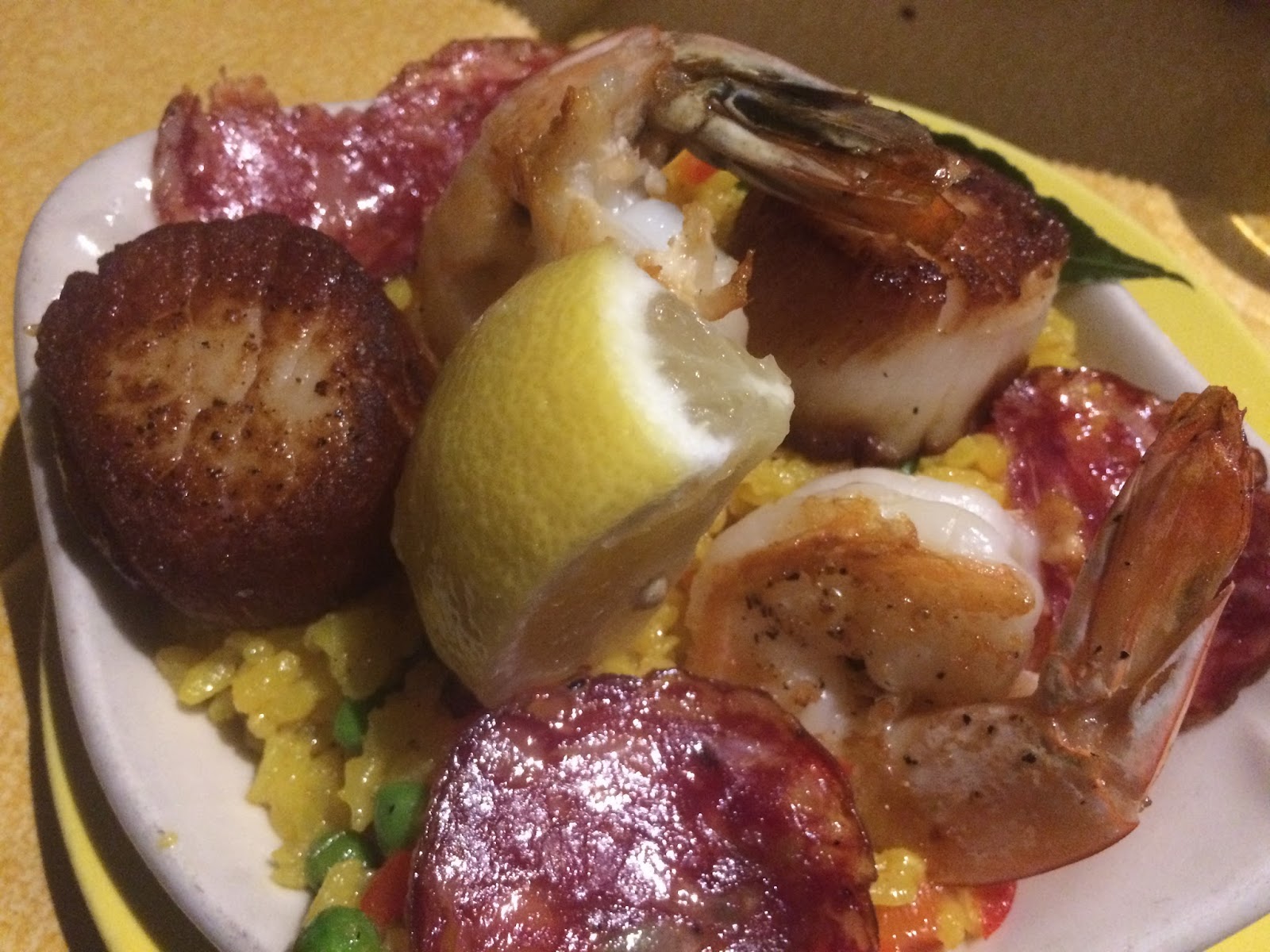
The special Paella del Dia (Tapas portion/$26) was made with cured Iberico ham, scallops, shrimp, peas, and pimento. The scallops had a crisp sear and were moist and tender, while the plump shrimp had more texture to them and the Iberico was slightly spicy. The rice was cooked nicely and I was impressed with this version of Paella, and I would have liked to order one of the entree sizes as well.
The Gambas al Pil Pil ($8.25) is a dish of hot sizzling shrimp in a spicy garlic oil with caramelized onions. Usually, I don't see onions in this dish, but they added a bit of sweetness to the spicy oil. It was nice to dip our bread into the dish and sop up the oil.
The Datiles Rellenos ($9) were crispy bacon wrapped Spanish dates stuffed with chorizo and sitting atop a mild goat cheese cream. Salty and slightly sweet, with creaminess from the goat cheese, this was a more decadent dish. A nice blend of flavors and textures and I strongly recommended this dish.
Our final dish of the evening were the Langostinos del Golfo Asados con Arroz Negro ($9), cilantro roasted Gulf shrimp on black rice & a saffron butter sauce. The shrimp was tasty again, and the black rice was earthy, with a briny note. And the saffron butter sauce added a hedonistic touch to the plate.
Service was excellent and I was very pleased with all of the dishes we ate. There was plenty of other items on the menu I would have liked to try too. I just wish the wine list was larger, with more Spanish options. Overall, Isabella's earns my recommendation.
For breakfast, we ate at Cafe Nola, kind of a hip cafe with an outside patio. It is well known for its breakfast offerings, some with a southern flair. The breakfast entrees generally range from $10-$18, including items such as French Toast, Croissant Sandwich, and Corned Beef Hash. They have a fully stocked bar so you can enjoy a cocktail such as a Bloody Mary Heat ($8), which is made with a house-infused habanero garlic vodka.
I opted for the Shrimp & Grits ($15), which is made with cheddar grits, Andouille sausage and bacon. The grits were creamy and cheesy and there plenty of plump shrimp, spicy sausage and crisp bacon pieces. A hearty dish, excellent comfort food.
We also ordered the Chesapeake Benedict ($18) which consists of jumbo lump crab cakes, atop English muffin and topped by poached eggs and an Old Bay hollandaise sauce, with a side of roasted potatoes. The crab cakes were very good, filled with plenty of sweet crab and not lots of filler. The hollandaise was interesting with the Old Bay, complementing the crab cakes. The potatoes were also nicely crisp. Again, another good breakfast choice.
My only issue with the restaurant was that the service was a bit lackluster, especially after we received our food. Our server didn't return until we were nearly down with our meal, failing to refill our beverages. The restaurant wasn't significantly busy and there didn't appear to be any reason for the lack of proper service. It could be outside the norm. The food though is definitely very good and I would recommend you check it out if you are ever in Frederick.
For dinner, after considering a number of potential choices, we opted for Spanish cuisine at Isabella's Taverna & Tapas Bar. It is a casual spot with a large bar (and has a Happy Hour tapas buffet for those at the bar). They have a full bar though the wine list wasn't too compelling to me, as they had only a small amount of Spanish wines, as well as plenty of other wines from numerous wine regions across the world. Though small, there were some good choices in Spanish wines but in the end, we opted for red Sangria, which was fruity and tasty, though not overly sweet.
The food menu was more interesting, and accompanied by a page of daily specials, with some traditional Spanish dishes as well as some of their own takes on tapas. On the menu, you'll find Soups & Salads (like Gazpacho), Cheeses (like Queso de Cabrales), Seafood (from Fried Calamari to Pan-Steamed Black Mussels), Meats (from Iberico de Bellota to House-Made Chorizo), Vegetables (from Papas Bravas to Brussel Sprouts), six different types of Paella, and a few Entrees (like Grilled Sirloin). Prices are reasonable, with a number of dishes costing $10 and less.
The Queso Frito con Alemendras y Salsa Vinagreta ($6.75) consists of three balls of fried house-breaded goat cheese & almond fritters with a tangy shallot vinaigrette. The crispy coating led to a creamy goat cheese center, accented by crunchy pieces of almond, with a bright acidity from the vinaigrette. Quite tasty and a pleasant way to start our dinner.
The Manchego Frito ($12) was made of a slice of baguette, topped by plenty of fried Manchego cheese, fig jam, and pear. The melted Manchego was delicious, with a mild tang and nuttiness, and was enhanced by the sweet fruit of the fig and pear. Another very good choice.
The special Paella del Dia (Tapas portion/$26) was made with cured Iberico ham, scallops, shrimp, peas, and pimento. The scallops had a crisp sear and were moist and tender, while the plump shrimp had more texture to them and the Iberico was slightly spicy. The rice was cooked nicely and I was impressed with this version of Paella, and I would have liked to order one of the entree sizes as well.
The Gambas al Pil Pil ($8.25) is a dish of hot sizzling shrimp in a spicy garlic oil with caramelized onions. Usually, I don't see onions in this dish, but they added a bit of sweetness to the spicy oil. It was nice to dip our bread into the dish and sop up the oil.
The Datiles Rellenos ($9) were crispy bacon wrapped Spanish dates stuffed with chorizo and sitting atop a mild goat cheese cream. Salty and slightly sweet, with creaminess from the goat cheese, this was a more decadent dish. A nice blend of flavors and textures and I strongly recommended this dish.
Our final dish of the evening were the Langostinos del Golfo Asados con Arroz Negro ($9), cilantro roasted Gulf shrimp on black rice & a saffron butter sauce. The shrimp was tasty again, and the black rice was earthy, with a briny note. And the saffron butter sauce added a hedonistic touch to the plate.
Service was excellent and I was very pleased with all of the dishes we ate. There was plenty of other items on the menu I would have liked to try too. I just wish the wine list was larger, with more Spanish options. Overall, Isabella's earns my recommendation.
Friday, June 16, 2017
Navazos Palazzi Malt Whisky: From Spain, With Sherry Love
When you think of whiskey, one of the last countries that probably comes to mind is Spain, despite the fact that they have been producing whiskey since the 1960s. It was only recently that I had the opportunity to taste a Spanish whiskey and I was thoroughly impressed, considering it one of my new favorite whiskies.
Let's start with a little history. In 1958, businessman Nicomedes García Gómez formed Destilerías y Crianza del Whisky S.A. (Whisky DYC), a Spanish distillery and it started producing whiskey in March 1963. During its first year of operation, it produced about one million liters and by the 1980s, that amount increased to about 20 million liters annually. In 1989, the company was sold to the Pedro Domecq Group and then later sold to Beam Suntory. The company currently operates two plants, producing only about 2.3 million liters annually, though they still have the capacity to distill much more.
And now let's touch on the recent past. While perusing the shelves at Julio's Liquors in Westborough, I stumbled upon the Navazos Palazzi Malt Whisky ($114.99), a Spanish whiskey that was aged in Sherry barrels. It intrigued me, especially as I knew that Equipo Navazos bottled some amazing Sherries. I figured that if they were involved in this whiskey, then it was likely going to be very good so I took a chance and purchased a bottle, which would turn out to be a very smart buy.
I would later learn that Jesus Barquin & Eduardo Oreja of Equipo Navazos chose to partner with Nicolas Palazzi of PM Spirits’ to produce a series of Spanish spirits, including brandy, rum, grain whiskey and malt whiskey. This Malt Whiskey was produced in the DYC distillery, using malted barley that was grown in Spain. It was distilled in a traditional pot still, being released at cask strength, 52.5% proof. Only 900 bottles of this whiskey were produced.
What helps to make this whiskey unique is that it spends all of its time in the barrel, about four to six years, in three Palo Cortado Sherry casks from Valdespino. Other whiskies may be finished in Sherry casks for a short time, but few, if any other, spend all of their time in Sherry barrels. In addition, few whiskies spend time in Palo Cortado barrels because it is a rarer Sherry, and also happens to be one of my favorite Sherry types.
This Malt Whiskey presents with a nice, dark amber color and its complex aroma is enticing, a blend of harmonious fruits and spices. You could easily sit and enjoy the diverse nose of this whiskey for quite some time before taking a sip. However, when you do sample it, your palate is going to be seduced by the complex, and sometimes subtle, melange of flavors that caress and tantalize. It is sweet, briny and savory, with plenty of fruit, from apples to raisins, as well as lots of spicy notes. Honey, caramel, and malt with clear Sherry notes and a long and lingering finish that satisfies to the last wispy taste. It is elegant and compelling, unique and delicious, a well-balanced whiskey that will surprise and delight. My highest recommendation!
If you are a whiskey lover, you need to explore what is now coming out of Spain, especially the releases from Navazos Palazzi. I've heard of other Spanish wineries that starting to produce whiskey too. This could be the beginning of an intriguing whiskey industry in Spain.
Let's start with a little history. In 1958, businessman Nicomedes García Gómez formed Destilerías y Crianza del Whisky S.A. (Whisky DYC), a Spanish distillery and it started producing whiskey in March 1963. During its first year of operation, it produced about one million liters and by the 1980s, that amount increased to about 20 million liters annually. In 1989, the company was sold to the Pedro Domecq Group and then later sold to Beam Suntory. The company currently operates two plants, producing only about 2.3 million liters annually, though they still have the capacity to distill much more.
And now let's touch on the recent past. While perusing the shelves at Julio's Liquors in Westborough, I stumbled upon the Navazos Palazzi Malt Whisky ($114.99), a Spanish whiskey that was aged in Sherry barrels. It intrigued me, especially as I knew that Equipo Navazos bottled some amazing Sherries. I figured that if they were involved in this whiskey, then it was likely going to be very good so I took a chance and purchased a bottle, which would turn out to be a very smart buy.
I would later learn that Jesus Barquin & Eduardo Oreja of Equipo Navazos chose to partner with Nicolas Palazzi of PM Spirits’ to produce a series of Spanish spirits, including brandy, rum, grain whiskey and malt whiskey. This Malt Whiskey was produced in the DYC distillery, using malted barley that was grown in Spain. It was distilled in a traditional pot still, being released at cask strength, 52.5% proof. Only 900 bottles of this whiskey were produced.
What helps to make this whiskey unique is that it spends all of its time in the barrel, about four to six years, in three Palo Cortado Sherry casks from Valdespino. Other whiskies may be finished in Sherry casks for a short time, but few, if any other, spend all of their time in Sherry barrels. In addition, few whiskies spend time in Palo Cortado barrels because it is a rarer Sherry, and also happens to be one of my favorite Sherry types.
This Malt Whiskey presents with a nice, dark amber color and its complex aroma is enticing, a blend of harmonious fruits and spices. You could easily sit and enjoy the diverse nose of this whiskey for quite some time before taking a sip. However, when you do sample it, your palate is going to be seduced by the complex, and sometimes subtle, melange of flavors that caress and tantalize. It is sweet, briny and savory, with plenty of fruit, from apples to raisins, as well as lots of spicy notes. Honey, caramel, and malt with clear Sherry notes and a long and lingering finish that satisfies to the last wispy taste. It is elegant and compelling, unique and delicious, a well-balanced whiskey that will surprise and delight. My highest recommendation!
If you are a whiskey lover, you need to explore what is now coming out of Spain, especially the releases from Navazos Palazzi. I've heard of other Spanish wineries that starting to produce whiskey too. This could be the beginning of an intriguing whiskey industry in Spain.
Thursday, May 18, 2017
Thursday Sips & Nibbles
I am back again with a new edition of Thursday Sips & Nibbles, my regular column where I highlight some interesting, upcoming food & drink events.
**********************************************************
1) Scampo, at The Liberty Hotel, has chosen to extend its “Jazzy Cocktail Nights,” a weekly late-night live music series that pairs sophisticated sounds with elegant cocktails and savory bites. Designed for Bostonians looking for a new twist on the nightlife scene, the Thursday night series, from 10pm-1am, transforms Scampo’s bar and lounge area into a sleek hideaway that showcases the talents of some of the region’s top music acts whose genres include jazz, vocals, Latin rhythms, funk and blues:
May 18: Alec Hutson Trio, an eclectic group that plays folk, gypsy and jazz
May 25: Tony Leva Trio, a quintessential upright bass jazz group featuring musicians from Longy School of Music
June 1: Bonnie & The Hot Stuff, a multi-decade group spanning classic jazz, standards and torch songs
June 8: Dylan Jack Quartet, a well-known group playing upbeat jazz with a bass clarinet, upright bass, guitar and percussion
June 15: Belén Cusi, an Argentinian singer-songwriter specializing in Latin jazz
June 22: Josef Nadj, an electric violinist who leads a quartet that plays jazz fusion and will feature a special guest vocalist
With the new series comes a dedicated list of cocktails and bar bites available exclusively during the Thursday performances from 10pm-1am. For single-serve cocktails ($16 each), highlights include the Boulevardier, a stirred concoction of rye, Campari and sweet vermouth finished with an orange twist; Classy Champagne Cocktail served in a water glass with sugar cubes and a lemon twist; and, Roaring Violette with lychee, Violette, lavender, white wine and bubbles.
For those looking to take their imbibing game to the next level, there are sharable Punch Bowl Cocktails ($36) – that come shaken for two, served in festive brass pineapple-shaped vessels – like the Sparkling Jazz with Absolut, lime, Aperol and a prosecco float with floating orange pin wheels and Dubonnet Sangria with wine, fruit, anejo tequila and hibiscus with a ginger beer float and fresh fruit. For those with a late-night sweet tooth, there’s the Prohibition Milkshake ($36), a large format liquid treat of vodka, chocolate ice cream, crème de cacao, Kahlua and bubbles served with freshly made mini bacon doughnuts.
On the culinary side, there are a quintet of items that are available in addition to Scampo’s seasonal pizza offerings: Veal & Pork Meatballs in a 17-minute candeli sauce with shaved pecorino gremolata ($12); Fried Arancini with Pomodoro and parmesan ($10); Calamari a la Plancha with fennel salad and chipotle aioli ($10); Bruschetta with homemade ricotta, candied pistachios and warm guanciale ($11); and Lydia’s Stuffed Dates ($11).
2) This Sunday, from 5pm-1pm, Taberna de Haro will open in honor of BU Graduation. They are accepting reservations, whether or not you are a BU grad. Starting June 4, Taberna de Haro will also open every Sunday with a special menu consisting of cold tapas. All will be priced at $5 each.
Here's a sample menu of Sunday's Tapas ($5 each)
Gildas ~ 2 toothpicks full of salty briny things
Canapé de jamón ibérico ~ one perfect Iberian ham canapé
Manchego con anchoa ~ sheep cheese w anchovy, evoo
Montaditos de erizo ~ mini canapés of sea urchin paté
Mar y montaña ~ tomato bread, one fuet, one tinned mackerel
Patatas alioli ~ garlic potato salad
Chorizo picante ~ spicy hard chorizo, evoo, picos
Mojama y huevas ~ cured tuna & mullet roe, olives
Tomates con atún ~ fresh tomato, tuna, onion, sherry vinaigrette
Cogollo con queso azul ~ Gem lettuce wedge w Spanish blue cheese
Alcachofas con pimiento rojo, boquerón, alioli ~ artichoke hearts, roasted red pepper, white anchovy, alioli
Arzua Ulloa con miel y nueces ~ Galician soft cheese with honey and walnuts
To make a reservation, please call 617-277-8272
**********************************************************
1) Scampo, at The Liberty Hotel, has chosen to extend its “Jazzy Cocktail Nights,” a weekly late-night live music series that pairs sophisticated sounds with elegant cocktails and savory bites. Designed for Bostonians looking for a new twist on the nightlife scene, the Thursday night series, from 10pm-1am, transforms Scampo’s bar and lounge area into a sleek hideaway that showcases the talents of some of the region’s top music acts whose genres include jazz, vocals, Latin rhythms, funk and blues:
May 18: Alec Hutson Trio, an eclectic group that plays folk, gypsy and jazz
May 25: Tony Leva Trio, a quintessential upright bass jazz group featuring musicians from Longy School of Music
June 1: Bonnie & The Hot Stuff, a multi-decade group spanning classic jazz, standards and torch songs
June 8: Dylan Jack Quartet, a well-known group playing upbeat jazz with a bass clarinet, upright bass, guitar and percussion
June 15: Belén Cusi, an Argentinian singer-songwriter specializing in Latin jazz
June 22: Josef Nadj, an electric violinist who leads a quartet that plays jazz fusion and will feature a special guest vocalist
With the new series comes a dedicated list of cocktails and bar bites available exclusively during the Thursday performances from 10pm-1am. For single-serve cocktails ($16 each), highlights include the Boulevardier, a stirred concoction of rye, Campari and sweet vermouth finished with an orange twist; Classy Champagne Cocktail served in a water glass with sugar cubes and a lemon twist; and, Roaring Violette with lychee, Violette, lavender, white wine and bubbles.
For those looking to take their imbibing game to the next level, there are sharable Punch Bowl Cocktails ($36) – that come shaken for two, served in festive brass pineapple-shaped vessels – like the Sparkling Jazz with Absolut, lime, Aperol and a prosecco float with floating orange pin wheels and Dubonnet Sangria with wine, fruit, anejo tequila and hibiscus with a ginger beer float and fresh fruit. For those with a late-night sweet tooth, there’s the Prohibition Milkshake ($36), a large format liquid treat of vodka, chocolate ice cream, crème de cacao, Kahlua and bubbles served with freshly made mini bacon doughnuts.
On the culinary side, there are a quintet of items that are available in addition to Scampo’s seasonal pizza offerings: Veal & Pork Meatballs in a 17-minute candeli sauce with shaved pecorino gremolata ($12); Fried Arancini with Pomodoro and parmesan ($10); Calamari a la Plancha with fennel salad and chipotle aioli ($10); Bruschetta with homemade ricotta, candied pistachios and warm guanciale ($11); and Lydia’s Stuffed Dates ($11).
2) This Sunday, from 5pm-1pm, Taberna de Haro will open in honor of BU Graduation. They are accepting reservations, whether or not you are a BU grad. Starting June 4, Taberna de Haro will also open every Sunday with a special menu consisting of cold tapas. All will be priced at $5 each.
Here's a sample menu of Sunday's Tapas ($5 each)
Gildas ~ 2 toothpicks full of salty briny things
Canapé de jamón ibérico ~ one perfect Iberian ham canapé
Manchego con anchoa ~ sheep cheese w anchovy, evoo
Montaditos de erizo ~ mini canapés of sea urchin paté
Mar y montaña ~ tomato bread, one fuet, one tinned mackerel
Patatas alioli ~ garlic potato salad
Chorizo picante ~ spicy hard chorizo, evoo, picos
Mojama y huevas ~ cured tuna & mullet roe, olives
Tomates con atún ~ fresh tomato, tuna, onion, sherry vinaigrette
Cogollo con queso azul ~ Gem lettuce wedge w Spanish blue cheese
Alcachofas con pimiento rojo, boquerón, alioli ~ artichoke hearts, roasted red pepper, white anchovy, alioli
Arzua Ulloa con miel y nueces ~ Galician soft cheese with honey and walnuts
To make a reservation, please call 617-277-8272
Wednesday, May 17, 2017
Ciders of Spain: Viuda de Angelón & Guzman Riestra
"Really, it is the Asturian cider makers who are calling the attention of Americans to your magnificent region and sidra is serving as an excellent ambassador."
--James Asbel
Besides my love for the diverse wines of Spain, from briny Manzanilla Sherry to aged Rioja, from crisp Albarino to fruity Mencia, I also enjoy their Ciders, from Asturias (which are known as Sidra) and the Basque region (which are known as Sagardoa). Cider may even have originated in Spain a few thousand years ago. Spanish ciders present their own unique flavor profiles and it's great to see more of them entering the U.S. market.
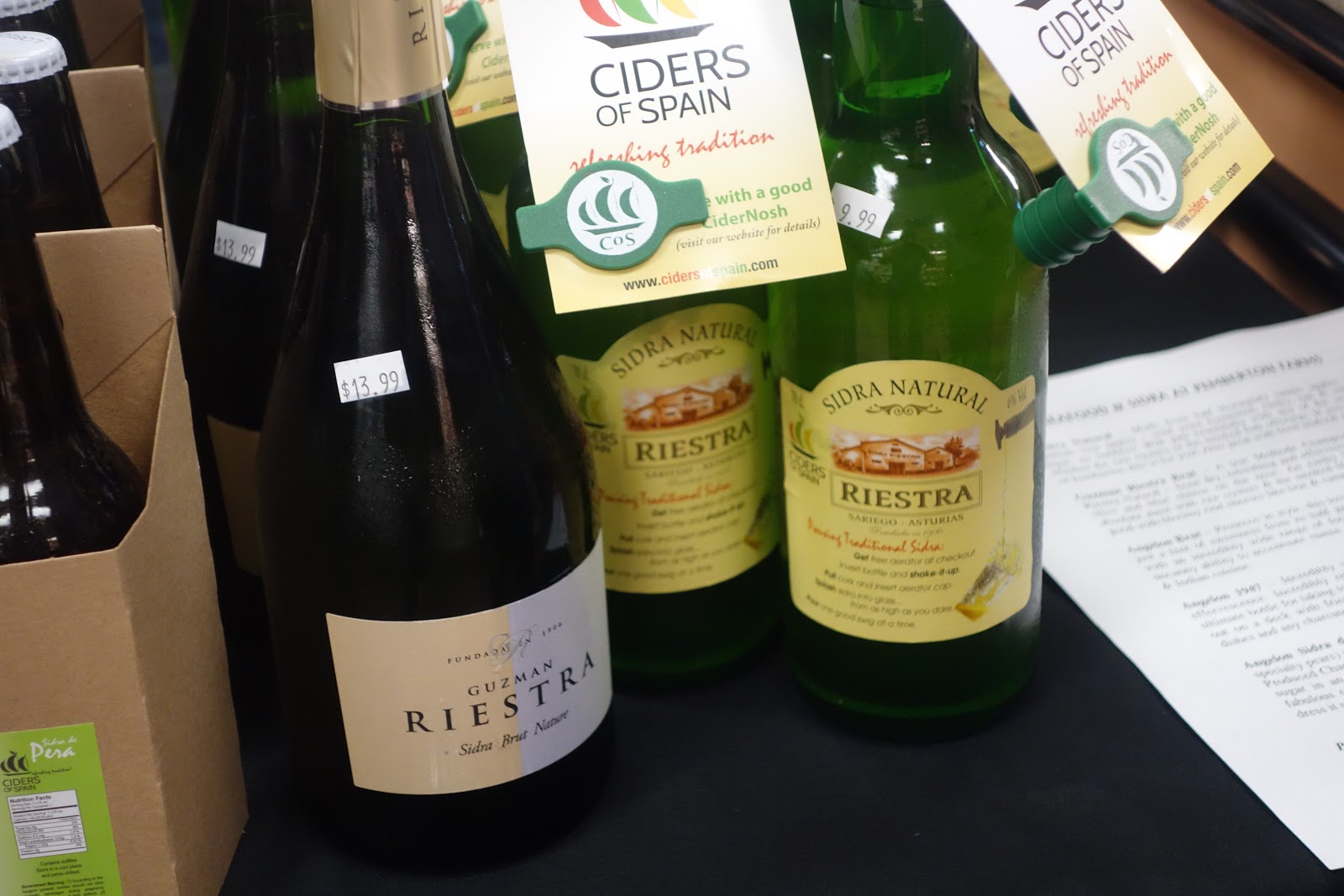
A Ciders of Spain tasting event, led by importer James Asbel, was recently held at Pemberton Farms in Cambridge, and two Sidra makers were in attendance, from Viuda de Angelón & Guzman Riestra. I've previously enjoyed Sidra from both of these producers but I wanted the opportunity to meet and speak with the Sidra makers. Please check out my two prior posts for more background and history on Ciders of Spain, James Asbel, Sidra and some specific reviews: Ciders of Spain: Asturian Cider (Part 1) and Ciders of Spain: Asturian Cider (Part 2).
Francisco Ordoñez Vigil, pictured above, is the main Sidra maker at Viuda de Angelón (the "widow of Angelon"), which was founded in 1947 by Alfredo Ordoñez Onís at the orchards of La Alameda. In 1978 the cidery was moved to La Teyera, Nava, home of the annual Asturian Cider Competition and the Museo de la Sidra de Asturias. It remains a family-owned and operated artisan cidery and they also operate a sidrería, a cider pub, in the center of Nava.
Francisco is a 3rd generation Sidra maker and acquired an oenology degree from the University of Valencia. Though he worked in the wine industry first, he eventually gravitated back to the family cidery. There isn't a school in Spain for cider making, so an oenology degree is the closest educational degree you can acquire. Francisco has been able to apply his winemaking knowledge, bringing more scientific analysis to the Sidra production. Francisco produces a wide range of Sidra, four of which are currently imported into the U.S. He stated that his biggest challenge in Sidra making is growing the apples.
The Sidra Brut Viuda de Angelón (about $16) is a Sparkling Off-Dry Cider made from 5 varieties of cider apples, though the exact proportions of each will vary some year to year. They have some of their own orchards, which are organic though not certified, and they purchase some apples from other local, organic orchards. Their orchards are quite steep so they must be do all hand harvesting, which is certainly laborious work. They also raise some livestock, including sheep and cows, which graze in the orchard.
Like all of their Sidras, the initial fermentation for the Brut occurs in an open tank and using wild yeasts. The cider will be cold shocked so some residual sugar remains within it, meaning they don't need to add additional sugar for the second fermentation, which occurs in a sealed tank. In addition, before that second fermentation, the cider is matured for about eight months in large chestnut barrels. It is cold shocked for a second time during the second fermentation so a little residual sugar, about 9 grams/liter, remains in the bottle. With a mild sweetness, this bubbly has rich apple flavors and would make a nice summer drink. There isn't much of a history of how well this Brut will age, but James believes it has a good aging potential.
The 1947 Sidra de Neuva Expresion (about $13) is a Petillant Semi-Dry Cider, produced from a blend of 14 apple varieties, all from their own orchards, with a rough breakdown of about 75% sharp, 15% bitter-sharp and the rest bitter-sweet. Fermentation occurs in an open chestnut vat, with wild yeasts, and I was quite surprised that they also allow it to mature in the open vat for about 12 months! The vats are old, some being as much as a hundred years or more, and are quite large, about 15,000 liters. Some of the vats are stored underground while others are at ground level. The chestnut provides a touch of sweetness to the cider.
How can the cider survive for 12 months in an open vat? First, the cider actually forms a type of flor atop it, like occurs with Sherry, protecting the cider from oxygen and bacteria. In addition, as they use higher acidity apples, that is another element protecting the cider. The cider is unfiltered, unfined and doesn't undergo any cold shock. It possesses a strong, appealing apple aroma and on the palate, it presents as mostly dry and crisp, with only the slightest hint of sweetness, with a mild effervescence, enough to be a nice palate cleanser and excellent for food pairings. It has delicious apple flavors, with a lengthy pleasing finish, and was one of my Top Three Sidras of the previous tasting.
The Viuda de Angelón Sidra de Pera ($3.50/330ml) is a Sparkling Off-Dry Perry, made from several varieties of pears from their estate. Perry production might extend back to the ancient Romans and was popular in Asturias during the last couple hundred years though mostly it was made by families at home and there was little, if any, commercial production. The pear trees are wild, organic and over 70 years old. Once the pears are picked, they are first fermented in stainless steel, with wild yeasts, and then mature for about four months in chestnut vats. Then, they undergo a second fermentation in the tank.
This is an impressive Perry, with a harmonious blend of earthiness with subtle pear flavor and a mild effervescence. It is dry and refreshing, with lots of depth. It would be excellent on its own or paired with food, especially something with umami. Absolutely delicious, it was also one of my a Top Three Sidras of the previous tasting.
I had some concerns last week when I read a news article from La Sidra titled "The Spanish administration bans pear cider." The article states "So now this category, pear cider, turns to be illegal and prevents the sale of perry with its own name. In Asturies, as we said, pear cider is a traditional and historical product as apple cider, despite its production and consumption was decreaded lately. Only the cider mill Viuda de Angelón produced this product since 2011 and now it will have to stop its production and distributon of this beverage, while the shops and cider bars can still sell this."
Fortunately, I spoke with James Asbel who soothed my worries, as the La Sidra article apparently wasn't fully accurate. James stated that Spain had only banned the use of the term "sidra" in referring to a "perry." As such, it will have no impact on production and sales, and no impact on Viuda de Angelón's labeling in the U.S. Perry can certainly still be produced in Spain, just as long as you don't try to label it as a sidra. Francisco Ordoñez Vigil, of Viuda de Angelón, has indicated he might decide to change over to the use of perea, the traditional term for Perry.
Raul Riestra, pictured above, is the main Sidra maker at Guzman Riestra, which was founded back in 1906 by Robustiano Riestra and it eventually was passed on to his daughter, Etelvina Riestra. With her husband, Ricardo Riestra Hortal, they eventually implemented some modern advances. Today, the cidery is in the hands of Raul and Ruben Riestra, the great grandsons of the founder, and Raul, with a business degree, is the chief cider maker.
Raul does not have an oenology degree but has always worked at the family cidery so he has learned everything on the job. Riestra grows some of their own apples and also purchases some. About 40% of their apples are from the local area, 40% are from little further away, and about another 20% come from Normandy, France. The cidery has about 30 vats for their apples, including chestnut, stainless steel and fiberglass. When making Sidra, the same juice goes into 3-4 vats to maintain consistency and they don't fill the vats all the way, allowing room for expansion.
Like Angelón, they conduct open vat fermentations, with wild yeasts. After the October harvest, fermentation can take about six weeks, though during the colder months, fermentation takes longer, and can extend even as long as 9 months. This is not a problem, as it allows them to more evenly spread out their availability. Overall, they produce about 850,000 liters of Sidra annually. Their greatest challenge is trying to press so many apples in such a short time.
The Sidra Natural Riestra (about $9.50/700ml) is a dry, unfiltered Sidra and when you are pouring it into a glass, you hold the bottle high in the area, a practice known as escanciar, which helps to aerate the cider as well as make it fizzier. It possesses a very mild earthiness, with much more rich apple flavors and stronger tannins. It is dry with sour and bitter notes as well as good acidity. This too would be excellent with a variety of food pairings, including cheese. The U.S. imports about 50% of the total production of this Sidra.
The Guzman Riestra Sidra Brut Nature (about $16/750ml) is a sparkling dry Sidra made in the Methode Champenoise. They select 2-3 tanks specifically for this Brut, only the best of their Sidra. It is matured for about 4 months in the tank, is then filtered and fined, before receiving a dosage and undergoing a second fermentation in the bottle. It spends at least four months in the bottle, and usually longer, and is commonly released about five months after disgorgment. The U.S. imports about 30% of the total production of this Brut.
The Brut is clean and dry with moderate bubbles, a mild earthiness, a bright apple flavor, a hint of tropical fruit, and a pleasingly long finish. It has similar tannins to the other Riestra and this could stand up to stronger foods, like cured meats.
Asturian Sidra offers a compelling and more unique flavor profile, with a great sense of history and tradition. And the Sidras in this article, from Ciders of Spain, offer an excellent value as well. A number of local wine and liquor shops now stock these Sidras, and if they don't, you should ask them to carry them.
--James Asbel
Besides my love for the diverse wines of Spain, from briny Manzanilla Sherry to aged Rioja, from crisp Albarino to fruity Mencia, I also enjoy their Ciders, from Asturias (which are known as Sidra) and the Basque region (which are known as Sagardoa). Cider may even have originated in Spain a few thousand years ago. Spanish ciders present their own unique flavor profiles and it's great to see more of them entering the U.S. market.
A Ciders of Spain tasting event, led by importer James Asbel, was recently held at Pemberton Farms in Cambridge, and two Sidra makers were in attendance, from Viuda de Angelón & Guzman Riestra. I've previously enjoyed Sidra from both of these producers but I wanted the opportunity to meet and speak with the Sidra makers. Please check out my two prior posts for more background and history on Ciders of Spain, James Asbel, Sidra and some specific reviews: Ciders of Spain: Asturian Cider (Part 1) and Ciders of Spain: Asturian Cider (Part 2).
Francisco Ordoñez Vigil, pictured above, is the main Sidra maker at Viuda de Angelón (the "widow of Angelon"), which was founded in 1947 by Alfredo Ordoñez Onís at the orchards of La Alameda. In 1978 the cidery was moved to La Teyera, Nava, home of the annual Asturian Cider Competition and the Museo de la Sidra de Asturias. It remains a family-owned and operated artisan cidery and they also operate a sidrería, a cider pub, in the center of Nava.
Francisco is a 3rd generation Sidra maker and acquired an oenology degree from the University of Valencia. Though he worked in the wine industry first, he eventually gravitated back to the family cidery. There isn't a school in Spain for cider making, so an oenology degree is the closest educational degree you can acquire. Francisco has been able to apply his winemaking knowledge, bringing more scientific analysis to the Sidra production. Francisco produces a wide range of Sidra, four of which are currently imported into the U.S. He stated that his biggest challenge in Sidra making is growing the apples.
The Sidra Brut Viuda de Angelón (about $16) is a Sparkling Off-Dry Cider made from 5 varieties of cider apples, though the exact proportions of each will vary some year to year. They have some of their own orchards, which are organic though not certified, and they purchase some apples from other local, organic orchards. Their orchards are quite steep so they must be do all hand harvesting, which is certainly laborious work. They also raise some livestock, including sheep and cows, which graze in the orchard.
Like all of their Sidras, the initial fermentation for the Brut occurs in an open tank and using wild yeasts. The cider will be cold shocked so some residual sugar remains within it, meaning they don't need to add additional sugar for the second fermentation, which occurs in a sealed tank. In addition, before that second fermentation, the cider is matured for about eight months in large chestnut barrels. It is cold shocked for a second time during the second fermentation so a little residual sugar, about 9 grams/liter, remains in the bottle. With a mild sweetness, this bubbly has rich apple flavors and would make a nice summer drink. There isn't much of a history of how well this Brut will age, but James believes it has a good aging potential.
The 1947 Sidra de Neuva Expresion (about $13) is a Petillant Semi-Dry Cider, produced from a blend of 14 apple varieties, all from their own orchards, with a rough breakdown of about 75% sharp, 15% bitter-sharp and the rest bitter-sweet. Fermentation occurs in an open chestnut vat, with wild yeasts, and I was quite surprised that they also allow it to mature in the open vat for about 12 months! The vats are old, some being as much as a hundred years or more, and are quite large, about 15,000 liters. Some of the vats are stored underground while others are at ground level. The chestnut provides a touch of sweetness to the cider.
How can the cider survive for 12 months in an open vat? First, the cider actually forms a type of flor atop it, like occurs with Sherry, protecting the cider from oxygen and bacteria. In addition, as they use higher acidity apples, that is another element protecting the cider. The cider is unfiltered, unfined and doesn't undergo any cold shock. It possesses a strong, appealing apple aroma and on the palate, it presents as mostly dry and crisp, with only the slightest hint of sweetness, with a mild effervescence, enough to be a nice palate cleanser and excellent for food pairings. It has delicious apple flavors, with a lengthy pleasing finish, and was one of my Top Three Sidras of the previous tasting.
The Viuda de Angelón Sidra de Pera ($3.50/330ml) is a Sparkling Off-Dry Perry, made from several varieties of pears from their estate. Perry production might extend back to the ancient Romans and was popular in Asturias during the last couple hundred years though mostly it was made by families at home and there was little, if any, commercial production. The pear trees are wild, organic and over 70 years old. Once the pears are picked, they are first fermented in stainless steel, with wild yeasts, and then mature for about four months in chestnut vats. Then, they undergo a second fermentation in the tank.
This is an impressive Perry, with a harmonious blend of earthiness with subtle pear flavor and a mild effervescence. It is dry and refreshing, with lots of depth. It would be excellent on its own or paired with food, especially something with umami. Absolutely delicious, it was also one of my a Top Three Sidras of the previous tasting.
I had some concerns last week when I read a news article from La Sidra titled "The Spanish administration bans pear cider." The article states "So now this category, pear cider, turns to be illegal and prevents the sale of perry with its own name. In Asturies, as we said, pear cider is a traditional and historical product as apple cider, despite its production and consumption was decreaded lately. Only the cider mill Viuda de Angelón produced this product since 2011 and now it will have to stop its production and distributon of this beverage, while the shops and cider bars can still sell this."
Fortunately, I spoke with James Asbel who soothed my worries, as the La Sidra article apparently wasn't fully accurate. James stated that Spain had only banned the use of the term "sidra" in referring to a "perry." As such, it will have no impact on production and sales, and no impact on Viuda de Angelón's labeling in the U.S. Perry can certainly still be produced in Spain, just as long as you don't try to label it as a sidra. Francisco Ordoñez Vigil, of Viuda de Angelón, has indicated he might decide to change over to the use of perea, the traditional term for Perry.
Raul Riestra, pictured above, is the main Sidra maker at Guzman Riestra, which was founded back in 1906 by Robustiano Riestra and it eventually was passed on to his daughter, Etelvina Riestra. With her husband, Ricardo Riestra Hortal, they eventually implemented some modern advances. Today, the cidery is in the hands of Raul and Ruben Riestra, the great grandsons of the founder, and Raul, with a business degree, is the chief cider maker.
Raul does not have an oenology degree but has always worked at the family cidery so he has learned everything on the job. Riestra grows some of their own apples and also purchases some. About 40% of their apples are from the local area, 40% are from little further away, and about another 20% come from Normandy, France. The cidery has about 30 vats for their apples, including chestnut, stainless steel and fiberglass. When making Sidra, the same juice goes into 3-4 vats to maintain consistency and they don't fill the vats all the way, allowing room for expansion.
Like Angelón, they conduct open vat fermentations, with wild yeasts. After the October harvest, fermentation can take about six weeks, though during the colder months, fermentation takes longer, and can extend even as long as 9 months. This is not a problem, as it allows them to more evenly spread out their availability. Overall, they produce about 850,000 liters of Sidra annually. Their greatest challenge is trying to press so many apples in such a short time.
The Sidra Natural Riestra (about $9.50/700ml) is a dry, unfiltered Sidra and when you are pouring it into a glass, you hold the bottle high in the area, a practice known as escanciar, which helps to aerate the cider as well as make it fizzier. It possesses a very mild earthiness, with much more rich apple flavors and stronger tannins. It is dry with sour and bitter notes as well as good acidity. This too would be excellent with a variety of food pairings, including cheese. The U.S. imports about 50% of the total production of this Sidra.
The Guzman Riestra Sidra Brut Nature (about $16/750ml) is a sparkling dry Sidra made in the Methode Champenoise. They select 2-3 tanks specifically for this Brut, only the best of their Sidra. It is matured for about 4 months in the tank, is then filtered and fined, before receiving a dosage and undergoing a second fermentation in the bottle. It spends at least four months in the bottle, and usually longer, and is commonly released about five months after disgorgment. The U.S. imports about 30% of the total production of this Brut.
The Brut is clean and dry with moderate bubbles, a mild earthiness, a bright apple flavor, a hint of tropical fruit, and a pleasingly long finish. It has similar tannins to the other Riestra and this could stand up to stronger foods, like cured meats.
Asturian Sidra offers a compelling and more unique flavor profile, with a great sense of history and tradition. And the Sidras in this article, from Ciders of Spain, offer an excellent value as well. A number of local wine and liquor shops now stock these Sidras, and if they don't, you should ask them to carry them.
Subscribe to:
Posts (Atom)