Tuesday, October 19, 2021

Origins of the Pu-Pu Platter

In an advertisement in the Boston Globe, October 14, 1982Bob Lee's Islander restaurant claimed "We invented The Pupu Platter.” Is this true?

According to Wikipedia, "The pupu platter was probably first introduced to restaurants on the United States mainland by Donn Beach in 1934." In addition, it notes, "The earliest known print reference to a pupu platter served at a Chinese restaurant is from 1969." Are either of those true?

What's the actual truth behind the origins of the Pu-Pu Platter?

There’s no question that the term “Pu-Pu” derives from the Hawaiian word, pū-pū, which refers to “appetizers.” Originally, pū-pū only referred to shellfish, but eventually expanded to a variety of other foods as well. 

During the 1950s, a number of Hawaiian newspapers mentioned pu-pu. For example, the Honolulu Star-Bulletin (HI), April 10, 1954, in describing the Ginza restaurant on Honolulu, stated, “.., there’s a tempting array of pupu—LOVE that word!—chasers in the form of shrimp tempura, sashimi, abalone, and umpteen varieties of Japanese pickles and vegetables.”

The Honolulu Advertiser (HI), January 22, 1955, detailed Les Gourmets de Pupu. The article stated, “Believing that one way to eliminate the problem of dinner is to concentrate exclusively on hors d’oeuvres, a group of dedicated young couples formed one of Honolulu’s most unusual clubs several years ago.” The article continued, “They hold that dinner uses up space, confuse the issue and adds dishes to wash.” The group held monthly epicurean dinners, specializing in pupus, “the Hawaiian approximation for hors d’oeuvres.” 

Travel back about twenty years, and in 1933, Don’s Beachcomber, likely the first Polynesian “Tiki” bar, opened in Hollywood, and in 1937, the bar moved across the street and became a restaurant as well. Around this same time, Victor Bergeron Jr. opened his own Polynesian bar & restaurant which would become known as Trader Vic’s.

It would seem to make sense that maybe one of these restaurants, which popularized Polynesian-Chinese cuisines, invented Pu-Pu platters, using the Hawaiian word to refer to their own collection of appetizers. If they did so, when did that occur? Was it when they first opened or was it sometime later?

Tthe evidence on behalf of Don the Beachcomber being the first to create a Pu-Pu Platter seems to be lacking. For example, I’ve examined three menus from Don the Beachcomber, from 1954-1965 (Menu 1Menu 2, and Menu 3), and there was not a single mention of Pu-Pu Platters, which makes no sense if Don invented it

As for Trader Vic's, he wrote a book, Trader Vic's Book of Food and Drink (1946) and it doesn't mention the Pu-Pu Platter either. However, there's a Menu from the 1950s (although a specific year is not mentioned) for their Honolulu location, and it had a category for Hot Pupus: Polynesian Hors d'Oeuvres. There was also a listing for PuPu Platter ($2.50), with Fried Shrimp, Egg Roll, Won Ton and Spareribs

As such, this might be the first restaurant documented to have served a Pu-Pu Platter, and provides at least some evidence that Trader Vic's might have invented the Pu-Pu Platter. I'll note though that it doesn't appear that Trader Vic's has made that claim for themselves. Trader Vic's has claimed to have invented the Mai Tai, so why wouldn't they make that same claim for the Pu-Pu Platter if it was applicable?

In 1957, a couple locations of the Luau 400, a Polynesian restaurant opened in New York City and Pennsylvania. The Daily News (NY), December 5, 1957, mentioned that the menu at Luau 400 included a Pu Pu Platter, with Tim Sam (dumplings), Shrimp Vela (fried shrimp with coconut), Egg Rolls, Barbecued Spare Ribs, and Rumaki. This might be the first newspaper mention of a restaurant serving a Pu-Pu Platter. 

As the Trader Vic's menu doesn't have a specific year, it is certainly possible that Luau 400 was the first restaurant to offer a Pu-Pu Platter and that Trader Vic's followed closely behind them, starting to offer a Pu-Pu Platter in 1958 or 1959. 

So what about the claim of Boston's Bob Lee's Islander? Around 1951, Bob Lee, a native of Canton, China, opened Bob Lee's Lantern House on Tyler Street in Boston's Chinatown. At first, it only had seven tables, although it would grow over the years, with its first expansion starting around April 1952. At that time, the restaurant served only typical Cantonese cuisine.

It wouldn't be until 1961, that Bob Lee's Lantern would add Polynesian cuisine and cocktails. The Boston Daily Record, January 2, 1961 noted the opening of the new Aloha cocktail lounge at Bob Lee’s Lantern House. The Boston American, May 15, 1961, mentioned that at this new Aloha lounge, you could find "tasty Polynesian-Chinese food and cocktails." 

By September 1961, the name of the restaurant was changed to Bob Lee's Islander, embracing the Tiki mystique. The Boston American, September 18, 1961, had an advertisement for this name change, noting they served “Exotic Polynesian Drinks, Finest Chinese Food."

The Boston Record American, December 20, 1961, had a full page advertisement for the restaurant, noting that the decor included:“Thatched roofs, Polynesian masks, ceramic figures and symbols, lush broadleaved foliage and a handsome tropical mural..” One of the items you could order were the “intriguing Pu-Pu Platters heaped with shrimp puffs, fried won-ton, rumaki, barbecued spare ribs, fried shrimp and barbecued chicken wings,..

It's important to note that at this time, Bob Lee's Islander didn't claim to be the inventor of the Pu-Pu Platter, which you would have expected them to have done if it were true. They had a full page advertisement, so plenty of room to add that information if it were correct. However, we have already seen there were Pu-Pu Platters at least as far back as the 1950s, before Bob Lee could have invented it in 1961. 

During the 1970s, Bob Lee ran into some legal problems. First, in late 1976 and early 1977, his restaurant had been found in violation of the health codes and was shut down for a day. According to the Boston Globe, February 9, 1977, he then planned to sue the city for violating his civil rights. He stated that three other restaurants which had also failed health inspections, Anthony’s Pier 4, Locke-Ober and Polcari's, had only been given warnings. His was the only restaurant shut down. He also claimed this was the restaurant's first violation in its 25 years. However, because of the public nature of the health allegations, Bob Lee also stated he had lost much business.

A year later, the Boston Globe, April 11, 1978, reported that Bob Lee had been charged with 3 counts of tax evasion for understating his taxable earnings by $158,680 from 1971-1973. The Boston Globe, May 10, 1978, then reported that Bob pled guilty to 1 count of tax evasion. He was sentenced to one year in jail, three months to serve and the rest suspended. Plus, he was fined $10,000 and had to pay the  back taxes, plus 6% interest and a fraud penalty of 50% of the overdue taxes. 

It wasn't until 1982 (in the ad at the top of this page) that Bob Lee's Islander made their first documented claim to have been the inventor of the Pu-Pu Platter. Why did they wait so long, at least twenty years, to make this claim? Why isn't there any earlier documented references to their alleged invention? And as Ive already pointed out, Bob Lee's Islander didn't exist until 1961, and there were  documented references to Pu-Pu platters in the 1950s. So their claim cannot be true.

At this time, the first documented references to Pu-Pu Platters were from the 1950s, including a Trader Vic's menu and a 1957 newspaper article about the Luau 400. From 1961 through the early 1960s, other restaurants, in New Jersey, Vermont and Hawaii, would also start offering Pu-Pu Platters (including the flaming Pu-Pu Platter. 

More research would be beneficial to seek the actual inventor of the Pu-Pu Platter, but we can at least state definitively it wasn't Bob Lee and it seems very unlikely that it was Don’s Beachcomber either. Trader Vic's and Luau 400 are in the running as potential inventors, but more evidence would be needed to determine the fact of the matter. 

Monday, October 18, 2021

Rant: Holiday Wines? Don't Be A Cheapskate

Next month begins the holiday season, and many people will be stop by their local wine shop to purchase wines for Thanksgiving to Christmas, Boxing Day to Festivus. You might be buying wines for parties, dinners, or gifts. I once again want to give my reader an important piece of advice, which applies to all the wine you'll purchase this holiday season.

Stop being a cheapskate! 

In preparation for the holidays, people stock up on wine to serve their guests at the various parties and celebrations. Often, because they are buying bottles in bulk, their primary concern is price. They generally want to purchase wine that costs $10 per bottle or less and usually end up buying those large, commercial "value" wines, the brand names which are known to everyone. Don't do it!

It takes almost no thought to buy such wines. Though such wines might be drinkable, they aren't going to impress anyone. You've chosen to take the cheapest route possible, in both price and time. There is a better way. 

If you're hosting a holiday party, don't you want to impress your guests? Or do you want to be known as the person who bought the cheapest wine available? Don't you want your guests to leave the party talking about the great time they had, telling others about the delicious wines they enjoyed? Or would you rather have them later complain that the wine was unappealing?

It only takes a little extra work, and maybe price, to elevate your wine selections. Or would you rather be known as a wine cheapskate by your guests, who know you bought cheap wine with no real thought?

I certainly understand the need to control your wine costs when you are providing for a number of guests. You don't have to buy $50 wines to impress your guests and you don't even have to spend $20 per bottle. I've purchased numerous $10-$12 wines and brought them to parties where the other guests loved then, wanting to know where they could buy them. There are good and interesting wines at this price point, if you know where to seek them out. If you want your holiday celebration to be even more popular, then you need to serve those type of wines. The extra effort will elevate your party and please your family, friends, and other guests.

How do you find these inexpensive but interesting wines?

To start, the easiest path is to seek out one of the better discount wine stores. These places often carry a good selection of wines costing $15 or under, much more than you will find at a regular wine store. You'll find plenty of variety in these inexpensive wines, whites and reds, domestic and imported. You'll find wines comparable in price to those large commercial "value" wines but which offer much more character, taste and value.

My top three recommendations for discount wine stores include Bin Ends in Braintree and NeedhamWine Connextion in North Andover, and Rapid Liquors in Stoneham. Make the effort and drive to one of these discount spots and find better value wines. The investment of time will pay off, creating many happy guests at your next party.

For example, when I go to Bin Ends in Needham, I can purchase a couple cases of wine, averaging $10-$15 per bottle, and get a nice diversity of wines, reds, whites & rose. These wines will satisfy most people. They are excellent every-day wines, and work well as inexpensive wines for larger parties too. Rapid Liquors expanded their store, offering a larger selection and you can always find excellent values there. The Wine Connextion also offers excellent prices, even better than many you would find in New Hampshire.

If you some reason you can't make it to one of these discount wine shops, you still have options. At whatever wine shop you visit, it might be best to ask the wine store staff for recommendations of value wines. They should be able to direct you toward those inexpensive wines which will be more interesting and delicious than those cheap commercial wines. You should also remember that most wine stores offer a discount for bulk purchases, sometimes as few as 6 wines, which is another way to save money on your purchases.

But if for some reason you can't ask a store employee for some recommendations, then my best advice for selecting a good wine that is $12 or under, is to buy a Portuguese wine. At this time, I think some of the greatest value wines are coming out of Portugal, especially at this price point. Chances are that if you purchase a Portuguese wine costing $12 or less, you will find a delicious wine, much better than similarly priced wines from most other regions. And there are plenty of Portuguese wines available in that price range. There is probably no other wine region where you can find as many good wines at that price point.

You also should know that paying a few dollars more for your wine can make a big difference. When you start considering wines priced from $10-$15, your options increase drastically. You can find some interesting wines from all over the world in that price range, though they still offer value. And if you are buying in bulk where the wine store offers a discount for larger purchases, you can save enough money so that the wines end up priced closer to $10 per bottle.

So this holiday season, don't buy the same old cheap wines. It won't take much effort to select some better choices, and still very inexpensively. In the end, you'll impress your guests, make your holiday party more memorable, and drink better wines.

Friday, October 15, 2021

A Chinese Restaurant in Mayberry?


The core of the story centered on Sheriff Andy Taylor, a widower, raising his son, Opie, assisted by his Aunt Bee, all in the small town of Mayberry, North Carolina

The Andy Griffith Show, which aired from 1960-1968, with 249 episodes, is a beloved and iconic comedy series. It always did very well in the ratings and is commonly listed as one of the best TV series ever. It was considered a wholesome show, generally upholding strict moral values. As a child, I watched the series and I’m sure many of my contemporaries did the same. 

However, nowadays, the series receives some criticism as there was almost no diversity in the show. For example, there was only a single black actor, Rockne Tarkington, who had a speaking part on the show and he only appeared in a single episode, as Opie's football coach. A few other black actors and actresses appeared as non-speaking extras, although none of them were listed in the credits.

Thus, I was recently surprised to learn that one of the episodes centered on a Chinese restaurant in Mayberry! I didn’t remember that episode from my childhood, and wouldn’t have imagined such an episode existed. Fortunately, the episode, from 1967, presented a very positive image, which would have reached many households all across the country, helping to break erroneous preconceptions and prejudices against the Chinese. Such positive depictions are absolutely necessary, so let's take a deeper look at this fascinating episode.

The episode, “Aunt Bee’s Restaurant” (Season 7, Episode 21) aired on February 6, 1967. At that time, in the fictional town of Mayberry, there were a few restaurants, primarily diners, including the Mayberry Diner, Bluebird Diner, and Snappy Lunch. There was a more upscale spot, Morelli’s, which was located just outside of Mayberry. All of these restaurants provided basic American fare, and most were relatively inexpensive. 

As the episode began, Andy and his friend, Gomer Pyle, were discussing what they would eat for lunch when Aunt Bee arrived. She mentioned that she might stop by the Spare Ribs Tavern and bring some home for dinner. However, Gomer mentioned that the restaurant had closed the day before, as they couldn’t succeed. 

Aunt Bee commented that Mayberry wasn’t really a spare rib town, which is very curious as North Carolina is well known for its barbecue, including its ribs. Aunt Bee then finished, by stating,  “The restaurant business can be so treacherous.” This was intended to mean the restaurant business was very difficult, and didn't refer to any betrayal or deception. 

Next, Aunt Bee stopped by the Spare Ribs Tavern, to speak to the owner Henry. The signs in the restaurant were interesting, providing insight into their menu. One signs mentioned, “Complete Lunch” including items like beef stew, meat balls, roast beef, roast pork, chicken fried steak, ham & lima beans, and hamburger steak (all priced $1.25-$1.35). The lower part of another sign mentioned Cole Slaw and Homemade Soup. A prominent third sign promoted Barbecued Ribs, To Go, for 85 cents. A fourth sign mentioned hot dogs, pizza, French dips, and chile. Interestingly, the sign also mentioned beer for 25 cents, even though Mayberry was a dry town. 

The Spare Ribs Tavern probably served a menu similar to many of the other existing restaurants in Mayberry, except for possibly the barbecued ribs. So why wasn't it able to compete with the other local restaurants? The tavern had far more variety on their menu than just barbecued ribs.  

Henry wasn’t present so Aunt Bee spoke with Charlie Lee, the chef, and the old her that he planned to return to Pittsburgh to work at Wong Soo’s Canton Palace. Bee was disappointed, as she felt he was an excellent chef, and Charlie then told her that he felt a Chinese restaurant in Mayberry would have been a great idea, a relative gold mine. Charlie began learning how to cook Chinese cuisine when he was 17 years old, and stated he knew how to prepare items like chop suey, chow mein, and egg rolls

However, Charlie noted it would take money, about $400, to renovate the tavern and turn it into a Chinese restaurant. Charlie lacked the needed capital so he needed a partner to invest that money, but he didn't know no one who would do so. As Bee left the restaurant, she found a penny on the floor, and Charlie told her it was her lucky day. 

Later that day, Bee was at home with Andy, and she began to sing “Chinatown, My Chinatown,” a popular song written by William Jerome and Jean Schwartz back in 1906. She had already made up her mind to invest in the Chinese restaurant and was slowly trying to tell Andy about it. She asked him, “Everybody likes good wholesome food, don’t they?” This was a clear indication that she considered Chinese cuisine to be “good wholesome food.” She finally then told Andy, who was skeptical of her plans. 

Andy didn’t think she knew anything about running a restaurant, although she claimed it would be like serving a lot of company, although Andy replied that she didn’t serve sub gum to her guests. Andy’s friend, Howard Sprague, showed up at their home and Andy asked for his opinion on Bee’s plans, hoping he would be on Andy’s side. Howard though was a fan of Chinese cuisine, and especially fond of water chestnuts, and thought having a Chinese restaurant in Mayberry would be a good idea. 

Andy remained doubtful but Bee went forward with her investment. So, at least some of the people of Mayberry had some familiarity with Chinese cuisine. Had they visited a Chinese restaurant in another part of North Carolina? That information isn't provided in the episode. However, it's good to see that none of them had a negative image of Chinese cuisine. 

Charlie Lee’s nephew, Jack, arrived in Mayberry to be the waiter in the new Chinese restaurant. He was currently attending the University of North Carolina, studying for a Masters in Psychology. Charlie, Bee and Jack, helped decorated the restaurant, with large Chinese screens, lanterns, and other similar items. 

The Grand Opening of “Aunt Bee’s Canton Palace” was held and the restaurant was packed. One of the guests raved about the Moo Goo Gai Pan, a dish he’d never eaten before. Andy, his girlfriend Helen, Howard, and Gomer, ate together. Howard caught an error on the menu on the name of a chicken dish, Ling Chi Chi, which he ordered along with a bowl of something like a Chinese matzoh ball soup. Andy, Helen and Gomer ordered the $1.95 chow mein dinner, although Gomer was going to get the smaller $1.65 chow mein dinner until Andy mentioned that he was treating. Everyone thoroughly enjoyed their meal and couldn’t wait to return. Gomer wanted to try their fried rice. 

At the end of the night, when the restaurant was essentially closed, Bee sat down with Andy and friends, and a plate of fortune cookies was brought to the table. Bee was pleased that they had a revenue of $80 (about $633 in today's dollars) for the night, which might mean they had about 40-60 customers that evening. When Bee opened her fortune cookie and read her fortune, she seemed nervous and wouldn't tell anyone what it said, merely claiming it was silly. 

Later that night, she couldn't sleep and sat in the kitchen, looking at her fortune. Andy woke up and saw her in the kitchen. He picked up her fortune from the table and read it, which said, “Beware of new business ventures, they can prove costly.” Bee, who was superstitious, was greatly concerned about the fortune, stating, “The Chinese are very intelligent people." 

The next day, Bee tried to get Charlie to make some changes to his restaurant, from adding more seasoning to the chow mein to expanding the menu to include steaks, chops and spaghetti. Charlie wasn’t happy with such changes and, with Jack, went to speak to Andy. Charlies was worried that the changes would quickly put them out of business. Jack eventually tried to use his knowledge of psychology to convince Bee not to worry about her fortune cookie, but was unsuccessful. Rationally, Bee understood she shouldn't be superstitious, but she couldn't stop her feelings. 

In the end, Jack opted to buy out Bee, giving her back her $400 investment. The Chinese restaurant remained open, although it’s unknown if they changed its name, or at least removed “Aunt Bee’s” from the name. Jack had previously not wanted to buy out Bee's investment, but he got a fortune cookie which helped changed his mind. The restaurant wasn’t mentioned again in the series so its ultimate fate was unknown, although it seemed very popular and likely would have remained in existence. 

Charlie Lee was played by Keye Luke, a native of Guangzhou, China, born on June 18, 1904, but who was raised in Seattle, Washington. His lengthy acting career began in 1934, and some of his roles included “Number One Son” in the Charlie Chan films and Kato in the Green Hornet film serials. He would also play the blind Master Po in the Kung Fu series, as well as Mr. Wing in the Gremlin movies. He was the first Chinese-American contract player signed by RKO, Universal Pictures and MGM. He died of a stroke in 1991. In 2012, he was also the subject of Keye Luke, a short documentary and bio-pic, directed by Timothy Tau, about his early life and career. 

Jack was played by Lloyd Kino (Kinoshita), who was born on May 18, 1919; in Seattle, Washington. He too had a lengthy acting career, appearing in numerous television series during from McHale’s Navy to CSI: Crime Scene Investigation (as well as one episode of Kung Fu), as well a number of movies from Mortal Kombat to Godzilla, The Cable Guy to The Last Tycoon. He passed away in 2012. Interestingly, in the Andy Griffith episode, Jack was a college student but the actor was actually 47 years old at that time.

This 1967 Andy Griffith episode depicted Chinese restaurants in a very positive manner, and due to its immense popularity, likely was influential in persuading Americans to dine at such restaurants. With Chinese restaurants receiving so much negative publicity over the years, it's always good to see a more positive depiction. And it's cool to imagine the Canton Palace having a lengthy and successful history in Mayberry.

Thursday, October 14, 2021

Thursday Sips & Nibbles

I'm back again with a new edition of Sips & Nibbles, my regular column where I highlight some interesting, upcoming food and drink events. I hope everyone dines out safely, tips well and are nice to their servers.
******************************************************
1) Greco, one of my favorite spots for Gyros & Loukamades, has opened a new location at Hub Hall next to TD Garden. To celebrate the opening their newest location, Greco is hosting their first Breakfast Gyro Pop Up on October 23 and October 24 from 8am-11am. 

Greco, ownered by Demetri Tsolakis and Stefanos Ougrinis, opened its first location on Newbury Street in 2017. Greco shares all of their tastes of home. Greco is their “meraki,” the need to remember and create. Greco now has three other locations in Boston’s Back Bay, Seaport and Downtown Crossing.

The Breakfast Gyro Pop Up Menu includes: 
--Greek American: two eggs your style, bacon or sausage, ketchup, honey mustard, onion, tomato, French fries ($10)
--Truly Greek Breakfast Gyro: two over easy eggs, pork gyro, feta, tzatziki, onion, tomato, French fries ($12)
--Beefeggy: two over easy eggs, bifteki, spicy feta, onion, tomato, French fries ($12)
--Breakfast Fries: Hand-cut potatoes, feta, pork gyro, fried egg, hot sauce ($8)
--Pumpkin Spiced Frappe: sketo, metreo, glyko +nounou ($5)

2) The 12th Annual Champagne Day is  next Friday, October 22. This is a day to celebrate all things Champagne, from the unique sparkling wine and its history to the region of France that gives it its name. To mark the occasion, retailers, restaurants, bars, clubs, and schools around the world are planning tastings and special events, both in person and virtually. Currently, I haven't seen any special Champagne events being held in the Boston+ area. 

Now more than ever, we know just how special it is to come together with loved ones and friends, and there is no better way to celebrate than by grabbing a glass of Champagne and toasting to brighter days ahead, either in-person or virtually.

Wednesday, October 13, 2021

Nightshade Noodle Bar: Compelling Vietnamese/French Cuisine in Lynn

Last week, I finally dined at Nightshade Noodle Bar, in Lynn, for the first time. I'd read the raves about it and had been intrigued by their menu. The pandemic certainly delayed plans but I finally made the journey, and now I look forward to returning, to try more of their delicious cuisine and drinks. It's a worthy restaurant destination for their Vietnamese and French influenced menu. 

There's plenty of on-street parking available near the restaurant, and I was actually surprised at how many open spaces there were on a Friday evening. Nightshade has a good sized patio, and they also offer take-out and delivery. There's a medium-sized room for indoor dining, with a bar to the left of the room, high tops to the right, and an open kitchen to the back. It has a comfortable ambiance, and I love the open kitchen concept. To dine inside, you must show proof of vaccination, which is a reasonable request during these times.

The kitchen is headed by Chef Rachel Miller, a Virginia native, who has worked at a variety of restaurants in Boston, including notably as the Chef de Cuisine at Clio. For over two years, she also worked as a private chef and conducted numerous Nightshade Pop Up dinners. In October 2019, she opened Nightshade Noodle Bar, and the last couple years have obviously been difficult due to the pandemic. Not the best time for a new restaurant. 

I want to provide my preliminary thoughts on Nightshade Noodle Bar, and please note that these are based on a single visit. After I dine there more, I'll update my thoughts in an additional article. 


For this visit, I chose to have cocktails rather than wine, although the wine list is interesting and I would like to explore it on future visits. The Drinks menu has 8 special Cocktails, priced $11-$15, with lots of diversity to the type of drinks available, often with an Asian flair.

The Nightshade Mai Tai ($15) is made with Privateer rum, almond, lime, and Vietnamese cinnamon. It's fruity, smooth and easy-drinking, with an intriguing hint of cinnamon, and is much different from the usual Mai Tais you find made with orange and pineapple juices. 

The Moon Rabbit ($12) is made with Tito's vodka, guanabana (also known as soursop), lychee, and lime. Another fruity, but not overly sweet, drink with a pleasing tropical flair.  

 
They offer a nonalcoholic drink, the Nha Trang Beach ($6), made with shiso, coriander, guanabana, lemon, lemon, and soda. However, you can add Mezcal (+$6), which I did. Another well-balanced, tasty cocktail, with the flavors meshing well with the taste of the Mezcal. 

 
My favorite of the cocktails was the Saigon Cigar Club ($13), made with bourbon, Thai banana, and black cardamom. What an intriguing and delicious drink, almost like a tropical version of a Manhattan, and the addition of the banana leaf was a cool visual touch. 

The Food Menu has plenty of interesting options, broken down into several different categories. There are Snacks & Bites, 5 choices ($5-$16), from Shrimp Toast ($5) to Chili Crisp Cream Cheese Crab Dip ($16). The Small Plates has 8 choices ($10-$18), from Pho-Smoked Shrimp Cocktail ($14) to Sungold Tomato Salad ($10) and they have two RollsFried Clams or Lobster ($16). There is also Viet-Cajun Seafood, a 1/2 pound of Wild Carolina Shrimp ($16) or Steamers ($12). In addition, there are sections for Noodles, 4 choices ($20-$32), and Rice, 3 choices ($20-$28). Finally, for a splurge, there are a few special Caviar dishes, with options to add caviar to some of the other dishes as well. 

Our server informed us that the menu is generally meant to be shared, and she recommended that we order three dishes per person. It might remind you of a Spanish tapas menu, where you get the opportunity to sample a variety of dishes for dinner. Service was excellent, with our server being personable and attentive. 


From the Snacks & Bites, we ordered the Curried Beef in Betel Leaves ($8), in a sweet chili sauce. This was my first bite of food, and it captivated me from the moment I tasted it. Juicy and flavorful  with a hint of spicy heat accented by the mild sweetness of the sauce. Pure deliciousness, and it boded well for the rest of the meal that was to come. I've had beef in Betel leaves before, but this was certainly the best version I've ever tasted. Highly recommended! 

Also from the Snack & Bites section, we ordered the Grilled Coconut Sticky Rice Pop ($6), topped by a brown butter tamarind pork floss. A well-balanced dish, the flavors worked together harmoniously, nothing over powering the others. The coconut, tamarind and pork each played their role, creating an intriguing and tasty appetizer. 

The Viet-Cajun Steamer Clams ($12) were served in a "super aromatic lemongrass cajun butter", and that butter was compelling, with lots of aromatics and a touch of spicy heat. In general, the clams were very tender and good, except a couple were a bit too gritty. I suspect the Viet-Cajun Shrimp dish would also be quite delicious.  

From the Small Plates, we chose the Kabocha Squash Bot Chien ($12), Vietnamese rice cakes, crispy confit duck tongues, green chili sauce, duck egg, and pickled carrots & daikon. An intriguing and creative dish, which was a fine blend of textures and flavors, all meshing well together. The crispy duck tongues were a nice addition and unless you knew what they were, you probably never would have guessed that they were tongues.  

The Dungeness Crab Fried Rice ($28), housed in a crab shell, is made with black garlic-chili sauce and a ginger scallion vinaigrette. Savory with sweetness from the black garlic and crab meat, this was another compelling dish, and I could have easily eaten this all on my own. The cool presentation also adds to the allure of the dish. Highly recommended. 

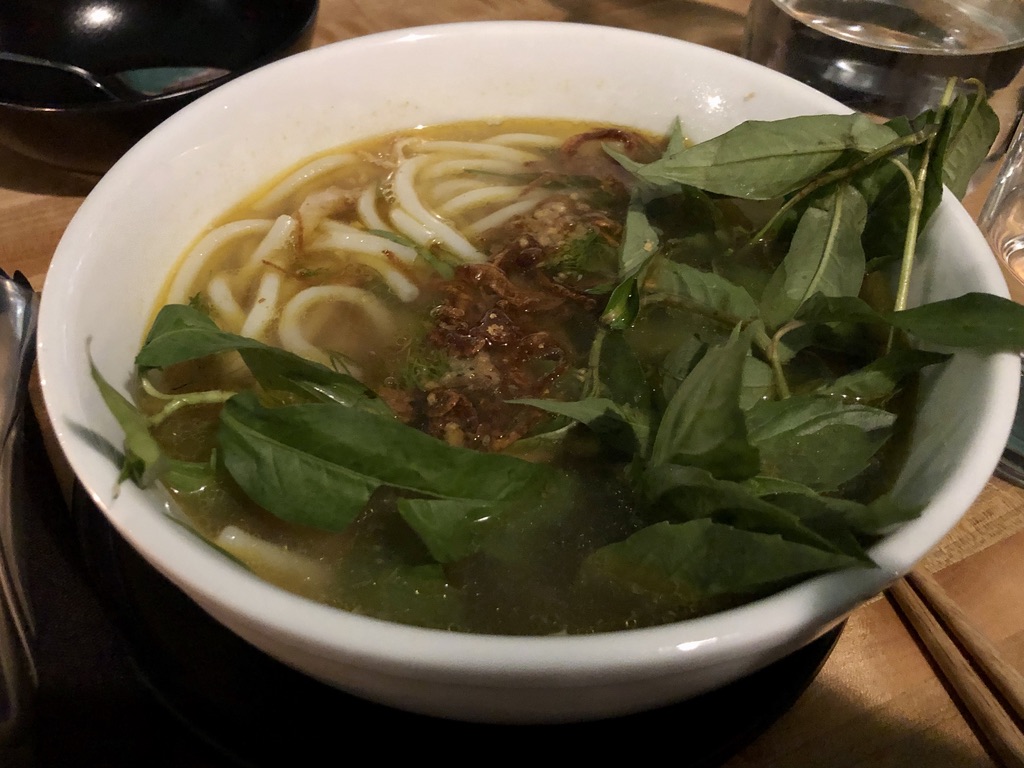
The Chicken Curry Noodle Soup ($20) is made with Vadouvan chicken broth, thick tapioca noodles, braised chicken thigh, crispy ginger, thai basil, and coriander. Again, another excellent dish, bursting with flavor, with an amazing broth, tender pieces of shredded chicken, and thick, chewy noodles. You'll be drinking the broth straight from the bowl.

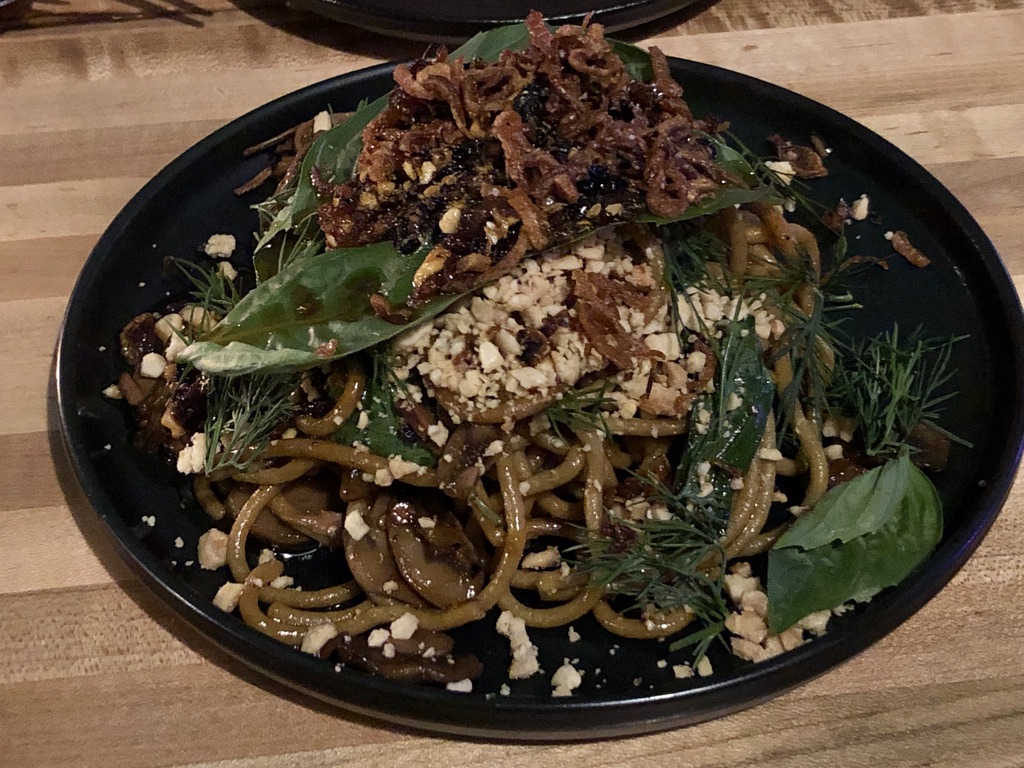
The Homemade Egg Noodles, made with caramelized garlic sauce, peanuts, Thai basil, and chili crisp, comes with either braised mushrooms, shredded beef or both, and we opted for both ($24). A superb dish, with immense flavor, lots of umami, and a great balance of textures and flavors. I would have loved to experience this dish with an umami-rich Kimoto/Yamahai Sake. Highly recommended!  

Overall, we enjoyed an excellent dining experience and the food was stellar, creative and flavorful. I'm eager to return and highly recommend that my readers dine there as well. 

I'll note that a 20% admin fee is added to every check and that money is supposed to be split among the whole team, including the back of the house, to make everything more equitable. "Additional tips to the restaurant are not necessary but are appreciated!"