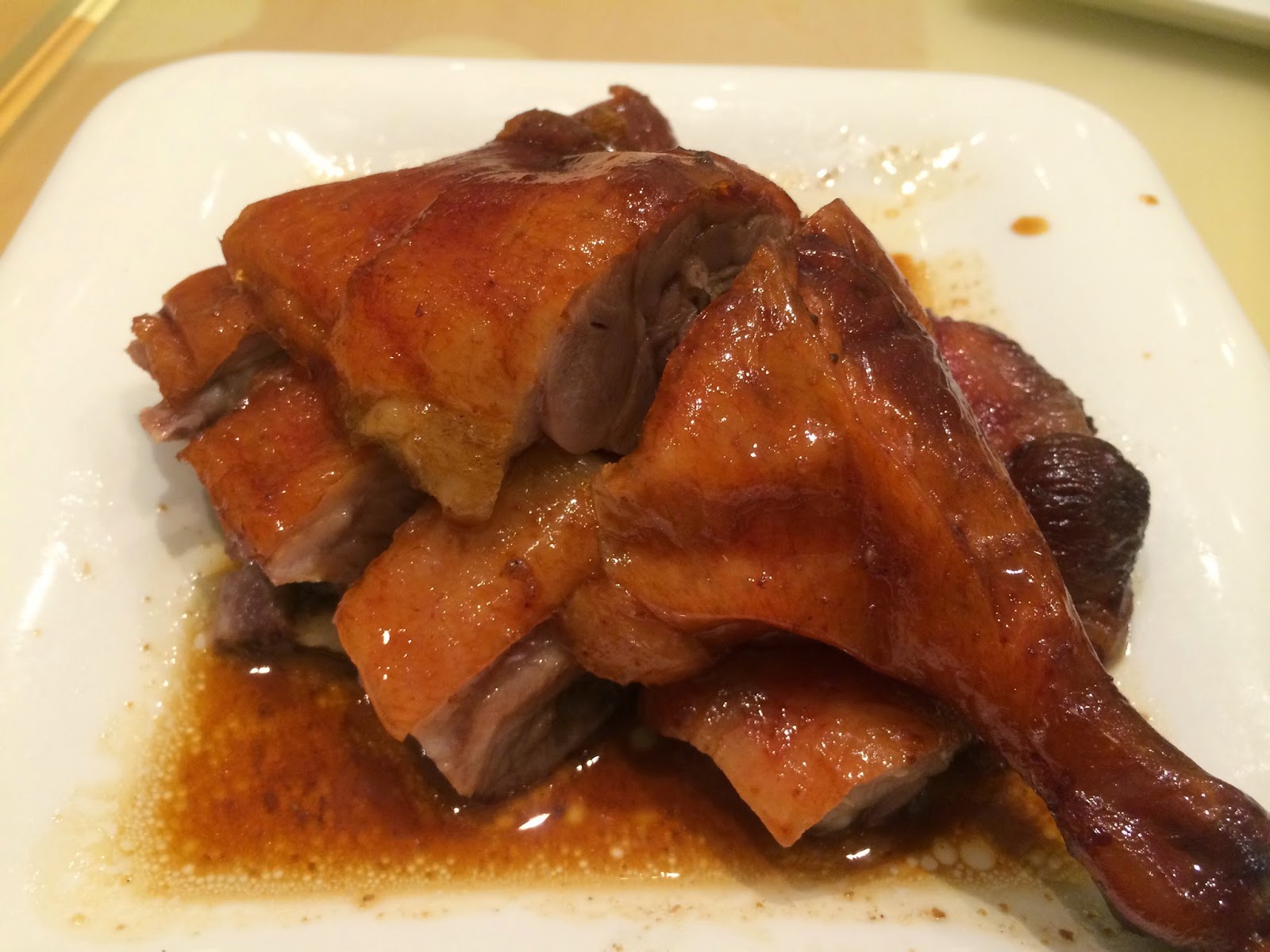
While recently in Vegas, my friends and I ate lunch at Beijing Noodle No.9, in Caesar's Palace, a place I positively reviewed five years ago. My experience this time was equally as positive, and I got to try several more dishes than I had previously. My only criticism is that their prices are higher than many you will find at many other Chinese restaurants, though you have to consider that this restaurant is located inside a major Vegas casino/hotel so you expect to pay a bit more. With the quality of the cuisine, you may not mind paying extra while you are on vacation.
As I've mentioned before, as you walk into dining room, you'll pass huge fish tanks containing Ryukin goldfish. I thought the sign on the tanks was amusing. I guess they won't serve any Goldfish Dumplings.
The food menu is extensive, and it might take you time to decide what to order. You could dine here several times and never have to order the same thing twice. Dumplings, congee, hot pot, soup noodle, live seafood and so much more. We ordered a bunch of dishes to share, so we all could taste many different dishes, and that is probably your best option if you want to experience the diversity of their menu.
We started with the Beef With Hand Pull Noodle ($19.99), which was an excellent way to start. The noodles were more like thin soba noodles, and they had a great texture and flavor. There is a noticeable difference between these noodles, including a certain freshness, than the average ones you find at many other Asian spots. The beef was also tender and tasty. You can even watch them making the noodles at various times in the front window. You should try one of their hand pull noodle dishes.
The BBQ Roast Duck ($16.99) was an ample portion of moist and flavorful duck with a sweetness from its sauce.
They have two different types of Soup Dumplings, the Beijing Noodle No.9 (6 for $12.99) and the Shanghai (6 for $12.99). Though both were good, I preferred the Shanghai which contained a little less meat and more soup. The soup was an umami burst of goodness, surrounded by the thin, light dumpling skins. These dumplings were so popular, we ordered a few extra dishes.
The Lamb Pancakes ($12.99) were like mini-sandwiches, filled with tasty ground lamb, which was spiced well, within a crispy, thin bread.
The Kung Pao Chicken ($16.99) was maybe the best example of this dish that I've ever tasted/ It was fresh, with a slightly spicy and compelling sauce and plenty of tender chicken. I probably could have devoured this entire dish myself.
This is a vegetable dish, which I think might be the Pea Leaves with Golden Garlic. I didn't taste it but as the plate was nearly empty by the end of the meal, it was enjoyed by my friends.
The BBQ Pork ($16.99) was moist and tender, complemented by the slightly sweet BBQ sauce. I liked the crispy coating and the pork was meaty, with only minimal fat.
At the end of the meal, we were given a plate of large, almond cookies.
We ate plenty for lunch, and every dish pleased us. The flavors are well balanced, and the quality of the ingredients seems high. Service was very good and everyone in my group enjoyed themselves. I recommend this restaurant, though I wish the prices were a bit lower.
For Over 18 Years, and over 5600 articles, I've Been Sharing My Passion for Food, Wine, Saké & Spirits. Come Join Me & Satisfy Your Hunger & Thirst.
Thursday, August 14, 2014
Thursday Sips & Nibbles
I am back again with a new edition of Thursday Sips & Nibbles, my regular column where I highlight some interesting wine and food items that are upcoming.
**********************************************************
1) Travessia, an "urban" winery in New Bedford, has recently announced a partnership with fine wine wholesaler M.S. Walker Inc. They are now distributing Travessia's latest wine releases, including Travessia's Riesling, Vidal Blanc and Pinot Noir Rose, all from the 2013 vintage.
"Earlier this year, M.S. Walker came into the winery and tasted all of our wines, and you could sense the excitement. Some of the wines were still unfinished, aging in barrels and tanks. I was impressed by their approach. They were very interested in finding a local winery they could get behind, and they wanted a high quality wine", says Marco Montez, owner and winemaker of Travessia, who is excited about the partnership and looking forward to seeing his wines reach a wider audience.
Travessia released its first wines in 2008 and currently makes just over 1,000 cases of wine per year. Grapes are mostly sourced from local vineyards and then brought to the winery in downtown New Bedford where Marco Montez handles all winemaking activities from fermentation to bottling.
"We have been researching the greater Northeast from Long Island to the Great Lakes, and Travessia's wines are a refreshing discovery," says Chip Coen, Vice-President of On Premise at M.S. Walker Inc. "M.S. Walker is thrilled to be involved with Travessia Winery!"
I am a fan of Travessia's wines, especially as most of their wines use Massachusetts grapes and their prices are reasonable. Marco is doing an excellent job in New Bedford and it is worth making a visit to his winery too. With a local distributor, it should soon be much easier to find his wines all across the state. So keep an eye out for them on your local wine store's shelves.
2) Join the Massachusetts Cheese Guild at Verrill Farm, in Concord, for al fresco evening of cheese tasting with Massachusetts cheesemakers. Get the chance to talk to your local cheesemakers, sample their delicious cheeses and learn about what makes their cheeses unique - the types of cows and goats and what they eat, the cheesemaking and aging processes, the terroir and much more.
This is a free Member Only event but everyone is welcome to join the Massachusetts Cheese Guild and it's just $25 for Enthusiast Members. If you're not already a Member, you can join when you sign up for this event.
Massachusetts Cheesemakers You Will Meet:
Appleton Farms
Berkshire Blue
Crystal Brooke Farm
Foxboro Cheese
Great Hill Blue
Mozzarella House
Robinson Farm
Ruggles Hill Creamery
Shy Brothers Farm
Sidehill Farm
Westfield Farm
Wolf Meadow Farm
3) Thirst Boston, a local drinks conference, returns on November 7th-10th. Hosted by industry professionals and founders Brandy Rand, Andrew Deitz, and Maureen Hautaniemi, Thirst Boston will serve up three major parties, 24 seminars, and tastings over the course of four days where guests can join some of the biggest names in mixology from across the country, experience a variety of educational and fun forums, and celebrate cocktails during one all-out weekend extravaganza.
I attended last year's Thirst Boston and you can check out my previous impressions, as well as my thoughts on some seminars such as Terroir & Merroir, Fortified Wines, and Whiskey. I also selected Thirst Boston as my Favorite Spirit & Cocktail Event of 2013. In addition, some of the drinks I sampled at the event also ended up on my 2013 Favorites lists.
Select stand-out events this year include but are not limited to:
The Thing: Kick off Thirst Boston at the now-legendary 3rd annual “The Thing” gala. Held opening night, Friday, November 7th, at The Fairmont Copley Plaza, this black tie optional party will celebrate all things grande old Boston and feature incredible craft cocktails from some of the city's best bartenders.
Portland-Providence Pop-Up: On Saturday, November 8th, bartenders from eight leading cocktail bars will be shaking up their best concoctions, showcasing what they’ve got up their sleeves back in their home cities of Providence, RI and Portland, ME. Held at The Fairmont Copley Plaza, guests will have the opportunity to meet and interact with great talent from nearby cities.
Roadhouse: This year, Thirst Boston introduces a brand new shindig for Saturday, November 8th. A raucous throwdown of Southern-style cocktails and cut-offs, BBQ and rockabilly, and more.
New England Craft Showcase: On Sunday, November 9th, join the region’s top distillers and brewers for a three-hour tasting event at The Fairmont Copley Plaza. With 12 confirmed brands and more to come, guests can experience what’s being made right around the corner from their own backyards.
Blender Bender: The grand finale to this year’s Thirst Boston, the 2nd annual 1980s tiki party will take place at Chau Chow City in Chinatown on Sunday, November 9th. Twelve of the city’s top bartenders will battle it out for best blended beverage as voted on by guests.
Bartender Brunch: Join friends and industry professionals for one last hurrah. On Monday, November 10th, The Hawthorne will host a sendoff brunch for Thirst Boston’s participants and attendees alike.
This year, The Fairmont Copley Plaza will host a majority of Thirst Boston events and offer accommodations at a special attendee rate. Additional information on seminars, special guests & appearances, and more will be available in the next month. For more information about Thirst Boston, please visit http://www.thirstboston.com/, follow @ThirstBoston on Twitter, and become a Facebook fan https://www.facebook.com/ThirstBoston.
1) Travessia, an "urban" winery in New Bedford, has recently announced a partnership with fine wine wholesaler M.S. Walker Inc. They are now distributing Travessia's latest wine releases, including Travessia's Riesling, Vidal Blanc and Pinot Noir Rose, all from the 2013 vintage.
"Earlier this year, M.S. Walker came into the winery and tasted all of our wines, and you could sense the excitement. Some of the wines were still unfinished, aging in barrels and tanks. I was impressed by their approach. They were very interested in finding a local winery they could get behind, and they wanted a high quality wine", says Marco Montez, owner and winemaker of Travessia, who is excited about the partnership and looking forward to seeing his wines reach a wider audience.
Travessia released its first wines in 2008 and currently makes just over 1,000 cases of wine per year. Grapes are mostly sourced from local vineyards and then brought to the winery in downtown New Bedford where Marco Montez handles all winemaking activities from fermentation to bottling.
"We have been researching the greater Northeast from Long Island to the Great Lakes, and Travessia's wines are a refreshing discovery," says Chip Coen, Vice-President of On Premise at M.S. Walker Inc. "M.S. Walker is thrilled to be involved with Travessia Winery!"
I am a fan of Travessia's wines, especially as most of their wines use Massachusetts grapes and their prices are reasonable. Marco is doing an excellent job in New Bedford and it is worth making a visit to his winery too. With a local distributor, it should soon be much easier to find his wines all across the state. So keep an eye out for them on your local wine store's shelves.
2) Join the Massachusetts Cheese Guild at Verrill Farm, in Concord, for al fresco evening of cheese tasting with Massachusetts cheesemakers. Get the chance to talk to your local cheesemakers, sample their delicious cheeses and learn about what makes their cheeses unique - the types of cows and goats and what they eat, the cheesemaking and aging processes, the terroir and much more.
This is a free Member Only event but everyone is welcome to join the Massachusetts Cheese Guild and it's just $25 for Enthusiast Members. If you're not already a Member, you can join when you sign up for this event.
Massachusetts Cheesemakers You Will Meet:
Appleton Farms
Berkshire Blue
Crystal Brooke Farm
Foxboro Cheese
Great Hill Blue
Mozzarella House
Robinson Farm
Ruggles Hill Creamery
Shy Brothers Farm
Sidehill Farm
Westfield Farm
Wolf Meadow Farm
3) Thirst Boston, a local drinks conference, returns on November 7th-10th. Hosted by industry professionals and founders Brandy Rand, Andrew Deitz, and Maureen Hautaniemi, Thirst Boston will serve up three major parties, 24 seminars, and tastings over the course of four days where guests can join some of the biggest names in mixology from across the country, experience a variety of educational and fun forums, and celebrate cocktails during one all-out weekend extravaganza.
I attended last year's Thirst Boston and you can check out my previous impressions, as well as my thoughts on some seminars such as Terroir & Merroir, Fortified Wines, and Whiskey. I also selected Thirst Boston as my Favorite Spirit & Cocktail Event of 2013. In addition, some of the drinks I sampled at the event also ended up on my 2013 Favorites lists.
Select stand-out events this year include but are not limited to:
The Thing: Kick off Thirst Boston at the now-legendary 3rd annual “The Thing” gala. Held opening night, Friday, November 7th, at The Fairmont Copley Plaza, this black tie optional party will celebrate all things grande old Boston and feature incredible craft cocktails from some of the city's best bartenders.
Portland-Providence Pop-Up: On Saturday, November 8th, bartenders from eight leading cocktail bars will be shaking up their best concoctions, showcasing what they’ve got up their sleeves back in their home cities of Providence, RI and Portland, ME. Held at The Fairmont Copley Plaza, guests will have the opportunity to meet and interact with great talent from nearby cities.
Roadhouse: This year, Thirst Boston introduces a brand new shindig for Saturday, November 8th. A raucous throwdown of Southern-style cocktails and cut-offs, BBQ and rockabilly, and more.
New England Craft Showcase: On Sunday, November 9th, join the region’s top distillers and brewers for a three-hour tasting event at The Fairmont Copley Plaza. With 12 confirmed brands and more to come, guests can experience what’s being made right around the corner from their own backyards.
Blender Bender: The grand finale to this year’s Thirst Boston, the 2nd annual 1980s tiki party will take place at Chau Chow City in Chinatown on Sunday, November 9th. Twelve of the city’s top bartenders will battle it out for best blended beverage as voted on by guests.
Bartender Brunch: Join friends and industry professionals for one last hurrah. On Monday, November 10th, The Hawthorne will host a sendoff brunch for Thirst Boston’s participants and attendees alike.
This year, The Fairmont Copley Plaza will host a majority of Thirst Boston events and offer accommodations at a special attendee rate. Additional information on seminars, special guests & appearances, and more will be available in the next month. For more information about Thirst Boston, please visit http://www.thirstboston.com/, follow @ThirstBoston on Twitter, and become a Facebook fan https://www.facebook.com/ThirstBoston.
Wednesday, August 13, 2014
Abriya Raku: Hidden No More
Five years ago, while in Las Vegas, I had an excellent dinner at Abriya Raku, a Japanese restaurant which then seemed to be a hidden treasure. Located in a small, Asian shopping center off the Strip, it was highly unlikely you would just stumble upon Raku. The area was filled with dozens of Asian restaurants, from Korean to Chinese, Thai to Japanese. You had to actively seek out Raku, but that meant someone had to tell you about it. You needed inside information, which I received from a few Las Vegas residents who raved about its cuisine. Based on those recommendations, I dined there and was thoroughly impressed.
Times have changed and Raku is now getting plenty of publicity. For example, it is currently #1 on Eater's 38 Essential Las Vegas Restaurants. You no longer need special insider information to know about this restaurant. However, I worried a little whether the restaurant had changed since my prior visit, whether all that publicity might have had a negative effect on this former hidden treasure. Despite my worries, I knew I still had to dine there again, hoping to recapture some of my previous joy.
On my trip to Vegas a couple weeks ago, I tried to make plans to dine at Raku and quickly noticed one change, that it was tougher to get a reservation there, even on a Tuesday evening. So if you want to dine there, I highly recommend making reservations as far ahead of time as possible. Fortunately, the five of us were able to get a table on a Thursday evening, and they sat us in a small private room that only had two tables.
I certainly enjoyed the intimacy of this room and I'm pleased to report that our dinner at Raku was as good, if not better, than my prior visit. The quality of their food has not diminished in the least, and their Sake list has exapnded. All of my friends were impressed with the cuisine, especially considering its affordability. Service was excellent and I continue to give Raku my highest recommendation. Fame has not diminished Raku in the least.
Raku's Sake menu appears to have grown, and now contains over 75 selections, from Junmai to Honjozo, Ginjo to Daiginjo, along with some Sparkling Sake and Nigori. Excellent diversity and plenty of interesting choices. Over 50 of the selections are available by the glass and some in "half" bottle formats. Price markups seem low, some of the best I've seen at any Japanese restaurant, and you could definitely while away an evening sampling and enjoying various Sakes. During the course of our dinner, we ordered three different bottles of Sake, none of which I had previously tasted. I wanted to experience something different, to continue expanding my Sake horizons.
We began with the Nyukon "Into Your Soul" Tokubetsu Honjozo ($52/24 oz), which can retail for around $30 so the markup is less than twice the retail, making it a very good value. Produced by the Musashino Shuzo, which is located in the Niigata Prefecture, they use Gohyakumangoku rice for this Sake which has been polished down to 60%, so it would technically qualify as a Ginjo though they do not label it as such. The taste was dry and clean, with subtle peach and melon flavors, and hints of herbs. Smooth and easy drinking, this was delicious and would appeal to Sake lovers as well as those new to Sake. It went well with our initial dishes, from tofu to seafood. A great starting point for the evening.
We then moved on to the Kamoizumi Shusen Junmai "Three Dots" ($50/30 oz), which can retail for $30-$35 so the markup is less than twice the retail, making it another good value. I should note as well that this bottle is 25% larger than the standard 24 oz bottle. So you get lots of Sake for the price. The Kamoizumi Shuzo, located in the Hiroshima Prefecture, started brewing Sake in 1910, and was one of ten breweries, in 1965, that committed to producing Junmai when nearly everyone else was making Honjozo. They use Hiroshima Hattan rice for this Sake which has been polished down to 58%, so it would technically qualify as a Ginjo though they do not label it as such. Another elegant Sake, this presents with a strong umami taste, more mushrooms and leafy herbs. It has a bit more body than the Nykon, but remains dry, smooth and easy drinking. This would be an excellent Sake with meat dishes.
The final Sake was the Kokuryu Tokusen "Crystal Dragon" Ginjo ($58/24 oz), which can retail for $40-$43 so the markup is less than twice the retail, making it another good value. The name, Kokuryu translates as "Black Dragon" and the name derives from the Kuzu-ryo River ("Nine-headed Dragon" river) in the Fukui Prefecture. They use Gohyakumangoku rice for this Sake which has been polished down to 50%, so it would technically qualify as a Daiginjo though they do not label it as such. This was a more powerful Sake, with bolder flavors of fruit, especially melon, pear and even a bit of cherry. There were depths to the Sake as well, showcasing hints of other, nearly elusive flavors. Definitely a Sake to slowly savor, to enjoy its complexity. It also paired very well with the various Robata skewers we enjoyed.
As for our food choices, we ordered a number of their evening Specials as well as numerous dishes off the menu. As the evening was primarily about enjoyment, I didn't take notes of everything we ate, though I took numerous photos. As such, I can't provide lots of detail of many things we ate, though I can say that everything was delicious, well-presented and I would recommend all of it. This is some of the best Japanese food you will enjoy in Vegas.
Above, is one of their homemade Tofu dishes, accompanied by a spicy side. I'm not a fan of Tofu but I actually enjoyed this dish. The tofu was creamy and clean rather than rubbery, and the spicy side went well atop a piece of the tasty tofu. So even if you dislike tofu, I'd suggest you give it a try at Raku. They have a few different Tofu dishes and they are worth exploring.
One of the Specials was a Tuna Tartare, a silky mound of tender tuna, with only minimal accompaniments, making the dish all about the tuna. I prefer my tartare to be more minimalist, to be more about the meat than what is atop it, and this fit that bill.
A Salad which had bacon, so that automatically elevates it above other salads. Lots of fresh ingredients.
There were two fish on the Specials menu, Flying Fish and Sea Bream, and each was served two ways, as a sashimi and a cooked, whole fish. Above is the Flying Fish sashimi, which had a stronger, but pleasing, flavor than the Sea Bream. The texture of the fish was tender and smooth, with just enough bite to it.
The Sea Bream sashimi possessed a milder taste, with a buttery feel. Very tasty.
The cooked Flying Fish had hearty chunks of meat, strong and tasty flavors with a nice broth.
The Sea Bream's flesh was mild and flaky, with a nice sweetness to the flesh. And the skin had a nice, crispy texture.
The Juicy Deep Fried Chicken also had a great, crispy skin, wrapped around moist and flavorful meat.
One of their specialties is Robata, a charcoal grill that uses binchotan, a traditional Japanese charcoal which burns at a higher temperature than regular charcoal, and also contains less moisture. There are over 30 Robata choices, a variety of skewers of meat, seafood and vegetables. We ordered maybe a dozen or so skewers, including Pork Ear, Duck with Balsamic Soy Sauce, Tomatoes Wrapped in Bacon, and more. It was all excellent, grilled perfectly, and full of interesting flavors. You could easily make a meal of just different skewers.
Raku is one of the best Japanese restaurants in Las Vegas, and also one of the most affordable. If you check out their menu, you will find most items cost under $10, so that even if you go with a group, your bill will still be very reasonable. In addition, their Sake is very reasonably priced, avoiding the outrageous markups that are very too common everywhere else. On the Strip, the Japanese restaurants are generally much more expensive, and it can be hard to find more than a couple items on their menus under $10.
With an excellent Sake list, great service, and a nice diversity of delicious dishes, Raku continues to earn my highest recommendation. If you are traveling to Vegas, make sure to dine at Raku, but just make your reservations as early as possible. Raku is hidden no more, but success hasn't gone to their heads.
Times have changed and Raku is now getting plenty of publicity. For example, it is currently #1 on Eater's 38 Essential Las Vegas Restaurants. You no longer need special insider information to know about this restaurant. However, I worried a little whether the restaurant had changed since my prior visit, whether all that publicity might have had a negative effect on this former hidden treasure. Despite my worries, I knew I still had to dine there again, hoping to recapture some of my previous joy.
On my trip to Vegas a couple weeks ago, I tried to make plans to dine at Raku and quickly noticed one change, that it was tougher to get a reservation there, even on a Tuesday evening. So if you want to dine there, I highly recommend making reservations as far ahead of time as possible. Fortunately, the five of us were able to get a table on a Thursday evening, and they sat us in a small private room that only had two tables.
I certainly enjoyed the intimacy of this room and I'm pleased to report that our dinner at Raku was as good, if not better, than my prior visit. The quality of their food has not diminished in the least, and their Sake list has exapnded. All of my friends were impressed with the cuisine, especially considering its affordability. Service was excellent and I continue to give Raku my highest recommendation. Fame has not diminished Raku in the least.
Raku's Sake menu appears to have grown, and now contains over 75 selections, from Junmai to Honjozo, Ginjo to Daiginjo, along with some Sparkling Sake and Nigori. Excellent diversity and plenty of interesting choices. Over 50 of the selections are available by the glass and some in "half" bottle formats. Price markups seem low, some of the best I've seen at any Japanese restaurant, and you could definitely while away an evening sampling and enjoying various Sakes. During the course of our dinner, we ordered three different bottles of Sake, none of which I had previously tasted. I wanted to experience something different, to continue expanding my Sake horizons.
We began with the Nyukon "Into Your Soul" Tokubetsu Honjozo ($52/24 oz), which can retail for around $30 so the markup is less than twice the retail, making it a very good value. Produced by the Musashino Shuzo, which is located in the Niigata Prefecture, they use Gohyakumangoku rice for this Sake which has been polished down to 60%, so it would technically qualify as a Ginjo though they do not label it as such. The taste was dry and clean, with subtle peach and melon flavors, and hints of herbs. Smooth and easy drinking, this was delicious and would appeal to Sake lovers as well as those new to Sake. It went well with our initial dishes, from tofu to seafood. A great starting point for the evening.
We then moved on to the Kamoizumi Shusen Junmai "Three Dots" ($50/30 oz), which can retail for $30-$35 so the markup is less than twice the retail, making it another good value. I should note as well that this bottle is 25% larger than the standard 24 oz bottle. So you get lots of Sake for the price. The Kamoizumi Shuzo, located in the Hiroshima Prefecture, started brewing Sake in 1910, and was one of ten breweries, in 1965, that committed to producing Junmai when nearly everyone else was making Honjozo. They use Hiroshima Hattan rice for this Sake which has been polished down to 58%, so it would technically qualify as a Ginjo though they do not label it as such. Another elegant Sake, this presents with a strong umami taste, more mushrooms and leafy herbs. It has a bit more body than the Nykon, but remains dry, smooth and easy drinking. This would be an excellent Sake with meat dishes.
The final Sake was the Kokuryu Tokusen "Crystal Dragon" Ginjo ($58/24 oz), which can retail for $40-$43 so the markup is less than twice the retail, making it another good value. The name, Kokuryu translates as "Black Dragon" and the name derives from the Kuzu-ryo River ("Nine-headed Dragon" river) in the Fukui Prefecture. They use Gohyakumangoku rice for this Sake which has been polished down to 50%, so it would technically qualify as a Daiginjo though they do not label it as such. This was a more powerful Sake, with bolder flavors of fruit, especially melon, pear and even a bit of cherry. There were depths to the Sake as well, showcasing hints of other, nearly elusive flavors. Definitely a Sake to slowly savor, to enjoy its complexity. It also paired very well with the various Robata skewers we enjoyed.
As for our food choices, we ordered a number of their evening Specials as well as numerous dishes off the menu. As the evening was primarily about enjoyment, I didn't take notes of everything we ate, though I took numerous photos. As such, I can't provide lots of detail of many things we ate, though I can say that everything was delicious, well-presented and I would recommend all of it. This is some of the best Japanese food you will enjoy in Vegas.
Above, is one of their homemade Tofu dishes, accompanied by a spicy side. I'm not a fan of Tofu but I actually enjoyed this dish. The tofu was creamy and clean rather than rubbery, and the spicy side went well atop a piece of the tasty tofu. So even if you dislike tofu, I'd suggest you give it a try at Raku. They have a few different Tofu dishes and they are worth exploring.
One of the Specials was a Tuna Tartare, a silky mound of tender tuna, with only minimal accompaniments, making the dish all about the tuna. I prefer my tartare to be more minimalist, to be more about the meat than what is atop it, and this fit that bill.
A Salad which had bacon, so that automatically elevates it above other salads. Lots of fresh ingredients.
There were two fish on the Specials menu, Flying Fish and Sea Bream, and each was served two ways, as a sashimi and a cooked, whole fish. Above is the Flying Fish sashimi, which had a stronger, but pleasing, flavor than the Sea Bream. The texture of the fish was tender and smooth, with just enough bite to it.
The Sea Bream sashimi possessed a milder taste, with a buttery feel. Very tasty.
The cooked Flying Fish had hearty chunks of meat, strong and tasty flavors with a nice broth.
The Sea Bream's flesh was mild and flaky, with a nice sweetness to the flesh. And the skin had a nice, crispy texture.
The Juicy Deep Fried Chicken also had a great, crispy skin, wrapped around moist and flavorful meat.
One of their specialties is Robata, a charcoal grill that uses binchotan, a traditional Japanese charcoal which burns at a higher temperature than regular charcoal, and also contains less moisture. There are over 30 Robata choices, a variety of skewers of meat, seafood and vegetables. We ordered maybe a dozen or so skewers, including Pork Ear, Duck with Balsamic Soy Sauce, Tomatoes Wrapped in Bacon, and more. It was all excellent, grilled perfectly, and full of interesting flavors. You could easily make a meal of just different skewers.
Raku is one of the best Japanese restaurants in Las Vegas, and also one of the most affordable. If you check out their menu, you will find most items cost under $10, so that even if you go with a group, your bill will still be very reasonable. In addition, their Sake is very reasonably priced, avoiding the outrageous markups that are very too common everywhere else. On the Strip, the Japanese restaurants are generally much more expensive, and it can be hard to find more than a couple items on their menus under $10.
With an excellent Sake list, great service, and a nice diversity of delicious dishes, Raku continues to earn my highest recommendation. If you are traveling to Vegas, make sure to dine at Raku, but just make your reservations as early as possible. Raku is hidden no more, but success hasn't gone to their heads.
Tuesday, August 12, 2014
Consumers & Seafood Certification
Seafood sustainability is a complex issue, especially for consumers. They feel overwhelmed by the myriad of issues and often are unwilling to take the time and effort to ask the necessary questions of a seafood purveyor or restaurant to determine whether a specific seafood is sustainable or not. They also can get confused by the conflicting information they receive from the media, such as whether aquaculture is sustainable or not. The media tends to showcase negative information about seafood, four times more than they showcase positive articles, and they often tend to exaggerate the perils.
What can a consumer do to more easily determine whether a specific seafood is sustainable or not?
Consumers need something simple, quick and trustworthy, and third party certifications can provide that solution. Such third party certifications can provide labels for seafood, vouching for the sustainability of the product, and consumers can then rely on those labels when purchasing seafood. That makes the buying decision much easier for consumers. They don't need to spend time asking lots of questions of the purveyor. All they have to do is look for a trusted label. It couldn't be any simpler for them.
There are a growing number of third party certifications for seafood sustainability, from the Marine Stewardship Council (MSC) to the Aquaculture Stewardship Council (ASC). Each has its own standards and covers its own types of seafood. There are also organizations such as the Monterey Bay Aquarium Seafood Watch which provide seafood sustainability recommendations but don't issue actual certifications. All of these groups do the difficult work of sustainability assessment, making their results available to the general public, and often for free.
Consumers need to understand a few basics about such certifications, and be willing to trust their decisions. It won't be the average consumer though who generally questions these certifications. Instead, it will be a passionate minority who will step up and inquire into those third party certifications. They will be the ones who question everything, including their motivations, knowledge level, biases and more. And that minority will then inform the general public, indicating which certifications are trustworthy or not.
As for the basics consumers need to know, they first need to understand that these certifications exist, and that they indicate the sustainability of the seafood. That requires such certification organizations to engage in media campaigns to make consumers aware of their existence. It requires fish markets, grocery stores, restaurants and others to make their customers aware of the certification labels on their seafood. It needs the media to spread the word, highlighting the positive work of these certification bodies. Unless consumers are educated, they won't be able to select seafood based on these certifications.
Second, consumers must learn that they cannot rely on a single certification for all their seafood decisions. Instead, they need to accept the validity of multiple certifications, as each specific certification has its limitations. For example, the MSC only certifies wild fisheries while the ASC only certifies aquaculture. Both certifications are equally valid and indicate sustainable seafood, just in different areas. If consumers seek only a single certification label, then they will be missing out on plenty of sustainable seafood.
If consumers start relying on these third party certification labels, then it will likely lead to more fisheries, both wild and farmed, to seek out certifications and that will lead to greater sustainability in the seafood industry. Educating consumers then about these labels is essential to the continued vitality of the seafood industry. As the importance of seafood grows, especially due to its potential to address the future food crisis, then the importance of sustainability becomes even more vital.
Another advantage to the proliferation if third party certification groups is that it seems to be leading to the creation of even stricter standards. The different groups want to differentiate themselves from the others and adhering to stricter standards is one way to do so. For example, the ASC, which was founded in 2010, created standards which include social issues, from worker safety to wages. This could be the future of sustainability, a consideration of not only the health of the oceans and fish, but also the health and safety of the workers involved in the industry. The more certification groups that embrace such social standards, makes the seafood industry better for all.
Spread the word about third party certifications, and let consumers understand their value. Let's have more consumers opt for sustainable seafood by making it easier for them to do so.
What can a consumer do to more easily determine whether a specific seafood is sustainable or not?
Consumers need something simple, quick and trustworthy, and third party certifications can provide that solution. Such third party certifications can provide labels for seafood, vouching for the sustainability of the product, and consumers can then rely on those labels when purchasing seafood. That makes the buying decision much easier for consumers. They don't need to spend time asking lots of questions of the purveyor. All they have to do is look for a trusted label. It couldn't be any simpler for them.
There are a growing number of third party certifications for seafood sustainability, from the Marine Stewardship Council (MSC) to the Aquaculture Stewardship Council (ASC). Each has its own standards and covers its own types of seafood. There are also organizations such as the Monterey Bay Aquarium Seafood Watch which provide seafood sustainability recommendations but don't issue actual certifications. All of these groups do the difficult work of sustainability assessment, making their results available to the general public, and often for free.
Consumers need to understand a few basics about such certifications, and be willing to trust their decisions. It won't be the average consumer though who generally questions these certifications. Instead, it will be a passionate minority who will step up and inquire into those third party certifications. They will be the ones who question everything, including their motivations, knowledge level, biases and more. And that minority will then inform the general public, indicating which certifications are trustworthy or not.
As for the basics consumers need to know, they first need to understand that these certifications exist, and that they indicate the sustainability of the seafood. That requires such certification organizations to engage in media campaigns to make consumers aware of their existence. It requires fish markets, grocery stores, restaurants and others to make their customers aware of the certification labels on their seafood. It needs the media to spread the word, highlighting the positive work of these certification bodies. Unless consumers are educated, they won't be able to select seafood based on these certifications.
Second, consumers must learn that they cannot rely on a single certification for all their seafood decisions. Instead, they need to accept the validity of multiple certifications, as each specific certification has its limitations. For example, the MSC only certifies wild fisheries while the ASC only certifies aquaculture. Both certifications are equally valid and indicate sustainable seafood, just in different areas. If consumers seek only a single certification label, then they will be missing out on plenty of sustainable seafood.
If consumers start relying on these third party certification labels, then it will likely lead to more fisheries, both wild and farmed, to seek out certifications and that will lead to greater sustainability in the seafood industry. Educating consumers then about these labels is essential to the continued vitality of the seafood industry. As the importance of seafood grows, especially due to its potential to address the future food crisis, then the importance of sustainability becomes even more vital.
Another advantage to the proliferation if third party certification groups is that it seems to be leading to the creation of even stricter standards. The different groups want to differentiate themselves from the others and adhering to stricter standards is one way to do so. For example, the ASC, which was founded in 2010, created standards which include social issues, from worker safety to wages. This could be the future of sustainability, a consideration of not only the health of the oceans and fish, but also the health and safety of the workers involved in the industry. The more certification groups that embrace such social standards, makes the seafood industry better for all.
Spread the word about third party certifications, and let consumers understand their value. Let's have more consumers opt for sustainable seafood by making it easier for them to do so.
Monday, August 11, 2014
Rant: Wine Is Losing Ground
Wine isn't as popular as it used to be, and beer is becoming a more favored choice. For several years, some have claimed that Millennials were the future of wine, that they would consume more wine than any previous generation. I voiced my doubts, worried that all of the new craft beers and spirits might capture the attention of Millennials. Based on a recent Gallup poll, craft beers might be replacing wine as the drink of choice.
For more than twenty years, beer has usually been the preferred drink of Americans, except for a brief moment in 2005 when wine surpassed beer. This year, beer has been on an upward surge, preferred by 41% of Americans while wine has been on the decline, preferred by only 31%. Those who prefer spirits was at 23%, which has slowly been climbing. It doesn't appear that the infusion of Millennials has been boosting the number of Americans who prefer wine. Instead, it seems beer and spirits may be capturing more of their attention.
When the results are broken down by demographics, the situation becomes even more interesting. 46% of women prefer wine while only 17% of men prefer it (and 57% of men prefer beer). A nearly 30% difference is astounding. Why do so few men prefer wine? Why does wine appeal more to women? Do wine marketers need to appeal more to men? How do they do that? With such a large discrepancy, then why are more wine blogs written by men? The number of female written wine blogs has been increasing each year, but men still author the majority.
Age also plays its part in one's preferences. Generally, the younger the group, the more they prefer beer. For example, those 18-34 years old prefer beer 48% while those 35-54 prefer beer only 43%, and those older prefer wine over beer, 38% to 32%. Millennials, especially males, are opting more for beer than wine. That will likely change as they get older, but it seems as if it will fall into old patterns, and not create anything new.
Roughly 64% of American adults drink alcohol, with the rest identifying as "total abstainers." This is roughly the same as it has been since the end of Prohibition. That is also a fascinating fact, that despite the production over the years of higher quality wine, beer and spirits, the total amount of drinkers has remained relatively stable, with only minor fluctuations.
How can wine regain ground against craft beers and spirits? How can we get more men to prefer wine? Are women the future of wine? These are all important questions that wineries, marketers, PR people, and others should be considering. Writers should also be exploring these issues, as well as considering the demographics of their readers.
For more than twenty years, beer has usually been the preferred drink of Americans, except for a brief moment in 2005 when wine surpassed beer. This year, beer has been on an upward surge, preferred by 41% of Americans while wine has been on the decline, preferred by only 31%. Those who prefer spirits was at 23%, which has slowly been climbing. It doesn't appear that the infusion of Millennials has been boosting the number of Americans who prefer wine. Instead, it seems beer and spirits may be capturing more of their attention.
When the results are broken down by demographics, the situation becomes even more interesting. 46% of women prefer wine while only 17% of men prefer it (and 57% of men prefer beer). A nearly 30% difference is astounding. Why do so few men prefer wine? Why does wine appeal more to women? Do wine marketers need to appeal more to men? How do they do that? With such a large discrepancy, then why are more wine blogs written by men? The number of female written wine blogs has been increasing each year, but men still author the majority.
Age also plays its part in one's preferences. Generally, the younger the group, the more they prefer beer. For example, those 18-34 years old prefer beer 48% while those 35-54 prefer beer only 43%, and those older prefer wine over beer, 38% to 32%. Millennials, especially males, are opting more for beer than wine. That will likely change as they get older, but it seems as if it will fall into old patterns, and not create anything new.
Roughly 64% of American adults drink alcohol, with the rest identifying as "total abstainers." This is roughly the same as it has been since the end of Prohibition. That is also a fascinating fact, that despite the production over the years of higher quality wine, beer and spirits, the total amount of drinkers has remained relatively stable, with only minor fluctuations.
How can wine regain ground against craft beers and spirits? How can we get more men to prefer wine? Are women the future of wine? These are all important questions that wineries, marketers, PR people, and others should be considering. Writers should also be exploring these issues, as well as considering the demographics of their readers.
Subscribe to:
Posts (Atom)