"Freedom and whisky gang thegither."
--Robert Burns
Robert Burns (1759–1796), also known as Rabbie Burns, the Bard of Ayrshire, and the Ploughman Poet. is often said to be the national poet of Scotland. Besides all of his poems, he also collected and composed various folk songs, including the well known Auld Lang Syne. He loved drinking, consuming Whisky, Ale, Claret, Port, Rum and Brandy, though he had to practice moderation due to his ill health.
At one point in his life. Robert needed a job to help support his large family and he became an exciseman, collecting taxes. Around 1780, there were only eight licenses whiskey distilleries while there were almost 400 illegal ones, which weren't paying any taxes. Robert didn't seem to prone to trying to collect taxes from these illegal stills. Sadly, Robert Burns died in 1796, at 37 years old, soon after a dental extraction. Despite the short number of years he spent in this world, he left a huge mark that continues to resound over 200 years later.
In memoriam of Robert, his birthdate, January 25, is celebrated worldwide as Burns Night, with the first Burns Night celebration having been held back in 1802. On Burns Night, a special supper is held, usually with traditional Scottish foods and Scotch whisky. There are also certain rituals that are enacted, from traditional toasts to a special prayer. Each year, there seem to be more and more Burns Nights held around the country. However, until recently, I hadn't attended a Burns Night so I was eager to check it out when I received a media invite to participate at the Burns Night being held at Civil Kitchen & Drink.
Civic Kitchen & Drink, located in Westborough, opened its doors in April 2016 and is connected to the Westborough Country Club though the restaurant is open to the public. The name of the restaurants derives from the concept of the "civic center," a focal point for community gathering. It is a gastropub, however it is also a "farm to fork" restaurant, where about 60%-70% of their ingredients are sourced from within 60-70 miles. They try to rely on many small businesses and farms, as many as local as possible, for their sourcing.
Executive Chef Rick Araujo presides over the kitchen and he was born locally, in Southborough. He is a graduate of both the Culinary Institute of America and Johnson & Wales University, bringing a youthful vigor to the restaurant. General Manager and Bar Manager Sarah Lee helps to keep much of the rest of the restaurant under control, and this was her first Burns Night dinner.
As the Robert Burns dinner was intended to be more traditional, I didn't have the opportunity to sample the usual menu items. From reviewing their usual menu, there is plenty of comfort food from Burgers to House-Made Pastrami, Chorizo Tacos to Mac & Cheese. You'll also find entrees like Scallops Rockefeller, Spring Ridge Pork Bolognese and Madeira Chicken, generally priced $20-$25. They also have a full bar program, with many local beers and spirits. However, based on the food served at the Burns Night dinner, Chef Araujo seems to be a talented and creative chef.
Some of the fine men who helped to coordinate and run the Burns Night dinner included, from left to right, Charles Tower, of The Espiritus Group, Ryan Maloney, owner of Julio’s Liquors; Tom Childs, the bagpiper; Chef Rick Araujo, and Randall Bird, also of The Espiritus Group.
It seemed that about 50 people attended the dinner and we sat at communal tables, getting to mingle and meet new people. Overall, it was a fun evening, with plenty of delicious food and compelling Scotches. The dinner followed many of the usual traditions of Burns night events, though sometimes abbreviated for times sake, or otherwise the dinner might have lasted an additional two hours or more. The rituals, from the toasts to the final song, added a fascinating and enjoyable element to the usual dinner event.
When we first entered the restaurant, we were handed a warm welcome cocktail, The Ginger Rabbie, which was made with Towiemore Classic Scotch, tea, molasses, and ginger. It was similar in some respects to a hot toddy, only mildly alcoholic, lightly sweet, and with a pleasing taste of tea and spice. As more guests arrived, and we mingled, chatted and sipped our cocktail, Tom Childs, the bagpiper played. This is a traditional entrance at a Burns Night dinner, to have a bagpiper greeting the guests.
The Scotches for this event were primarily from The Lost Distillery Company, a Scottish company which attempts to replicate the whisky that once was produced by numerous closed and destroyed Scotch distilleries. They engage in rigorous historical research to try to determine how these old Scotches were created and then try to duplicate the process. It is an intriguing process and I think especially appropriate for a Burns dinner, as you get to taste what Scotch might have tasted like maybe 100 years ago or so.
Eventually, we took out seats at the various tables and the Host's Greeting began, with Sarah Lee starting off, welcoming us and talking a bit about the restaurant. Then, Charlie Tower spoke, informing us that the usual Burns rituals would be modified a bit, for time, and then bringing our attention to the quaich (pronounced "quake"), which is an ancient Scottish tasting cup. The cup is two-handed and everyone who spoke that evening would toast from that cup. Originally, the cups were made of wood but eventually became made of silver.
Next up was the Presentation of the Haggis, another traditional ritual where the haggis is brought out on a dish and brought around the room. The mini-parade included Chef Araujo, carrying the haggis, Tom Childs, playing the bagpipes, and Kevork Dikramanjian, the Whisky Steward. Once the haggis was brought front and center, they paid the bagpiper with Scotch, another tradition (and I bet the bagpiper enjoys that tradition). In the picture above, you can see the Haggis in the center.
Charles Tower toasting Chef Araujo.
Charles also led the Address to the Haggis, reciting only three verses of a lengthier ode to Haggis that was written by Robert Burns. While reciting the poem, Charles cut into the Haggis, slicing it from end to end. The Haggis was then taken away, to be plated as our first course of the evening.
Rick Maloney led the Selkirk Grace, a common thanksgiving prayer in Scotland said before many meals. This prayer extends back to at least the 17th century, when it was known as the Galloway Grace or the Covenanters' Grace. It may have acquired the name Selkirk because it is alleged that Robert Burns once delivered the prayer at a dinner for the Earl of Selkirk.
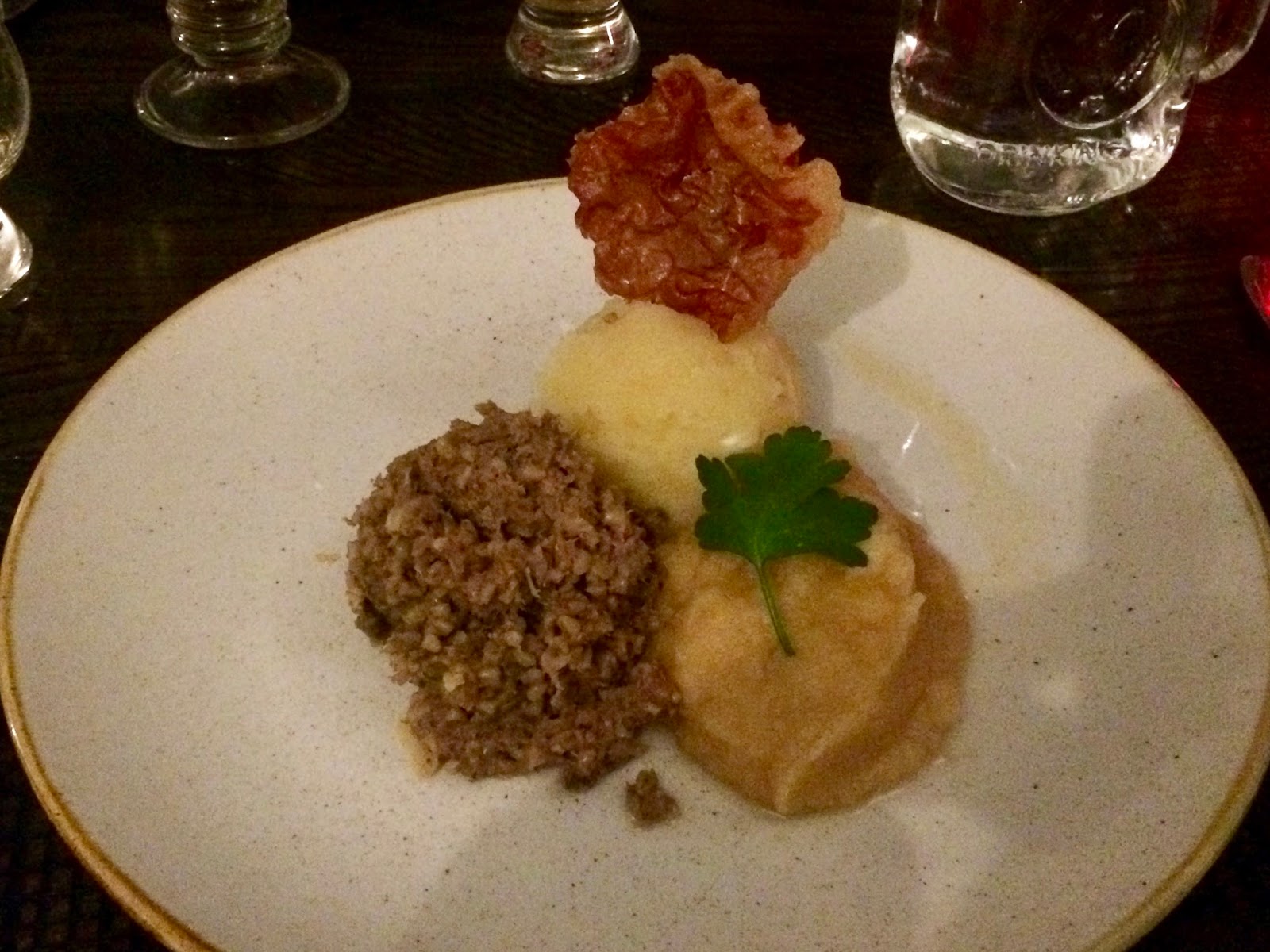
With much trepidation, we received our plate of haggis with neeps and tatties. Haggis has such a terrible reputation among many, as it is considered to both smell and taste bad. People know it is composed of organ meats and that turns off many people as well. Yet many of the diners, including myself, had never tasted haggis before. So this was certainly an adventure to undertake.
Traditionally, haggis is made from a sheep's heart, liver and lungs, mixed with onion, oatmeal, suet, spices, and salt, and then encased in a sheep's stomach. Neeps and tatties are a traditional side, being mashed turnip and potatoes. Interestingly, a poll of American tourists to Scotland showed that about one-third of the guests believed haggis was an actual animal. Haggis is also used in the sport of haggis hurling, simply throwing a haggis as far as you can. The world record is about 217 ft.
However, you cannot import Scottish haggis into the U.S., at least since 1971. The U.S. Department of Agriculture (USDA) led a ban because haggis includes sheep's lungs, which they believe pose a potential danger to consumers. Recent discussions between officials in the U.S. and Scotland have tried to find way to remove this bam, and Scottish officials have been optimistic that the ban might be lifted later this year.
Chef Araujo sourced his haggis from the Scottish Gourmet in New Jersey, which was made with oatmeal, beef liver, lamb breast, onions and spices. For the neeps, he used Gilfeather turnips, and for the tatties, locally grown potatoes. He also added a crispy prosciutto chip to the dish.
As I looked at my dish, the haggis looked like a scoop of corned beef hash, and it actually had a pleasant aroma. It had already defeated one of my preconceptions, that it might smell awful. So, I dug my fork into the haggis and placed a hearty amount into my mouth. And it was delicious! A texture like corned beef hash, a silky texture, with a nice balance of spices and a slightly earthy element. I wasn't the only person at the table who was surprised at how tasty it was, and it seemed like everyone around me enjoyed it. I devoured every bit of haggis on my plate and would order it again if I had the opportunity. I think a breakfast of haggis and eggs would be very satisfying.
Accompanying the haggis course was a glass of Stratheden Archivist Scotch, a smooth and light bodied whisky with a spicy kick, a hint of smoke and a lengthy, pleasing finish.
The evening then moved onto a Toast to Heritage, led by Randall Bird, with a glass of Auchnagie Archivist Scotch. This Scotch was a bit sweeter than the previous one, with caramel and vanilla notes, and was also smooth and easy drinking, with a lengthy finish. I should note that many of these Scotches were high in alcohol so a touch of water was warranted.
For our second course, we had Cock-a-leekie Soup, a traditional Scottish soup, commonly made with leeks and chicken stock, often thickened with rice or barley. Originally, the soup had prunes in it and sometimes slices of prunes are still added. Chef Araujo created his soup with a chicken bone broth, local leeks, local barley, and topped it with black pepper oil. The broth had such an intense depth of flavor and there were tender pieces of chicken within the broth. The black pepper oil added a nice spiciness to the dish too.
Another Toast was then made, To The Lassies, by Brad Jarvis, with a glass of Loch & Key Towiemore Port Finish Scotch. In the past, Burns clubs used to be men only, except for their annual Burns Night dinner. Burns certainly loved women, having fathered 13 children, with 5 different women, within an 11 year period. Traditionally, this toast is humorous without being offensive, and Brad followed in that vein. The men all stood, toasting to the women. The Scotch, with an almost light red color, was the same one used earlier in the evening for the cocktail. It spent about 6 months in a Port barrel, and full bodied and fruity, a tasty whisky which should appeal to many wine lovers.
Our third course was House Smoked Salmon (fished from the waters of the North Atlantic) and accompanied by garlic pickles, brioche toast points and creme fraiche. The silky salmon had a light, smoky flavor and the crisp, garlic pickles were a tasty addition and I wish there had been more of them.
The next Toast, led by Jill Pendleton, was The Reply, a toast by the ladies to the men, and it too was humorous and fun, with the women standing as they toasted the men. With this toast was the Loch & Key Auchnagie Port Finish Scotch, similar in many respects to the prior Port finished Scotch, though with a little less berry flavor.
For the fourth course, Chef Araujo put together his own interpretation of haggis, creating the Lilac Hedge Farm Lamb & Spent Grain Goetta. Goetta is a German inspired meat-and-grain sausage or mush that is very similar to the Scottish White Pudding. The haggis cake was at the bottom of the dish, using spent grains from a local brewery, a potato puree and a crisp turnip chip. Atop the cake were pieces of lamb, in a demo-sauce, which are from a local farm. The lamb was delicious, tender and flavorful, and the "haggis" cake also had intense and tasty flavors. This dish might have been the closest one to the type of dishes you might find on their regular menu.
The next stage was The Immortal Memory, led by Charles Tower, where the speaker discusses aspects of Burn's life and might include a reading of some of his poetry. This can usually take 30-45 minutes but Charles kept it shorter, discussing some of the history of Burns, a bit of his life. At the end, we all toasted to Burns. And the fact that Burns Night continues to be celebrated across the world shows that his memory might be immortal.
We then moved onto another Toast, to Friendship & Fellowship, led by Kevork Dikramanjian. We made this toast with the only non-Scotch of the night, the Loch & Key Virginia Highland Malt. This relatively new company purchases Scotch and then ships it to the U.S., where it is then aged in Virginia port-style wine barrels. It is a blended malt whisky, from 3 different barrels, and was quite good, smooth and flavorful, with hints of berry, but also some spice and malt notes.
The final course, our dessert, was the Tipsy Laird Tiramisu. Tipsy laird is a traditional Scottish dessert, similar to a trifle, and Chef Araujo put his own spin on this dish. He used whisky soaked lady finger cakes, layered with expresso mascarpone cream and dark chocolate shavings. It was creamy and rich, with a pleasing blend of sweet and savory, and lots of chocolate flavor.
Next up, Charles Tower sang a song, The Parting Glass, which actually was not composed by Robert Burns. It is a traditional song, sung at the end of gatherings. With this song, we enjoyed the Gerston Archivist Scotch, which had a mild peaty note, a pleasing smokiness which I like. There was a hint of sweetness, some mild spiciness and a smooth, lingering finish. Very tasty.
Finally, we ended the evening singing Auld Lang Syne, which was composed by Burns. We stood, holding hands with each other, and singing the verses. That's probably the only time I've ever sang the song outside of New Year's Eve. We had one final Scotch, the Loch & Key Lossit, which was even peatier than the prior Scotch, though it wasn't overly so, and presented plenty of complexity. Another excellent Scotch.
What a fun and tasty evening! Next year, I highly recommend you check out a Burns Night celebration. And if you are in the Westborough area, check out Civic Kitchen & Drink too. It is clear that Chef Araujo is talented and creative, and Sarah Lee has designed an interesting drinks program. And make sure to stop by Julio's Liquors too, which is only a short distance away from the restaurant, and carries plenty of interesting whiskies, and much more.
"Wi’ usquebae, we’ll face the devil!”
--Robert Burns
For Over 18 Years, and over 5600 articles, I've Been Sharing My Passion for Food, Wine, Saké & Spirits. Come Join Me & Satisfy Your Hunger & Thirst.
Showing posts with label poetry. Show all posts
Wednesday, February 1, 2017
Wednesday, February 10, 2010
Kyokusui-no-en: A Poetry & Saké Game
Yes, there are drinking games involving Saké, including at least one with a very long history. Care to partake of such a game?
Kyokusui-no-en, also known as gokusui-no-en and which translates as "party held by a meandering stream," is a game where the participants must compose poetry within a certain time limit. The game is held outdoors, beside a stream or slow flowing waterway.
In ancient times, March 3 (using the lunar calendar) was a time when the Chinese would purify themselves, washing away their sins. Over time, this developed into the game of Kyokusui-no-en and became very popular in the fourth century. The Japanese later adopted the game, which became popular with the nobility during their Heian period (794-1185).
The participants, aristrocrats and artists, would sit by a stream while lacquered Saké cups would be sent floating down the stream. A person had to write a tanka, a short poem, on a piece of paper before the cup passed him. If he failed to do so, then he had to drink Saké as a punishment. (Though I would not consider that a real punishment!)
In the present day, a Kyokusui-no-en Festival is held in certain areas of Japan on the first Sunday of March. They still play this poetry writing game, though sometimes with slight modifications.
You may not have a stream by your home, but you could try something similar. Just use some type of timer, giving each person a set amount of time to write a small poem, maybe a haiku. If they run out of time, they must drink some Saké.
Have you played any drinking games with Saké?
Kyokusui-no-en, also known as gokusui-no-en and which translates as "party held by a meandering stream," is a game where the participants must compose poetry within a certain time limit. The game is held outdoors, beside a stream or slow flowing waterway.
In ancient times, March 3 (using the lunar calendar) was a time when the Chinese would purify themselves, washing away their sins. Over time, this developed into the game of Kyokusui-no-en and became very popular in the fourth century. The Japanese later adopted the game, which became popular with the nobility during their Heian period (794-1185).
The participants, aristrocrats and artists, would sit by a stream while lacquered Saké cups would be sent floating down the stream. A person had to write a tanka, a short poem, on a piece of paper before the cup passed him. If he failed to do so, then he had to drink Saké as a punishment. (Though I would not consider that a real punishment!)
In the present day, a Kyokusui-no-en Festival is held in certain areas of Japan on the first Sunday of March. They still play this poetry writing game, though sometimes with slight modifications.
You may not have a stream by your home, but you could try something similar. Just use some type of timer, giving each person a set amount of time to write a small poem, maybe a haiku. If they run out of time, they must drink some Saké.
Have you played any drinking games with Saké?
Sunday, February 7, 2010
Saké Sunday: Poetry & Saké Tasting
Alcohol has often been a muse for writers and poets, so enjoy some Saké related poetry.
A poet in 8th century China named Li Po, known as Rihaku in Japan, loved Saké and his motto was: “I drink a whole bottle, and pen a hundred poems.”
Ōtomo no Tabito, a Japanese poet contributed thirteen tanka, short poems, in praise of Saké to the Man'yo-shu (“Collection of Ten Thousand Leaves”), the oldest imperial anthology of Japanese poetry. Here are a few of his poems, which are more like one-line quotes.
"To keep silent and act wise is still not as good as drinking sake, getting drunk, and weeping."
"Don’t think about useless things—
You should be drinking, it seems to me,
A bowl of raw sake."
"Rather than be a so-so human being, I’d like to be a sake jar and get steeped in sake."
“O what an ugly sight the man who thinks he’s wise and never drinks saké!”
A beautiful fire,
And some beautiful sake,
How warming it is.
A haiku by the Japanese poet Yamaguchi Seison
**********************************************************
This Thursday evening, February 11, from 5pm-9pm, Central Bottle will turn their weekly wine bar into a Saké bar. Come join Michael Simkin, Saké expert, as he leads a tasting of four brews from the Ichishima Brewery. See how they pair with Italian cicchetti!
I had the pleaure to meet Michael previously, as well as to taste through the Ichishima line-up. Michael currently consults with some breweries to help get their Saké introduced into the U.S. market. He also runs numerous seminars, acting as a Saké ambassador. He will be sure to answer whatever questions about Saké you might have. For more information and some tasting note on the Ichishima Sakés, please see my prior post.
I will be going to this Saké Bar and hope to see you there too.
A poet in 8th century China named Li Po, known as Rihaku in Japan, loved Saké and his motto was: “I drink a whole bottle, and pen a hundred poems.”
Ōtomo no Tabito, a Japanese poet contributed thirteen tanka, short poems, in praise of Saké to the Man'yo-shu (“Collection of Ten Thousand Leaves”), the oldest imperial anthology of Japanese poetry. Here are a few of his poems, which are more like one-line quotes.
"To keep silent and act wise is still not as good as drinking sake, getting drunk, and weeping."
"Don’t think about useless things—
You should be drinking, it seems to me,
A bowl of raw sake."
"Rather than be a so-so human being, I’d like to be a sake jar and get steeped in sake."
“O what an ugly sight the man who thinks he’s wise and never drinks saké!”
A beautiful fire,
And some beautiful sake,
How warming it is.
A haiku by the Japanese poet Yamaguchi Seison
**********************************************************
This Thursday evening, February 11, from 5pm-9pm, Central Bottle will turn their weekly wine bar into a Saké bar. Come join Michael Simkin, Saké expert, as he leads a tasting of four brews from the Ichishima Brewery. See how they pair with Italian cicchetti!
I had the pleaure to meet Michael previously, as well as to taste through the Ichishima line-up. Michael currently consults with some breweries to help get their Saké introduced into the U.S. market. He also runs numerous seminars, acting as a Saké ambassador. He will be sure to answer whatever questions about Saké you might have. For more information and some tasting note on the Ichishima Sakés, please see my prior post.
I will be going to this Saké Bar and hope to see you there too.
Wednesday, March 4, 2009
Cabot Creamery Haiku Contest
The Cabot Creamery of Vermont recently held a Haiku Contest where you simply had to write a haiku about Cabot Creamery or any of their products. I love haiku and go through spurts of haiku writing, generally when I get inspired about something. So this challenge intrigued me and I got to composing haiku.
In the end, I submitted thirteen entries and I am pleased that one of my entries was a runner-up in the contest. Here is that entry.
Moo! You take my milk!
Crafting long-lasting cheeses
Make me immortal
Thanks to Cabot Creamery!
In the end, I submitted thirteen entries and I am pleased that one of my entries was a runner-up in the contest. Here is that entry.
Moo! You take my milk!
Crafting long-lasting cheeses
Make me immortal
Thanks to Cabot Creamery!
Thursday, November 13, 2008
Wine Parties & Hebrew Wine Poetry
"Wine is bottled poetry." --Robert Louis Stevenson
Wine is far more than just a liquid to quench your thirst or get you drunk. Wine can arouse many emotions, as well as provide impetus to writers, poets, and artists. When I savor a special bottle of wine, one that wows me, it puts me into a poetical mood. It makes me want to rhapsodize about the hedonistic pleasures of the wine. Other times, when I share a bottle of wine with family or friends, that might also put me into a poetical mood. At those times, the wine does need to wow me as it is the surrounding circumstances that elevate even a more ordinary wine to higher levels.
Wine was also inspirational to Arabic and Hebrew poets in Spain during the 8th to 11th centuries. They wrote much wine poetry yet it seems largely forgotten now. Were you aware of their poetry? I knew nothing about it until I chanced upon a passage discussing it in a recent biography, Maimonides. The passage intrigued me so I dug deeper, researching more about this wine poetry. I found a few resources about it, though it is still an area that needs more study.
My primary resource was Wine, Women and Death: Hebrew Poems on the Good Life by Raymond Scheindlin (Oxford University Press, 1986), a book I recently bought as it seemed interesting. It turned out to be a fascinating book, containing not only background on Hebrew poetry but all presenting 31 different poems, with explanations of each. I should also note that each poem is presented in Hebrew as well as English. I highly recommend this book to anyone who wants more information on this subject.
Arabic wine poetry, called khamriyyah, originated in the 6th century but started to become more prominent in the 9th century. The most important Arabic wine poet was Abu Nuwas (9th century). During the 9th through 11th centuries, in Moslem Spain, wine parties became an honored tradition and very popular, especially in the lifestyle of courtiers. These parties were the origin and subject of many wine poems.
Jews in Moslem Spain, especially Andalusia, were influenced by the wine poetry of the Arabs and they began to imitate such poetry. The first Hebrew wine poem was written by Dunash ibn Labrat, also known as Rabbi Adonim ha-Levi, who lived in Spain in the middle of the 10th century. He was also the first Jewish poet to apply Arabic forms of poetry to Hebrew, causing quite a controversy at first. But this style of poetry eventually caught on and became the norm. Unfortunately, only a few of Dunash's poems still exist and most are known only by lines quoted by others.
Though Jews participated in wine parties, we don't have many specifics about those parties. But based on their poetry, it appears they were very similar to Arabic wine parties, provided the Jewish poets were writing about their own experiences. There seems little reason to doubt that the parties were not similar.
Most Arabic wine parties began after dinner and resembled in some ways the ancient Greek symposiums. Participants would sit on cushions with small tables next to them. The wine they drank was usually mixed with water, like the ancient Greeks. Attendees might bring their own glass, often crystal, or share a communal cup. The wine pourer, a saqi, was often an attractive young boy who was flirtatious but followed certain etiquette. Any young girls who acted as saqi had their hair cut short and dressed like a boy. These parties were most often held outside, commonly in a garden, and there would be entertainers such as singers and dancers.
Wine poetry lacked any rigid rules though they usually consisted of one of two themes, either descriptive or meditative, those sometimes poets combined the two. Descriptive poems would give details of the wine and the circumstances surrounding it. The poems might describes the wine’s age, fragrance, clarity, brilliance, and color. It might describe the cup, the jug which filled the cup, the table on which it is set, or even the saqi who served. Some even seemed like love poetry addressed to the saqi. Or the poems might detail the place where the party was being held or even discuss the entertainers. Meditative poems detailed the feelings that the wine aroused in the poet. These emotions were usually sad and the poems might contrast joy and sadness, indicating how pleasures are but temporary and fleeting.
Though wine poems are primarily secular, religious themes and imagery were sometimes added to them. For example, it was traditional to greatly exaggerate the age of the wine. It might be associated with biblical characters to indicate its great age. Interestingly, this did not originate with the Jews but actually came from the Arabs. Abu Nuwas sometimes described wines as coming from the age of Adam and Eve or Noah. In addition, in the wine poetry of the mystics, wine was a symbol of divine love while drunkenness was viewed as mystical ecstasy.
Samuel ha-Nagid (11th century) was the Jewish vizier of Granada, a very powerful man, and also wrote many wine poems. In some of his poems, he characterized King David as the model drinker as well as a symbol of the wine's great age.
Here are two short poems that he wrote, both from Wine, Women and Death: Hebrew Poems on the Good Life.
If you’re like me, and want to pour the wine of joy,
Hear what I have to say.
I’ll teach you pleasure’s way, though you don’t want to hear,
You friend of sighs and pain.
Five things there are that fill the hearts of men with joy,
And out my grief to flight:
A pretty girl, a garden, wine, the water’s rush
In a canal, and song.
(p.51)
Take from a fawn the crystal filled with blood
Of grapes, as bright as hailstones filled with fire.
Her lips are a scarlet thread; her kisses, wine;
Her mouth and body wear the same perfume.
Her hands are crystal wands with ruby tips—
She tints her fingers with her victim’s blood.
(p.74)
What are your feelings about these poems? I find the second poem to be especially evocative, with powerful imagery. It is a poem of passion and speaks to my heart.
Does wine make you feel poetic? It might be fascinating to see others write some wine poetry, either descriptive or meditative. If you write some, I would love to read it as I am sure others would be interested to read it as well.
Maybe it would be interesting to have our own wine parties in an outside garden, beneath the stars. Winter in New England might not be the best time for that but we could look forward to doing it this spring. Anyone want to join me for a garden wine party?
"No thing more excellent nor more valuable than wine was ever granted mankind by God."--Plato
Wine is far more than just a liquid to quench your thirst or get you drunk. Wine can arouse many emotions, as well as provide impetus to writers, poets, and artists. When I savor a special bottle of wine, one that wows me, it puts me into a poetical mood. It makes me want to rhapsodize about the hedonistic pleasures of the wine. Other times, when I share a bottle of wine with family or friends, that might also put me into a poetical mood. At those times, the wine does need to wow me as it is the surrounding circumstances that elevate even a more ordinary wine to higher levels.
Wine was also inspirational to Arabic and Hebrew poets in Spain during the 8th to 11th centuries. They wrote much wine poetry yet it seems largely forgotten now. Were you aware of their poetry? I knew nothing about it until I chanced upon a passage discussing it in a recent biography, Maimonides. The passage intrigued me so I dug deeper, researching more about this wine poetry. I found a few resources about it, though it is still an area that needs more study.
My primary resource was Wine, Women and Death: Hebrew Poems on the Good Life by Raymond Scheindlin (Oxford University Press, 1986), a book I recently bought as it seemed interesting. It turned out to be a fascinating book, containing not only background on Hebrew poetry but all presenting 31 different poems, with explanations of each. I should also note that each poem is presented in Hebrew as well as English. I highly recommend this book to anyone who wants more information on this subject.
Arabic wine poetry, called khamriyyah, originated in the 6th century but started to become more prominent in the 9th century. The most important Arabic wine poet was Abu Nuwas (9th century). During the 9th through 11th centuries, in Moslem Spain, wine parties became an honored tradition and very popular, especially in the lifestyle of courtiers. These parties were the origin and subject of many wine poems.
Jews in Moslem Spain, especially Andalusia, were influenced by the wine poetry of the Arabs and they began to imitate such poetry. The first Hebrew wine poem was written by Dunash ibn Labrat, also known as Rabbi Adonim ha-Levi, who lived in Spain in the middle of the 10th century. He was also the first Jewish poet to apply Arabic forms of poetry to Hebrew, causing quite a controversy at first. But this style of poetry eventually caught on and became the norm. Unfortunately, only a few of Dunash's poems still exist and most are known only by lines quoted by others.
Though Jews participated in wine parties, we don't have many specifics about those parties. But based on their poetry, it appears they were very similar to Arabic wine parties, provided the Jewish poets were writing about their own experiences. There seems little reason to doubt that the parties were not similar.
Most Arabic wine parties began after dinner and resembled in some ways the ancient Greek symposiums. Participants would sit on cushions with small tables next to them. The wine they drank was usually mixed with water, like the ancient Greeks. Attendees might bring their own glass, often crystal, or share a communal cup. The wine pourer, a saqi, was often an attractive young boy who was flirtatious but followed certain etiquette. Any young girls who acted as saqi had their hair cut short and dressed like a boy. These parties were most often held outside, commonly in a garden, and there would be entertainers such as singers and dancers.
Wine poetry lacked any rigid rules though they usually consisted of one of two themes, either descriptive or meditative, those sometimes poets combined the two. Descriptive poems would give details of the wine and the circumstances surrounding it. The poems might describes the wine’s age, fragrance, clarity, brilliance, and color. It might describe the cup, the jug which filled the cup, the table on which it is set, or even the saqi who served. Some even seemed like love poetry addressed to the saqi. Or the poems might detail the place where the party was being held or even discuss the entertainers. Meditative poems detailed the feelings that the wine aroused in the poet. These emotions were usually sad and the poems might contrast joy and sadness, indicating how pleasures are but temporary and fleeting.
Though wine poems are primarily secular, religious themes and imagery were sometimes added to them. For example, it was traditional to greatly exaggerate the age of the wine. It might be associated with biblical characters to indicate its great age. Interestingly, this did not originate with the Jews but actually came from the Arabs. Abu Nuwas sometimes described wines as coming from the age of Adam and Eve or Noah. In addition, in the wine poetry of the mystics, wine was a symbol of divine love while drunkenness was viewed as mystical ecstasy.
Samuel ha-Nagid (11th century) was the Jewish vizier of Granada, a very powerful man, and also wrote many wine poems. In some of his poems, he characterized King David as the model drinker as well as a symbol of the wine's great age.
Here are two short poems that he wrote, both from Wine, Women and Death: Hebrew Poems on the Good Life.
If you’re like me, and want to pour the wine of joy,
Hear what I have to say.
I’ll teach you pleasure’s way, though you don’t want to hear,
You friend of sighs and pain.
Five things there are that fill the hearts of men with joy,
And out my grief to flight:
A pretty girl, a garden, wine, the water’s rush
In a canal, and song.
(p.51)
Take from a fawn the crystal filled with blood
Of grapes, as bright as hailstones filled with fire.
Her lips are a scarlet thread; her kisses, wine;
Her mouth and body wear the same perfume.
Her hands are crystal wands with ruby tips—
She tints her fingers with her victim’s blood.
(p.74)
What are your feelings about these poems? I find the second poem to be especially evocative, with powerful imagery. It is a poem of passion and speaks to my heart.
Does wine make you feel poetic? It might be fascinating to see others write some wine poetry, either descriptive or meditative. If you write some, I would love to read it as I am sure others would be interested to read it as well.
Maybe it would be interesting to have our own wine parties in an outside garden, beneath the stars. Winter in New England might not be the best time for that but we could look forward to doing it this spring. Anyone want to join me for a garden wine party?
"No thing more excellent nor more valuable than wine was ever granted mankind by God."--Plato
Subscribe to:
Posts (Atom)


