Wednesday, April 11, 2012

A Tavola: Chef Ettore Brings Italian Cuisine To Winchester

Octopus sopresatta? Wild boar mortadella? In the suburbs? Yes to all three questions, brought to you by A Tavola, a new and compelling Italian restaurant in Winchester. And don't worry if you are not that adventurous, as you can find classic dishes too, like Tagliatelle Bolognese.

Chef Vittorio Ettore (pictured above) is the owner of Bistro 5 in Medford, which opened in 1999, and last November he opened a second restaurant, A Tavola. I have long been a fan of Bistro 5 and you will find numerous positive reviews of it on my blog. In addition, it was selected as my Favorite Suburban Restaurant for three years running and I interviewed Chef Ettore for my Culinary Creativity series. So, I was excited to learn about his new restaurant, to see how it differed from Bistro 5. I expected A Tavola to live up to the quality of Bistro 5, though I knew that is not always a given with a chef's second restaurant.

Chef Ettore stated to me that A Tavola is the type of restaurant with a menu like how they eat in Italy. He has roots in Tuscany though stated the menu will contain dishes from a variety of Italian regions. This is an incentive for him to learn more regional Italian cuisine. In the near future, the restaurant will host special Regional Menu dinners, presenting three courses from a specific regional cuisine.

The chef de cuisine at A Tavola is Brendan Wood, formerly of KO Prime and who also worked with Jamie Bissonnette at Eastern Standard. He will the main presence in the kitchen as Chef Ettore splits his time between the two restaurants. The menu recipes are basically a joint effort between the two men and the menu will change seasonally, as it does at Bistro 5. I got to meet Brendan and chat briefly with him during the course of my dinner. He was personable and seemed very meticulous in the kitchen.

It is a small and intimate restaurant, elegant without pretension, and plenty of dark wood colors. There is an open kitchen and six seats directly in front of the kitchen. I sat at this counter, with a front row view of everything happening in the kitchen. As I have said before, I like an open kitchen and think it shows the confidence of the chef and his staff. And if you don't want to watch the kitchen, there are plenty of tables where you can remain out of view. For a weeknight, the restaurant was fairly full, including all of the seats at the chef's counter.

Their drink list is nearly all Italian, except for a couple American beers, and they make their own sodas, in an Italian style. All of their wines are from various regions of Italy and rather than by the glass, wine is available by the quartino or bottle. A quartino contains 1/3 of a bottle (250ml or about 8.5 ounces) and there are 11 options by the quartino ($12-$17). By the bottles, there are 14 whites ($29-$46) and 25 reds ($29-$119), and wine prices appear to range from 2-3 times the usual retail. It is a diverse and interesting selection, with much more variety than you find at some Italian restaurants. It was nice to witness a server allow another guest to taste a few of the wines to help them determine which wine they wanted to order.

I ordered a bottle of the 2010 Anna Maria Abbona "Sori dij But" Dolcetto di Dogliani ($46 & which retails for about $17). This Dolcetto sees no oak so the fresh fruit is prominent, including cherry, blueberry and raspberry with mild herbal notes. It was light, with mild tannins, and had a pleasing finish. A nice start the meal. I also later ordered a quartino of the 2008 Querceto Chianti Classico ($14), a medium bodied wine with nice red fruits accented by some blackberry and spice. It was a nice pairing with the pasta dishes.

The fact the wine list contains only Italian wines does not bother me at all, and I respect their decision to try to maintain a certain ambiance. There are plenty of choices on the list which should be able to please any wine lover. It is not snobby or pretentious to do this, it is simply a way to provide a more authentic Italian dining experience. So expand your palate and delve into the diversity of Italian wines.

The food menu begins with an assortment of Piattini, small plates, and they recommend 2 per person. The Piattini are divided into three groups Vegetali (6 options for $6 each), Salumi (7 options for $7 each) and Pesce (6 options for $7 each). The menu also lists Antipasti (4 options for $8-$10), Le Paste (6 options for $18-$24) and Secondi (5 options for $21-$28). All of the pasta is homemade and each pasta entree is available as a half-portion. They also have gluten free pasta. There are plenty of traditional recipes on the menu, some with their own unique take.

One dish that I did not taste, though I look forward to checking it out on a later visit, is their Seafood Risotto, which is served to 2 or more people for $25 per person. The Risotto can be served as Red, White, Yellow or Black and comes with mussels, shrimp, calamari, scallops and the fish of the day. As it is made to order, it takes 30 minutes to prepare.

I didn't need to decide what to order off the menu as Chef Ettore prepared a tasting menu for me.

Chef Wood prepares most of the charcuterie, and he learned much of his skill from Chef Jamie Bissonnette. The charcuterie is usually displayed on wooden blocks, which you can see above, and Chef Ettore actually made all of those blocks himself. While sitting at the kitchen seats, you have a direct view when they slice the charcuterie. To start the meal, I was served a new charcuterie that hadn't yet made the menu, Wild Boar Mortadella, which is made with pistachios. It was quite tasty, with a nice nice texture, combining the silkiness of the fat with the crunch of the nuts.

Next up was some Stracciatella ($9), a traditional egg drop soup that has been modified a bit. It contains chicken broth soup, Pete & Gerry's Heirloom Sunny Side Up Egg, spinach, parmigiano & thyme. In the first picture above, you see how the fried egg is laid in the bowl along with thinly sliced spinach strips and slivers of cheese. At the table, the stock is then poured atop the bowl, breaking the yolk which then spreads through the soup. The soup was delicious and very savory, yet remaining light, and a fine way to begin your dinner. Even though I generally dislike spinach, I had no problem devouring this soup.

The Melenzane consists of roasted eggplant topped by melted parmigiano and pine nuts and is acompanied by slices of grilled bread. Once again, though I am usually not a big fan of eggplant, this was quite tasty. It was creamy, spreading easily across the bread and the pine nuts added some texture. This is a dish I would order again, even though it is eggplant.

I should also note that if you have a nut allergy, you need to be very careful, as there are nuts, of various types, in many different dishes. As food is generally made to order, it probably would not be a problem to have them leave out those nuts in many dishes.

Onto Burrata and Salumi. The Burrata is from Maplebrook Farm in Vermont, and is topped with sea salt, black pepper, Falconero EVOO and Aged Balsamic. A wondrously creamy and moist burrata with the slight sweetness of the balsamic. Who doesn't like burrata?

The Salumi board contained, from left to right, Lombata (Berkshire Pork Loin Lomo); Cingbiale (Wild Boar Prosciutto), Anatra (Duck prosciutto) and Lamb Sopresatta. The Cingbiale, from the sirloin, was cured with juniper berries and black pepper and that pepper was originally to keep rodents and insects away. The Anatra was topped with shaved foie gras torchon and aged balsamic, a decadent delight that was silky and rich. The salumi came with some pickled veggies, carrots and green beans. The charcuterie had tasty, clean flavors, each with its own distinctive taste.

Seafood charcuterie is up and coming, and A Tavolo is trying it with their Polpo Sopresatta, thinly sliced octopus with pistachio and accompanied by some frisee with a pistachio vinaigrette. It was tender and delicious, with a nutty texture, but the slices fell apart on the board. It seems some other ingredient is needed to make it a bit sturdier.

The Calamari alla Griglia ($7) is grilled Rhode Island squid with radicchio, lemon & EVOO. Another nice dish, the squid having a firm texture though not overly chewy. The grilled radicchio was also quite good.

After the Piattini, is was time for some home made pasta. First up was the Pappardelle Al Cioccolato ($22 full portion), with cocoa pasta, braised rabbit, goat cheese, and almonds. The pasta was cooked perfectly and had a subtle cocoa flavor which complemented the tender, savory rabbit. The creamy goat cheese and crunchy almonds added to the sensory pleasures of this dish. You might not think these ingredients would work well together but they certainly did and this was a winner of a dish. Highly recommended.

Now onto an iconic dish, Tagliatelle Bolognese ($19 full portion). This is one way that I measure an Italian restaurant, by the quality of their Bolognese. This recipe is from Chef Ettore's grandmother and her secret is to use a bit of lemon zest. The ragu is made from beef, pork and pancetta and is topped with shaved parmigiano. The pasta was once again cooked just right, and the ragu was excellent, with a nice depth of flavor and the merest hint of lemon on the finish. Another dish I would highly recommend, and I could use a big bowl right now.

Our final entree was the Porchetta ($28) a Pig Roast accompanied by Roman gnocchi, braised artichoke and grilled Anaheim peppers. The porchetta is a blend of numerous cuts of pork and is slow cooked for about nine hours. When it is served, the dish is covered by a glass dome and smoke is injected into the dome, which gives a light smokiness to the pork. The pork was moist, tender and flavorful, a treat for all lovers of the pig. The gnocchi was almost like a fried polenta and was very compelling as well.

The dessert menu has 5 options ($9-$15) such as the Bunet (Chocolate Custard & Amaretti Cookies with Butterscotch) and Frittelle (sweet house-made ricotta with lemon zest and cocoa nibs). I received the Bomboloni, House-made Fried Dough with Chantilly Cream, Chocolate Hazelnut Sauce & Strawberries. I could have done without the powdered sugar, per my usual complaint, but the rest of it was quite good. The hot "donut" was crisp on the outside with a soft and fluffy interior, and the chocolate and cream made for a hedonistic pleasure. Paired with a glass of 2009 Villa M Brachetto, this was a fine ending to my satisfying dinner.

Service, as expected, was excellent. Overall, I was impressed with the quality of food at A Tavola, and it certainly is at the same caliber as Bistro 5. Chefs Ettore and Wood have created a fine culinary destination in Winchester and it is well worth checking out. I recommend sitting at the chef's table area to watch the staff prepare the various dishes. I will be returning soon to try more of the menu, and should also note that A Tavola is open for Brunch on Sundays. I plan on checking out their brunch too.

(My dinner was complimentary and there was no obligation on my behalf to review the restaurant. In addition, if I did choose to review it, I was under no obligation to say anything in particular, or refrain from any specific comments. Everything was solely at my discretion.)

A Tavola on Urbanspoon

Tuesday, April 10, 2012

TerraVino: Every Wine Tells A Story

Terra Vino=Dirt Wine?

Last week, TerraVino, a new wine store in Brookline, opened its doors and I stopped by on their second day to check it out. The shop is owned by Christopher Carbone, and this endeavor is the fulfillment of his dream, a way to express his passion for wine. Terra Vino is a reflection of his long held principles and ideals. Of course, the store is a work in progress, newly opened, so that not everything is yet in place, and changes and adjustments may occur to make it a better and more responsive business. So some of my thoughts here may be tentative, and could change as the store makes adjustments.

In short though, this is a wine store that I recommend everyone check out.

I'll address the negative first, to get it out of the way, and should note that it primarily revolves around nomenclature. The motto of the store, prominent on the front window as well as their website, is "Real. Natural. Wines." The terms "real" and "natural" both suffer from a lack of precision, loosely and ambiguously defined terms which have been at the center of numerous controversies. They are sometimes seen as arrogant and elitist, as if any wine that does not meet their definitions is automatically inferior. They can create an adversarial relationship with other wineries, wine makers and wine stores.

I have greater issues with the use of the term "real wine" rather than "natural wine," though even that term has problems. What is the opposite of a real wine? A fake wine? Illusionary wine? Unreal wine? Frankly, I don't like the prominent use of these terms because they can cause more confusion and friction than they resolve. If the terms were not so blatantly displayed and promoted, I would not have as significant a reaction.

Christopher stated to me that "real wine" comes from real people, from farmers who have a passion for the craft and who make wine for a reason and not as a commodity. I am sure many wine makers would consider themselves to fit that definition, though Christopher and others might not agree. Christopher also told me that real wines don't have to be natural though he also could not really provide me a concise term for the opposite of a "real wine."

He acknowledged that the term "natural wine" is loosely defined and he offered his own definition that it entails "nothing added, nothing taken away." Even that is not fully accurate as a wine with some minimal additions and deletions may still be permitted within the definition. So what is the standard for a permissible "minimal" addition or deletion? Different people will have different standards. All of the wines stocked in Christopher's are sustainable, organic, biodynamic or locally produced, though not all of them may be certified as such.

The problem is with the terms themselves, and not Christopher. He considers himself a "real" person, and from what I know of him, that is an accurate description. He is unpretentious, down to earth, sincere, passionate and true to his principles. He tries to live a "green" lifestyle, and that is reflected in his business as well. The shop is built with natural and eco-friendly materials, they try to recycle all that they can, and have instituted numerous other green practices as well. This is very important to Christopher and it is not merely a marketing stunt. I find it much easier to consider Christopher to be "real" rather than consider the wines he sells to be "real."

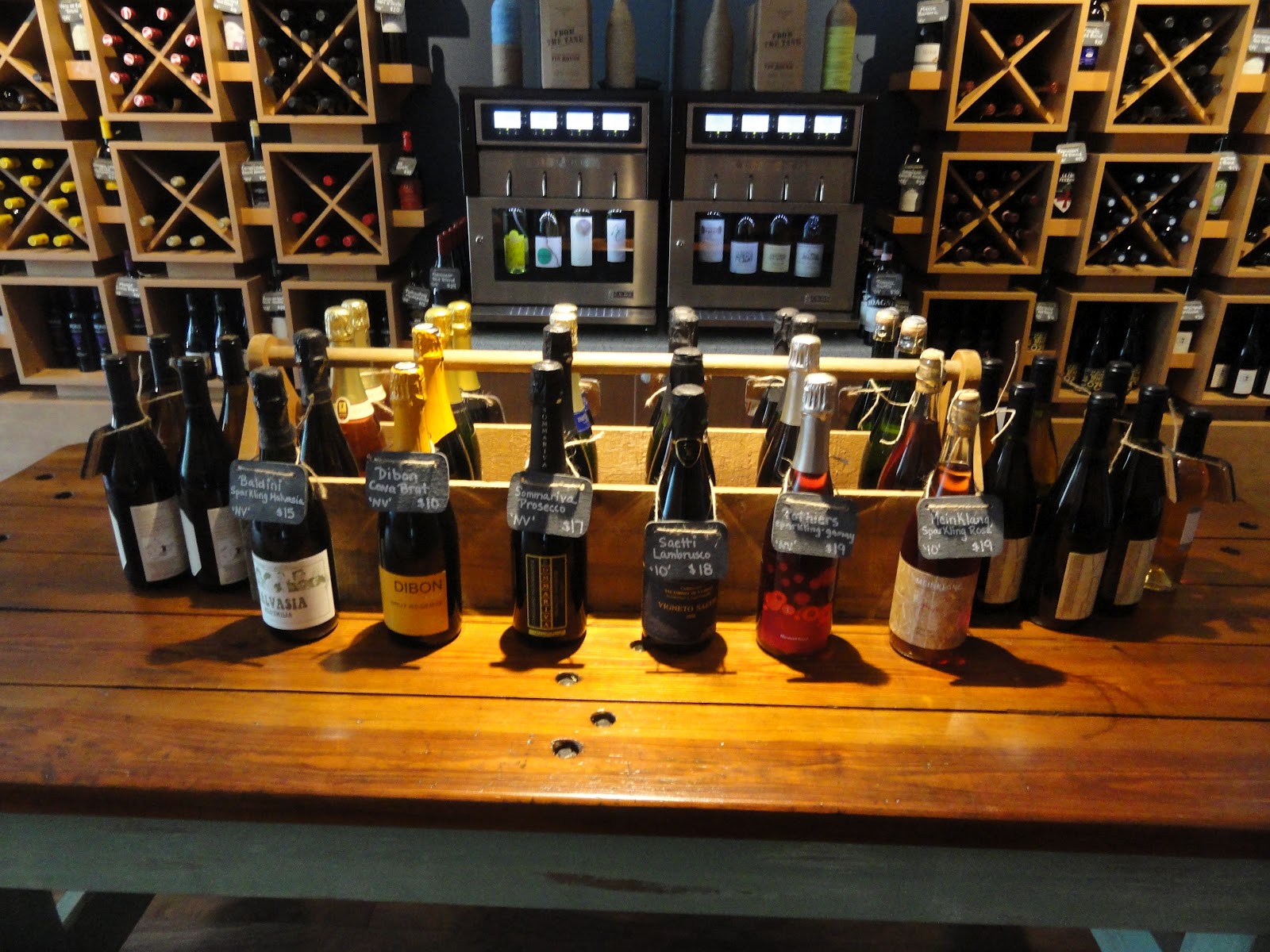
The store is small but spacious, and you will generally find red wines on the left wall and white wines and rosés on the right wall. The table in the center of the store has sparkling wines, including local ones from Westport Rivers. Against the back wall is a small selection of beer, and also on the right wall is a refrigerator holding wines and beers while the left wall has a wine tasting machine.

Currently, they carry about 135 wines and ultimately that number will rise to the range of 150-200. So this is more a boutique wine shop, with a carefully selected, small collection of wines. About eleven countries are now represented, including France, Italy, Spain, Argentina, Chile, Austria, and New Zealand, as well as five U.S. states, including California, Massachusetts, Oregon, Washington, and New York. As more wines are being added all the time, this diversity should expand. In the near future, they may add Sake, Sherry, Port, Hard Cider and Dessert wines to the mix as well as more local wines, such as from Travessia.

The wines are generally organized by grape, grouping them as well by similar style, though this is still a work in progress. Christopher did not want to organize them by country and region as he felt that a customer would have to walk all around the store to find all of the Pinot Noirs. Though that same problem exists with grouping by grape if a customer wants to find all of the wines from a single country. Plus, in a store where terroir, where a sense of place, is so important, you would expect to see the wines organized by country and region to better reflect that sense of place. No organization system is without flaw, and Christopher may adjust his system dependent on customer feedback.

The selections are currently heavy on Pinot Noir and Chardonnay as Christopher is still unsure of the local market and is trying to play it a bit safe initially. But you will still find some more unique wines there too, from less common grapes like Bobal and Zweigelt. Wine prices are competitive to other local stores, and about 25% of their stock is priced under $15, with a large proportion under $25. Right now, their most expensive wine is only $64. They also offer discounts, 10% for 6 bottles and 15% for 12 bottles, whether the same bottle or a mixed bunch.

There is a wine tasting machine which carries eight different wines so there is always something available for customers to taste. The machine issues 1/2 ounce pours, and the selection changes frequently, once a bottle is emptied. It is very important to Christopher that his customers have the opportunity to taste the wines before they buy them. Besides the machine, they will also have regular Saturday tastings and possibly other special tasting events.

You won't find shelf talkers on the racks, no wine scores or lists of medals. This is very much a hand sell store where customer service is key. Many of these wines will be unfamiliar to the average consumer, and even the avid wine lover is likely to find plenty of wines they have not tasted before. It is a very intriguing selection of wines, and there were plenty of wines which interested me. For a wine lover, the selection is going to be especially compelling. For the average consumer, the store will be an educational experience, and hopefully they will be adventurous enough to expand their palates and try these wines.

It is in this area where I believe the true motto of the store exists, that "Everything has a story behind it." Christopher wants to be a storyteller, more in the traditional, oral sense rather than as a writer. More Homer than Hemingway. He desires to share with his customers the stories of each wine, tales of the farmers, the history of the wineries, the nature of the grapes, and much more. He wants to intrigue and fascinate his customers, to provide them reasons why they should buy the wines. The intent is to share his passion, to establish relationships with his customers rather than viewing them merely as wallets and pocketbooks. I believe it is this aspect which will inspire far more customers than the motto of "Real. Natural. Wines."

Eco-practices are very important to Christopher and he pays attention to what may seem the smallest of details. For example, each wine has a chalk tag hung on the neck with the name of the wine and its price. This helps reduce on paper use and waste, rather than using adhesive tags or paper prices. The chalk tags can be easily erased and used again and again, a very green practice. It may seem like a small thing, but when taken together over time, it adds up.

What does the owner want his customers to know about his new store? I asked Christopher to give me his top three points, the most important items that a new customer should know. First, the entire inventory is sustainable and consists of wines you are unlikely to find in most other stores. Second, the store is devoted to being "green" and that is reflected in all aspects of the shop. Finally, customer service is key, as it is a hand sell place where the staff will share the stories of the wines with all of the customers. All very valid points, and I find the third point the most compelling.

There is a small beer selection, mostly local, artisan beers, and including some gluten free beers. You will find some chilled beers in their refrigerated unit too. Their emphasis is on wine, but they wanted to carry a select assortment of beers too.

As the store is a work in progress, much more will be coming in the near future such as recyclable 6 pack wine totes and assorted wine accessories. The customers' feedback will also be influential in the future path of TerraVino, though I am sure that Christopher will always remain true to his principles. Christopher has not chosen an easy path, creating a boutique wine store which doesn't sell consumer friendly, mass produced wines like Yellow Tail. He will have to work hard to persuade consumers to take a chance on the type of wines he sells. But he deserves much credit for taking on such a challenge.

This is the type of store that requires much from its owner, who cannot just sit behind a cash register and let the wine sell itself. Rather, Christopher must take a very active role in promoting his wines, in convincing consumers that they are worthy wines. He must be seller and storyteller, a passionate advocate of his selections, and I believe he is up to that challenge. All you have to do is spend some time talking with Chris, and you will realize the deep reservoirs of passion within him for wine, especially the type of wines he chooses to sell.

I bought five different wines while I was at the store, including: 2010 Vera de Estenas P.G. Bobal ($13), 2008 Monje Tradicional Tinto ($22), 2010 Tintero Rosso ($10), 2009 Meinklang Burgenland Red ($16), and 2010 La Roche Buissiere Petit Jo Rogue ($20). I needed some wines for every day drinking, and these wines intrigued me.

Since my visit to the store, I have drank one of the wines I purchased, the 2010 Vera de Estenas P.G. Bobal. I had tasted and enjoyed this wine at the store, so expected that I would enjoy it later at home too. the wine is from the Spanish D.O. of Utiel-Requena and the winery is the oldest in that region. The wine is produced from 100% Bobal, an indigenous grape which has been around since at least the 15th century. It derives its name from the Latin term "bovale" which refers to the shape of a bull’s head.

This wine was fermented in stainless steel and spent a few months in oak. It is light bodied, with delicious fruit flavors complemented by a subtle earthiness and hints of spice. I paired the wine with veal parmigiana and it went very well together.  It is a wine with plenty of character and is an excellent value which I highly recommend. I am fairly confident this wine will end up on my 2012 Favorites list.

So check out TerraVino, meet Christopher and learn about some intriguing and delicious wines.

Terra Vino=Story Wines!

Update: 4/10/12, 7pm--Christopher informed me that his store's wines are now organized by country rather than grape variety. As I stated, it is still a new story, subject to change, and I am pleased to see this change, especially as I think it better reflects terroir, a sense of place.

Update: As of the end of August 2012, Terravino is now closed. 

Monday, April 9, 2012

Rant: Give Me The Lesser Vintages

"Great vintages are all well and good, but harsh vintages are wines too."
--The Drops of God, vol.3

Wine regions loudly proclaim their best vintages, and in recent years, you probably have heard much acclaim for a number of different vintages. Some go so far as using extreme superlatives, such as "one of the best vintages of the century." The wine media helps to spread the word about these "great" vintages, recommending that consumers purchase wines from these vintages. You can get very jaded with all the hyperbole.

Based on this hype, wine consumers may seek out the best vintages at wine stores and restaurants, often ignoring wines which come from "lesser" vintages. You can find plenty of vintage charts, telling you which are the "best" and "worst" vintages, with the implication that you should only select the best. But I think too many people, to their detriment, are ignoring the so-called "lesser" vintages.

In my prior review of The Drops of God, vol.3, I mentioned that the topic of vintages played a significant role in the plot. In essence, the book recommended lesser vintages, even indicating that they might possess an advantage over great vintages. "The chosen few grapes that survive such harsh years have a vitality hidden deep within that the grapes of great vintages lack." Do you believe that to be true? I think there is truth within that quote, that a grape that can persevere and thrive during a harsh vintage is deserving of great respect. During a great vintage, the grapes have it easy, and don't have to work as hard to become what they need to be. I think the struggle though can lead to a greater character within the grape.

It is certainly much easier to make great wine with great grapes, so that even a less skilled wine maker can produce excellent wine in a great vintage. The true challenge of the skill of a wine maker though is during the lesser vintages. That is where experience and skill matters the most, where a master vintner must confront greater obstacles in his path to creating an excellent wine. How does he overcome the adversity? A lesser wine maker may not possess the experience to handle the difficulties of a tough vintage. So the true test of a wine maker is not the great vintages, but what he does during the lesser ones.

A wine does not have to be perfect to be compelling, interesting or desirable. "A mediocre vintage can still be augmented by an 'individuality' unique to humans and produce a wine that may be imperfect but charming, like people themselves." In a lesser vintage, a wine maker may produce less wine, but what is produced has the potential to be extremely interesting and delicious. It may also have the advantage of being much less expensive than a wine from a "great" vintage. In comparing the value of wines from different quality vintages, you may find that the lesser quality vintage provides a far better value.

My point is that lesser vintages should not be dismissed out of hand. They can offer much to a wine lover, especially if the wine maker is highly skilled and experienced.

Do you tend to neglect lesser vintages? Do you feel only great vintages make worthy wines? Or do you revel in finding excellent wines from lesser vintages?

Friday, April 6, 2012

The Drops of God: Volume 3-The First Apostle

The first score in the epic vinous battle between Shizuku Kanzaki and Issei Tomine finally occurs. Who successfully determined the identity of the First Apostle, taking an initial lead in the competition to win a vast wine collection valued at more than $20 million dollars?

I previously raved about the first two volumes of The Drops of God and you can read my prior reviews of The Drops of God: Volume 1 and The Drops of God: Volume 2. I was excited to read Volume 3, which was recently published, knowing that one of the Apostle wines would be finally identified. At the heart of the grand wine contest, the two competitors, Shizuku and Issei, must identify 12 Apostles and one final wine, The Drops of God. In Japan, the Drops of God manga continues to be published and 8 Apostles have already been identified. The English translations need to catch up, though that is still going to take several years.

The Drops of God, Volume 3 ($14.95) is a trade paperback, about the size of a usual paperback manga, of 402 pages, which is about 8 pages less than the second volume. Like a traditional manga, the book is read from back to front, which is a minor adjustment if you are not a regular manga reader and used to this format. It contains 20 issues of the original manga, the same as the second volume. The first three volumes basically cover the first year of issues of the Japanese weekly manga.

This volume picks up where the last volume ended, as the two contestants, Shizuku and Issei, try to identify the first Apostle wine. The Apostle was described with a scene of nature, including woods, a spring, and butterflies, an intriguing way to describe a wine. The competitors had only three weeks to identify the wine and as in the other volumes, there are always various detours on the path to the conclusion of the primary contest.

Shizuku encounters an artist who has created a painting that seems to closely resemble the description of the first Apostle, and which was inspired by a specific wine. But, the problem is that the artist has amnesia and cannot remember the name of the wine. Shizuku wants to help her regain her memory, for her own sake, but also so she can potentially help him identify the Apostle. To do so, he has the artist drink a number of different wines, hoping one will spark a flood of memories. While Shizuku tastes various wines with the artist, Issei opts for a very different road to identifying the Apostle. He visits a temple and undergoes a tasting of three glasses of spring water. How will that help him decide on the Apostle?

Burgundy takes center stage through much of this volume, and there is educational information about some regions and chateaus. Shizuku eventually makes his own decision as to which wine is the first Apostle. Interestingly, he does not taste the wine he believes to be correct, rather choosing to rely on his own conviction. When Issei hears about that, he too decides not to taste the wine that he has chosen as the Apostle. For one of them, that will turn out to be a significant mistake. They finally confront each other, reveal their selections and the winner is determined, though I won't spoil that decision.

Once again, this volume continues to "review" wines in more unique ways, describing the feelings, images and memories the wines invoke. One Burgundy is compared to "a marble statue, meticulously chiseled with a sharply honed blade."  Two other Burgundies, differing only by their vintage, are described in contrast, one as a "perfect movie" and the other as a "well-crafted mystery novel." A white Bordeaux is described as like a "bride's beautiful, diaphanous white veil."  Such evocative imagery, this provides such a fuller picture instead of a dry recitation of fruit and floral flavors and smells.

The manga also presents some thought provoking quotes, comments to ponder over, such as:
--"Just as the finest wines are only born from the harmony of Heaven, Earth, and Man."
--"Some people are saved by wine, while others are led astray because of it."
--"With wine, you taste and think for yourself."
--"A wine's appeal and its price are different things."
--"You're a woman of business. I'm just a drunkard. I have no interest in some critic's scores."
--".., wine is no mere alcohol but a masterwork as of literature or art."

An important lesson from this volume centers on vintages, and their impact on wine. There are at least a couple times when characters taste the same wines, but of different vintages, and the lessons learned make a significant difference in the manga. They should also serve as a thought experiment for the reader. One of the main lessons is that wine from all vintages should be cherished and not just the great vintages. "Great vintages are all well and good, but harsh vintages are wines too."

In fact, the book seems to take a position that the lesser vintages may actually possess an advantage over great ones. "The chosen few grapes that survive such harsh years have a vitality hidden deep within that the grapes of great vintages lack." Though such a wine may not be "perfect" it still possesses special characteristics. "A mediocre vintage can still be augmented by an 'individuality' unique to humans and produce a wine that may be imperfect but charming, like people themselves." Do you tend to neglect lesser vintages? Do you feel only great vintages make worthy wines?

Once again, this volume of The Drops of God addresses the matter of wine scores, pushing the idea that scores shouldn't matter much and that wine lovers should first depend on their own tastes. It is stated that Yutaka Kanzaki, the famed wine critic whose will is at the center of the plot, never gave points to wine. "He always used his superb imagination to bring wines to life in fine descriptions." This is something for wine critics to carefully consider.

After the first Apostle contest is decided, we move onto another diversionary test. Shizuku's company gets a huge order for wine, to stock a chain of supermarkets. But, the customer, Takasugi, only wants wine from the top five chateaux of Bordeaux, their top rivals, and DRC for Burgundy. The wines will include all vintages from 1970 to most recent. But Shizuku and his co-worker Miyabi, who is a former school mate of Takasugi, think he would be better served by choosing other wines. So they propose a blind taste test to Takasugi, pitting wines of their wine choices against the top Bordeaux and DRC. Takasugi consents but if he wins, then Miyabi must come to work for him.

Shizuku then undergoes a tasting of the five First Growths, all from 2002, and the manga goes into an explanation of these wines, including unique wine "reviews" from Shizuku. After this tasting though, Shizuku is feeling very insecure about the upcoming contest so he visits his rival, Issei, seeking his advice. This is certainly an intriguing twist. Issei will only help him if Shizuku can pass a test, comparing a 1970 and 1978 Chateau Margaux and explaining the reason for the difference between the two wines.

Once again, this volume impressed me and I continue to highly recommend the entire series to all wine lovers. It is a compelling and fun story, while also educating people about wine. Some wine lovers might consider a portion of the information to be very basic, but they will still find value in the books, various aspects that will make them think about wine in different ways. At different points during this volume, I had to put the book down while I thought about some idea I had found. Bring on the next volume!

You can look forward to Volume 4 being published on June 12 and Volume 5 on September 11. I suspect they might also publish Volume 6 in December.

Thursday, April 5, 2012

Thursday Sips & Nibbles

I am back again with a new edition of Thursday Sips & Nibbles, my regular column where I briefly highlight some interesting wine and food items that I have encountered recently.
**********************************************************
1)  Towne Stove and Spirits has a new spring menu, created by Culinary Director Lydia Shire and Executive Chef Mario Capone. The revamped carte du jour will refresh some signature dishes by incorporating new seasonal flavors while adding in some future classics.

In the “Start” category of the menu, you will find some new options: English Pea Soup (with basil, tender purple garlic flan - $9); Crisp Soft Shell Crab Panini (drunken avocado soup shot - $21); Rock Shrimp Spaghetti (with guanciale & Calabrian spiced tomato, hot pepper oil - $16); Sashimi of #1 Tuna (miso mustard “paint” bowl of crisp edamame beans - $18); and, Spring Artichoke Raviolini (with whole deep-fried artichoke Romano - $17). The culinary duo has also unveiled new “share” options including: Giant Hot Pita (made to order with ember-roasted eggplant, creamy fava bean ‘pate’, spiced lamb kabob - $18); Charcuterie: Italy’s Best Sopressata & Prosciutto (Towne’s best potted trout, chicken liver and cider pate with wood grilled Pugliese bread - $21); and, Towne’s Own Rum Smoked Salmon (on crisp maple brown bread with preserved beet and pink horseradish - $17).

There is also a new “pizza – wood grilled” option: Garlic Pizza (with carpaccio of king oyster mushroom & Sardinia’s truffle cheese, truffle honey - $18). The new Little Gem Salad (with whipped feta, peeled grapes, Marcona almonds and lemon-poppy seed dressing - $12) and Asparagus Cooked Over Coals (ciabatta with burrata, lambs lettuce, Argan oil, pistachio polonaise - $13) now also grace the “salad” section.

Moving onto the “sea + crustacea” section of the menu, find Fluke Filet (with sorrel butter and lime on bed of flaked fluffy crisped brioche and parsley crumbs - $31); Swordfish Steak (simply grilled or charcoaled, rosemary skewered with squid, lemon risotto and olio santo - $32); Black Sea Bass (with ramps, grilled razor clams and cassava puree - $31); Bouillabaisse Lobster & Pork Belly Roast (with baby monkfish tail, saffron, sea urchin rouille - $38); and, Wood Grilled Lobster Tails (with drawn butter and charred lemon – market).

For "steaks, chops + birds” options, check out: Giannone Roto Chicken (citron ‘flak’ salt, Chantilly mashed potatoes - $24); Coq au Vin (young chicken brick-style with Austrian Riesling, strewn with toasted garlic and spring carrot spaetzle - $32); Sirloin 14 oz Prime (simply grilled or with chive blossom, fresh horseradish butter - $42); Lamb Sirloin Steak (tandoori-charcoaled with golden lentils, crisp fried okra and India’s poppadoms - $38); and, Veal Porterhouse (roast cippolini onions, caramelized shallots, fig and morel sauce - $42).

For “sides,” you will find the following: Tagine of Basmati Rice (with cardamom, cilantro, mint, thin fried spring onions - $7); French Fries (whole head of roasted garlic, rosemary salt, truffle and porcini oil - $8); Wood Grilled Asparagus (with hollandaise or simply steamed - $12); and, Whole Roast Large Mushroom Caps (with garlic, fine sherry and curly parsley - $11).

2)  From creating items such as the “Mellow Yellow” cupcake infused with melatonin and valerian, to his “Elvis Cupcake,” a chocolate, peanut butter, banana and bacon homage to the king of rock n’ roll, Chef Stephen Butters of Butter Café and Bakery located in Walpole, continues to make a name for himself in the world of sweets. On April 19, at 10pm ET/PT, Chef Butters will appear on the Food Network's show "Sweet Genius” competing for a prize of $10,000.

Though I find host & dessert master Ron Ben-Israel to be a little creepy, I do enjoy the show, watching the pastry chefs create some amazing desserts with very strange ingredients. And it is even better when there is a local competitor. So let us give our support to Chef Butters on April 19.

3)  As part of its ongoing efforts to support the community, Blue on Highland, located in Needham, is launching “Dine & Donate,” a program that allows guests to donate a percentage of their final bill to a local school or non-profit pediatric cancer care and research organization of their choosing. Guests that dine-in or order take-out from Blue on Highland on Sundays will be able to specify which local education or non-profit children’s organization they would like a percentage of their final bill to be donated to including: St. Jude Children’s Research Hospital, Dana-Farber Cancer Institute’s The Jimmy Fund, Chickering School PTO in Dover, or the Needham Education Foundation.

“We’re a neighborhood restaurant and there’s nothing more important in our communities than our schools and children. Our guests come from a variety of communities so we wanted to come up with a way that we could support several local PTO’s and cancer research centers, not just one organization,” said Catherine Walkey, Owner of Blue on Highland.

Guests need only fill out a card that specifies where they would like their percentage allocated, and Blue on Highland will do the rest. This takes place every Sunday, from 11:30am-9pm.

4)  In a city where scotch bars are often limited to scotch and cigar bars, Towne Stove and Spirits is ready to revamp and refocus the beverage program at their second level “Uptowne” bar. To introduce their new scotch bar concept to the neighborhood, Towne's Beverage Manager, Brad Bernardo, will be hosting a series of scotch tastings. Connoisseurs will sip, swizzle and snack while Towne’s beverage team shakes, stirs and swirls different single, blended, pure, and vatted malts that have been aged perfectly in oak.

When: Tuesday, April 17 & April 24, from 6pm – 7:30pm
These tasting events are complimentary to guests ages 21+ and an RSVP is required by emailing Towne’s Beverage Manager, Brad Bernardo: bbernardo@lyonsgroup.com. Limited space is available and is granted and confirmed (via email) on a first come, first serve basis.

5)   Concord Cheese Shop proprietor Peter Lovis is "..mad for spring goat cheeses, made from the milk of Mama Goats whose kids were born in March. While suckling, Mama’s milk is bold flavored and rich, which is manifested in spring-produced cheese. Of the 20-plus local and European goat cheeses sold at the Concord Cheese Shop, Lovis’ favorites are the “buttons” and “pillows” that are delivered within days of being inside Mama Goat. But like his children, he cannot choose between them."

“Goat cheese tastings should include one fresh, one ash-coated or leaf-wrapped, and one aged French goat cheese,” says Lovis. Some to look for now:
--Crystal Brook Farm (Sterling, MA) There are 100 kids on Annie Stoddard’s farm, and their mamas are producing incredibly thick and healthful milk. Annie’s cheese is delivered to the shop within 5 days of milking. Then, it is shaped into 2-inch crottins (French for goat droppings) and marinated in garlic and olive oil.
--Le Lingot de Quercy (France) resembles a small gold bar or ingot. It weighs half a pound, has a thin rind, and is firm enough to slice. One can observe the cheese ripening from the outside in, resulting in two distinct colors, textures and flavors.
--Valency (France) was created by a friend of Napoleon’s in the 1800s. Because the emperor’s war in Egypt was faring badly, the friend made sure that the traditional pyramidal shape of the cheese was truncated, so as not to remind Monsieur Bonaparte of his battle woes while dining.
--Ponte de Bique (Loire Valley) Another classically pyramidal cheese that’s light, fresh and pairs well with a glass of chilled Sancerre.
--Arina (Holland) This versatile goat gouda is firm and large. It utilizes milk from goats who’ve grazed all summer on fresh grass and hay. It’s made in the fall, so is slightly aged and ready for optimum eating now.
--Bonne Bouch (Vermont) is a 4-ounce round, packaged in a sweet wooden crate. Made from spring milk, but aged for a few months while covered in fine ash, an ancient method of cheese preservation that’s still popular.
--Laura Chenel’s Chevre (Sonoma) Creamy and mild, this handcrafted cheese is well-priced, and complements pizza and warm sandwiches.