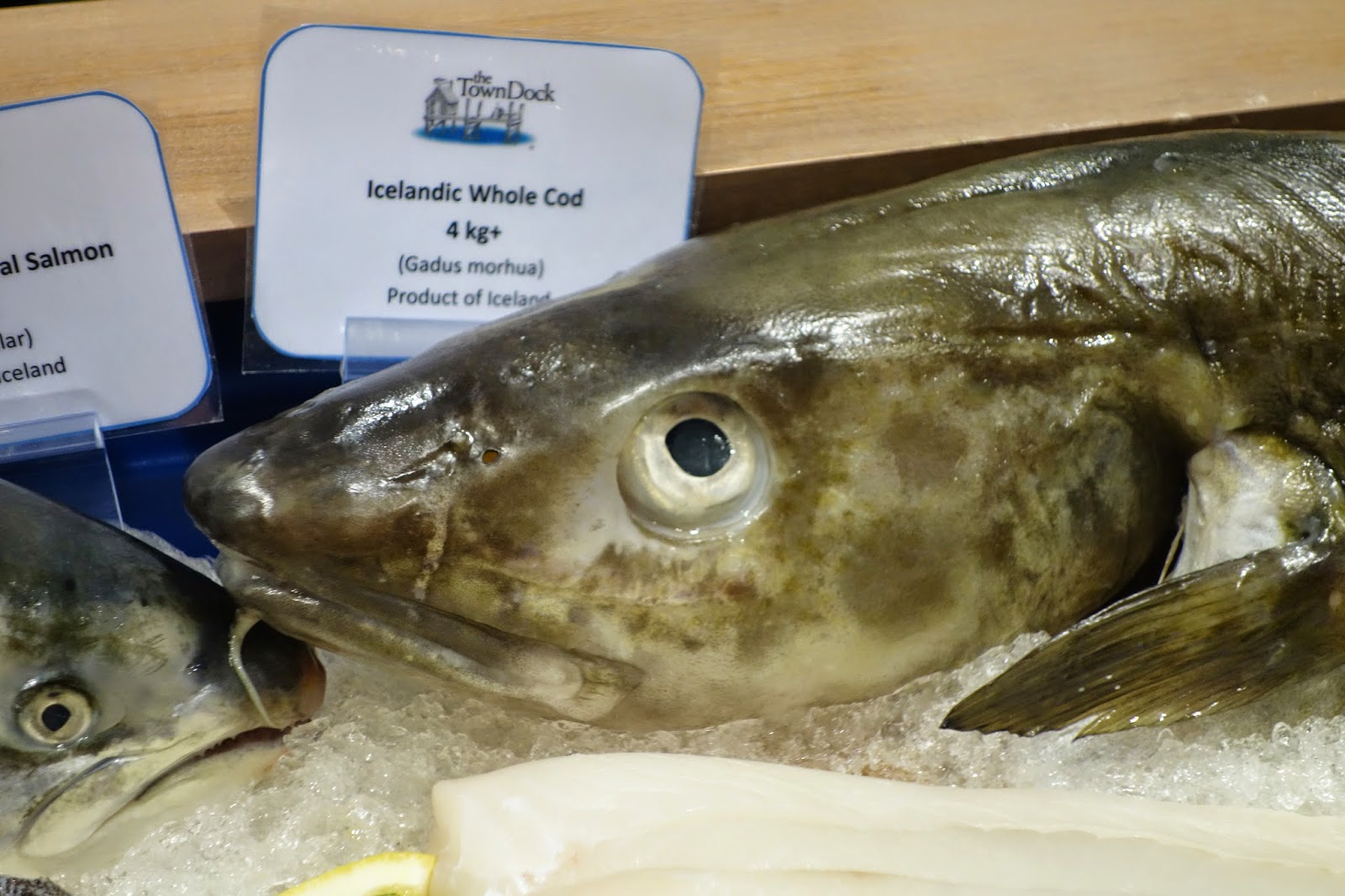
“The sea can bind us to her many moods, whispering to us by the subtle token of a shadow or a gleam upon the waves, and hinting in these ways of her mournfulness or rejoicing. Always she is remembering old things, and these memories, though we may not grasp them, are imparted to us, so that we share her gaiety or remorse.”
--H.P. Lovecraft
It's time to wind down my coverage of the Seafood Expo North America, though I assure you that I will continue to write about seafood issues, including matters that inspired by what I learned or discovered at the Expo. Every Tuesday, you can look forward to a new seafood-related post on my blog. And if there is a seafood issue you would like to see me cover, drop me a line and I'll see what I can do.
For this last post about SENA, I wanted to raise some final questions and issues about seafood matters, thoughts which have come to mind this past week. Each of those points is worthy of a full post, but time is needed for the ideas to percolate and come to fruition. Or additional research is needed. Some of these thoughts touch on important themes at the Expo, as well as potential themes for the future. I would love for these final ponderings to develop into conversations and I welcome any and all comments about these matters.
1. What is missing at most of the conference sessions at SENA is a difference of opinion. The panels often largely consist of like-minded individuals, so there is little disagreement or debate. We need more conflict on some of these panels, to present differing viewpoints and see how each side deals with that conflict. It would be beneficial to see how the panelists handle criticism of their positions, which could better point out the strengths and weaknesses of their points. Without such conflict, you are sometimes presented with a one-sided position, which potentially could be affected by bias. I'm sure such debates would be very popular at SENA. Sometimes, the Q&A after a panel session raises some conflict, but by then so much has already been presented without disagreement. Wouldn't you like to see a heated debate on the future of aquaculture or the sustainability of tuna?
2. I was once again disappointed to see that the two local newspapers, the Boston Globe and the Boston Herald, have each published but a single article about the Seafood Expo, and both concentrated on the same issue, the Presidential Task Force on IUU & Seafood Fraud. Sure, that was a worthy, international story but there are hundreds of other stories which could have been found at SENA. Why do these newspapers choose to ignore all of those other stories? They could have done an entire week of seafood-related stories. Locally, if you want stories about SENA, you have to seek out the passionate bloggers who have been covering the event for a number of years. They have written many dozens of stories about the Seafood Expo, doing a far better job than the local print media. More attention should be paid to these dedicated writers who are sharing the seafood stories of SENA.
3. Sustainable Farmed Bluefin Tuna? That is the claim of True World Foods which presents their Kai Oh Maguro, the "King of Ocean Tuna." I've read about Japanese farmed Bluefin before, though I haven't explored it in the last couple years. From a recent, brief scan of some of the available information, it appears that changes have occurred in the industry in a quest to be sustainable. This is a topic I need to research further, to see what has changed in recent years. I tasted some of their farmed tuna at SENA and it was quite delicious, silky smooth and with a meaty texture. I'll be following up on this matter so you can look forward to a post in the near future. Bluefin Tuna is a hot button issue so this will be a fascinating matter.
4. Located at the back of the main exhibition hall of SENA, you will find much of the seafood processing companies, and I think that section is largely ignored when many people seek seafood tales at the Expo. Many don't seem to realize the role processing plays in the seafood industry, such as how it interacts with sustainability and seafood fraud. Did you know that some seafood that is harvested in the U.S. is actually sent overseas to be processed before returning to the U.S.? Proper processing can provide more edible meat from seafood, increasing yields and helping sustainability. For example, a poorly processed fish might offer only 20 pounds of meat while more skilled processing could carve out 40 pounds of meat. More stories about seafood processing are needed, to explore how they affect the larger issues.
5. Does Asia favor frozen seafood far more than the rest of the world? At SENA, the majority of displays of frozen seafood seem to have been at the Asian booths. A number of Asian booths, such as the Japanese pavilion, sampled out some of their frozen products. At a seminar concerning mussels, it was noted that their fresh mussels were sold mainly in North American while their frozen mussels were sold primarily in Asia. I don't know the answer to this question, but what I found has made me curious to explore the matter further. If it is true, I would like to understand the reasons behind it. Is it a cultural matter? Or merely just a coincidence?
6. One of my favorite foods at SENA was a Kelp Smoothie, which was tasty and fruity, and mot anyone would have enjoyed too. You never would have known it contained Kelp. This year, there were 16 exhibitors of sea vegetables, 2 more than last year, so there has been growth in this area. However, I remain puzzled why seaweed and algae products don't receive more attention. I don't recall any recent conference sessions that deal with them, and I don't think there was ever a Master Class on seaweed. The Asian booths seem to most often showcase seaweed and algae products, especially laver snacks. It is sustainable and nutritious, and land-based vegetables are extremely popular, so why don't sea veggies get enough respect? I want to know.
“Don’t expect to catch big fishes from small rivulets.”
--French saying
For Over 18 Years, and over 5600 articles, I've Been Sharing My Passion for Food, Wine, Saké & Spirits. Come Join Me & Satisfy Your Hunger & Thirst.
Tuesday, March 24, 2015
SENA15: Aquaculture Stewardship Council Update
Each year at Seafood Expo North America (SENA), a few of the major third-party sustainable seafood certification organizations provide updates on their progress during the past year. I've already written about the updates from the Marine Stewardship Council, which certifies wild fisheries. Now it is time to deal with farmed fish.and obtain an update from the Aquaculture Stewardship Council (ASC).
The ASC is an independent, not-for-profit organization that certifies "responsible" seafood farms, processors and distributors worldwide. Founded in 2010 by the WWF and Dutch Sustainable Trade Initiative (IDH), and based in the Netherlands, the ASC wants to be a leader in the certification of responsible aquaculture. Rather than use the term "sustainable," they have chosen to use "responsible" and believe that consumers can better understand that term, which seems to make sense. They also think "sustainable" doesn't really fit certain aspects of their standards. This is another part of the evolution of seafood sustainability.
The panel was led by CEO Chris Ninnes who presented some of the ASC's past year's accomplishments. Last year, the ASC certified 75 farms, in 10 countries, for a total of 955 products. This year, there are now 127 certified farms, a growth over over 50 farms, and there are over 65 farms in the assessment process. The number of their certified products has also doubled this year, to over 2000 products. This significant growth is indicative of the great strides being made in aquaculture. It also shows substantial support for the work and mission of the ASC. Let us hope that such growth continues in the years to come.
A short preview of a movie, Tranforming Aquaculture in the State of Rio de Janeiro, was shown, telling the story of how 30 aquaculture operations in and around Rio de Janeiro were seeking ASC certification before the 2016 Summer Olympics. This could draw more attention, to a worldwide audience, to the benefits of sustainable aquaculture. More good news.
Earlier this year, Marine Harvest Canada became the first salmon farm in North America to receive certification from the ASC. Earlier this month, Bakkafrost also became the first certified salmon farm in the Faroe Islands. There are currently 30 certified salmon farms, with another 21 in assessment. In addition, the ASC has now certified their first scallop farms, a group of five farms in Peru owned by AquaPesca Group.
I'm pleased to see so much positive news coming from the ASC and it can only benefit the overall cause of aquaculture. Aquaculture gets plenty of bad press from the media so it is satisfying to read about success stories. And as Chef Rick Moonen said, we need to celebrate these successes, to showcase and highlight the best examples of the seafood industry. We don't do enough to celebrate their successes so we must make the effort to do so.
The ASC is an independent, not-for-profit organization that certifies "responsible" seafood farms, processors and distributors worldwide. Founded in 2010 by the WWF and Dutch Sustainable Trade Initiative (IDH), and based in the Netherlands, the ASC wants to be a leader in the certification of responsible aquaculture. Rather than use the term "sustainable," they have chosen to use "responsible" and believe that consumers can better understand that term, which seems to make sense. They also think "sustainable" doesn't really fit certain aspects of their standards. This is another part of the evolution of seafood sustainability.
The panel was led by CEO Chris Ninnes who presented some of the ASC's past year's accomplishments. Last year, the ASC certified 75 farms, in 10 countries, for a total of 955 products. This year, there are now 127 certified farms, a growth over over 50 farms, and there are over 65 farms in the assessment process. The number of their certified products has also doubled this year, to over 2000 products. This significant growth is indicative of the great strides being made in aquaculture. It also shows substantial support for the work and mission of the ASC. Let us hope that such growth continues in the years to come.
A short preview of a movie, Tranforming Aquaculture in the State of Rio de Janeiro, was shown, telling the story of how 30 aquaculture operations in and around Rio de Janeiro were seeking ASC certification before the 2016 Summer Olympics. This could draw more attention, to a worldwide audience, to the benefits of sustainable aquaculture. More good news.
Earlier this year, Marine Harvest Canada became the first salmon farm in North America to receive certification from the ASC. Earlier this month, Bakkafrost also became the first certified salmon farm in the Faroe Islands. There are currently 30 certified salmon farms, with another 21 in assessment. In addition, the ASC has now certified their first scallop farms, a group of five farms in Peru owned by AquaPesca Group.
I'm pleased to see so much positive news coming from the ASC and it can only benefit the overall cause of aquaculture. Aquaculture gets plenty of bad press from the media so it is satisfying to read about success stories. And as Chef Rick Moonen said, we need to celebrate these successes, to showcase and highlight the best examples of the seafood industry. We don't do enough to celebrate their successes so we must make the effort to do so.
SENA15: The Evolution Of Seafood Sustainability
"The sea, once it casts its spell, holds one in its net of wonder forever."
--Jacques Yves Cousteau
While walking down the many aisles of the Seafood Expo North America , enjoying seafood samples, you cannot fail to notice all the attention given to sustainability. I've already mentioned the prevalence of seafood sustainability at the Expo. Many of the exhibitors tout the sustainability of their products, though, in the darker corners of the hall, there are items which are more questionable, such as Shark Fin, though fortunately only a single exhibitor had that item. Each year, SENA seems to become more an more sustainable.
Besides the seafood purveyors, you'll also find organizations devoted to sustainable issues, such as Aquaculture Stewardship Council, CleanFish, Fish Choice, Global G.A.P., Marine Stewardship Council, Monterey Bay Aquarium, Seaweb, Trace Register and others. These groups are a wealth of information concerning seafood sustainability, and are more than willing to share all they know. Besides the exhibitors, there was also a Seafood Sustainability track in the conference sessions, presenting five different seminars (2 less than last year) on sustainability-related issues.
Over the last five years, during my most intense immersions into the Expo, there has been a clear evolution in seafood sustainability, a constant move forward. This is not a new evolution and has been occurring ever since the idea of seafood sustainability was first broached. In some ways, the evolution of seafood sustainability has been quicker and more significant than that occurring in any other food industry. For example, early aquaculture saw serious problems, such as pollution and disease, yet many of those problems have been resolved. The problems of factory farms that raise chickens, pigs and cows, have not been addressed as quickly or as successfully as aquaculture.
The relative rapid evolution of seafood sustainability has unfortunately been an obstacle in some regards to the average consumer. Due to the complexities of sustainability, and its rapid changes, consumers get overwhelmed, failing to properly understand the issues. Instead, they often tend to rely on sensationalist media reports, usually outdated, mentioning the dangers of seafood. Consumer education though is starting to be addressed, as well as the development of ideas which will make it much easier for consumers to understand what is most important. As my own contribution to correcting the misconceptions of consumers, I want to address some of the key points of the sustainability issue as it presently stands, pointing our some of its evolution as well.
1. Seafood sustainability is vital.
This is a fact that has not changed over the years. If anything, it has become stronger as new studies are conducted. As I mentioned in a previous post, by the mid-2040s, it is projected that the world population will grow from 7 to 9 billion, requiring us to double our food supply. The UN also reported that 90% of wild fisheries are being harvested at their sustainable limit. Without seafood, we won't be able to feed the world's growing population. In addition, the extinction of species and the destruction of their environment could have cataclysmic consequences for us all. Sustainability in all industries is a vital element, and the seafood industry is definitely not an exception. Consumers need to consume sustainable seafood, and contribute to our future. There is no valid argument that sustainable seafood is unnecessary.
2. Seafood sustainability still isn't a major consumer concern.
Despite the vital nature of seafood sustainability, it still is not a high priority for the majority of consumers. Various seafood purveyors have indicated to me that their customers rarely ask about sustainability. Other seafood articles have repeated this sentiment, indicating that consumers care far more about cost, ease of prep and taste than sustainability. However, those same consumers, in other studies, indicate that they equate sustainability to quality, but they just are not motivated sufficiently to opt only for sustainable seafood.
What helps to drive sustainability in the marketplace is that there is a small yet vocal and powerful minority of consumers who want seafood sustainability. They are the ones who demand to know the source of the seafood they purchase, who question their restaurant servers about sourcing. Retailers are listening to these people, even though they are a minority, as they understand that the number of consumers seeking sustainable seafood is growing, even if it is slow. They see the future, knowing that the consumer base is evolving, getting more educated about these issues. Hopefully, in the near future, a majority of consumers will be concerned about sustainability.
3. Seafood sustainability isn't an either/or issue.
No one is 100% sustainable, and as Michael Tlusty, the Director of Ocean Sustainability Science at the New England Aquarium, said, anyone claiming otherwise is merely ego. Sustainability is a journey, and everyone falls somewhere on the spectrum, hopefully moving closer to an ideal destination. At the Marine Stewardship Council meeting, it was noted that even when their fisheries received sustainable certification, they continued to work towards improving their practices, trying to become even more sustainable. Every seafood-related organization needs to constantly endeavor to better themselves, to improve any aspect which is less than perfect, even if they will never reach that ideal goal.
Sustainability is often about trade-offs, a balancing of competing interests. For example, though the Maine lobster fishery is considered sustainable, it is also an industry that is very energy intensive, far more than many other types of fisheries. The industry needs improvement, despite being sustainable in one sense. Consumers must learn not to be too judgmental about seafood sustainability, and understand that no one is perfect, and those dedicated to working hard towards sustainability deserve their support.
4. Seafood sustainability is a complex issue.
In understanding something, starting with its definition is often a good beginning. With sustainability though, there is no single, agreed upon definition. Tania Taranovski, the Director of Sustainable Seafood Program at the New England Aquarium, previously noted that with sustainability, "we are trying to do too much with one word," over simplifying a very complex issue. As such there has been an evolution for some away from that term, choosing to refer to it instead as "responsibly sourced" seafood. This growing movement could potentially be the wave of the future.
Determining whether seafood is sustainable or not depends upon a plethora of questions, including where the seafood was harvested, how it was harvested, who harvested it, the health of the specific fishery, and so much more. Few consumers have the inclination to ask their local seafood purveyor or restaurant the necessary questions to determine the sustainability level of the seafood they wish to purchase. Fortunately, the evolution of seafood sustainability has seem some potential solutions to this consumer confusion.
5. Seafood sustainability is about trust.
To combat consumer confusion about seafood sustainability, consumers need to rely on trust, to allow other to indicate which seafood is sustainable. One important way to provide such information is through third party certifications, such as that of the Marine Stewardship Council and Aquaculture Stewardship Council. Such organizations ask the necessary questions, and take it further through a thorough examination of the issues, ensuring the sustainable of any fishery they choose to certify. For consumers, all they have to do then is to look for a certification label or logo on their seafood. It couldn't be much easier. However, consumers must first trust these organizations,
That element of trust extends to other seafood companies, restaurants, markets or more. Consumers need to rely upon trusted people to determine what is sustainable seafood. I have often heard chefs tell me that the first step for consumers to do is to find a trusted seafood purveyor. Consumers can rely upon some elements of the media, friends, and word of mouth to help determine who is worthy of their trust. I have previously written about seafood businesses which I believe are worthy of your trust. Having that trust makes the issue of seafood sustainability much easier for consumers.
6. Aquaculture is the future of seafood sustainability.
Some consumers have a knee-jerk reaction against aquaculture. It is a strange double standard though as they might refuse to eat farmed salmon but will gladly partake of factory farm chicken or pork, both which are far more questionable than farmed salmon. Consumers have been deluged with negative media depictions of farmed farm, and don't understand the realities. During the last forty or so years, aquaculture has made significant strides in technology and progress, and continues to do so all the time. Many of the criticisms lodged against aquaculture are no longer valid, yet those criticisms continue to circulate.
Approximately 50% of the seafood in the world now comes from aquaculture, and that percentage is likely to grow in time. As I mentioned earlier, our population is growing and the only way we can feed the additional billions will likely be through additional aquaculture. Land based agriculture already uses 70% of our water supply and 30%-40% of our land, so there is little room, if any, for growth. As 90% of our wild fisheries are at their peak, there is little room for growth there either. Aquaculture though is not at its peak, and its potential is quite higher. Consumers need to understand that aquaculture can be sustainable, that it constantly improves, and that it is necessary to feed future generations.
7. Seafood sustainability is about diversity of species.
Most Americans are boring. Consider that though there are more than 100 seafood species available in U.S. markets, a mere 6 species account for 91% of the seafood consumed here. There is an abundant bounty of available seafood species, but many Americans won't venture out to try all of these delicious and interesting species. By consuming such a small number of species, we put undue pressures on the stocks of those fish, causing sustainability problems. It's easy to resolve this problem, by Americans simply expanding their palates and eating other, less common species.
You might have heard about "trash fish," though some in the seafood industry cringe at that term, and it refers to those species which Americans rarely eat, and which fishermen find difficult to sell. However, many of those species are delicious, and people would enjoy them only if they gave them a chance. I've written before about a local effort, Red's Best Seafood, to make those less common fish available to consumers. As I walked the aisles of SENA, I saw a wide variety of seafood which will end up on local store shelves and on restaurant menus, so there is hope that Americans can break out of their boring seafood eating habits. You should also check out this new article in the Wall Street Journal about this very issue.
8. Seafood sustainability should include a social element.
Initially,seafood sustainability was primarily about the fish and their environment, the water. The concern was whether there were sufficient stocks of a particular fish, or whether fishing gear was damaging the bottom of the sea. As this type of sustainability became more prevalent. as it started becoming more commonplace in the marketplace, people started to ask whether there was more to sustainability. Some sought a new competitive edge while others were truly concerned about expanding the scope of sustainability.
Now, more and more seafood organizations are talking about sustainability and social issues, especially after all of the publicity last year from the Thailand scandal concerning slavery and the seafood industry. Some third party certification bodies, such as Aquaculture Stewardship Council, have social issues within their sustainability criteria. In time, it is very likely that all of these certification groups will include social criteria. It's no longer sufficient to care just about the fish and the oceans, but you need to be concerned about the people involved too.
Besides extreme cases like those of Thailand, there also needs to be a concern for local fishing communities and their economic well being. There needs to be a balancing act between strict fishing regulations and protecting the livelihood of fishermen. It is far from an easy task and the important point is that we need to consider these social issues in seafood sustainability discussions.
I'm sure that at next year's SENA, I'll see a further evolution of the issue of seafood sustainability. There will be more positive change, more efforts to resolve existing problems. I'll be there to learn what has changed, and what the future holds. Will you be there too?
“There are fish in the sea better than have ever been caught.”
--Irish saying
--Jacques Yves Cousteau
While walking down the many aisles of the Seafood Expo North America , enjoying seafood samples, you cannot fail to notice all the attention given to sustainability. I've already mentioned the prevalence of seafood sustainability at the Expo. Many of the exhibitors tout the sustainability of their products, though, in the darker corners of the hall, there are items which are more questionable, such as Shark Fin, though fortunately only a single exhibitor had that item. Each year, SENA seems to become more an more sustainable.
Besides the seafood purveyors, you'll also find organizations devoted to sustainable issues, such as Aquaculture Stewardship Council, CleanFish, Fish Choice, Global G.A.P., Marine Stewardship Council, Monterey Bay Aquarium, Seaweb, Trace Register and others. These groups are a wealth of information concerning seafood sustainability, and are more than willing to share all they know. Besides the exhibitors, there was also a Seafood Sustainability track in the conference sessions, presenting five different seminars (2 less than last year) on sustainability-related issues.
Over the last five years, during my most intense immersions into the Expo, there has been a clear evolution in seafood sustainability, a constant move forward. This is not a new evolution and has been occurring ever since the idea of seafood sustainability was first broached. In some ways, the evolution of seafood sustainability has been quicker and more significant than that occurring in any other food industry. For example, early aquaculture saw serious problems, such as pollution and disease, yet many of those problems have been resolved. The problems of factory farms that raise chickens, pigs and cows, have not been addressed as quickly or as successfully as aquaculture.
The relative rapid evolution of seafood sustainability has unfortunately been an obstacle in some regards to the average consumer. Due to the complexities of sustainability, and its rapid changes, consumers get overwhelmed, failing to properly understand the issues. Instead, they often tend to rely on sensationalist media reports, usually outdated, mentioning the dangers of seafood. Consumer education though is starting to be addressed, as well as the development of ideas which will make it much easier for consumers to understand what is most important. As my own contribution to correcting the misconceptions of consumers, I want to address some of the key points of the sustainability issue as it presently stands, pointing our some of its evolution as well.
1. Seafood sustainability is vital.
This is a fact that has not changed over the years. If anything, it has become stronger as new studies are conducted. As I mentioned in a previous post, by the mid-2040s, it is projected that the world population will grow from 7 to 9 billion, requiring us to double our food supply. The UN also reported that 90% of wild fisheries are being harvested at their sustainable limit. Without seafood, we won't be able to feed the world's growing population. In addition, the extinction of species and the destruction of their environment could have cataclysmic consequences for us all. Sustainability in all industries is a vital element, and the seafood industry is definitely not an exception. Consumers need to consume sustainable seafood, and contribute to our future. There is no valid argument that sustainable seafood is unnecessary.
2. Seafood sustainability still isn't a major consumer concern.
Despite the vital nature of seafood sustainability, it still is not a high priority for the majority of consumers. Various seafood purveyors have indicated to me that their customers rarely ask about sustainability. Other seafood articles have repeated this sentiment, indicating that consumers care far more about cost, ease of prep and taste than sustainability. However, those same consumers, in other studies, indicate that they equate sustainability to quality, but they just are not motivated sufficiently to opt only for sustainable seafood.
What helps to drive sustainability in the marketplace is that there is a small yet vocal and powerful minority of consumers who want seafood sustainability. They are the ones who demand to know the source of the seafood they purchase, who question their restaurant servers about sourcing. Retailers are listening to these people, even though they are a minority, as they understand that the number of consumers seeking sustainable seafood is growing, even if it is slow. They see the future, knowing that the consumer base is evolving, getting more educated about these issues. Hopefully, in the near future, a majority of consumers will be concerned about sustainability.
3. Seafood sustainability isn't an either/or issue.
No one is 100% sustainable, and as Michael Tlusty, the Director of Ocean Sustainability Science at the New England Aquarium, said, anyone claiming otherwise is merely ego. Sustainability is a journey, and everyone falls somewhere on the spectrum, hopefully moving closer to an ideal destination. At the Marine Stewardship Council meeting, it was noted that even when their fisheries received sustainable certification, they continued to work towards improving their practices, trying to become even more sustainable. Every seafood-related organization needs to constantly endeavor to better themselves, to improve any aspect which is less than perfect, even if they will never reach that ideal goal.
Sustainability is often about trade-offs, a balancing of competing interests. For example, though the Maine lobster fishery is considered sustainable, it is also an industry that is very energy intensive, far more than many other types of fisheries. The industry needs improvement, despite being sustainable in one sense. Consumers must learn not to be too judgmental about seafood sustainability, and understand that no one is perfect, and those dedicated to working hard towards sustainability deserve their support.
4. Seafood sustainability is a complex issue.
In understanding something, starting with its definition is often a good beginning. With sustainability though, there is no single, agreed upon definition. Tania Taranovski, the Director of Sustainable Seafood Program at the New England Aquarium, previously noted that with sustainability, "we are trying to do too much with one word," over simplifying a very complex issue. As such there has been an evolution for some away from that term, choosing to refer to it instead as "responsibly sourced" seafood. This growing movement could potentially be the wave of the future.
Determining whether seafood is sustainable or not depends upon a plethora of questions, including where the seafood was harvested, how it was harvested, who harvested it, the health of the specific fishery, and so much more. Few consumers have the inclination to ask their local seafood purveyor or restaurant the necessary questions to determine the sustainability level of the seafood they wish to purchase. Fortunately, the evolution of seafood sustainability has seem some potential solutions to this consumer confusion.
5. Seafood sustainability is about trust.
To combat consumer confusion about seafood sustainability, consumers need to rely on trust, to allow other to indicate which seafood is sustainable. One important way to provide such information is through third party certifications, such as that of the Marine Stewardship Council and Aquaculture Stewardship Council. Such organizations ask the necessary questions, and take it further through a thorough examination of the issues, ensuring the sustainable of any fishery they choose to certify. For consumers, all they have to do then is to look for a certification label or logo on their seafood. It couldn't be much easier. However, consumers must first trust these organizations,
That element of trust extends to other seafood companies, restaurants, markets or more. Consumers need to rely upon trusted people to determine what is sustainable seafood. I have often heard chefs tell me that the first step for consumers to do is to find a trusted seafood purveyor. Consumers can rely upon some elements of the media, friends, and word of mouth to help determine who is worthy of their trust. I have previously written about seafood businesses which I believe are worthy of your trust. Having that trust makes the issue of seafood sustainability much easier for consumers.
6. Aquaculture is the future of seafood sustainability.
Some consumers have a knee-jerk reaction against aquaculture. It is a strange double standard though as they might refuse to eat farmed salmon but will gladly partake of factory farm chicken or pork, both which are far more questionable than farmed salmon. Consumers have been deluged with negative media depictions of farmed farm, and don't understand the realities. During the last forty or so years, aquaculture has made significant strides in technology and progress, and continues to do so all the time. Many of the criticisms lodged against aquaculture are no longer valid, yet those criticisms continue to circulate.
Approximately 50% of the seafood in the world now comes from aquaculture, and that percentage is likely to grow in time. As I mentioned earlier, our population is growing and the only way we can feed the additional billions will likely be through additional aquaculture. Land based agriculture already uses 70% of our water supply and 30%-40% of our land, so there is little room, if any, for growth. As 90% of our wild fisheries are at their peak, there is little room for growth there either. Aquaculture though is not at its peak, and its potential is quite higher. Consumers need to understand that aquaculture can be sustainable, that it constantly improves, and that it is necessary to feed future generations.
7. Seafood sustainability is about diversity of species.
Most Americans are boring. Consider that though there are more than 100 seafood species available in U.S. markets, a mere 6 species account for 91% of the seafood consumed here. There is an abundant bounty of available seafood species, but many Americans won't venture out to try all of these delicious and interesting species. By consuming such a small number of species, we put undue pressures on the stocks of those fish, causing sustainability problems. It's easy to resolve this problem, by Americans simply expanding their palates and eating other, less common species.
You might have heard about "trash fish," though some in the seafood industry cringe at that term, and it refers to those species which Americans rarely eat, and which fishermen find difficult to sell. However, many of those species are delicious, and people would enjoy them only if they gave them a chance. I've written before about a local effort, Red's Best Seafood, to make those less common fish available to consumers. As I walked the aisles of SENA, I saw a wide variety of seafood which will end up on local store shelves and on restaurant menus, so there is hope that Americans can break out of their boring seafood eating habits. You should also check out this new article in the Wall Street Journal about this very issue.
8. Seafood sustainability should include a social element.
Initially,seafood sustainability was primarily about the fish and their environment, the water. The concern was whether there were sufficient stocks of a particular fish, or whether fishing gear was damaging the bottom of the sea. As this type of sustainability became more prevalent. as it started becoming more commonplace in the marketplace, people started to ask whether there was more to sustainability. Some sought a new competitive edge while others were truly concerned about expanding the scope of sustainability.
Now, more and more seafood organizations are talking about sustainability and social issues, especially after all of the publicity last year from the Thailand scandal concerning slavery and the seafood industry. Some third party certification bodies, such as Aquaculture Stewardship Council, have social issues within their sustainability criteria. In time, it is very likely that all of these certification groups will include social criteria. It's no longer sufficient to care just about the fish and the oceans, but you need to be concerned about the people involved too.
Besides extreme cases like those of Thailand, there also needs to be a concern for local fishing communities and their economic well being. There needs to be a balancing act between strict fishing regulations and protecting the livelihood of fishermen. It is far from an easy task and the important point is that we need to consider these social issues in seafood sustainability discussions.
I'm sure that at next year's SENA, I'll see a further evolution of the issue of seafood sustainability. There will be more positive change, more efforts to resolve existing problems. I'll be there to learn what has changed, and what the future holds. Will you be there too?
“There are fish in the sea better than have ever been caught.”
--Irish saying
Monday, March 23, 2015
SENA15: Paiche, the "Cod Of The Amazon"
A prehistoric fish? It looks almost the same as it did over five million years ago and it was on display at the Seafood Expo North America (SENA). One of my favorite parts of SENA is finding more unusual fish species and sharing their tales, trying to get more people to enjoy these intriguing fish. Let me now tell you about the ancient Paiche.
Paiche ( pronounced "pie-chay"), also known as Arapaima or Pirarucu, is a South American freshwater fish, one of the largest freshwater fish in the world. They can be up to 15 feet long and weigh up to 400 pounds. It is also sometimes known by nicknames such as the "Amazonian Bass" or the "Cod of the Amazon." Interestingly, Paiche also possess pseudo-lungs which allow them to breathe air like we do.
They have been popular food fish in the Amazon for many years, though it wasn't until the 20th century that harvesting started to seriously deplete stocks. Traditionally, the tongue of the Paiche is thought to have medicinal qualities, but as the tongue is also bony, it is sometimes used as a scraper. The Paiche's tough scales are also commonly used as small files. The Paiche's popularity eventually led it down a dangerous path,and the Brazilian government had to ban commercial fishing, Only limited fishing of Paiche is now permitted, and generally only in remote regions by indigenous peoples.
As people still want to eat Paiche, it has led to the establishment of farmed Paiche operations, such as that of Amazone, who was exhibiting at SENA. Amazone is committed to environmental responsibility and sustainability, hoping to preserve the Paiche species by lessening the pressures on wild stocks. In their farming operation, there is no genetic or chemical interventions and they have a full cycle farm, including their own hatchery. Their operation has been certified as sustainable by IMOswiss AG.
Paiche meat is white, firm, relatively boneless, high in Omega-3s and high in protein (20 grams per 100 grams of meat). It's meat also possesses a more subtle and elegant taste, which means it is versatile, allowing a wide range of flavor pairings and preparations. If you look at some Paiche Recipes from Amazone, you'll find a nice diversity of dishes. In some respects, it resembles cod, though has a firmer texture and there are some differences in the taste.
Though they did not have any samples of Paiche available at SENA, I have enjoyed Paiche before at a couple local restaurants, including Taranta, where Chef Jose Duarte has a Paiche dish (sourced from Amazone) regularly on the menu, though the preparation varies on a regular basis. I found that Paiche has a nice and firm texture with a subtle and slightly sweet flavor, reminding me a bit like cod. It is a tasty fish and if you are in the Boston area, you should check our Taranta. Whole Foods Markets sometimes sells Paiche too, and they even offer Recipes.
Enjoy an ancient and sustainable fish, the Amazonian Paiche.
Paiche ( pronounced "pie-chay"), also known as Arapaima or Pirarucu, is a South American freshwater fish, one of the largest freshwater fish in the world. They can be up to 15 feet long and weigh up to 400 pounds. It is also sometimes known by nicknames such as the "Amazonian Bass" or the "Cod of the Amazon." Interestingly, Paiche also possess pseudo-lungs which allow them to breathe air like we do.
They have been popular food fish in the Amazon for many years, though it wasn't until the 20th century that harvesting started to seriously deplete stocks. Traditionally, the tongue of the Paiche is thought to have medicinal qualities, but as the tongue is also bony, it is sometimes used as a scraper. The Paiche's tough scales are also commonly used as small files. The Paiche's popularity eventually led it down a dangerous path,and the Brazilian government had to ban commercial fishing, Only limited fishing of Paiche is now permitted, and generally only in remote regions by indigenous peoples.
As people still want to eat Paiche, it has led to the establishment of farmed Paiche operations, such as that of Amazone, who was exhibiting at SENA. Amazone is committed to environmental responsibility and sustainability, hoping to preserve the Paiche species by lessening the pressures on wild stocks. In their farming operation, there is no genetic or chemical interventions and they have a full cycle farm, including their own hatchery. Their operation has been certified as sustainable by IMOswiss AG.
Paiche meat is white, firm, relatively boneless, high in Omega-3s and high in protein (20 grams per 100 grams of meat). It's meat also possesses a more subtle and elegant taste, which means it is versatile, allowing a wide range of flavor pairings and preparations. If you look at some Paiche Recipes from Amazone, you'll find a nice diversity of dishes. In some respects, it resembles cod, though has a firmer texture and there are some differences in the taste.
Though they did not have any samples of Paiche available at SENA, I have enjoyed Paiche before at a couple local restaurants, including Taranta, where Chef Jose Duarte has a Paiche dish (sourced from Amazone) regularly on the menu, though the preparation varies on a regular basis. I found that Paiche has a nice and firm texture with a subtle and slightly sweet flavor, reminding me a bit like cod. It is a tasty fish and if you are in the Boston area, you should check our Taranta. Whole Foods Markets sometimes sells Paiche too, and they even offer Recipes.
Enjoy an ancient and sustainable fish, the Amazonian Paiche.
SENA15: Combating IUU Fishing & Seafood Fraud
It was the biggest news of the Seafood Expo North America (SENA), the only aspect that the two, major local newspapers, the Boston Globe and the Boston Herald, chose to cover about SENA. The special announcement dealt with two global problems that plague the seafood industry, and offered recommendations for a potential solution. Many have been referring to it as a historic event. It is a cause for optimism, though we must also remember that it is mainly potential at this time, and we shall see whether it succeeds or not.
At SENA, I attended a conference session, IUU Fishing Panel Discussion, at which Bruce Andrews, Deputy Secretary for the U.S. Department of Commerce, delivered an announcement from the Presidential Task Force on IUU and Seafood Fraud, stating that the task force had just issued 15 recommendations for a strategic action to combat these problems. After the announcement, there was a panel discussion on the announcement, including Dr. Kathryn D. Sullivan, NOAA Administrator and Under Secretary of Commerce for Oceans and Atmosphere; Sally Yozell, senior advisor to the Under Secretary of State for Economic Growth, Energy and Environment, Department of State; William Jones, acting deputy director of the Center for Food Safety and Applied Nutrition’s Office of Food Safety; John Connelly, president of the National Fisheries Institute; Michele Kuruc, VP-Ocean Policy, World Wildlife Fund; and Mike Kraft, VP-corporate social responsibility and fisheries management at Bumble Bee Foods
Let's begin with some definitions and a bit on the scope of the problems.
Illegal, Unreported, & Unregulated (IUU) Fishing, also sometimes known as "pirate fishing," includes a number of activities such as breaking fishery rules, failing to properly report catches, or otherwise trying to circumvent measures intended to preserve species and environments. These pirate vessels also sometimes engage in other illegal activities, including drug, arms and human trafficking. As a very conservative estimate, a study concluded that IUU fishing causes global losses of at least $23 Billion. Another study concluded that 20% to 32% of wild-caught seafood that is imported into the U.S. derives from IUU fishing. This is a significant problem that needs to be addressed.
Seafood Fraud is another significant problem of concern. It includes any illegal activity that misrepresents fish that is sold, such as mislabeling, selling a cheaper fish species but claiming it actually is a more expensive fish species. In a study conducted by Oceana, they examined 1200 seafood samples, across 21 U.S. states, and concluded that 1/3 of the samples had been mislabeled. These practices are harmful to the economy, to those fishermen following the law, and also pose a potential health risk to consumers.
Now, let me present two examples of IUU fishing, one with a negative result and another with a much more positive result. These examples can serve as a framework for better understanding the rest of the discussion on these matters.
The Times recently reported about a super-trawler that was apprehended engaged in IUU fishing. The trawler illegally harvested 632,000 kilos of mackerel and the owner plead guilty to the charges. The court fined him, and the total of the fine and costs was £102,000. That would seem to be a win, however, the owner was permitted to sell the illegal fish, receiving £437,000. After paying the court, he netted £335,000, so crime did pay in his case. That case sends the wrong message to pirate fishermen, that the penalty for IUU fishing is minor and well worth the risk. It is a failure on many levels.
On a more positive note, last year, I wrote an article about the Patagonian Toothfish, also known as Chilean Sea Bass, which had been a major target of IUU fishermen, leading the fish to the brink of extinction. To save the species and combat IUU fishing, a collaboration formed of members of the fishing industry, conservation groups, scientists, governments, and the international Commission for the Conservation of Antarctic Marine Living Resources (CCAMLR). Together, they were able to nearly wipe out IUU fishing of the toothfish, rebuild stocks and now there is a sustainable toothfish fishery, A resounding success, indicative that IUU fishing can be successfully defeated,though it requires collaboration, time and great effort.
Onto the announcement and the discussion that followed.
In June 2014, the Presidential Task Force on IUU and Seafood Fraud was formed, gathering together numerous government agencies, including Department of Agriculture; Department of Commerce; National Oceanic and Atmospheric Administration; Department of Defense; The Navy; Department of Health and Human Services; Food and Drug Administration; Department of Homeland Security; U.S. Customs and Border Protection; U.S. Immigration and Customs Enforcement; U.S. Coast Guard; Department of the Interior; U.S. Fish and Wildlife Service; Department of Justice; Department of State; Bureau of Oceans and International; Environmental and Scientific Affairs; Executive Office of the President Council on Environmental Quality; National Security Council; Office of Management and Budget; Office of Science and Technology Policy; Office of the U.S. Trade Representative; Federal Trade Commission; and the U.S. Agency for International Development. This task force was co-chaired by Dr. Kathryn Sullivan, NOAA Administrator, and Catherine Novelli, State Department Under Secretary.
This Task Force just released a 44-page document presenting their 15 recommendations, a strategic action plan to combat IUU and seafood fraud. Deputy Secretary Bruce Andrew stated that there was not a simple solution to these issues, and that it would require a long term collaboration with a significant investment and a passage of time. This is exactly the lesson of the salvation of the Toothfish. Can we succeed in a similar manner to those who saved the Toothfish?
Bruce noted that the task force wants to "create a risk-based chain of custody." The plan begins with enforcement, and includes much information gathering. There will also be extensive federal collaboration with the individual states as well as foreign countries. The public will be kept continually updated on their progress, and a public web portal will be created to share such information. They will also host an annual forum to acquire input on these matters.
A committee will be formed to take over from the Task Force and they start by addressing the seafood species which are most at risk, and hopefully after a year or so, they will expand to coverage of other species. This risk-based strategy has an aggressive time frame so its expansion will not drag out. Why use a risk-based approach? It is because certain species and border entry points have a greater exposure to IUU and seafood fraud. One of the keys to defeating these matters will be traceability. If you can track seafood from its point of harvest all the way through the chain of custody, you can eliminate most of the problems. Information gathering, such as on traceability, will be vital to the task force's plans and NOAA will be at the forefront of obtaining such information.
By June 2015, the task force will identify additional data that is needed to implement the plan, and there will also be a public comment period, to further hone the strategic plan. From April to October 2015, the task force will determine parameters to identify the most at risk species. There will need to be information sharing with a number of different federal agencies. The goal is full implementation by September 2016. In the end, we need to get the right data, exchange it well, and then use existing tools to enforce the law.
The task force's recommendations are a blueprint for inter-agency cooperation, and it will be difficult to bring together so many different agencies to work towards a common goal. That will be a serious potential obstacle going forward with implementation of the plan, which could delay matters and even prevent proper enforcement. However, we would not even be at this point without significant cooperation from all of the various agencies. That gives us optimism for the future of the task force's plans.
There are already plenty of existing laws which can be used against IUU and seafood fraud, but the task force's recommendations call for greater enforcement. In fact, five of the recommendations deal with enforcement issues. Some of law enforcement authorities will need to be strengthened. For example, President Obama previously reduced the number of agents, by half, who investigate seafood fraud but now he is seeking $3 Million to increase the number of these same agents. Most of the new recommendations can be enacted without new legislation; and some can be done through Executive Authority though certain aspects will require Congressional action.
Trade agreements with foreign countries will target marine issues, and the U.S. will tie in these issues into all new trade treaties. The State Department has a dominant role in diplomacy and IUU, and Secretary of State John Kerry has long been a supporter of ocean issues. Not all countries have sufficient resources and infrastructure to combat IUU and they will need additional support. The European Union has a program, which started in 2010, that is similar to the Task Force, and it is based on a system like soccer, the use of red and yellow cards. It has allegedly driven some change but my previous example of the trawler allowed to sell its illegal fish shows there are problems with the EU system.
There was multiple references to the role of the Trans-Pacific Partnership (TPP) in helping to fight IUU fishing. One provision would prohibit some fishing subsidies, those which have led to over-fishing and been an incentive for IUU fishing. The task force's plan calls for these subsidies to be ended by 2020. Other environmental provisions could help as well. However, the TPP and its negotiations have been plagued with controversy and there has been much opposition to it. The TPP has been cloaked in secrecy, even from much of Congress, which has bothered both Democrats and Republicans. There are also allegations that TPP is more about protectionism than free trade, that it will provide little direct economic benefit to the U.S., and more. All of this controversy could potentially prevent the completion of this agreement, or at least drastically alter its contents.
Another important treaty that was mentioned multiple times was the Port State Measures Agreement, which would set standards to prevent IUU seafood from entering ports. Though it has bipartisan support in the U.S., fourteen more countries still need to ratify the agreement before it will become enacted. It would provide significant leverage if it gets passed, but much more work is necessary before it will be effective.
The response from NGOs to the task force recommendations has been very positive. The World Wildlife Fund (WWF) has issued its full support for the recommendations. Michele Kuruc, the VP of Ocean Policy at the WWF, stated that it was historic and unprecedented, the first time a President has ever said he would shut down the borders to IUU seafood. She was also very enthusiastic that traceability would be such an important aim of the task force. I also want to note that the WWF has an interesting infographic, How Illegal Fish Arrives on Your Dinner Plate, illustrating the path of IUU seafood to your table.
Beth Lowell, the Senior Campaign Director for Oceana, gave support to the task force recommendations, stating, “Today’s announcement is proof that the Obama administration is committed to stopping seafood fraud and ending global illegal fishing. Oceana applauds these efforts to break the unintended link between U.S. dollars and pirate fishing. Traceability will forever change the way we think about our seafood. Additionally, while these initial efforts only start with risk-based species to the first U.S. sale, they create a pathway to full chain traceability for all seafood." The Monterey Bay Aquarium also voiced their support for the task force, noting their willingness to work with them in any manner needed to further their goals.
John Connolly, President of the National Fisheries Institute and who is from Gloucester, was essentially the only voice of any dissent on the panel, and his skepticism about a few aspects of the task force's recommendations was welcome. We can never stop thinking critically about such major endeavors, as such questioning can lead to improvements. Connolly stated that he agreed with 11 of the 15 recommendations, disagreeing mainly on implementation and cost. He also mentioned another serious issue,short weighting, which hadn't really been addressed by the task force. Estimates state short weighting, deceiving buyers and others about the actual weight of a seafood shipment, costs the seafood industry about $150 Million.
Connolly mentioned that the task force has failure to identify the extent of IUU on the U.S. market. He also countered the task force's claim that the Lacey Act was too light on enforcement. He feels that it is far from inadequate and its criminal sanctions can be quite severe. In addition, he has concerns about the potential use of RICO to fight seafood fraud, stating it is an over reaching of the law which could potentially be used against relatively innocent chefs who use a different fish name on their menus. RICO is an organized crime issue, not something for individual chefs to fall into.
The FDA has already conducted analysis on high risk seafood, at the wholesale level, as well as targeting those fish which as most mislabeled. Snapper and grouper were the two most mislabeled fish, and most other species were low on that problem. The point is that much of the investigation has already been done, and doesn't need repeating. Connolly also encouraged the task force to use the FDA's list of acceptable species names, the market name, for their seafood fraud measures. Lastly, he mentioned that NOAA already has a responsibility to report on nations with increased IUU fishing, and that there is a low bar for a nation to end up on that list.
I believe that the task force's recommendations and strategic plan are worthy matters intended to combat significant problems of the seafood industry. Action is certainly warranted and we can hope that they garner great success. However, it is a matter that requires constant vigilance and scrutiny. The implementation of these recommendations faces a number of obstacles, from financial to the difficult of various agencies working well together. Those obstacles can be overcome but we need to keep an eye to ensure that occurs. A healthy does of critical thinking and skepticism can go a long way to assisting the task force succeed in defeating IUU fishing and seafood fraud. Let the positive example of the Patagonian Toothfish pave the way.
At SENA, I attended a conference session, IUU Fishing Panel Discussion, at which Bruce Andrews, Deputy Secretary for the U.S. Department of Commerce, delivered an announcement from the Presidential Task Force on IUU and Seafood Fraud, stating that the task force had just issued 15 recommendations for a strategic action to combat these problems. After the announcement, there was a panel discussion on the announcement, including Dr. Kathryn D. Sullivan, NOAA Administrator and Under Secretary of Commerce for Oceans and Atmosphere; Sally Yozell, senior advisor to the Under Secretary of State for Economic Growth, Energy and Environment, Department of State; William Jones, acting deputy director of the Center for Food Safety and Applied Nutrition’s Office of Food Safety; John Connelly, president of the National Fisheries Institute; Michele Kuruc, VP-Ocean Policy, World Wildlife Fund; and Mike Kraft, VP-corporate social responsibility and fisheries management at Bumble Bee Foods
Let's begin with some definitions and a bit on the scope of the problems.
Illegal, Unreported, & Unregulated (IUU) Fishing, also sometimes known as "pirate fishing," includes a number of activities such as breaking fishery rules, failing to properly report catches, or otherwise trying to circumvent measures intended to preserve species and environments. These pirate vessels also sometimes engage in other illegal activities, including drug, arms and human trafficking. As a very conservative estimate, a study concluded that IUU fishing causes global losses of at least $23 Billion. Another study concluded that 20% to 32% of wild-caught seafood that is imported into the U.S. derives from IUU fishing. This is a significant problem that needs to be addressed.
Seafood Fraud is another significant problem of concern. It includes any illegal activity that misrepresents fish that is sold, such as mislabeling, selling a cheaper fish species but claiming it actually is a more expensive fish species. In a study conducted by Oceana, they examined 1200 seafood samples, across 21 U.S. states, and concluded that 1/3 of the samples had been mislabeled. These practices are harmful to the economy, to those fishermen following the law, and also pose a potential health risk to consumers.
Now, let me present two examples of IUU fishing, one with a negative result and another with a much more positive result. These examples can serve as a framework for better understanding the rest of the discussion on these matters.
The Times recently reported about a super-trawler that was apprehended engaged in IUU fishing. The trawler illegally harvested 632,000 kilos of mackerel and the owner plead guilty to the charges. The court fined him, and the total of the fine and costs was £102,000. That would seem to be a win, however, the owner was permitted to sell the illegal fish, receiving £437,000. After paying the court, he netted £335,000, so crime did pay in his case. That case sends the wrong message to pirate fishermen, that the penalty for IUU fishing is minor and well worth the risk. It is a failure on many levels.
On a more positive note, last year, I wrote an article about the Patagonian Toothfish, also known as Chilean Sea Bass, which had been a major target of IUU fishermen, leading the fish to the brink of extinction. To save the species and combat IUU fishing, a collaboration formed of members of the fishing industry, conservation groups, scientists, governments, and the international Commission for the Conservation of Antarctic Marine Living Resources (CCAMLR). Together, they were able to nearly wipe out IUU fishing of the toothfish, rebuild stocks and now there is a sustainable toothfish fishery, A resounding success, indicative that IUU fishing can be successfully defeated,though it requires collaboration, time and great effort.
Onto the announcement and the discussion that followed.
In June 2014, the Presidential Task Force on IUU and Seafood Fraud was formed, gathering together numerous government agencies, including Department of Agriculture; Department of Commerce; National Oceanic and Atmospheric Administration; Department of Defense; The Navy; Department of Health and Human Services; Food and Drug Administration; Department of Homeland Security; U.S. Customs and Border Protection; U.S. Immigration and Customs Enforcement; U.S. Coast Guard; Department of the Interior; U.S. Fish and Wildlife Service; Department of Justice; Department of State; Bureau of Oceans and International; Environmental and Scientific Affairs; Executive Office of the President Council on Environmental Quality; National Security Council; Office of Management and Budget; Office of Science and Technology Policy; Office of the U.S. Trade Representative; Federal Trade Commission; and the U.S. Agency for International Development. This task force was co-chaired by Dr. Kathryn Sullivan, NOAA Administrator, and Catherine Novelli, State Department Under Secretary.
This Task Force just released a 44-page document presenting their 15 recommendations, a strategic action plan to combat IUU and seafood fraud. Deputy Secretary Bruce Andrew stated that there was not a simple solution to these issues, and that it would require a long term collaboration with a significant investment and a passage of time. This is exactly the lesson of the salvation of the Toothfish. Can we succeed in a similar manner to those who saved the Toothfish?
Bruce noted that the task force wants to "create a risk-based chain of custody." The plan begins with enforcement, and includes much information gathering. There will also be extensive federal collaboration with the individual states as well as foreign countries. The public will be kept continually updated on their progress, and a public web portal will be created to share such information. They will also host an annual forum to acquire input on these matters.
A committee will be formed to take over from the Task Force and they start by addressing the seafood species which are most at risk, and hopefully after a year or so, they will expand to coverage of other species. This risk-based strategy has an aggressive time frame so its expansion will not drag out. Why use a risk-based approach? It is because certain species and border entry points have a greater exposure to IUU and seafood fraud. One of the keys to defeating these matters will be traceability. If you can track seafood from its point of harvest all the way through the chain of custody, you can eliminate most of the problems. Information gathering, such as on traceability, will be vital to the task force's plans and NOAA will be at the forefront of obtaining such information.
By June 2015, the task force will identify additional data that is needed to implement the plan, and there will also be a public comment period, to further hone the strategic plan. From April to October 2015, the task force will determine parameters to identify the most at risk species. There will need to be information sharing with a number of different federal agencies. The goal is full implementation by September 2016. In the end, we need to get the right data, exchange it well, and then use existing tools to enforce the law.
The task force's recommendations are a blueprint for inter-agency cooperation, and it will be difficult to bring together so many different agencies to work towards a common goal. That will be a serious potential obstacle going forward with implementation of the plan, which could delay matters and even prevent proper enforcement. However, we would not even be at this point without significant cooperation from all of the various agencies. That gives us optimism for the future of the task force's plans.
There are already plenty of existing laws which can be used against IUU and seafood fraud, but the task force's recommendations call for greater enforcement. In fact, five of the recommendations deal with enforcement issues. Some of law enforcement authorities will need to be strengthened. For example, President Obama previously reduced the number of agents, by half, who investigate seafood fraud but now he is seeking $3 Million to increase the number of these same agents. Most of the new recommendations can be enacted without new legislation; and some can be done through Executive Authority though certain aspects will require Congressional action.
There was multiple references to the role of the Trans-Pacific Partnership (TPP) in helping to fight IUU fishing. One provision would prohibit some fishing subsidies, those which have led to over-fishing and been an incentive for IUU fishing. The task force's plan calls for these subsidies to be ended by 2020. Other environmental provisions could help as well. However, the TPP and its negotiations have been plagued with controversy and there has been much opposition to it. The TPP has been cloaked in secrecy, even from much of Congress, which has bothered both Democrats and Republicans. There are also allegations that TPP is more about protectionism than free trade, that it will provide little direct economic benefit to the U.S., and more. All of this controversy could potentially prevent the completion of this agreement, or at least drastically alter its contents.
Another important treaty that was mentioned multiple times was the Port State Measures Agreement, which would set standards to prevent IUU seafood from entering ports. Though it has bipartisan support in the U.S., fourteen more countries still need to ratify the agreement before it will become enacted. It would provide significant leverage if it gets passed, but much more work is necessary before it will be effective.
The response from NGOs to the task force recommendations has been very positive. The World Wildlife Fund (WWF) has issued its full support for the recommendations. Michele Kuruc, the VP of Ocean Policy at the WWF, stated that it was historic and unprecedented, the first time a President has ever said he would shut down the borders to IUU seafood. She was also very enthusiastic that traceability would be such an important aim of the task force. I also want to note that the WWF has an interesting infographic, How Illegal Fish Arrives on Your Dinner Plate, illustrating the path of IUU seafood to your table.
Beth Lowell, the Senior Campaign Director for Oceana, gave support to the task force recommendations, stating, “Today’s announcement is proof that the Obama administration is committed to stopping seafood fraud and ending global illegal fishing. Oceana applauds these efforts to break the unintended link between U.S. dollars and pirate fishing. Traceability will forever change the way we think about our seafood. Additionally, while these initial efforts only start with risk-based species to the first U.S. sale, they create a pathway to full chain traceability for all seafood." The Monterey Bay Aquarium also voiced their support for the task force, noting their willingness to work with them in any manner needed to further their goals.
John Connolly, President of the National Fisheries Institute and who is from Gloucester, was essentially the only voice of any dissent on the panel, and his skepticism about a few aspects of the task force's recommendations was welcome. We can never stop thinking critically about such major endeavors, as such questioning can lead to improvements. Connolly stated that he agreed with 11 of the 15 recommendations, disagreeing mainly on implementation and cost. He also mentioned another serious issue,short weighting, which hadn't really been addressed by the task force. Estimates state short weighting, deceiving buyers and others about the actual weight of a seafood shipment, costs the seafood industry about $150 Million.
Connolly mentioned that the task force has failure to identify the extent of IUU on the U.S. market. He also countered the task force's claim that the Lacey Act was too light on enforcement. He feels that it is far from inadequate and its criminal sanctions can be quite severe. In addition, he has concerns about the potential use of RICO to fight seafood fraud, stating it is an over reaching of the law which could potentially be used against relatively innocent chefs who use a different fish name on their menus. RICO is an organized crime issue, not something for individual chefs to fall into.
The FDA has already conducted analysis on high risk seafood, at the wholesale level, as well as targeting those fish which as most mislabeled. Snapper and grouper were the two most mislabeled fish, and most other species were low on that problem. The point is that much of the investigation has already been done, and doesn't need repeating. Connolly also encouraged the task force to use the FDA's list of acceptable species names, the market name, for their seafood fraud measures. Lastly, he mentioned that NOAA already has a responsibility to report on nations with increased IUU fishing, and that there is a low bar for a nation to end up on that list.
I believe that the task force's recommendations and strategic plan are worthy matters intended to combat significant problems of the seafood industry. Action is certainly warranted and we can hope that they garner great success. However, it is a matter that requires constant vigilance and scrutiny. The implementation of these recommendations faces a number of obstacles, from financial to the difficult of various agencies working well together. Those obstacles can be overcome but we need to keep an eye to ensure that occurs. A healthy does of critical thinking and skepticism can go a long way to assisting the task force succeed in defeating IUU fishing and seafood fraud. Let the positive example of the Patagonian Toothfish pave the way.
Subscribe to:
Posts (Atom)