Showing posts with label pinotage. Show all posts

Tuesday, May 12, 2015

Mellasat Vineyards: A White Pinotage

Pinotage can be a polarizing grape, one that you either love or hate. However, I believe that much of the criticism is due to some poor examples from the past, and not a proper tasting of the wines that now are being produced in South Africa. I've long been a fan of Pinotage and was intrigued recently when perusing the wine shelves at the Beacon Hill Wine & Gourmet in Melrose (where I work part-time) and noticed a White Pinotage.

White Pinotage? Red grapes can be used to make white wine as the color of wine is usually derived from the skins. If you press the red grapes quickly, and keep the juice away from the skins, you can obtain a "white" wine. That is a simple explanation for what can be a more complex process, but the important fact is to know that it is possible.

The Mellasat Vineyards are located at the foot of the Klein Drakenstein Mountains in the Paarl region of South Africa. Some of the vineyards were once part of the Dekkersvlei farm, which was established in 1693. In 1996, Stephen Richardson, an Englishman with a deep passion for wine, purchased the property  He replaced some of the pre-existing Chenin Blanc vines with Pinotage, and the entire vineyard is only around eight hectares.

In 2007, Richardson chose to create the first barrel-fermented White Pinotage. No other winery appears to make a still White Pinotage bottling, though under South African wine law, it cannot be labeled as a "white wine" because it is made from red grapes. Instead, it must be labeled as "blanc de noirs." The grapes are "whole bunched pressed without de-stemming or crushing in a pneumatic “bag” press to minimise colour retention." They are fermented in 300 liter Romanian oak barrels (19% new). The wine spends about 11 months in the barrel with regular stirring of the lees.

The 2012  Mellasat White Mellasat ($27) won't remind you of Pinotage and  in a blind taste test, you would never guess the correct grape. With an alcohol content of 13.5%, I found it to be complex, intriguing and delicious. I have seen several sources say that it is reminiscent of Chardonnay, and I can see some of the reasons for such a belief, but I also think there are differences too which might get you thinking of a few other white grapes, from Melon de Bourgogne to Viognier.

There is a certain richness to the wine, likely due to the time on the lees, but there is plenty of crisp acidity to balance this richness. That may bring to mind a fine Muscadet. There is an interesting melange of flavors, including tropical fruits and bright citrus, as well as a backbone of minerality. Well balanced and with a lengthy, satisfying finish, I loved this wine and feel the quality of the wine is worth the price. Even if you think you dislike Pinotage, you are going to enjoy this wine. It is unique and interesting, delicious and compelling.

Seek out this South African treasure.

Tuesday, November 27, 2012

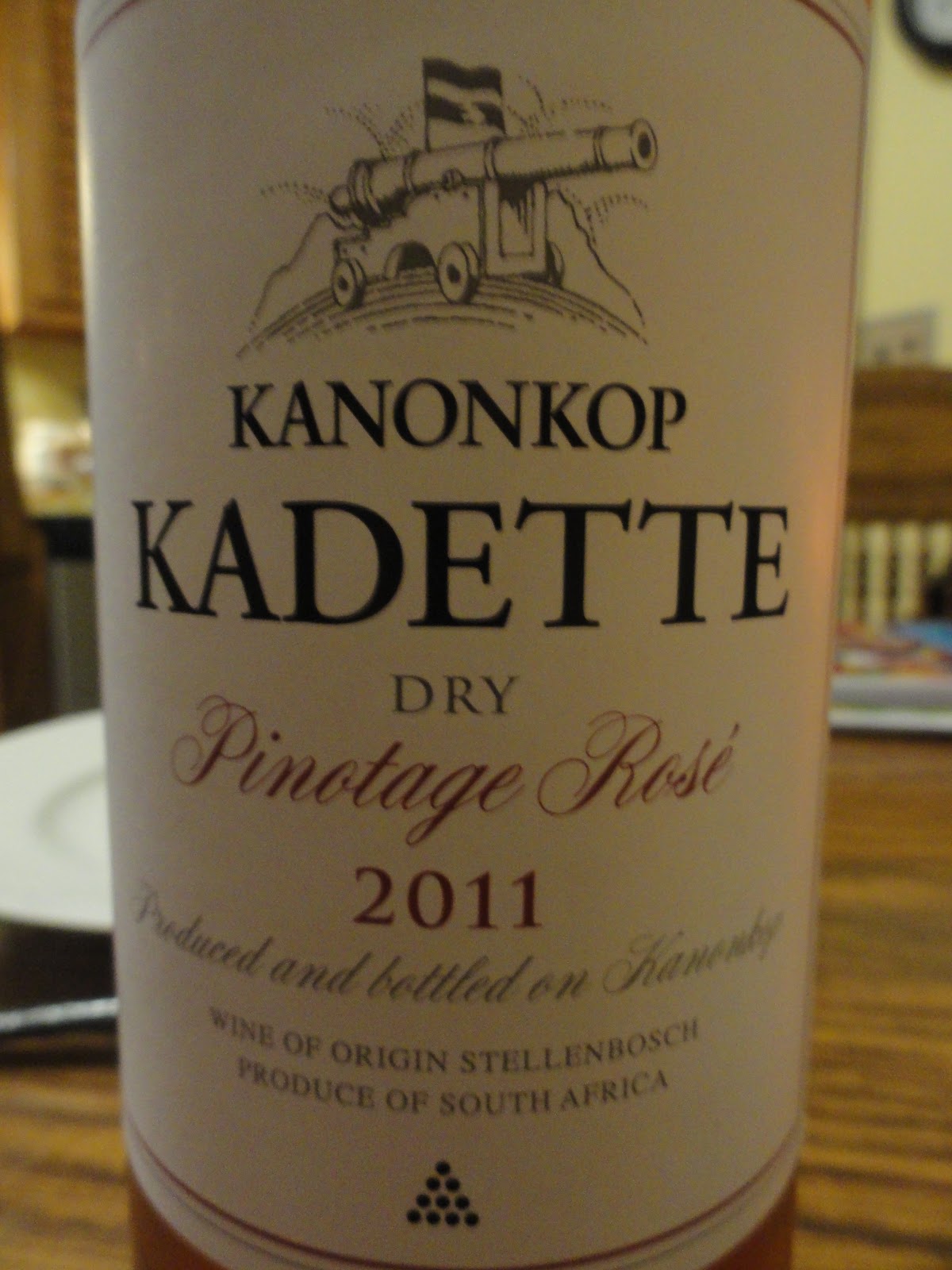
Pinotage Recommendations: Kanonkop Kadette Rosé & Lion's Drift

Why is Pinotage still such a divisive grape? In the past, there might have been some Pinotage wines that evidenced a nasty, burnt rubber aroma and taste, but that has largely vanished. Today's Pinotage wines have never been better, offering intriguing and compelling flavors and aromas. I have long been a fan of this grape and strongly recommend that all wine lovers check out these wines. Forget your old prejudices and give Pinotage another chance.

For more information about Pinotage, you might want to start with a fascinating book devoted to this grape, Pinotage: Behind The Legends Of South Africa's Own Wine by Peter May, which is now available as an ebook too. I previously reviewed this book and urge all wine lovers to check it out. Peter tells a compelling story and you will learn much.

I recently tasted two delicious Pinotage wines, including a Rosé, and both of these wines should convince skeptics of the wonders of this grape.

"Pinotage is the juice extracted from women's tongues and lions' hearts. After having a sufficient quantity one can talk forever and fight the devil."
--On a sign in the tasting room of the Kanonkop winery in South Africa.

The Kanonkop Wine Estate is one of the top wineries in South Africa and they produce some of the best Pinotage in the world. Located on the lower slopes of the Simonsberg Mountain in the Stellenbosch region, Kanonkop is a fourth generation family estate. The estate has about 100 hectares of vineyards, roughly 50% planted with Pinotage. Their Pinotage wines are complex, elegant and absolutely satisfying.  

Only recently though did I taste their Rosé, the 2011 Kanonkop Kadette Pinotage Rosé ($12), which is made from 100% Pinotage. If you tasted this blind, you never would realize that it was Pinotage as it doesn't fit any stereotype of a typical Pinotage profile. There were no smoky or bacon flavors. Instead, it was an easy drinking Rosé with tasty red fruit flavors, including raspberry and cherry. Excellent acidity, plenty of character, and a pleasant finish. It was more Old World in nature and I couldn't drink enough of it. It is an excellent food wine, as well as enjoyable on its own. Highly recommended and a very good value.

The 2009 Lion's Drift Pinotage ($18), from the Silkbush Mountain Vineyards, is another wine that is likely to surprise Pinotage haters. I received this wine as a media sample and it presents more of a New World flavor profile.

Silkbush Mountain Vineyards are located in the Breede River Valley and this is their first wine available in the U.S. The estate was purchased in 2000 by Californian Dave Jefferson and a group of American investors though it is managed by Anton Roos, a South African viticulturist. For more info on this winery, check out an informative article written by Peter May. The first vintage of Lion's Drift was 2008, so this wine was only the second vintage.

The 2009 Lion's Drift spent about 13 months in new French oak and has an alcohol content of 14.5%. This is a more fruit forward Pinotage, lush flavors of plum, black cherry and blackberry with a hint of vanilla and touch of spice. It is easy drinking with a good acidity and satisfying finish. It is very pleasant on its own, though would also pair well with foods such as burgers or pizza. This Pinotage is going to please many wine lovers and I give it my strong recommendation.

Stop hating Pinotage! Forget your preconceptions and just start tasting them again. I know you will be surprised at how good they taste.

Wednesday, January 25, 2012

Boston Wine Expo: Pinotage Rosé to Cape Verde

Here is a sampling of some of the other wines that I found interesting at the Boston Wine Expo, and I will be posting about even more wines this week too.

Long a fan of South African wines, I am even a lover of the Pinotage grape, a rather divisive variety which I don't feel gets enough credit. The quality of Pinotage wines continues to improve all the time. At the Expo, I found a delicious Rosé wine made from 100% Pinotage, the 2010 Fantail Pinotage Rosé.

Fantail is the second label of the Morgenhof Wine Estatesituated on the slopes of the Simonsberg mountains outside Stellenbosch. The winery dates back to 1692 and is currently owned by Anne Cointreau, part of the famed French liqueur company, and she was the first women to invest in South Africa post-apartheid. The winery is small, with 74 hectares under vines and only producing about 35,000 cases each year.

The Pinotage vines for this wine average about 15 years, and the juice receives about three hours of skin contact. It is a small production wine, sells for under $15 and has an alcohol content of 12.75%. It possesses a rich pink color, with a nose of red fruit, and on the palate it is crisp and dry, with tastes of strawberry and bright cherry. It is more an Old World style, and does not possess any of the negative characteristics that some try to attribute to Pinotage. If you tasted this wine, you probably would not even guess it was produced from Pinotage. But you very likely would enjoy it and it is well worth giving it a try.

Several New England wineries were present at the Expo and one of my favorites is Turtle Creek Winery of Lincoln. I posted about some of their wines last year, have written other posts about the winery, and am back with an update on some of their new wines. Kip Kumler (pictured above) is the owner and winemaker of Turtle Creek, a small, artisan winery which produces around 900-1000 cases annually. Kip is very passionate about wine and I believe he is a skilled winemaker.

As a treat, Kip was pouring a barrel sample of his 2010 Pinot Noir, the grapes being from the Carneros region. Though a bit rough, it showed plenty of potential with excellent red fruit flavors, good acidity and a touch of earthiness. This promises to be a very good wine when it is ready for bottling and I look forward to its release. The 2009 Syrah seemed to me to be even better than the 2008, possessed of deep, rich flavors, and being powerful but not overly tannic. Its complexity was attractive and it screamed out for a hearty steak. Check this one out.

Kip is introducing a special Reserve line and those wines will be identified with a black backed label rather than the usual white (and you can see that label above). Most of Kip's wine are priced $18-$20, and the Reserve line will be priced around $30. The 2009 Cabernet Franc Reserve appealed to me, possessed of ripe black fruit flavors, a spicy backbone, and no green, vegetal notes. This is my preferred style of Cabernet Franc so I was very taken with it. It has plenty of complexity, a long and pleasing finish and is well balanced. Another recommended wine and I look forward to more of his Reserve wines.

One of the most unique offerings at the Expo were two wines from Cape Verde, which was the first time the wines had been shown in the U.S. Cape Verde is an island country in the central Atlantic Ocean, consisting of about ten islands. During the 15th century, Portuguese explorers found the islands, soon after settling there and planting grape vines during the 16th century. Cape Verde gained its independence in 1975.

The island of Fogo (which is a Portuguese term for "fire") has an active volcano, which includes a nine kilometer wide caldera, and the island rises to almost 3000 meters above sea level. There is a small village, Chã das Caldeiras (“Plain of the Calderas”), situated within the caldera, not exactly the safest place to be cause of the active volcano. Most of the grape cultivation of Cape Verde occurs on Fogo, and actually within the caldera itself at altitudes of 1500-2000 meters. Wine has been produced in the caldera for about 120 years. The manual agriculture and harvesting is difficult work in this terrain. Two cooperatives, Chã das Caldeiras and Sodade, produce all of the wine and production is very small, only about 160,000 bottles annually.    

The first wine I tasted was the NV Chã Branco, made from 100% Moscatel and with an alcohol content of 14%. It has a light yellow color with an amber tinge and a nose of perfume and herbs. On the palate, there were flavors of flowers, herbs and spices with a mild grapefruit taste as well. It had decent acidity and a touch of sweetness. I would have enjoyed this with some spicy Asian food. The second wine was the Chã Passito, also made with late harvest Moscatel grapes but which had been dried in the sun. It only has an alcohol content of 10.6%. This was a sweet wine, though balanced with nice acidity, and there were flavors of honey, dried apricot, raisins and with some floral notes and even some minerality. Both wines were good and I would like to try more wines from Cape Verde.

Next time you visit a large wine tasting or expo, skip the California Cabernet and French Bordeaux and seek out the less common wines, the more unusual choices.

Update 1/15/12: I have learned that Beacon Hill Wine & Gourmet in Melrose will soon be carrying the 2010 Fantail Pinotage Rosé.

Monday, October 26, 2009

A Few, Delicious South African Wines

I am a big fan of South African wines, especially Pinotage, so when I found a table with such wines at the Wine Riot 2, I just had to taste their wines. I was even more excited when I found a wine using a grape that I had never tasted before, Bukettraube.

Heritage Link Brands is an importer and distributor of wine produced by indigenous African vintners and people of African descent throughout the world. I tasted wines from two of their producers, M'Hudi and Seven Sisters.

M'Hudi is derived from the Setswana word, “mohudi” meaning “harvester”. It is also the name given to the heroine of a great African story. The 2006 M'Hudi Pinotage ($17.99) is made from 100% Pinotage and comes from the Stellenbosch region. I enjoyed this wine with its dark berry and smoky bacon taste. There were some hints of vanilla as well, along with a moderately long finish. Definitely a food wine, especially wild game or BBQ.

The Seven Sisters are members of the Brutus family, evicted from their home at a young age and forced to move out of their small fishing village. Twenty years later, the sisters reunited, choosing to produce wine. Each of their wines is said to "match the styles and personalities of each sister" and "celebrate their bond and devotion to one another."

The 2007 Seven Sisters Pinotage/Shiraz-Dawn ($14.99) was pleasant, a smooth wine with lots of dark berry and spice flavors with a smoky finish. It is a simple wine but with plenty of taste. The 2008 Seven Sisters Bukettraube-Odelia ($12.99) is made from 100% Bukettraube, a grape I had never tasted before. The grape has Germanic origins, though South Africa currently produces the most wine using the grape. This wine had an intriguing floral and herbal nose, almost a cross between Viognier and Gewurtztraminer. The taste was exotic, with the floral and herbal elements present as well as some pear, honey and melon flavors. Such an interesting character to this wine, and an excellent bargain at this price.

If you have not tried many wines from South Africa, you really should do so. They are producing some very good, and sometimes very different, wines that are worth checking out.

Thursday, June 11, 2009

Pinotage: Behind the Legends by Peter May

How much do you know about Pinotage? You might only know that it is a grape that originated in South Africa. Even if you know a bit more than that, you probably still don't know a lot about the grape. But as Pinotage plantings continue to spread to many different wine regions, it is a grape you may start hearing about more and more. So maybe you should be learn more about this unique grape. Plus it wouldn't hurt to taste and try some different Pinotage wines.

I recently reported on the publication of a new book all about Pinotage. Well, I purchased the book, eagerly devoured it and have returned to review it. Pinotage: Behind the Legends of South Africa's Own Wine (Inform & Enlighten, April 2009, $31.50) was written by Peter May, who also authors the Pinotage Club blog. The book is a trade-sized paperback of 238 pages.

This is a very comprehensive book, covering so many different aspects of Pinotage, from its origins to its future. I learned plenty about this grape, much of the information probably not available elsewhere. Peter also helps to clarify the facts behind the myths surrounding Pinotage. I enjoyed the stories about Pinotage wine makers and wineries. Overall, I was very pleased with this book and certainly recommend it.

The book begins seeking the origin of Pinotage, which has been shrouded in error and mystery. Yet in the end, you will learn the truth of when Pinotage was created, which grapes were used, and how it spread through South Africa. It is almost a miracle that it ever happened at all. I was amazed at the role a simple paintbrush played in the creation of Pinotage, and that the creator, Abraham Izak Perold, never got to taste a Pinotage wine.

Peter next discusses the growth, production and marketing of Pinotage, providing examples of specific wineries. Learn the role of an office stapler for joining scion and rootstock. Ever hear of a kuipe? It is an open concrete fermentation tank used by many Pinotage producers. There is even a discussion of Stormhoek Winery, who became very popular in large part to wine bloggers.

Next up, there is an interesting discussion of the various styles and types of Pinotage wines available, including rosé, sparkling, and dessert wines. The most fascinating varieties included a Pinotage Grappa and Pinarone, an Amarone style Pinotage! Have you seen the term "Cape Blend" on some South African wines? You can learn about the origins of this term, and efforts to create standards for the use of that term.

Much of the rest of the book discusses the spread of Pinotage to other regions of the world. I bet you did not realize how many areas now grow Pinotage. Though I knew Pinotage was grown in New Zealand, I thought their efforts were rather recent and did not realize their first Pinotage wine was released in 1964, only five years after South Africa. Over twenty California wineries now grow Pinotage.

Pinotage is also grown in Virginia, Montana, Oregon, North Carolina, New York, Canada, Israel, Zimbabwe, Australia, Brazil, and Cyprus. And probably other wine regions by now too. New York was a surprise to me, though currently only a single winery near Seneca Lake produces a wine with Pinotage as part of the blend. Maybe Long Island wineries should give it a try.

Peter May has written an excellent and fascinating book about an intriguing grape and I recommend you check it out.

Friday, May 29, 2009

Golden Kaan: Values Wines of South Africa

We all want good value wines, especially if we can find bottles that cost $10 or less. There are plenty of wines in that price range, but some are much better values than others. I recently received samples of three South African wines, all priced at $10, and found them to be very good values. And if the winery can make such delicious, inexpensive wines, then maybe their higher-end wines are quite interesting as well.

The Golden Kaan winery has been around for about five years and their grapes come from select vineyards from the Western Cape region of South Africa. They produce three ranges of wines: Golden Kaan Classic, Golden Kaan Winemaker's Edition and Golden Kaan Private Collection. The three wines I tasted are from their Classic range.
The 2007 Golden Kaan Chenin Blanc ($10) is made from 100% Chenin Blanc, and the grapes come from vineyards in the Paarl and Malmesbury areas. 30% of the blend was aged in French oak for about three months, while the rest saw no oak. Thus, the fruit was allowed to take center stage. The wine has an alcohol content of 14.2% and only 977 cases were imported into the U.S. I enjoy Chenin Blanc and South Africa often does well with this grape. This wine had a moderate yellow color and a nice citrus nose. On the palate, it was crisp with good flavors of melon, lemon and a hint of grapefruit. It was full bodied with a touch of creaminess to the taste. There is a bit of vanilla too and a decently long finish. This would be a good summer wine and should appeal to many people.
The 2007 Golden Kaan Shiraz ($10) is made from grapes in the warmer areas around Paarl. The wine saw some aging in American oak, has an alcohol content of 14.1% and 4668 cases were imported into the U.S. This ruby colored wine had an enticing, red fruit nose with only the merest hint of spice. Up front on the palate, there was plenty of juicy fruit, some nice cherry, raspberry and plum. The spice notes were most prominent on the finish though they were still restrained. Tannins were mild. The fruit takes front place in this wine, yet it has enough character to make it a good value. I was most excited to taste the 2006 Golden Kaan Pinotage ($10) as I really enjoy the grape, and I was not disappointed. This wine was aged in French and American oak, has an alcohol content of 14% and about 9236 cases were imported. The wine was dark red in color and had an appealing nose of dark berries and smoky spice. It really pleased my palate, with luscious flavors of black cherry, ripe plum and smoky bacon. It was much spicier than the Shiraz and had a fairly long and satisfying finish. Tannins were restrained and this would be a great BBQ wine. Even those who don't like Pinotage may find they enjoy this wine. A very good value at $10 and one I highly recommend.

Wednesday, May 27, 2009

New Pinotage Book by Peter May

Are you a fan of Pinotage? If not, you really should try some of the latest Pinotage wines because they may change your mind about the grape. This is actually a special time for Pinotage as it is the 50th Anniversary of the world’s first Pinotage wine.

Besides celebrating with a glass of delicious wine, you might also want to check out a new book all about Pinotage, the first book of its kind. Pinotage: Behind the Legends of South Africa's Own Wine was written by Peter May, who also runs the famed Pinotage Club blog. He is very passionate about Pinotage as well as very knowledgeable.

The book "...tells of Peter F May's infatuation with the Pinotage variety and follows his investigations into its origins. He identifies when it was created and first planted and he discovers the oldest living Pinotage vineyard. There's a history of winemaking in South Africa and a biography of Pinotage's creator, Professor Abraham Perold. In the second part of the book May discusses growing, making and marketing Pinotage wines with case studies of classic South African vineyards. Various styles of Pinotage are discussed, the Cape Blend controversy is covered and criticisms of the variety are analysed. In the third section of the book, May takes a look at Pinotage in other countries. His travels take him from South Africa to California and Virginia, Canada, Israel and New Zealand."

This book sounds quite fascinating to me and I have already ordered a copy. I love Pinotage so this book is very appealing to me. If you have read Peter's blog, you know that he is an excellent writer so you should look forward to the book. I will review the book in the near future, but you may not want to wait for my review to buy it.

You can order the book from its website, especially if you want a signed copy. Or you can order it through Barnes & Noble or Amazon.

Saturday, July 5, 2008

2004 Fort Ross Vineyard Pinotage

Yesterday was time to try a new acquisition, the 2004 Fort Ross Vineyard Pinotage. I obtained some of this wine from Jill of Domaine547, who has been able to get me several hard to find California wines.

Last fall, I tasted their 2003 Fort Ross Vineyard Pinotage and absolutely loved it. So how would the 2004 vintage fare?

The Fort Ross website states that only 166 cases were produced of the 2004 Pinotage though the label states there were 175 cases. Either way, it is a small production wine. I should note that this is about half the production of the 2003 vintage. This seems based on the weather conditions during 2004, where the vines produced less grapes per acre. The 2004 Pinotage also saw 17 months in French oak, 20% new, while the 2003 vintage saw 15 months.

The 2004 Pinotage is similar in many ways in color, smell and taste to the 2003 vintage. The primary difference, though I don't think the difference is too pronounced, is that the 2004 seems to have more concentrated fruit and a bit less spice. It is still a hedonistic joy, a rich and complex wine that certainly pleased me very much. I may try the 2003 and 2004 Pinotages side by side sometime to get a better feel for their differences but I know I thoroughly enjoyed both. Overall, I highly recommend the 2004 Pinotage.

And in the near future, I will be tasting some of the Fort Ross Pinot Noir!

Monday, March 10, 2008

Kanonkop & Pinotage

"Pinotage is the juice extracted from women's tongues and lions' hearts. After having a sufficient quantity one can talk forever and fight the devil."
On a sign in the tasting room of the Kanonkop winery in South Africa.

While reading Around the World in 80 Dinners by Cheryl & Bill Jamison, they mentioned the above sign and it definitely caught my attention. I am not sure the origin of the saying, whether it originated with Kanonkop or they borrowed it from another source. Some initial research has not turned up anything but I will keep checking.

Wonder how much is sufficient as though I enjoy Pinotage, I don't think I have ever had enough to make me talk forever or fight the devil.

Thursday, February 14, 2008

South African Wines: Sizanani & Tumara

It is always a dilemma at the Boston Wine Expo. With nearly 2000 wines available for tasting, what do you select? You certainly cannot try more than a small fraction of all those wines. So you must make some hard decisions and be very choosy. Or end up like some of the people I saw at the Expo, staggering and slurring. That was not my goal.

For me, one of my planned stops was at the South African wine section. I am a big fan of their wines and I love good Pinotage. South African wines are still not as easily found in many wine stores so this would be an opportunity to try some new wines. I can taste California wines almost any time. But it is much more difficult to find a South African wine tasting.

One of my first stops was at the table of 57 Main Street Imports, who import numerous South African wines as well as other countries. In addition, through their Vision 57 programs, they help educational advancement and opportunity in the Western Cape of South Africa. For example, their Adopt-a-School Program gives 5% of the net proceeds of every bottle sold in the U.S. of their South African wines to beneficiary schools in the Cape of Good Hope. As another example, through their Wine for Literacy Program, shipping containers that drop off South African Wines in the U.S. are returned to South Africa containing books and educational materials. All very worthy charitable efforts.

I tasted two wines from their portfolio, a 2006 Sizanani Pinotage and a 2002 Tumara Titan. Both impressed me.

The 2006 Sizanani Pinotage (about $9) is produced through a partnership of Bellevue Wine Estate and over eighty members of its staff from previously disadvantaged population groups. They formed a new company called Stellenbosch Wine and Logistics (Pty) Ltd. with a focus on upliftment and empowerment. The aim is to achieve this focus through the production and trade of quality wines at real value price points, and through the provision of logistical services to the wine industry.

The range of wines they will produce include both red and white wines, single cultivars as well as blends. The focus will be on making wines that can be enjoyed at any occasion. They will be easy to enjoy wines, full of ripe fruit. Their label name, "Sizanani," is a Xhosa word that means "helping each other." Xhosa is one of the eleven official languages in South Africa.

The 2006 Sizanani Pinotage won't be available in stores until about June and when it is available, I would recommend that you buy it. The wine is a dark ruby in color with fresh berries on the nose. There is a lot of spice on the palate mixed with lush dark berry flavors. There are also hints of vanilla in the taste. This is definitely an easy-drinking wine, but with character, and is a Pinotage that should appeal to most, even those who generally don't care for Pinotage. For under $10 this is a very good buy. Drink this with a big, juicy burger!

The 2002 Tumara Titan (about $15-16) is produced by Bellevue Estate in Stellenbosch. Bellevue was founded in 1701 and have the oldest Pinotage vines in South Africa. The label name, "Tumara," derives from the name of the estate's beloved Arabian mare.

This wine is a Bordeaux-style blend of 66% Cabernet Sauvignion, 15% Merlot, 4% Cabernet Franc, 10% Malbec and 5% Petit Verdot. It was aged in 300L French Oak barrels (50% new) for about twelve months. The 2002 vintage was a cool and wet summer which resulted in a smaller crip with intense fruit.

I found the wine to have a medium ruby color with a strong nose of blackberry and raspberry. On the palate, the flavors of this wine just flowed over my taste buds. Lots of dark berries, vanilla, subtle spicy notes and a hint of smoke. It was a very smooth wine with a lingering finish. It is a bolder wine than many French Bordeaux but subtler than many California Bordeaux blends. It is said that this wine will continue to mature over 5-10 years. At this price, this wine is an exceptional value. You won't find too many wines of this complexity, character and flavor for under $20. This is another wine I highly recommend.

The Wine Expo started off very well for me as the first couple wines I tried were big hits. I hoped that the rest of the Expo would go as well.

Wednesday, December 26, 2007

The Pinotage Club-10 Year Anniversary!

The Pinotage Club, an excellent website dedicated to the Pinotage varietal, is celebrating its 10th Anniversary! Peter May, the founder and site author, is a personable advocate of Pinotage and his site provides much interesting information about the varietal and its wines. Not only does he cover Pinotage in South Africa, but he also covers Pinotage wherever it is grown, including the U.S., Canada, Israel and New Zealand.

If you have never checked out Peter's website, then you definitely should do so. It is a very well written wine blog and ten years is a very impressive achievement. Pinotage is also an underrated varietal and there are many good wines made from it. Go to Peter's website and learn more about Pinotage and find many recommendations.

Wednesday, October 24, 2007

2003 Fort Ross Vineyard Pinotage


Do you like Pinotage? Well, I certainly do.

Fort Ross Vineyard is located in the Sonoma County of California. They grow three only varietals: Pinot Noir, Chardonnay and Pinotage. Their Pinotage was first harvested in 2001. (For additional information on the winery, you can check out the excellent article on Dr. Deb's blog, Good Wine Under $20).

The Pinotage grown at Fort Ross consists of two proprietary clones that were developed from bud wood imported from one of the most select Pinotage vineyards in South Africa. They were the first vineyard to import such bud wood into California. It is one of the few California vineyards that grows this varietal.

The Pinotage spends about fifteen months in French oak, about 20% new oak. The Pinotage is typically barreled for between 12 and 18 months and racked just prior to bottling. It is unfined and unfiltered. Only about 400 cases of this wine were produced.

The Wine Spectator awarded this wine 91 Points and stated: "Pure and delicious, with a core of ripe blackberry, wild berry and cherry fruit that’s supported by lively acidity and & firm yet ripe tannins. Ends with a nice spicy, earthy quality. Drink now through 2011."

The Fort Ross Pinotage has received a lot of positive press. And as a big fan of Pinotage, I definitely wanted to try this wine. But it is currently not available in Massachusetts. So what was I to do? Luckily, Jill, a fellow blogger who also sells wines at Domaine547, was able to get me some of this Pinotage.

I opened a bottle last night and was thoroughly impressed.

The 2003 Fort Ross Vineyard Pinotage ($36) has a very dark purple color and an intoxicating nose of dark berries with a tinge of spice. This is a wine that beckons to you like the call of a Siren. When you taste this wine, its rich body swells in your mouth and fills it with lush blackberries, blueberries and black cherries. A hedonistic joy. Besides the fruit, there are tiny bits of smoke, cocoa, and spice that mesh well with the lush fruits. There is even a slight earthiness to this wine, mostly on the finish. The wine is very well balanced and provides an interesting melange of flavors. The tannins do not overwhelm and the finish lingers on and on, a very satisfying ending to a luscious wine. This is a sensuous wine, a delightful nectar that is sure to please. Overall, I highly recommend this wine as Drink & Buy.

In a previous post, I reviewed the 2004 Kanonkop Estate Wine Pinotage and issued a challenge: " If you don't think you like Pinotage, then I challenge you to taste this wine and see what you think."

I would issue that same challenge once again with this wine. Taste this Pinotage and I very much doubt then that you will be able to say you don't like Pinotage.