Thursday, January 28, 2021

Thursday Sips & Nibbles

I'm back again with a new edition of Sips & Nibbles, my regular column where I highlight some interesting, upcoming food & drink events. For now, some of these events will simply be the opening of certain restaurants, generally ones dear to my heart for a variety of reasons. And I hope everyone dines out safely, and tips well.
******************************************************
1) Red 8, the traditional Chinese restaurant within Encore Boston Harbor, will be offering a Lunar New Year Feast on February 11-21 for four guests. This feast is only available for dine-in only guests. 
This will be the first Lunar New Year where the new Red 8 Executive Chef, Richard Chen, will be at the helm. Chef Chen came from Wing Lei inside Wynn Las Vegas where he earned a Michelin star in both 2008 and 2009.

There are two Lunar New Year Feasts available, one for $188 for a table of four people (with $48 more per extra guest) and another for $288 for a table of four people (with $72 more per extra guest). Some of the dishes include Braised Fish Maw Soup, Braised Sea Moss with Golden Oysters, Crispy Chicken, Steamed Fresh Whole Fish, Red Bean Jelly Cake, Wok Tossed Lobster, and Sampan Dungeness Crab.  

To make reservations, log onto https://www.encorebostonharbor.com/dining-and-nightlife. For additional questions, please call (857) 770-3388. 

2) Oysters are delicious, but at $3-$4 each, they are often more of a luxury item. However, when you find $1 Oyster specials, then it's often the time to splurge on a dozen or more. Grill 23 & Bar, located in Boston's Back Bay is now offering Island Creek Oysters for just $1 each every Tuesday through Thursday, from 5pm-7pm. Island Creek Oysters are one of my favorites, and I love their briny taste. I'd recommend stopping by Grill 23 soon to savor some inexpensive and delicious oysters.

3) Local non-profit Rodman for Kids purchased $50,000 worth of gift cards from restaurants and culinary partners including Davio's, the Smoke Shop, Legal Seafoods, Flour Bakery, and more to be distributed to Rodman for Kids affiliate charities for families in need. After a year that hit the restaurant industry hard, Rodman for Kids sought to give back to the many Boston area chefs and restaurants that have supported the organization for years through their annual holiday gala, Celebration for Kids.

We at Rodman for Kids believe in community, collaboration and supporting organizations that care for and nurture youth, especially those most in need,” explained Rodman for Kids President Joe D’Arrigo. “We foster working together to achieve individual goals rather than competition. Through the years the restaurants and chefs of Boston have worked together collaboratively to support us. This was a perfect year to support them and in doing so feed families that our partner organizations care for. We believe in creating win-win scenarios." 

Rodman for Kids Executive Director Amy Rossman expressed the toll the pandemic has taken on the community, saying “Kids and families are facing unprecedented challenges as we navigate the pandemic. We could not let a cancelled gala stop us from supporting organizations who help kids overcome these challenges, and fortunately our sponsors and donors shared our resolve. We look forward to a time when we can gather for a Celebration for Kids again, but in the meantime we’re immensely grateful for a community of supporters who are committed to making a difference.

Rodman for Kids works year-round to raise funds for youth-focused social-service organizations supporting positive youth development and knows their work is a group effort amongst donors, sponsors, chefs, and more, making this latest initiative all the more important. While continuing their core-mission of helping kids and families, Rodman for Kids is excited to be able to expand their support by helping out the restaurants that have helped them make Celebration for Kids such a resounding success in the past.

4) Celebrate Valentine's Day, February 14,  from 5:30pm11:30pm, this year at Zuma, located in the Four Seasons One Dalton. Zuma will transform Valentine’s night into a Coney Island-themed getaway complete with a special omakase offering, champagne packages and special Valentine’s Day cocktails. From popcorn and snow-cones to psychic and tarot card readings, expect the unexpected as you strike a pose at the photo booth and score prizes from carnival-inspired games. 

In addition to serving up its signature menu, Chef Helmy Saadon has created a 13-course omakase experience that is as extravagant as the night’s theme. After supping East and West Coast oysters, indulge in a watercress and avocado salad, rock shrimp with lime and chili tofu, and sliced seabass sashimi with truffle. The next course includes grilled scallops and a chu toro tartare with ponzu, saikyo miso bun and caviar. For raw offerings, there is a selection of chef-selected sashimi and sushi and a fatty tuna roll with scallion and caviar. The entrée course comes fourfold with a Boston lobster served atop a miso bun, miso-marinated black cod, shiitake mushrooms with garlic and soy butter, and a US beef tenderloin with truffle ponzu and fresh shaved truffle. The culinary ride ends with a Valentine’s-themed dessert platter. 

Cost: Omakase: $135 per person; Tax & gratuity not included. A la carte items and supplemental items are priced separately.
Reservations are available by contacting (857) 449-2500 

Wednesday, January 27, 2021

Yuki Otoko "Yeti" Honjozo Sake: Like Melting Snow

What is that hairy creature on the label? 

It is the Yuki Otoko, the Snow Yeti. The illustration is from a 19th century book, the Hokuetsu Seppu, Snow Stories of North Etsu Province, written by Suzuki Bokushi. This book was an extensive work on the life in the snowy southern region of the Niigata region and became extremely popular. Bokushi was a textile merchant and author, and also is an ancestor of the Aoki Shuzo, the Sake brewery which now produces this Sake. The Yuki Otoko is alleged to inhabit the snowy mountains of Niigata, and sometimes helps travelers who are lost or in need of assistance in the mountains. 

The Aoki Shuzo was founded in 1717, making it over 300 years old, and it is located in Shiozawa, an area well known for both its quality rice and well water.  They are a very traditional brewery, and only produce Sake during the cold months rather than year round like some other breweries. The Niigata region is famous for producing a certain style of Sake, known as Tanrei-Karakuchi, which is light, crisp and dry. However, Aoki Shuzo aims for a slightly different style, what they call Tanrei-Umakuchi, which is crisp and dry but with more umami. 

It's also interesting to note that Aoki Shuzo donates part of their proceeds to support rescue efforts for hikers lost in the snowy mountains. emulating the Snow Yeti who was also said to assist hikers.

The Yuki Otoko "Yeti" Honjozo (about $28) is a premium Sake, made from only five ingredients: rice, water, yeast, koji-kin, and a little distilled alcohol. It was made with Gohyakumangoku and Koishibuki rice, polished down to 65%, a bit more than what is required to be a Honjozo. The Sake also has a 15.5% ABV, a SMV +8 (meaning its generally dry), and an Acidity of 1.2. It is said to be "Dry, light and clean like melting snow."It also can be served chilled, warmed, or at room temperature. 

I drank this chilled, and found it to be a clean and refreshing Sake, with a savory kick of umami. Subtle melon and citrus flavors with the umami taking center stage. This would be excellent for seafood, mushrooms, or truffle dishes. The umami of the Sake makes it even more food friendly. Or you can just enjoy this Sake on its own, slowly sipped and enjoyed. Highly recommended. 

Monday, January 25, 2021

Rant: How Much Should A Bánh Mì Cost?


In general, restaurants operate on very small profit margins. That's a fact that many people need to understand. Their menu prices are not intended to gouge your wallet but rather to support the functioning of the restaurant, to pay the bills, to pay their employees, and to hopefully give at least a small profit to the owner. Those are the same basic objectives of any for-profit business. 

Some people seem to believe that if they can find a food item for a cheap price somewhere, that the same item should be priced similarly everywhere. However, just because you might be able to get a cheeseburger for $1.00 at a large chain restaurant doesn't mean all restaurants should charge that price. There are numerous factors to consider in evaluating the price of a burger and whether it's reasonable or not. 

The same applies to the famed Vietnamese sandwich, the Bánh Mì. Some local Vietnamese restaurants have offered very inexpensive Bánh Mì, from $4-$5, and that has led some to believe that Bánh Mì, at any restaurant, shouldn't cost much more than that, and especially not over $10.  

I know two newer, suburban Vietnamese restaurants which charge $11-$12 for their Bánh Mì. I consider both to be reasonably priced and I don't see any reason to complain about the prices. Both places have received some feedback from others that their prices are too high, and I've also personally heard from a few people complaining about their prices. These complainers are failing to properly take into consideration all the factors going into pricing. 

For example, what is the cost of their ingredients? If they are using higher quality ingredients, then their costs are higher so they have to raise their prices. Would you rather that they used cheaper, lesser quality ones? Are they using just any baguette, or do they have a bakery especially making baguettes for them? How much work goes into the preparation of their Bánh Mì? Are they slow cooking their meats, marinating them over the course of a day or so? Are they making their own pickled vegetables? Are they using house-made sauces?

Consider as well that these Vietnamese restaurants are generally small businesses, not some large chains. They need to price their items appropriately so that their business can survive. In addition, they are often run by passionate people who want to serve their communities, to share their love for their native cuisine. Their goal is not to become wealthy but rather to make enough to live. If you speak to these owners, you won't get the impression they are trying to gouge or overcharge their customers. They are trying to fairly price their items.

Consumers need to start paying the true value of the food they consume. They shouldn't expect that certain types of food must always be cheap. They should think about their own business, and whether they would be happy charging the lowest price in the market for their services or products. Stop complaining about  Bánh Mì prices and simply enjoy that delicious sandwich.

Saturday, January 23, 2021

New Sampan Article: A Boston Origin of Duck Sauce?


"The most interesting feature of Chinese life to me was that on board their boats, or sampans, as they are called....Upon these boats live whole families of three and even four generations."
--The Fall River Daily Herald, November 20, 1888

As I've mentioned previously, I've a new writing gig, contributing to Sampan, the only bilingual Chinese-English newspaper in New England. I've previously written fourteen articles for Sampan, including:


My newest article, A Boston Origin of Duck Sauce?, is now available in the new issue of Sampan. Duck sauce is ubiquitous at most Chinese-American restaurants, and you can even find it at non-Asian restaurants. However, what is its origin? Was it an American invention? Is duck sauce just a renaming of plum or hoisin sauce? I explore the origins of duck sauce and find evidence that Boston could potentially be where duck sauce acquired its name. 

I'm currently working on a new article for the Sampan. 

What is a "sampan?" The newspaper's site states, "A sampan is a popular river boat in traditional China. This small but useful vessel, by transporting cargo from large boats to the village ports, creates a channel of communication among villages." And like that type of boat, Sampan delivers news and information all across New England, and "acts a bridge between Asian American community organizations and individuals in the Greater Boston area."

Sampan, which was founded in 1972, is published by the nonprofit Asian American Civic Association, "The newspaper covers topics that are usually overlooked by the mainstream press, such as key immigration legislation, civil rights, housing, education, day-care services and union activities. These issues are crucial to the well-being of Asian immigrants, refugees, low-income families as well as individuals who are not proficient in the English language."

There is plenty of interest in Sampan which will appeal to all types of readers, from restaurant reviews to historical articles, from vital news stories to travel items. In these current days when racism and prejudice against Asians and their restaurants is high, it's more important than ever that accurate information about the Asian community is disseminated and promoted. We need to combat the irrational prejudices that some possess, and support our Asian communities just as we would support any other element of our overall community. We are all important aspects of a whole, and we need to stand together.

Support Sampan!

Friday, January 22, 2021

Soall Viet Kitchen: A Bright & Tasty Spot in Beverly


Beverly continues to become a compelling culinary destination, and a few of my favorite restaurants there include A&B Burgers, Ellis Square Social, and Frank. I'm adding a new restaurant to my list of favorites, Soall Viet Kitchen, a Vietnamese spot which is located on Rantoul Street and open for lunch and dinner, from Tuesday to Sunday. 

This is actually a second location, the first being the Soall Bistro in Marblehead which opened in March 2012. The two owners are Sa Nguyen and Mia Lunt, close friends who desired to offer authentic Vietnamese cuisine, to highlight the culinary delights of their homeland. The name "Soall" is connected to their families, a combination of Nguyen's mother's name, Soa, and the first letters of Lunt's sons' names, Logan and Liem. As their website states, "Fresh herbs & vegetables, quality ingredients and minimal use of oil make Vietnamese one of the healthiest cuisines." 

I've had lunch three times at Soall (once comped by the owners), and intend to return to try more of the menu, as well as to enjoy some of my favorite dishes again. I've met and conversed with both Sa and Mia, who are very personable and obviously passionate about Vietnamese cuisine. They want to show their customers more than just Bahn Mi and Pho, to let people experience all the other culinary treasures to be found in Vietnamese cuisine. Even though this is their second location, they still have the difficulty of opening a new restaurant in a different city. In addition, opening any restaurant during the pandemic has plenty of its own obstacles. In short, I've generally been impressed with the quality and taste of the dishes I've eaten. 

The restaurant has indoor dining, and the tables are well spaced, and as soon as the Spring weather arrives, they will open their patio. Take-out and delivery are also available, and during my visits, take-out seemed popular.  They have future plans to open a small market within the restaurant, selling Asian items as well as some of their prepared foods. I'm eager to see this market come together.

Besides the regular tables, they have several seats at a small bar adjacent to the counter where you order your food. 


The Menu has plenty of options, and though much is authentic, they also allow themselves room for some creative takes. There are five main sections to the menu, such as Snacks & Salads (12 options, $5-$9), Bowls (vermicelli noodles, jasmine rice, or greens with 2 toppings, meat, poultry, seafood, veggie, $17), Noodles Soups (5 options, $14-$15), Bahn Mi (6 options, $11 each), and a few Special items like a Caramelized Pork Chop ($19) and Shrimp Tamarind Soup ($16). Prices are reasonable considering the quality of the ingredients, the work that goes into the creation of each dish, and their taste. 
 
They also sell wine, beer, and hard seltzer, and there appears to be some good choices available. Would be nice to see some Sake available, as it would pair very well with the cuisine. 

The Pork & Prawn Egg Rolls ($6) are also made with carrot, onion, taro, and glass noodles. An excellent, crispy and thin skin, with a tender, flavorful filling. Much lighter than the typical Chinese egg roll. 

The Spring Roll ($4) is available with shrimp, beef, chicken or tofu, and I opted for the Shrimp. As can be seen through the thin rice paper, the roll contained three good-sized shrimp, as well as a spring mix, cucumber, and mint. It was accompanied by a hoisin sauce and sriracha. Very fresh and light, with plump and tender shrimp. And that sriracha is hot! 

One of my favorite dishes was the Sweet Potato & Shrimp Fritters ($7), with sweet chili sauce. It was as if they made crisp noodles, though still with a touch of softness, out of the sweet potato and molded them together around a couple plump shrimp. A fine blend of flavors and textures, these fritters were excellent comfort food and the chili sauce was a nice accompaniment. I actually ordered these on two of my visits as I enjoyed them so much. Highly recommended.

I received a couple of the Braised Pork Ribs ($8) to sample, and the sweet sauce on the ribs was quite compelling, with a definite Asian flair. The sauce wasn't overly sweet, and possessed a savory element that helped balance the sweet. The ribs themselves were meaty and tender, and it was easy to clean them down to the bone. 

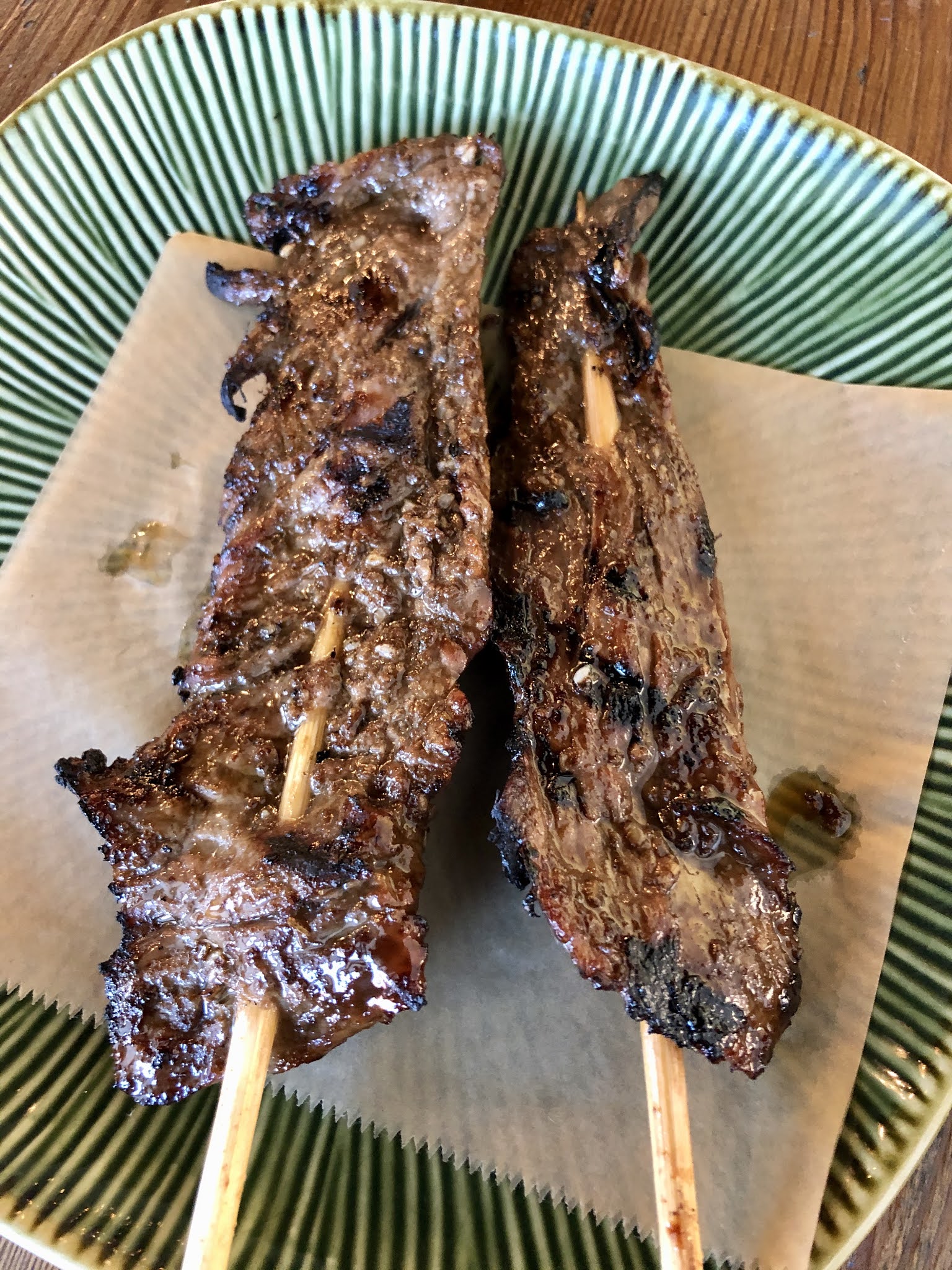
The Grilled Beef Skewers ($8), made with garlic, soy, lemongrass, and honey, were also very tender and flavorful, again not too sweet. In addition, they possessed a very pleasing and enticing aroma. 


The Steamed Bao ($8), which you can order with shrimp or pork, is also made with cucumber, pickled veggies, and Vietnamese mayo (though I omitted the mayo on mine). I opted for the pork and as you can see, they well filled the two soft bao. The tender pork was very thinly sliced and burst with flavors that reminded me a bit of the ribs. The pickled veggies added a crunchy aspect, as well as some different flavors, to the softer meat and bao. Also highly recommended. 


They serve six different types of Bahn Mi ($11), made with cucumber, cilantro, jalapeño, Vietnamese mayo (again omitted for me), and I chose the Roasted BBQ Pork for my main filling. This pork may be the same as in the Bao, and definitely is very tender and possessed of much delicious flavor. The baguette is nice and crunchy on the outside, and much softer inside. An excellent choice for lunch.


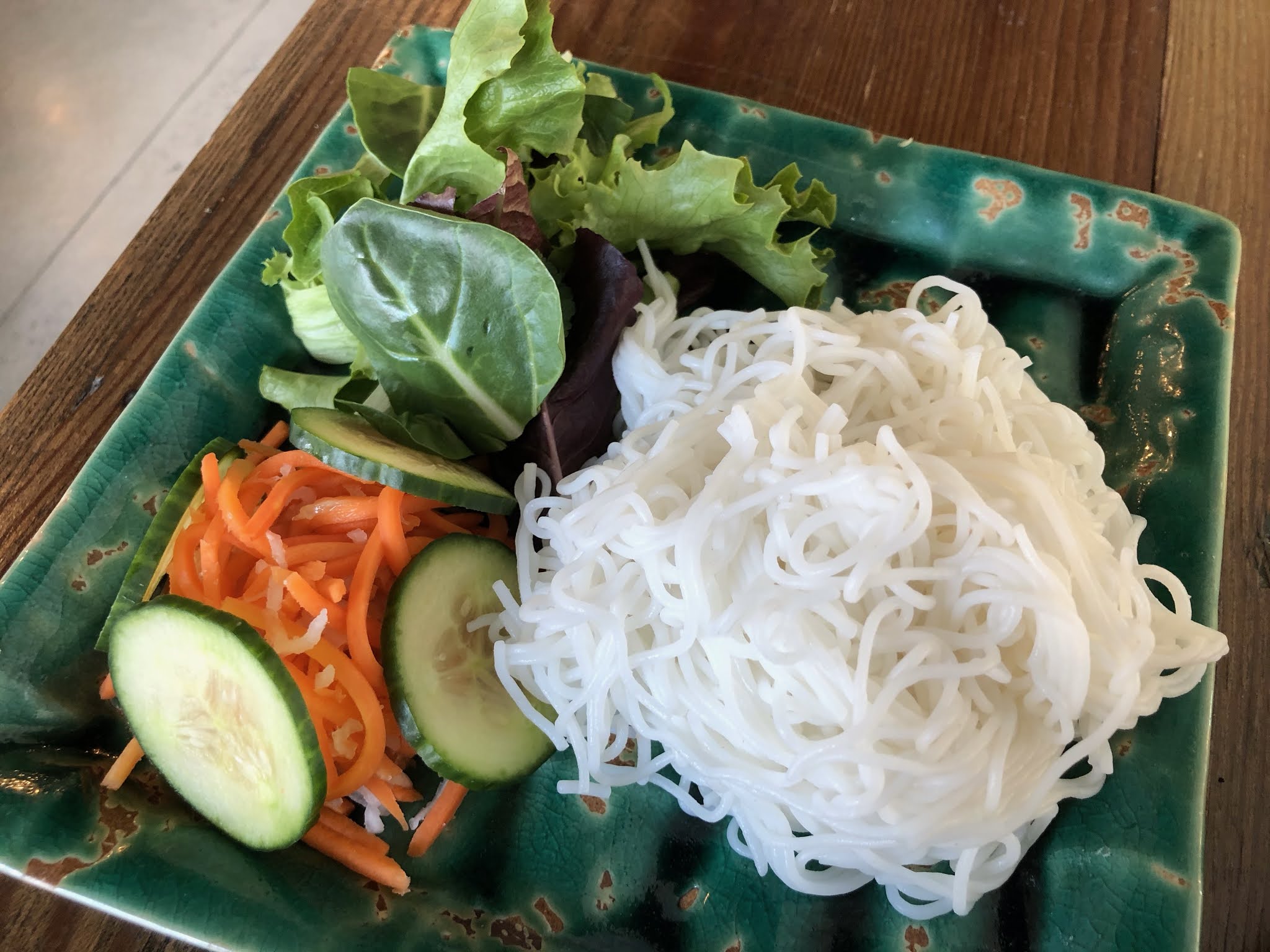
I was thoroughly impressed with the Clay Pot, which is made with either Salmon ($16) or Chicken ($14). I chose the chicken, which was cut into small chunks and prepared within a caramelized sweet and savory sauce, which is served bubbling hot. To accompany the dish, you have your choice of jasmine rice, vermicelli noodles or salad, and you also received cucumber, pickled daikon, and carrot. The chicken was moist and tender, and the sauce possessed a great depth of flavor, which you were supposed to pour atop your accompaniments. The sauce was nicely balanced between sweet and savory, and I could easily see this sauce atop seafood, beef, or basically any protein. The veggies kind of acted as a nice palate cleanser to the richer sauce. Highly recommended. 

 
Overall, Soall Viet Kitchen earns my hearty recommendation and I'm eager to return to try more of their menu. The food was fresh, well-prepared, delicious and reasonably priced. Service was very good and everyone who works there is personable and professional. Soall is still relatively new to Beverly, so it will be intriguing to see how it develops, including when they eventually open their market. I wish Sa and Mia much luck in this new endeavor. Beverly has a new culinary gem, enhancing its growing reputation for excellent restaurants.