Monday, September 19, 2022

Rant: Eat More Mussels!

This past week, I traveled to Nova Scotia for vacation and enjoyed plenty of delicious seafood, from Seafood Chowder to Lobster Poutine. I also ate a seafood that is is inexpensive, delicious, very healthy, and an excellent sustainable choice. I'm referring to Mussels. 

Mussels are bivalve molluscs, generally from the marine family Mytilidae, and may inhabit both freshwater and saltwater. There are numerous types of mussels, about 17 which are edible, including blue mussels, green-lipped mussels, and zebra mussels. Interestingly, few people now eat freshwater mussels, though the Native Americans used to consume them frequently.

The delectable wild mussel has been consumed for thousands of years. In ancient Greece, mussel shells were used as ballots in voting. Farmed mussels extend back at least to the 12th century, when they were cultivated in the waters off the coast of France. The Pilgrims probably feasted on mussels during the first Thanksgiving, though they also fed them to pigs. In the U.S., during World War II, mussels were a common dish at diners because beef was rationed and thus rare.

Farmed mussels are one of the most sustainable forms of aquaculture, and you would be hard pressed to find any opposition to its practice. First, mussels are both easy and quick to grow, better than probably any other bivalve. Second, mussels are filter feeders, which eat algae, plankton and other microscopic sea creatures, and help to purify the water. They make the oceans cleaner which is a great benefit. Unlike many other seafoods, there isn't a worry about how much other fish are needed to feed them. And these farming operations aren't creating pollution, but instead help to clean the waters.

Mussels are also a healthy choice, one of the best seafoods you can consume. They are a good source of protein, with the added benefit of being low in calories and saturated fats. In some respects, that makes it a better choice than beef. In addition, mussels are a good source of selenium, vitamin B12, zinc and folate. Most importantly, mussels also possess a significant amount of Omega-3 fatty acids, which is important in reducing the risk of heart disease. A 3 ounce portion of mussels contains about 700 milligrams of Omega-3s, placing it high on the list of seafood with significant amounts of Omega-3 fatty acids. Plus, mussels have a far less risk of mercury and PCBs. In many ways, mussels are an excellent nutritious choice and should be a regular visitor to your dinner plate.  

What do mussels cost? Are they expensive? They are actually a very affordable choice, commonly under $5 per pound, making it a good value. Even at restaurants, mussel dishes ate generally relatively inexpensive. With the rising costs of beef, pork and chicken, it makes sense to purchase something like mussels instead. You'll get your protein, as well as all of the other health benefits, from vitamins to Omega-3s. At restaurants, mussel dishes are usually inexpensive as well. Scratch off another objection.

Many people complain that it is too difficult to cook seafood, but mussels are very simple. You can steam them in only 5-10 minutes, and you know they are done when the shells have opened. It couldn't be much easier. Though you can steam them in just water, you can use any liquid, and such liquids can imbue the mussels with a diversity of flavors. Try Sake or beer, or create your own special broth. Mussels are also versatile, and can be prepared in many other methods, in all types of cuisine. 

Another interesting bit of trivia is that you can tell the sex of your mussel based on the color of its meat. The meat of male mussels tends to have a tan color while female mussels tend to be orange. So the next time you enjoy a big bowl of mussels, try to determine their sex.

In 2009, the worldwide supply of farmed mussels was approximately 4 billion pounds, with China accounting for about 40%. In Europe, Spain is the leading producer of mussels. In 2010, the United States imported most of their mussels, with about 47% being imported from Canada and 42% from New Zealand. This was actually the first year that Canadian imports were greater than New Zealand. Within Canada, Price Edward Island (PEI) exports about 88% of all Canadian mussels, with Newfoundland and Nova Scotia occupying second and third place.

U.S. mussel production is only about 700,000 pounds, the majority grown in Maine with a smaller portion grown in the northwest region, especially Washington. The U.S. has much room for growth in this area, and should move forward to expand mussel aquaculture. Instead of importing most of our seafood, we should be finding ways to produce more domestic seafood, including mussels. They are sustainable and good for the ocean.

What is your favorite way to eat mussels? What restaurants have the best mussel dishes?

Thursday, September 15, 2022

Peruvian Taste Restaurant: 2nd Anniversary Specials

Two years ago, as the pandemic raged, Peruvian Taste Restaurant opened in Charlestown. It's located, almost hidden, in a heavily industrial area and it's not a place you would easily stumble upon. However, it's impressive and well worth seeking out. Check out my prior review for more background on the restaurant and a look at some of its delicious cuisine.

One of their specialties is Chifa, a tasty fusion of Peruvian and Chinese cuisines, and Peruvian Taste has more Chifa dishes, easily a dozen, than any other local Peruvian restaurant. Check out my prior article about the history of Peruvian restaurants and Chifa in the U.S. 

For their 2nd Anniversary, only on the weekends of September (and not available for take-out or delivery), they are running a number of food specials including:
  • Conchitas a la Parmesana ($12): Four scallops on the shell baked with parmesan cheese, white wine and butter,
  • Min Pao Special ($15): Chifa steamed bun, inspired by Barrio Chin original recipe containing chicken, pork, steak, quail egg, on a flavorful Chinese sauce.
  • Seco de Cordero a la Norteña ($26): Lamb shank slowly cooked after being marinated overnight with a cilantro sauce and peruvian spices, served with rice, beans and boiled yucca.
  • Causa Acevichada ($18): Traditional cold mashed potatoes with aji amarillo and lime juice filled with avocado and mayonnaise, shredded chicken layered with ceviche and fried jumbo shrimp.
  • Tay Pa ($31): Stir fried chicken, steak, shrimp, pork, mushrooms, snow peas, red peppers, boo choy, Chinese cabbage, string beans and broccoli. 
It's a small restaurant so I advise you to make a Reservation by calling 617-242-5100. If you can't make it for these Anniversary specials, then I highly recommend you dine there another time. 

Wednesday, September 14, 2022

Channel Marker Brewing: A Killer Popsicle Style Sour Ale

As my regular readers know, I rarely write about beer, but sometimes I taste a particular beer which truly excites my palate, and I share that experience. Last week, I tasted just such a killer beer, from a local brewery in Beverly, and I even purchased a four-pack because I enjoyed it so much. 

Channel Marker Brewing is located on Rantoul Street in the Porter Mill building in Beverly, and it was formed by three friends, Justin Negrotti, Jake Crandell, and Tim Corcoran. They initially began brewing beer in Justin's garage in 2013, and launched their brewery in 2017. 

As their website states: "Channel Marker Brewing offers a perpetually changing menu of hand crafted, bright, and explorative microbrews. Our pride in freshness and quality compels us to keep production in-house, brewing everything on our five-barrel brewhouse. This small batch size gives us the freedom to brew experimental beers and our approach allows us to package several fresh batches every week. We have an affinity for brewing heavily fruited, expressive sours and hop-forward New England style IPA’s, but we offer a well-rounded portfolio of beer that includes lagers, stouts, porters, and more."

One of the beers that they are currently producing is Propeller, a Cherry Vanilla Popsicle Style Sour Ale. Popsicle style ales seem to be have been around for at least a few years, although this is the first one I've ever tasted. This particular beer has a 6.3% ABV, and is said to be a "Sour Ale brewed with sweet cherry, tart cherry, vanilla beans and milk sugar." 

Thie ale has a deep, rich pink color, and when you take a sip, the front of your palate is struck by bright cherry flavors, with a hint of tartness, The flavors then transform in your mouth, finishing with creamy vanilla notes, and the cherry taste becomes more subtle. I was enamored with how the delicious flavors evolved over my palate. In addition, it presented with only a mild hint of sweetness, which pleased me as well. Highly recommended!

You should visit their brewery in Beverly, and even though they don't have a kitchen, they usually have a food truck on the premises. In addition, Rantoul Street has some cool restaurants, including Soal Viet Kitchen, Frank, and Butter "Ur" Biscuit.  If you can't make it to their brewery, you can purchase some of their beers, including the Propeller, at Beacon Hill Wine & Gourmet in Melrose.

Tuesday, September 13, 2022

Jagunić Winery in Plešivica: Tasty Bubbly & Amber Wines

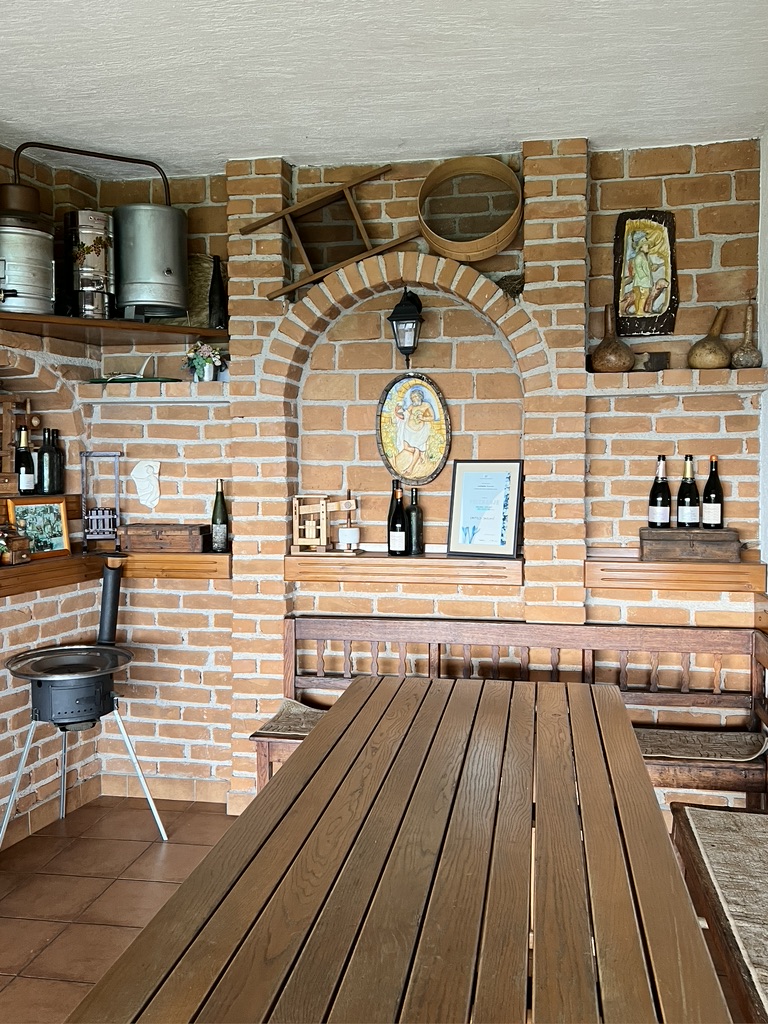
Continuing our visit to the Croatian wine region of Plešivica, our next visit was to the Jagunić Winery, located in Plešivica. We were looking forward to sampling more Sparkling Wines and Amber wines, hoping to continue to find excellent examples from this region. We were certainly not disappointed, and also enjoyed a delightful lunch. 

Jagunić is a family winery, owned and operated by 3 brothers, and our host was the oldest brother, Dominik. Dominik went to school for wine, finishing college in 2011, and he began making wine in 2013. His father "retired" from the operation of the winery in 2017, however he actually still works in the vineyards, and probably won't stop until he is physically unable to do so. True passion for the vine.

Dominik provided us some of his thoughts on the Plešivica region. First, he mentioned that the region can easily grow at least 30 different grapes however it doesn't currently have a signature grape, like many other regions. Even though this may be the case, I think Plešivica could make a case for having a signature type of wine, Sparkling. Dominik noted that the terroir of the region is excellent for bubbly, and it also fills a hole in the market. He also stated that there are few indigenous wineries in the region as most of those grapes are best for Sparkling wines and not still wines.   

Around 10-11 years ago, Jagunić started producing Sparkling wine and now it constitutes about 40% of their production. Annually, they only produce roughly 4,000 cases of wine and grow nearly all of their own grapes. They make three labels of Sparkling wine, including a Blanc de Blancs, made from 100% Chardonnay. Their first vintage for that wine was 2016 and currently only about 1560 bottles of the wine are produced. Nearly all of their Sparkling Wine, except the Blanc de Blancs, are non-vintage. However, the bubbly usually only has about 15% from another vintage so technically they could label it as vintage if they so desired. Dominik also told us, that "If you have a good base wine, your Sparkling wine can be three times better, but if you have a poor base wine, then the Sparkling wine will be five times worse."

In addition to their Sparkling wine, Jagunić also make 4 labels of Amber wines, all 100% varietal, including Pinot Noir, Traminac, Riesling, and Pinot Gris.


From the back porch of the winery, we could look out over their vineyards of Traminac (aka Gewürztraminer), which were planted in 2006, when Dominic started college. They believe the grape is ideal for sweet/dessert wines.  

We began out tasting with the NV Jagunić Three Stars Brut, produced in the Méthode Champenoise, from a blend of 40% Chardonnay, 10% Riesling, and 50% of a field blend of local varieties. The grapes come from three different vineyards, their best sites, and this particular wine was primarily from the 2019 harvest. Each year, the blend varies some, and the wine was a 12.5% ABV.  This wine is their main product, and it's available in Massachusetts, for around $30. It was fresh and crisp, with tiny bubbles, and a pleasing blend of flavors, including green apple, pear, a hint of brioche, and a lengthy finish. An excellent way to begin our tasting.


During the tasting, lunch was served, and we began with a light course of a domestic beef soup with home-made pasta. The broth and noodles were delicious, the broth possessing a nice depth of flavor. A very simple soup but compelling nonetheless. 

We moved onto the NV Jagunić Blanc de Noirs, which was made from 100% Pinot Noir, spent two years on the lees, and had a 12.5% ABV. This was an interesting wine, with upfront cherry notes but with a mild smokiness permeating the rest of the taste. Good acidity, some intensity in the taste, and a richer mouthfeel. A very different Sparkling wine.

The NV Jagunić La Bulle Rose, made from a blend of 70% Blauer Portugieser and 30% Pinot Noir, had a 12.5% ABV. The first vintage of this wine was 2016, and they initially experimented with a 100% Blauer Portugieser wine but found it lacking. Thus, they added some Pinot Noir to fill what they felt was missing. This wine is produced for the summer, and was bright, light and crisp, rwith tasty red fruit flavors. I think this would be another excellent wine for Thanksgiving too.  

A fresh and simple Salad was then served for lunch.

The centerpiece of our Lunch was a platter of veal neck, chicken filet (stuffed with cheese and ham), potatoes, and vegetables, all prepared under a Peka. Check out my prior post for more details about the Peka, such a superb way to prepare a meal. Our lunch was prepared by Dominik's mother, and it was delicious, with very tender and flavorful meats. 


There was also fresh home-made bread, with an excellent crusty exterior and a pillowy soft interior. This was all pure comfort food, and went very well with the wines. 

As for Amber wines, we enjoyed the 2020 Amber Pinot Crni (Pinot Noir), which underwent 7 months of maceration. With a 13.4% ABV, the wine had a light red color, and an interesting nose of red fruit. On the palate, it was bright and dry, intense and intriguing, with tart cherry flavors and hints of spice. A very pleasant and interesting wine.

I was also enamored with the 2020 Amber Traminac Crveni, with a 13.1% ABV. An alluring nose of tropical fruit, herbs and floral elements, all of which also come out on the palate. Firm but restrained tannins, honey notes, bright spices, kiwi and pineapple, and a lengthy, satisfying finish. Such an intriguing wine, bringing new flavors to your mouth with every sip. Highly recommended. 

Our visit to Jagunić Winery continued to confirm my respect for the wines of the Plešivica region, especially their Sparkling and Amber wines. Plešivica is also a region of natural beauty. In addition, we enjoyed a delicious lunch, and if you visit the Dalmatian region of Croatia, you must have a Peka experience, and preferably at someone's home rather than a restaurant. 

Monday, September 12, 2022

Rant: Give Respect To Hybrid Grapes

This week, I'm visiting Nova Scotia once again, with plans to visit some of the wineries of the Annapolis Valley. I'll definitely be returning home with wine, at least a case, and most of those wines will have been produced from hybrid grapes. As such, I wanted to bring back an applicable older post, with some revisions and updates, advocating for respect for hybrid grapes.

I feel sorry for grapes like Baco Noir, Frontenac Noir, Marechal Foch, Seyval Blanc and others. Though they are used to make wine, with a number of excellent examples, they often get very little respect because of their parentage. These grapes are known as hybrids, not pure vitis vinifera like Cabernet Sauvignon or Chardonnay. 

Because they are not "pure," too many people look down upon them, sometimes even shunning them. They don't give those wines a chance, rejecting them without even tasting them. Shouldn't these hybrid grapes be judged by the quality of their wine rather than the identity of their parents?

Vitis vinifera is the common grape vine and the one most used for making wine. All of the major grapes of which you are familiar are likely these types of grapes, from Pinot Noir to Syrah, from Sauvignon Blanc to Pinot Blanc. Hybrids are a cross of two or more Vitis species, such as vitis vinifera and vitis labrusca. They are often created to produce a hardier grape, especially for harsher, colder northern climates. Because they are not pure vitis vinifera, some people turn up their noses at these hybrids, refusing to believe they can produce quality wine. 

Drop that pretentiousness and judge these wines by their taste. 

Many of the wines made in Nova Scotia are made from hybrid grapes, but they are still worthy of respect. I've previously enjoyed other Nova Scotian wines, made from hybrids, and they have been delicious, and definitely wines I'd recommend. I'm looking forward to tasting more new wines in Nova Scotia, seeing what the hybrid grapes bring to the bottle. 

Sure there are poor quality wines made from hybrids, but there are plenty of poor quality wines made from vitis vinifera too. Yet there are excellent wines made from these hybrids as well, and a wine lover would be hard pressed to guess they were hybrids simply from tasting the wine. You should approach a wine without prejudices or biases, willing to taste the wine and let it stand on its own. If you do so, you will probably find plenty of delicious wines that you might never have experienced otherwise.

It has gotten to the point that some fans of hybrid grapes don't even want to use the term "hybrid," to avoid the prejudices that the term can spawn. I believe we should embrace the term, and don't try to hide what is being used. Instead, we need to fight the prejudice by getting these people to taste these wines, to understand the quality that can be found within them.

So get over yourself and stop prejudging hybrids. Drink the wine before making any judgments. Judge a wine on its taste, not its parentage.