Showing posts with label hybrid. Show all posts

Monday, September 12, 2022

Rant: Give Respect To Hybrid Grapes

This week, I'm visiting Nova Scotia once again, with plans to visit some of the wineries of the Annapolis Valley. I'll definitely be returning home with wine, at least a case, and most of those wines will have been produced from hybrid grapes. As such, I wanted to bring back an applicable older post, with some revisions and updates, advocating for respect for hybrid grapes.

I feel sorry for grapes like Baco Noir, Frontenac Noir, Marechal Foch, Seyval Blanc and others. Though they are used to make wine, with a number of excellent examples, they often get very little respect because of their parentage. These grapes are known as hybrids, not pure vitis vinifera like Cabernet Sauvignon or Chardonnay

Because they are not "pure," too many people look down upon them, sometimes even shunning them. They don't give those wines a chance, rejecting them without even tasting them. Shouldn't these hybrid grapes be judged by the quality of their wine rather than the identity of their parents?

Vitis vinifera is the common grape vine and the one most used for making wine. All of the major grapes of which you are familiar are likely these types of grapes, from Pinot Noir to Syrah, from Sauvignon Blanc to Pinot Blanc. Hybrids are a cross of two or more Vitis species, such as vitis vinifera and vitis labrusca. They are often created to produce a hardier grape, especially for harsher, colder northern climates. Because they are not pure vitis vinifera, some people turn up their noses at these hybrids, refusing to believe they can produce quality wine. 

Drop that pretentiousness and judge these wines by their taste. 

Many of the wines made in Nova Scotia are made from hybrid grapes, but they are still worthy of respect. I've previously enjoyed other Nova Scotian wines, made from hybrids, and they have been delicious, and definitely wines I'd recommend. I'm looking forward to tasting more new wines in Nova Scotia, seeing what the hybrid grapes bring to the bottle. 

Sure there are poor quality wines made from hybrids, but there are plenty of poor quality wines made from vitis vinifera too. Yet there are excellent wines made from these hybrids as well, and a wine lover would be hard pressed to guess they were hybrids simply from tasting the wine. You should approach a wine without prejudices or biases, willing to taste the wine and let it stand on its own. If you do so, you will probably find plenty of delicious wines that you might never have experienced otherwise.

It has gotten to the point that some fans of hybrid grapes don't even want to use the term "hybrid," to avoid the prejudices that the term can spawn. I believe we should embrace the term, and don't try to hide what is being used. Instead, we need to fight the prejudice by getting these people to taste these wines, to understand the quality that can be found within them.

So get over yourself and stop prejudging hybrids. Drink the wine before making any judgments. Judge a wine on its taste, not its parentage. 

Wednesday, November 10, 2021

More Baco Noir from Nova Scotia: Blomidon Estate & Domaine de Grand Pré

In a recent post, I reviewed the 2020 Saint-Famille Lost Bell Baco Noir, providing information and history about the Baco Noir grape. Now, I've tasted two more Baco Noir wines from Nova Scotia, giving me a bit more experience with how this intriguing grape is being produced in this region.  

The first of those two wines is from the Blomidon Estate Winery, and you can find more background on this winery in another of my recent posts, a review of a Blomidon Crémant. The 2019 Blomidon Estate Baco Noir ($22) is made from 100% Baco Noir, but the winery's website lacks any details of its production process, although it seems like it has seen some aging in American oak and it only has a 12% ABV. 

The wine has a medium-red color with pleasing aromas of red and black fruit with a touch of spice. On the palate, it was smooth and juicy, with rich black and red fruits, including some cherry and blackberry, complemented by some vanilla and other spices. Mild tannins, good acidity, and a nice finish. A very tasty wine, it was my favorite of the three Nova Scotian Baco Noirs wines I've tasted recently. It had more character and complexity than the other two, and would be excellent on its own or paired with food. I enjoyed it with some turkey tips, and it would go well with plenty of dishes, from pizza to burgers. 

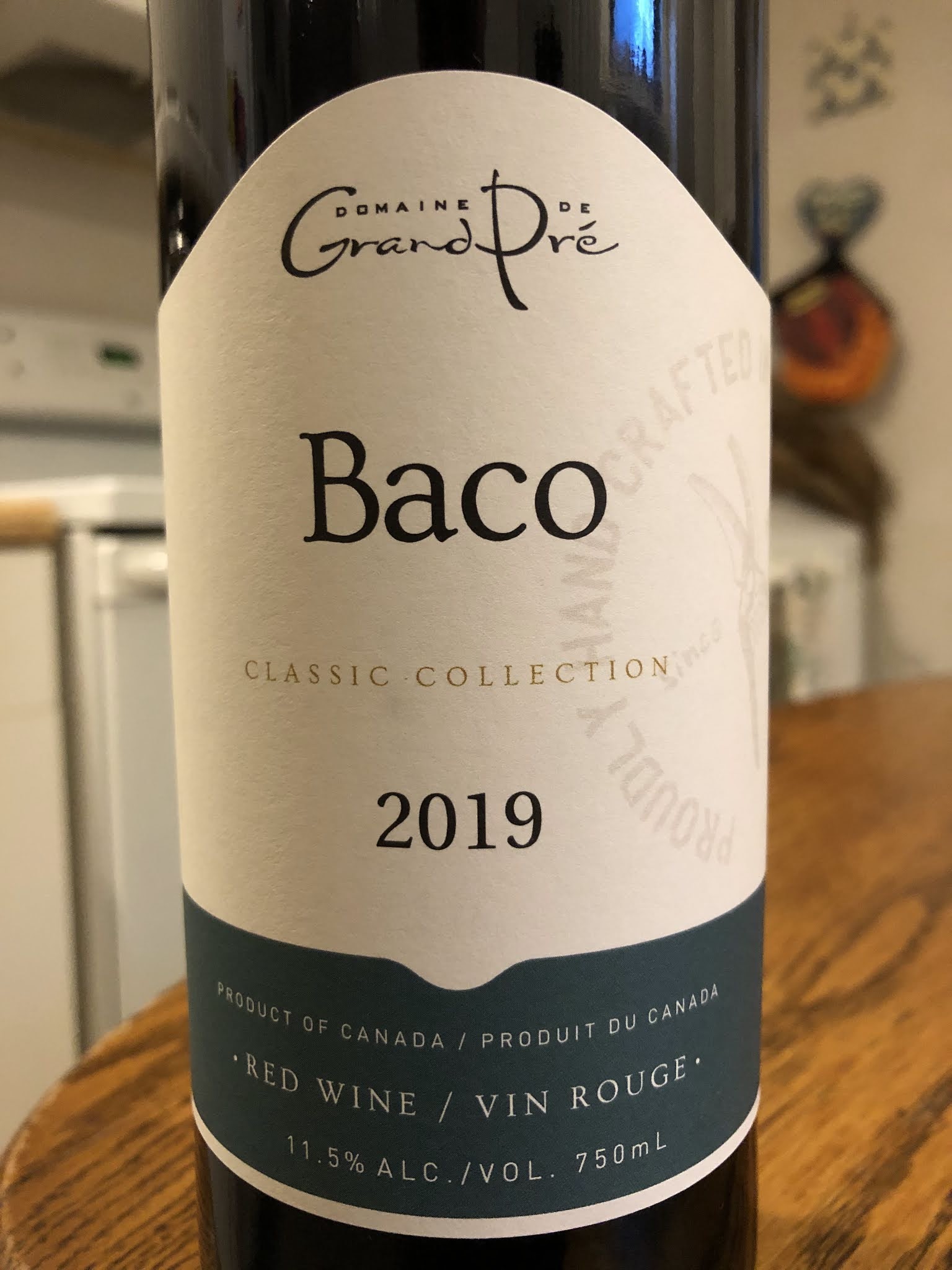
The original Domaine de Grand Pré winery was founded in 1979, making it the oldest farm winery in Atlantic Canada. In 2000, the winery was reopened by Hanspeter Stutz, a native of Switzerland, with his son, Jürg, a Swiss trained winemaker. The 2019 Domaine de Grand Pré Baco Noir ($16) might be a new product for this winery as it isn't even listed on their website. It's a simple, easy drinking red wine, with strawberry and black cherry flavors, and a touch of pepper. The tannins are a bit stronger than the Blomidon, so this wine is probably better served with food.

Monday, November 1, 2021

2020 Saint-Famille Lost Bell Baco Noir: A 100+ Year Old Hybrid

"Among these wines, Baco Noir is the only eastern cheese partner. It is a full-bodied red from a grape of the same name, which makes it a 'varietal' wine. The grape is expected to have a great future in eastern winemaking."
--Chicago Tribune, November 3, 1968 

Baco Noir is a French hybrid grape, whose origin extends back to 1902, though it was initially called Baco 24-23. It didn't become known as Baco Noir until 1964 and very little is currently grown in France. In the early 1950s, the grape was planted in North America and currently you'll find it grown in various states as well as Canada, including Nova Scotia. 

I've enjoyed Baco Noir before, primarily from the Hudson-Chatham Winery in New York, and they have ended up on my prior Top Ten Wine lists. I also previously highlighted some intriguing historical items, found in old newspapers, concerning the some of the earliest mentions of Baco Noir grape in North America, 

Recently, I tried a Baco Noir from Nova Scotia, the 2020 Saint-Famille Lost Bell Baco Noir (about $20). Saint-Famille Wines is located in Falmouth, on a hill overlooking the Avon River Valley. This region was settled by the Acadians around 1685 and was known as La Paroisse Sainte Famille De Pisiquid, "the Parish of the Blessed Family on the Pisiquid." The winery, founded by Doug and Suzanne Corkum, adopted this name for their own. They bought the farm over 40 years ago, planting an acre of vines in 1980, and they now have some of the oldest vines in Nova Scotia. In 1990, they established their winery and Suzanne became the first female winemaker in Nova Scotia.

Most recently, Tracy Lake, the Corkum's daughter, took over the winery several years ago and may not be trying to sell the winery. 

The back label of the wine states, "It is one of the warmest vineyard sites in Nova Scotia, resulting in rich, full-bodied reds and white with exceptional character." 95% of their wines are made with estate grown grapes, and they purchase the rest from other local growers. They currently grow about 12 different grapes, including 8 whites and 4 reds. 

The 2020 Saint-Famille Baco Noir is likely made from 100% Baco Noir, although the winery website doesn't provide any details on this wine and its production. It has an 11% ABV, making it one of the lower alcohol red wines I've had in some time. It's a dark colored wine, with pleasant black fruit aromas and a hint of spice. On the palate, it's medium-bodied, easy drinking, with lots of juicy black fruit flavors, including blackberry and black cherry. It's an everyday wine, fine on its own, although it will pair well with everything from burgers to pizza, pasta to stews. It is a relatively simple wine, but not a one-note wine. 

Thursday, October 28, 2021

2019 Bent Ridge Winery Contorto: Another Hybrid Wine From Nova Scotia

This week, I've already reviewed a Rosé and a Sparkling Wine from Nova Scotia, and now I'm moving onto a Red wine, made from a hybrid grape, the 2019 Bent Ridge Winery Contorto

The Bent Ridge Winery, accompanied by the Bent Nail Brewery and Fuego at Bent Ridge restaurant, in located in Winsor Forks, in the Avon Valley of Nova Scotia. The vineyards were planted in 2009 and the winery, with an Italian flair, was opened in July 2018 by owners Steven & Glenn Dodge. The land has been in their family since 1862, and currently consists of about 6 acres, planted with approximately 6,7000 Marquette vines. 

Marquette is a complex hybrid grape, made to be hardy in colder weather, that was created in 1989, but not released until 2006. It was named after Jacques "Père" Marquette, a seventeenth-century Jesuit missionary and explorer who founded the first European settlement in Michigan. The grape is currently grown in numerous U.S. states as well as Canada. Marquette commonly has high acidity, noticeable tannins,, red and black fruit flavors, and spicy notes. 

Bend Ridge choose to concentrate on Marquette because: "Much or our wine making philosophy stems from a belief that you can't make great wine without great grapes. When we decided to start a vineyard in 2009 we experimented with a few grape varietals and quickly discovered how perfect Marquette grapes were for the Avon Valley and Nova Scotia terrior. The right grapes are the foundation for our great wine. The Marquette grape's ability to fully ripen in our climate means we can reach and go beyond quality benchmarks for making a truly great Nova Scotia red wine. ​Bent Ridge was the first vineyard to grow Marquette grapes and remains the largest dedicated grower of Marquette grapes in Atlantic Canada."

The 2019 Bent Ridge Winery Contorto ($23) is produced from 100% Marquette, and unfortunately, details of the production process are not available on the winery's website. I also have not been able to find the details elsewhere online. I suspect it has received some oak aging and it has a 13.5% ABV. 

On the nose, there are notes of black fruits and spice, and the wine has a rich, dark red color. On the palate, it has a relatively complex and tasty blend of flavors, including black cherry and black raspberry, with spice notes and a touch of vanilla. It's a bolder wine, yet the tannins are still restrained, and the wine is balanced, with good acidity and a pleasing finish. 

This is a wine probably best paired with food, and the back label suggests pasta as one possible pairing. So, I drank this wine with a dinner of chicken parmigiana and pasta, topped by a spicy arrabbiata sauce. It went well with the food, holding its own against the heat of the sauce. This is definitely a wine that goes well with hearty dishes, and I'd said it would be good with pizza to burgers as well. This wine would also be an excellent introduction for wine lovers to the potential of the Marquette grape. 

Monday, October 25, 2021

Rant: Respect Hybrid Grapes

I feel sorry for grapes like Baco Noir, Frontenac Noir, Marechal Foch, Seyval Blanc and others. Though they are used to make wine, with a number of excellent examples, they often get very little respect because of their parentage. These grapes are known as hybrids, not pure vitis vinifera like Cabernet Sauvignon or Chardonnay

Because they are not "pure," too many people look down upon them, sometimes even shunning them. They don't give those wines a chance, rejecting them without even tasting them. Shouldn't these hybrid grapes be judged by the quality of their wine rather than the identity of their parents?

Vitis vinifera is the common grape vine and the one most used for making wine. All of the major grapes of which you are familiar are likely these types of grapes, from Pinot Noir to Syrah, from Sauvignon Blanc to Pinot Blanc. Hybrids are a cross of two or more Vitis species, such as vitis vinifera and vitis labrusca. They are often created produce a hardier grape, especially for harsher, colder northern climates. Because they are not pure vitis vinifera, some people turn up their noses at these hybrids, refusing to believe they can produce quality wine. 

Drop that pretentiousness and judge these wines by their taste. 

This issue has arisen within me again as I start to drink the wines I recently purchased in Nova Scotia. Many of those wines were made from hybrid grapes, but they are still worthy of respect. I've previously enjoyed other Nova Scotian wines, made from hybrids, and they have been delicious, and definitely wines I'd recommend. I'm looking forward to tasting these new wines, seeing what the hybrid grapes bring to the bottle. 

Sure there are poor quality wines made from hybrids, but there are plenty of poor quality wines made from vitis vinifera too. Yet there are excellent wines made from these hybrids as well, and a wine lover would be hard pressed to guess they were hybrids simply from tasting the wine. You should approach a wine without prejudices or biases, willing to taste the wine and let it stand on its own. If you do so, you will probably find plenty of delicious wines that you might never have experienced otherwise.

It has gotten to the point that some fans of hybrid grapes don't even want to use the term "hybrid," to avoid the prejudices that the term can spawn. I believe we should embrace the term, and don't try to hide what is being used. Instead, we need to fight the prejudice by getting these people to taste these wines, to understand the quality that can be found within them.

So get over yourself and stop prejudging hybrids. Drink the wine before making any judgments. Judge a wine on its taste, not its parentage. 

Tuesday, December 17, 2019

2019: Top Ten Wines Over $20 (But Under $50)

What were some of my favorite wines of the past year?

Welcome to my second Top Ten Wine List. Yesterday, I posted my Top Ten Wines Under $20, which I hope you enjoyed and found useful. Now it is time for my Top Ten Wines Over $20, though these wines also cost less than $50.

Like the prior list, this list includes wines that not only I enjoyed, but which I also found to be particularly compelling for various reasons. They might be especially delicious, something more unique or just excellent values for the price. They all stood out, for some particular reason, above the other wines at this price point that I have tasted this past year.

This is a purely subjective list, based on my own preferences, and makes no claims about being the "best" wines out there. It is primarily the wines which spoke to me the loudest, even when they were subtle wines. These are all wines that I highly recommend and which I believe many other wine lovers will also enjoy.

The wines are not listed in any particular order and each choice is linked to my more detailed prior review. All of these wines are worth your consideration but please also note that the prices are approximations and the actual price may vary in your area. In addition, some of the wines might not be available in your local region, though you might be able to order them from the winery or an online store, dependent on your state's shipping laws.

1) 2004 Shavnabada Mtsvane ($39.99)
This is an amazing Georgian wine, quite unique and absolutely delicious. It is made from 100% Kakhuri Mtsvane, where the grapes were foot trodden and then it was macerated in qvevri for about five months, before aging in the qvevri for another 11 years! The wine has a light mahogany color, with an intriguing nose of nuts and savory spices. On the palate, it is a complex melange of savory notes, with basically no fruit elements. I was enthralled with its flavors, hints of salted nuts, smoke, as well as savory spices and herbs. In addition, the taste is very clean and elegant, a feeling of freshness, and you might not even believe it has been aging for 11 years. Phenomenal.

2) Gonzalez Byass La Copa Vermouth Extra Seco ($21.99)
You almost never see Vermouth on other top ten wine lists but that needs to change, especially with the surge of so many excellent artisan Vermouths. And this isn't the first year I've had Vermouths on my Top Ten lists. This La Copa Extra Seco, a Spanish Vermouth, has a 17% ABV and was produced with numerous botanicals, including wormwood, savory, clove, and cinnamon. In addition, some red fruits were added "to achieve a long and persistent balsamic aftertaste." All you have to do is to smell this vermouth and it will remind you of a Fino Sherry. On the palate, it is bone dry, like a good Fino, with a compelling blend of flavors, including citrus and peach, herbal notes, and a hint of bitter. It is fresh and elegant, with a pleasant mouthfeel and a long, pleasing finish. It would be easy to drink this on its own, simply slightly chilled.

3) T.W. Hollister Oso de Oro Dry Vermouth ($37)
Another excellent Vermouth, the Oso de Oro, made in California, with a 16% ABV, begins with a base of "quality white wine" and is macerated with a blend of 12 botanicals that include orange peel, wormwood, chamomile, rosehip, and hyssop. It was dry and light, with an intriguing melange of herbs, bright fruit, and a touch of bitterness. Nice acidity, a lengthy finish, and such a pleasing taste on the palate. It went down so easy. You can enjoy this Vermouth on its own, though I loved it mixed with some club soda and ice. It would also work well in a cocktail though I'd suggest making it the star of a cocktail rather than as a minor ingredient.

4) 2016 Hudson-Chatham "Block 3 North Creek Vineyard" Baco Noir ($24.95)
Produced in the Hudson Valley of New York, this Baco Noir wine is quite compelling. At only 12% ABV, it is easier to drink multiple glasses, and you'll want to do so with this wine. With a light red color, this wine possesses an appealing fruity nose with subtle hints of vanilla and spice. On the palate, it is smooth, delicious and easy drinking, but this isn't a simple wine but rather one with some interesting complexity. It also possessed bright cherry and raspberry flavors, subtle spice notes, a touch of vanilla, and excellent acidity. This is a versatile food wine, great for pizza to burgers, salmon to roast pork.

5) 2015 Gitana Winery Lupi Reserve ($27.99)
I loved the label of this Moldovan wine, with its wolf paw print, as "Lupi" means "wolf," and it's named after a pack of wolves that wander through the vineyard. This wine is a blend of Cabernet Sauvignon, Merlot and Saperavi, which was aged for two years in big, used oak barrels and then for another year in new barrique. This is a complex and delicious wine, with plenty of rich, black fruit flavors, mild spices, some vanilla notes, and hints of chocolate. It is full bodied and powerful, yet with well-integrated tannins, and paired beautifully with lamb.

6) 2017 Gilbert Picq Chablis ($24.99)
At a superb dinner at Mooncusser Fish House in Boston, this was one of the wines paired with our multi-course seafood dinner. It was an absolutely delicious Chardonnay, from the Burgundy region of France, with complex notes of white flowers, citrus, and minerality with a hint of briny salt. It went great with a halibut crudo and I would love to try this wine with oysters too. This is the style of Chardonnay I love the best.

7) NV Domaine Mittnacht-Freres Crémant d'Alsace Extra Brut ($22.99)
Crémant d'Alsace has a special place in my heart and I loved this example. The Crémant was produced from an intriguing blend of 60% Pinot Auxerrois, 10% Pinot Blanc, 10% Riesling, 10% Pinot Gris, and 10% Pinot Noir, all from 25+ year old vines. The wine, with a 12% ABV, was aged on the less for about 18 months. With a light golden color, and plenty of tiny bubbles, this Crémant was bone dry, with high acidity, and intriguing subtle tastes of green apple and peaches, and an underlying steely minerality. Elegant and delicious, this would be a great pairing with oysters or fried foods, as well as even a simple bag of potato chips.

8) 2017 Antiquum Daisy Pinot Gris ($24.99)
This Oregon wine, from a farm that practices "grazing-based viticulture," is named in honor of the owner's daughter, is intended to be an everyday wine. It is easy drinking and delicious, with fresh flavors of citrus, pear, and lime, bright acidity, and an underlying backbone of minerality. An excellent summer wine, with plenty of complexity at this price point, this would also be a nice pairing with a variety of seafood.

9) 2015 Henry's Drive "H" Syrah ($27.99)
I enjoyed a few delicious Australian wines this past year and loved this wine, made from 100% Syrah and with a 14.1% ABV. I found this wine to have a rich, red color and an appealing nose of blueberries and floral notes, with just a hint of spice. On the palate, there was an initial bust of bright fruit, cherry, raspberry and blueberries though it wasn't jammy in the least. As the taste progressed, there was an undertone of spice notes, especially on the finish. The tannins were well-integrated and the wine presented as silky and elegant, with a fairly lengthy and satisfying finish.

10) 2015 Pombal do Vesuvio ($27.99)
This Portuguese wine is a blend of 50% Touriga Nacional, 45% Touriga Franca, and 5% Tinto Amarela. At only 13.5% ABV, the wine had a rich, dark red color with a pleasing nose of red fruits and floral notes, a touch of violets. On the complex palate, the red and black fruit flavors were prominent, accented by some dusty spices, bright acidity, well-integrated tannins, and some underlying minerality. The finish was long and satisfying, and there was a mild earthy touch as well. Definitely an excellent food wine, with everything from pizza to burgers, steak to pasta with a hearty ragu.

Summary

Nine wine countries and regions made the list this year, one more than last year. France ekes out first place, with two wines on the list. The rest of the list is occupied by Australia, California, New York, Oregon, Georgia, Moldova, Spain, and Portugal. The list is also broken down into one Sparkling wine, two Aromatized wines, one Amber wine, two White wines and four Red wines.

I have plenty of other recommendations for wines at this price point on my blog. There are top notch wines from countries all over the world, made from an incredibly diverse selection of grapes and you can still find plenty of values too. My advice is that you seek out wines outside of your comfort zone. Explore the multitude of diversity in the wonderful world of wine. Taste and try anything new, unique or potentially interesting. I am sure your search will lead to new favorites.

If you have some of your own recommendations for wines that are over $20 but under $50, please add them to the comments.

Wednesday, August 14, 2019

Hudson-Chatham Winery & Respect For Hybrids: A New Estate Blend

There are prejudiced individuals who would dislike the 2016 Hudson-Chatham Block Two Red Table Wine without even tasting it. These snobs would dismiss this wine without sampling the liquid within the bottle. Such a shame!

They would miss out on a delicious wine, all because of their shallow views concerning hybrid grapes. This Red Table Wine is a blend of four hybrid grapes but you should't allow that fact to color your opinion about this wine. Hybrids often get little respect because they are not "pure" vitis vinifera like Cabernet Sauvignon, Pinot Noir or Chardonnay. Hybrid wines are far too often judged by the nature of the grapes rather than the taste of the wine.

Vitis vinifera is the "common grape vine" and the one most used for making wine. All of the major grapes of which you are familiar are likely these types of grapes, from Tempranillo to Syrah, from Sauvignon Blanc to Pinot Blanc. Hybrids are a cross of two or more Vitis species, such as vitis vinifera and vitis labrusca. They are often created by people seeking to create a hardier grape, especially for harsher northern climates. Because they are not pure vitis vinifera, some people turn up their noses at these hybrids, refusing to believe they can produce quality wine. Drop that pretentiousness and judge these wines by their taste.

It has gotten to the point that some fans of hybrid grapes don't even want to use the term "hybrid," to avoid the prejudices that the term can spawn. I believe we should embrace the term, and don't try to hide what is being used. Instead, we need to fight the prejudice by getting these people to taste these wines, to understand the quality that can be found within them.

Sure there are poor quality wines made from hybrids, but there are plenty of poor quality wines made from vitis vinifera too. There are also some excellent wines made from these hybrids, and a wine lover would be hard pressed to guess they were hybrids simply from tasting the wine. You should approach a wine without prejudices or biases, willing to taste the wine and let it stand on its own. If you do so, you will probably find plenty of delicious wines that you might never have experienced otherwise.

In the Hudson Valley of New York, one of the most ardent advocates of hybrid grapes is Carlo DeVito. Carlo, with his wife Dominique, own the Hudson-Chatham Winery and you can read my prior article for background on the winery. The winery produces a number of different hybrid wines from grapes like Baco Noir and Chelois. I've enjoyed a number of them in the past, and I recently opened a media sample of the 2016 Hudson-Chatham Block Two Red Table Wine, sharing it with friends during a meal of grilled ribeye and sausages.

This wine is a field blend of four grapes, Baco Noir, Chambourcin, DeChaunac and Chelois, and this is their first release of this wine, made from all estate fruit. The wine was inoculated, but underwent open top fermentation for approximately 21 days. It was subsequently aged in older French barrels, for about two years, and has only a 12% ABV. When I tasted the wine, I immediately thought of Beaujolais, a light, fruity wine with subtle spice notes. Easy drinking and delicious, it was the type of wine that makes you crave a second, and third, glass. It was perfect on a fine summer day with some grilled meats. It isn't a wine to over-analyze, but one simply to drink and enjoy.

In addition, if you were blind-tasted on this wine, you'd never know hybrid grapes were used. It would certainly be an example of a wine that could change your views about hybrids. So get over yourself and stop prejudging hybrids. Drink the wine before making any judgments. Carlo certainly understands the quality that can be produced from hybrids and wine lovers should broaden their palates and enjoy his wines, including this new red blend.

Wednesday, July 17, 2019

Hudson-Chatham Winery & the Joys of Baco Noir

"Among these wines, Baco Noir is the only eastern cheese partner. It is a full-bodied red from a grape of the same name, which makes it a 'varietal' wine. The grape is expected to have a great future in eastern winemaking."
--Chicago Tribune, November 3, 1968

Have you ever tasted a wine made from Baco Noir?

Baco Noir is a French hybrid grape, whose origin extends back to 1902, though it was initially called Baco 24-23. It didn't become known as Baco Noir until 1964 and very little is currently grown in France. In the early 1950s, the grape was planted in North America and currently you'll find it grown in various states as well as Canada. In the Hudson Valley of New York, you'll find one of Baco Noir's most ardent advocates, Carlo DeVito.

Carlo, with his wife Dominique, own the Hudson-Chatham Winery and you can read my prior article for background on the winery. The winery produces a number of different Baco Noir wines and I've enjoyed them in the past, especially the Baco Noir Old Vines. Recently, he sent me a media sample of the 2016 Hudson-Chatham "Block 3 North Creek Vineyard" Baco Noir and it didn't disappoint in the least.

Before I review this wine though, I wanted to highlight some intriguing historical items, found in old newspapers, concerning the some of the earliest mentions of Baco Noir grape in North America,

The earliest newspaper reference I found of a U.S. winery using this grape concerned the Pleasant Valley Wine Company, founded in 1860, which is said to be the oldest winery in the Finger Lakes region of New York. The Chicago Tribune, November 20, 1967, published an article about the winery, noting that in a few years they would market a Baco Noir varietal wine. They didn't have sufficient grapes yet for a varietal wine, but had been adding some Baco Noir to their Burgundy wine, sold under their Great Western label.

Interesting, the Princeton Bureau County Record (IL), November 25, 1968, presented some Thanksgiving recipes and wine recommendations, and Baco Noir was mentioned. "Non-conformists and red wine lovers find that a herb-stuffed turkey calls for the depth of flavor found only in a Baco Noir Burgundy or Chelois." However, apparently the recommendations came from the Pleasant Valley winery so the inclusion of Baco Noir shouldn't be a surprise.

The above advertisement was in the Nashua Telegraph (NH), December 12, 1968, noting the unique taste provided by the Baco Noir.

The Cincinnati Enquirer, March 14, 1969, presented a different advertisement, which seemed to indicate their Baco Noir varietal wine was now being sold, although it still stated "Burgundy" on the label. An article in the Chicago Tribune, July 25, 1969, seemed to confirm this, noting "Great Western has made varietal wines of some of its former generics, and hopefully they will drop the name 'burgundy,' which should be reserved for French wines,...as soon as Baco Noir burgundy...are better known." The article also states that Baco Noir is "destined for popularity."

The Chicago Tribune, July 24, 1970, published an article about the Great Western wines, commenting on the Baco Noir and Chelois grapes, "Both are interesting, both popular and growing more so." The Daily News (NY), October 22, 1970, then printed an article on the grapes of New York. It mentioned, "Before the hybrids, New York wines were less than glorious. Native American stocks and crosses grew well, but wines from them had a strange, wild taste." It then continued, "Main interest now centers on red wines like Baco Noir and Chelois...these are low-priced at less than $2 a bottle."

Baco Noir had already spread to other U.S. states, but the first mention of a state other than New York  producing a Bacon Noir wine was in The Times Herald (MI), April 14, 1971. It had an advertisement for Bronte's Baco Noir Wine, comparing it to a Burgundy, just as Great Western had done. The Fort Lauderdale News, March 15, 1972, also noted that an Ohio winery was producing a red table wine made from Baco Noir and Chelois.

The Democrat & Chronicle (NY), March 16, 1972, provided some information on grape production in the Finger Lakes during 1971. The wineries processed 66,242 tons of grapes, a 32% increase from the prior year. Only 40% of these grapes were used for the production of wine. French hybrids, including Baco Noir, totaled 6,716 tons, so only about 10% of total production.

Great Western's Baco Noir was becoming so popular, that the Chicago Tribune, March 16, 1972, noted the wines had to be allocated, or they would have been completely sold out. In only a few years, Baco Noir had captivated wine lovers.

Now, back to the 2016 Hudson-Chatham "Block 3 North Creek Vineyard" Baco Noir. Block 3 is planted with two varieties of Baco Noir, including the hearty and dark Finger Lakes variety and the French/Hudson Valley variety which produces a lighter wine. Some of the wine is aged for about six months in neutral oak barrels, and the final blend isn't fined or filtered.

Initially, I love that this wine is only 12% ABV, making it easier to enjoy multiple glasses. When so many other red wines have a 14-16% ABV, it is always a pleasant change to see a lower alcohol red. With a light red color, this wine possesses an appealing fruity nose with subtle hints of vanilla and spice. On the palate, it is smooth, delicious and easy drinking, but this isn't a simple wine but rather one with some interesting complexity. It also possessed bright cherry and raspberry flavors, subtle spice notes, a touch of vanilla, and excellent acidity. This is a versatile food wine, great for pizza to burgers, salmon to roast pork. Highly recommended.

If you haven't tasted a Baco Noir wine, then now is the time to try one. And if you can find Baco Noir from the Hudson-Chatham Winery, then I strongly encourage you to buy it.

Saturday, November 1, 2014

TasteCamp At Hudson Valley: Hudson-Chatham Winery

In organizing TasteCamp in the Hudson Valley, Lenn Thompson had assistance from Carlo Devito (pictured above), an author, publisher, writer, winery owner and probably more. He and his wife, Dominique, own the Hudson-Chatham Winery, located in Ghent, and it was the first winery in the Colombia County. One of our TasteCamp visits was to his winery, where he served us lunch, sampled us through many of his wines, and ran a tasting of wines, ciders, and cassis from other local wineries and cideries

I've met Carlo before on other wine trips, and found him to be personable, jovial, self-deprecating, passionate about wine, and hard working. When you consider everything that he does, you might wonder when he finds time to sleep. For example, he has authored over 15 books, writes the blogs East Coast Wineries and Hudson River Valley Wineries, and operates Warren Street Books, And he still finds time to operate and promote his winery, a winery that has garnered attention from the national media.

Carlo and his wife purchased the 14 acre property in 2006, and planted about 1000 vines of mostly hybrids. In 2007, they opened their winery and would subsequently plant more vines, so that they now have about 5 acres of vineyards, mostly hybrids. They hired Steve Casscles as their winemaker, and expanded the winery in 2012, increasing production and storage capacity, and now produce about 4000 cases annually. Besides table wines, they also make Port-style wines, Sherry-style wines, Cassis and Grappa. Carlo has a diverse palate, and wants to emulate some of the wines he loves in the best way he can in the Hudson Valley.

On the day of our visit, they were pressing grapes. As you can see, this is a very hands-on, artisan operation.

Carlo loves Spanish Sherry and has a dream of making a Sherry-like wine that will taste like amazing aged Sherry. He created his own Solera, in a small building behind the tasting room. Using mainly 25 year old, Italian chestnut barrels, he is trying to make a three stage solera, drawing no more than 1/3 from a barrel each time he takes any wine. At this time, the wine is an average age of four years, though he wants the Solera to last for many more years, even though his children might be the ones that ultimately benefit from it. He knows that his dream will take many years to accomplish but that doesn't discourage him.

The building where the Solera is stored lacks air conditioning or heat. He wants the weather to affect the wine, to let it do its worst. So far, that hasn't hurt the wine in the least. Carlo isn't seeking to emulate any specific style of Sherry, though he has previously bottled a Cream-Sherry style wine. His primary goal is consistency, to make a product that is essentially similar each year, though it might gain in complexity with time. Unfortunately, he didn't have any of his Cream Sherry available for me to taste. Carlo also wants to make Port-style wines, generally in a Tawny style. I got to taste a barrel sample and it showed promise. Carlo has very ambitious, long-term plans,

Carlo led us through a tasting of more than a dozen of his wines and spirits. His wines are about 70% dry reds, and all are produced from New York state grapes, with 85% being made from Hudson Valley grapes. All of their wines are also single vineyard, hand made, and hand pressed, Their tasting room was busy on the day we were there, and the guests seemed to be enjoying the wines very much, and buying a number of bottles. It was good to see that his wines were so well received.

Carlo believes they are making some of the best red wines in New York, especially soft, approachable reds at very good value. Carlo also told me an interesting story which provided me a clear insight into his goals for his winery. He was once asked by someone, "What is it you are trying to do here?" As he is a a big sports fans, and has written much about sports, he replied, "This I the only way I know how to say this. If we were a sports team, my goal would be to make the playoffs every year and to win a championship or multiple championships. I'm not in it for any other reasons than that. I want us to be among the best of them every year." As I said, he is very ambitious.

I was impressed with many of their reds. The 2013 Pinot Noir is the first vintage they have made of this wine, and it uses grapes from the Hudson Valley. It spends almost four weeks on the skins and is aged in French oak for about nine months. With a light red color, this wine is light in body too, with pleasant cherry and raspberry flavors and a hint of spice. Easy drinking and tasty. The 2012 Chelois is an intriguing wine, made from a hybrid grape, and saw about nine months in oak. With a little spritz, the wine presented an intriguing blend of black fruit flavors, nice acidity, spicy undertones and nicely integrated tannins.

The 2011 Empire Reserve is a unique blend of three grapes from 3 different regions of New York, including Hudson Valley Baco Noir, Finger Lakes Cabernet Franc and Long Island Merlot. It spends at least two years in oak. Smooth and easy drinking, it had a delicious and complex blend of red and black fruits, a spicy backbone and herbal notes. Good structure and acidity, it had a moderately long finish, and I'd enjoy a bottle with pork or beef. It's not a pure Hudson Valley wine, but was tasty and interesting anyways.

At the heart of the winery is their Baco Noir, another hybrid grape, and these wines have garnered lots of attention. Forget your preconceptions and prejudices about hybrids creating lesser wines compared to vinifera. If you tasted these wines blind, you would never suspect they were hybrids. These are well-crafted wines of character, possessed of excellent taste, and you really owe it to yourself to check them out.

The 2013 Baco Noir Cascades Middle Hope is from 45 year old vines, and the wine was aged for about 9 months in French oak. It possessed pleasant cherry and raspberry flavors, with an underlying spice, especially on the finish. Easy drinking, with mild tannins. The 2013 Baco Noir Reserve, Casscles Vineyard possesses more intense fruit flavors, and more ripe plum and black cherry flavors, with spicy accents throughout the taste. It was smooth, with nice acidity and a lengthy finish. Very tasty. The 2013 Baco Noir Block 3 North Creek Vineyard has a similar flavor profile as the Reserve, except that the spice notes and tannins are stronger in this wine.

My favorite of the Baco Noies was the 2013 Baco Noir Old Vines, which is made from 60 year old vines. It was complex and intriguing, presenting a delicious melange of flavors, including ripe plum, blueberry, black cherry, vanilla and baking spices. It possessed a silky feel, was well balanced and had a lingering and pleasing finish. This elegant and alluring wine is something to slowly sip with friends, savoring its complexity and quality. I bought a few bottles of this wine, and highly recommend it.

Even some of their Grappa is made from their Baco Noir! Essentially, this is a distilled spirit using grape skins, and they have the grappa produced by Harvest Spirits. The basic Grappa was aromatic and pleasant, with cherry and red berry flavors. The Grappa Reserve, which sees some oak, was even better, with a smoother taste, and the red fruit flavors enhanced by spice notes. This would be a pleasant digestive after a nice dinner.

In the "sports league" of New York wines, Hudson-Chatham Winery is definitely a worthy contender.

Wednesday, June 19, 2013

Taste Camp: The Wine Industry of Quebec (Part 2)

Vinifera are also important at Vignoble Les Pervenches. The vineyard was established in 1991, but the current owners, Michael Marler and Véronique Hupin, purchased it in 2000. The vineyard consists of three hectares, certified organic, and they grow hybrids and vinifera, though since 2003, they have only planted vinifera grapes. Their most planted grape is Chardonnay, and they possess some which is 22 years old. You'll also find grapes like Zweigelt, Pinot Noir, Marechal Foch, Seyval Blanc, and Frontenac. They plan on planting some Pinot Gris this year, planting a few rows to see how it does.

Michael, pictured above, informed us that for the last five years, they have been practicing Biodynamic viticulture though they are currently not Demeter certified. Their issue right now that that they have made some changes to their viticulture, due to difficulties with the laborious practice of stirring the waters for their Biodynamic preparations. To Michael, the only way to assess the efficacy of Biodynamics is to do it and check the results. He is still unsure if his results are due to Biodynamics or simply from being a conscientious farmer.

The winery produces about 15,000 bottles annually, with small increases each year. The cold, like for all of Quebec, is an issue and they cover their vinifera grapes with cloths to protect them, though that can also lead to mice and rabbits sometimes taking residence under the cloths.

We got to taste one of their recently released wines as well as a number of barrel samples. Their whites were definitely my favorites, especially their Seyval Blanc and Chardonnay wines. The 2012 Seyval Blanc & Chardonnay blend ($17) was bottled only 2 weeks ago. The blend consists of 85% Seyval and 15% Chardonnay, was barrel fermented and they used natural yeast. It had a clean, crisp, fruity taste, some delicious pear and apple. Based on my tastings, I think their concentration on white wines is a very good idea and I would recommend you check out their wines.

One of the most beautiful properties we visited was at L’Orpailleur, where we met founding member Charles-Henri de Coussergues. As I stated yesterday, they are now the largest winery in Quebec, producing around 160,000 bottles per year.

Their biggest challenge is to pass safely through the Quebec winters and pruning is a very important aspect in that regard. They conduct 3 main types of pruning, and each grape type has its preferred method of pruning. For example, Chardonnay has a more complicated pruning. They also practice hilling, putting sand or dirt over some of the vines as protection. Their oldest grapes are hybrids, sich as Vidal Blanc, Seyval Blanc, Marechal Foch while their newer grapes include Chardonnay, Riesling, and Gewurztraminer.

We started our visit with some bubbly, the NV Orpailleur Brut ($26), and several writers even got to saber open some bottles, using the blade pictured above. They first started producing this sparkling wine back in 1992, beginning with 2000 bottles, and they use the traditional Champagne method. The Brut is made from 100% Seyval Blanc, is aged for about 2 years and has an alcohol content of 11.5%. I was impressed with this Brut, which was crisp, clean and dry, possessed of some subtle and pleasant apple and melon notes. A hearty recommendation for this bubbly.


The winery also produced one of my favorite wines of the trip, the 2010 Cuvee Natashquan ($25), which is also made from 100% Seyval Blanc. It spends a year in French oak, 30% which are new, and it possessed an intriguing complexity, as well as a rich, savory mouth feel and nice citrus tastes. Each sip impressed and I seemed to find something else within it to enjoy. This may be made from a hybrid, but you wouldn't know it from the taste. You would just taste a delicious and compelling wine. Highly recommended.

At L’Orpailleur, after lunch, we had a tasting of wines from a number of other nearby wineries, and I wanted to highlight a few of my favorites.

The 2012 Val Caudalies Rosé ($17.50), a blend of Chambourcin, De Chaunac, Marshal Foch and Lucy Kuhlman, was crisp and dry, with subtle red fruit flavors that brought to mind a Provence Rosé. An excellent summer wine, as well as something that would be delicious year round. Their 2012 Vidal ($16.75) was very aromatic, with citrus, peach and floral notes. Another nice summer wine, something to sip on the front porch, in the backyard or at the beach.

Vignoble Gagliano made a delicious 2012 Frontenac Gris ($18) which had a complex melange of taste, with notes of honey, apricot, and lychee. It was crisp and smooth, with a very pleasing finish. Their 2011 Frontenac Noir ($25) was one of my favorite red wines, with rich red and black fruit flavors, hints of spice and a smooth, lingering finish.

The 2009 Domaine Les Brome Reserve Vidal ($24.50) was intriguing, with delicious citrus, peach, white flower and a backbone of minerality.

White hybrids and ice wine also impressed me at Vignoble Le Marathonien, which is owned by Jean Joly which ran some marathons when he was younger, hence the winery name.

Jean Joly, pictured above, led us on a tour of his 2 hectares of vineyards, which have a very stony soil that provide excellent drainage, and the rocks also maintain heat. The vineyard started in 1989, growing only hybrids, but they now grow a few vinifera, like Cabernet Franc and Merlot.

There are several goats on the property, and the baby goats were especially cute. They serve no larger purpose on the vineyard but they do make for a fascinating attraction for visitors.

The winery produces about 12K-15K bottles annually, including some compelling ice wines.

The NV Seyval Blanc ($12) is 100% Seyval Blanc, a blend of 80% from the 2011 vintage and 20% from the 2012 vintage. It was fresh, clean and crisp with bright fruit. Simple but not one-dimensional. An excellent value wine, pleasant enough to drink on its own or a nice accompaniment with food. The 2009 Boise d'Havelock ($13) is also 100% Seyval Blanc but is undergoes 6-8 months of oak aging. It had a richer, more complex taste and I found it very appealing. Of these two wines, each has their place, and it depends on your mood at the moment which you would prefer.

The 2011 Late Harvest ($28), made from Vidal, was delicious, with a pleasant sweetness, balanced by acidity, and flavors of honey, apricot and citrus. The most impressive wine though was their Ice Wine ($50), also made from Vidal. In 1994, they were the the first ice wine producer in Quebec. This ice wine had a bright golden color, and an alluring aroma of honey, flowers and dried fruit. Its richness caressed the tongue, yet possessed sufficient acidity to prevent it from being too cloying. A lengthy, satisfying finish helped to elevate this wine to the top of the charts. A killer wine and highly recommended.

Tuesday, June 18, 2013

Taste Camp: The Wine Industry of Quebec (Part 1)

Exploring emerging wine regions is always a fascinating endeavor even if their wines are not readily available outside of that region. It is an educational experience that can reflect the realities faced by many other emerging regions. It is also fascinating to witness the early growth of a wine region, to be one of the first to see their potential. During TasteCamp, our three-day exploration of the wines, beer and food of Quebec, we encountered one of these emerging regions, which has an approximately thirty year history, and an even shorter history with vinifera grapes.

Quebec's first winery, established in 1981, was Côtes d’Ardoise and it is still in existence. In 1982, the L’Orpailleur vineyard and winery was founded by four men, two from France and two from Quebec. These men purchased a 20-hectare farm not far from Côtes d’Ardoise and their winery is now the largest in Quebec, producing over 160,000 bottles of wine annually. Currently, there are over 100 wineries in Quebec, though there appears to be some contradictory information online, with a few sources claiming that there are only around 50 or so wineries. Nonetheless, Quebec has a small wine industry which continues to grow each year.

One of the biggest challenges facing Quebec wineries is the cold weather. It makes it difficult to grow vinifera grapes, and the frost can decimate much of your vineyard. If you lose 50% of your crop or more in a given year, that certainly makes it more difficult to turn a profit. That risk tends to lead to higher prices for vinifera wines, which can make them less of a value. Hybrid grapes, which can be much hardier, generally grow better in this climate yet some feel they don't possess a sufficient cachet, and won't put Quebec on a competitive level with the rest of the world. There is some validity to that argument as a significant number of wine lovers seem to have a prejudice against wines made from hybrid grapes. They shouldn't possess that prejudice, but we cannot deny it exists. If vinifera grapes don't grow well though, what should the wineries do?

This division of opinion as to what grapes should be planted in Quebec seems to extend to a greater division over many other issues. There are two winery organizations in Quebec, the older Association des Vignerons du Québec (AVQ) and the newer Vignerons Indépendants du Québec (VIQ). For a small wine industry, to have two such organizations working at cross purposes, may not be beneficial. At TasteCamp, we heard little about these organizations though we did hear about some of the differing opinions of winery owners and winemakers. These organizations should work together to benefit the entire Quebec wine industry, helping its growth.

Based on my own tasting experiences with the wines of Quebec, I felt that, in general, the white wines and ice wines were of better quality than the red wines. Some of my favorite wines were also made from hybrid grapes. None of that means they cannot make good red wines in Quebec, but I think it is going to take more time and experimentation to increase the overall quality of the reds. Due to the risks of the weather, price is going to be an important factor, meaning you might not find many value vinifera wines. One finds much passion in the winery owners and wine makers, pioneers who are working hard to produce wine in a less than ideal climate. Improvements in the Quebec wine industry will continue to come.

Located along the St. Lawrence River, our first winery visit was to Vignobles Carone, owned by Anthony Carone. The winery was established in 1997 by Anthony's father and originally grew only hybrid grapes, as that was all that was available. However, his father wanted to experiment with vinifera and starting bringing home grape vines from Italy in his luggage. Would you have ever imagined that anyone in Quebec would grow Italian grapes like Sangiovese and Nebbiolo?

Anthony, pictured above, has been following in his father's footsteps. The vineyard consists of 8 hectares which are broken into 3 lots and possesses 25-30K vines. Though they still grow some hybrids, such as Marquette and Frotenac, they have been slowly, taking baby steps, replacing their hybrids with vinifera such as Pinot Noir, Nebbiolo, and Sangiovese. In addition, Anthony has chosen to only produce red wines and his annual production is roughly 25K liters.

On his blog, Anthony has stated the reason for why he embraces vinifera. "I have always been an advocate that nature will always do a better job of creating new grape varieties than man. Hybrids are a creation of man and while useful in allowing the range of viticulture to be extended where natural varieties might not succeed, by definition this does not produce great wine." He also believes that "Hybrids are like Gerber’s baby food. It was fine for a while, but now the consumer wants and expects more."

Anthony keeps the vinifera vines low to the ground to provide them better protection from frost damage though that is not always successful. This year, they were devastated by a terrible black frost, which was worse than anything else they had sustained previously. There were two weeks of extremely hot temperatures which caused everything to bud early. Then the black frost arrived and Anthony lost 50-75% of his grapes, including about 75% of his Pinot Noir. How do you continue after such a catastrophic loss? For Anthony though, there was no question. He would continue, no matter how deep the loss. He has chosen a formidable challenge and his passion drives him despite adversity.

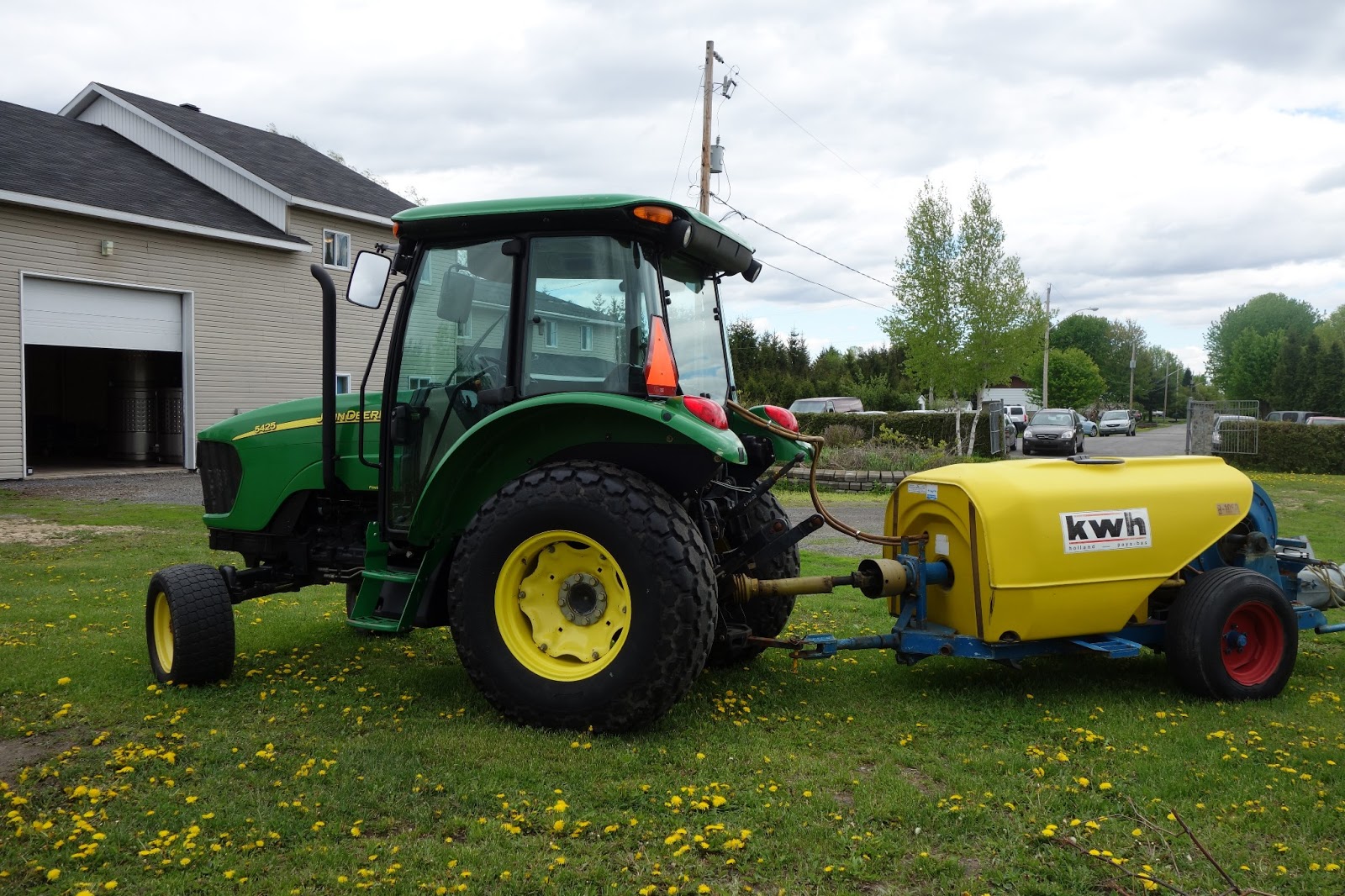
About 75%-85% of the vineyard operations, like pruning, are mechanized and Anthony owns a number of specialized tractors.

Anthony owns a two ton hydraulic press, which was originally designed for ice wine though works with red wines too. He uses both French and American oak barrels, usually a year old, and rotates them every three years. To produce white wines, Anthony would need different equipment, and he thinks reds are more interesting anyways.

I tasted four of the Carone wines and overall they were good, though I didn't find any of them especially impressive. They show promise and it would be interesting to see how the winery develops during the next five years.

The NV Rosso Classico ($18), a blend of Frontenac, Landot Noir, Landal Noir, and Cabernet Severyni, spent about three months in new American oak and has an alcohol content of 12.5%. This wine accounts for about 20% of their production and was a creation of Anthony's father. It was fruity and pleasant, though a bit simple, with a nice element of herbs and spice on the finish and hints of oak. An easy drinking wine, this would be a good burger or pizza wine.

The 2011 Venice Cabernet Severyni ($24), a blend of 90% Cabernet Severyni and 10% Frontenac, has an alcohol content of 13%. Anthony's father planted the Severyni because it reminded him of Barolo. This wine had some volatile acidity and tasted a bit unripe, a strong green aspect to it. The aroma seemed a bit chemical though the taste had more raspberry and spice notes. I would like to have tasted some other vintages to see if this wine was more an exception or not.

The 2010 Venice Pinot Noir ($35), a blend off 85% Pinot Noir and 15% Landot Noir, has an alcohol content of 12.5%. Anthony was the first producer of Pinot Noir in Quebec and loves growing the grape because it is such a challenge. In 2010, he produced about 2500 bottles. He blends in other grapes for more complexity, a greater bouquet and greater fruitiness. I found thus wine to have an interesting nose of herbs and spice, and on the palate those remained prominent, though nice red fruit tastes also came though. It was smooth and pleasant, with moderate complexity. If this were less expensive, I would more strongly recommend it.

The 2009 Double Barrel ($55), a blend of 92% Cabernet Severyni and 8% Sangiovese, has an alcohol content of 14.5% and only 1000 bottles were produced. A special yeast, imported from Italy, is used in fermentation. Its oak aging is more unique in that the wine is first aged in American oak for a year and then it is transferred into French oak for another four months. This wine avoided the negative aspects of the Venice Severyni, and presented lots of compelling fruit flavors up front with spicy edge on its finish. Its tannins were mild and the finish was relatively long and pleasant. This was a good wine, but I think it is pricey for what it delivers compared to similarly priced wines.

To Be Continued...