On our first day in Portugal, we traveled to
Ponte de Lima, the oldest chartered town in Portugal, which is located on the banks of the
Lima River in the
Vinho Verde region. We visited some of the sights in this scenic and historic town, enjoying its beauty and history. Yesterday, I wrote about our visit to
Vinho Verde Interpretation & Promotion Center. Today, I'm going to detail the other sights we saw in Ponte de Lima. Fortunately, we didn't have any rain that day.
A statue of Dona Teresa, once the Queen of Portugal, who granted the charter to Ponte De Lima in 1125. The statue shows her holding out a document, which is probably the charter.
An army of Romans, led by
Decius Juno Brutus, came to the area of Ponte de Lima around 136 B.C. When they reached the Lima River, much of the army refused to cross it because they believed the river was actually
Lethes, the mythical River of Forgetfulness. Allegedly, if you crossed the river, you would forget your entire life, and the Romans were terrified that might occur. Their leader, Brutus, safely crossed the river and eventually persuaded the rest of the army to follow him.
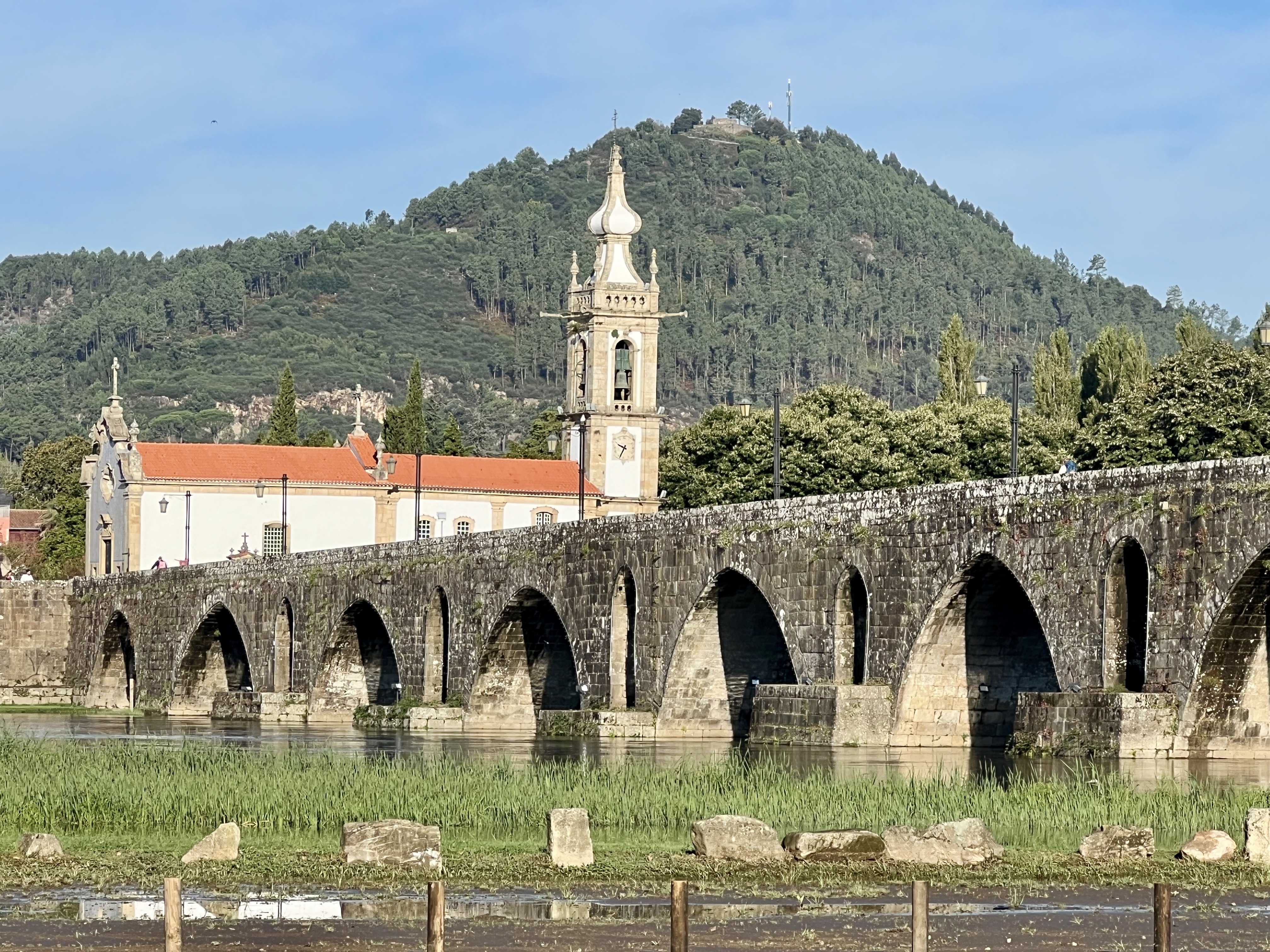
The Romans eventually, around 1 A.D., constructed a bridge across the Lima River, and that bridge was later renovated and improved during the 14th century.
More photos of the bridge.
At one end of the bridge, near a church, was a small shrine with
azulejos, glazed ceramic tiles, usually with blue painting, which are a common artwork in Portugal.
Near the shrine was a statue, stating "
Bom Caminho," ("good road" or "the right path"). This is a typical pilgrim greeting.
Across from the shrine and pilgrim statue is the
Church of Santo António da Torre Vellha ("Old Tower"), which was constructed in the 19th century.
Behind the church is the small
Chapel of Anjo da Guarda ("Guardian Angel"), which may date to the 13th century.
This tower had an intriguing azulejos mosaic, which was created by
Jorge Colaço, a famed Portuguese painter. It's caption states, "
Cabras São, Senhor," which roughly translates as "They are goats, Sir." The mosaic depicts
King Afonso Henriques, around 1140 AD, on a hunt. While enjoying dinner at the Chaplain of the Nuns of the Monastery of Vitorino das Donas, the group worried about great sounds and lots of dust in the distance, fearing it might be an enemy army. When scouts checked out the situation, they returned to King Afonso and told him that "
They are goats, sir."
A statue of
José António Francisco Maria Xavier de Sá Coutinho, the
Conde d'Aurora ("Count of Aurora"), a 20th century magistrate and writer of Ponte de Lima. One of his novels,
O Pinto, won a major Portuguese literary award in 1935.
This is
O Amor Eo Tempo, a famous poem about love and time by poet
António Feijó, who was from Ponte de Lima.
Bronze statues, ''
Alegoria as Feiras novas e no folclore'' (''Allegory to the New Fairs and Folklore'') created in 2009 by sculptor
Salvador Vieira (1937-2017).
More bronze statues, this time of farmers using traditional techniques.
This bronze bull statue commemorates the traditional
Vaca da Cordas, whose origins are lost in the ancient past. It takes place on the day before the
Feast of Corpus Christi, and a bull is led through the city on several ropes. It's still dangerous and some people who get too close to the bull have been injured. But, it's a joyous occasion, with much festivities.
The
Igreja Matriz ("Mother Church") of Ponte de Lima, constructed during the 15th century.
Another mosaic of azulejos, depicting
King João ("John") IV, the Restorer, who reigned from 1640-1656.
Photos from inside the church. Such intricate and beautiful artwork. This would be common in a number of the churches we visited in northern Portugal. The dedication, skill and passion of the artists is amazing.
And now, just a number of other photos of Ponte de Lima.
So rare to see a phone booth any longer in the U.S.
Ponte de Lima was a charming and beautiful town, and I only scratched the surface of the sights. I highly recommend you visit if you visit the Vinho Verde region.


 Bronze statues, ''Alegoria as Feiras novas e no folclore'' (''Allegory to the New Fairs and Folklore'') created in 2009 by sculptor Salvador Vieira (1937-2017).


 So rare to see a phone booth any longer in the U.S.


