Last weekend, on Saturday morning, I journeyed to the Westin Boston Waterfront for what would be a nontraditional breakfast. Though you could find danish there, much of my breakfast consisted of sweeter treats, including whoopie pies, chocolate, ice cream, gelato, brownies, cupcakes, popcorn and much more. Dessert for breakfast? This was not the first time that I have done so, and there was a reason for my seeming gustatory madness.
Once again, it was time for the annual New England Dessert Showcase, in its fifth year, hosted by The Anthem Group, a Boston-based marketing and event agency. There were numerous local exhibitors, each offering a sweet treat or two (or even more). As the media hour started at 10am, this was my breakfast. I attended last year's event and you can find my prior Top Three choices here. None of my prior choices attended the event again this year.
For this year, I shall again provide my Top Three picks, those desserts which I most enjoyed and which were new to me. I strongly encourage all of my readers to seek out these companies and taste their treats.
Boston Whoopie
The first dessert I tasted at the Showcase was their mini Vanilla Whoopie Pie with a marshmallow filling (shown in the second photo). The cake was moist while the creamy filling wasn't overly sweet and complemented the vanilla of the cake. I also tried the Chocolate, which also had the marshmallow filling, and it was just as tasty. A whoopie pie is a great way to get an even distribution of cake to frosting/filling when you bite into it, a better method usually than a cupcake.
The company is very new, having just started in March 2013 in Somerville. Their Whoopie Pies are primarily available through online ordering, only in the Greater Boston area, though they are available for sale at a few spots listed on their website. Their Whoopie Pies come in two sizes: Regular (3.5" round/$4) and Small (1.75" round/$2). They sell around 15 different flavors, including seasonal ones, including Pumpkin Spice with cinnamon cream cheese frosting, Raspberry Coconut, Red Velvet,Oreo Cookie and more.
Whoopie pies are starting to get more attention and Boston Whoopie is making some delicious ones.
BudiBar
I can honestly say that I almost walked past this table without stopping when I noticed their sign for Certified Vegan & Wheat Free Superfood Bars. That doesn't sound like an appealing dessert to me but I remembered the "healthy" snack bars I tasted the previous year from Kind Snacks so I decided to stop and give them a chance. I am glad that I did. I met Michael McCarthy who created the Budi Bar in 2010, with an initial goal of creating a food to enhance brain function. “Budi” is an Indonesian word that means "wise."
Since their beginning, the scope of their bars has expanded to be very allergy focused as well. They use ingredients which possess "high antioxidant levels, mind balancing Omega-3 fatty acids, mind focusing amino acids, and natural ingredients that time release energy without causing sugar spikes." For example, they use Chicory Root Fiber as a binder and a substitute for milk and sugar, helping to protect against allergies. Because of potential nut allergies, they sometimes use sunflower seeds. Online, the bars are available for about $3/bar.
No matter how healthy they are though, the key is how they taste. And in that regard, they are a winner too.
The Zen BudiBar is made from 80% Dark Chocolate and is nut & dairy free. It contains Belgian Chicory Root Fiber, Sunflower Seeds, Chocolate Liquor (100% Swiss Cacao), Vegan Chocolate (Cane Sugar, Unsweetened Chocolate, Cocoa Butter), Unsweetened Coconut, American Chia Seeds & Canadian Hemp Seed, L-Theanine (Green Tea Amino Acid), & Ginger. It tastes sweet and nutty, with a nice chocolate taste and intriguing spice notes. It doesn't taste healthy and it does seem like a delightful dessert. If you have allergies or not, this bar is going to appeal to you.
The Namaste BudiBar is also made from 80% Dark Chocolate, is dairy free but does contain nuts, almonds. It contains Belgian Chicory Root Fiber, American Almond, 100% Swiss Cacao, Guatelmalan Organic Taza 80% Dark Chocolate (Cacao Beans, Cane Sugar, Cocoa Butter, Vanilla Bean), Unsweetened Coconut, American Chia Seeds & Canadian Hemp Seed. Like Zen, this bar was sweet and nutty, with plenty of chocolate taste and enjoyable almond pieces. And once again, it doesn't taste healthy. I would recommend this bar as well and hope my readers will look past the "healthy" signs and simply enjoy the fine taste of these bars. And if you have allergies, you'll be able to safely enjoy these treats, without any sacrifice of taste.
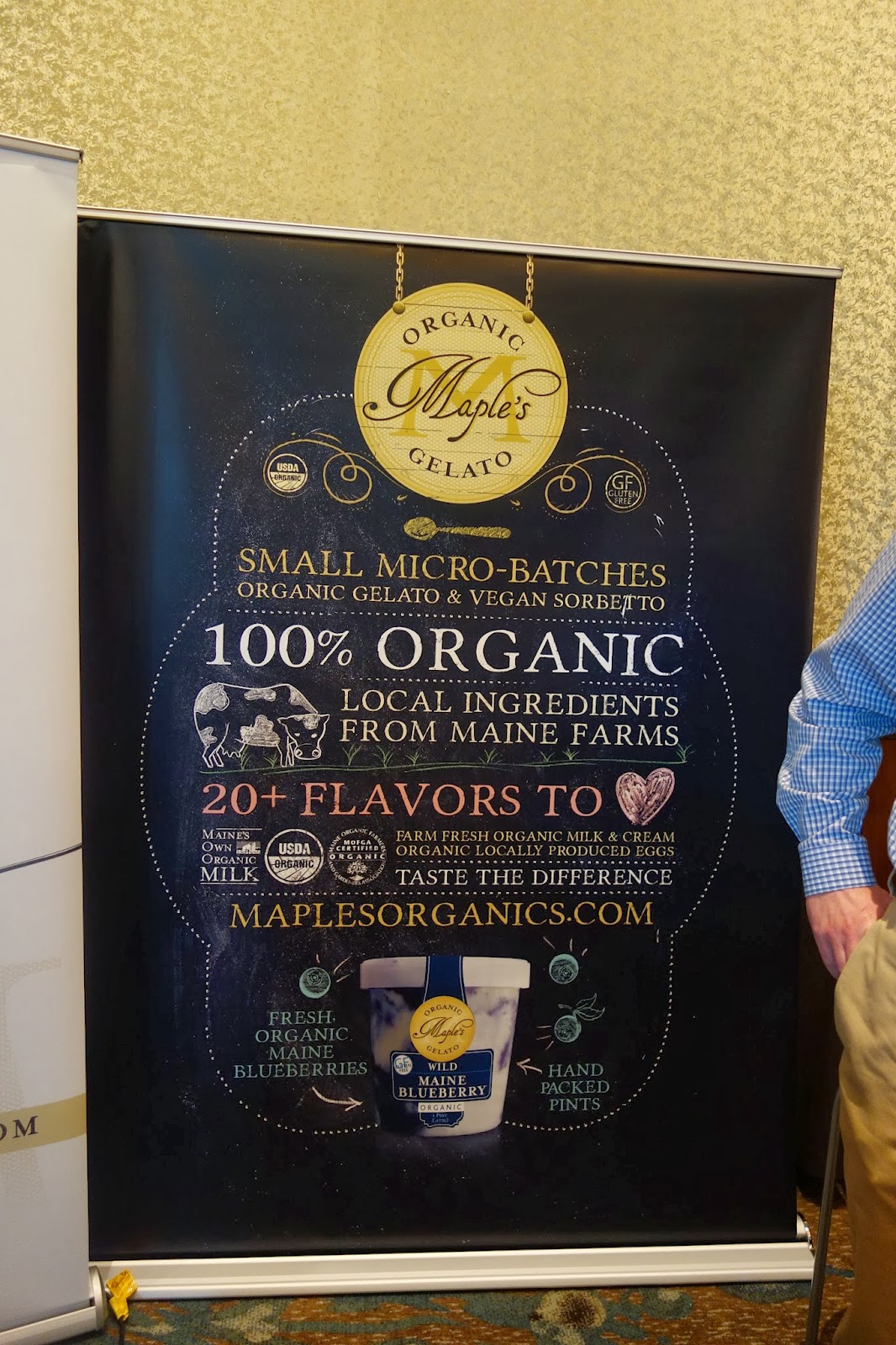
Maple's Organic Gelato
Artisan gelato is hot right now, and rightfully so. Maple's makes all of their flavors from scratch, and do not use any bases or pre-made flavorings. They obtain many of their ingredients from local providers, including organic farm-fresh milk, organic cream and organic eggs. You can even download a list of all the ingredients in their products. That is being transparent.
Besides gelato, they also make vegan sorbetto, and combined make over 25 different flavors, including such things are Vanilla Bean, Chocolate, Maine Maple, Thai Coconut, Cardamom-Ginger, Sea-Salt Caramel Almond, Wild Maine Blueberry, Red Raspberry Sorbetto, and Coconut Lime Sorbetto. I tried a few different flavors and all of them were creamy with pronounced flavors that didn't taste artificial. The Sea-Salt Caramel Almond was a pleasant balance of sweet & salty while the Cardamom-Ginger had nice spicy elements, that were also well balanced. The Coconut Lime Sorbetto tasted creamy, with a dominant coconut flavor, despite the fact it possesses no dairy.
You can visit their scoop shop in Yarmouth, Maine, or find their gelato and sorbet at some supermarkets and artisan food shops. Stay away from the overly processed ice creams and seek out this organic gelato and sorbetto.
For Over 18 Years, and over 5600 articles, I've Been Sharing My Passion for Food, Wine, Saké & Spirits. Come Join Me & Satisfy Your Hunger & Thirst.
Showing posts with label organic food. Show all posts
Wednesday, October 16, 2013
Tuesday, April 30, 2013
Modern Farmer Magazine: A Debut, With Chicken Love
Do you care about the source of your food? Do you prefer local, organic products? Do you frequent farmers' markets and local farms? Do you belong to a CSA or CSF? Do you grow your own herbs, vegetables or fruits? Do you have respect for farmers? Do you want to learn about all of these topics, and more? If you answer affirmatively to any of these questions, then I recommend you check out a new quarterly magazine, Modern Farmer.
While perusing the magazine stands at Barnes & Noble, I noticed the inaugural issue of Modern Farmer, which was newly released. As I flipped through the pages, it intrigued me, with its fascinating photography and article topics. I bought a copy and have spent several days enjoying its contents. The magazine makes a promising debut, I will be awaiting their next issue and it earns my hearty recommendation.
Their website states their intent: "There has been a movement afoot in recent years to make connections between what we eat, how we live and the planet. Modern Farmer exists for people who want to be a part of that movement—it is for window-herb growers, career farmers, people who have chickens, people who want to have chickens and anyone who wants to know more about how food reaches their plate." Besides being a quarterly magazine, Modern Farmer is also a daily website, events series, and online store.
The magazine runs 136 pages and consists of about 35 articles, columns and reports. I love the diversity of the content, from frozen foods to wild pigs, from smoothies to cocktails. I found the various articles to be well written, informative as well as interesting. They did not come across as preachy or pretentious. The magazine also has a global scope, with articles about the U.S., China, Malawi, South Africa, Italy and more. With the articles, there are plenty of excellent, accompanying photographs of people, animals, items, scenes and much more.
There is a 20+ page center section of the magazine, called The Modern Farmer Handbook, and it is devoted to many more practical issues for farmers. You will learn items such as how to select the best breed of chicken to raise, how to turn your backyard into a four-season farm, and how to build a straw bale house. There is even a section on different type of "poop" used for fertilizer. Immediately following this section is a photo essay, Meet the Modern Farmers, which presents pictures of seven farmers, and some of their families, from around the world and devotes a couple of paragraphs to each one. There is even a farmer and restaurant owner from Massachusetts presented there, Mark Firth of Monterey.
Some of these articles are going to lead me to further research into their topics. I was pleased to see the current surge in organic farms in China and worried about the exploding population of wild pigs, including radioactive pigs wandering across Europe. Another uplifting article was on mangoes in Malawi, and how they have become so popular now for smoothies across the world. And it was cool to end the last page of the magazine devoted to a Durian vendor.
Check out Modern Farmer. You won't be disappointed. You will undoubtedly learn plenty. And you will enjoy it.
While perusing the magazine stands at Barnes & Noble, I noticed the inaugural issue of Modern Farmer, which was newly released. As I flipped through the pages, it intrigued me, with its fascinating photography and article topics. I bought a copy and have spent several days enjoying its contents. The magazine makes a promising debut, I will be awaiting their next issue and it earns my hearty recommendation.
Their website states their intent: "There has been a movement afoot in recent years to make connections between what we eat, how we live and the planet. Modern Farmer exists for people who want to be a part of that movement—it is for window-herb growers, career farmers, people who have chickens, people who want to have chickens and anyone who wants to know more about how food reaches their plate." Besides being a quarterly magazine, Modern Farmer is also a daily website, events series, and online store.
The magazine runs 136 pages and consists of about 35 articles, columns and reports. I love the diversity of the content, from frozen foods to wild pigs, from smoothies to cocktails. I found the various articles to be well written, informative as well as interesting. They did not come across as preachy or pretentious. The magazine also has a global scope, with articles about the U.S., China, Malawi, South Africa, Italy and more. With the articles, there are plenty of excellent, accompanying photographs of people, animals, items, scenes and much more.
There is a 20+ page center section of the magazine, called The Modern Farmer Handbook, and it is devoted to many more practical issues for farmers. You will learn items such as how to select the best breed of chicken to raise, how to turn your backyard into a four-season farm, and how to build a straw bale house. There is even a section on different type of "poop" used for fertilizer. Immediately following this section is a photo essay, Meet the Modern Farmers, which presents pictures of seven farmers, and some of their families, from around the world and devotes a couple of paragraphs to each one. There is even a farmer and restaurant owner from Massachusetts presented there, Mark Firth of Monterey.
Some of these articles are going to lead me to further research into their topics. I was pleased to see the current surge in organic farms in China and worried about the exploding population of wild pigs, including radioactive pigs wandering across Europe. Another uplifting article was on mangoes in Malawi, and how they have become so popular now for smoothies across the world. And it was cool to end the last page of the magazine devoted to a Durian vendor.
Check out Modern Farmer. You won't be disappointed. You will undoubtedly learn plenty. And you will enjoy it.
Thursday, December 16, 2010
Thursday Sips & Nibbles
I am back again with a new edition of Thursday Sips & Nibbles, my regular column where I briefly highlight some interesting wine and food items that I have encountered recently.
**********************************************************
1) Mela Modern Indian Cuisine in the South End is now offering an organic menu featuring fresh ingredients straight from Boston area farms to your plate. With locally forged mushrooms, meats from Lexington’s Wilson Farms and fresh veggies from Allandale Farms in Brookline and Butter Brook Farms in Acton, Mela’s organic menu provides an interesting local dinning experience.
Here are some of the dishes you will find on their menu:
--“Golden bag” Samosas (Local mushroom forage, Indian spices, money bag Samosa pastry)
--Organic Tandoori Chicken (Wilson Farms free range Chicken, Indian spices, minty greens)
--“Kerala” Salmon Curry (Wild caught Alaskan Salmon, coconut braised chickpeas, tomatoes, curry leaf, Indian spices)
--Paalak Tofu Strir fry (Morinaga Farms Tofu, baby spinach, cumin, spices
--Chicken Tikka Masala (Wilson farms free range chicken, Butter Brook farms heirloom tomatoes)
--Veggie Korma of the Day (Allandale Farm seasonal veggies braised in a spicy korma sauce)
2) The Beacon Hill Hotel & Bistro will be hosting a special New Year’s Eve Dinner featuring the culinary styling of Executive Chef Mathew Molloy. Early birds can finish dinner and enjoy the fireworks over Boston Common, located just steps from the Beacon Hill Hotel & Bistro. Or, guests can ring in the New Year by dining later in the evening when the mood begins to levitate and the champagne starts flowing. Book early for this very special evening by calling 617-723-7575.
When: Friday, December 31, 2010 from 5:30PM to 10PM.
Cost: $77 per person. Optional Wine pairing for an additional $35. A 20% Gratuity Will Automatically Be Added To Your Bill
Menu:
Amuse Bouche (Pat Woodbury’s Wellfleet Oyster with Champagne Gelée and American Caviar_
With NV Mumm Napa Brut Prestige (Napa Valley, California) Champagne Toast
* * *
Appetizers
--Ingrid’s Stonington Maine Scallops with Parsnip Purée, Wild Mushrooms, and Sherry-Truffle Emulsion
--Boston Bibb Lettuce with Winter Citrus, Hearts of Palm, Pomegranate and Citrus Vinaigrette
--Hamachi Tataki with Apple, Radish, and Upland Cress, with Soy-Ginger Vinaigrette
--Roasted Vermont Squab Ballotine with Celery Root Purée, Roasted Chestnuts and Apples, and Foie Gras Butter
--Stonington Maine Lobster Soup with Lobster Knuckle and Sherry-Pimenton Froth
Paired with 2008 Montinore, Pinot Gris (Willamette Valley, OR) or 2007 Cusumano Pinot Nero (Sicily, Italy)
* * *
Supplement Course for Two For An Additional $20.00
Duo of Foie Gras – Torchon with Pineapple Chutney and Seared with Pain Perdu and Caramelized Pineapple
or
Carnoroli Risotto with Shaved White Alba Truffles
Paired with 2005 Haut Charmes, Sauternes (Bordeaux) or 2008 Pio Cesare, Barbera d’Alba (Piedmont, Italy)--For An Additional $10.00
* * *
Main Courses
--Butter Poached Stonington, Maine Lobster with Potato Mousseline, Mushroom Ragout, and Buerre Rouge
--Pan Roasted Wild Striped Bass with Heirloom Carrots, Capers, Pinenuts and Golden Raisins, and Cider Brown Butter
--Roasted Sika Venison with Chestnut Purée, Root Vegetable Glacé and Red Wine Sauce
--Wolfe’s Neck Farm Strip Loin with Oxtail, Roasted Shallots and Mushroom Ragout
--Roasted Vegetable Lasagna with Mustard Cream, Beluga Lentil Ragout and Perigord Truffle Vinaigrette
Paired with 2008 Olivier Leflaive “Les Sétilles” Bourgogne Blanc (Bourgogne, France) or 2007 Anjoli Priorat (Catalonia, Spain)
* * *
Desserts or Cheese
--Passionfruit Tartlet with Sesame Shortbread and Champagne Granite
--Malted Chocolate Mousse with Bitter Chocolate Sorbet and Cocoa Nibs Cookies
--Rhum Baba - Citrus Sponge Cake with Rum Spiked Custard and Lemon Gastrique
--Hannahbells Cinnamon Roasted Apples and Puff Pastry
Paired with 2008 Domaine de Fenouillet, Muscat de Beaumes de Venise (Rhône Valley, France) or 2007 Les Clos de Pauliles, Banyuls (Banyuls, France)
3) This December, the holiday season will come to Towne Stove and Spirits in the form of exclusive specials available for a limited time only. They will serve a festive cocktail, “Holiday Macaroon,” while also introducing a new weekday three-course prix fixe lunch menu specially created for the season by Co-Culinary Director Lydia Shire.
The Holiday Macaroon ($12) is perfectly crafted with Ciroc Coconut Vodka and Godiva Chocolate Vodka and then finished with a hint of Green Crème de Menthe and a splash of cream. The Holiday Macaroon is then festively garnished with red sprinkles and coconut shavings.
The customizable, three-course prix fixe lunch menu, for $35 per person, is as follows:
First course: Choice of--
--Acorn squash bisque w/ apple calvados butter
--Mesclun greens and english cucumber w/ choice of dressing: fiery peanut .. carrot + ginger / green goddess / balsamic
--Caesar salad
--Lobster “cappuccino” w/ lobster popover ($5 supplement)
Second course: Choice of-
--Wood grilled + roasted statler chicken breast .. simple / steamed delicata squash .. spoon of chestnut polenta
--Rare salmon filet .. pink sea salt + fennel emulsion w/ provencal olive oil*
--Jasper’s infamous duck salad w/ mango + spiced pecans
--Rotisserie prime rib + toasted ` french dip ‘ sandwich w/ melted brie , watercress aioli + Belgian fries*
--“Double OO “ sugar pumpkin ravioli w/ mascarpone .. toasted sage + cranberry mostarda
--Lobster cobb salad
--#1 crab cake .. shire recipe w/ english mustard sauce + frites .. avocado salad
--Margherita pizza
--Sausage + pepperoni pizza
--Lobster pizza w/ baby red mustard greens + meyer lemon ($10 supplement)
--Deluxe 8 oz. all american bacon burger 70/30 .. ground skirt + shortrib w/ or w/o cheddar .. rare please*
--Tuchler wagyu skirt steak w/ green tabasco , grilled onions + radicchio* ($10 supplement)
Third Course: Choice of=-
--Ex-treme chocolate pudding / new orlean’s style pralines
--Coconut crème brulee w/ “popped hawaiian caramel corn”
--Sugared thin crisp apple tart w/ apple ice cream
--Lemon sherbert + berries
WHEN: The three-course prix fixe lunch menu will be available weekdays from 11:30am – 2:00pm from December 13th through December 31st. The specialty Holiday Macaroon cocktail will be available for the entire month of December.
4) Here are some more options for your New Year's Eve celebrations:
MET Back Bay
279 Dartmouth Street, Boston
Phone: 617-267-0451
Celebrate New Year’s Eve at Back Bay’s newest dining destination, MET Back Bay. Dance the night away while you enjoy appetizers and indulge in a dessert buffet prepared by Executive Chef Todd Winer. Guests will receive festive party favors, an exclusive sneak peak at Townhouse, and of course, plenty of champagne and MET Punch to toast the New Year at midnight.
Date/Time: Friday, December 31st – 9pm-2:00am
Cost: $100 per person. Guests who book a dinner reservation will enjoy the party for $50 per person.
Umbria
295 Franklin Street, Boston
Phone: 617-338-1000
This New Year’s Eve, Umbria is hosting their 20th year anniversary party. Enjoy three floors of festivities in Umbria’s state-of-the-art nightclub. The evening will feature an open bar, two DJs, party favors, and a traditional Champagne toast.
Date/Time: Friday, December 31st – 10:00pm-2:00am
Cost: $125 per person
Gargoyles on the Square
219 Elm Street, Somerville
Phone: 617-776-5300
Enjoy New Year’s Eve dinner at Gargoyles on the Square where Chef Jason Santos will prepare a celebratory three-course prix-fixe menu for three seating times. Indulge in dishes including Butter Basted Grilled Lobster Tail or “Signature” Honey & Hoisin Glazed Duck Confit. There will be a traditional champagne toast and party favors during the final seating.
Date/Time: Friday, December 31st – The three seatings will be at : 5-5:30pm, 7-7:30pm and 9-9:30 pm
Cost: First seating is $50 per person, the second seating is $60 per person, and the third seating is $70 per person.
5) Join the Beacon Hill Hotel & Bistro for their Fondue Sundays featuring classic, French-style fondue presented for sharing. With pots suitable for sharing between 2 to 4 guests ($26per pot) - you’ll be treated to a piping hot pot of classic French fondue served with small potatoes boiled in sea-salted water, cornichon pickled vegetables such as ramps, cipolini onions and cauliflower, and rustic bread locally sourced from Iggy's Francese. Fondue Sundays will be served as a special in conjunction with the Bistro’s regular menu, and will be available during dinner service (5:30PM-10:00PM) beginning Sunday, December 19th, through the spring. Reservations are recommended by calling 617-723-7575.
Recipe for Matt Molloy’s Classic Fondue in French style
Ingredients:
3 oz dry white wine (Domaine Giachino Abymes from the Savoie)
Pinch kosher Salt
2 grinds white pepper, from a mill
5 passes fresh grated nutmeg
2 ounces Bergkäse Alpenblumer, grated
2 ounces Emmentaler, grated
2 ounces Gruyére Vieux, grated
1 clove of garlic, minced
1 tsp Kirschwasser
1/2 Tablespoon cornstarch
Directions:
--Make a slurry with the Kirschwasser and the cornstarch. It should be thick, but pourable. Use more or less Kirschwasser to get a consistency you like. Set at the ready, next to the stove.
--In an enameled cast iron fondue pot, add the wine, salt, pepper and nutmeg.
--Bring to a boil and add the grated cheese all at once. Whisk over heat until the cheese has melted. Add the minced garlic. Whisk in your slurry, a little at a time, until the fondue has a pleasant texture. Adjust the seasoning and serve hot.
**********************************************************
1) Mela Modern Indian Cuisine in the South End is now offering an organic menu featuring fresh ingredients straight from Boston area farms to your plate. With locally forged mushrooms, meats from Lexington’s Wilson Farms and fresh veggies from Allandale Farms in Brookline and Butter Brook Farms in Acton, Mela’s organic menu provides an interesting local dinning experience.
Here are some of the dishes you will find on their menu:
--“Golden bag” Samosas (Local mushroom forage, Indian spices, money bag Samosa pastry)
--Organic Tandoori Chicken (Wilson Farms free range Chicken, Indian spices, minty greens)
--“Kerala” Salmon Curry (Wild caught Alaskan Salmon, coconut braised chickpeas, tomatoes, curry leaf, Indian spices)
--Paalak Tofu Strir fry (Morinaga Farms Tofu, baby spinach, cumin, spices
--Chicken Tikka Masala (Wilson farms free range chicken, Butter Brook farms heirloom tomatoes)
--Veggie Korma of the Day (Allandale Farm seasonal veggies braised in a spicy korma sauce)
2) The Beacon Hill Hotel & Bistro will be hosting a special New Year’s Eve Dinner featuring the culinary styling of Executive Chef Mathew Molloy. Early birds can finish dinner and enjoy the fireworks over Boston Common, located just steps from the Beacon Hill Hotel & Bistro. Or, guests can ring in the New Year by dining later in the evening when the mood begins to levitate and the champagne starts flowing. Book early for this very special evening by calling 617-723-7575.
When: Friday, December 31, 2010 from 5:30PM to 10PM.
Cost: $77 per person. Optional Wine pairing for an additional $35. A 20% Gratuity Will Automatically Be Added To Your Bill
Menu:
Amuse Bouche (Pat Woodbury’s Wellfleet Oyster with Champagne Gelée and American Caviar_
With NV Mumm Napa Brut Prestige (Napa Valley, California) Champagne Toast
* * *
Appetizers
--Ingrid’s Stonington Maine Scallops with Parsnip Purée, Wild Mushrooms, and Sherry-Truffle Emulsion
--Boston Bibb Lettuce with Winter Citrus, Hearts of Palm, Pomegranate and Citrus Vinaigrette
--Hamachi Tataki with Apple, Radish, and Upland Cress, with Soy-Ginger Vinaigrette
--Roasted Vermont Squab Ballotine with Celery Root Purée, Roasted Chestnuts and Apples, and Foie Gras Butter
--Stonington Maine Lobster Soup with Lobster Knuckle and Sherry-Pimenton Froth
Paired with 2008 Montinore, Pinot Gris (Willamette Valley, OR) or 2007 Cusumano Pinot Nero (Sicily, Italy)
* * *
Supplement Course for Two For An Additional $20.00
Duo of Foie Gras – Torchon with Pineapple Chutney and Seared with Pain Perdu and Caramelized Pineapple
or
Carnoroli Risotto with Shaved White Alba Truffles
Paired with 2005 Haut Charmes, Sauternes (Bordeaux) or 2008 Pio Cesare, Barbera d’Alba (Piedmont, Italy)--For An Additional $10.00
* * *
Main Courses
--Butter Poached Stonington, Maine Lobster with Potato Mousseline, Mushroom Ragout, and Buerre Rouge
--Pan Roasted Wild Striped Bass with Heirloom Carrots, Capers, Pinenuts and Golden Raisins, and Cider Brown Butter
--Roasted Sika Venison with Chestnut Purée, Root Vegetable Glacé and Red Wine Sauce
--Wolfe’s Neck Farm Strip Loin with Oxtail, Roasted Shallots and Mushroom Ragout
--Roasted Vegetable Lasagna with Mustard Cream, Beluga Lentil Ragout and Perigord Truffle Vinaigrette
Paired with 2008 Olivier Leflaive “Les Sétilles” Bourgogne Blanc (Bourgogne, France) or 2007 Anjoli Priorat (Catalonia, Spain)
* * *
Desserts or Cheese
--Passionfruit Tartlet with Sesame Shortbread and Champagne Granite
--Malted Chocolate Mousse with Bitter Chocolate Sorbet and Cocoa Nibs Cookies
--Rhum Baba - Citrus Sponge Cake with Rum Spiked Custard and Lemon Gastrique
--Hannahbells Cinnamon Roasted Apples and Puff Pastry
Paired with 2008 Domaine de Fenouillet, Muscat de Beaumes de Venise (Rhône Valley, France) or 2007 Les Clos de Pauliles, Banyuls (Banyuls, France)
3) This December, the holiday season will come to Towne Stove and Spirits in the form of exclusive specials available for a limited time only. They will serve a festive cocktail, “Holiday Macaroon,” while also introducing a new weekday three-course prix fixe lunch menu specially created for the season by Co-Culinary Director Lydia Shire.
The Holiday Macaroon ($12) is perfectly crafted with Ciroc Coconut Vodka and Godiva Chocolate Vodka and then finished with a hint of Green Crème de Menthe and a splash of cream. The Holiday Macaroon is then festively garnished with red sprinkles and coconut shavings.
The customizable, three-course prix fixe lunch menu, for $35 per person, is as follows:
First course: Choice of--
--Acorn squash bisque w/ apple calvados butter
--Mesclun greens and english cucumber w/ choice of dressing: fiery peanut .. carrot + ginger / green goddess / balsamic
--Caesar salad
--Lobster “cappuccino” w/ lobster popover ($5 supplement)
Second course: Choice of-
--Wood grilled + roasted statler chicken breast .. simple / steamed delicata squash .. spoon of chestnut polenta
--Rare salmon filet .. pink sea salt + fennel emulsion w/ provencal olive oil*
--Jasper’s infamous duck salad w/ mango + spiced pecans
--Rotisserie prime rib + toasted ` french dip ‘ sandwich w/ melted brie , watercress aioli + Belgian fries*
--“Double OO “ sugar pumpkin ravioli w/ mascarpone .. toasted sage + cranberry mostarda
--Lobster cobb salad
--#1 crab cake .. shire recipe w/ english mustard sauce + frites .. avocado salad
--Margherita pizza
--Sausage + pepperoni pizza
--Lobster pizza w/ baby red mustard greens + meyer lemon ($10 supplement)
--Deluxe 8 oz. all american bacon burger 70/30 .. ground skirt + shortrib w/ or w/o cheddar .. rare please*
--Tuchler wagyu skirt steak w/ green tabasco , grilled onions + radicchio* ($10 supplement)
Third Course: Choice of=-
--Ex-treme chocolate pudding / new orlean’s style pralines
--Coconut crème brulee w/ “popped hawaiian caramel corn”
--Sugared thin crisp apple tart w/ apple ice cream
--Lemon sherbert + berries
WHEN: The three-course prix fixe lunch menu will be available weekdays from 11:30am – 2:00pm from December 13th through December 31st. The specialty Holiday Macaroon cocktail will be available for the entire month of December.
4) Here are some more options for your New Year's Eve celebrations:
MET Back Bay
279 Dartmouth Street, Boston
Phone: 617-267-0451
Celebrate New Year’s Eve at Back Bay’s newest dining destination, MET Back Bay. Dance the night away while you enjoy appetizers and indulge in a dessert buffet prepared by Executive Chef Todd Winer. Guests will receive festive party favors, an exclusive sneak peak at Townhouse, and of course, plenty of champagne and MET Punch to toast the New Year at midnight.
Date/Time: Friday, December 31st – 9pm-2:00am
Cost: $100 per person. Guests who book a dinner reservation will enjoy the party for $50 per person.
Umbria
295 Franklin Street, Boston
Phone: 617-338-1000
This New Year’s Eve, Umbria is hosting their 20th year anniversary party. Enjoy three floors of festivities in Umbria’s state-of-the-art nightclub. The evening will feature an open bar, two DJs, party favors, and a traditional Champagne toast.
Date/Time: Friday, December 31st – 10:00pm-2:00am
Cost: $125 per person
Gargoyles on the Square
219 Elm Street, Somerville
Phone: 617-776-5300
Enjoy New Year’s Eve dinner at Gargoyles on the Square where Chef Jason Santos will prepare a celebratory three-course prix-fixe menu for three seating times. Indulge in dishes including Butter Basted Grilled Lobster Tail or “Signature” Honey & Hoisin Glazed Duck Confit. There will be a traditional champagne toast and party favors during the final seating.
Date/Time: Friday, December 31st – The three seatings will be at : 5-5:30pm, 7-7:30pm and 9-9:30 pm
Cost: First seating is $50 per person, the second seating is $60 per person, and the third seating is $70 per person.
5) Join the Beacon Hill Hotel & Bistro for their Fondue Sundays featuring classic, French-style fondue presented for sharing. With pots suitable for sharing between 2 to 4 guests ($26per pot) - you’ll be treated to a piping hot pot of classic French fondue served with small potatoes boiled in sea-salted water, cornichon pickled vegetables such as ramps, cipolini onions and cauliflower, and rustic bread locally sourced from Iggy's Francese. Fondue Sundays will be served as a special in conjunction with the Bistro’s regular menu, and will be available during dinner service (5:30PM-10:00PM) beginning Sunday, December 19th, through the spring. Reservations are recommended by calling 617-723-7575.
Recipe for Matt Molloy’s Classic Fondue in French style
Ingredients:
3 oz dry white wine (Domaine Giachino Abymes from the Savoie)
Pinch kosher Salt
2 grinds white pepper, from a mill
5 passes fresh grated nutmeg
2 ounces Bergkäse Alpenblumer, grated
2 ounces Emmentaler, grated
2 ounces Gruyére Vieux, grated
1 clove of garlic, minced
1 tsp Kirschwasser
1/2 Tablespoon cornstarch
Directions:
--Make a slurry with the Kirschwasser and the cornstarch. It should be thick, but pourable. Use more or less Kirschwasser to get a consistency you like. Set at the ready, next to the stove.
--In an enameled cast iron fondue pot, add the wine, salt, pepper and nutmeg.
--Bring to a boil and add the grated cheese all at once. Whisk over heat until the cheese has melted. Add the minced garlic. Whisk in your slurry, a little at a time, until the fondue has a pleasant texture. Adjust the seasoning and serve hot.
Tuesday, November 30, 2010
Rant: What Food Says About Class in America
(Yes, two Rants this week. There is a lot peeving me this week.)
"As more of us indulge our passion for local, organic delicacies, a growing number of Americans don’t have enough nutritious food to eat. How we can bridge the gap."
Many of us celebrated Thanksgiving recently, probably enjoying a bounty of food, possibly including some local and/or organic foods. Some of us might have turned up our nose at boxed stuffing, boxed potatoes, canned vegetables or similar such items. For others though, such foods played a central place in their dinners, if they could even afford that much. It is very disturbing that in our plentiful country, there are still so many people who cannot afford adequate food.
You should read a new article in Newsweek magazine, "Divided We Eat," by Lisa Miller. It is a disturbing look at how: "Food has become the premier marker of social distinctions, that is to say--social class." It also offers some suggestions for changing this situation.
About 17% of Americans are "food insecure," meaning that they sometimes run out of money to purchase food or they run out of food before they can obtain more money. That is almost 1 out of 5 people, a significant problem. Food insecurity is higher in the South, in big cities, and families headed by a single mother. This has led to a 58.5% increase in food stamp use over the last three years. But that also seems to go with increased obesity, and a recent study has shown that women and children on food stamps are more likely to be overweight.
It is not a matter of nutritional education. "Lower-income families choose sugary, fat, and processed foods because they're cheaper--and because they taste good." Even though some low-income neighborhoods are "food deserts," lacking a significant supermarket for fresh produce and such, others are not, and there is little difference in the buying patterns of these low-income people. Michael Pollan stated: "Essentially we have a system where wealthy farmers feed the poor crap and poor farmers feed the wealthy high-quality food."
I have mentioned it a number of times before, that local, sustainable, organic products need to be much less expensive before they can spread to the wider community, before they stop being elitist. That is not easy to accomplish and will require a united effort on many fronts. Some efforts are being taken on the local level, such as efforts to allow food stamps to gain extra credit at farmers' markets. But much more needs to be done, starting with a greater awareness of the issue. If local is so important to us, then helping local people who are food insecure should be important as well.
If you are working on this issue, please add a comment and tell us what you are doing. Let us know about some of the local efforts to help in this regard.
"As more of us indulge our passion for local, organic delicacies, a growing number of Americans don’t have enough nutritious food to eat. How we can bridge the gap."
Many of us celebrated Thanksgiving recently, probably enjoying a bounty of food, possibly including some local and/or organic foods. Some of us might have turned up our nose at boxed stuffing, boxed potatoes, canned vegetables or similar such items. For others though, such foods played a central place in their dinners, if they could even afford that much. It is very disturbing that in our plentiful country, there are still so many people who cannot afford adequate food.
You should read a new article in Newsweek magazine, "Divided We Eat," by Lisa Miller. It is a disturbing look at how: "Food has become the premier marker of social distinctions, that is to say--social class." It also offers some suggestions for changing this situation.
About 17% of Americans are "food insecure," meaning that they sometimes run out of money to purchase food or they run out of food before they can obtain more money. That is almost 1 out of 5 people, a significant problem. Food insecurity is higher in the South, in big cities, and families headed by a single mother. This has led to a 58.5% increase in food stamp use over the last three years. But that also seems to go with increased obesity, and a recent study has shown that women and children on food stamps are more likely to be overweight.
It is not a matter of nutritional education. "Lower-income families choose sugary, fat, and processed foods because they're cheaper--and because they taste good." Even though some low-income neighborhoods are "food deserts," lacking a significant supermarket for fresh produce and such, others are not, and there is little difference in the buying patterns of these low-income people. Michael Pollan stated: "Essentially we have a system where wealthy farmers feed the poor crap and poor farmers feed the wealthy high-quality food."
I have mentioned it a number of times before, that local, sustainable, organic products need to be much less expensive before they can spread to the wider community, before they stop being elitist. That is not easy to accomplish and will require a united effort on many fronts. Some efforts are being taken on the local level, such as efforts to allow food stamps to gain extra credit at farmers' markets. But much more needs to be done, starting with a greater awareness of the issue. If local is so important to us, then helping local people who are food insecure should be important as well.
If you are working on this issue, please add a comment and tell us what you are doing. Let us know about some of the local efforts to help in this regard.
Monday, October 4, 2010
Rant: Moving Toward Sustainability
Please keep me safe from sustainability fanatics, those who see only black and white issues, refusing to consider all of the gray that exists. They may believe they are doing good, but their efforts more often have a negative effect. They turn away far more people than they convert, like the old cliche of attracting more flies with honey than vinegar. Their solutions, often more idealistic than realistic, fail to properly address the real problems.
I am currently attending the second annual Chefs Collaborative National Summit, Redefining our Culinary Traditions, which has brought together approximately 300 chefs, culinary professionals, and members of the food media. The Summit is "... focused on the theme of integrating sustainable principles into regional culinary and agricultural heritage." Their focus certainly has a very appealing ring to it, and they have compiled an impressive agenda.
The Chefs Collaborative is a nonprofit group with the mission statement: "Chefs Collaborative works with chefs and the greater food community to celebrate local foods and foster a more sustainable food supply. The Collaborative inspires action by translating information about our food into tools for making knowledgeable purchasing decisions. Through these actions, our members embrace seasonality, preserve diversity and traditional practices, and support local economies."
Though the Summit began yesterday, the first day was more just registration and informal networking at Rendezvous and Russell House Tavern. Monday and Tuesday are the heart of the Summit, including numerous discussion sessions about a diverse selection of sustainability topics, from seafood to heirloom fruits & vegetables to meat. I am planning to attend as many sessions as I can: to try to learn, to discuss these important issues, to meet new people, and more. I know some of those attending, and they are good, sensible people.
Of the new people I have met so far, they too have seemed to be good people. I have yet to encounter any fanatics, and I would be immensely pleased if I didn't meet any during this event. Though I suspect I may run into at least a couple, as it seems to go with the territory. Maybe the Summit would have benefited from honing their mission statement and purpose to "sensible sustainability," to better reflect the realities of our lives.
The best way to begin a discussion or debate of an important issue is to start by defining your terms. Sustainability is a complex issue, and even its definition is somewhat vague and disputed. So if even the definition has lots of gray, then how can the overall topic be black and white? It cannot. So we must do the best we can, considering all of the relevant factors that are involved. We must be sensible and flexible in our consideration of this topic, and the actions we wish to enact. That is the path to true change.
I hope to meet many sensible people at the Summit and work toward realistic solutions to the sustainability dilemmas. Each person has a role to play, and it is together that we can accomplish even more than we do individually. Sustainability fanatics are obstacles to change, and they need to understand the fatal flaw of their inflexibility and unrealistic attitudes.
Instead of being a fanatic, be a zealous and sensible advocate for sustainability.
I am currently attending the second annual Chefs Collaborative National Summit, Redefining our Culinary Traditions, which has brought together approximately 300 chefs, culinary professionals, and members of the food media. The Summit is "... focused on the theme of integrating sustainable principles into regional culinary and agricultural heritage." Their focus certainly has a very appealing ring to it, and they have compiled an impressive agenda.
The Chefs Collaborative is a nonprofit group with the mission statement: "Chefs Collaborative works with chefs and the greater food community to celebrate local foods and foster a more sustainable food supply. The Collaborative inspires action by translating information about our food into tools for making knowledgeable purchasing decisions. Through these actions, our members embrace seasonality, preserve diversity and traditional practices, and support local economies."
Though the Summit began yesterday, the first day was more just registration and informal networking at Rendezvous and Russell House Tavern. Monday and Tuesday are the heart of the Summit, including numerous discussion sessions about a diverse selection of sustainability topics, from seafood to heirloom fruits & vegetables to meat. I am planning to attend as many sessions as I can: to try to learn, to discuss these important issues, to meet new people, and more. I know some of those attending, and they are good, sensible people.
Of the new people I have met so far, they too have seemed to be good people. I have yet to encounter any fanatics, and I would be immensely pleased if I didn't meet any during this event. Though I suspect I may run into at least a couple, as it seems to go with the territory. Maybe the Summit would have benefited from honing their mission statement and purpose to "sensible sustainability," to better reflect the realities of our lives.
The best way to begin a discussion or debate of an important issue is to start by defining your terms. Sustainability is a complex issue, and even its definition is somewhat vague and disputed. So if even the definition has lots of gray, then how can the overall topic be black and white? It cannot. So we must do the best we can, considering all of the relevant factors that are involved. We must be sensible and flexible in our consideration of this topic, and the actions we wish to enact. That is the path to true change.
I hope to meet many sensible people at the Summit and work toward realistic solutions to the sustainability dilemmas. Each person has a role to play, and it is together that we can accomplish even more than we do individually. Sustainability fanatics are obstacles to change, and they need to understand the fatal flaw of their inflexibility and unrealistic attitudes.
Instead of being a fanatic, be a zealous and sensible advocate for sustainability.
Monday, July 5, 2010
Stoneham Farmers Market: Now Open
The market has more vendors than last year, and it appears some additional ones will be joining the market in the near future. I was also pleased to see some of my favorite vendors from last year have returned. The vendors appeared well stocked with lots of delicious fruits, vegetables and baked goods. I am eagerly looking forward to stopping by the market each week, to stock up on local products. Nothing beats getting fruits and vegetables at the peak of their season.
I will be returning to the market on Tuesday, looking forward to any new vendors, as well as checking out my favorites to stock up for the week. I strongly urge you to support local farmers markets. You will find plenty of excellent and fresh items, which may be healthier for you than many of the alternatives at grocery stores. The Farm Hill Farmers Market is even better than last year, and it is well worth making it a weekly stop. There is plenty of parking in the area so you can easly access it.
I hope to see you there.
Sunday, May 16, 2010
Smolak Farms: Summer Chef Series
Smolak Farms, in partnership with Edible Boston and the Wineconnextion, will present the 2010 Summer Chef Series, highlighting fresh local fare and wonderful summer wine pairings. Presented the last Wednesday of each month (June – August), Smolak Farms will host some of Greater-Boston’s best chefs dedicated to using in-season local fare. Each chef will demonstrate signature dishes using fresh Smolak Farms produce and provide tastes for all in attendance.Wines will be paired by the Wineconnextion located in North Andover, with the event presented on the picturesque grounds of Smolak Farms (Series held outside, no-rain date, If poor weather event will be moved indoors). The 21+ series is free to the public with RSVP to inform@smolakfarms.com.
“We are truly honored to have such amazing sponsors and chefs joining us for this event, and are truly excited to launch this new series at the farm. We hope those familiar with our farm and new customers will both join us,” said Michael Smolak of Smolak Farms. Chefs slated for the series are Chef Antonio Bettencourt, of Sixty2 on Wharf in Salem, Chef Jason Bond of the Beacon Hill Hotel & Bistro in Boston, and Chef Samuel Hunt, of 15 Walnut in South Hamilton.
WHEN:
Wednesday, June 30, 7:00PM – 8:30PM, Chef Antonio Bettencourt, Sixty2 on Wharf.
Wednesday, July 28, 7:00PM – 8:30PM, Chef Jason Bond, Beacon Hill Hotel & Bistro.
Wednesday, August 30, 7:00PM – 8:30PM, Chef Samuel Hunt, 15 Walnut.
INFO:
Free to the Public, Free Parking, RSVP required to: inform@smolakfarms.com
This sounds like an interesting series of events, with some excellent people involved and I highly recommend you check it out. And it is free, so how much better than that can it be?
Saturday, April 24, 2010
Thomas Hill Organics: Local & Organic
The owners, Debbie and Joe Thomas, used to run a CSA but decided to take a chance on opening a restaurant. They also own a ten-acre, organic farm where they have over 800 fruit and nut trees, a vineyard of Italian grapes, and raised beds with greens, garlic, tomatoes and various seasonal vegetables and herbs. All of this organic produce is served at their restaurant, and they sell some of their excess to other local establishments. Their menu changes weekly, depending upon what is available and in season. They purchase as much local as they can, from their bread to their meat.
We stopped there for lunch and were seated in their open-air courtyard, which was very pleasant in the warm weather. Our lunch was also to be a tasting of wines from Villicana Winery and olive oil from Pasolivo. (More details of those tastings will follow in other posts.)
We received several appetizers for the table, and then were able to order off the menu. The lunch menu has Appetizers, Salads & More, and Sandwiches. There were two choices of Appetizers ($7-$14), eight choices of Salad ($7-$15), and five choices of Sandwiches ($11-$14). The choices are intriguing, with creative combinations of ingredients. I also note that they are accomodating, and can omit any ingredients that you may not like.
The initial appetizers included:
*Early Spring Pea Salad with House Saffron Ricotta, Mint Italian Salsa Verde
*Thomas Hill Arugula Salad with Blood Oranges and Bacon Avocado
*Bagna Cauda of Purple Potatoes and Farmed Fresh Hard Boiled Eggs
*Shaved Cauliflower Salad with Meyer Lemon Vinaigrette and Candied Kumquats
All of these appetizers used different types of Pasolivo olive oils. Presentation was very nice, and the dishes were good, with tasty combinations of fresh flavors. My favorite of the four was the Bagna Cauda, though the Saffron Ricotta was also especially tasty. The appetizers were very popular with most of our group.
Overall this was a very enjoyable lunch, and I would recommend the restaurant. Its intent of providing local, organic food is admirable, and the chef is creative in his cuisine. Service was excellent, and the restaurant was quite busy for lunch. This is a popular place and easy to understand the reason for such. If in Paso Robles, make sure to stop by.
Thomas Hill Organics
1305 Park Street
Paso Robles, CA
Phone: 805-226-5888
Wednesday, April 14, 2010
Farmstand 46: Farm to Table
Farmstand 46 is a small restaurant and deli, which promotes a "farm to table" concept. It also promotes local, organic and sustainable farming. Farmstand 46 is associated with the Four Vines Winery, and they have a tasting room at the back of the restaurant. Their food menu, which changes seasonally, includes sandwiches ($8-$14), salads ($9 per pound), and wood-fired pizzas (cheese $8, meat $10).
They also have an interesting "drop-a-pot" concept. Customers stop by the restaurant in the morning, or up to about 2pm, and drop off a pot or dish. The restaurant will then fill that pot or dish with food, whatever is on the menu for that day, and the customer will pick it up around dinner time, taking it home to enjoy. The menu changes monthly and the customers are charged per serving. So, you might find chicken pot pie one day or cassoulet another time. I like this unique idea, and think it could work in the Boston area too.
I later learned that Harris Livestock is still in its early stages, and he is trying to develop a ranchers alliance, to coordinate production throughout the state and ensure a steady supply of consistent quality meats, at a reasonable price. When more information becomes available, I will post about it.
I love the concept of Farmstand 46, and their pizzas impressed me. It is a welcome respite in the middle of wine country, and you should stop by if you are in the area.
Farmstand 46
3750 Highway 40 W
Templeton, CA
Phone: 805-239-3661
Monday, April 12, 2010
Rant: Organic is Expensive!
Go to Whole Foods and load up your shopping cart with just organic food. When you take your cart to the cashier, you might be in for a big shock when you realize the size of your bill. It will be much higher than if you had not purchased any organic food.
It would be great if everyone ate healthy and organic, if we all could enjoy grass-fed beef and supported local, small farms. But eating organic is generally not cheap, and it is thus very difficult for numerous people to afford to do so. And until the price of organic food drops, it will remain largely out of reach for too many people.
On average, you'll pay 50% more for organic food, and as much as 100% more if you want organic milk or meat. But many proponents of organic food won't tell you that, or will try to minimize the fact that it can be so expensive. They thus do a disservice to the community, failing to provide full disclosure. If they are going to promote organic food, they should be telling consumers the negative aspects as well, especially something as important as price.
There are some ways to reduce part of the added cost but it requires extra effort. You can find some advice in books, magazines or online. For example, Vintage Eats recently posted some good suggestions in her article "Eating Well on a Budget: Recession Eats." But in the end, you are likely to still be paying more overall for your food, your savings mainly helping to reduce the usual increased price of such items.
Consumers have to balance the financial cost with the benefits they can derive from organics. Is it worth it to you to pay extra to avoid the potential dangers of pesticides, hormones, and chemical additives? For some people, the higher prices are an acceptable price for the benefits gained, while others don't accept that rationale. It is a matter of priorities.
Restaurants have to conduct this same balancing act. Though they may want to provide organic, local, sustainable products to their customers, they must balance the added cost to purchase those ingredients. They worry that their customers won't be willing to pay higher food costs, just to have organic ingredients. A restaurant is still a business, and needs to make money to continue operating. I have spoken to a few chefs lately, and they have talked of this dilemma, and it is often a difficult decision for them.
How much more are you willing to pay for organic products? Or do you consider them too expensive? Do you have more suggestions on saving money on organics?
It would be great if everyone ate healthy and organic, if we all could enjoy grass-fed beef and supported local, small farms. But eating organic is generally not cheap, and it is thus very difficult for numerous people to afford to do so. And until the price of organic food drops, it will remain largely out of reach for too many people.
On average, you'll pay 50% more for organic food, and as much as 100% more if you want organic milk or meat. But many proponents of organic food won't tell you that, or will try to minimize the fact that it can be so expensive. They thus do a disservice to the community, failing to provide full disclosure. If they are going to promote organic food, they should be telling consumers the negative aspects as well, especially something as important as price.
There are some ways to reduce part of the added cost but it requires extra effort. You can find some advice in books, magazines or online. For example, Vintage Eats recently posted some good suggestions in her article "Eating Well on a Budget: Recession Eats." But in the end, you are likely to still be paying more overall for your food, your savings mainly helping to reduce the usual increased price of such items.
Consumers have to balance the financial cost with the benefits they can derive from organics. Is it worth it to you to pay extra to avoid the potential dangers of pesticides, hormones, and chemical additives? For some people, the higher prices are an acceptable price for the benefits gained, while others don't accept that rationale. It is a matter of priorities.
Restaurants have to conduct this same balancing act. Though they may want to provide organic, local, sustainable products to their customers, they must balance the added cost to purchase those ingredients. They worry that their customers won't be willing to pay higher food costs, just to have organic ingredients. A restaurant is still a business, and needs to make money to continue operating. I have spoken to a few chefs lately, and they have talked of this dilemma, and it is often a difficult decision for them.
How much more are you willing to pay for organic products? Or do you consider them too expensive? Do you have more suggestions on saving money on organics?
Friday, April 2, 2010
The Conscious Kitchen
Food can be dangerous, to both consumers and the environment. Most people have heard about the horrors of factory farms, the dangers of pesticides, the worries of contaminated meat. But what is the consumer to do, to best avoid these perils and be a more responsible and socially conscious shopper? More practical advice and recommendations are needed and it would be easiest if there was a single source for such valuable information. A new book, The Conscious Kitchen, may fit that need.The Conscious Kitchen: The New Way to Buy and Cook Food - to Protect the Earth, Improve Your Health, and Eat Deliciously (Clarkson Potter, 2010, $13.99) was written by Alexandra Zissu. It is a trade paperback of 224 pages with eleven chapters. The first seven chapters deal with food and drink, the next two with cooking tools and equipment and the final two chapters with cleaning and waste disposal.
Alexandra Zissu is a writer and her articles have appeared in The New York Times, The Green Guide, Cookie, Details, Bon Appétit, Self, and Health, among other publications. She is also the coauthor of The Complete Organic Pregnancy, and contributes the "Ask an Organic Mom" column to The DailyGreen.com.
Zissu's objective with this book to provide the eco-conscious consumer "...with the education needed to make the best decisions in any venue, from convenience store to supermarket to farmers' market." (p.11) In large part, I believe she is successful, providing a wealth of practical information for consumers without being preachy or absolutist. She is more realistic, understanding not everyone is going to change completely, and that every small change adds up to a greater overall benefit.
You'll learn plenty from this book, such as the definitions and standards for "organic." You will find out the places places to purchase fresh produce, including the balancing act of organic vs local. There are sections on grass-fed beef, raw milk, sustainable seafood, coffee, and even wine. Each section provides the necessary basics as well as providing additional resources you can seek out, from books to websites, to garner more detailed information. There are also several recipes scattered throughout the book, each provided by some other food personality, from Michael Pollan to Emeril Lagasse.
Zissu also covers some areas that many other articles seem to omit, including cooking tools, equipment, cleaning and waster disposal. You will learn about the best materials to cook upon, avoiding plastic in the kitchen, low energy appliances, grills, disinfectants, recycling, and much more. This is certainly a very comprehensive work, albeit some of the information is brief and to the point, yet if you want more information, you are pointed in the right direction.
My primary complaint is that Zissu somewhat glosses over the fact that organic foods generally are more expensive. In a prior post, I reported how Consumer Reports stated that on average, you'll pay 50% extra for organic food, and as much as 100% extra for organic milk and meat. Zissu specifically raises the issue of pricing and saving money four times in the book, though she does not indicate how much more expensive organic foods can be. Her primary advice is that by not buying processed food, you'll have more money to spend on organics. And as for organic meats, she suggests buying less organic meat than you would normally eat. As long as organic foods remain more expensive, it will be more difficult for everyone to buy them.
Overall though, I give this book a high recommendation as it is educational, informative and very practical. It helps cut through much of the confusing debate over being more eco-conscious, and allows the average consumer to understand how they can alter their every day habits. It is fairly comprehensive, covering most everything the average consumer might want to know. Check it out, and learn how to eat and live better, making yourself and your family healthier, as well as helping the environment.
Friday, March 19, 2010
Consumer Reports: Food & Fitness
If you want to purchase a car or TV, or even a computer, you might peruse Consumer Reports to garner their opinion on your potential purpose. But, if you wanted to buy an organic tomato, breakfast cereal or ice cream, Consumer Reports would probably not be a resource you might consider. That might be changing though as Consumer Reports has published a special issue, Food & Fitness. This 84 page magazine, costing $6.99, might be a one-shot issue, though there is some indication that additional issues may be published in the future, though not on a regular basis. It is well worth picking up this magazine though as it is filled with lots of valuable advice and recommendations.
The magazine begins with some Food Tests, including breakfast cereal, oatmeal, orange juice, pancakes in a can, coffee, peanut butter, yogurts for children, ice cream, veggie burgers, and more. These are similar to the standard product comparisons you find in Consumer Reports.
The next section is a Supermarket Survival Guide, which has six articles, two of which are comparisons such as a comparison of 59 national chain supermarkets. What I found more interesting was an article called Sidestep These Supermarket Traps. It produces good advice on how to lower your grocery bill, or buy better products.
Another valuable article is When It Pays to Buy Organic. Did you know that on average, you'll pay 50% extra for organic food, as as much as 100% extra for organic milk and meat? This article gives you suggestions on how to get less expensive organic food and they follow up indicating which items are best bought organic and which organic items are not that useful.
There is a section on Expert Tips, including What The Label Means, which is a fascinating article. Learn what it means when a label states "Whole grains" or "100% organic." What surprised me was the information on "cage free" and "free range." There is no regulation on the term "cage free" so it is relatively meaningless. "Free range" only applies to poultry, not eggs, and it does not mean much either. All it takes is 5 minutes a day of open-air access to qualify.
Check out the item on Value Vitamins, which discusses whether you need a multivitamin or not, or the article Under The Influence, which provides advice on protecting your children from the deluge of food advertisements on television. The Healthy Eating section has plenty of informative articles, on everything from better ways to dine at home as well as dining out. It includes articles on incorporating dietary restrictions into your cooking, and also provides some recipes. Finally, the Fitness section, provides information on how to exercise as well as product comparisons on exercise machines.
Overall, this magazine is loaded with fascinating and practical information, giving you lots of value for your money. The information is well written and easily understandable. I hope that they continue to publish more of these magazines, expanding their coverage to other food and fitness topics. Issues of health, sustainability, organics, and such can be very complex issues and people need good resources to delve to the heart of such matters. This magazine is a good starting resource.
Subscribe to:
Posts (Atom)