Is being a restaurant critic the best job in the world? When I meet someone new and tell them that I write about food and wine, they often respond by telling me I am a lucky person to have such a great job. They want to hear the details, to know the names of my favorite restaurants and wines. They want to hear about my best and worst meals. Yes, I love what I do but, like any job, it is not perfect. And most restaurant reviewers would likely agree.
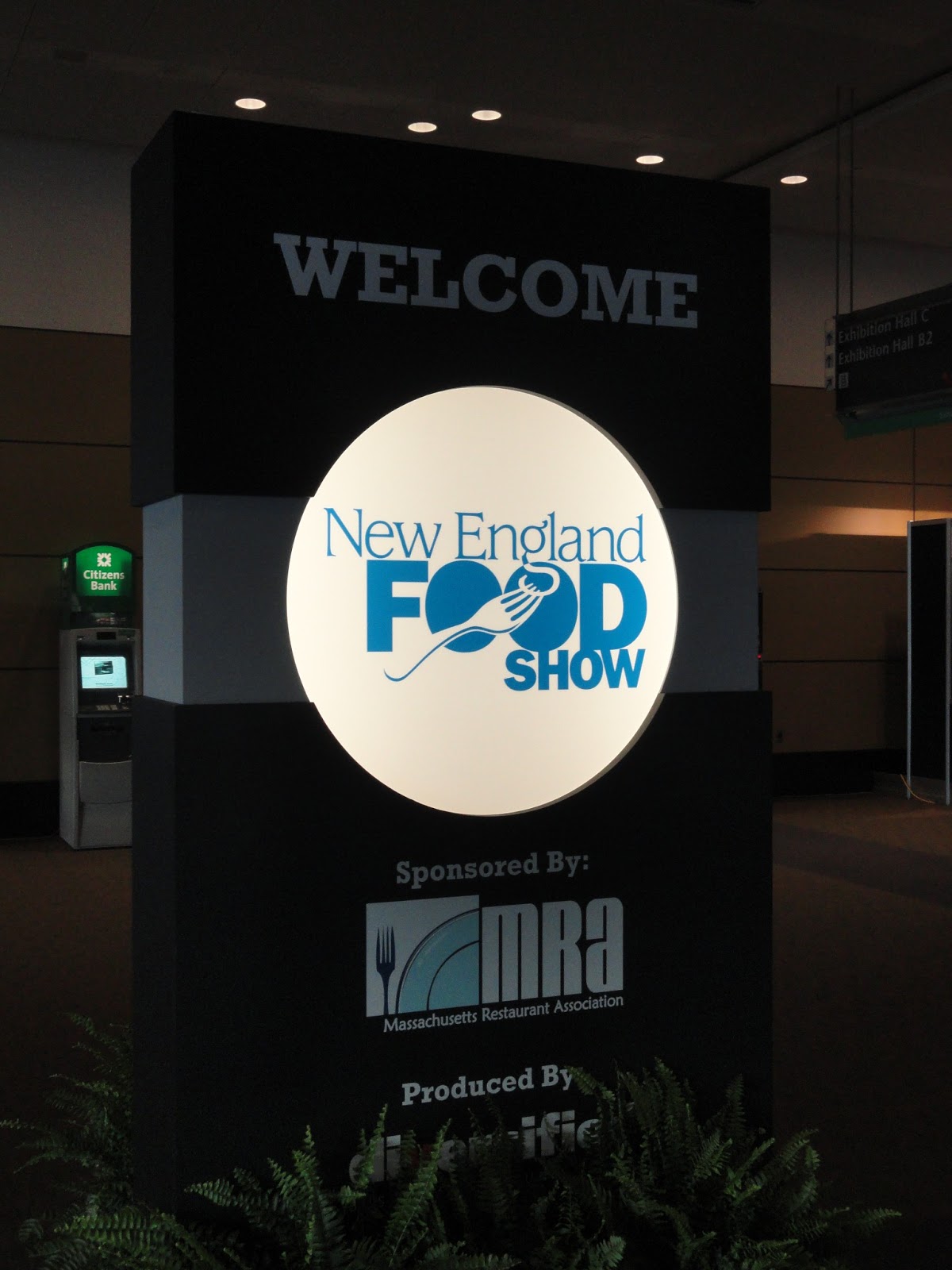
At the New England Food Show (NEFS), I attended an interesting panel, put on by the Massachusetts Restaurant Association, called Once A Critic, Always a Critic. The discussion dealt with: "What makes a great restaurant? Where do they usually make mistakes? What are new trends in dining (and what trends should end)? Join some of Boston’s most respected and influential food writers and critics for an open discussion about the restaurant industry in the Hub and as a whole. In this insightful and entertaining conversation, writers will share personal anecdotes and discuss their best and worst experiences (on and off the job), pet peeves, what always impresses them, and,favorite new local restaurants, and what keeps them coming back for more."
Moderated by Nicole Russo, Executive Vice President of 451 Marketing, the panel participants included (as pictured above): Mat Schaffer, a former Boston Herald restaurant critic and now the principal of Mat Schaffer Consulting, Jolyon Helterman, an Independent Writer & Editing Professional, and Amy Traverso, Senior Editor, lifestyle of Yankee Magazine. Nicole asked the panelists a series of questions, and then there was a time for questions from the audience. The panel only lasted an hour though could have easily gone for twice that length.
Please note that I am paraphrasing the responses of the panelists.
Is being a restaurant critic the best job in the world?
Amy: Yes, is is an amazing way to make a living.
Jolyon: There are beauty hazards and it is hard to keep the weight off
Mat: It can be the best job but still lots of work is involved. He had to eat out 5-6 times per week and had to be in mood for whatever restaurant cuisine his editor assigned to him that week. He used to eat at a restaurant, anonymously, 2-3 times and order lots of food. After quitting his job as a critic, he lost about 30 pounds. He notes that a restaurant critic must be objective, honest, fair and possess a professional attitude.
What type of feedback have you received from your reviews?
Amy: She related an anecdote about a hotel which was upset that it did not receive a magazine award. They bundled up copies of the magazine in a ttrash bag and delivered it to her office.
Jolyon: He mentioned that he has not written about some negative things he has encountered at restaurants as he felt it would not be fair to the restaurant, such as finding chewed gum in a dish.
Mat: He has received plenty of negative feedback from his critical reviews, from mass emails to profantity laced diatribes.
Where do restaurants make their biggest mistakes?
Amy: She is very sensitive to sound issues. Also thinks service is very important.
Jolyon: There is too much fancy plating at casual dining spots.
Mat: The "restaurant business is all about expectations" and they must meet or exceed them. He has little issue with noise but hates misspelled menus.
What are some of your "go to" restaurants outside of reviews?
Amy: As she has a child, she now goes most often to casual spot. She really enjoys Area 4, Sofra, Puritan, Island Creek, and Marliave.
Jolyon: He searches for a perfect vibe, even if all of the food is not so good. Maybe a place does a great fried chicken but the rest of their menu is merely average. Also likes sitting at the bar. He enjoys Myers + Chang, Coppa, Belly Bar, Westbridge, and Erbaluce.
Mat: He likes a number of places in Chinatown, such as Montien, China King, and some Hot Pot spots. He thinks that the best restaurant in the Boston area is Salts and that Clio is another top notch place. He also enjoys Stella's in the South End.
What are some current restaurant trends?
Amy: Experimental business models such as popups, underground restaurants, and food trucks. She likes the new restaurant Asta which only offers three prix fixes each night and there is no ala carte menu. She also likes to see old style recipes brought back, kind of retro for traditional dishes.
Jolyon: He likes the pre-order big dinners, like pig roasts, which become more of an event than just a dinner.
Mat: Cocktail culture, farm to table, other nationality cuisines.
How does the Boston dining scene compare to other cities?
Jolyon: He likes Boston but feels that Portland, Oregon and Seattle are kicking our butts. Much of that is due to the issue of liquor licenses as it is so tough for new restaurants in Boston to obtain them. That acts as a significant obstacle to potential new places.
Mat: He feels the Boston culinary scene is not as big as some other cities and that we lack sufficient resources to support many more restaurants. He is proud of our restaurants, feeling we have come a long way but that we still have a long way to go.
Who are some young chefs to watch?
Jolyon: Should keep an eye on the Chefs de cuisine who are working under the big name chefs.
Mat: Will Gilson and Louis DiBiccari
How has food writing changed in recent years?
Amy: Critics have been forced to review restaurants earlier. Used to wait 4 months but now only 2. A great restaurant review should present a historical/cultural context, and almost be like an anthropological study.
Jolyon: Immediate feedback. One of the biggest problem is a lack of calibration, where some writers let one small slight take over their entire review, rather than giving each element its proper proportional credit.
Mat: For bloggers and online writers, there often is no editor to keep them honest.
I asked them a question on whether restaurant critics should address drink programs in their reviews.
All of them agreed it was necessary and recommended critics gain wine/alcohol knowledge. They also mentioned there were three possible reasons why a review might not include coverage of drinks programs. First, it might be the fault of the critic. Second, it might be the fault of the restaurant which fails to emphasize its drinks program. Third, it could be due to editorial cuts in the review.
A few additional comments of note.
Amy stated some advice for writers. "The more specific your pitch the better."
It is hard to get attention from restaurant critics for a long term client. The new restaurants seemd to get all the attention.
It also seems hard for restaurants outside of the Boston area, such as in the suburbs, to get restaurant reviews.
For Over 18 Years, and over 5600 articles, I've Been Sharing My Passion for Food, Wine, Saké & Spirits. Come Join Me & Satisfy Your Hunger & Thirst.
Tuesday, March 19, 2013
New England Food Show: Some Thoughts
Along side the International Boston Seafood Show (IBSS), there is a smaller trade show, the New England Food Show (NEFS), and I always take some time to check it out, to see what new food & drink items are being showcased. The NEFS seemed more crowded than the IBSS on Sunday and Monday, and it was difficult to pass down the aisles due to the crowds. On Tuesday, it was far easier to navigate the NEFS, to check out the various booths which cater to restaurants, food shops and more.
I found numerous items that had been shown at the NEFS last year and some items which, though tasty, didn't impress me. I only found two items, one food and one drink, which were especially compelling, which I wanted to bring to the attention of my readers.
The Swatt Baking Company, located in New York, produces L.A. Cinnamon Bread, which they prepared with a sweet glaze atop it. I love cinnamon bread and this was an excellent example of such, with plenty of cinnamon flavor, a good texture to the bread, and the glaze added a nice sweetness without stepping over into being cloying. A two pound loaf of bread and a 15 ounce bottle of cinnamon glaze costs $7.95, with discounts for larger quantities. Unfortunately, their website has very little information about the product.
Want a new, tasty local drink that might actually be good for you too? Motto Sparkling Matcha Tea was created by two friends, Tom Olcott and Henry Crosby, and it was launched about seven months ago. This drink is crafted with premium matcha, basically ground green tea, as wellas apple cider vinegar, honey, organic agave, lemon juice, sparkling water and "other natural flavors." A 12 ounce bottle sells for about $3-$4 so it is priced similarly to other high end juices and carbonated drinks. A bottle also contains 70 calories and 16 grams of sugar.
Green tea has a number of health benefits so this drink should provide some of those benefits, though I don't know how much matcha is in this drink or its rough equivalency to a cup of green tea. I may follow up on that matter with the creators. What appealed to me was its taste, which was only lightly sweet and with a prominent green tea taste. I am not a big fan of sweet tea, but the sweetness level here is low so I enjoyed it. It also has a clean and compelling taste which many tea lovers would enjoy.
There was a panel discussion, put on by the Massachusetts Restaurant Association, at the NEFS called Social Chefs: Using Your Followers to Build a Following. This discussion brought together four prominent Boston chefs who shared "some of their tips and tricks for converting virtual followers into regular customers." Though I was unable to attend this discussion on social media, I received some notes on the discussion that I wanted to share. Though much of this information is directed to chefs, everyone will be able to find value in these words in regard to the use of social media.
Chef Jason Santos:
-His phone is always in his pocket so it’s very convenient to be active on social. “I try to make is a part of my day.”
-He doesn’t look at social as a competition. “We’re all friends. I just naturally go into it and use it to engage with my followers.”
-His tactic is to keep it visual. He likes to excite people with what he’s doing. “Pictures add realism.”
-It is important to be active on social. “As chefs we are in charge of shaping the brand.”
-Always create a conversation. “I always end my posts with a question to keep people engaged.”
-He thinks it is important to use hashtags on Twitter
Chef Joanne Chang:
-“It takes all of a minute. I try to engage my following by letting them know what’s going on behind the scenes.”
-She gets ideas from other chefs/ restaurants and finds social educational.
-“I ignore negative feedback. If I can’t do it positively, I just don’t do it at all.”
-“If you view social media as advertising, it will backfire.” Her tactic is to keep things educational and create a buzz.
-Twitter is her favorite social platform because it’s short.
-“My managers are busy engaging with guests, I engage virtually on social platforms.”
Chef Jamie Bissonnette:
-Facebook is like a calendar, uses it to post pictures of events but mostly uses Twitter day to day.
-Engages managers and chefs to post on behalf of restaurants and wants them to be a part of their social voice.
-Social media allows for a new platform to learn about peers worldwide. “We don’t have to travel to France to see what chefs are cooking there. It’s a new way to get to know each other.”
-“It’s all about PMA-Positive Mental Attitude. You have to support everyone and engage in friendly competition.”
-“We have our own voice in this city, we aren’t competing with the food scene in NYC or Chicago.”
-“A chef is a teacher. I teach my employees but I learn from them too. It’s the same with social, it allows us to learn from each other.”
-When asked about negative feedback on social “I look at it as a door to turn the situation around.” Explains that he can reach out to them and listen to their concerns.
Chef Brian Poe:
-Uses Yelp to keep track of customer complaints and fix any reoccurring issues. “If I see continuous comments that a door guy is charging $20 to let people in, that’s something I wouldn’t have found out otherwise.”
-Explains that building a following on social takes time. “Be patient.”
-“The Boston food scene is becoming more serious, we have some of the best chefs, our clientele is becoming more educated.”
-“Twitter is instant and more like a filter, Facebook has staying power.”
-At first his tactic was just to get people to go in and eat. He would use social to see what others were doing. Now he’s “grown-up” and working on his brand.
We can see that each chef views social media in their own way, though there are similarities between some of their positions. Each chef has provided some valuable insight here and it is worthwhile to consider their thoughts in our own use of social media. These are chefs who have been successful in their use of social media so they have the experience and knowledge to help others.
Would any other chefs like to add their thoughts on social media?
Monday, March 18, 2013
Rant: You're Fat & It Is Your Fault
Face the truth. The reason you are overweight is likely because you eat too much and don't exercise enough.
My Rant is not about those who have actual medical conditions that cause obesity, whether it be glandular or some other legitimate matter. I am addressing only those people for whom being overweight is due to lifestyle choices. Don't blame the soda companies, the candy makers, the cake bakers. Don't blame McDonald's, Burger King or Wendy's. Take personal responsibility for your condition. Own up to the choices you have made and accept your guilt.
Yesterday, I read an editorial in the New York Times called How to Force Ethics on the Food Industry by Michael Mudd, a former executive at Kraft Foods. Mr. Mudd wants the government to intervene "..to protect the public health by limiting the marketing tactics of food companies." Do we really need more government intervention into our lives, limiting our choices? Do we really need more laws? Mr. Mudd also suggests that the government institute taxes "..on sugared beverages and a few categories — snack foods, candy, sweet baked goods — that most undermine health." Do we really need more taxes?
My main problem with Mr. Mudd's editorial is it seems to absolve people of their personal responsibility for their own actions. Do we want people to start even more lawsuits against the food industry, blaming them for obesity? We already have far too many lawsuits where people try to blame others for their own stupidity or poor choices. I want people to stand up and accept responsibility for their own actions, for eating too much, for not exercising enough. I don't think we need more laws and regulations, but rather more education for consumers.
Interestingly, Mr. Mudd seems to believe education is necessary too, as he wants the taxes on sugary drinks and foods to pay for education programs. He also wants the government to support "community-based campaigns to inform and inspire better eating and more exercise." In the suggestion changes that Mr. Mudd lists in his editorial, none mention banning over-sized drink cups. It is obvious that at its most elemental, Mr. Mudd understands personal choice is at the bottom of the problem, though he would rather cast blame on the food companies.
I want the blame squarely on the people who make the choices which lead to them being overweight. Do food companies try to convince people to make bad choices? Sure, but people should be smart enough to know better. I am overweight, and the responsibility for my condition lies solely on my own shoulders. I eat too much and don't exercise enough. I understand and accept my own culpability and I don't place the blame on anyone else. Why can't everyone else do the same?
If more people accepted personal responsibility for their actions, in all arenas, then the world would be a better place.
Friday, March 15, 2013
All About The International Boston Seafood Show 2013
"It has always been my private conviction that any man who pits his intelligence against a fish and loses has it coming."
--John Steinbeck
This past week, I have been immersed in the ocean, swimming with the fishes. The 2013 International Boston Seafood Show (IBSS) is past and I have written a bunch of posts this week about it, exploring some of the stories I found there. To be beneficial for my readers, I am compiling all of the links to my IBSS articles into a single place. This post will be that repository, and as such will be updated whenever I write another related article about IBSS. There is a good possibility that I will follow up on certain seafood issues in the near future. And if you have any questions about the Seafood Show, feel free to ask.
On this past Monday at IBSS, the SeaFood Business released its second Show Daily magazine and I was pleasantly surprised to find that one of my tweets had been selected as their "Tweet of the Day." My tweet stated: "@BostonSeafood Show is healthy for you. Lots of exercise via walking, lots of Omega-3s from seafood, good info for your brain. #ibss13." As they select only two tweets during the entire show for their daily magazine, I was honored to have been chosen.
Here is the list of my IBSS posts:
Rant: Get Thee To The Seafood Show!
SeaShare: Seafood For Hungry Americans
Rant: Wake Up Japan, Bluefin Are In Danger
Rant: Stop Worrying, Seafood Is Safe
International Boston Seafood Show: Japanese Pavilion
Perceptions of Seafood Sustainability
Verlasso Salmon: An Update
International Boston Seafood Show: Food of Interest
International Boston Seafood Show: Some Highlights
International Boston Seafood Show: Fish Fun & Photos
Eat More U.S. Seafood: The Gulf Coast
U.S. Aquaculture Advocacy
Next year, the International Boston Seafood Show will be renamed the Seafood Expo North America as part of a global rebranding effort. Will you attend in 2014? I hope to be there.
"But more wonderful than the lore of old men and the lore of books is the secret lore of ocean."
--H. P. Lovecraft
U.S. Aquaculture Advocacy
"Oysters are the most tender and delicate of all seafoods. The stay in bed all day and night. They never work or take exercise, are stupendous drinkers, and wait for their meals to come to them."
--Hector Bolitho
As I have mentioned before, about 50% of the world's seafood production is through aquaculture and it is necessary if we intend to expand our seafood consumption. There is an insufficient supply of wild stocks to fulfill all our needs, especially if we can get everyone to eat seafood at least twice a week. The U.S. imports an unbelievable 91% of our seafood, and much of that comes from foreign aquaculture. Such aquaculture may not be sustainable and the media has indicated all of the problems, actual and potential, from those operations. The U.S. has little control over this overseas aquaculture, so what can we do?
What about U.S. aquaculture?
The U.S. currently engages in only a small amount of aquaculture and we rank 13th in total worldwide aquaculture production. Most of U.S. aquaculture is made up of freshwater farms, the majority which raise catfish. About 20% of U.S. aquaculture is for marine species, and 80% of that is for shellfish, such as oysters, clams and mussels. This marine aquaculture provides only 1.5% of U.S. seafood consumption. There have been a number of calls for increased aquaculture in the U.S. and that might be exactly what we need to increase U.S. purchases of domestic seafood.
At the International Boston Seafood Show, I stopped by the booth of the National Aquaculture Association (NAA), an advocacy group for U.S. aquaculture. Their mission is "To provide a unified national voice for aquaculture that ensures its sustainability, protects its profitability, and encourages its development in an environmentally responsible manner." The two main issues that get raised about all aquaculture are whether it is sustainable or not, and whether it is safe or not. The media often likes to talk up the risks and dangers of aquaculture, exaggerating the perils. That can create in the mind of the general public an undue paranoia against aquaculture.
In the defense of U.S. aquaculture, the NAA cites the alphabet soup of federal agencies that govern the various aspects of aquaculture, such as the USDA, EPA, NOAA, FDA and USFWS. In addition, there is a long list of stringent state and local regulations which are applicable to aquaculture operations. All of this oversight and regulations should make Americans feel more secure with domestic aquaculture, more confident that it is safe and sustainable, despite fear mongering by some of the media.
All of these legal restrictions, regulations and agencies apparently have succeeded to a large extent. According to the Seafood Watch, much of the U.S. farmed seafood is considered sustainable. For example, U.S farmed channel catfish, oysters, mussels, shrimp, Coho salmon (farmed in tank systems) and others are listed as Best Choices. The same cannot be said for many instances of foreign aquaculture. It seems that U.S. aquaculture is largely sustainable so consumers have more reasons to be confident and secure about domestic seafood.
As for the potential risks from mercury/PCBs in seafood, I have already written about that issue, that the health benefits from seafood consumption far outweigh any minimal risks. It is essentially a non-issue. Again, consumers have little reason to worry.
As I said before, you should give your support to domestic seafood, and that includes both wild and farmed seafood. It will be good for you, good for your community and good for our country.
Subscribe to:
Posts (Atom)