Combine Kentucky Bourbon, Japanese Whisky, Spanish Sherry, California Vermouth, Massachusetts Cider, and Italian Fernet Branca. Mix in oysters, chocolate, jerk chicken, and miso pickles. Pour into a large rocks glass and garnish with an assortment of local mixologists, drink writers, brewers, distillers and cocktail enthusiasts. Call this concoction: Thirst Boston.
Last week, I attended, as a media guest, the multi-day event, Thirst Boston, held at the Hotel Commonwealth in Kenmore Square. The event was created and organized by a group of four locals, including Maureen Hautaniemi, Brandy Rand, Andrew Deitz, and TJ Connelly, though plenty of others contributed to the event's success, from presenters to volunteers. On their website, Thirst Boston's intent is to be "...a gathering of bartenders, industry icons and beverage connoisseurs from Boston and beyond. Our goal is to educate attendees on the science, craft, and taste of all things related to the art of drink. We want to celebrate our local talent (your favorite bartenders and baristas) and have a pretty kick-ass time hanging out together." I believe they successfully accomplished their objective.
The event started on Saturday night and ended on Tuesday morning, though the heart of the event took place on Sunday and Monday. There were an assortment of parties and lunch events, priced from $30-$75, and over 20 seminars, priced $20 each, with a number of complimentary events, such as after- parties and tasting rooms, which accompanied your purchase of any event or seminar ticket. You could also purchase a one or two day pass, for $135 or $295, which allowed you entry to three seminars each day, as well as the three daily special events. The two day pass also included a ticket to the Saturday evening party, The Thing. Even if your budget was tight, there was still plenty you could experience for just $20, the cost of a seminar.
There was a nice diversity of events, from the Saturday night opening party, The Thing, at the Harvard Club, to lunch events such as High Tea & Tipples with Drambuie and The Appleton Estate Jamaican Bartender's Brunch. There were other parties too, such as Blender Blender (a bartender competition of frozen drinks) to Stars, Stripes & Swing (a celebration of Armistice Day). You also found after parties hosted by brands from Fernet Branca to Bulleit Whiskey. There were over 20 seminars, a pop-up of The Boston Shaker, book signings, a few tasting areas, and more. There was something for everyone, and plenty of opportunities to taste some fine drinks.
As I attended last year's Boston Cocktail Summit, drawing comparisons between the two events seems appropriate. First, the Summit was primarily concentrated on spirits and cocktails, while Thirst, which was heavy on spirits and cocktails, expanded its offerings to include beer, wine, cider, and non-alcoholic drinks. Second, the audience at the Summit seemed to consist mostly of people in the trade, while the audience at Thirst included many more individuals who were just enthusiasts, and didn't work in the trade. In addition, Thirst seemed to have a higher overall attendance than the Summit. Third, the Summit ran twice as many seminars as Thirst, however the Thirst seminars garnered nearly full attendance while a number of Summit seminars had a much more skeletal attendance.
Probably the most significant difference between the Summit and Thirst was logistical. I previously discussed the logistical problems with the Summit, primarily because they split their events between two hotels which were situated a fair distance from each other. That made it more difficult for attendees to attend events because of the often lengthy travel time that had to be considered. Thirst concentrated their events at a single location, the Hotel Commonwealth, making it far easier to get around and attend events. The evening parties were generally at different locations but that wasn't a significant concern. Thirst seemed to run very well, and was better organized than the Summit. Hopefully Thirst will return again next year and be even better.
The Thirst Lounge was a complimentary area for event/seminar ticket holders and included the Boston Shaker Pop-Up Shop, four different Hosted Cocktail Bars (2 on each day), and a couple tables promoting drink media and the On The Bar app. They even had some breakfast pastries each morning for the early risers, those who weren't too hungover from the evening parties.
The Boston Shaker Pop-Up presented a wide variety of cocktail related items for sales, from bitters to mixing kits, books to t-shirts. There were even author signings. For cocktail supplies, the Boston Shaker is certainly the local go-to spot and after getting excited at the various seminars, it was cool that attendees could pick up some of these items at Thirst.
On Sunday, I stopped by the Hosted Bar for the "Wake Up Breakfast Bar" with Galliano and had a cocktail, the Harvey Wallbanger, which I haven't had in many years. A Harvey Wallbanger is basically a Screwdriver with the addition of Galliano, and November 8 was even National Harvey Wallbanger Day. The origins of the cocktail are in dispute and it seemed to fade out of popularity, however it might be making a comeback. Galliano is a sweet & herbal Italian liqueur and in the Wallbanger, it adds a bit of sweetness as well as some herbal elements.
The basic recipe for the cocktail contains 1 1/2 oz. Vodka, 4 oz. Orange Juice and 1/2 oz. Galliano L’Autentico. Mix the vodka & orange juice in a highball glass filled with ice cubes and then pour atop a float of Galliano. Garnish with an orange wedge. I actually enjoyed this cocktail, kind of a retro thing, and with the orange juice, it was a nice morning drink.
On Monday, I stopped by the "Top o’ the Morning Bar" with Kilbeggan & Tyrconnell Irish Whisky. I've enjoyed Kilbeggan before but Tyrconnell ($72), an artisan distillery that was bought by Kilbeggan, was new to me. It is a Single Malt Irish Whiskey that was aged for ten years, including 8 months in a Port cask. The whisky is smooth and complex, with notes of vanilla, honey, citrus, red berries, spice and caramel. Everything is well balanced and the finish is lengthy and pleasing. A fine sipping whisky, and it would make a great gift for the holidays. Highly recommended.
Another complimentary area was the Hall of Liquids, which offered tasting samples of beer, cider, and some nonalcoholic beverages. For example, local beer brands and producers included Boulevard, Rising Tide, Ithaca Beer, Newburyport Brewing, Peak Organic, Notch, and Long Trail. Flat Black Coffee, which specializes in single origin coffees and is committed to ethics & sustainability, was very popular each morning.
Fever Tree makes a series of cocktail mixers, including Indian Tonic Water, Tonic Water, Mediterranean Tonic, Bitter Lemon, Club Soda, Ginger Beer, Naturally Light Ginger Beer, Ginger Ale, and Sparkling Lemon. The company launched in the UK in 2005 with their Premium Indian Tonic, which contained quinine. ‘Fever Tree’ is a colloquial name for the Cinchona Tree in which quinine is found. They use all natural ingredients and I have enjoyed their products before. I tasted their Sparkling Lemon, which I hadn't had before, and it was only mildly sweet with a strong lemon flavor and a refreshing effervescence.
They have an ad that states: "If 3/4 of a cocktail is the mixer, make sure you use the best." That is certainly an important issue in cocktail making, that the quality of your mixers matters a great deal. Using a high end spirit, but cheap ass mixers, defeats the purpose and lessens the cocktail. Top mixologists understand and it is something that home bartenders need to pay heed. Every ingredients matters.
Michele da Silva, one of the owners of Bantam Cider, showcased three of their ciders. I've raved about their ciders before, and got to taste one of their new products, the Bantam Rojo ($7.99/22 oz). It is made with sour cherries and black peppercorns, and it is a challenge to produce year round as fresh cherries aren't available all year. It is mostly dry, with a sour aspect up front, and a prominent cherry flavor throughout. There is a mild peppery note in the background. It was made for Thanksgiving and I think it would be a good choice for such. I think this is another winner from Bantam.
In the future, Bantam will be making more barrel aged ciders, and maybe using straight bourbon barrels.They are also working on a Smoked Saison, which will use smoked apples with a Saison yeast, and it could be available in January or February.
Thirst Boston held 22 different seminars, 11 each on Sunday and Monday, and they ran for 90 minutes. The seminars were broken down into 4 time periods, with 2-3 seminars in each period. The seminars covered a diversity of subjects and they were well attended, a number of them selling out. Each seminar seemed to have 25-30 or so attendees, and when the attendees were polled, it showed the variety of the audience, from bartenders to enthusiasts. The presenters did well, and there were tasting components to all of the seminars I attended. Next year, as the number of attendees will likely grow, the event might want to add one or two more seminars each period.
The seminar panels I attended included:
The Evolution of Bourbon
Whiskey Women
Pirates, Partisans & Grandmothers: The Legacy & Use of Sherry
Location, Location, Location: Terroir & Merroir
Rethinking Vermouth: The Renaissance of Fortified Wine
Japanese Whisky: Pride, Perfection, Passion.
I'll be posting more about these seminars in the near future.
Thirst Boston was an improvement over last year's Cocktail Summit, and hopefully it will return next year. I met lots of great people at the event, tasted some delicious beverages, learned more about spirits & cocktails, and had a fun-filled couple of days.
If you attended Thirst Boston, what were your thoughts?
For Over 18 Years, and over 5600 articles, I've Been Sharing My Passion for Food, Wine, Saké & Spirits. Come Join Me & Satisfy Your Hunger & Thirst.
Wednesday, November 20, 2013
Tuesday, November 19, 2013
Abacela Vineyards: A Spanish Touch
When visiting different wine regions, I usually find a number of wines I would like to purchase, but flying with wine is a challenge. There can be the added cost for additional luggage and the a risk that the bottles might break during the flight. Generally, I'll only purchase one to three bottles, and pack them carefully in my existing luggage. Thus, I need to be very selective in which bottles I decide to transport home. When I recently visited Oregon, I purchased only a single bottle, a high end Tempranillo from Abacela Vineyards. It was a most impressive wine.
Earl Jones, pictured above, is the owner of Abacela Vineyards and led us on a tour of the winery. Living with his wife, Hilda, in Pensacola, Florida, Earl had a passion for Spanish wine, specifically the Tempranillo grape. From that passion spawned the question for Earl whether Tempranillo could be successfully grown in the U.S.or not. As he searched for an appropriate region, he found that Southern Oregon occupied a similar latitude as sections of northern Spain, including parts of Ribera del Duero and Rioja. Further analysis and investigation, including consultation with his son Greg, led him to believe that Tempranillo could potentially do well in this area. So, in 1992, he purchased land on south sloping hillsides in Umpqua Valley, hoping to fulfill a dream.
In 1995, they planted the first Tempranillo in the Pacific Northwest and would make their first varietal Tempranillo in 1997. For the name of their winery, they chose an ancient term, "abacela," which is common to the Spanish, Galician and Portuguese languages. The term means "to plant a grape vine," symbolic of their efforts in starting a new vineyard, as well as honoring the Spanish Tempranillo. Besides grapes, they also chose to preserve some 19th century orchards that already existed on the property, which bear pears, apples and oranges.
There is a fault line beneath their property, a "bulldozer" fault, which moves north but does not cause any shaking. However, it does mean that part of their soil is approximately 450 million years older than the rest of the soil. Their estate now consists of 500 acres and there are about 76 acres under vine, though they only count the actual area occupied by the vines and not the alleys between the vine rows. Besides Tempranillo, they grow other Spanish and Portuguese grapes, as well as a few others. In all, they grow about 20 grapes, some experimental, as they still seek to determine which other grapes will grow well on their property. Over time, they have stopped growing some grapes as they determined they could not grow them commercially and constantly for 8 out of 10 years. Earl stated that "climate is the dominant factor in deciding what to grow."
When we first arrived at Abacela, we saw this intriguing cannon, initially suspecting it was merely decorative. However, Earl indicated that it was a working cannon that they found for sale, and now use on special occasions. Not sure there are many wineries that have their own working cannon. Wine thieves beware!
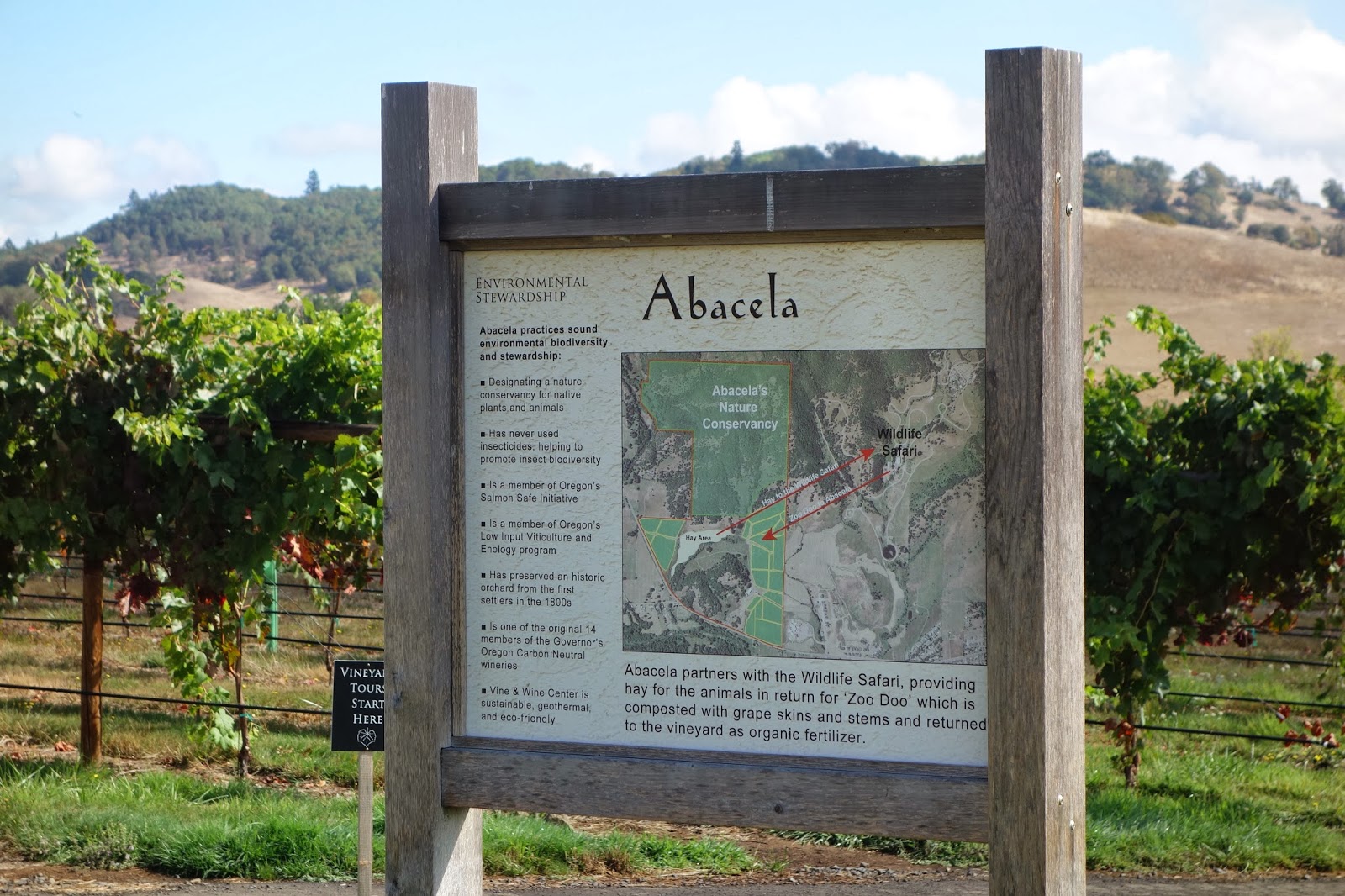
Abacela is very eco-conscious and was one of the first carbon neutral wineries. Outside the winery, there is a series of panels about the winery, including one which outlines all of their eco-conscious programs. For one, they work with Wildlife Safari, trading hay for manure, which they will use for compost/fertilizer. Like many other Oregon wineries, they care about the environment, and work towards supporting it, rather than working against it.
The Abacela property has one of the longest growing seasons in the region and a low frost risk. To monitor matters, there are about 30 weather stations on the estate gathering data. This is not surprising as Greg has assisted his father in understanding the climate, soil and terroir of the estate. In 2013, they have only had about 8.8 inches of rain so far, which is unusual, and they expect to harvest, only hand harvesting, about 200 tons of grapes. Earl stated that it is still too early to determine the signature grape of Southern Oregon. Though he, and now other wineries, are having success with Tempranillo, more time and experimentation is still necessary. Earl conducts plenty of experiments, from different grapes to different barrels. It is a continual learning experience, gathering lots of data each year, constantly seeking to improve.
Abacela produces wines including Tempranillo, Dolcetto, Garnacha, Malbec, Syrah, Merlot, Muscat, Albarino, Viognier and more. The wines are distributed in about 27 states, so there is a decent chance that you might be able to find them locally, though they have little distributiion outside of the U.S. Their wines are available in Massachusetts and I strongly recommend that my local readers seek them out. You won't be disappointed.
As we toured the winery, we sipped some of their 2012 Grenache Rosé ($16). They crop tbeir Grenache differently for their rosé than they do their red, and Earl noted that Grenache can be a challenging grape as it needs a long time to ripen. The rosé undergoes only four hours of skin contact, giving it a nice, pink color, and it has an alcohol content of 13.1%. It reminded me more of a French rosé, dry and with restrained but complex red fruit flavors. Delicious, and the type of rosé I prefer to drink.
The rest of our wine tasting took place during lunch, which began with a fresh salad of mixed greens, peaches, crispy serrano ham, and a verjus dressing. Tasting wine with food is always a worthwhile experience, giving you a better sense of the wine.
What is Tempranillo without Spanish cuisine? Our main dish was a huge Paella, with chicken, shrimp, chorizo, peas, green beans, tomatoes, and peppers. Compelling and flavorful, I had refills, and probably could have eaten even more. It well well with the wines, and seemed appropriate for much of what we were drinking. Everyone should have more paella in their lives.
Though Earl stated that the estate is a difficult terroir for Albarino, the 2012 Albarino ($18) was excellent. It was crisp and dry,with pleasant flavors of apple and pear as well as some mineral notes. The finish was long and delicious, and it would make a fine food wine, or be enjoyable on its own too.
Besides Spanish and Portuguese grapes, Abacela also does well with their 2009 Malbec ($25), a smooth and approachable wine with lush black fruit flavors and plenty of spicy notes. Good complexity and a long finish enhance this wine. The 2009 Estate Syrah ($30) is another easy drinking wine, big and fruity with restrained tannins and mild spice and earth elements.
For me, the star of the tasting, and the only wine I purchased this trip, was the 2005 Paramour ($90). Abacela makes 4 different Tempranillos and this is the top of their line. Inspired by the iconic Vega Sicilia Unico, Earl has long desired to make a Gran Reserva style, and the great vintage of 2005 provided him an opportunity. 2005 also happened to be an excellent vintage in Spain too. One key difference between Spanish Gran Reservas and the Paramour is that Earl chose to use French oak rather than American. The Paramour spent about two years in French oak barrels (30% new) and then four years in the bottle. Only 170 cases of this wine were produced, using very much hands-on wine making processes. They believe the 2005 Paramour will reach its full maturity in 2017 and plateau around 2029.They will produce additional Paramour wines, in exceptional vintages.
This was an amazing wine, and reminded me of some high end Spanish Tempranillo wines. From its alluring aromas to its complex melange of flavors, this wine impressed from start to finish. I think it was very drinkable now, and will continue to remain strong for years to come. It is difficult to describe this wine, which is something you need to experience and which mere words cannot adequately encapsulate. Each sip brings new flavors to mind, and it is a wine to slowly savor over dinner, with great friends. Earl should be extremely proud of the Paramour, and this wine is evidence of how well Tempranillo can be produced in Southern Oregon.
After dinner, we got to try a wine that hadn't been released yet, which had been bottled the week before, the 2008 "Five Year" Tawny Port ($37.50/500ml). They have made other Ports before, since 1999, and were grandfathered by law so they can legally use the term "Port" on their wines. This is their first Tawny style, and unlike many other American style Ports, they use five Portuguese grapes in their blend, including Bastardo, Tinta Amarela, Tinta Cao, Tinta Roriz, and Touriga Nacional. They acquire their brandy from Clear Creek Distillery, and aged this Tawny for five years in neutral oak. Only 200 cases were produced and it has an alcohol content of 19%.
A delicious and complex taste, with plenty of flavor, including raisin, fig, ripe plum, caramel, and nutty notes. Very concentrated flavors, well balanced, smooth and with a lingering finish. In a blind taste test with Portuguese Tawny Ports, you would likely be hard pressed to pick out the Abacela.
Abacela Vineyards is a star of Southern Oregon, and Earl's dreams have come to fruition in his exceptional Paramour. Much of his success is due to his extensive data collection and analysis of the terroir, which is important for all wineries that are concerned with terroir. Experimentation is still important in Southern Oregon as well, to learn which grapes grow best, which grapes will one day be the signature grapes of the region. If visiting Southern Oregon, make sure to check out Abacela.
Monday, November 18, 2013
Rant: Cook More Seafood, Especially Local
I don't think you're listening to me and I'm only trying to help. Pay attention! My advice will benefit your health, bring you pleasure, help local businesses, and assist the country's economic welfare. And what I am asking is relatively easy to do, so why aren't you listening to me?
My advice is: Cook More Seafood, Especially Local.
Last year, my advice was very similar: Eat More Seafood, Especially Local. And as far back as March 2010, I've been exhorting people to Eat More Fish, especially because of its significant health benefits. However, seafood consumption in the U.S. has been declining for the last seven years. That is a terrible situation and needs immediate change. Numerous health problems plague our population and increased seafood consumption would help to change that situation.
As I mentioned last year, annual seafood consumption in 2011 decreased to 15 pounds per person, dropping from 15.8 pounds in 2010. Recent reports indicate that seafood consumption in 2012 continued to decline, down to 14.6 pounds. The prior 2011 report was even more disturbing when it revealed that the U.S. imports 91% of their seafood, up 5% from 2010. Why aren't we buying more locally sourced seafood?
It seems that cost is often at the root of these problems. Earlier this year, I indicated this was a significant issue and recent reports reiterate that conclusion. However, recent reports delineate the issue in more depth, indicating that seafood consumption at restaurants may actually be increasing in many places. That is obviously a positive development, seeming to indicate that people want to eat more seafood and understand the benefits. The overall decline in consumption seems to be mostly due to less people cooking seafood at home.
Do you have difficulty preparing seafood at home? Do you know how to cook fish and shellfish? Are there reasons why you don't cook more seafood at home? Is the price alone the problem?
Fish can be prepared in a myriad of methods, from raw to baked, fried to grilled. It can be added to soups, stews, risottos, casseroles, stir fry or sauces. Seafood can be prepared very simply and still possess plenty of taste. Buy a seafood cookbook and experiment if you want to make more intricate dishes. Seek out help from other cooks about the best ways to prepare seafood. It isn't as hard to prepare as you think.
So what are you waiting for? Get out there and cook more seafood, especially local.
If you have a recommendation for an excellent seafood cookbook, please leave it in the comments.
If you have advice and suggestions for cooking seafood at home, please leave it in the comments.
Thursday, November 14, 2013
Thursday Sips & Nibbles
I am back again with a new edition of Thursday Sips & Nibbles, my regular column where I briefly highlight some interesting wine and food items that I have encountered recently.
**********************************************************
1) The Salty Pig announces the introduction of a new pasta program. Showcasing the talents of Executive Chef Kevin O’Donnell and Sous Chef Michael Lombardi - both of whom worked in Italy and at Mario Batali’s Del Posto - the menu now features a rotating selection of pastas and Italian-influenced starters and mains.
Not only will The Salty Pig make all pasta in-house, but it will also produce pasta for sister restaurants Coda Bar & Kitchen and Canary Square, averaging about 50 pounds per week. Three different types are currently featured on the menu: a buckwheat pappardelle with rabbit and local cabbage, cavatelli with sausage, broccoli, and chili, and tonnarelli with pecorino, black pepper, and olive oil.
The Salty Pig has also introduced a new weekly concept, Red Sauce Sundays, created to give guests a fun yet affordable dining experience. Each Sunday, the restaurant will transform into a throwback Italian joint reminiscent of the good ol’ days with red checkered tablecloths, candles, and the smooth sounds of Sinatra. The menu will feature a rotating selection of Italo-American crowd-pleasing classics made with high quality ingredients and The Salty Pig’s touch including marinated house made mozzarella, bolognese, eggplant parmesan, and chicken piccata.
2) As fall segues to winter, Ashmont Grill has changed their menus to match the seasons. That includes the following:
Spicy Smoked Pork Tacos, tomatillo salsa, cotija, cilantro crema
Oyster Pan Roast an Acadian recipe that adds the heat of chourizo broth to shucked oysters; sop em up with tarragon-parmesan toasts
Marks Charcuterie Board meats and cheeses change often, but this will always feature the snappiest housemade pickle in Boston
Roast Delicata Squash stuffed with pumpkin-cranberry farro
Lemony Braised Pork Shank with grilled Napa cabbage
Beef Tongue & Kimchee Sandwich (with cheddar, avocado and fries)
Salted Caramel Parfait with almond shortbread streusel, candied almonds
Clare's Ice Cream Sandwich of the Month: roasted banana chip ice cream with peanut butter cookie
Dorchesters own beer: Percival Brewing Companys DOT ALE 1630
The Hot & Dirty: hand-stuffed blue cheese olives, brine and Tabasco, with Ketel One
Three unique events are also coming up at Ashmont Grill:
Sunday, November 24: Moustache Brunch
A hair-raising benefit, with proceeds donated to the Codman Square Health Center
Monday, December 2: Five Course Beringer Wine Dinner
$65 per person, by reservation only.
Sunday, December 15: Ugly Christmas Sweater Brunch
Everyones got one; we wanna see em. Come wearing yours and you could win a prize.
3) Each year, on the first Thursday in December at 3:30 PM, residents of all ages in Concord assemble on Walden Street for the arrival of the largest wheel of Italian cheese in North America. This year, the date is December 5. The annual Crucolo Cheese Parade attracts over 1,000 adults and children, attracted to a spectacle that includes:
--The arrival down the towns main commercial street, by horse-drawn cart, of a 400 lb. wheel of Crucolo cheese, equal in diameter to a 3-year-old child.
--The Crucolo is accompanied by a member of the Purin family, makers of Crucolo for the past 250 years. Its trip began in Scurelle, a town in the mountains of Trentino, Italy, where the cheese is made especially for this event.
--The Crucolo Dancers, a troupe of exuberant Concord Academy teenagers, prance down the street in advance of the cheese. Simultaneously, the cheese is loudly serenaded by an Italian chorale group, while 1,000 excited onlookers brandish Italian flags.
--A proclamation announcing Crucolo Day in Concord is read, Occupy Wall Street-style; a human megaphone echoing in English and Italian.
--The Crucolo is rolled from the horse cart to a stage, as if bridging the Old World with the New World. It is then cut, sliced and distributed to the hungry crowd.
On the sidewalk people pose with the giant cheese, while inside The Concord Cheese Shop, cheese-lovers clamor to purchase Crucolo, which retails for about $20/lb. The entire 400-lb. wheel will be sold before Christmas.
The Crucolo parade is free and open to the public.
4) On Tuesday, December 3, at 6:30pm, Piattini, located on Newbury Street, is hosting a special tasting of rare and unusual Italian cheeses. Owner Josephine Oliviero Megwa will be joined by cheese extraordinaire Mark Sutherland of WB Cheese, and the two will lead an intimate tasting in Piattini’s private dining room. Guests will learn about the ancient cheese-making methods that are still used today and will even have a chance to make their own fresh mozzarella. Sutherland will bring with him a rare and unusual selection of imported Italian cheeses and as guest’s sample the different varieties he’ll explain the different nuances and tasting notes of each.
Piattini’s cheese tasting is $30 per person (tax and gratuity not included), and for an additional $15 guests can sip on perfectly paired wines for each cheese selection. Space is limited and reservations are required by calling Piattini at 617-536-2020.
5) Do you feel lucky? Want to win a free dinner? Laurie’s 9:09, located in Wakefield, will begin offering a new Wednesday night special that gives customers the chance to eat for free with the flip of a coin. Every Wednesday evening, starting November 13, guests will be presented their bill at the end of the meal and the waiter will flip a coin and the guests will be allowed to call “heads” or “tails.” If they guess correctly their dinner is completely free. If they guess incorrectly they will be required to pay their bill. There are no party size restrictions on this offer and all are welcomed in to try their luck.
“We’re still a pretty new restaurant and while Thursdays, Fridays and Saturdays are very busy, we still want to give people a fun reason to come in and enjoy our place mid-week. When thinking of a fun promotion I tried to think of what would make me want to come out on a Wednesday night. The idea of getting it all for free seemed like a big motivator to me,” said Chef/Owner, Laurie Rizzo.
The promotion is not valid for takeout, excludes alcohol and you are asked to still tip on the total amount of the bill that is complimentary should you win the coin flip.
6) On Monday and Tuesday November 25 and 26, 2013, Rolling Stones band members Tim Reis, Bernard Fowler and Darryl Jones will be performing songs off of Reis’s album “The Rolling Stones Project,” at the newly opened Beat Hôtel located in Harvard Square, for a once-in-a-lifetime iconic performance. From 9pm-12am, the former Rolling Stones band members will play an assortment of Stones classics as guests enjoy food from Executive Chef Rebecca Newell and sip on cocktail specials from Ketel One and Bulleit Rye Whiskey.
Tim Reis, one of the one of the most sought after soloists, composers, and arrangers in the music business, had the opportunity to play the keyboard and horn while touring with The Rolling Stones in 1999. Following the tour, Reis began work on his album and realized that a lot of The Stones music had “great potential for jazz arrangements,” and thus, “The Rolling Stones Project” was formed. The project features guests like Sheryl Crow, Norah Jones and original Stones members Keith Richards and Charlie Watts. Since their first live performance in 2004, The Rolling Stones Project toured the world playing in prestigious venues and festivals including Toronto Jazz Festival, The Stockholm Jazz Festival, Ronnie Scotts in London and The Melbourne Jazz Festival.
Reis will be joined on stage at Beat Hôtel by Rolling Stones backup vocalist Bernard Fowler and bassist Darryl Jones. Fowler’s relationship with the Stones began when he sang back up vocals for Mick Jagger on his solo album “She’s the Boss.” Proving his stamina and soulful talent, Fowler joined The Rolling Stones and has since toured with them as a backup vocalist and worked with Ronnie Wood, Charlie Watts and Keith Richards on their solo projects, also appearing on their albums and tours.
Much like Reis and Fowler, Darryl Jones has the same extraordinary experience. Jones has appeared on over 30 albums and worked with an astounding list of accomplished artists including Yoko Ono, Robert Plant, Pearl Jam, The Neville Brothers, Herbie Hancock, Duran Duran and The Red Hot Chili Peppers to name a few. In 1994 he was asked to join The Rolling Stones as a bassist, replacing Bill Wyman and he has been with them ever since.
To make a reservation or for more information please call 617-499-0001
Wednesday, November 13, 2013
Rant: People of Color & The Local Alcohol Industry
How many people of color work in the spirits/cocktail industry in the Boston area? How many people of color are involved in brewing and distilling? How many people of color enjoy drinking spirits and cocktails?
I don't have answers for the first two questions, though there appears to be only a tiny number of people of color involved in craft brewing. However, I suspect that the answer to the third question is significant, that many people of color enjoy a wide variety of spirits and cocktails. However, at this week's Thirst Boston, there seemed to be only a handful of people of color at the event. Why was that so?
From their website: "Thirst Boston is a gathering of bartenders, industry icons and beverage connoisseurs from Boston and beyond. Our goal is to educate attendees on the science, craft, and taste of all things related to the art of drink." At some of the seminars I attended, they asked the audience about their connections to the industry, and there were always a significant portion of enthusiasts, people who didn't work in the industry and just enjoyed alcoholic beverages. So it wasn't just a trade event and was inclusive of enthusiasts as well. There seemed to be a parity of male and female attendees, which was good to see. Overall, it was a fun, educational and interesting event, and I'll be writing more about it soon.
However, I wondered why there weren't more people of color.
Thirst Boston isn't unique in this regard. Last year's Boston Cocktail Summit had the same issue and at other, smaller spirits/cocktail events I have attended in the last couple years, there have also been a dearth of people of color. This is a bigger issue than a problem at any single event. It is an issue worthy of examination, analysis and discussion. Let us find ways to attract more people of color to these type of beverage events.
As a start, I would like to start a list of people in color who are involved in the local beverage industry. Back in 2008, I started a list of female wine writers and would like to do something similar for people of color in Massachusetts. To help me compile this list, please send me info on any people of color in Massachusetts who are bartenders, mixologists, distillers, brewers, distributors, beverage writers, brand ambassadors, or connected to the alcohol industry in any other way. Let's highlight these individuals and show the diversity that currently exists, and maybe motivate others to get involved as well.
Subscribe to:
Posts (Atom)