Monday, June 14, 2021

Rant: How Many Restaurants Have Closed Due To the Pandemic?

We're well aware that the pandemic significantly impacted the restaurant industry. As the states start to lift pandemic restrictions, these restaurants can start to recover as more and more customers can dine-in rather than just obtain take-out and delivery. 

One question that comes to mind is: How many restaurants permanently closed due to the pandemic?

It's estimated that pre-pandemic, there were about a million or so restaurants nationwide. Normally, about 50,000 restaurants close each year, due to a myriad of reasons. Some of the latest data from the National Restaurant Association indicates that about 90,000 restaurants have closed permanently or long-term, which would be about 9% of all restaurants, and only 40,000 more than usual. 

In Massachusetts, it's been alleged by the MA Restaurant Association, since at least June 2020, that about 20% of local restaurants closed. However, no breakdown of those numbers, such as by city/town, have been provided, and the alleged numbers haven't changed or been adjusted in the past year. National numbers have certainly changed since last June, so it makes sense that local numbers would have changed as well. So, the MRA numbers may not be accurate as of time. 

During the pandemic, numerous new restaurants have also opened. A CBS article, from May 2021, discussed some recent statistics concerning new restaurants. For example, in the last three months of 2020, Yelp added 18,000 new spots to their platform. And according to the Census Bureau, in January and February 2021, there were about 50,000 applications for new food businesses. 

In the end, the pandemic has hurt the restaurant industry, in the number of closings, far less than the direct predictions from a year ago. Roughly, about an additional 4% of restaurants closed above the usual annual number of closings. For those closed restaurants, this was definitely a terrible occurrence, and should not be dismissed. However, if we just look at the overall industry, it has struggled but it could have been far worse.

More restaurants could still close, which is why restaurants need our support now more than ever. Even those restaurants who haven't closed, have often faced a significant loss of income. Some are clinging to existence, hoping that the lack of restrictions will save them. Just because the worst case scenarios didn't occur doesn't mean the impact hasn't been significant. 

We need to patronize restaurants now, as much as possible, to help them survive. We should also tip well. Every restaurant that must close adversely affects so many people, from the owners to the servers, from the suppliers to the customers. Fortunately, the pandemic wasn't as devastating to the restaurant industry as it could have been, but the industry definitely still needs our assistant and patronage. We have the opportunity to patronize our favorite restaurants, so we need to take that opportunity. 

Friday, June 11, 2021

New Sampan Article: An Early History of Chinese Laundries in Boston

"The most interesting feature of Chinese life to me was that on board their boats, or sampans, as they are called....Upon these boats live whole families of three and even four generations."
--The Fall River Daily Herald, November 20, 1888

As I've mentioned previously, I've a new writing gig, contributing to Sampan, the only bilingual Chinese-English newspaper in New England. I've previously written twenty-three articles for Sampan, including:


My newest article, An Early History of Chinese Laundries in Boston, is now available in the new issue of Sampan. During the 19th century, the most prevalent occupation for Chinese men who settled in the Boston area was being a laundryman. This was also true for many cities across the country, especially as Chinese had few available options, being barred from many other occupations. Let's explore these early Chinese laundries in Boston, from the first in 1875. 

I'm currently working on a new article for the Sampan.

What is a "sampan?" The newspaper's site states, "A sampan is a popular river boat in traditional China. This small but useful vessel, by transporting cargo from large boats to the village ports, creates a channel of communication among villages." And like that type of boat, Sampan delivers news and information all across New England, and "acts a bridge between Asian American community organizations and individuals in the Greater Boston area."

Sampan, which was founded in 1972, is published by the nonprofit Asian American Civic Association, "The newspaper covers topics that are usually overlooked by the mainstream press, such as key immigration legislation, civil rights, housing, education, day-care services and union activities. These issues are crucial to the well-being of Asian immigrants, refugees, low-income families as well as individuals who are not proficient in the English language."

There is plenty of interest in Sampan which will appeal to all types of readers, from restaurant reviews to historical articles, from vital news stories to travel items. In these current days when racism and prejudice against Asians and their restaurants is high, it's more important than ever that accurate information about the Asian community is disseminated and promoted. We need to combat the irrational prejudices that some possess, and support our Asian communities just as we would support any other element of our overall community. We are all important aspects of a whole, and we need to stand together.

Support Sampan!  

Thursday, June 10, 2021

Thursday Sips & Nibbles

I'm back again with a new edition of Sips & Nibbles, my regular column where I highlight some interesting, upcoming food and drink events. I hope everyone dines out safely and tips well. ****************************************************** 
1) Celebrating Boston-area culinary talent, over-the-fire cooking, and the defeat of a global pandemic, Blue Barn Outdoor Living will be hosting a special culinary event, The Landing, featuring food and drink from Boston’s top chefs at Chef Will Gilson’s The Herb Lyceum at Gilson’s, in Groton, on Sunday, June 27, from 4pm-8pm.

The Landing features a celebration of beer, spirits, fire, food, and live music. The event will feature six local chefs using their creative culinary (and pitmaster!) chops to prepare signature tasting dishes on the new UFO firepit and cook system by Blue Barn Outdoor Living alongside a cocktail to complement their offering; live music; drinks; and more.

Participating chefs include:
Will Gilson (Puritan & Co. and The Lexington)
Daniel Bojorquez (La Brasa)
Peter Ungar (Tasting Counter)
Douglas Williams (Mida)
Patrick Basset (Forge & Vine)
Colin Lynch (Bar Mezzana and Black Lamb)

Featured live musical acts include:
Romance Novel
Moe Poper & Christopher Talken As “Lethal Weapon”

Tickets cost $140 and include all food, cocktail samples, two drink tickets, and performances. Attendees must be 21+ and are respectfully requested to be vaccinated as this will be a mask-less event designed to recapture the norms the culinary world has all worked hard and waited a long time for.

Please visit HERE for more information or to purchase tickets.

2) On Thursday, June 24, from 7pm-10pm, join Pedro Martinez, Carolina Martinez, and other special guests on Casa Caña’s courtyard patio for the fiesta of every foodie and Red Sox lover’s dream! Raising critical funds for The Pedro Martinez Foundation’s community center in the Dominican Republic, the exclusive event will feature live music, passed bites from Casa Caña’ delicious taqueria-inspired menu, drinks, and of course.... Pedro himself.

Ticket packages begin at $95 with all proceeds benefiting the Pedro Martinez Foundation. To purchase tickets, or to learn more about the event, please visit HERE.

Wednesday, June 9, 2021

A Short History of Franciacorta in the U.S. (Part 2)

According to information from the Consorzio per la Tutela del Franciacorta, next year, 2022, will be the 40th Anniversary of the first official importation, in 1982, of Franciacorta Sparkling Wine into the U.S. However, it appears that a single sparkling wine from Franciacorta made its appearance in California at least as early as 1979, which was likely a rare exception.  

Franciacorta remains under-the-radar even to many wine lovers. As I wrote back in 2013, "Franciacorta may be the best sparkling wine that many people know nothing about." Part of the issue is that only a relatively small amount of Franciacorta is imported into the U.S., but wine lovers should still be aware of this quality sparkling wine, seeking it our at their favorite wine shops. For most basic information about Franciacorta, please read yesterday's article, Franciacorta: A Sparkling Treasure of Lombardy.

Let's explore some of the early history of Franciacorta in the U.S., noting that even from its start in the U.S., its high quality was already being recognized. 

The first U.S. newspaper reference I found concerning Franciacorta was back in 1977, however it was about Franciacorta still wines. The Sunday News (NJ), October 16, 1977, printed an advertisement for Wine & Spirit’s World, noting they were selling an “exquisite red wine, Franciacorta Rosso DOC 1973 and 1974." It also continued, “There is evidence Franciacorta always had an ancient tradition of grape cultivation and wine growing stemming from the Middles Ages settlement of Benedictine Monks whose abbeys were surrounded by vineyards.” Next, it was mentioned that the “Franciacorta Rosso DOC is made in Oakwood casks on the Longhi-DeCarli estate. Originally used only by the family, this great wine is now offered to you exclusively through Wine World…” A 24 ounce bottle sold for $2.99, with a case price of $32.50.  

The Villager (NY), November 24, 1977, published an ad for Crossroad, a wine shop which was offering for sale the Pinot Di Nigoline Cantine del Baroni Monti Della Corte, from the Franciacorta DOC,  which is supposed to be “One of Italy’s finest white wine. Soft, scented, Meursault-like,” and sold for $2.99 a bottle. 

Some other quick mentions were in other newspapers. The Modesto Bee (CA), July 28, 1978, had an ad which mentioned the 1975 Franciacorta Rosso, which usually sold for $3.75, and was on sale for $2.99. The Chicago Tribune (IL), March 4, 1979, in an article on the best wine values, around $5, referenced the Longhi do Carli’s Franciacorta 1975. The Press and Sun-Bulletin (NY), April 12, 1979, ran an ad for the Spirit Shoppe, which sold Franciacorta Bianco, 24 ounce bottle for $3.49, and Franciacorta Rosso, 24 ounce bottle for $3.49. 

The first sparkling wine from Franciacorta? The San Francisco Examiner (CA), October 26, 1979, had a discussion with Al Malatesta, co-ownr of the Iron Gate restaurant, and who stated they had introduced many new Italian wines into the area, including the rare Pinot De Franciacorta from Lombardy. Back in 1961, this was the first sparkling wine produced in Franciacorta, by the Berlucchi winery. A year later, the San Francisco Examiner (CA), December 12, 1980, discussing the Iron Gate restaurant again, noted “Their Pinot Di Franciacorta from Lombardy is a fine rare Italian white wine.”It's fascinating that they didn't refer to it as a sparkling wine.  

As the 1980s began, Franciacorta still wines continued to be mentioned briefly. The Boston Globe, May 8, 1980, in an ad for “Martignetti IS an Italian Wine Festival” listed only two wines from Lombardy the 1975 Francia Corta Red and White, 24 ounce bottles for $3.99.  

The Journal News (NY), August 7, 1980, printed an ad for Wines & Spirits in Suffern, New York, offering the 1978 Franciacorta Pinot Bianco,Semi dry, with a nice touch of fruit,”a 25 ounce bottle for $4.39. 

In the Daily Register (NJ), November 4, 1981, there was an article on the wines of Italy, which briefly mentioned that “Franciacorta Rosso and Pinot are two well-known wines from... Lombardy."

Besides the references to the Pinot De Franciacorta, the first American newspaper references to Franciacorta Sparkling Wine occurred in 1982.

The Daily Register (NJ), June 2, 1982, described the annual Italian Barrel Tasting, held by the Les Amis du Vin, at the Tavern-On-The-Green restaurant in New York City. The article mentioned, “A Franciacorta Pinot Spumante Dosage Zero Ca’ del Bosco and a Brut from the same producer were served as aperitifs before the dinner. These two sparkling wines were clean and crisp on the palate but they lacked a little elegance. Both are made in the Champagne method. The Dosage Zero, as the name implies, has no dosage (touch of sweet syrup) added to the wine so it is extremely dry—drier than Brut.”   

This writer wasn't fully impressed with the Franciacorta but it was only one person's take. The Daily Record (NJ), August 4, 1982, detailed the experiences of another writer at that same tasting, and he wrote, “Our aperitifs were the two finest sparklers I have ever tasted from Italy. Ca’del Bosco Franciacorta Pinot Dosage Zero and Franciacorta Brut.”

There was a brief mention in the Daily News (NY), April 17, 1983, “At Altri Tempi, the unique and chic Neapolitan restaurant, Norman Mailer quaffed bubbly from Lina Wertmuller’s own vineyard, Paderno Franciacorta in Lombardy.”

One of the first lengthier articles that deal with Franciacorta was in the Daily Times (NY), October 5, 1983, in an article titled, “It’s Time to Look for the Wines of Lombardy.” A number of wine producers from Lombardy had come to the U.S. to showcase their wines at the Italian Wine Center in New York City. The article initially stated, “Once of Brescia’s three areas given DOC status is Franciacorta, whose vineyards cover a natural amphitheater sloping down to Lake Iseo."

The writer tasted three wines from Fratelli Berlucchi, and all were “distinct winners.” The wines included the 1980 Franciacorta Pinot Spumante DOC Metodo Champenois, the 1982 Franciacorta Pinot Bianco DOC and the 1980 Franciacorta Rosso DOC. As for the sparkling wine, “The first sniff, the first taste of the dry spumante was a delight. Made primarily of Pinot Bianco, with some Pinot Grigio and Pinot Nero, the Berlucchi spumante displays classic fruitiness in bouquet and flavor, along with a fresh tasting quality. It’s finely pearled mousse is long lasting as is its pleasing finish. It should be on retailers’ shelves by late fall, selling for about $8.”

The writer than stated, “The Pinot Bianco, a 100 percent varietal, is well balanced, smooth drinking yet crisp, with a lively aftertaste of fresh young apples.” And continued, “The Rosso is particularly interesting, produced from an unusual blend of Cabernet Franca, Barbera, Nebbiolo and Merlot. Its aged in oak for two years, in bottle, between six months and a year…It makes an immediate impact as a well balanced, medium bodied wine, with elements of complexity at a young age. The wine is full of character but not overly fruity. It certainly is a memorable wine, a wine of elegance. It is available at retail for about $5.99.”

The Star-Gazette (NY), June 19, 1984, referenced the La Camelia Ristorante, in New York City, which may have the city’s finest Italian wine list, including 10 methode champenoise wines by the glass. One of the writer’s favorites was the Ca’Del Bosco Franciacorta Pinot.

In a wine review, the Central New Jersey Home News (NJ), November 2, 1986, discussed the Ca’Del Bosco Dosage Zero, which is produced by Maurizio Zanella in the Franciacorta DOC. This winery made about 150,000 bottles annually, using only estate grown grapes. The writer noted the winery “is considered one of the finest producers in Italy of less-pressurized wines.” The wine sold for $22.50 per bottle. There was also a brief review of Bellavista Franciacorta Brut ($18), which had some similarities to the other Franciacorta, made from Pinot and Chardonnay, but a  dosage was added.

The Los Angeles Times (CA), December 26, 1986, briefly stated that the 1982 Ca’ del Bosco Franciacorta Rosso ($22), “...got more delicious the longer it breathed.”

In an article on sparkling wine around the world, the Shreveport Journal (LA), January 2, 1987, stated, “The Berlucchi label on a sparkling wine is a sign of quality. Since the northern Italian company brought its prices into line with competitors from other countries, the wines are reasonably priced. Look for the Cuvee Imperiale Brut. Ca’ del Bosco, from Franciacorta, may be the best of all the Italian sparklers, particularly the Dosage Zero, which, as its name implies, is anything but sweet. Ca’ del Bosco prices are high, though—starting at about $20—and if there is French Champagne to be had at the same price, it’s a tough call.” High praise for Franciacorta. 

Ca’ del Bosco continued to receive raves. The San Francisco Examiner (CA), January 14, 1987, in a wine review of the NV Cremant, Franciacorta, Ca’ del Bosco ($28), noted, “Anyone skeptical about the future of Italian Champagne method sparklers should try this wine. It is concentrated, complex and toasty (like a top-of-the-line Champagne), with a terrific finish.” The Rocky Mount Telegram (NC), September 2, 1987, stated, “Ca’ del Bosco’s sparkling Franciacorta is rich but dry, appetizingly crisp and a fine opening shot for a great dinner.”

Other Franciacorta Sparkling Wines got positive reviews as well. The San Francisco Examiner (CA), November 18, 1987, in a wine recommendation, mentioned, “The Italian sparkler is the 1982 Franciacorta Brut from Bella Vista at $18.95. Very light and dry. Delicate and graceful.”

Locally, the Boston Globe, August 24, 1988, printed a lengthy article titled, “Italy’s sparkling wines can rival Champagne.” The article began by stating these sparkling wines can rival Champagne "in quality, character and price when skillful winemakers lavish capital, labor and time on selected lots of chardonnay and white, gray and black pinots.” The writer continued, “I first came across a Ca’del Bosco sparkling wine a couple of years ago, and was amazed by its elegance and intensity of flavor, so I followed its trail.” 

This led the writer to visiting the winery in Lombardy, and he continued, “Ca-del Bosco is dialect for ‘house in the woods. In 1968, there was only forest. Enter the Zanella family, amply equipped with financial daring, imagination and astral goals. The first wine was made in 1973. Most of the planned 136 acres have been planted. Current production is 30,000 cases annually; the goal is, at most, 38,000.” Their young winemaker was Brian Larky, from California, and 9 of their wines are currently imported, including four sparkling, two still whites, and three still reds.

As for the Sparkling Wines, his reviews included, “Cremant: 3.5 atmospheres. Made from half chardonnay, half piniot bianco. Lovely bouquet. Light and delicate, almost ethereal. $35” and “Brut: This and the two following are fully sparkling, and made from chardonnay, pinot bianco and pinot nero. Full, dry, elegant and substantial. $30.” The other two sparklers included, “Dosage Zero: Totally dry. Toasty and intense, full-bodied, long finish. $28.” and “Rose. Attractive color. Dry, with restrained fruitiness. Creamy texture. Very long finish. $31.”

The article also discussed the sparkling wines of Bellavista, a neighbor of Ca’del Bosco in Franciacorta,  which "likewise produces medal-worthy wines at an outstanding facility." They produce about 17,000 cases annually, which includes five varieties of sparkling wines and five types of still wines. The writer mentioned, “They are, like Ca’del Boso, necessarily expensive because of costs of materials, labor, time, capital investment and profits for the several tiers of firms involved in the passage of the wine from Italian soil to your glass. The Cuvee Brut is $22, the Gran Cuvee Brut $31.” The reviews continued, “Cuvee Brut: From pinot bianco and chardonnay. Fine, yeasty nose. Elegant: very well made,” “Gran Cuvee Brut 1984: Chardonnay 80 percent, pinot nero 20 percent. Weightier wine. Quite dry and stylish,” and “Gran Cuvee Pas Opere 1983: Totally dry (no sugar dosage added. Similar proportion of chardonnay and pinot nero. Austere, forceful, beautifully made—it would have to be, with no sugar to fill in defects.” 

Another lengthy article was presented in the San Francisco Examiner (CA), February 7, 1990, starting, “Most of Italy’s sparkling wines, and virtually all of its best ones, are produced in the northern half of the country.” It was then noted that Italy produced about 20 million cases of bubbly each year,  about 10% of the world’s production; ranks, placing them 5th of the worldwide producers of sparkling wine. Only their 20 million cases, only about 2.5 million are made through the metodo classic

The article then gave 10 recommendations, which included, “Bellavista, Brut, Franciacorta, $26. Bellavista is a first-rate champagne-method producer in the Franciacorta zone. Its wines are a bit lighter, crisper and more subtle in style than those of the other great Franciacorta producer, Ca’de; Bosco. This is an excellent Brut: fruity and crisp in style, with moderate yeast flavors.” 

Another recommendation was the “Bellavista, 1982 Gran Cuvee, Pas Opere, Franciacorta, $38. This is Bellavista’s prestige cuvee—a blend with no dosage, and with considerable complexity and elegance. It is medium-bodied (for an Italian sparkler), crisp and long on the palate, and is now at its peak of development.” As for Ca’del Bosco, it was said to be, “Arguably, Italy’s top producer of spumante, Ca’del Bosco’s sparkling wines are rich and complex in style.” Their Ca’del Bosco, Dosage Zero ($31) is “among the best of its type.

Today, Italy is the #1 producer of Sparkling wines in the world, producing about 660 million bottles annually. The ranking continues: France #2 at 550 million bottles, Germany #3 at 350 million bottles, Spain #4, at 260 million bottles, and the U.S. #5 at 162 million bottles. As for Franciacorta, only about 11% of their production is exported, and Italian Prosecco is by far the greatest sparkling export of Italy. I hope you can look beyond Prosecco, seek out Franciacorta, and understand the marvels of this high0-quality sparkling wine. 
To Be Continued....

Tuesday, June 8, 2021

Franciacorta: A Sparkling Treasure of Lombardy (Part 1)

Have you ever enjoyed Franciacorta Sparkling Wine, Italian bubbly from the Lombardy region? Unfortunately, despite its high-quality, many people are still not familiar with it, partially because only a relative small amount is currently imported into the U.S. However, it's well worth seeking out, and you can likely find it near you if you try. 

In short, Franciacorta is Italian Sparkling Wine, made in the méthode traditionnelle, and produced in the province of Brescia in Lombardy. It's a small, hilly region and its history extends back thousands of years. Wine was produced in this region for at least a couple thousand years, and ancient Romans, such as Virgil and Pliny the Elder, wrote about them. 

Though "Francia" is the Italian term for "France," the name of the region does not apparently derive from this definition. Though there is some disagreement, the name likely derives from the Latin term "curtes francae," which referred to small communities of Benedictine monks who lived near Lake Iseo, and were excused from paying taxes because of their help to the community. 

For most of the region's history, still wines were produced, and it was not until the 1960s that sparkling wines started being created. Guido Berlucchi, who owned a winery in Franciacorta, hired Franco Ziliani, a young enologist, to assist with his winery. Franco was full of enthusiasm and ideas, and desired to produce a sparkling wine. Guido allowed him to do so, and in 1961, they produced their first bubbly, Pinot di Franciacorta, which was also the first time that the term "Franciacorta" appeared on a wine label. 

The sparkling wine soon became popular, and other local producers started creating their own too, trying to join this new trend. In 1967, the region was awarded DOC status, though that was probably more for their still wines, though by 1983, the DOC rules were revised and referenced sparkling wine. In 1990, 29 wineries, which made still and sparkling wines, formed the Consorzio per la Tutela del Franciacorta, a voluntary organization to help promote their wines. 

Five years later, the sparkling wines of Franciacorta received great recognition, being awarded DOCG status, while the still wines were still under a DOC status called Terre de Franciacorta. The regulations in Franciacorta are amongst the strictest in Italy and have been tightened at least five times in the past 25 years. In 2008, the DOC name was changed to Curtefranca, to further set apart Franciacorta as a special sparkling wine. Today, the Consorzio has over 200 members (growers, wineries and bottlers), which includes 121 wineries, covering 98% of all producers in the region. 

Currently, there are about 7978 acres of vineyards in the Franciacorta region, with 7170 dedicated to the Franciacorta DOCG, leaving 808 acres for the Curtefranca DOC. The region produced about 17.6 million bottles in 2019, and only 11% were exported. Their wine industry has shown steady, incremental growth, until 2020, which was due to the pandemic. Of their production, about 77% is Brut, Rose is about 13%, and Saten is about 9%. 

The #1 import market For Franciacorta is Switzerland, which constitutes about 23.4% of imports, while #2 is Japan with 12.19%. Germany is #3 with 11.9% while the U.S. is #4 with 9.2%. That means, the U.S. receives roughly 178 thousand bottles, a mere drop in the bucket compared to all of the other Sparkling wine produced in the U.S. or imported here. 

Franciacorta is produced in the méthode traditionnelle, similar to Champagne, and is produced from almost exclusively three grapes: Chardonnay, Pinot Noir and Pinot Bianco. About 82% of their vineyards grow Chardonnay, with 16% growing Pinot Nero and only 3% growing Pinot Bianco. 

However, some producers have started working with Erbamat, a grape indigenous to the Brescia region which was first mentioned in written documents around 1564. Since 2017, Franciacorta Sparkling Wines have been permitted to add up to 10% Erbamat to their wines. About 12 wineries are currently working with Erbamat, which is a slow ripening grape that produces high acidity. There are no other grapes at this time which might be permuted in Franciacorta in the near future. 

Franciacorta is produced in a number of styles that are listed in the DOCG regulations, including:
--Franciacorta: Produced with Chardonnay, Pinot Noir and up to 50% Pinot Bianco. The NV must spend a minimum of 18 months on the lees. 
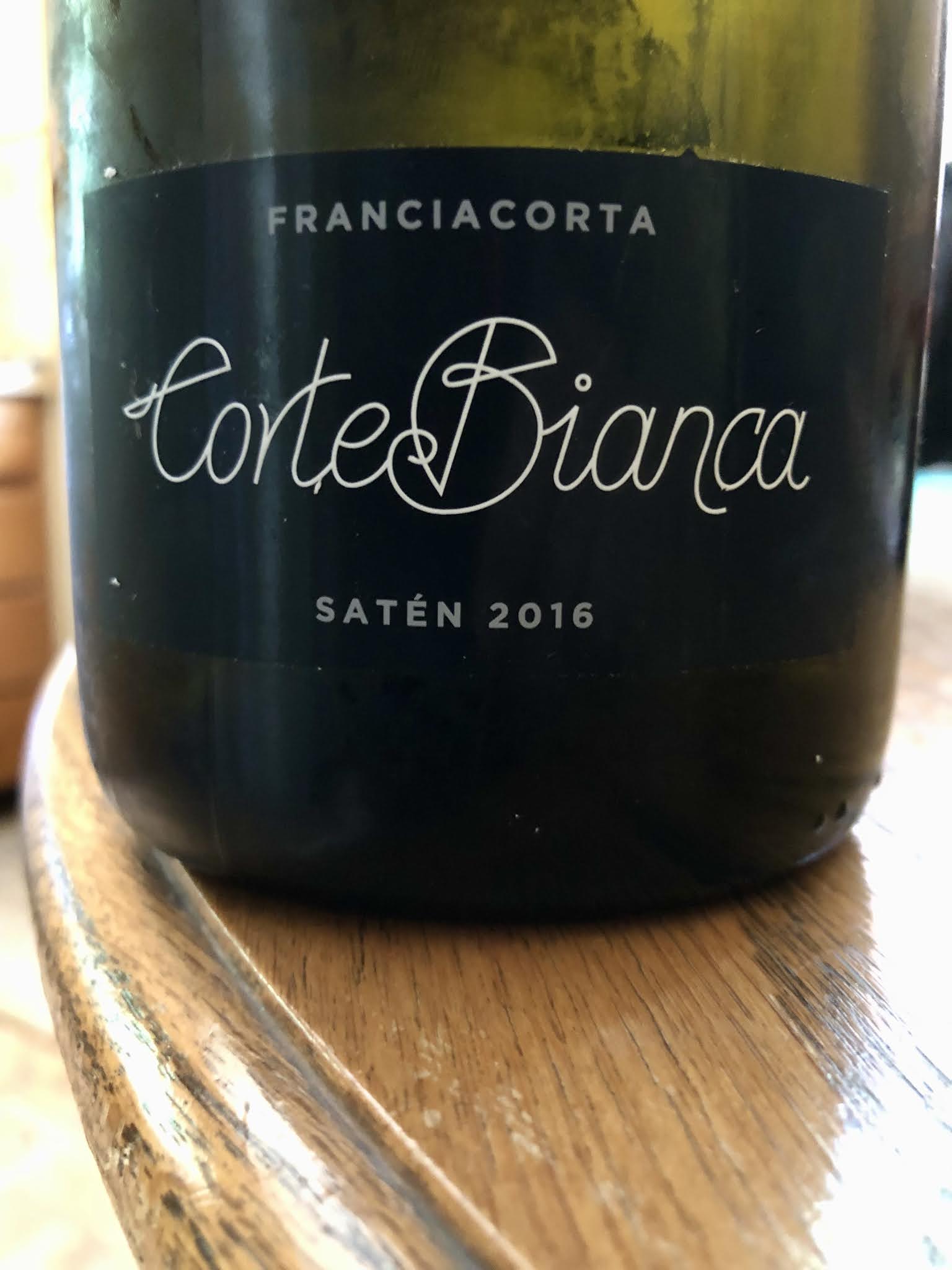
--Franciacorta Saten: Essentially a blanc de blancs, which is usually predominantly Chardonnay but can contain up to 50% Pinot Bianco. Must spend a minimum of 24 months on the lees. Made to be more food friendly.
--Rosé: It requires at least 35% Pinot Noir and the rest can be Chardonnay and Pinot Bianco. Must spend a minimum of 24 months on the lees. 
--Millesimato: This is a vintage wine, and must consist of at least 85% wine from a single growing year. It cannot be released until at least 37 months after harvest. Must spend a minimum of 30 months on the lees. 
--Riserva: This is also a vintage wine, and can be a Satèn or Rosé as well. It must have matured sur lie for a minimum of 60 months. 

All of these styles will possess a specific dosage level, just like a Champagne, including: Dosage Zero (aka Brut Nature), Extra Brut, Brut, Extra Dry, Sec/Dry or Demi-sec. Unlike in Champagne, the date of disgorgement must be placed on a Franciacorta label. Some of the aging requirements for Franciacorta are also a bit longer than Champagne. 

One of the most important aspects of the Franciacorta region, which causes it to stand apart from many other regions which produce sparkling wine, is the climate. Franciacorta has an alpine climate rather than a continental one, which means their vineyards produce riper grapes so there is much less need to add sugar to the bubbly.

Thus, when you drink Franciacorta, the sweetness you perceive is often due much more to the fruit rather than added sugars. That is a significant difference which often doesn't receive sufficient attention. There seem to be few discussions on sugar levels in sparkling wine, despite the importance of that topic. It should also be mentioned that the alpine climate is affected in part by the moderating influence of Lake Iseo. Thus, the terroir of Franciacorta plays a strong role in the ultimate product, in the taste of its sparkling wine.

Another important consideration in the Franciacorta region is the diversity of its soils, over 60 different types. Its morainic soils, caused by ancient glacial action, are stony, with larger stones located in the northern part and much smaller stones to the south. These stony soils don't retain water well, which force grape vines to become stressed as they have to seek deeper to find water. That struggle leads to better grapes, and it is often said that the worst soils make the best wines. About 71% of Franciacorta vineyards are organic and the rest are moving in that direction too. 

Franciacorta is very food friendly and unlike some other sparkling wines, works very well throughout an entire meal, especially due to its freshness and fruit flavors. You can find good Franciacorta for around $30-$40, though you can also find high end bottlings costing $200 or more. 

This region has undergone such an amazing transformation in only about 50 years, starting from nearly scratch to become a high quality producer of sparkling wine, which can compete with the best anywhere in the world. The next time you're out shopping for bubbly, consider Franciacorta.

To Be Continued.....