Showing posts with label whiskey. Show all posts

Tuesday, February 10, 2026

Glenmorangie Extremely Rare 18 Year Old Single Malt Scotch: Winter Tranquility

I greatly enjoy the various Scotches produced by the Glenmorangie Distillery, which is located north of Inverness, about half a mile from Tain, in the Highlands of Scotland. In Gaelic, Glenmorangie means "Valley of Tranquility." It's the smallest distillery in the Highlands and was founded in 1843 by a farmer, William Matheson, who bought a couple of ex-gin stills in England to start producing scotch. These stills were over 16 feet tall, the tallest in Scotland, and the distillery now possess 24 stills. The height provides a higher distillate, which ends up being lighter and smoother than some smaller stills. Glenmorangie is currently owned by Moët Hennessy-Louis Vuitton (LVMH).

Glenmorangie possesses their own water source, the Tarlogie Springs, including approximately 100 acres around it, to ensure the purity and quality of their water. Their barley is sourced only from Scotland. As I've mentioned before, the oak barrel is one of the most significant aspects of whiskey production, providing 60%-70% of the flavor and all of the color. Glenmorangie contracts with loggers in the Ozark Mountains for American white oak and then have the barrels constructed from the finest wood. They then lend the barrels to two American bourbon and whiskey distilleries for aging. After the barrels are used, they are then disassembled and sent to Scotland, to be reassembled and used to age Glenmorangie. They only use their barrels twice, as opposed to some other distilleries which may use them five or six times.

Dr. Bill Lumsden, the Director of Distilling, Whisky Creation, and Whisky Stocks, is a pioneer in the use of double maturation and the distillery is also well known for its experimentation. Their tagline is "unnecessarily well made," Their Scotch tends to be a lighter, ethereal, and layered style, which can be more consumer friendly than some other scotches. Yet it's far from simple, indicating the complexity and flavors possible within single malts. In addition, it's very food friendly, although not enough people consider pairing Scotch with dinner. 

The signet found on every bottle of Glenmorangie has its roots in the ancient past. At the end of the 8th century, the native Picts carved a huge stone, the Cadboll Stone, which eventually became the oldest recorded archaelogical find in Scotland. Though the Stone was eventually relocated to the National Museum in Scotland, Glenmorangie commissioned a stone replica which was eventually placed on its original location. The signet on their bottles is one of the carvings on this Stone.

The Glenmorangie Extremely Rare 18 Year Old Single Malt ($120-$150), with a 43% ABV, was matured for 15 years in American white oak, ex-bourbon casks, with 30% finished in Spanish Oloroso Sherry casks for three years. On the nose, there were more subtle and complex aromas of caramel, honey, and floral accents. On the palate, the Scotch was complex and compelling, smooth and ethereal,  with an intriguing melange of flavors, including dried fruits, caramel, figs, salted nuts, and a touch of citrus. It possessed a lengthy and satisfying finish, emphasizing the Oloroso elements. An excellent sipping whiskey, especially on a chilly winter night, providing a sense of tranquility and pleasure. It's also something best shared, with good friends or family, which would enhance the experience. Highly recommended.

Wednesday, December 20, 2023

2023: Favorite Wine, Spirit, Sake & Drink-Related Items

What were some of my favorite Wine, Spirit, Sake & Drink-related related items of the past year?

As 2024 approaches, it's time once again to reflect upon the past year, to remember and savor pleasant memories. Previously, I posted three of my food-related Favorites lists as well as my Top Twenty Wines of 2023. It's time now to cover my Favorite Wine, Spirit, Sake and Drink-Related Items of 2023. 

This is certainly not a complete list but it is more a sampling of compelling and memorable matters I have experienced and posted about over the past year. This is also a purely subjective list, based on my own preferences, and makes no claims about being the "best" of anything. But all of the items here have earned my strong recommendations and I hope you will enjoy them as well. For more wine related items, you can just search my blog posts for the past year.

************

Favorite Discount Wine Stores: Consumers always want bargains, excellent value wines which won't stretch their wallets. You can buy the cheap, mass-produced commercial wines which can be found in almost any wine store or, instead, you can seek out excellent, value wines which put to shame those cheap wines. Certain discount wine stores provide not only excellent prices but also an interesting selection and good service. I want to highlight two such stores which continue, year after year, to do an especially good job, places where I go to seek bargains. Shop at any of those stores and you won't be disappointed.

Favorite Wine Stores: 
This is a small list of wine stores which consistently impress me with their selection and service. Each shop is worthy of your patronage and wine lovers should make the effort to visit these places if you have not done so yet.

Favorite Maine Wine Store: Browne Trading Company sells gourmet foods, including caviar and fresh seafood, but they also have an excellent wine selection. They sell many high-end wines as well as more unique wines, including a very good Sherry selection. It's a place I could easily buy a case of wines, reveling in the finds. Any wine lover who visits Portland should definitely stop here. I also want to note that have an intriguing selection of soy sauces, from Mizunara Whisky Barrel Aged Shoyu to a White Shoyu. 

Favorite Restaurant Wine Lists: I want to highlight a few restaurants which offer some intriguing and excellent wine lists. 
     Krasi: With the largest Greek wine list in the country, you'll find almost any type of Greek wine you could desire. There are so many excellent options that you might have difficulty selecting a bottle, but the sommelier/wine director, Evan Turner, and staff can help guide you through the intriguing list. Expand your palate and explore the wonders of Greek wine. Plus, Krasi now sells their wines at retail, so if you enjoy a bottle for dinner, you can buy a bottle and take it home with you. This is such a great option, and I bought a couple bottles during my last visit to Krasi. 
    Kosmos: Although their wine list is not as large as Krasi, Kosmos also has an excellent and interesting Greek wine list, which well complements their excellent Greek cuisine. 
    Nightshade Noodle Bar: Their eclectic, well-curated wine list has primarily more natural wines from small producers. There's plenty of interesting options available, and the wines pair very well with their delicious cuisine. The list changes fairly regularly, and there's always something new to tantalize your palate.  

Favorite Wine Dinner: For the second year in a row, my favorite wine dinner was at A Tavola in Winchester. Their Fantasy Fine Wine Dinner was compelling, with excellent wines, two of which made my list of Top Twenty Wines of 2023, and they paired very well with the delicious foods prepared by Chef Carli, from Chatham Scallop Carpaccio to Mortadella Rotolo. A Tavola holds a number of wine dinners each year and you definitely should check them out. For 2024, they have already announced a Bourbon & BBQ dinner to be held on February 28. 

Runner-Up Wine Dinners: There are two other wine dinners in 2023 which are worthy of recognition. First, there was a Greek Wine Dinner with Domaine Costa Lazaridi and Yiannis Distributing at the Ithaki Restaurant. The food was delicious, including Marinated Sardines, Tuna Crudo, Scallops, Beef Kebob, Halibut, and more. The wines were tasty too, including an Assyrtiko which made my list of Top Twenty Wines of 2023,  Second, there was a California wine dinner with Ireland Family Wines at the Coach Grill. From Lobster Bisque to Seared Sirloin, the delectable food paired well with the higher-end California wines. Two of those wines made my list of Top Twenty Wines of 2023,

Favorite Single Country Wine Tasting:  2023 is the 25th Anniversary of the first Uruguayan wines being exported to the U.S. This year, I attended a fascinating media tasting of the Wines of Uruguay, which provided much information about the wine industry in this small South American country. We also got to taste a number of tasty wines, from Albariño to Tannat, including one which made my list of Top Twenty Wines of 2023,  

Favorite Large-Scale Wine Event: In 2023, the Boston Wine Expo returned, under new ownership and at a new venue, the Boston Park Plaza Hotel. It was a smaller more intimate event, and included a Spirits Tasting room and several Wine Classes. I found some excellent wines here, including a number which ended up on my list of Top Twenty Wines of 2023. There were also several food exhibitors, which enhanced the event. I would have liked to see more diversity in the wines, more wines from different countries, and hopefully there will be more in 2024. For example, there was only a single booth of Greek wines and only one of Portugal wines, and I would like to see more such booths. Stay tuned as sooner to the 2024 Expo, I will post an article with my recommendations for booths to visit. 

Historical Drink Articles: Since the start of the pandemic, it's been tough for many food and drink writers and some have simply written sporadically,. For myself, I've continued to devote many hours to researching and writing numerous historical food and drink articles, combing through thousands of newspapers and books. I've especially delved into the origins of numerous foods and drinks, trying to seek out their true origins, and not just accepting the unsubstantiated claims of others. Here are the historical drink articles I completed this past year.

Favorite Whiskey: During the 1850s, Chicken Cock Whiskey was created, and it was a very popular whiskey in the Boston area during the 19th century. However, the distillery burnt to the ground in the 1950s, but the brand was recently resurrected. This new whiskey is made from a mashbill of 70% Corn, 21% Rye, and 9% Malted Barley, and it bottled at 90 proof. With a pleasing golden-brown color, it has an appealing and complex nose, with notes of caramel, vanilla, spice and more. It's smooth on the palate, with only a touch of heat, and isn't as sweet as many bourbons due to its high rye percentage. The taste possesses a complex melange of caramel, vanilla, butterscotch, dried fruit, and more with a lengthy, spicy finish. It's an excellent sipping Bourbon, and each sip will bring something new and delicious to your mouth. 

Favorite Irish Whiskey: I tasted the four whiskey expressions from The Busker Irish Whiskey, and my favorite was The Busker Single Pot Still Irish Whiskey. It was produced in copper pot stills, and then matured in ex-bourbon and sherry casks. This was an impressive whiskey, especially considering the price point ($33), delivering a complex, delicious, and alluring taste. On the palate, there's an intriguing melange of flavors, each sip bringing something new to your mouth. There are floral notes, touches of honey and caramel, hints of nuttiness, and plenty of pepper and spice, especially on the lengthy, satisfying finish. It's rich and smooth, perfect neat or on the rocks. It's a whiskey to slowly sip and enjoy, to savor each intriguing taste

Favorite Main Cocktails: At the Brown Cow in Portland, Maine, a casual burger spot and cocktail bar, I was impressed with two of their cocktails. The Angel Fire was made with mezcal, amaretto, madeira, Jamaican rum, and charred apricot bitters. This was a very well-made and balanced cocktail, with a complex blend of flavors, with the mezcal being the most prominent taste. The Before Sunset was made with cynar, bourbon, averna, lemon, and Islay scotch. Another excellent, complex and well-balanced cocktail, with a nice smokey edge to it. I'd return here just for their cocktails.

Favorite Greek Cocktail: At the opening of Bar Vlaha in Brookline, I was thoroughly impressed with the Ode to Pan, a delicious concoction that will remind you of a Gin Bloody Mary. The Ode to Pan is made with Moletto's Tomato Gin, lemon, celery, mastic cucumber soda, and heirloom tomato cubes. I watched one of the bartenders prepare this cocktail and it was quite an involved process. It was such a refreshing and delicious drink, lighter than the typical Bloody Mary, with a prominent tomato flavor, accented by cucumber and lemon notes. The gin was noticeable without being overpowering, and the tomato ice cubes were visually beautiful, and took a while to melt, leaving you a thicker tomato base once the cocktail was drank. 

Favorite Junmai Sake: The Imada Shuzo Fukucho "Forgotten Fortune" Junmai ($35-$40) is produced by Miho Imada, a female Toji, who is also the owner of the brewery. The sake is produced from Hattanso sake rice, an heirloom breed which was nearly extinct, and it was polished down to 70%. It also has a 15% ABV, a SMV +3, and the label states it is best served slightly chilled. It is said to pair very well with oysters, as the Hiroshima Prefecture has the most amount of oyster beds in Japan. I found this Sake to be complex and pure delicious, with tasty flavors of melon and pear, a dominant earthiness and good acidity. Silky smooth, with a fuller body, and a lengthy, satisfying finish. It paired very well with a variety of foods, from raw octopus to grilled chicken skin. 

Favorite Junmai Ginjo Sake: The Heiwa Shuzou "Kid" Junmai Ginjo Hiyaoroshi ($39) is a type of Sake, hiyaoroshi, which is made specifically for the autumn. This sake is made with Gohyakumangoku rice that was polished down to 55%. They use a natural water source, the Koyasan Nansui, which is said to be "soft and luscious." It also has a 15% ABV, a Sake Meter Value (SMV) of +1.5, and an Acidity of 1.7 (making it more acidic than average). The label states that it can be served chilled, warmed or at room temperature. It was a delicious Sake, with a soft and rich mouth feel, but crisp acidity balancing the richness. It was fruity, with tastes of banana, citrus, apple, and hints of raspberry, and also had some steamed rice flavors. It was rich in umami, especially on the finish, and made for an excellent pairing with the fatty salmon. Definitely a heartier Sake for the cooler Autumn weather, although it would work well in the Winter as well.

Favorite Sake Rant: Especially relevant this winter, I previously ranted that people should Drink Warm Sake! Most premium Sake is best when serve slightly chilled, however there are plenty of exceptions. Sake shouldn't be served as hot as you would drink a glass of tea. It should be more gently warmed, although it can be served at a range of warmer temperatures, with each point in that range presenting a slightly different taste profile. In the winter, warm Sake can be very satisfying, presenting a unique flavor profile, and more people should embrace it. Just remember not to see it too hot, like you unfortunately find at many restaurants.   

Favorite Sake Educational Resource: For some of the latest and most fascinating current information about Sake, you need to read the Sake Industry News by John Gauntner. Each twice-monthly issue contains numerous intriguing news articles, sure to interest all Sake lovers, and with information you would be hard pressed to find elsewhere. I've learned plenty from this newsletter and eagerly look forward to each new issue. There's not enough Sake news available out there, and Gauntner is filling a much-needed niche. If you're interested in Sake, you definitely should subscribe. 

What were some of your favorite Wine, Spirit, Sake & Drink-related items this year?

Wednesday, October 4, 2023

The Busker Irish Whiskey: Single Pot Still For The Win

The popularity of Irish Whiskey in the United States continues to grow significantly. In 2021, U.S. consumption of Irish Whiskey grew by 15%, and in 2022, the growth was 6.9%. And in 2022, 6 Million cases of Irish whiskey were exported to the U.S., their #1 export market, comprising about 40% of their total exports.

Jamesons is, by far, the most popular brand of Irish Whiskey but there are currently over 40 distilleries in Ireland, including some small producers which are making their mark in the U.S. At the recent WhiskyX event held in Boston, where I was a media guest, I made my acquaintance with one of the newer brands, The Busker Irish Whiskey. They currently produce four types of Irish Whiskey, and I was impressed by their portfolio, especially considering the price points.

As a little background, there are four types of Irish Whiskey, including Single Malt, Single Grain, Single Pot Still and Blended Irish Whiskey. The first three styles must all be aged for a minimum of three years in wooden casks. Single Malt must be made from 100% malted barley. Single Grain must contain malted barley, but no more than 30%. Single Pot Still must have a minimum of 30% malted barley, a minimum of 30% unmalted barley, and may have up to 5% other cereal grains. Single Pot Still must also be made only in a pot still, not a column still. Blended Irish Whiskey is just a blend of two or more of the three styles. 

The Busker Irish Whiskey, which launched in September 2020, is produced at the Royal Oak Distillery in Carlow County, located about 60 miles south of Dublin. The distillery is located on an 18th century estate, the former Holloden House. It's located close to the Barrow River, and the distillery's water comes from an underground water reservoir. Illva Saronno Holding, best known for Disaronno Amaretto, entered into a partnership to construct the Royal Oak Distillery, which opened in 2016. It's alleged that Augusto Reina, the CEO, wanted to produce a whiskey that would mix well with their Amaretto in a Godfather cocktail. That distillery produced Walsh Whiskey for a short time, until the partnership ended in 2019. Then, the distillery, which has a capacity of about 500,000 cases annually, began to produce Busker Irish Whiskey. 

The Busker wants to be true to its Irish roots, but also wants to be more adventurous, more cutting edge Their Master Blender, who works exclusively for The Busker, is Caroline Martin, who has about 35 years of whiskey experience and has won numerous awards in the industry. Martin is highly skilled, bringing her vast experience to the production of The Busker. The company produces all four types of Irish Whiskey, and one of their key points of differentiation from other Irish whiskey producers is their use of "rare and selected Cantine Florio (1833) Sicilian Marsala wine casks." Cantine Florio makes excellent Marsala, and one of their wines was in my list of Top Ten Wines of 2022.

The Busker Single Pot Still Irish Whiskey ($32.99), produced in copper pot stills, is matured in ex-bourbon and sherry casks. This was an impressive whiskey, especially considering the price point, delivering a complex, delicious, and alluring taste. On the palate, there's an intriguing melange of flavors, each sip bringing something new to your mouth. There are floral notes, touches of honey and caramel, hints of nuttiness, and plenty of pepper and spice, especially on the lengthy, satisfying finish. It's rich and smooth, perfect neat or on the rocks. With the weather starting to cool down, this would be an excellent choice on a chilly night. It's a whiskey to slowly sip and enjoy, to savor each intriguing taste. Highly recommended!  

The Busker Single Grain Still Irish Whiskey ($32.99), produced through a column still, is matured in ex-bourbon barrels and Marsala casks. With a fruity aroma, this whiskey has more of a sweeter taste, with flavors of caramel, vanilla, and butterscotch, although the finish is more dry. This is also a whiskey that can be enjoyed neat or on the rocks, although you might use it in cocktails too. 

The Busker Single Malt Still Irish Whiskey ($32.99) is matured in ex-bourbon and Oloroso sherry barrels, and is a more intense whiskey. There are initially fruity flavors, citrus and stone fruit, but the flavors transform on your palate, with additional notes of herbs and spice, as well as hints of caramel, salted almonds, and a bit of chocolate on the finish. Interesting complexity, a lengthy finish, and a creamy mouthfeel. Perfect neat or on the rocks, and I wouldn't recommend using it in a cocktail as it would be better on its own. 

The Busker Triple Cask Triple Smooth Irish Whiskey ($27.99) is a blend of the other three whiskies, presenting a smooth and easy drinking whiskey, with plenty of flavor. It's more mellow, with tastes of vanilla, tropical fruit, caramel, and mild spices. There's a touch of sweetness on the finish, with notes of chocolate. This is their whiskey which is most recommended for use in cocktails, however you might enjoy it neat or on the rocks as well. 

My overall favorite of the four was the Busker Single Pot Still Irish Whiskey, which is an excellent buy, especially at only $32.99. With so many whiskies on the market ranging from $40-$60, this is a whiskey that can compete with many others at that higher price range. Check out all four of The Busker Irish Whiskies, and maybe find a new favorite.  

Tuesday, September 26, 2023

The Return of Chicken Cock Whiskey

“The G.G. White Co. has shipped 180 barrels of eighteen year old Chicken Cock whiskey to Boston parties.”
--The Bourbon News (KY), April 1, 1898

Chicken Cock Whiskey was obviously extremely popular in Boston in the 19th century. Now that the brand has returned, how will it be received in Boston, and elsewhere? 

In 1856, James A. Miller built a distillery in Paris, Kentucky, starting the Chicken Cock Whiskey brand. Unfortunately, only a few year laters, Miller passed away, and George G. White, his former distillery clerk, purchased the distillery, continuing the brand. In 1880, he renamed the distillery to G.G. White Distillery, but also renamed the whiskey as the Old J.A. Miller Chicken Cock.

The earliest mention I found to Chicken Cock Whiskey in the newspapers was in an advertisement in The Times-Picayune (LA), November 20, 1862. The earliest mentions, for a number of years, were nearly all in Louisiana newspapers. One interesting mention was in The Louisiana Democrat (LA), January 20, 1869, in an ad which stated, “just received a fresh supply of the genuine Miller Chicken Cock Whiskey, an article that every body knows is good, when genuine, as this is.” It appears at this time there might have been counterfeit whiskey being passed off as the real thing. 

The Arizona Daily Star (AZ), June 1, 1880, printed an ad by the agents for J.A. Miller’s Chicken Cock Whiskey in Arizona and New Mexico. 

The Lowell Sun (MA), December 2, 1893, published an ad for the, “celebrated Chicken Cock Whiskey, 4 years old, for 75 cents, for a 1/5th." And the The Bourbon News (KY), March 21, 1899, mentioned, “…John Henry Trigg was sentenced to ten years for stealing a barrel of Chicken Cock whiskey,..” 

During the 20th century, Chicken Cock Whiskey was very popular, and even during Prohibition it was still sought after. For example, it was said to have been popular in the Cotton Club, where it was smuggled into the club in tin cans. Unfortunately, the original distillery burned down in the 1950s, so the whiskey wasn't available for a time. 

The Chicken Cock brand began its resurrection in 2011, when Matti Anttila, the CEO of Grain and Barrel Spirits, learned about the old brand from his research and decided it deserved to return. In 2018, Grain and Barrel, with master distiller Gregg Snyder, joined with the Bardstown Bourbon Company to create Chicken Cock Whiskey. They now produce a Straight Bourbon, a Straight Rye, and a number of limited releases. 

At the recent WhiskyX event held in Boston, where I was a media guest, I had the opportunity to taste both the Chicken Cock Straight Bourbon and Straight Rye. I was most impressed with their Straight Bourbon although I enjoyed the Straight Rye as well. I can see how these whiskies could become very popular in the Boston area, maybe as much as it had been popular in 1898. 

The Chicken Cock Kentucky Straight Bourbon Whiskey (about $60) is produced from a Mashbill of 70% Corn, 21% Rye, and 9% Malted Barley. It doesn't have an age statement, is bottled at 90 proof, and the bottle itself is a replica of the Prohibition-era bottle. With a pleasing golden-brown color, it has an appealing and complex nose, with notes of caramel, vanilla, spice and more. It's smooth on the palate, with only a touch of heat, and isn't as sweet as many bourbons due to its high rye percentage. The taste possesses a complex melange of caramel, vanilla, butterscotch, dried fruit, and more with a lengthy, spicy finish. It's an excellent sipping Bourbon, and each sip will bring something new and delicious to your mouth. Highly recommended!

The Chicken Cock Kentucky Straight Rye Whiskey (about $70) is produced from a Mashbill of 95% Rye and 5% malted barley. It doesn't have an age statement, is bottled at 90 proof, and the bottle itself is also a replica of the Prohibition-era bottle. It too has a pleasing golden-brown color, and its nose presents more spice notes, with underlying caramel. On the palate, the spice dominates, especially baking spices, with touches of vanilla and caramel, and a hint of chocolate. The finish is long, spicy and satisfying. 

Have you tried the new Chicken Cock Whiskey yet?

Tuesday, August 24, 2021

Shacksbury Whistlepig Lo-Ball: A Delicious Barrel Aged Highball Cider

Located in Vermont's Champlain Valley, Shacksbury Cider is an artisan cidery that was founded in 2013 by David Dolginow and Colin Davis. They produce a variety of different ciders, some limited edition, and others are part of their Lost Apple Project. Tis intriguing program is intended to seek out the type of apples that were planted for cider over one hundred years ago. 

Back in 2016, I met David Dolginow at a local spirits convention, and got to sample a number of their ciders. One of those ciders was their Shacksbury WhistlePig Barrel-Aged Cider, a cider that was aged in used barrels from WhistlePig Rye for about 6 months. David stated that cider is very delicate so you must be very careful with barrel aging and they engaged in three years of experimentation before finding something which they felt good enough for their cider. This is their first batch and they considered it to be a dessert cider. 

I found it to be more full-bodied and smooth, with a complex melange of flavors, including caramel, honey, vanilla, mild spices and some fruity notes, mostly apple but with some citrus and pear as well. It had only a small touch of sweetness and mild effervescence. It was a fascinating cider which I felt would pair well with cheese. 

Jump forward five years. On my recent trip to southern Vermont, I made a brief stop at the Meditrina Wine & Cheese shop (of which I'll write about more later() in Chester, and found the Shacksbury Whistlepig Lo-Ball, which is about $5 a can, and sold at retail in four-packs. This was different from the prior barrel-aged cider I'd sampled, so I was intrigued and bought a four-pack to check it out. 

The Shacksbury 
Whistlepig Lo-Ball is a limited edition, a "barrel aged highball cider," at 4.8% ABV, which was aged in WhistlePig's Vermont white oak barrels that were used to age their FarmStock whiskey. This cider is very different from their prior Whistlepig collaboration, especially as it wasn't produced to be a dessert cider. And now, the cidery had five more years of experience with barrel aging cider.   

The Lo-Ball is crisp and dry, quite refreshing, and possesses a rich apple flavor complemented with spicy notes and a subtle hint of whiskey. It was well balanced, with a pleasing finish, and I was extremely glad that I bought it. With its low alcohol content, you can easily have a few cans in a fine summer day, or a crisp autumn afternoon. It is certainly delicious on its own, but could also pair well with a variety of foods. 

Last night, I drank the Lo-Ball with Smoked Beef Chorizo, from Vermont Waygu (which I also obtained on my recent trip), and they worked well together. The Lo-Ball is supposed to be available in a few stores in Massachusetts, or you could just drive up to Vermont and get some. 

Tuesday, July 27, 2021

Black Button Distilling: Bourbon Cream to Canned Cocktails

Last Friday, shares of Boston Beer dropped by 26%, largely because of a significantly decreased demand for Hard Seltzer. One of the reason for this reduced demand is the presence of Ready to Drink cocktails (RTDs), which have seen a huge boom in recent years. In 2019, RTD sales increased by about 43% and in 2020, they increased again by about 43%. I recently enjoyed a RTD new to the Massachusetts market, and was quite impressed with it.   

I participated in a media Zoom call, having received review samples of spirits, with Jason Barrett, the founder of Black Button Distilling in Rochester, New York. This distillery, which was founded in 2012, is the first grain-to-glass farm distillery in Rochester since Prohibition. At age 24, Jason quit his job to produce whiskey, a bold move but Jason's business appears to becoming successful. 

What is the meaning of the name of the distillery? Since 1922, Jason's family has been involved in the business of making buttons for men's suits. His mother still owns the company, and the distillery's office is located next to the button office. Jason is color blind so there was a long standing family joke that if Jason made buttons, he could only produce black buttons. So, that joke was adopted for the name of his distillery. 

As Jason stated, "Distillation is concentrating your ingredients." As preparation for his new venture, Jason learned double pass distillation but unknowingly ordered a single pass machine. So, he had to adjust his distillation process, noting that only 5% of these stills are capable of doing what Jason does with his still. However, it also takes twice as long, and can only work for a two hour span. This all helps the uniqueness of his spirits/ 

All of the grains they use are sourced from within 45 minutes of their location. They produce about 6,500 bottles of spirits each week, and four of their products account for about 85% of their income. Their products, the top four selling ones, are available in about 14 states, and just started becoming available in Massachusetts, distributed by Martignetti Companies. These include their Four Grain Straight Bourbon, Bespoke Bourbon Cream, Citrus Forward Gin, and CanBee Cocktails. 

The Citrus Forward Gin ($34.99), their #3 best seller, is made in an American New Age Style, produced with Cascade Hops and navel oranges. As it's fruit forward, it works best in cocktails with fruit components, and doesn't work as well in a cocktail like a Martini. There is a pleasant blend of botanicals, although there's a bit too much juniper for my personal taste (like 90% of all gins), but the addition of the citrus provides a nice balance. This is definitely a gin that works well in fruity cocktails, and which I could enjoy that way. 

The Four Grain Straight Bourbon ($59.99) is small-batch made, with 100% New York state grown grains including 60% corn, 20% wheat, 9% rye, and 11% malted barley. It's been aged for about 3 1/2 years in new charred American white oak barrels. The color is 100% from the barrels but only 30% of the taste is from the barrels. By the end of the year, their bourbon will be sold in cardboard tubes, to protect it from UV light which can hurt the whiskey. The bourbon has a pleasant flavor, a nice blend of vanilla, caramel, and baking spices, and would probably work best in cocktails. This is their #4 best seller.

The distillery also make a Rye (which I'd love to taste) as well as a Lilac Whiskey. As Rochester is known as the Lilac City, the distillery decided to make a special whiskey to reflect it. They only make the Lilac Whiskey one day a year, but it's a huge seller.

Their #1 best seller is their Bespoke Bourbon Cream ($34.99), and its creation was a fortuitous accident. Jason's father, a mechanical engineer, retired about 6 weeks after Jason started his distillery. So, his father sometimes worked at the distillery. However, his father rarely drank alcohol, except for Irish Cream, and he was also a very literal man. So, he couldn't tell customers that he enjoyed drinking any of the distillery's products. His father thus asked Jason to make something that he would enjoy to drink, that he could praise to customers.

At a meeting of local farmers, Jason fortunately ran into a man who had the machinery to make Irish Cream, one of only four such machines in the U.S. The man offered his machinery and fresh farm cream to combine with Jason's bourbon. A little caramel was also added to the drink. It quickly became extremely popular, and now they produce about 500,000 bottles annually, selling mostly in New York.

After tasting it, its easy to understand its popularity as it's absolutely delicious, with a rich, creamy mouthfeel and delicious and complex notes of cream, caramel, vanilla and spices. It has a nice freshness to it that some other cream liqueurs lack. This Bourbon Cream is going to appeal to many people, and is perfect on its own, although you could make cocktails with it as well. Highly recommended!

Their first RTD cocktail, produced under the brand of CanBee Cocktails, is Bee's Knees, and it's now their #2 best seller. The original Bee's Knees cocktail was likely invented during Prohibition, and is a blend of gin, lemon juice and honey. The CanBee Bee's Knees debuted in 2021, and is produced from their own Citrus-Forward Gun, real lemon juice, and farm-fresh honey (made from their own bees), without any artificial flavors or colors. It's available in 12 ounce cans, usually in 4-packs for $14.99, with an 8% ABV, 

Jason's sister has a Phd on bee neurology, which also intrigued Jason about bees so that they now have six beehives on their farm, using the honey for this canned cocktail. When they first made this cocktail, it was close to a 18% ABV, so they needed to lower that, including the use of additional botanicals. Another challenge was that when lemon juice is pasteurized, it acquires a greater potency, becoming super sour, so they had to significantly cut back the amount of lemon juice they used. As an aside, Jason mentioned that grapefruit doesn't distill well. Finally, they work with a local brewery to can these cocktails for them. 

I found this canned cocktail to be light, refreshing and tasty. It wasn't overly sweet or sour, but possessed a nice balance of flavors, citrus and botanicals. And with its lower alcohol, you can enjoy a few on a nice summer day, at the beach, on a boat, etc. There's a light effervescence to the cocktail, and it would work well with food too, especially seafood. And the can is portable and without the worry of glass breakage. Highly recommended! 

They are working on two additional cocktails, a Strawberry Mint Vodka and a Bourbon with Honey, Lemon & Coffee. Jason stated he generally doesn't like coffee but this Bourbon cocktail is supposed to taste more like Tiramisu. 

Plus, and importantly, "CanBee Cocktails aim to bring awareness to essential bee conservation efforts that preserve their vital presence within our delicate ecosystem by supporting the Xerces Society’s Pollinator Conservation Program, the largest pollinator conservation program in the world."  They can't legally say how much money from the sale of each can goes to saving the bees, but Jason would say that the sale of every can saves about 10 honeybees. 

Check the shelves of your favorite liquor store to seek out Black Button products, from their Bespoke Bourbon Cream to the CanBee Bee's Knees.  Jason was personable and down-to-earth, very honest about his distillery and spirits. Its great to support more local distilleries, which are clearly driven by passion.

Wednesday, August 26, 2020

Porter's Small Batch Rye Whiskey: From Massachusetts to Utah

This scary looking guy, who reminds me a bit of of Charlie Manson, is Orrin Porter Rockwell, a Western lawman and Mormon, who was known as the "Destroying Angel." Although he spent much of his life in Utah, he was born in Belchertown, Massachusetts. When he was 16 years old, he was baptized into a church that later became the Church of Jesus Christ of Latter-day Saints. In 1840, Rockwell became a Deputy Marshall of Great Salt Lake City, and he also chose to never cut his hair or beard. His life was controversial, and it's claimed he killed a significant number of outlaws, many more than some more famous Western lawmen. 

Porter's image, made to resemble a Western wanted poster, is on bottles in the Porter Whiskey portfolio, produced by Ogden's Own Distillery. Porter Whiskey includes several different products, including Porter Peach, Porter Huckleberry, Porter Apple, Porter's Fire, the new Peanut Butter Whiskey, and Porter's Small Batch Rye Whiskey. The first five products are a blend of Canadian whiskey and other flavorings. I received a media sample of their Small Batch Rye Whiskey, which is not made from Canadian whiskey.

"From the late 1800's to the mid 1900's setting foot off of the train in Ogden was often a life changing experience for a transcontinental rail traveler. The train station sat as the root of the infamous Two-bit Street. "Any man's desire fulfilled for two bits." Two-bit/25th Street was a hedonist's paradise. With no trouble from the law, a man could gamble, drink bootleg liquor, spend time with an unfamiliar lady, smoke opium, or befall a worse fate." 
--From the Ogden's Own Distillery website

Ogden's Own Distillery was established in 2009, making it the first licensed distillery in Ogden since the 19th century, and their first product was the Underground Herbal Spirit, a liqueur that contains 33 herbs and flavors. From the beginning, they cherished a connection to Utah's historic past, as well as having a sense of humor. Their next product, which garnered some controversy, was Five Wives Vodka, which teased about Utah's history of polygamy. They also produce Gin, under the Madam Pattirini brand, as well as the Porter whiskies. Earlier this year, Ogden's opened a new and much larger distillery facility, about 32,000 square feet, which should allow for an impressive 10-fold increase in production. 

Porter’s Small Batch Rye Whiskey (about $39.95) is made from a mashbill of 95% rye and 5% malted barley. The rye is sourced from MGP, in Indiana, where the finished distillate also spends a year of aging. When the distillate is sent to Utah, it spends another three to four years aging, at 111 proof, in heavily-charred, new American white oak barrels. When the aging is complete, it is blended down to 90 proof. This Rye was first launched in 2019, when about 1000 cases were released, and it remains a small production, though the new distillery could lead to a larger production next year. 

On the nose, this Rye has that spicy edge you seek if you love Rye, accompanied by more subtle elements of herbs and toasted notes. On the palate, the spicy aspect is bold, with plenty of peppery notes as well as baking spices. There is some complexity to its flavors though, with intriguing herbal notes, berry flavors, and a hint of chocolate. Each sip seems to bring something new, though subtle, to your palate. It has a bit of heat to it, a fairly lengthy finish, and some bitter notes on the finish. 

It's definitely a young whiskey, and it could probably benefit from more aging. As such, I think it's best used in cocktails, rather than sipped on its own, and would make a fine Manhattan, one of my favorite Rye Whiskey cocktails. 

Thursday, April 30, 2020

GlenDronach Scotch: Compelling Sherry Maturated Whisky

With the pandemic and social distancing, there aren't any wine dinners, tastings, seminars or similar such offline events. So, some companies are getting more creative, with virtual events, often using Zoom. Recently, the GlenDronach Distillery hosted a virtual Scotch dinner, inviting several writers to participate. Each writer was sent a dinner from The Haven, a Scottish tavern in Jamaica Plain, as well as two bottles of GlenDronach Scotch. Then, we dined and drank together on Zoom, as we learned more about GlenDronach from Rebecca Gardiner, their Boston Brand Ambassador.

Let's begin with a little history of the GlenDronach Distillery. The Aberdeen Journal (Scotland), April 27, 1853, reported the passing of James Allardes (also known as James Allardice), who was 82 years old. In the 1790s, Allardes started his career as a farmer in the Forgue region, part of the Aberdeenshire. The obituary also stated, "In the year 1825, the Glendronach distillery, whose mellow spirit has rendered the name familiar to all ears, was set on foot, mainly through the active cooperation of Mr. Allardes;..." Thus, GlenDronach is one of the oldest legal distilleries in Scotland.

This announcement, from the Aberdeen Journal (Scotland), September 6, 1826, is one of the earliest notices from the distillery concerning their Whisky for sale.

The Aberdeen Journal (Scotland), March 21, 1827, presented some statistics on Scotch distilleries, noting the total gallons of proof spirits made from malt only from January 5, 1826 to July 5, 1826. During this period, Glendronach produced 17,728 gallons. The Aberdeen Journal (Scotland), August 13, 1828, presented similar statistics, for the period from October 10, 1826 to October 10, 1827, and Glendronach produced 31,329 gallons.

The Caledonian Mercury (Scotland), February 27, 1830, reported there was a significant fire at the GlenDronach distillery, which began in the still-house. "The fire baffled every attempt to extinguish it, and in a short time completely destroyed the principal building, with the stills, utensils, and stock in it, leaving only the bare walls." The distillery was rebuilt, only slowed down a bit, and there was still plenty of stock for sale.

One of the first ads in the U.S. for GlenDronach was in the Daily News (NY), November 26, 1935. The ad noted that the Scotch was over 7 years old, and originally priced at $3.60 but on sale for $2.79. In the second half of the 1930s, other ads also popped up in both Massachusetts and Texas. This may have been the initial period when GlenDronach first started getting exported to the U.S.

The GlenDronach distillery is located in the Valley of Forgue, deep in the East Highland hills, and was named after the Dronac burn, a river that flows through the property. It's a very old-style distillery, and it's said they "run on GlenDronach time," a much more relaxing pace. For example, they own four huge pot stills with saxophone-like necks, and those necks take more time, slowing down the entire production process. And that is what GlenDronach prefers.

Over the course of the event, Rebecca Gardiner led us through the tasting, telling us the history and philosophy of GlenDronach. Her passion and knowledge were quite clear, and she also possessed a fine sense of humor. She made it fun, while also ensuring it was informative. At one point, she said that "Scotch is the Shakespeare of spirits." For some people, they get snobby about whisky and other people tend to avoid and fear it. Glendronach wants to make Scotch more approachable, to break down those artificial barriers and share it with everyone.

One of the ways they seek to make Scotch more accessible is through the use of maturation in Sherry barrels. Allardice himself used Oloroso Sherry barrels for aging, and the distillery eventually added, during the 1920s, the use of Pedro Ximénez (PX) barrels. Currently, they are the biggest user of PX barrels in the Scotch industry. Rather than just use Sherry barrels for finishing aging, they choose to use Sherry barrels for the entire length of maturation, which most other distilleries don't. These barrels are expensive, far more expensive than used bourbon barrels which are the norm, but GlenDronach is more concerned about the quality than the cost.

As I've previously discussed, I'm passionate that whisky producers should not place the term "Sherry" on their labels unless they are using authentic Sherry barrels, from the Jerez-Xérès-Sherry DO. "Sherry," like the term "Scotch Whisky," is a Protected Geographical Indication (PGI), worthy of respect and legal protection. Some whisky producers use barrels acquired from Sherry-style producers outside of the Jerez-Xérès-Sherry DO, and they wrongfully refer to them as "Sherry" barrels. That use violates the law and it shows a lack of transparency on behalf of the producer who is concealing the true nature of the barrels they used.

I asked about the sourcing of GlenDronach's Sherry barrels and I was pleased and impressed that all of their barrels are authentic Sherry barrels from the Jerez-Xérès-Sherry DO, and each barrel is traceable to its bodega in Jerez. This is very important to me, and GlenDronach is definitely a leader in this regard, respectful of the Sherry PGI and concerned about the true nature of the barrels they use for their maturation. Kudos to GlenDronach!

The Master Blender at GlenDronach is the famed Rachel Barrie, who has been in the whisky business for about 25 years, having begun her long career at Glenmorangie. In 2017, she became the Master Blender at the BenRiach Distillery Company, responsible for three distilleries, including BenRiach, Glenglassaugh and Glendronach.

Rather than call herself a Master Distiller, she prefers the term Master Blender, as she feels it is more reflective of her actual work. And as she has nosed and tasted over 150,000 whiskies, she brings an immense wealth of knowledge to her position. As I've long said, the art of blending doesn't always receive adequate appreciation, despite its importance to so many alcoholic beverages. It takes great skill and knowledge to be a proper blender, creating exactly what flavor profile is desired.

In many respects, GlenDronach flies under people's radar, especially as its production is relatively low, roughly 145,000 cases annually. The big names in the Scotch industry commonly produce millions of cases of whisky, so they get far more attention that a small distillery like GlenDronach. However, they recently received some serious attention, which may cause many Scotch lovers to start seeking out GlenDronach. At the San Francisco World Spirits Competition, held in March 2020, the GlenDronach Revival 15 Year Old Scotch won for "Best In Show Whiskey." Quite an honor.

Rebecca mentioned that "Scotch is very subjective," that different people will smell and taste different elements within the same Scotch. She also advised that you shouldn't add ice to your Scotch as it tends to dilute the whisky and freeze the Sherry aspect. Adding a little water is fine, but you might want to avoid ice. In addition, Rebecca stated that different foods bring out different flavors in Scotch, which can be fun to experiment with, to try out different pairings. And those pairings don't have to be fancy, like caviar and oysters, but can be simple, like a tasty fish & chips. I fully support these ideas, and have mentioned before that spirit-paired dinners can be fun and delicious.

The food provided by The Haven was tasty, and appealed to me enough that I want to dine at the restaurant once our current situation changes. I'm a big fan of Scotch Eggs, and the allspice in the coating around the eggs helped to bring out the allspice flavors on the Scotch.

The Fish & Chips offered a nice, flaky piece of white fish, with a pleasing batter, and large potato slices. As Oloroso Sherry often pairs well with fried items, the Scotch, matured in Oloroso barrels, benefited from that pairing. Now I'd like to pair that Scotch with fried clams from the Clam Box in Ipswich.

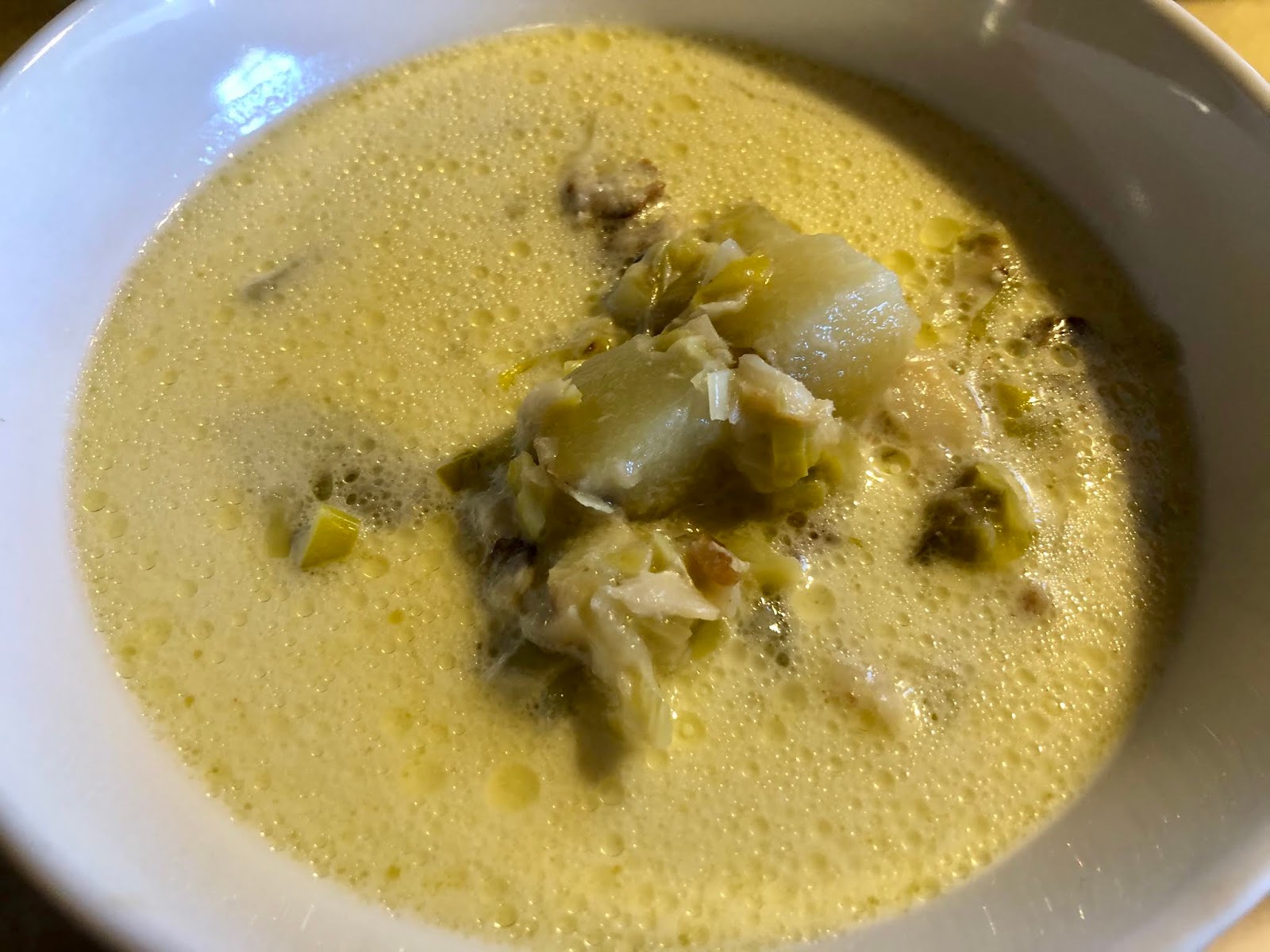
The Fish Chowder was tasty too, with plenty of fish and potatoes, and a savory and buttery broth, which also was intriguing with the Scotch. And it was true that each of these dishes brought something different out of the Scotch.

The creamy Haddie Spread, with Oatcakes, was flavorful as well, and the oatcakes also made for an excellent palate cleanser.

Scotch and cheese? Yes, this was a fine pairing too. With the Dubliner, we paired the 12 Year Old, and the sharpness of the cheese helped to bring out vanilla notes and creaminess in the Scotch. The butteriness of the cheese also drew out the Oloroso notes. With the Gorgonzola, we paired the 18 Year Old, and the mild sweetness of the Scotch contrasted well with the pungency of the cheese. Port and Blue Cheese has always been one of my favorite pairings, but I think I need to explore more Scotch and Blue cheese pairings.

The GlenDronach 12 Year Old Single Malt Scotch ($62.99) was aged in a combination of Pedro Ximénez (PX) and Oloroso Sherry casks and has a 43% ABV. It's important to note that GlenDronach doesn't add any caramel coloring to their whiskies, and that their color is all natural, imparted only by the barrel maturation. With a light amber color, this whisky presented with an intriguing nose that would remind you of Sherry, with some sweet, raisiny notes of PX and the nuttiness of an Oloroso. On the palate, the Scotch was smooth, creamy, dry and full-bodied, with a complex melange of flavors, including vanilla, dried fruits, hints of citrus, spice notes, and plump raisins. The finish was lengthy and pleasing, with the Oloroso elements becoming even more prominent. Overall, a delicious and compelling whisky, which would make for an excellent introduction for those new to Scotch, but which would also please Scotch lovers.

The GlenDronach Allardice 18 Year Old Single Malt Scotch ($179.99) was aged solely in Oloroso Sherry casks and had a 46% ABV. Rebecca stated this was her favorite, and that sipping it brought her home. She also recommended that you should let this Scotch breathe for about 20 minutes before drinking, to bring out its best aromas and flavors. It had a darker amber color than the 12 year old, and its nose was complex and alluring, with plenty of spice, chocolate notes, and nutty elements. The Oloroso aspect was noticeable and pleasing, especially to a Sherry lover like myself.

When I tasted this Scotch, I was immediately enamored with its complexity and fine taste. It was silky smooth, seductive on the palate, and each sip brought different notes to my mind. There were baking spices and salted nuts, chocolate notes and ripe fruit notes, honey and vanilla, sweet and bitter, and so much more. The finish was incredibly long, extremely satisfying, and beckoned you like a Siren to sip more. I loved this Scotch and its Oloroso notes, and continued sipping it long after the tasting event concluded. Highly recommended, and well worth the splurge.

GlenDronach makes other whiskies as well, including the Parliament 21 Year Old, the Cask Strength Batch 8, and the Grandeur Batch 10 (a 27 Year Old Scotch). I have great respect for the whisky-making philosophy of GlenDronach, especially concerning their use of only authentic Sherry barrels. And their Scotches are delicious and complex, compelling spirits which are worthy of much more attention than they receive. Their 18 Year Old Scotch is a rock star, and has become one of my new favorite whiskies.

Monday, December 2, 2019

Nomad Whiskey: A Marriage of Scotland & Spain

There are numerous wines and spirits which possess names which are worthy of protection, indicative of a specific place of origin which cannot be adequately replicated elsewhere. Some examples include Champagne, Port, Bourbon, and Cognac. Scotch Whisky is another example and the term is a Protected Geographical Indication (PGI), meaning it can only be produced in Scotland according to UK rules. No other distillery in any other country can claim to produce 'Scotch Whisky,' and if they tried, there are legal remedies to stop them from doing so.

What boggles my mind though is that some Scotch distilleries have chosen to ignore one of the Protected Geographical Indication of another country, Spain. Two years ago, I wrote, Rant: Whisky, Sherry Barrels & A Lack Of Transparency, detailing how some Scottish distilleries used the term 'Sherry' on their bottles, describing the type of barrels used for aging, when those barrels weren't actually from the Jerez-Xérès-Sherry DO. In its most simplistic, they use 'fake' Sherry barrels. For unknown reasons, this doesn't seem to be a significant matter though it certainly should be.

As such, I'm always pleased to find a whiskey that uses authentic Sherry barrels, like the Nomad Outland Whisky ($49.99). This whiskey is an intriguing partnership between Richard Patterson, the famed Master Blender, with over 50 years of experience, of Whyte & Mackay and Antonio Flores, the Master Blender of González Byass, an esteemed Sherry House. As the whiskey is aged in both Scotland and Spain, it was given the name 'Nomad,' indicative of its travels.

The base is a blended whiskey, at 41.3% ABV, produced from a melange of over 30 different malt and grain whiskies, each 5-8 years old, from the Speyside and Highlands regions. This blend is then aged in González Byass Pedro Ximénez Sherry barrels for three years. They had previously experimented with a variety of Sherry barrels, including Fino and Oloroso, but they ultimately selected Pedro Ximénez as best for their vision.

What then makes this whiskey more unique, is that it is then transported to Spain, to the city of Jerez, where it continues to age for another year, in the San Fernando cellar of González Byass, in old Pedro Ximénez Sherry barrels. This adds an intriguing element to the whiskey, aging in a vastly different climate than Scotland.

With a rich amber color, the Nomad has an appealing nose which definitely reminded me of Pedro Ximénez sherry, combined with a spicy undertone and subtle malt notes. The taste is compelling and complex, a wondrous melange of flavors of both whiskey and sherry. It is smooth and elegant, with a bold spicy aspect, and notes of vanilla, salted nuts, raisins, honey, and dried fruit. It is more dry, not sweet, despite the raisin and honey notes. The pleasing finish simply lingers and lingers within your mouth, and it beckons you toward another sip. Well-balanced, delicious, and unique. Highly recommended!

Monday, July 8, 2019

Kamakura & Kumo Sky Bar: A Passion For Japanese Drinks

Chilled Sake, Warm Sake, Shochu, Japanese Koshu wine, Japanese Whiskey, Japanese beer, Japanese-inspired cocktails. There are very few local restaurants or bars which offer nearly all of these choices, and only one place that offers all of them.

That restaurant is Kamakura, located at 150 State Street in Boston. Chef Youji Iwakura has created a compelling Japanese restaurant, offering his take on Kaiseki (basically a seasonal tasting menu) as well as a la carte choices, Bento Boxes, Sushi Omakase, and more. Dining there is a superb experience with some of the finest Japanese cuisine available in the area. The restaurant is spread out over three stories, with the top story being their Kumo Sky Bar & Lounge.

I recently attended a media cocktail party at their Kumo Sky Bar, though I have also visited the bar previously on my own. The bar has about 26 seats, with several seats looking out into the city, a number of seats at the bar, and a number of small tables. This bar has a 400-square foot, retractable glass roof, which should get plenty of use this summer, and presents quite a great view during both day and night. "Kumo" is the Japanese word for "cloud," and with its retractable roof, you certainly get a nice view of the clouds when they are in the sky,

It is an intimate room, and can be booked for special events. It is also a great place to just grab a drink and a snack any night.

The Drinks program at Kamakura, which is available throughout the restaurant including the Kumo Sky Bar, is strong on Japanese beverages, offering much that is delicious, interesting and unique. This is a great place to expand your palate, to sample exciting new drinks you know little about. The staff at Kamakura can help educate you about these drinks, and provide plenty of suggestions for you. And for those who are already familiar with these Japanese drinks, you'll find some more unique items to thrill your palate.

They have a list of ten Featured Cocktails, priced $13-$18, with one outlier at $34. The cocktails change seasonally and all have a Japanese aspect to them, whether it is the main spirit or one of the ingredients. A few of the cocktails include the John Manjiro (Iwai Whisky, Choya, Cherry, $14), Murasaki (Empress 1908 Gin, Sake, Floral Vermouth, $16) and Shoyu What I Got (Blanco Tequila, Mezcal, Choya, Sea Fennel, Aged Shoyu, Orange Bitters, $14). Aged shoyu? How many cocktails have you ever seen that use soy sauce as an ingredient? Choya is Japanese plum wine. I like the innovativeness of these cocktails. Most of the media at the cocktail party ordered cocktails, and I heard many compliments about their taste.


If you'd prefer a Non-Alcoholic Cocktail, they have three choices, all priced $10 each. You could opt for a Matcha Tonic (Matcha, Simple Syrup, Tonic Water), Cucumber Rickey (Fresh Cucumber Juice, Lime, Spritz), or a Lychee Collins (Lychee syrup, Soda, Citrus).

Of course they have a Sake menu, both by the glass and by the bottle. There are about 15 selections by the glass, broken down into two main categories: Junmai and Honjozo, the primary divisions of Premium Sake. There is also a single American-produced Sake. The Sake by the glass is available as a 4 ounce ($11-$35) or 6 ounce ($16-$52) pour. They also offer Junmai and Honjozo flights, each with 3 Sakes, for $38, which is an excellent way to sample a variety of Sakes. A few of the interesting Sakes I'd recommend include the Yuho Junmai Kimoto, Katsuyama Ken Junmai Ginjo, and Musashino Nyukon Tokubetsu Honjozo. You'll also find one Sake on tap, the Bushido Ginjo Genshu, 4-oz $12/6-oz $18, which I've enjoyed on a previous visit.

There are about 21 options for Sake by the Bottle, which come in various sizes such as 300ml, 500ml, and 720ml. About 60% of the options cost less than $100 a bottle, though you could splurge as well on the Hideyoshi "Flying Pegasus" Daiginjo at $560/720ml. You could opt to celebrate with some Sparkling Sake, such as the Dassai Sparkling Junmai Nigori ($62/360ml), which is one of my favorite Sparkling Sakes. The Hakkaisan Snow Aged Junmai Ginjo ($140/720ml) is a hedonistic pleasure I've previously reviewed.

A couple months ago, I recommended that people drink more Warm Sake, and Kamakura is a great place to experience it. They have 5 choices of Warm Sake, available in 5 ounce ($14-32) or 10 ounce ($28-$64) chirori, metal vessels. They serve the Sakes at what they suggest as the ideal temperature, from 104 to 113 degrees, but you can ask for a specific temperature if you so desire.

Of their five options, my favorite is the Shinkame "Holy Turtle" Tokubetsu Junmai, 2 year aged (5 oz $20/10 oz $40). Yoshimasa Ogawahara is the 7th generation owner of Shinkame Shuzo, a Sake brewery located in the Saitama Prefecture. I have the privilege to meet and interview him back in 2014. He told me that Sake is the only alcohol in the world where the taste varies according to a wide variety of temperatures, both hot and cold. He also stated that warm Sake pairs well with a diversity of cuisines and not just Japanese. During the cocktail party, I once again enjoyed some of the warm Shinkame and highly recommend it as an experience more people should try.

Kamakura has a small Wine List, with about 12 options, including 10 available by the glass ($12-$22). The options include 3 Sparkling Wines (all French), 4 Whites, 1 Rosé, and 4 Reds. Of the 12 wines, 7 are from France, 2 from California, 1 from Germany, 1 from Washington, and 1 from Japan. The wines aren't the usual suspects, and present some interesting and classic choices, from German Riesling to French Rhone wines.

What is unique though is that they carry a Japanese wine, the 2017 Chateau Mercian Yamanashi Koshu (glass $19/ bottle $76), and they are the only restaurant in Massachusetts to carry this wine. Nine years ago, I attended a tasting of Japanese Koshu wines at Uni, and that was also the first time I met Chef Youji Iwakura. You can read my previous article for more information about the Koshu grape. This was an excellent summer wine, with plenty of acidity, bright citrus and peach notes, a streak of mineralogy, and a pleasing and fairly lengthy finish. There was a mild richness to the wine as well as a touch of salinity. This would pair great with seafood, including raw oysters. Highly recommended!

Their Beer list is also small, with a rotating selection of Draft Beer, including the Lamplighter ($9).  By the bottle/can, they have 3 Japanese beers, including the Orion ($8), Koshihikari ($11), and Ginga-Kogen ($16).

Check out their list of Featured Spirits which includes some local options, like Bully Boy (vodka, gin and rum) as well as Japanese Gin (Nikka Coffey and Ki No Bi Kyoto), which is the hot new alcohol coming out of Japan. They also have about 10 Japanese Whiskies, and you can order a Flight of 3 for $35. I enjoyed a glass of the Nikka Miyagikyo Single Malt, a fine sipping whiskey with fruity notes, a hint of smoke, subtle spice notes, and a noticeable influence of Sherry.


Kamakura also has a menu of Shochu, a distilled Japanese alcohol, with 6 options and you can order a Flight of 3 for $18. Most of their Shochu selections are made from sweet potato, which is often considered to be the ingredients that makes the best Shochu. My favorite on their list is the Tenshi no Yuwaku, 8 Year ($21), made from 83% Sweet Potato and 17% Rice. It was fermented in Sherry casks for about 8 years, which is rare as few Shochu are ever aged this long. It's name translates as "Angel's Temptation," a reference to the Angel's Share, the amount of spirit that evaporates over time while it ages in a barrel. I enjoyed it neat, finding it rich, creamy and smooth, with intense Sherry notes, hints of sweetness, and plenty of complexity. This is the first time I've seen this Shochu available in a Massachusetts restaurant. Highly recommended!

To sample what Kamakura has to offer, rather than opting for the multi-course Kaiseki dinner, you can always check out the Kumo Sky Bar to have drinks and small plates. You'll have a great view of the city while enjoying a large variety of Japanese drinks. Be adventurous and try some Japanese Koshu wine, aged Shochu, warm Sake, or a premium chilled Sake.